

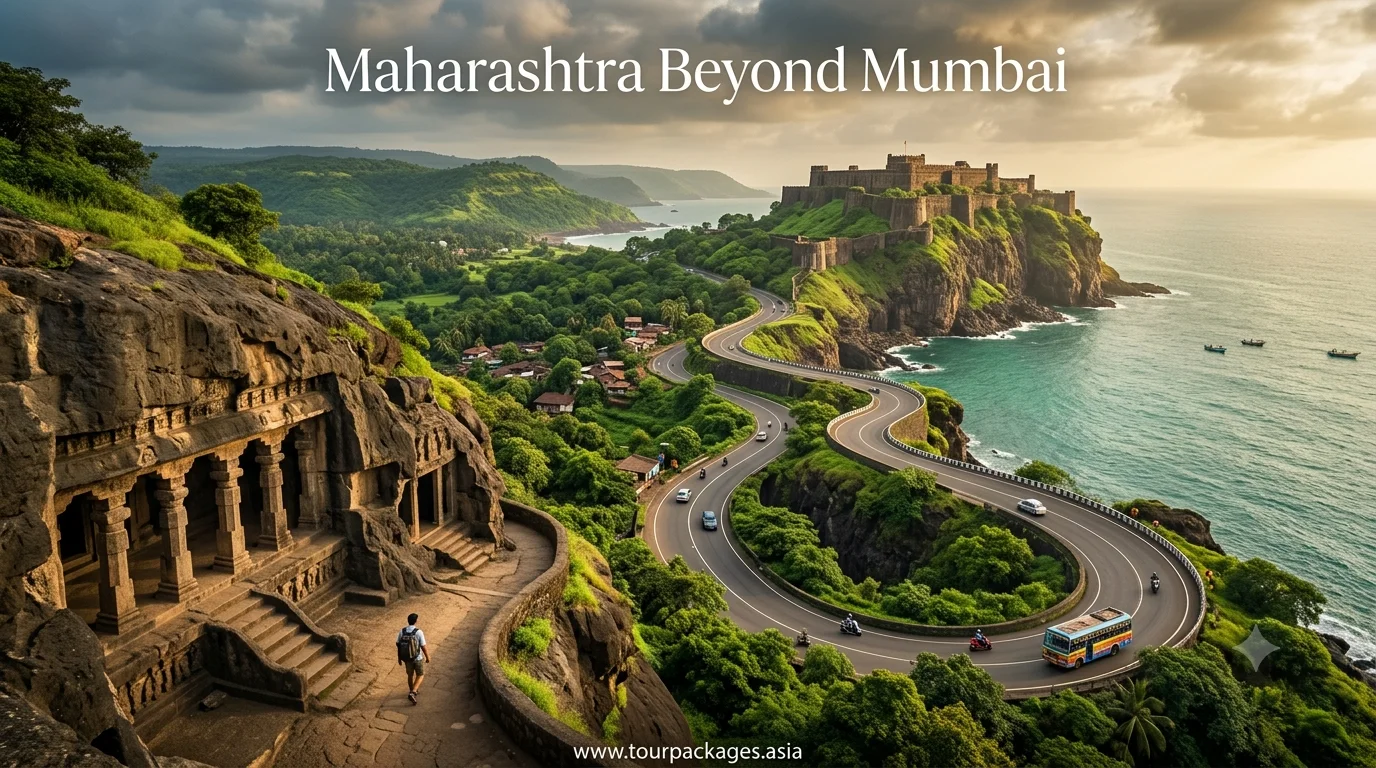
Maharashtra Beyond Mumbai — Ancient Caves, Coastal Drives and Hidden Forts (2026 Guide)
Most people associate Maharashtra with Mumbai or Lonavala — but that barely scratches the surface of what this state actually is. I spent time exploring the interiors, the coastline, and the Sahyadri ranges that most visitors drive past on the expressway, and what I found was a version of Maharashtra that is wilder, quieter, more historically dense, and more visually varied than the standard routes suggest. This is the guide to that version.
What This Guide Covers
Jump directly to the section you need — from cave architecture and fort trekking to the Konkan coastal drive, practical tips and a complete itinerary.
Why Maharashtra is More Than Mumbai and Hill Stations
Maharashtra is the third-largest state in India by area and one of the most geographically diverse. The Western Ghats run its entire western length. The Konkan coast sits between the mountains and the Arabian Sea. The Deccan plateau covers the interior. And scattered across all of it are UNESCO cave complexes, medieval forts that controlled trade routes for centuries, a coastline that is less commercialised than Goa, and a food culture that changes character every 150 kilometres. Most travellers see almost none of this.
The standard Maharashtra itinerary — Mumbai's Gateway, Elephanta Caves day trip, weekend in Lonavala — is a single layer of a state with at least six. The Ajanta Caves contain Buddhist murals painted between the 2nd century BC and 6th century AD that are considered the finest surviving examples of ancient Indian painting anywhere in the world. They are 340 kilometres from Mumbai. The Konkan coast from Alibag to Sindhudurg is 600 kilometres of beaches, sea forts, river estuaries, and coconut groves with water clear enough for scuba diving at Tarkarli. It is largely undeveloped. Harishchandragad Fort in Ahmednagar district has a cliff face — the Konkan Kada — that drops 600 to 800 metres in a concave curve resembling a cobra's hood. Most people who live in Maharashtra have not been there.
This is not a criticism of Mumbai, which is itself one of the world's great cities. It is simply a statement about what exists beyond it — a version of Maharashtra that requires more than a weekend and rewards that extra time with experiences that are, in the full sense of the word, extraordinary.
My Personal Journey Into Maharashtra's Interior — What Changed
The first time I left Mumbai's orbit for longer than a weekend, I took a train to Aurangabad. Not the express — the night train, which reaches Aurangabad just as the light is gathering enough definition to show the Deccan plateau through the window. The landscape changes somewhere east of Nashik: the hills flatten, the vegetation thins, and the ground takes on the particular dusty ochre of the interior Maharashtra plains. Nothing about it looks like the Maharashtra of travel brochures. It looks old. Not heritage-old but geologically old — basalt country, deep-time old.
At the Ajanta Caves that morning, I walked through a corridor that humans carved from living rock approximately 1,800 years ago and looked at paintings that have survived the centuries in the dark. The colours — lapis blue, terracotta, ochre yellow — are achieved through mineral pigments applied to wet plaster on cave walls. They have survived because the caves face a specific direction that limits direct sunlight, because the ambient humidity inside the rock maintains stable conditions, and because for centuries nobody knew they were there. The Ajanta caves were rediscovered by British officers in 1819 after having been forgotten for over a millennium. They were known to the jungle, not to people.
Two days later, I was standing on the Konkan Kada at Harishchandragad — a concave cliff face that drops 600 metres in a single overhanging wall. The wind coming up that face was physical: warm and continuous, pushing back against you as you leaned over the edge. Below, the Konkan plains stretched all the way to where the horizon met the Arabian Sea. I had driven 180 kilometres from Aurangabad, trekked four hours, and arrived at something that absolutely nobody I knew had told me about. That is what offbeat Maharashtra travel delivers when you actually go looking — not a hidden gem in the Instagram sense, but a genuinely significant place that simply has not entered the mainstream travel conversation yet.
The Konkan coastal road from Alibaug to Malvan — which I drove a week later — was the third revelation. The road follows the coast with frequent views of the Arabian Sea through gaps in the cashew and coconut plantation. At Tarkarli, I went scuba diving in water of visibility I had not expected to find on an Indian beach — 15 to 20 feet, with coral formations and reef fish dense enough to make the site worth the journey from anywhere in India. The evening meal at a local Malvani home — Kombdi Vade, Sol Kadi, fresh Surmai fry — was the best seafood meal I ate in India that year.
Ancient Cave Experiences in Maharashtra — Ajanta, Ellora and Beyond
Maharashtra has more rock-cut cave architecture than any other state in India. These are not abandoned ruins — they are living archives of 2,000 years of religious art, architectural evolution, and the particular genius of carving entire building complexes from solid rock. Plan This Trip
World's Finest Ancient Paintings · 30 Rock-Cut Caves · Rediscovered 1819
Ajanta Caves — Where 2,000-Year-Old Paintings Still Hold Their Colour
The Ajanta Caves are 30 rock-cut Buddhist cave monuments carved into a horseshoe-shaped basalt cliff above the Waghora River in Aurangabad district. The caves were created in two distinct phases — the earliest group dates from approximately the 2nd century BC, the later and more elaborate group from the 5th to 6th century AD. What makes Ajanta globally significant is its paintings: detailed, luminous murals depicting the life of Buddha and Jataka tales in mineral pigments applied to wet plaster, covering entire cave interiors with narrative sequences of extraordinary sophistication. The figures have defined musculature, expressive faces, and clothing depicted in specific textile textures — the level of artistic understanding represented in caves carved into rock 1,800 years ago is difficult to fully process on a first visit. Cave 17, known as the "Picture Gallery," has the densest concentration of narrative paintings. Cave 2 contains a ceiling covered in geometric and floral patterns of extraordinary complexity. Cave 26 houses a 7-metre reclining Buddha in high relief that occupies an entire wall. The cave complex was abandoned after the 7th century, swallowed by jungle, and rediscovered by British Army officers during a tiger hunt in 1819 — a fact that adds its own dimension to the experience of standing inside them today.
Kailasa Temple — Single Rock Excavation · Three Faiths · Must-See
Ellora Caves — The Kailasa Temple That Defies Comprehension
Ellora Caves — 30 kilometres from Aurangabad — represent the full arc of Indian classical religious architecture in rock-cut form: 12 Buddhist caves (6th–8th century), 17 Hindu caves (6th–9th century), and 5 Jain caves (9th–11th century) carved into a single 2-kilometre cliff face. They can be visited in sequence as a compressed timeline of a civilisation's religious imagination. The defining structure at Ellora is Cave 16: the Kailasa Temple — an excavation rather than a construction, created by removing 200,000 tonnes of basalt from the top down to reveal a complete multi-storey temple complex, including elephants, elephants fighting lions, a hall of 16 columns, and a main shrine tower (shikhara) replicating the proportions of Mount Kailash. No material was added to create the Kailasa Temple. An estimated 7,000 labourers worked for an estimated 150 years to remove the rock. The result is the largest monolithic structure carved from a single rock in the world. Standing inside the courtyard and understanding what it is — not built but excavated — produces the specific vertigo of an encounter with an achievement that the modern mind genuinely cannot map onto any familiar category. Unlike Ajanta, which is all about painting, Ellora is about architectural sculpture — the difference between the two caves, visited in sequence over two days from an Aurangabad base, is one of the most complete two-day art history experiences available anywhere in India.
Largest Ancient Chaitya Hall in India · 1st Century BC · Far Less Visited Than Ajanta
Karla and Bhaja Caves — The Caves Maharashtra Visitors Most Often Miss
Karla Caves and Bhaja Caves sit within 5 kilometres of each other near Lonavala — meaning they are accessible as a half-day detour from one of Maharashtra's most-visited hill station areas, yet they remain dramatically less visited than Ajanta. Karla contains the largest surviving ancient Chaitya hall (prayer hall) in India: 38 metres long, 14 metres wide, and 14 metres high, with 37 carved octagonal pillars supporting a barrel-vaulted ceiling whose wooden ribs (original 2nd century timber) are still visible. The ornamented facade features a large horseshoe-shaped window (the classic chaitya window form that influenced Buddhist architecture across Asia) and elaborately carved pillars with animal and figure capitals. Bhaja has 22 caves including one of the finest early stupas in the Western Ghats — a simple, powerful form that predates the decorative elaboration of later Buddhist architecture. Both sites represent the oldest period of Maharashtra's rock-cut tradition — before the figurative complexity of Ajanta, before the architectural ambition of Ellora. The experience is of Buddhism at its architectural beginning, carved into the Sahyadri hillside with a spatial confidence that two millennia have not diminished.
Plan Your Maharashtra Caves and Forts Circuit
From Aurangabad for Ajanta and Ellora to the Konkan coast for scuba diving and seafood — our team builds complete Maharashtra tour packages and India tour packages around every experience in this guide.
Plan My Maharashtra Trip More Travel GuidesHidden Forts and Trekking in Maharashtra — History at Altitude
Maharashtra has over 350 identified forts — more than any other state in India. The Maratha Empire under Chhatrapati Shivaji Maharaj built and captured a network of mountain forts across the Sahyadri ranges in the 17th century that controlled the passes between the Deccan plateau and the Konkan coast. In 2024, 14 of these forts were inscribed as UNESCO World Heritage Sites under the collective designation "Maratha Military Landscapes of India" — one of the largest recent UNESCO inscriptions for any single country. Most travellers have never heard of this.
Konkan Kada — India's Most Dramatic Cliff Face · 600m Drop · Ancient Fort Complex
Harishchandragad — Maharashtra's Most Spectacular Fort Trek
Harishchandragad Fort in Ahmednagar district is the most visually dramatic fort trek in Maharashtra and arguably in the Western Ghats. Its defining feature is the Konkan Kada — an enormous concave cliff face that plunges 600 to 800 metres in a curve resembling a cobra's hood, with the Konkan plains and the Arabian Sea visible in the far distance below. The vertiginous quality of standing at the lip of this formation — with the wind pushing up from below — is unlike anything available at any other accessible trekking destination in peninsular India. The fort complex dates from the 6th century AD and includes a natural cave with a carved Harishchandreshwar Shiva linga, ancient water tanks, a kedareshwar cave (with a Shiva linga surrounded by ankle-deep cold water in a narrow cave — one of the most unusual settings in the Sahyadri range), and a relatively flat summit plateau ideal for camping. The standard route from Khireshwar village involves a 4 to 5 hour trek through dense Sahyadri forest on a well-marked trail with significant elevation gain in the final approach. The difficulty is medium to hard — manageable for any reasonably fit trekker with appropriate footwear. The Pachnai route is shorter and steeper. Overnight camping on the plateau is popular; the sunrise from the Konkan Kada with the mist clearing from the plains below is one of the defining Maharashtra trekking moments. Best season October to March; monsoon treks are dramatic but require experience with slippery basalt and Sahyadri weather changes.
Two Citadels · Sahyadri Forest Trek · Village Homestay Available · UNESCO Maratha Military Landscape
Rajmachi Fort — Where History and Forest Share the Same Mountain
Rajmachi Fort consists of two citadels — Shrivardhan and Manaranjan — perched on adjacent peaks in the Sahyadri ranges, 16 kilometres from Lonavala as the trail goes. The fort controlled the ancient Bor Ghat trade route between the Deccan and the Konkan — the same route that the Mumbai-Pune expressway now follows — and passed through Maratha, Mughal, and British hands over its history. In 2024 it was included among the UNESCO-inscribed Maratha Military Landscapes of India, adding formal heritage recognition to what has been a popular trekking destination for decades. The standard trail from Udhewadi village takes 3 to 4 hours return, through dense Sahyadri forest with valley views appearing at consistent intervals as you gain altitude. The difficulty is genuinely low to medium — Rajmachi is recommended for first-time fort trekkers, families with older children, and anyone wanting an introduction to Sahyadri fort trekking without the commitment of a harder route. The alternative longer trail from Kondivade near Karjat approaches from the opposite side and makes the trek into an overnight with a village stay at Udhewadi — local Wadi residents run simple homestays — creating a much richer experience for those with an extra day. Monsoon season (July to September) transforms the approach with waterfalls and intense jungle greenery; October to February offers clear summit views.
Maratha Capital · UNESCO Listed 2024 · Ropeway Access · 820 Metres Elevation
Raigad Fort — The Capital of the Maratha Empire
Raigad Fort was the capital of Chhatrapati Shivaji Maharaj's Maratha Empire from 1674 until his death in 1680, and remains the most historically significant of all Maharashtra's forts. The fort sits at 820 metres on a flat-topped basalt hill in the Raigad district, accessible by ropeway (the most popular option) or a 1,737-step staircase. The plateau contains the ruins of the Raj Sabha (royal court), granaries, water storage tanks, a bazaar street, Shivaji's samadhi (memorial), and the Takmak Tok — a cliff from which prisoners of the empire were executed. The views from the plateau extend across the Raigad district's forest and hill country in every direction. In 2024, Raigad was inscribed as part of the UNESCO World Heritage "Maratha Military Landscapes of India" designation — making it one of 14 Maratha forts now carrying international heritage recognition. For travellers interested in understanding the Maratha Empire in physical terms rather than textbook terms, walking the ruins of Raigad's royal court — which at its height oversaw an empire covering much of the Deccan — is one of the most grounding historical experiences in Maharashtra.
The Konkan Coastal Drive — Maharashtra's Least Commercial Coastline
The Konkan coast runs 720 kilometres from Dahanu in the north to Goa in the south, between the Western Ghats and the Arabian Sea. It is a different India from the rest of Maharashtra — greener, more humid, slower, with a food culture built around freshwater rivers, coconut palms, and the Arabian Sea's specific marine inventory. And despite being adjacent to the most commercially developed coastal stretch in India (Goa), the Konkan remains one of the country's least overdeveloped coastlines.
Best Scuba Diving on Mainland India · 20ft Visibility · Sindhudurg Sea Fort · Malvani Seafood
Tarkarli — The Konkan's Clearest Water and Best Underwater Experience
Tarkarli is an 8-kilometre beach in Sindhudurg district with water clarity that is exceptional by mainland Indian standards — visibility of 8 to 20 feet depending on conditions — making it the best scuba diving and snorkelling destination on the Maharashtra coast. The diving sites range from shallow beginner-friendly reef sections (5 to 10 metres) to deeper sites with larger fish populations. The most unusual dive is around Sindhudurg Fort — a 17th-century Maratha sea fort built on a tidal rock island, now partially submerged — where fort stonework and marine life share the same underwater space. PADI-certified operators run discovery dives (no certification required), Open Water courses, and guided experienced dives. The beach itself is calm, clean, and — by the standards of any comparable coastal destination in western India — quiet. The development that exists is low-rise and appropriately scaled. Malvan, 4 kilometres from Tarkarli, is the commercial centre of the area — where the market, restaurants, and the ferry to Sindhudurg Fort are based. The daily fresh catch market at Malvan functions every morning from around 6 AM and is worth visiting even if you do not cook — the variety and freshness of the fish supply is an education in the Konkan's marine resources. Malvani cuisine — the coastal cuisine of this district — includes some of the most distinctive seafood cooking in India: Kombdi Vade (spiced chicken with fried flatbread), Sol Kadi (pink kokum-coconut cooling drink), Surmai and Bangda fry in Malvani spice paste, and the area's characteristic fish curry with red coconut base that separates it clearly from Goan, Kerala, and other coastal cuisines.
Rock-Fringed Beach · Alphonso Country · Road Trip Stopover · Less Commercial Than Goa
Ganpatipule — Where the Konkan Coast Feels Most Like Itself
Ganpatipule in Ratnagiri district is a small coastal town with a crescent beach flanked by rocky headlands — the water here is not as clear as Tarkarli's but the setting is arguably more complete: the beach curves around a natural bay, the coastal road has cashew and jackfruit trees on the landward side, and the horizon is uninterrupted. Ratnagiri district is Alphonso mango country — the premium Hapus variety grown here is considered the finest mango in India and is exported internationally. Between March and June, the roadside stalls selling Alphonso by the dozen, the smell of mango pulp in every guesthouse kitchen, and the particular pleasure of eating a Ratnagiri Hapus at source are themselves worth the drive down from Pune. The Konkan Railway serves Ratnagiri station (10 km from town) with connections from Mumbai (4 hours) and Goa (3 hours), making the Ganpatipule and Ratnagiri coast accessible without a car. The coastal drive from Chiplun to Ratnagiri along the Konkan highway — winding through forest, past river estuaries and fishing villages — is one of the most scenically rewarding road sections in western India.
Explore Maharashtra's Layered Travel Experiences
For customised Maharashtra travel planning, TourPackages Asia and Revelation Holidays offer curated multi-experience itineraries covering caves, forts, and coastal routes — tailored to your dates, group size and interests.
Get My Custom Itinerary Contact Our TeamUnique Cultural and Local Experiences in Maharashtra
The most undervalued dimension of offbeat Maharashtra travel is the cultural diversity of the state's interior — a diversity that changes character approximately every 150 kilometres as the base cuisine, the architectural tradition, the predominant language variety, and the relationship to geography shift.
Village Stays in the Sahyadri
Homestays in Udhewadi village at the base of Rajmachi Fort, in the villages near Harishchandragad, and in the Konkan coastal settlements near Tarkarli represent some of the most accessible and genuinely immersive rural accommodation available in western India. These are not managed ecotourism facilities — they are family homes where you sleep on a simple mattress, eat what the family eats, and spend the evening learning more about Sahyadri farming and Konkan fishing than any cultural museum could convey. Costs are minimal; the experience is proportionally richer.
Malvani Cuisine — The Konkan's Distinct Food Identity
Malvani cuisine is one of India's most regionally distinct coastal cuisines. Its base flavour is a dried spice blend — the Malvani masala — that includes dried Malvani red chillies, coriander, cumin, cloves, cinnamon, and several locally foraged ingredients not available in commercial spice markets. The cuisine uses fresh coconut, coconut milk, and kokum (a coastal souring agent that is not tamarind and not lime — a fruit specific to this coast with a distinctive dark, slightly astringent quality). Sol Kadi — coconut milk with kokum, producing a natural pink — is served as a digestive at every Malvani meal and is the definitive flavour experience of the Konkan coast. The best Malvani food is not in restaurants. It is in the homes of fishing families in Malvan and the smaller coastal villages between Vengurla and Vijaydurg.
The Kaas Plateau — Maharashtra's Valley of Flowers
Between late August and mid-September each year, the Kaas Plateau — a UNESCO World Biodiversity Heritage Site near Satara — erupts with 150 species of wildflowers across a 1,000-metre high basalt plateau. The bloom depends on that year's monsoon timing and lasts 3 to 4 weeks. Daily visitor numbers are capped to protect the ecosystem; entry passes must be pre-booked. The visual effect — carpets of pink Smithia, purple Utricularia, yellow Eriocaulon, and dozens of endemic species covering the rock surface — is genuinely unlike any other seasonal natural event in the Deccan. For context: this is the closest equivalent to Uttarakhand's Valley of Flowers available in peninsular India, accessible from Pune in 3 hours.
The Lonar Crater Lake — Geology as Experience
The Lonar Crater Lake in Buldhana district is one of only four hyper-velocity meteorite impact craters in basaltic rock on earth, formed approximately 50,000 years ago. The crater is 1.8 kilometres in diameter and contains a saline-alkaline lake (pH 10.5) that supports unique microbial ecosystems studied by researchers from NASA and ISRO for insights into early Earth chemistry and potential life in extreme environments on other planets. Ancient Hindu structures ring the crater rim. The lake's colour shifts from blue-green to orange-pink depending on the season and the activity of its algae populations. It is 140 kilometres from Aurangabad — a logical addition to any Ajanta-Ellora circuit for travellers who want something that definitively does not fit any conventional category of travel.
Why Most Maharashtra Trips Feel Limited — and What's Missing
The standard Maharashtra itinerary — Mumbai two days, Lonavala weekend, possibly Pune — covers approximately 2 percent of the state's geographical area and an even smaller fraction of its actual travel inventory. This is not a failing of the travellers who do it; it is a consequence of how Maharashtra is marketed, how travel agents package it, and how weekend trip culture shapes what people consider achievable.
The practical reality is that Ajanta and Ellora are 340 kilometres from Mumbai — too far for a weekend, absolutely manageable for a 3-day extension. Tarkarli and Malvan are 500 kilometres from Pune — a full day's drive that requires a proper overnight, but accessible by Konkan Railway train in 6 hours from Mumbai. Harishchandragad is 180 kilometres from Pune — a 2-night trip that most Pune residents could do without particularly ambitious planning but rarely do.
The gap is not distance. The gap is the mental model of what a "Maharashtra trip" means — a model that treats the state as an extension of Mumbai's weekend circuit rather than as one of the most geographically and historically rich territories in India. The hidden places in Maharashtra are not actually hidden. They are simply beyond the radius that most people have decided constitutes a manageable trip. Extending that radius by 200 kilometres in any direction from Mumbai or Pune opens an entirely different version of the state.
Best Time to Explore Maharashtra — Season by Season
Maharashtra's size means that the best season varies significantly by region and experience type. There is no single "best time" for the whole state — there is a best time for each type of travel.
Monsoon — July to September
Monsoon is the best season for the Sahyadri fort treks for experienced trekkers — the ranges are an intense, saturated green, the waterfalls are at full volume, and the mist that moves through the valleys creates an atmosphere that photographs cannot fully capture. Rajmachi and Harishchandragad in monsoon are genuinely extraordinary. However, slippery basalt, unpredictable weather, and Konkan highway flooding mean monsoon travel requires local knowledge and flexibility. The Konkan coast is not suitable for water sports during monsoon. Caves are open but more humid. The Kaas Plateau wildflower bloom peaks in late August to September — the single best monsoon-season attraction in Maharashtra.
Winter — October to February
October to February is the ideal window for most Maharashtra travel. Temperatures are comfortable across the interior plateau and the Konkan coast. Fort trekking has clear summit views and dry trail conditions. Cave visits are pleasant. Scuba diving at Tarkarli has the best water visibility of the year. Aurangabad — the base for Ajanta and Ellora — is cool and agreeable. Lonar Crater Lake is accessible. November and December are peak season for Konkan coastal travel; book early.
Summer — March to June
Summer in Maharashtra's interior is hot — 38 to 42°C in Aurangabad and Nashik. However, the Ajanta and Ellora caves are carved into rock and remain 5 to 8 degrees cooler than outside air throughout May and June, making them practical summer destinations if you focus on cave interiors and early morning outdoor movement. The Konkan coast in April and early May (before the June monsoon) offers good scuba diving conditions and beach weather, with Tarkarli's water quality at its most consistent. Hill stations — Mahabaleshwar, Matheran, Panchgani — are in peak season March to May. Alphonso mango season in Ratnagiri runs March to June and is itself a compelling reason to visit the Konkan coast in summer.
Essential Tips for Exploring Offbeat Maharashtra
Click each panel to expand practical guidance on distances, transport, accommodation, photography, and the most common mistakes visitors make when planning offbeat Maharashtra travel.
Understanding Maharashtra's Scale
- Maharashtra is 307,713 sq km — roughly the size of Poland. Underestimating distances between destinations is the most common planning error: Aurangabad to Tarkarli is 600km; Pune to Harishchandragad is 180km. Plan for 2 to 3 hour drives as the norm between major stops, not the exception
- The Konkan Railway from Mumbai to Goa passes through the Western Ghats and Konkan coast — one of India's most scenic train journeys. For any Konkan destination, the train is faster and more enjoyable than driving the coastal road
- Flying into Aurangabad (IXU) directly from Mumbai (50 min) or Pune (50 min) saves 7 to 8 hours of road travel for the Ajanta-Ellora circuit and is worth considering if your time is limited
- The Mumbai-Pune Expressway is India's most efficient highway and covers the 150km in under 2 hours — but it bypasses the entire Sahyadri landscape. Take the old NH4 through the ghats once if you have time; the view from Khandala Ghat is exceptional
- Google Maps consistently underestimates drive times on Maharashtra's interior roads — particularly in Nashik, Ahmednagar, and the Deccan plateau districts. Add 30 percent to any route estimate for interior Maharashtra travel
- Hire a self-drive or chauffeur-driven vehicle for the Konkan coastal drive — public transport between coastal villages is infrequent and the road experience itself is half the value of the journey
Where to Stay and What to Expect
- Aurangabad has the best accommodation options for the Ajanta-Ellora base — from budget guesthouses to 4-star properties. The city is 30 km from Ellora and 104 km from Ajanta — both manageable as day trips from an Aurangabad base
- For Harishchandragad, stay at Khireshwar village the night before your trek — basic but clean guesthouses are available and a 6 AM start is essential for the summit in comfortable temperatures before midday heat
- Tarkarli and Malvan have a good range of beach resorts and family-run guesthouses, but properties within 200 metres of the beach fill completely on weekends during October to February — book 3 to 4 weeks ahead minimum
- Village homestays near Rajmachi (Udhewadi) provide the most authentic accommodation option in the Sahyadri circuit — costs around Rs 500 to 800 per night including simple meals; book through Lonavala-based trekking operators
- In Aurangabad, staying in the old city area (near Panchakki) provides easy access to local restaurants serving Marathwada cuisine — distinctly different from Pune or Mumbai food and worth seeking out
- For Lonar Crater Lake, the MTDC resort on the crater rim is the standard option — basic but well-positioned; arrive by 4 PM to walk the crater rim in good light before sunset
Fort Trekking Tips for Maharashtra
- Never attempt Harishchandragad's Konkan Kada without a local guide for your first visit — the path to the cliff edge requires knowing exactly where the safe viewpoint is; the cliff itself has no railing or safety barrier
- Start all Sahyadri fort treks by 6 AM at the latest — the temperature climbs rapidly after 9 AM and exposed ridge sections become uncomfortable by 10:30 AM from October to May
- Wear shoes with grip, not trekking sandals — Maharashtra's Sahyadri trails involve sections of smooth basalt that is significantly more slippery than sandstone or granite trail conditions
- Carry 2.5 to 3 litres of water per person for any full-day fort trek — water sources on Sahyadri trails are unreliable except in monsoon, and many marked springs are seasonal
- Inform your accommodation of your trekking plans and expected return time — cell coverage is intermittent on most Sahyadri ridge sections; leave contact details with someone who will raise an alert if you do not return by a specified time
- For monsoon trekking, buy a lightweight waterproof poncho rather than carrying a heavy rain jacket — the rain can arrive suddenly and heavily, and flexibility of movement matters more than total waterproofing on short-duration Sahyadri trails
Photography Tips Across Maharashtra
- At Ajanta Caves, flash photography is prohibited inside all caves — bring a camera with high ISO capability (ISO 3200 to 6400) and a wide-angle lens for the interior painting sections; a small tripod significantly improves results in the dimly lit cave interiors
- Ellora's Kailasa Temple photographs best from the upper gallery walkway looking down into the excavated courtyard — the scale of the rock removal becomes visually comprehensible only from this elevated angle
- The Konkan Kada at Harishchandragad is best photographed in early morning with the mist clearing from the plains — by 9 AM the light is harsh and the haze in the valley below reduces depth and colour saturation significantly
- For the Konkan coastal road near Tarkarli, a wide-angle lens captures the road threading between ocean on both sides — shoot from a pulled-over position, not from a moving vehicle, and early morning light gives warm tones on the coastal vegetation
- The Lonar Crater Lake changes colour through the day as the angle of light interacts with its algal populations — visit at both sunrise and mid-morning to compare the dramatic colour shift; a polarising filter is essential for cutting glare from the alkaline water surface
- The Kaas Plateau wildflower bloom requires a wide-angle lens to capture the carpet effect — get low, at flower level, to show the density of bloom across the plateau surface; shoot in the first two hours of morning before direct sun flattens the colours
Food and Local Tips
- Order Sol Kadi at every Konkan meal — the kokum-coconut pink drink is both a digestive and the most culturally specific flavour of the Konkan coast; it is made fresh at Malvani restaurants and should be consumed immediately, not packaged or heated
- For Malvani seafood, ask specifically which fish was landed that morning — the catch composition changes daily and the best preparation is always of the freshest fish, not a fixed menu item
- In Aurangabad, try Naan Qalia and Bhuna Gosht at local eateries in the old city — the Aurangabad culinary tradition draws on Mughal, Deccani, and Marathwada influences and produces a Muslim-majority meat cuisine distinct from anything available in western Maharashtra
- Near Nashik, the Sula and Grover Zampa vineyard visits include guided tasting sessions — Maharashtra's wine region is the most developed in India and an appropriate afternoon activity between the Trimbakeshwar area and a Pune-bound drive
- For Rajmachi trekking, carry your own food — the trail has no vendors and the only food available at Udhewadi village is what your homestay family prepares, which is simple Sahyadri food (bhakri, dal, seasonal vegetables) and genuinely worthwhile in its own right
- Alphonso mangoes from Ratnagiri (March to June) should be purchased directly from orchard gates or roadside stalls rather than from city markets — the quality difference between orchard-fresh Hapus and market-distributed Hapus is substantial and immediately apparent
What Surprised Me the Most About Maharashtra Beyond the Cities
The diversity of the landscape surprised me genuinely. I had known intellectually that Maharashtra was geographically varied — Western Ghats on one side, Deccan plateau in the middle, Konkan coast on the other. What I had not anticipated was how completely and quickly the landscape character changes as you move through those zones. The basalt plateau of Buldhana district (where Lonar Crater sits) looks nothing like the Sahyadri forest above Lonavala, which looks nothing like the Konkan beach at Tarkarli, which looks nothing like the interior farmland of Nashik. These are not subtle regional variations. They are fundamentally different physical worlds.
The low crowd density at most of the destinations in this guide surprised me. I had expected — given Maharashtra's population and the proximity of Mumbai and Pune — to find significant visitor numbers at all the destinations I covered. What I found was: Harishchandragad on a November weekday with fewer than 20 trekkers on the entire mountain, the Karla Caves with a handful of visitors across a 3-hour morning, Lonar Crater Lake entirely to myself for two hours at sunrise. The pressure of Indian domestic tourism that makes Lonavala feel crowded on weekends does not extend to destinations that require more than a two-hour drive from a highway.
And the depth of history surprised me in the way that scale always surprises. The Kailasa Temple at Ellora required the removal of 200,000 tonnes of rock over an estimated 150 years. The paintings at Ajanta were abandoned for 1,000 years and survive with colours still visible today. The Rajmachi Fort controlled a mountain pass that Mughal armies fought for and lost. The Maratha forts that I walked were not ancient history in the dusty sense — they were the architecture of a military and political system that shaped the entire subcontinent for two centuries, and walking them in the Sahyadri light made that history feel immediate in a way no textbook had managed.
What I Didn't Like About Offbeat Maharashtra — Honest and Balanced
Connectivity Issues in the Interior
The gap between Maharashtra's major cities and its interior destinations in terms of public transport connectivity is real. There is no good public transport option to Harishchandragad without a complex combination of buses and shared jeeps. Lonar Crater Lake requires a vehicle — public transport reaches Lonar town but the crater rim and the resort are not accessible on foot from the bus stop. The Konkan coastal villages south of Ganpatipule have infrequent bus services. For independent budget travellers without a vehicle, several of the most interesting destinations in this guide are genuinely difficult to reach.
Infrastructure Gaps at Remote Sites
The lack of basic tourist infrastructure at several otherwise exceptional destinations is a practical frustration. The path around the Lonar Crater rim is poorly maintained. Signage at many fort sites is inadequate — understanding what you are looking at without a guide at Raigad or Harishchandragad requires prior research. Several Maharashtra cave sites outside the UNESCO complexes have no lighting inside the caves themselves, making torches essential. Restroom facilities at remote trekking bases are minimal or non-existent.
Summer Interior Heat
The interior Deccan plateau — Aurangabad, Nashik, Buldhana — reaches 38 to 42°C between April and June. This is not a criticism of the destination but a practical consideration that significantly affects the visitor experience for outdoor exploration during these months. The caves themselves are cool, but the walk between cave sites in May midday heat is demanding. Plan outdoor activities strictly for early morning and late afternoon during the April to June window.
Who Should Explore Offbeat Maharashtra — and Who Should Think Carefully
This Travel Experience is Made For
Travellers with a genuine interest in history, architecture and archaeology — the combination of Ajanta, Ellora, Karla, and the UNESCO Maratha forts in a single circuit is one of the most concentrated multi-era heritage journeys available in India. Trekkers and adventure seekers who want the specific combination of history and altitude that Sahyadri fort trekking provides — particularly Harishchandragad for the experienced and Rajmachi for beginners. Coastal road trip enthusiasts for whom the Konkan drive from Alibaug to Malvan through cashew groves, river estuaries, and fishing villages is itself the experience. Food-focused travellers who want to eat Malvani cuisine at source in Sindhudurg and Alphonso mangoes in Ratnagiri during the March to June season. Anyone who has visited Mumbai or Pune multiple times and wants to understand what the state beyond those cities actually is.
Consider Carefully
Travellers with very limited time (under 4 days) should stick to one region rather than trying to cover caves, forts, and coast simultaneously — the distances make this impossible to do well in a short trip. Those wanting luxury-standard accommodation and restaurant dining throughout should know that offbeat Maharashtra has limited luxury infrastructure outside Aurangabad, Pune, and the Konkan resort belt. Travellers without independent transport should carefully research connectivity to specific destinations before planning around them.
For any of these situations, a customised Maharashtra tour package from our team or through Revelation Holidays will solve the logistics and build the trip around your actual constraints and preferences.
How to Plan a Maharashtra Itinerary — Mumbai to Caves to Forts to Konkan
| Day | Destination | Experience | Stay |
|---|---|---|---|
| Day 1 | Mumbai → Aurangabad (overnight train or flight) | Evening in Aurangabad town; Bibi ka Maqbara at sunset (exterior) | Aurangabad hotel |
| Day 2 | Ajanta Caves | Full day at Ajanta — cave paintings 2nd century BC to 6th century AD; Waghora River viewpoint | Aurangabad hotel |
| Day 3 | Ellora Caves | Kailasa Temple and full cave circuit; afternoon at Daulatabad Fort en route back | Aurangabad hotel |
| Day 4 | Drive to Lonavala (4 hrs); afternoon Karla and Bhaja caves | Karla Caves — largest ancient chaitya hall in India; Bhaja stupas | Lonavala hotel |
| Day 5 | Rajmachi Fort trek | Early morning start; Udhewadi trail through Sahyadri forest; Shrivardhan and Manaranjan citadels | Lonavala or Udhewadi homestay |
| Day 6 | Drive to Tarkarli / Malvan (5–6 hrs via Pune and NH66) | Evening Malvani dinner at local restaurant; Sindhudurg Fort exterior view | Tarkarli beach resort |
| Day 7 | Tarkarli scuba diving | Morning scuba or snorkelling; Malvan market seafood lunch; Konkan Railway from Kudal to Mumbai (eve) | Train back to Mumbai |
This 7-day circuit is the minimum for covering Maharashtra's three headline experience categories — UNESCO cave heritage, Sahyadri fort trekking, and Konkan coastal travel. A 10-day version adds Harishchandragad (replace Rajmachi, 2 nights), the Lonar Crater Lake (2-hour detour from the Aurangabad circuit), and Ganpatipule on the Konkan drive. For a complete customised itinerary — including all accommodation, transport, and activity booking — contact our team at TourPackages Asia or Revelation Holidays.
The Real Maharashtra is Waiting — Let Us Plan Every Detail
From Ajanta cave mornings to Konkan Kada sunrises and Tarkarli dive days — our team builds India tour packages that treat Maharashtra as the multi-layered destination it actually is.
Plan My Maharashtra Trip Talk to Our Team15 Frequently Asked Questions — Offbeat Maharashtra Travel
Direct answers to the real questions people ask about hidden places in Maharashtra, cave timings, fort trekking, the Konkan coast and itinerary planning.
Maharashtra Is One of India's Most Underrated Travel States — Not for Long
The version of Maharashtra that most travellers experience is real but incomplete. Mumbai is one of the world's great cities. Lonavala is a pleasant hill station. But the rest of the state — the Ajanta cave murals that survived 1,000 years of obscurity, the Konkan Kada cliff that drops 700 metres into the plains below Harishchandragad, the Konkan coast with its clear water and Malvani seafood and sea forts that three empires failed to conquer — is a different travel experience entirely.
The awareness of Maharashtra's interior and coastal travel potential is growing — the 2024 UNESCO inscription of the Maratha Military Landscapes was a global signal, the Konkan Railway has made coastal travel significantly more accessible, and the Kaas Plateau wildflower bloom has reached an international photography audience. The destinations covered in this guide will not remain as uncrowded as they currently are. The time to go is now, while the crowds are still manageable and the experience is still raw.
For help putting together a circuit that covers what you are actually looking for — caves, forts, coast, food, adventure, or any combination — our team at TourPackages Asia and Revelation Holidays builds Maharashtra tour packages around experiences, not just destinations.
Get a Custom Maharashtra Itinerary
Share your dates, interests and group size — we will come back with a complete plan within 24 hours.
Published by RTH World Tour Packages | Also through Revelation Holidays | Enquiries: tourpackages.asia@gmail.com | WhatsApp: +91 91009 84920
All Travel Guides | India Tour Packages | Plan My Trip | Contact Us
