
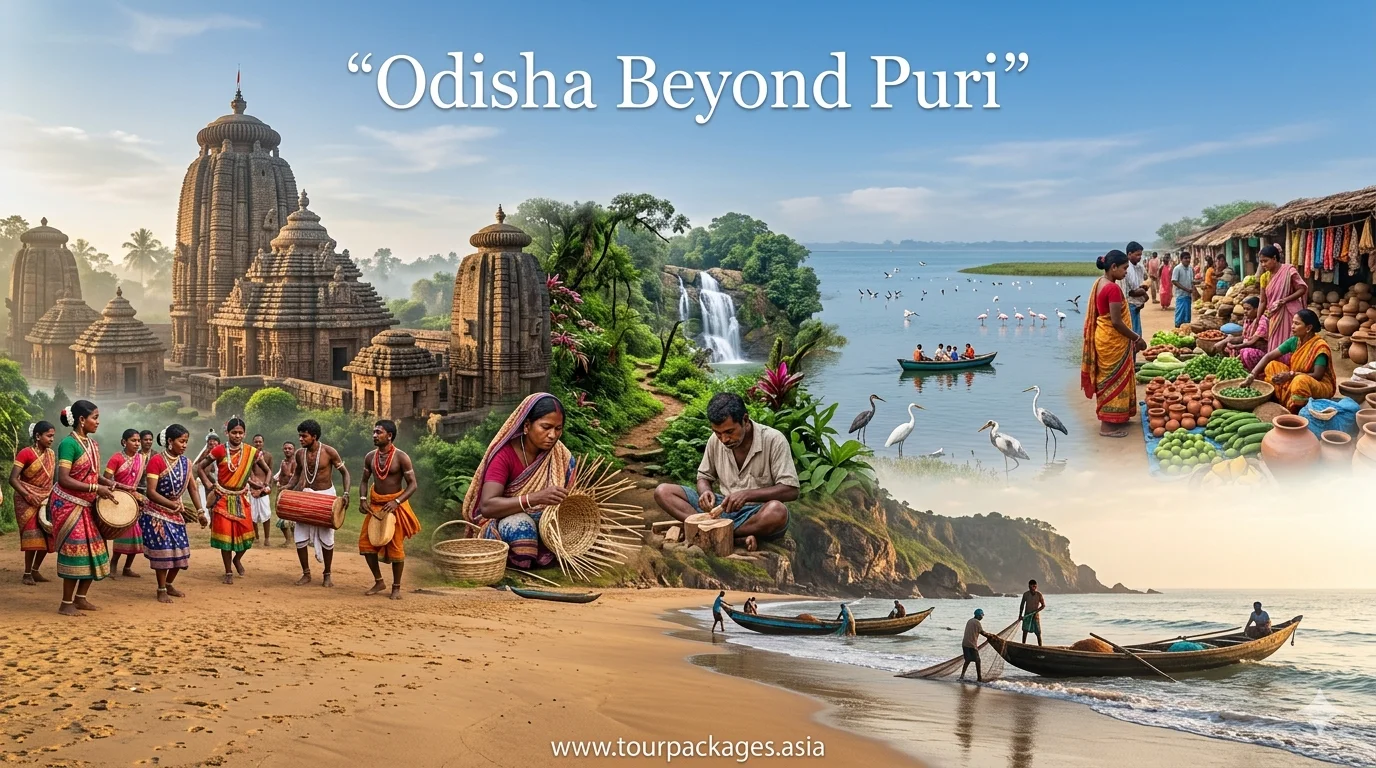
Odisha offers far more than Puri’s famous beach and Jagannath temple. Discover hidden shores along the Bay of Bengal, explore ancient temples in Bhubaneswar and Konark, and immerse yourself in vibrant tribal culture across the hinterlands. From serene Chilika Lake escapes to offbeat adventures in untouched villages, Odisha blends spirituality, heritage, and raw natural beauty—an authentic journey beyond the usual tourist trail of India.
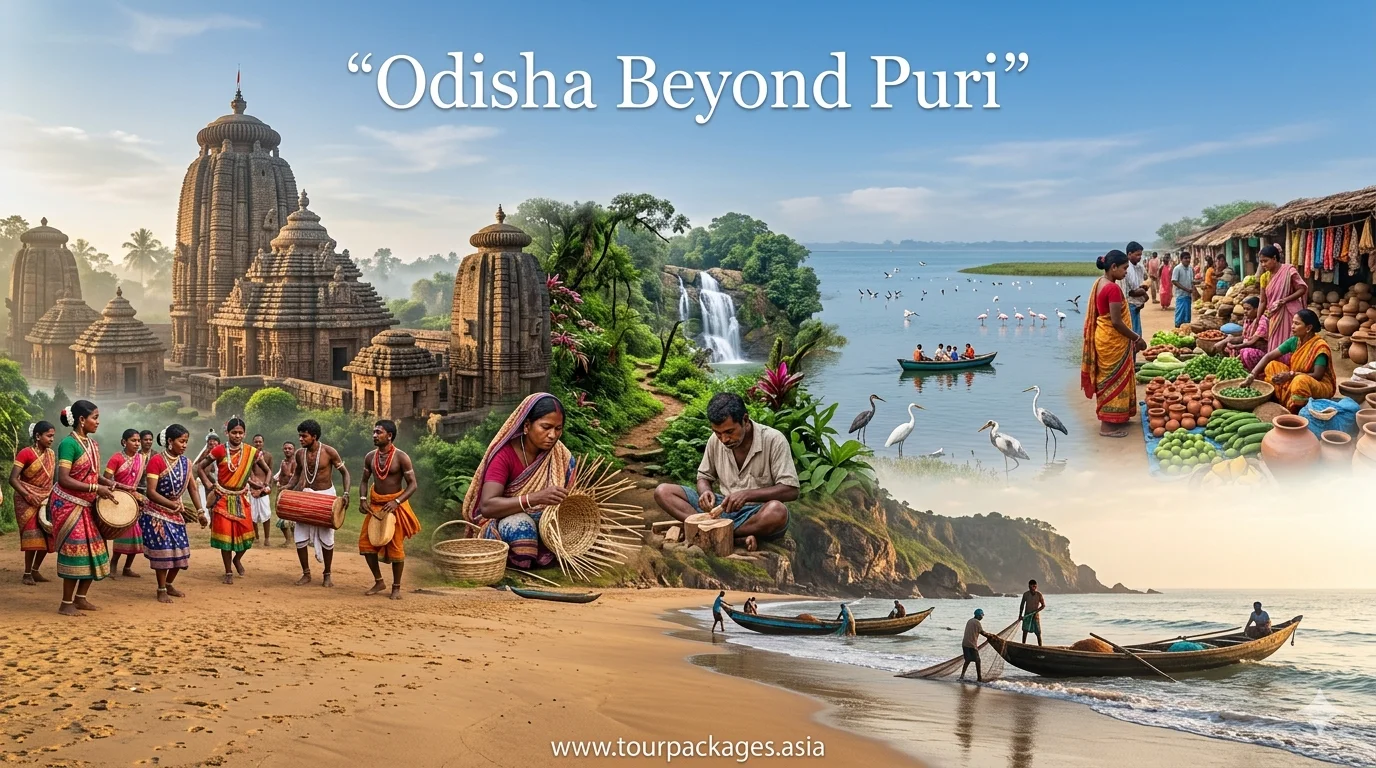
"Most travellers pass through Odisha for Puri or Konark — but very few realise this state quietly contains one of India's richest combinations of spirituality, coastline, wildlife, tribal culture, and slow travel experiences. I spent eleven days crossing it end to end, and I came back wondering why nobody talks about it the way they talk about Kerala or Rajasthan."
What This Guide Covers
India has a hierarchy of travel states — the famous ones that dominate the conversation and attract the infrastructure of attention. Rajasthan. Kerala. Goa. Himachal. And then there are the states that contain equivalent wealth — historical, ecological, cultural — and receive a fraction of the notice. Odisha is at the top of that second list and has been for as long as I can remember travelling through India.
The statistics are quietly extraordinary. Odisha has a coastline of over 480 kilometres — longer than Goa and Kerala combined — and most of it is empty. It contains Asia's largest brackish water lagoon. It has three UNESCO sites (Konark Sun Temple is the most famous; Sun Temples and the Odisha historic urban area of Bhubaneswar are on the tentative list). Its Buddhist heritage sites at Ratnagiri, Lalitgiri, and Udayagiri preserve ruins from a monastery complex that once housed thousands of monks and predates most of the Buddhist sites that Indian travellers commonly visit. Its tribal belt in Koraput is one of the richest concentrations of indigenous cultural traditions in Asia. And Bhubaneswar — its capital — has more surviving medieval stone architecture within a single urban area than virtually any other city in India.
None of this is secret. It is simply under-promoted in an era where Odisha tourism is still building the kind of narrative that turns destination awareness into travel decisions. The result is that travellers who do come find less crowd, lower cost, and more authenticity than almost any other Indian state at a comparable level of historical and ecological richness.
Is Odisha worth visiting? The question undersells what the state offers. The correct question is: why haven't more people been yet?
I arrived in Bhubaneswar in the second week of December. The flight from Hyderabad takes 75 minutes and is unremarkable except for the landing approach, which passes over a flat coastal plain so densely dotted with small ponds and tanks that from the air it looks as if the land cannot quite decide whether it is earth or water. That ambiguity — between solid and liquid, between what is cultivated and what is wild — turned out to be a useful metaphor for Odisha as a whole.
Bhubaneswar surprised me immediately. I had expected a functional capital city with the standard South Indian urban character. What I found was a city with more than 400 surviving historical monuments, most of them stone-built temples from the 7th to 13th centuries, distributed throughout a relatively compact urban area. Walking between the Mukteswara and Raja Rani temples in the morning — when the stone is still cool and the light is just beginning to warm the carved surfaces — is one of the most architecturally rewarding hour-and-a-half in Indian urban travel. Not because the temples are the most famous, but because they are among the finest.
From Bhubaneswar I drove south and east: toward Puri, then Konark, then the Chilika Lake shoreline, then the long coastal road south toward Gopalpur. The quality of the drive through the coastal strip of Odisha — paddy and casuarina alternating, fishing villages every few kilometres, the sea visible in brief glimpses between the tree lines — is something that no Instagram post I had seen before the trip had prepared me for. It is a simple, quietly beautiful landscape that asks nothing of you except your attention.
The tribal belt of Koraput in the southwest, which I reached on day seven, was different in character from everything that preceded it. The roads narrowed. The landscape changed to forested hills. The weekly tribal market at Onukadelli — where women from the Koraput tribes gather in traditional dress to trade vegetables, cloth, and livestock — was the most vivid single scene of the entire trip. Not because it was dramatic in any cinematic sense. Because it was real. Not arranged for visitors. Simply existing, as it has existed for generations, in the middle of a hill market in an Indian state that most travellers have never seriously considered visiting.
The Odisha coastline between Konark and Gopalpur — 200 kilometres of largely empty shoreline with fishing villages every few kilometres. Most travellers drive past it to reach Puri.
The Odisha beaches conversation almost always begins and ends with Puri, which is simultaneously Odisha's most visited and least characteristic beach experience. Puri beach is busy, commercialised, and flanked by the kind of beach shack and hotel strip that could be transplanted to a dozen other Indian beach towns without anyone noticing. It is not representative of what Odisha's 480-kilometre coastline actually looks like.
The coastline beyond Puri — both north and south — is something else entirely. These are hidden beaches in Odisha that most visitors never reach, not because they are remote but because the standard Odisha itinerary does not build in the road time to find them.
Chandipur in Balasore district (200km north of Bhubaneswar) deserves special mention because it offers something that no other beach in India — or possibly the world — can offer in quite the same way. The sea at Chandipur recedes approximately 5 kilometres during low tide, exposing a vast tidal flat of hard sand that you can walk on, drive on, and watch transform the entire coastal geography twice daily. The phenomenon is caused by the specific tidal characteristics and the shallow gradient of this part of the Bay of Bengal coast. The area where the water was an hour ago becomes, at low tide, a flat expanse that stretches to the visible horizon. At the incoming tide, the water returns at a speed that requires attention — not dangerous, but fast enough to be visually dramatic.
Aryapalli beach in Berhampur district, Talasari in the northern corner where Odisha meets West Bengal, and Ramchandi near Konark — all of these reward the traveller who departs from the Puri-Konark axis with empty sands and uncrowded mornings that are simply not available at Odisha's most famous beach.
Chilika Lake is Asia's largest brackish water lagoon and one of India's most important ecosystems. It covers approximately 1,100 square kilometres in the Puri, Khurda, and Ganjam districts — a shallow, seasonally variable body of water that connects to the Bay of Bengal through a narrow channel and supports an extraordinary range of aquatic and avian biodiversity. Over 150 species of fish, dozens of crustacean species, sea horses, and the only population of Irrawaddy dolphins in Indian coastal waters are resident in Chilika. Between November and February, the lake receives approximately 150 species of migratory birds — flamingos, Siberian white cranes, geese, and vast flocks of waterfowl that transform the lake's character during the winter months.
Visiting Chilika requires an early start. The best experience — boat through the channels with migratory birds in their largest numbers — happens between 6 AM and 10 AM. After that, the wind picks up, the birds disperse, and the experience becomes significantly less rewarding. The main boat departure points are Chilika Brahmapur (near Rambha), Barkul, and Satapada. Satapada is the point from which dolphin-watching trips operate — the Irrawaddy dolphins are reliably sighted in the channel between the lake and the sea, and the experience of watching them surface in the silver morning water, with migratory birds overhead and the mangrove shore in the background, is genuinely remarkable.
The fishing communities that live on the lake's islands — over 150,000 people in 132 villages — use traditional dugout boats and cone nets that have not significantly changed in centuries. Several of these communities offer homestay experiences that allow visitors to spend a night on the lake island, eat freshly caught fish cooked in the traditional way, and watch the morning boat launches in complete darkness before dawn. This is eco tourism Odisha at its most authentic and most rewarding.
Approximately 22.8% of Odisha's population belongs to scheduled tribes — the third-highest proportion of any Indian state. The tribal belt concentrated in the southern districts of Koraput, Malkangiri, Rayagada, and Kandhamal is home to more than 62 distinct tribal communities, each with distinct languages, material cultures, agricultural traditions, and ritual practices. This is tribal tourism Odisha territory — and how you approach it matters considerably.
The most responsible and rewarding way to experience Koraput travel is through the weekly tribal markets, known locally as haats, that function as the primary commercial and social gathering points for the surrounding communities. The Onukadelli market (Tuesday) and the Bissam Cuttack haat (Saturday) near Koraput are the most visited, but smaller markets throughout the district offer more intimate encounters and fewer domestic tourists. At these markets, you will find Dongria Kondh women in their distinctive bead jewellery, Bonda tribal women in their traditional metal ring-neck adornment, Gadaba community members selling forest produce and hand-woven cloth. The market is not a cultural performance — it is the weekly economy of these communities, and you are a bystander with a camera and a responsibility to behave accordingly.
Visiting tribal areas requires a disposition of genuine respect and some basic practical awareness. Photography should be with explicit consent — many tribal communities have strong feelings about being photographed, and those feelings deserve more respect than the photograph is worth. Hiring a local guide from the community is not only practically useful (navigation in the tribal belt requires local knowledge) but sends the right economic signal. Stay in community-run guesthouses rather than in facilities operated by outside entrepreneurs — the economic benefit flows to the right place. The Odisha cultural tourism that actually contributes to these communities is the kind that generates direct income for residents rather than extracting cultural spectacle for outside benefit.
Koraput itself — the district capital — is a base from which the market circuit and the tribal village visits operate. OTDC runs a decent guesthouse, and several NGO-linked homestay programmes in the tribal belt allow overnight stays in village homes. These must be arranged in advance and are best organised through a registered Odisha tour operator who knows the community contacts. For complete cultural heritage travel in India, TourPackages Asia has guides across the subcontinent's most significant living culture experiences.
The Buddhist sites in Odisha are among the most important and least visited in India. Ratnagiri, Lalitgiri, and Udayagiri — collectively known as the Diamond Triangle of Buddhist heritage — are located in the Jajpur and Cuttack districts, approximately 90 to 110 kilometres north of Bhubaneswar. Together they form the ruins of a monastic complex that once constituted one of the most significant centres of Tantric Buddhism in South Asia, dating from the 5th to 12th centuries CE.
Tantric Buddhism Ruins · Monastery Remains · Stone Sculpture · Almost No Visitors
Ratnagiri is the largest and most intact of the three sites — a hilltop covered with the foundations of monasteries, stupas, and carved stone debris from a complex that once accommodated thousands of monks. The main stupa at Ratnagiri is partially restored and retains significant decorative carving. The museum on site contains some of the finest Tantric Buddhist sculpture in India — bodhisattva figures, Tara images, and ritual objects that were excavated from the ruins and represent the highest level of artistic production in medieval Odisha.
Lalitgiri is even less visited and arguably more atmospheric — a hilltop with a main stupa, monastery foundations, and views of the surrounding agricultural landscape that have changed very little in a thousand years. An urn was found at Lalitgiri containing bone relics, gold, and crystal, now housed in the site museum. Udayagiri's significance is primarily architectural — its brick monastery foundations are the most extensive of the three and give the clearest sense of the scale at which Buddhist monastic education was operating in this region during the 7th and 8th centuries.
The three sites together represent an afternoon and morning of travel — they are 20 to 30 kilometres apart and best covered by hired car from Bhubaneswar or Cuttack. What they lack in the crowd-management infrastructure of more famous Buddhist sites, they compensate for in the quality of silent, unhurried access to ruins that are genuinely extraordinary and genuinely under-appreciated.
Odisha food is not a national conversation in the way that Rajasthani, Punjabi, or South Indian food is a national conversation. It should be. Odia cuisine is built around rice — the state produces some of India's finest rice varieties — and around a set of preparations that are simpler, less oil-heavy, and more ingredient-focused than most regional Indian cooking traditions. The flavours are subtle where much of Indian cooking is emphatic.
Pakhala Bhata is fermented rice — cooked rice soaked overnight in water and served the following day, typically at room temperature or chilled, with a range of accompaniments: fried vegetables, dry fish, pickles, and sometimes curd. The fermentation produces a mild sourness and a slightly effervescent quality. It is the Odia farmer's working meal, eaten in the heat of summer because the fermentation cools the body. It is also profoundly delicious in a way that surprises most first-time eaters who arrive expecting something more elaborate. The specific character of the fermentation — which varies with local water, the clay pot used, and the length of soaking — means that the best pakhala is available at home cooks' tables rather than in restaurants, where it is often less carefully prepared.
Odisha food landmarks include Dalma (a thick lentil and vegetable preparation with raw banana, raw papaya, and pumpkin that is cooked without onion or garlic and is the standard festival and offering food throughout the state), Chhena Poda (literally "burnt cheese" — a dessert made from fresh cottage cheese baked until the exterior caramelises, with a dense, creamy interior that is nothing like any other Indian sweet), and the extraordinary range of fresh seafood available at coastal town markets. The fish curry tradition of coastal Odisha — using turmeric, mustard, and raw mango rather than the richer coconut and coriander bases of Kerala — produces a clean, direct flavour that is among the best regional fish curry traditions in India.
The best eating in Odisha is at the simplest venues: the communal thali restaurants in Bhubaneswar's older quarters, the seafood stalls at Gopalpur and Puri's fish market, and the weekly markets in tribal Koraput where women sell freshly roasted forest produce alongside their regular goods.
Every Indian state has a distinct character, but Odisha's distinctness is particularly pronounced — and particularly hard to articulate without visiting it. The quality that I keep returning to when I try to describe the state to people who haven't been is pace. Odisha moves slowly. Not the slow of underdevelopment — the slow of a culture that has not been accelerated by tourism in the way that Kerala or Rajasthan has. The interactions are unhurried. The landscapes are not arranged for consumption. The food is not adapted for outsider palates. The tribal communities in Koraput are not performing their culture — they are living it.
This is the offbeat Odisha experience that a small number of travellers have already discovered and that the state's tourism narrative is only beginning to build. The affordability is striking by Indian tourism standards — accommodation, food, and transport in Odisha cost considerably less than equivalent quality in Goa, Kerala, or Rajasthan. The heritage density is extraordinary — Bhubaneswar alone has more medieval stone monuments per square kilometre than any Indian city except possibly Khajuraho.
And the people. The warmth and genuine curiosity of the people I encountered throughout Odisha — in the tribal markets, at Chilika's fishing villages, on the coastal roads — is the kind of hospitality that exists before tourism has standardised human interaction into a service transaction. It is the hospitality of a place where visitors are still relatively unusual and therefore genuinely interesting rather than economically predictable.
The best time to visit Odisha, for almost all of the experiences described in this guide, is October through February. November and December in particular represent the state at its finest: Chilika is full of migratory birds, the coastal beaches are clear and calm, the temperatures are comfortable (22 to 28 degrees Celsius), the Buddhist sites are easily accessible, and the Koraput tribal markets are operating in full season. The Konark Festival — held in the first week of December at the Sun Temple — is one of India's finest classical dance festivals and alone justifies timing a visit to coincide with it. January is the best month for olive ridley turtle nesting at Rushikulya beach near Gopalpur and at Gahirmatha marine sanctuary in northern Odisha.
The monsoon (June to September) transforms Odisha into one of India's most lush and visually striking landscapes. The Simlipal biosphere reserve in the north is at its most beautiful. The waterfalls in the tribal belt are spectacular. But the same rains that create this beauty also make many roads in the tribal belt impassable, raise Chilika to levels that affect boat access, and produce a level of humidity (85 to 95%) that makes outdoor exploration genuinely uncomfortable. The Odisha coast also sees cyclone risk between October and November — check weather advisories before coastal travel in this window.
March to May sees temperatures rising to 38 to 42 degrees Celsius in the interior, with the coast somewhat cooler due to sea breezes. Early morning temple and heritage site visits remain perfectly feasible. The Buddhist triangle is actually one of the better warm-season destinations because the sites provide shade and the absence of tourists in summer is at its maximum. Pakhala Bhata — the fermented rice dish — is at its most culturally relevant in the summer months when it is eaten daily across the state.
Click each panel below for detailed guidance on transport, accommodation, cultural behaviour, safety, and the most common errors that limit travellers' experience of Odisha.
The architectural quality of Bhubaneswar was the first surprise — not because I didn't know the city had important temples, but because the sheer density and diversity of surviving medieval stone architecture within a single urban area is simply not something that the way Odisha is discussed in national travel media prepares you for. The Mukteswara Temple, completed in the 10th century, is arguably one of the most elegantly proportioned buildings in all of India. Not the most famous. Not the most visited. Possibly the most beautiful.
The second surprise was the quality of the light on the Odisha coast. There is something about the interaction of the Bay of Bengal and the shallow coastal landscape — the casuarina-filtered morning sun, the particular quality of the early mist over the paddy fields between the coast and the first ridge of hills — that is specifically Odia and unlike the coastal light of any other part of India I've visited.
And the third surprise, the one I find hardest to convey, was the sense that Odisha had not yet been fully absorbed into the transaction economy of Indian tourism. Things still happened on their own terms. The Chilika fisherman going out at 4:30 AM was not going out for tourism photography — he was going out because that is when you go out for fish. The tribal women at the Onukadelli market were selling vegetables because they had vegetables to sell, not because they had agreed to be photographed while doing so. That quality of un-performing genuineness is increasingly rare in Indian travel and, I would guess, will become rarer as the state develops its tourism identity over the next decade.
The tourism infrastructure is genuinely uneven. In some areas — Bhubaneswar, Puri, the OTDC network — it is adequate and sometimes good. In others — the approach roads to the Buddhist triangle, the interpretation boards at heritage sites, the accommodation options in coastal towns between Puri and Gopalpur — it falls considerably short of what the quality of the destination warrants. The ASI interpretation boards at Ratnagiri and the Bhubaneswar temples are sparse and sometimes inaccurate. Arriving without prior reading means arriving without context, which is a significant handicap at sites this architecturally complex.
Transport connections beyond the railway and national highway network can be slow and unreliable. Getting from Chilika to Koraput in a single day is technically possible and practically exhausting. The tribal belt roads in the deep interior are in poor condition in sections, and the concept of a clear road sign to a specific destination is more aspirational than actual in some districts.
The language barrier is more significant in rural Odisha than in most Indian tourism states. Odia is not Hindi, and in the tribal belt several communities speak primarily their own language. This is not insurmountable — a good local guide solves it entirely — but it requires planning rather than the assumption of Hindi-as-universal-communicator that works in North and Central India.
For customised Odisha travel planning, TourPackages Asia and Revelation Holidays provide curated itineraries covering temples, beaches, Chilika Lake, and tribal regions — designed for travellers who want to experience India's most underrated state at its full depth.
Plan My Odisha Trip More India Travel GuidesA cultural traveller who values historical depth over tourist comfort. A photographer looking for coastal landscapes, medieval architecture, and human subjects in genuinely unpretentious contexts. A slow traveller — someone who is happy to sit by a lake for two hours before the boat arrives, to walk through a weekly market for a full morning, to eat whatever the dhaba is serving rather than negotiating for a familiar cuisine. A nature traveller interested in the Chilika ecosystem, the Simlipal biosphere, or the olive ridley turtle nesting events. A first-time visitor to East India who wants an introduction to the region's cultural geography. Someone who is specifically tired of the over-touristed circuits and wants their travel to feel like discovery rather than consumption.
Consistent luxury accommodation throughout a circuit — the OTDC network is good value and the better private hotels in Bhubaneswar and Puri are comfortable, but the equivalent of a premium Kerala or Rajasthan resort circuit does not yet exist across Odisha's full geography. Rapid, tight-schedule travel — Odisha's logistics reward patience; a 4-night trip that tries to cover beaches, Chilika, Buddhist sites, and Koraput will exhaust the traveller and shortchange every destination. Nightlife or urban entertainment beyond the cultural calendar of performances and festivals — Odisha's evening entertainment is largely defined by classical dance and traditional music, which is extraordinary if that is what you want, and absent if it isn't.
The Odisha itinerary I recommend covers the state in a logical geographic circuit that minimises backtracking and maximises the quality of each experience. 8 days is the ideal minimum. 10 days allows for the Koraput tribal belt without rushing.
Arrive Bhubaneswar. Day 1 afternoon: the old temple district — Mukteswara, Raja Rani, and Lingaraj. Day 2: Buddhist triangle day trip — Udayagiri, Lalitgiri, and Ratnagiri, with overnight return to Bhubaneswar. Evening: Bhubaneswar State Museum's collection of Odia sculpture and tribal artefacts.
Drive to Puri (60km from Bhubaneswar). Morning at the Jagannath Temple exterior and the Puri beach fish market. Afternoon: drive to Konark Sun Temple — allow 2 hours, ideally arriving at 4 PM for the afternoon light on the sculpture. Evening: Chandrabhaga beach (3km from Konark) for sunset. Stay in Puri or Konark.
Depart Puri by 5:30 AM for Satapada (100km). 6 AM dolphin-spotting and bird-watching boat. Return to shore by 10 AM. Afternoon: drive to Barkul (on the opposite shore of Chilika, 30km), check into OTDC Panthanivas. Afternoon boat through the bird channels. Overnight on the lake.
Drive from Barkul to Gopalpur (70km, 2 hours). Afternoon and evening at Gopalpur beach — walk the fishing shore at low tide, dinner at a local seafood restaurant. Overnight in Gopalpur.
Drive or take overnight train to Koraput (175km from Gopalpur or overnight train from Berhampur). Days 6 to 8: base in Koraput, day trips to tribal markets (align with the weekly haat schedule — Onukadelli on Tuesday, other markets on other days), tribal village visit with local guide, Duduma Waterfall and Deomali Hill (Odisha's highest point).
For a 10-day itinerary, fly or train from Koraput to Bhubaneswar and drive north to Simlipal Biosphere Reserve in Mayurbhanj district — a 2-night wildlife experience that provides Odisha's most dramatic forest landscape. Return to Bhubaneswar for departure.
Odisha connects logically with Andhra Pradesh to the south (Vizag, Araku Valley) and West Bengal to the north (Kolkata, Sundarbans). For a combined East India circuit, starting in Kolkata and moving south through Odisha to Andhra is one of India's most rewarding and least overused itineraries. For curated India tour packages that combine Odisha with neighbouring state experiences, TourPackages Asia designs multi-state East India itineraries. For more on regional Indian travel connections, Revelation Holidays also specialises in experience-based circuit planning across Eastern and Southern India.
Detailed answers to the most searched questions about Odisha travel — beaches, Chilika, tribal tourism, safety, best time, food, and the Buddhist heritage circuit.
Tell us your travel interests and dates and our team will design a customised Odisha itinerary — covering hidden beaches, Chilika, tribal Koraput, Buddhist heritage, or the complete state circuit.
This state does not announce itself. It reveals itself — at dawn on a Chilika boat, in the silence of a Ratnagiri monastery ruin, on the empty shore at Gopalpur before the fishing boats return. For customised Odisha travel planning, TourPackages Asia and Revelation Holidays offer itineraries that go well beyond the Puri-Konark circuit.
Plan My Odisha Experience More India Travel GuidesIndia Travel Guides | Beach & Islands Travel | Best Time to Visit India | Honeymoon Destinations in India | Cultural Heritage Journeys | Nature & Wildlife Travel
