
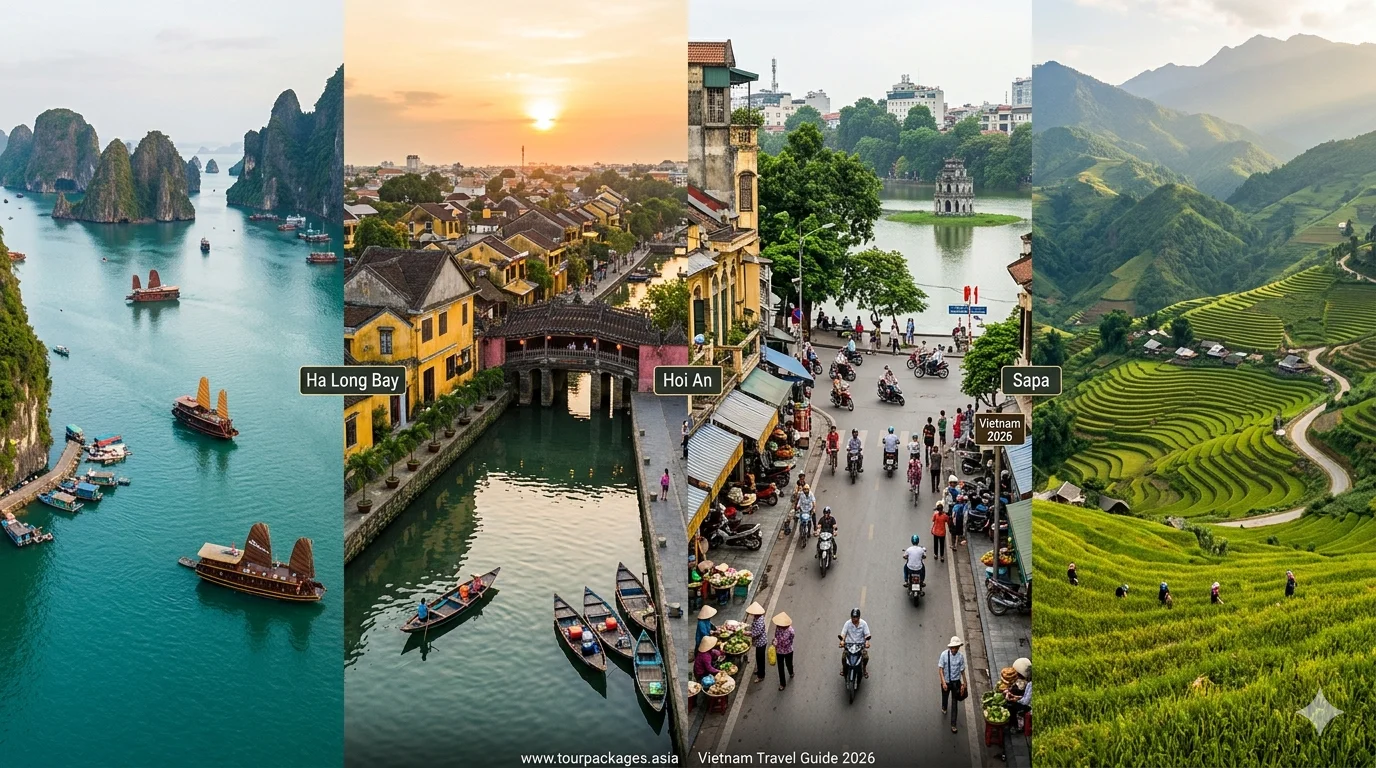
There is a moment on a Ha Long Bay overnight cruise — somewhere around 6am, when the mist is still sitting on the water between the limestone karsts, and the only sound is the boat's gentle movement — when Vietnam stops being a travel destination and becomes something else. Something more difficult to describe. The country has a quality of concentrated beauty that feels almost deliberate, as if the landscape were arranged by someone who knew exactly what they were doing.
Indian travellers have been discovering this in large and growing numbers. The 656,000 who visited in the first eleven months of 2025 represent a 30% increase on the year before, driven by an e-Visa process that takes 3 business days and USD 25, direct or one-stop flights from every major Indian city, and a currency exchange rate that makes even mid-range Vietnam feel remarkably affordable by Indian standards. 1 INR equals approximately 286 Vietnamese Dong — which means the mental arithmetic of budgeting in Vietnam has a pleasing extra zero on all the local prices.
"Vietnam is not just beautiful. It is beautiful in a way that surprises you — because no photograph quite prepares you for the scale of Ha Long Bay, the smell of Hoi An's night market, or the noise and energy of Hanoi's Old Quarter at 7am."
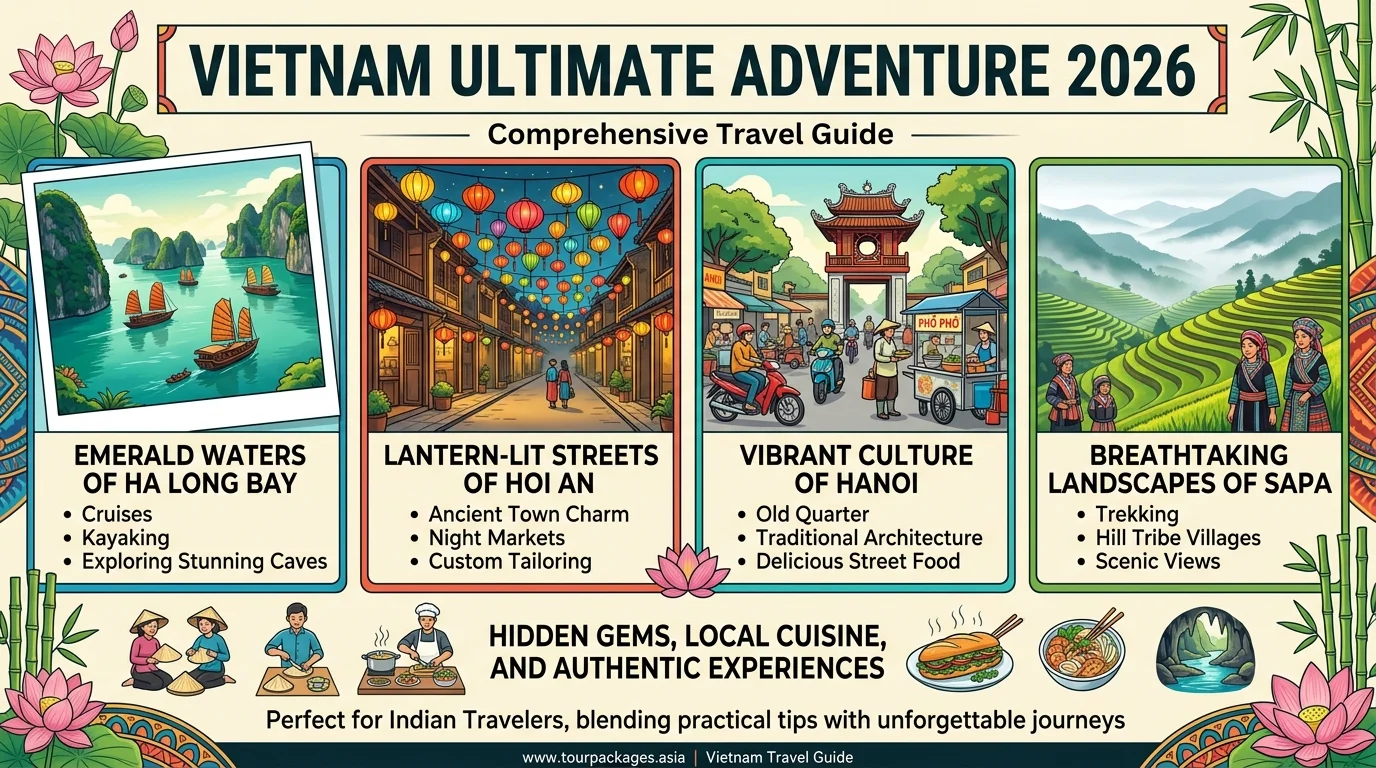
This guide covers the seven destinations that define a well-planned Vietnam trip for Indian travellers — from the limestone karsts of Ha Long Bay to the rice terraces of Sapa, from the lantern-lit streets of Hoi An to the war history of Ho Chi Minh City. It also covers the practical logistics that actually matter: the e-Visa step-by-step, realistic costs in INR, vegetarian food navigation, 7-day and 10-day itinerary structures, and the specific things worth booking in advance versus leaving spontaneous. Our Asia travel guide archive covers companion destinations across Southeast Asia for multi-country circuit planning.
Why Vietnam Works So Well for Indian Travellers
Three things distinguish Vietnam from comparable Southeast Asian destinations in 2026 for Indian travellers. First, the value: the exchange rate makes a quality mid-range hotel room (INR 2,500-4,500 per night) and an outstanding restaurant meal (INR 600-1,500 for two) accessible at a price point that would buy considerably less in Thailand or Singapore. Second, the variety: a country the length of Italy that compresses four entirely different climate zones, landscapes, and cultural traditions into a single continuous itinerary — mountain rice terraces in the north, imperial history in the centre, colonial-era architecture in the south. Third, the food: Vietnamese cuisine is one of Asia's most distinctive and health-forward food traditions, built around fresh herbs, light broths, rice-based preparations, and minimal oil — which suits the Indian palate considerably better than the heavier, saltier food traditions of some neighbouring countries.
The Vietnam e-Visa for Indian passport holders is one of the most straightforward international entry processes available. Applied online at evisa.xuatnhapcanh.gov.vn: USD 25, valid for 90 days from issue, permits a stay of up to 90 days, processed in 3 business days. Required: a passport valid for at least 6 months beyond your planned departure from Vietnam, a digital passport photograph, and your accommodation address for the first night. The e-Visa replaced the earlier letter-based visa-on-arrival system for Indian passport holders in 2023 and is now the standard and reliable entry method. Apply before purchasing flights — the e-Visa is issued within 3 days but occasionally takes longer during peak periods.

Questions and Comments