
In This Guide
One of the Highest Lakes in the World
At over 17,000 feet, Gurudongmar Lake is not just a destination — it is an experience that tests your body and rewards you with surreal beauty. I have travelled across most of the Indian Himalayas, from the trekking trails of Uttarakhand to the high passes of Ladakh, but nothing quite prepared me for the particular intensity of standing at the edge of this lake, lungs working hard for oxygen that simply was not there in the quantity I needed, looking at water so still and so blue it seemed to belong to a different planet.
This guide is not a polished brochure description. It is an honest account of what the journey to Gurudongmar Lake Sikkim actually involves — the permit process, the altitude reality that almost nobody describes accurately in advance, the logistics of getting there from Gangtok via Lachen, and a clear answer to the question every potential visitor eventually asks: is it actually worth it.
If you are researching North Sikkim travel for 2026 and Gurudongmar is on your list, you need facts, not just postcard imagery. That is what this article delivers.
My Journey to Gurudongmar Lake
The journey begins, realistically, two days before you ever see the lake. I flew into Bagdogra and drove up to Gangtok — a five to six hour climb through tea estates and pine forest that gains nearly 5,000 feet but feels, in comparison to what comes later, almost gentle. Gangtok itself is a pleasant shock after the plains: a hill capital with proper cafes, momos at every corner, and a buzz that belies its location at the edge of one of the most restricted travel zones in India.
From Gangtok, the real journey toward North Sikkim travel begins with the drive to Lachen, roughly 120 km that takes five to six hours on roads that narrow and roughen the further north you travel. The landscape changes by the hour. Forest gives way to scrub, scrub gives way to bare rock, and by the time Lachen appears — a small army-and-monastery town wedged into a steep valley — the temperature has dropped sharply and the air already feels thinner, even though Lachen itself sits at a comparatively modest 8,800 feet.
This is where acclimatization matters. We stayed overnight in Lachen specifically to let our bodies adjust before the final ascent, and this single decision is, in my experience, the difference between a manageable trip to Gurudongmar and a genuinely miserable one.
The final leg starts absurdly early — we were on the road by 3:30 AM, headlights cutting through total darkness on a track that climbs roughly 9,000 feet in 65 km. This is not an exaggeration for effect; it is operational reality. The Gaigong Army Check Post, the final military checkpoint before the lake, closes to incoming traffic by 10:30 to 11:30 AM, and missing that window means missing the lake entirely. The early start is non-negotiable.
What struck me most on that drive was the army presence — checkpoints, convoys, soldiers stationed at intervals in conditions that are genuinely brutal. This is a militarized border region, and that reality is impossible to ignore. It also explains much of the restriction and permit structure that governs travel here.
As the vehicle climbed past 15,000 feet, the landscape became almost lunar — no vegetation, no colour beyond grey rock and white snow patches, and a silence in the vehicle that was less about fatigue and more about the sheer scale of where we were.
First View of the Lake
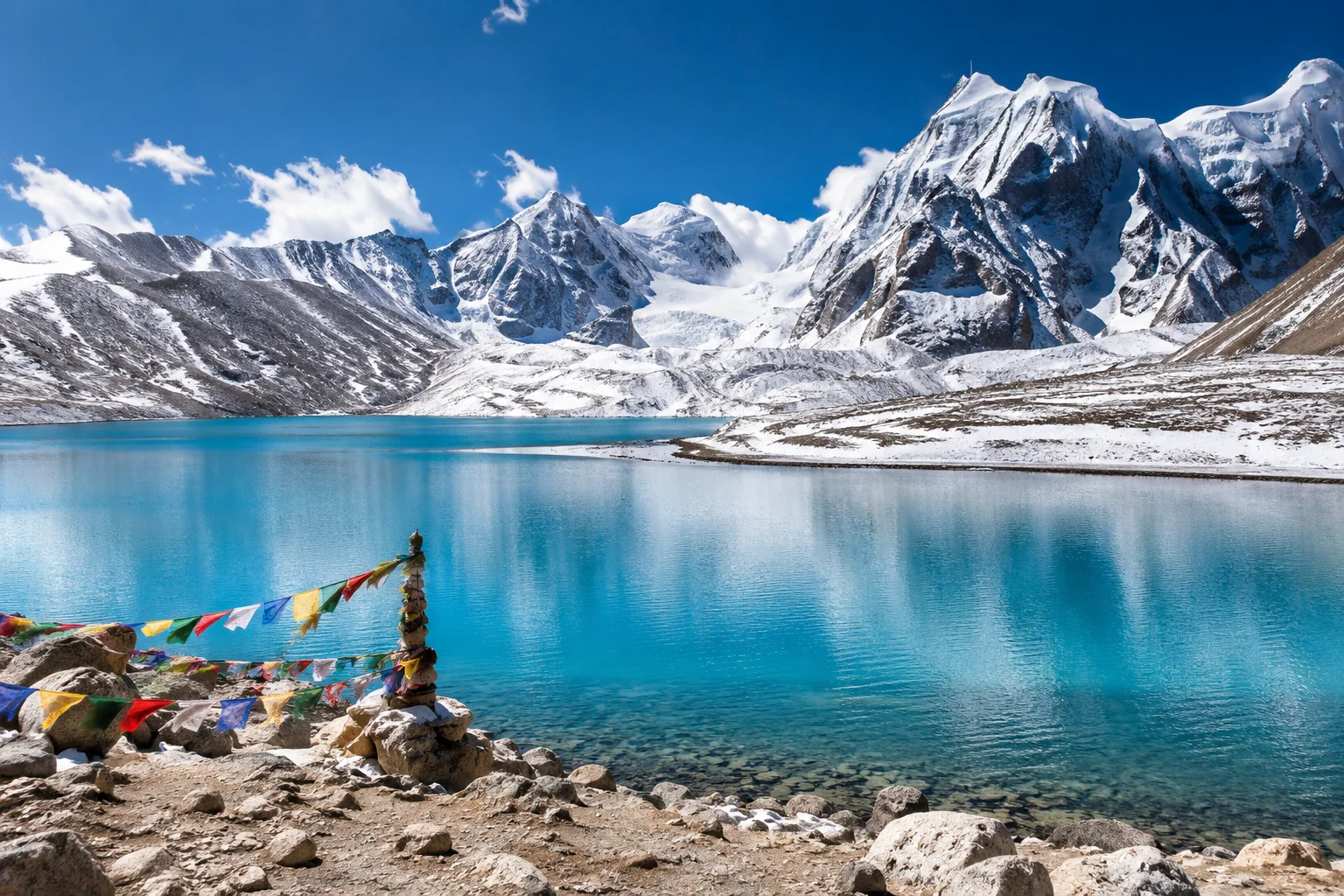
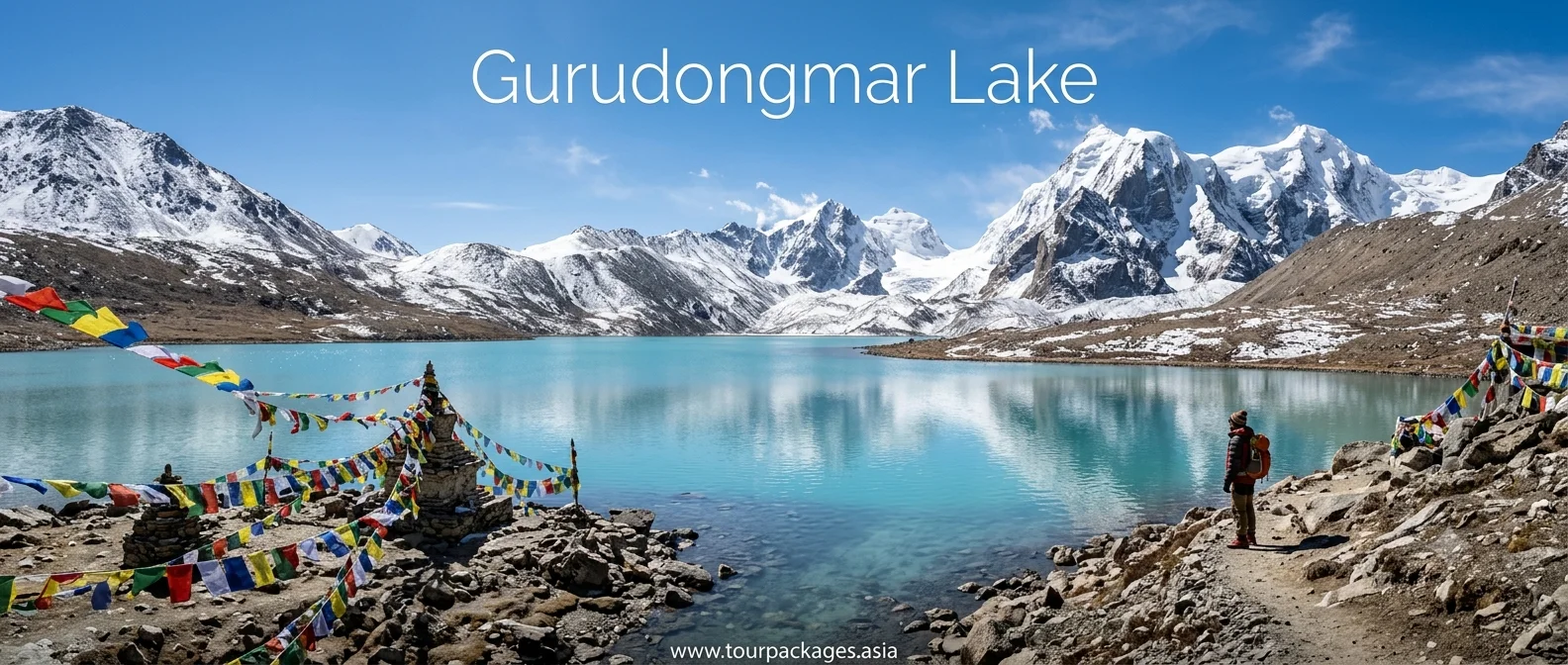
Nothing about the approach prepares you for the moment the lake actually comes into view. The track rounds a final ridge, the vehicle slows, and suddenly there it is — a sheet of impossibly still water, partially frozen at the edges even in late spring, set against a backdrop of snow peaks that seem to rise directly out of the shoreline. The sky here, at this altitude, has a depth and clarity that simply does not exist at lower elevations. The blue is sharper. The light is harder.
There is a quiet that settles over everyone who steps out of their vehicle at Gurudongmar Lake Sikkim. Partly this is the altitude — talking is genuinely more effort than usual — but partly it is something else, a kind of involuntary stillness that the place seems to demand. Prayer flags strung near the small shrine at the lake's edge snap in a wind that never seems to stop. Local legend holds that a portion of the lake, blessed by Guru Padmasambhava, never fully freezes even in the depths of winter — and standing there, looking at open water surrounded by ice in temperatures well below zero, that legend feels entirely plausible.
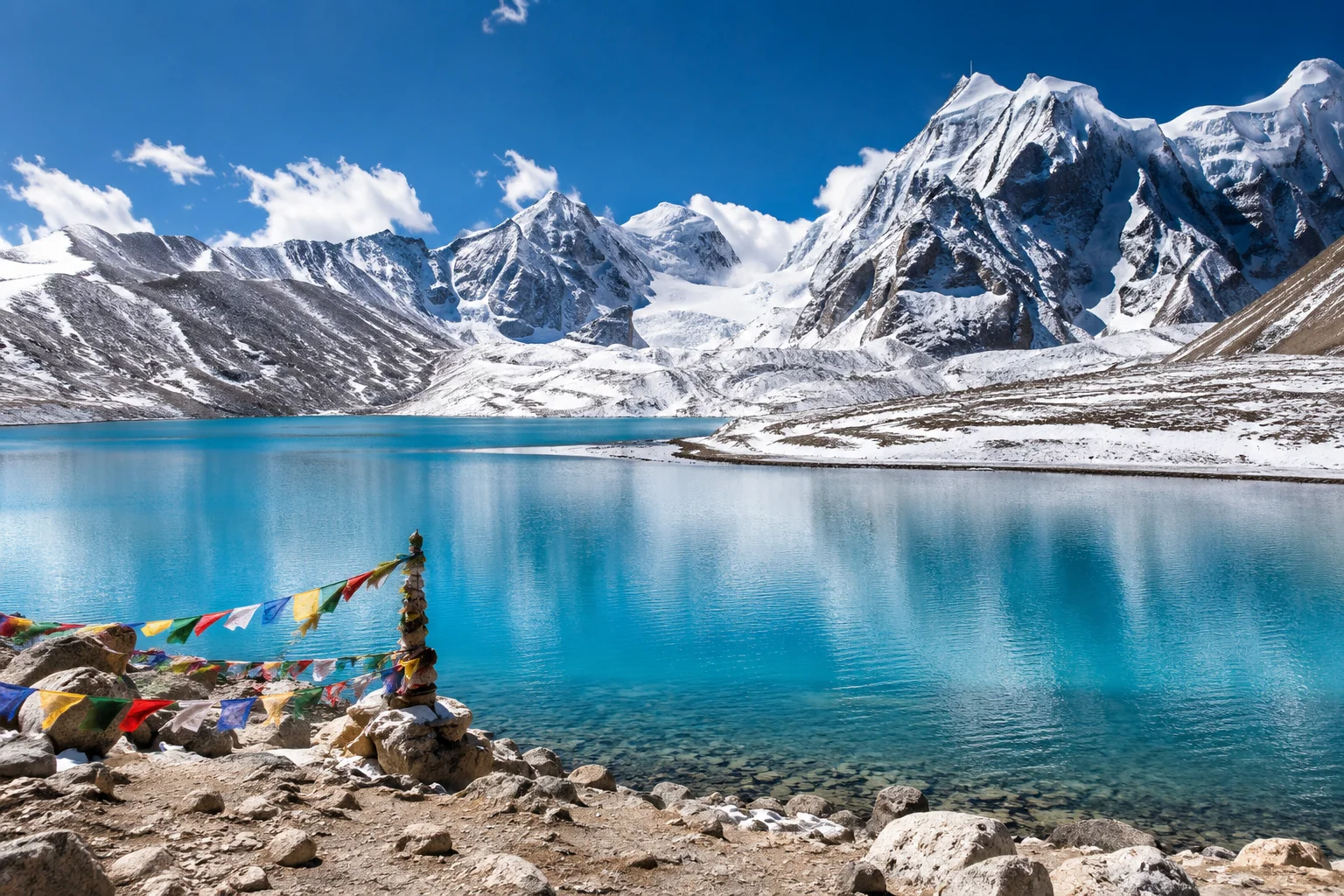
The lake is sacred across three faiths — revered by Buddhists, Hindus, and Sikhs alike — and that shared reverence is visible in the small offerings, prayer flags, and quiet rituals performed by visitors despite the physical discomfort of being there. It is one of the few places I have visited where the spiritual significance of a site and its raw physical impact arrive simultaneously and with equal force.
Altitude Reality — What No One Tells You
This is the section most travel content skips, and it is the most important one. Gurudongmar Lake altitude sits at approximately 17,800 feet (5,430 metres) — higher than Everest Base Camp on the Nepal side, and well into the zone where altitude sickness becomes a genuine, not theoretical, concern.
The honest physical experience: within minutes of stepping out of the vehicle, most people in our group — myself included, despite reasonable fitness and prior high-altitude experience in Ladakh — felt noticeably breathless simply from walking 20-30 metres. Several people in the group experienced a sharp headache that arrived almost immediately. One person felt distinctly dizzy and had to sit in the vehicle rather than walk to the shoreline. This is normal, not unusual, and it is the primary reason visitor time at the lake itself is restricted.
Oxygen saturation at this altitude is roughly half of what it is at sea level. The body simply cannot function normally, and pushing through symptoms — a common instinct for fit, determined travellers — is precisely the wrong response. The correct response to worsening symptoms at altitude is always descent, not persistence.
Acclimatization in Lachen the night before is the single most effective thing you can do to reduce risk. Hydration matters enormously — the dry, thin air at altitude dehydrates the body faster than most people expect, and dehydration significantly worsens altitude symptoms. Avoiding alcohol the night before, eating light, and sleeping as much as possible all measurably help.
If you have any history of cardiac or respiratory conditions, or hypertension, a conversation with your doctor before this trip is not optional — it is essential. The nearest serious medical facility from Gurudongmar is hours away, and the margin for a medical emergency at 17,800 feet is genuinely thin.
Permit Process Explained
The Gurudongmar Lake permit process is straightforward in practice but mandatory without exception. Because the lake sits within a Protected Area close to the Tibetan border, an Inner Line Permit (ILP) is required for all visitors traveling beyond Lachen.
Only Indian citizens are currently permitted to travel to Gurudongmar Lake. Foreign nationals are generally restricted from this specific route and typically cannot proceed beyond Lachen — a restriction that surprises many international travellers researching things to do in North Sikkim for the first time. This is a long-standing security policy tied to the border-sensitive nature of the region and is not something that varies by operator or season.
For Indian nationals, the permit itself is processed through registered local tour operators or directly through your hotel in Gangtok or Lachen, using a government-issued photo ID — Aadhaar card, passport, voter ID, or driving licence are all generally accepted. Processing is usually completed within a day, sometimes faster, but building in buffer time is always wise, particularly during peak season (April-June and October-November) when permit offices handle higher volumes.
Most travellers find it significantly easier to arrange the ILP through an established tour operator who handles the paperwork as part of a complete North Sikkim travel packages itinerary, rather than attempting to navigate the process independently on a tight schedule.
Best Time to Visit Gurudongmar Lake
The character of the lake changes dramatically by season, and choosing the right window depends entirely on what experience you are seeking.
Is It Worth Visiting?
Yes — but not for everyone, and that qualification matters more than the headline answer.
Gurudongmar Lake is physically demanding in ways that no amount of advance reading fully prepares you for. The early starts, the altitude effects, the long hours in a vehicle on rough roads, and the brief, breathless window actually spent at the lake all add up to a genuinely taxing day. This is not a relaxed sightseeing excursion.
And yet, it is also a once-in-a-lifetime experience in the most literal sense. Few places on earth combine this altitude, this remoteness, this stillness, and this particular quality of light and water. The honest measure of whether it is worth it comes down to what you are seeking: if you want comfort and certainty, this is not your destination. If you want to stand somewhere genuinely extreme, somewhere that demands something of you physically before it rewards you, Gurudongmar Lake Sikkim delivers that in full.
Who Should Visit / Who Should Avoid
Gurudongmar is Right For You If...
- You are an adventure traveler comfortable with physical discomfort
- You are a photographer seeking genuinely rare high-altitude imagery
- You have prior high-altitude experience or acclimatize well
- You are in good general cardiovascular and respiratory health
- You can tolerate long, rough road journeys and early starts
- You are drawn to remote, less-touristy Himalayan destinations
Think Carefully If...
- You have heart conditions, hypertension, or respiratory issues
- You are elderly or have limited mobility for vehicle-based travel
- You have no prior exposure to high altitude (above 10,000 ft)
- You are pregnant — altitude exposure at this elevation is not advised
- You are travelling with very young children
- You need guaranteed conditions rather than weather-dependent access
How to Include Gurudongmar in Your Sikkim Itinerary
Gurudongmar Lake works best as part of a broader North Sikkim circuit rather than a standalone trip. Here is a balanced 7-day route.
| Day | Location | Highlights |
|---|---|---|
| Day 1 | Bagdogra → Gangtok | Drive up from the plains. Settle in, MG Marg evening stroll. |
| Day 2 | Gangtok | Tsomgo Lake and Nathu La day trip (permit required separately). Acclimatization day. |
| Day 3 | Gangtok → Lachen | 5-6 hour drive north. Overnight stay for acclimatization before Gurudongmar. |
| Day 4 | Lachen → Gurudongmar Lake → Lachung | 3:30 AM start. Lake visit (15-30 min). Continue to Lachung by afternoon. |
| Day 5 | Lachung → Yumthang Valley → Lachung | Sunrise visit to the Valley of Flowers (Yumthang) and Zero Point if conditions permit. |
| Day 6 | Lachung → Gangtok | Return drive south. Rest and recover at lower altitude. |
| Day 7 | Gangtok → Bagdogra | Departure, or extend with a Darjeeling toy train add-on. |
For a customised North Sikkim itinerary covering Gurudongmar Lake, Yumthang Valley, and Lachung, contact TourPackages Asia directly — permits and acclimatization stops are built into every itinerary.
What Surprised Me the Most
The silence surprised me more than anything else. At 17,800 feet, away from any settlement, with the wind as the only consistent sound, there is a quality of quiet that simply does not exist anywhere at lower elevations. It is not peaceful in a gentle sense — it is vast, almost overwhelming, the kind of silence that makes you acutely aware of your own heartbeat and breathing.
The extremity of the weather also surprised me, even having prepared for it. Within the same hour, we experienced harsh wind, intense sun reflecting off snow and ice, and a cold that cut through multiple layers almost instantly the moment the wind picked up. Nothing about the conditions at Gurudongmar Lake Sikkim is moderate.
And finally, the untouched quality of the landscape surprised me — despite being a known destination, there was no commercialization at the lake itself, no stalls, no crowds lingering. The military presence and altitude naturally limit how developed this place can ever become, and that absence of commercial infrastructure is, paradoxically, part of what makes it so powerful.
What I Did Not Enjoy
Honest balance requires acknowledging the parts of this journey that were genuinely difficult, not just admirable in retrospect.
The sheer number of hours spent in a vehicle on rough roads was demanding — the round trip from Lachen alone is roughly 130 km on a track that is rarely smooth, and combined with the early start, it makes for a long, physically tiring day even before altitude effects are factored in.
The physical discomfort at the lake itself — the breathlessness, the headache, the cold — is real and unavoidable. There is no version of visiting Gurudongmar Lake that bypasses this discomfort entirely. Anyone planning this trip should go in with realistic expectations about how their body will respond, rather than assuming general fitness alone is sufficient preparation.
Why Gurudongmar Lake is Different from Other Himalayan Lakes
Gurudongmar vs Other High-Altitude Indian Lakes
Compared to better-known high altitude lake India destinations like Pangong Tso in Ladakh (13,900 ft) or Tsomgo Lake near Gangtok (12,300 ft), Gurudongmar sits significantly higher at nearly 17,800 feet — a difference that translates directly into a more intense physical experience and a noticeably more remote, less developed setting. Pangong Tso has grown substantially in tourist infrastructure in recent years, with lakeside camps and a steady stream of visitors. Gurudongmar, by contrast, remains logistically restrictive enough — through permits, altitude, and time limits — that it has resisted the same level of commercialization. Where Pangong rewards travellers with extended time at the shoreline and overnight camping options, Gurudongmar offers something rarer: a brief, intense, almost ceremonial encounter with one of the highest accessible bodies of water on the planet.
This is, ultimately, what separates Gurudongmar Lake Sikkim from nearly every other lake destination in the Indian Himalayas — the combination of extreme altitude, restricted access, military proximity, and genuine remoteness creates an experience that cannot be replicated by simply visiting a "similar" lake elsewhere.
Essential Tips for Visiting Gurudongmar Lake
Click each panel to expand detailed, practical tips across the five most important planning areas for this journey.
Before You Go — Planning Tips
- Arrange your Inner Line Permit through a registered local operator at least a day in advance — peak season offices can be slow
- Consult your doctor about preventative altitude medication (such as acetazolamide) if you have any history of altitude sensitivity
- Build in an overnight acclimatization stop at Lachen — do not attempt Gurudongmar as a direct same-day ascent from Gangtok
- Confirm your tour operator is using a registered, high-clearance vehicle suitable for the Lachen-Gurudongmar track
- Check recent road condition updates before travel, particularly outside the April-June window
- Carry travel insurance that explicitly covers high-altitude travel and emergency evacuation
Permit and Document Tips
- Only Indian citizens can currently travel beyond Lachen toward Gurudongmar Lake — foreign nationals are restricted on this specific route
- Carry your original government-issued photo ID at all times — Aadhaar, passport, voter ID, or driving licence are accepted
- Keep at least 3-4 photocopies of your ID for checkpoint verification along the route
- Permits are typically tied to a specific vehicle registration number — confirm this before any last-minute vehicle changes
- The Gaigong Army Check Post closes to incoming traffic by 10:30-11:30 AM — plan your departure from Lachen accordingly
- Children travelling with you also require valid ID for permit purposes
Packing for Gurudongmar Lake
- Heavy thermal layering is essential — temperatures at the lake can be well below freezing even in late spring
- Windproof and waterproof outer layers — the wind at the lake is constant and significantly increases the effective cold
- Good UV-protection sunglasses — snow and ice glare at this altitude is intense and can cause snow blindness without protection
- High-SPF sunscreen and lip balm — UV exposure is significantly stronger at this elevation
- A few energy bars or dry snacks — appetite often drops at altitude but some intake helps maintain energy
- A basic first aid kit including pain relief for altitude-related headaches
Altitude Safety Tips
- Watch for symptoms of Acute Mountain Sickness — persistent headache, dizziness, nausea, confusion — and report them to your guide immediately
- Do not push through worsening symptoms — descent is the only reliable treatment at this altitude
- Stay hydrated throughout the journey — dehydration significantly worsens altitude symptoms
- Avoid alcohol entirely the night before and during the Gurudongmar ascent
- Move slowly and deliberately once at the lake — rapid movement at this elevation worsens breathlessness
- If you have cardiac, respiratory, or hypertension conditions, get explicit medical clearance before this trip
On the Road — Practical Notes
- Expect a 3:00-3:30 AM departure from Lachen — confirm this timing with your operator in advance
- Mobile connectivity is extremely limited or absent for most of the route beyond Lachen — inform family of your plans before departure
- Carry cash — there are no ATMs or card payment facilities anywhere on the Lachen-Gurudongmar stretch
- The vehicle journey itself is rough — motion sickness medication is worth carrying if you are prone to it
- Photography at military checkpoints is generally restricted — follow your guide's instructions on where photography is permitted
- Plan a rest day in Gangtok after returning from the Lachen-Gurudongmar circuit before continuing your itinerary
Plan Your North Sikkim Trip
Tell us your travel dates and group size, and we will send you a complete Gurudongmar Lake itinerary — including permits, acclimatization stops, and accommodation — within 24 hours.
Or email directly: tourpackages.asia@gmail.com
Frequently Asked Questions — Gurudongmar Lake 2026
Detailed answers to the questions travellers ask most about planning a trip to Gurudongmar Lake and North Sikkim.

Comments