
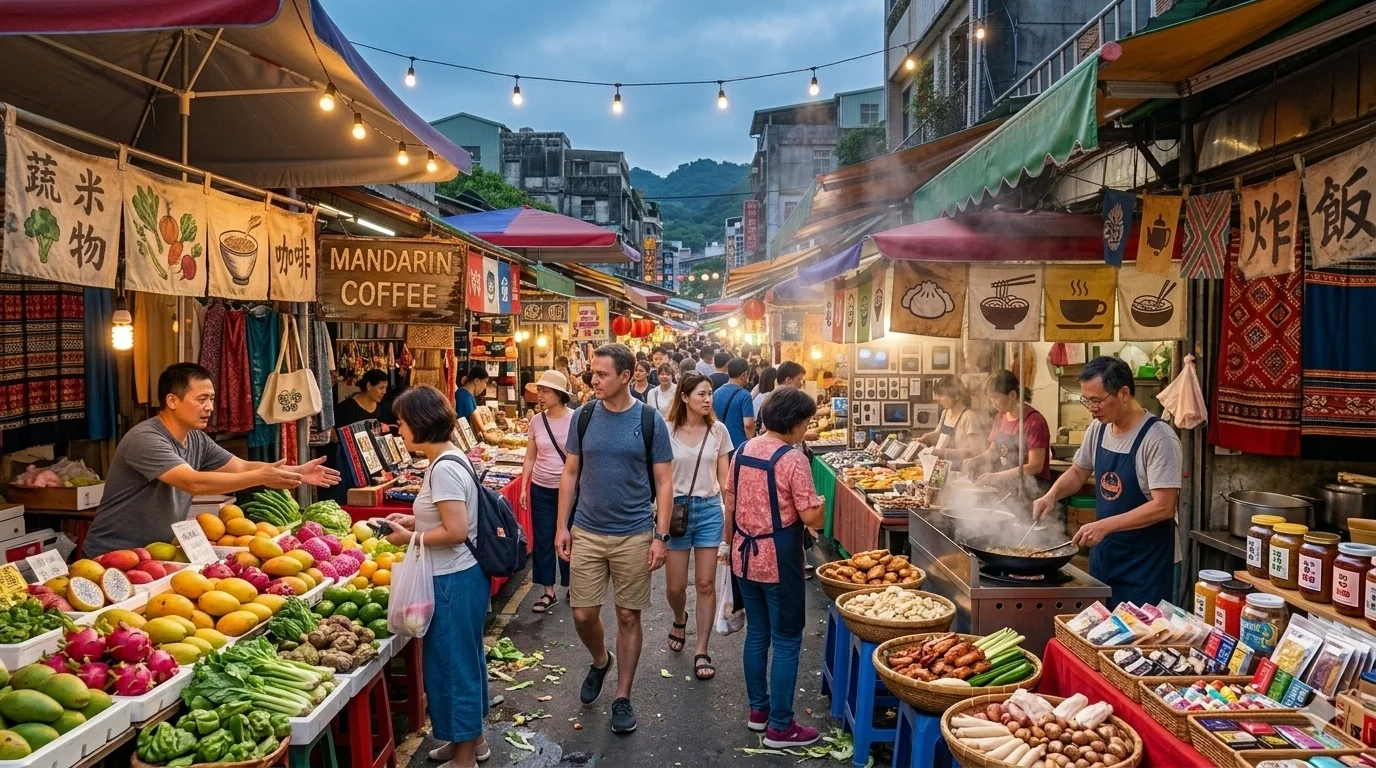
Markets in Taiwan — Night Markets, Bazaars & Street Food Guide
From the legendary Shilin Night Market in Taipei and the creative food capital of Fengjia in Taichung to the heritage lanes of Dihua Street and the seafood paradise of Liuhe in Kaohsiung — Taiwan's markets are the cultural heartbeat of the island and the single best reason to explore every city after sunset.
Taiwan's Market Culture — The Island's Living Soul
Understanding Taiwan begins at the market. Every city, every neighbourhood, every community has one — and each tells a different story.
No single experience captures the essence of Taiwan more completely than a night market. The island has over 400 night markets of varying sizes — from sprawling, internationally famous destinations drawing tens of thousands of visitors nightly to modest neighbourhood affairs where the same vendor families have been frying the same dish for three generations and every regular customer is addressed by name. Taiwan's market culture is not a tourist attraction bolted onto the country's real life — it is the real life of Taiwan, the primary arena in which the island's extraordinary food culture is created, contested, and consumed, where social bonds are maintained, where new trends emerge and old traditions are preserved side by side. For Indian travellers visiting Taiwan on a Taiwan tour package, the night markets are non-negotiable — skip them and you have missed the most important thing about the island.
The origins of Taiwan's market culture lie in the island's economic history: the period of rapid industrialisation from the 1960s to 1980s created a large urban working class that needed affordable, fast, good food close to where they lived — and the night market format (open-air, low-overhead, street-side cooking) was the perfect economic and social solution. Today the economic necessity has been replaced by cultural pride, but the essential format — the open street, the smoking grill, the shouted orders, the crowds navigating between stalls — remains unchanged. The night market experience is simultaneously deeply local and completely accessible to outsiders: no language skill is needed, prices are displayed, and the universal language of pointing at what looks good works perfectly. Complement your market visits with our guides to top beaches in Taiwan, historical places in Taiwan, and Taiwan's culture, food and festivals for a complete island picture.
Taipei Night Markets — The Capital's After-Dark Food Universe
From Shilin's scale to Raohe's charm and Ningxia's tradition — Taipei's markets cover every appetite
Taipei Night Markets
Shilin Night Market — Taiwan's Most Iconic Night Market Experience
Shilin Night Market is the name every visitor to Taiwan knows before they arrive — the most famous, most visited, and most internationally discussed night market on the island, drawing upward of 100,000 visitors on peak weekend nights. Located in Taipei's Shilin District around Jiantan MRT station (Danshui Red Line), it sprawls across two distinct zones: the indoor underground food centre beneath Shilin Market plaza (over 500 vendor stalls in an air-conditioned basement, selling every conceivable Taiwanese street food) and the outdoor street market extending through the surrounding lanes, packed with clothing stalls, carnival games, accessories, phone cases, and supplementary food vendors. The indoor food centre is where the serious eating happens: stinky tofu in four preparations, oyster omelette, deep-fried chicken cutlet the size of a dinner plate (the da ji pai — a Shilin signature that was invented here), coffin bread (guancai bing), fresh fruit smoothies, grilled corn, and dozens of vendor stalls each with a queue that tells you exactly how good the food is. For Indian travellers, the scale and energy of Shilin on a Friday or Saturday night is genuinely overwhelming in the best possible way — the combination of steam, charcoal smoke, chilli oil, and the sheer noise of thousands of people eating in contained streets creates an atmosphere unlike any other food market in Asia.
Raohe Street Night Market — Taipei's Most Atmospheric Traditional Market
Raohe Street Night Market is the market most frequently recommended to first-time visitors to Taipei by locals — not for its size (it is much smaller than Shilin, confined to a single 600-metre straight street) but for its authentic, manageable atmosphere, its concentrated food quality, and its beautiful setting with the historic Ciyou Temple (a major Mazu deity temple, almost 200 years old) framing the market entrance in red lantern light. The temple entrance is where you will find the pepper buns (hu jiao bing) — the single most celebrated Raohe food item, made by a vendor family that has operated from the same position beside the temple gate for decades. The bun is made of yeasted dough stuffed with pork mince, scallion, and a generous quantity of black pepper, then pressed against the interior wall of a charcoal-heated clay oven until the exterior is blistered and caramelised — the result is a snack of extraordinary flavour that requires both hands, a napkin, and complete attention. Beyond the pepper bun, Raohe offers excellent oyster omelettes, herbal pork ribs soup (four-herb broth with slow-cooked ribs), snake gourd pastry, and one of the better shaved ice selections in Taipei.
Ningxia Night Market — The Purist's Choice for Authentic Taiwanese Street Food
Ningxia Night Market in Taipei's Datong District is the market food critics and serious food travellers consistently cite over Shilin as the best night market for traditional Taiwanese street food quality. It is smaller, less visually spectacular, and significantly less crowded with tourists — which is precisely why its food is better. Without the distraction of carnival games and fashion stalls, Ningxia is entirely focused on food, and the vendor competition on a single street has produced some of the finest versions of classic Taiwanese dishes in the city. The oyster vermicelli (o-a-mi-sua) here — oysters in a thick, gelatinous sweet potato starch broth with vermicelli noodles, finished with black vinegar and coriander — is widely considered Taipei's best. Pork liver soup, taro balls in sweet broth, scallion pancake with egg, fried taro balls (wu xiang), spring roll (run bing) stuffed with vegetables and peanut powder — Ningxia is where the classics are executed at their highest level. The market also hosts a Saturday morning farmers market featuring organic produce from small-scale Taiwanese farms, adding a completely different dimension to the address on weekend mornings.
Huaxi Street Night Market — Old Taipei's Raw and Historic Market Lane
Huaxi Street Night Market — informally known as Snake Alley — is the oldest night market in Taipei and one of the most historically layered, located in Wanhua District (Taipei's oldest neighbourhood) immediately south of the celebrated Longshan Temple. The market achieved international notoriety in the 1970s–1990s for its exotic food culture including live snake shows, snake blood drinks, and turtle soup — practices that have largely disappeared under modern animal welfare regulations but whose memory still draws curious visitors. Today Huaxi Street is a more conventional but still atmospheric traditional Taiwanese market, with a covered arcade structure that gives it a distinctive enclosed character different from the open-air markets of Shilin and Raohe. Cantonese-influenced cooking dominates — fish congee, slow-cooked soups, braised pork, seafood dishes — reflecting the southern Chinese heritage of Wanhua's original settler population. The covered lantern-lit arcade, combined with the proximity of the ancient Longshan Temple and the time-worn character of the surrounding Wanhua streets, gives Huaxi a historical atmosphere that younger, more polished markets cannot replicate. Best visited in combination with an evening at Longshan Temple for a complete old Taipei experience. See our guide to historical places in Taiwan for context on Wanhua District's heritage.
Gongguan Night Market — The Student Market of National Taiwan University
Located adjacent to the main campus of National Taiwan University (NTU) — Taiwan's most prestigious university — Gongguan Night Market caters primarily to the student population and has the youthful energy, experimental food offerings, and excellent value that a large student clientele demands. The market is less internationally known than Shilin or Raohe but is highly regarded by residents of Taipei's southern districts. Japanese-influenced dishes (takoyaki octopus balls, ramen, Japanese-style curry) mix with Taiwanese classics (bubble tea, scallion pancakes, fried taro) and international food stalls in a casual, relaxed setting. The surrounding Gongguan commercial area has excellent bookshops, vintage clothing stores, and independent cafes that make it one of the best half-day destinations in Taipei for travellers interested in Taiwan's contemporary urban culture. The nearby Treasure Hill Artist Village (a hillside settlement turned arts community) adds a unique cultural dimension.
Jingmei Night Market — South Taipei's Relaxed Neighbourhood Market
Jingmei Night Market in Wenshan District serves one of Taipei's older residential communities and has the unhurried, genuinely local character that the larger famous markets can no longer offer. There are no tour groups here — the clientele is almost entirely local residents, and the vendor families have been operating in the same locations for decades. The market runs along Jingmei Street and extends through surrounding lanes, covering traditional Taiwanese food (braised pork rice, rice noodle soup, herbal soups), fresh produce, tofu preparations, and simple household goods. For Indian travellers staying in southern Taipei or visiting Muzha Tea Plantation or Maokong gondola (both nearby), Jingmei Night Market provides an authentic evening food experience without the crowds of the famous markets. The Jingmei riverside park adjacent to the market adds a pleasant post-dinner walking option.
Taipei Daytime & Speciality Markets
Heritage bazaars, jade trading, flower markets, and traditional shopping streets
Taipei Day Markets
Dihua Street — Taiwan's Oldest Trading Street
Dihua Street is Taipei's oldest and most historically significant commercial street — a Qing Dynasty-era trading street lined with beautifully preserved Baroque, Neo-Classical, and Minnan-style shophouses dating from the late 19th and early 20th centuries. It is Taiwan's premier destination for dried goods, traditional Chinese medicine herbs (ginseng, deer antler, dried seafood), premium tea (oolong, dong ding, ali shan), nuts and dried fruits, fabric merchants, and the packaged traditional snacks (pineapple cake, mochi, sesame brittle) that define Taiwanese food souvenir culture. Dihua Street is at its most vibrant during the weeks before Lunar New Year, when the entire street becomes a festival market for traditional holiday foods and decorations. The street's architectural character alone justifies a visit — the continuous heritage shophouse facade is one of the finest preserved 19th-century commercial streetscapes in East Asia. Our guide to historical places in Taiwan covers Dihua Street's architectural heritage in detail.
Jianguo Jade & Flower Market
The Jianguo Holiday Jade Market operates beneath the Jianguo Elevated Expressway every Saturday and Sunday, with hundreds of vendors selling jade, coral, amber, agate, crystal, lapis lazuli, and semi-precious stone jewellery, carvings, and raw stones. It is one of Asia's most significant jade trading markets and a destination for serious collectors as well as casual visitors. Immediately adjacent, the Jianguo Holiday Flower Market sells cut flowers, orchids (Taiwan is one of the world's largest orchid exporters), potted plants, bonsai, and garden supplies. Together the two markets create a remarkably civilised, unhurried market experience — the antithesis of the night market chaos — with knowledgeable vendors willing to explain the quality gradations of jade (the difference between A-grade jadeite and lower quality nephrite is substantial and not obvious to the untrained eye). Hours are approximately 9:00 AM – 6:00 PM weekends only.
Guanghua Computer Market
Guanghua Digital Plaza is Taipei's electronics and technology market — a multi-storey complex in Zhongzheng District and the surrounding streets (particularly Bade Road) densely packed with vendors selling computer components, cables, surveillance equipment, electronic accessories, second-hand smartphones, gaming peripherals, and every conceivable electronic part at prices significantly below retail. It is the destination for travellers interested in technology shopping — the selection of components, adapters, and specialist electronic items far exceeds what is available in conventional retail. Surrounding streets have many small independent shops specialising in vintage electronics, second-hand cameras, and audio equipment that attract dedicated enthusiasts. Best visited on weekday mornings when the streets are less crowded and vendors are more willing to negotiate.
Yingge Ceramics Market
Yingge — a district of New Taipei City approximately 30 minutes by train from Taipei Main Station — is Taiwan's ceramics capital, an entire town devoted to the production, sale, and display of ceramics and pottery. The Yingge Old Street is lined with over 100 ceramics shops, studios, and galleries offering everything from functional tableware and tea sets (Taiwan's tea culture demands extraordinary ceramic quality) to fine art pieces and decorative tiles. A ceramics museum of international standard displays the history and technique of Taiwan's pottery tradition. Many studios offer hands-on pottery workshops (book in advance) — making and firing a small piece to take home is one of the most popular activities for visiting families. Yingge is the best single-day trip from Taipei for anyone interested in craft, design, or shopping for genuinely high-quality handmade ceramics at fair prices.
Guangzhou Street Antique Market
Guangzhou Street in Taipei's Wanhua District hosts a sprawling antiques and collectibles market — stretching between Longshan Temple and the Bopiliao Historic Block, with vendors selling antique furniture, old coins, stamps, vintage photographs, temple paraphernalia, jade pieces of uncertain provenance, traditional wood carvings, and Chinese decorative arts spanning the Qing Dynasty and early Republican periods. The market is particularly active on weekends when additional vendors set up temporary stalls. Bargaining is expected and effective — prices are not fixed, and vendors expect negotiation as part of the social ritual of sale. Whether you plan to buy or simply browse, the combination of antique market culture and the adjacent Longshan Temple area makes this one of the most atmospheric experiences in old Taipei.
Taipei Design & Creative Markets
The Xinyi District around Taipei 101 hosts a rotating programme of pop-up design markets and creative fairs throughout the year, showcasing local Taiwanese designer brands, independent fashion, handmade jewellery, artisanal food products, and creative homeware. The most significant recurring events include the Taipei Design Festival market (October), the Huashan Creative Park market (ongoing, in the repurposed Huashan 1914 Creative Park complex), and seasonal weekend markets in the Zhongshan and Yongkang Street areas. For Indian travellers interested in contemporary Taiwanese design and local fashion, these creative markets offer a completely different shopping experience from the traditional night markets — smaller scale, curated, and focused on original design rather than mass-produced goods.
Taichung Night Markets — Taiwan's Creative Food Capital
Fengjia and its neighbours — where new food trends are invented before spreading island-wide
Taichung Markets
Fengjia Night Market — Where Taiwan's Food Trends Are Born
Fengjia Night Market is, by most metrics, the largest night market in Taiwan — covering an area of approximately 3.7 hectares with over 1,000 vendor stalls surrounding and radiating outward from Feng Chia University in Taichung's Xitun District. The market's proximity to a major university with 25,000 students has made it the most innovative food market in Taiwan — student demand for novel, affordable, Instagram-worthy food at competitive prices has driven an extraordinary culture of culinary experimentation. Food trends that now appear across Taiwan's night markets — the grilled corn cup, the cheese lobster, the stinky tofu spring roll, the honeycomb ice cream — were invented or popularised at Fengjia before spreading island-wide. The market operates on a completely different commercial logic from Taipei's more tourist-oriented markets: here, survival depends on being new and better, not on tourist footfall, producing a genuine food innovation culture. For Indian travellers visiting Taichung, Fengjia is not merely a good night market — it is an experience of food culture in real time, watching new dishes emerge and older ones gradually fade. The market is also an excellent destination for fashion shopping — the clothing and accessories stalls cater to the student market and are strong on trend-led fashion at very low prices. Include Taichung in your Taiwan itinerary to experience Fengjia.
Zhonghua Road Night Market — Central Taichung's Traditional Evening Market
Zhonghua Road Night Market is Taichung's most centrally located night market — situated along Zhonghua Road in the historic West District near Taichung Railway Station, making it the most accessible market for visitors staying in the city centre. It is smaller and less fashionable than Fengjia but has a more traditional local character — the food stalls here lean toward classic Taiwanese preparations (braised pork rice, coffin bread, oyster omelette, cold noodles) rather than Fengjia's experimental offerings, and the clientele is a mix of local families, office workers on their way home, and visitors staying in the nearby hotels. Taichung speciality foods are well represented here — including the suncake (taiyang bing, a flaky pastry filled with maltose — Taichung's most famous edible souvenir) and miyue (a local fried rice noodle dish unique to the Taichung area). The market has a pleasant, low-pressure atmosphere that makes it a good introduction to Taiwanese night market culture for visitors who find Fengjia or Shilin overwhelming on a first encounter.
Nantun Night Market
Nantun Night Market in Taichung's Nantun District is a large residential neighbourhood market that operates primarily on Thursday, Friday, and Saturday evenings. It is particularly popular with local families for its clean, well-organised layout, wide food variety, and the generous quantity of non-food vendors — clothing, household items, accessories, and children's toys — alongside the standard food stalls. Less famous than Fengjia, Nantun provides an excellent complementary experience of a more domestic Taiwanese market culture.
Bubble Tea Heritage Trail, Taichung
Taichung is the birthplace of bubble tea (boba milk tea) — invented at the Chun Shui Tang teahouse in the 1980s. The original Chun Shui Tang location near Zhongming South Road, and the competing birthplace claim of Hanlin Tea Room in Tainan, make Taichung the essential destination for bubble tea pilgrims. The Chun Shui Tang flagship on Siyuan Street serves the original recipe in a heritage setting — a cultural experience as much as a food stop. The surrounding area has numerous bubble tea museums, educational displays, and tea culture shops.
Kaohsiung, Tainan & Southern Taiwan Markets
Seafood paradise, ancient city markets, and the island's most historic bazaar culture
Southern Taiwan Markets
Liuhe Night Market — Kaohsiung's Seafood Night Market Capital
Liuhe Night Market (also romanised as Liouhe) is Kaohsiung's most famous and tourist-friendly night market — a pedestrianised street in the city centre, accessible from Formosa Boulevard MRT station (home of the extraordinary stained glass dome, one of the world's most beautiful metro stations), operating nightly from approximately 6 PM to midnight. The market's culinary identity is centred on seafood — Kaohsiung's position as Taiwan's principal port city gives it access to exceptional fresh seafood, and Liuhe's vendors exploit this fully: grilled stingray, oyster vermicelli (a slightly different preparation from Taipei's version), seafood congee, crab, squid, prawn, and the island's freshest papaya milk (fresh papaya and milk blended to order — a Kaohsiung signature available throughout the market in several competing vendors). Papaya milk at Liuhe is an experience — the competition between vendors has produced extraordinary quality, and the Kaohsiung papaya, grown in the warm climate of southern Taiwan, has a sweetness and creaminess that northern varieties cannot match. For Indian travellers on a southern Taiwan circuit, Liuhe is the essential evening market experience.
Ruifeng Night Market — Where Kaohsiung Residents Actually Eat
Ruifeng Night Market in Kaohsiung's Zuoying District is consistently cited by Kaohsiung residents as the market they prefer over Liuhe for everyday eating — it is larger, more varied, significantly less oriented toward tourists, and maintains the authentic local market character that more famous markets lose under the pressure of visitor numbers. The scale of Ruifeng is impressive — it covers a large area with a mix of food stalls, clothing and accessories vendors, and carnival-style entertainment — and the food quality is high precisely because the local clientele is discerning and the vendor competition intense. Dumplings, grilled meat, noodle soups, oyster dishes, and creative drinks fill the main food sections. The market also has a large fresh produce section in the morning (before the night market opens) — a completely different dimension from the evening food market that gives Ruifeng a genuine community market character. Best visited mid-week when the crowds are manageable and the atmosphere genuinely local.
Tainan Flower Night Market — The Ancient Capital's Great Market Tradition
Tainan — Taiwan's oldest city, the former capital of the island under Dutch and Qing rule, and the city most deeply associated with Taiwanese culinary heritage — has a market culture that reflects its historical depth. The Tainan Flower Night Market (Shengping Road market) is one of Taiwan's largest single night market events — rotating between four different locations on different days of the week (typically Thursday, Saturday, and Sunday with different venues). The scale is extraordinary: on peak nights, the Tainan Flower Night Market attracts over 50,000 visitors, with vendor rows extending hundreds of metres in every direction. Tainan food specialities are well represented throughout: coffin bread (guancai bing — invented in Tainan in the 1940s), milkfish soup (the milkfish is Tainan's signature ingredient, farmed in the city's coastal ponds for centuries), dan zai noodles (a Tainan invention — small portion of noodles in shrimp broth with pork, shrimp, and black vinegar), and shrimp rolls (xia juan) are the most distinctly Tainan street foods. The proximity to Tainan's extraordinary concentration of historic temples and colonial-era architecture makes the Flower Night Market an ideal evening conclusion to a day of historical sightseeing — read our guide to historical places in Taiwan for a full Tainan heritage itinerary.
Other Notable Markets Across Taiwan
Hsinchu, Keelung, Hualien, Taitung, and the island's most distinctive regional markets
Other Taiwan Markets
Miaokou Night Market, Keelung
Keelung Miaokou Night Market is one of northern Taiwan's most beloved local markets — centred on the Diean Temple (Laoda Gong) steps in Keelung's port district, a tight cluster of stalls that specialise in Keelung's distinctive seafood preparations: oyster noodle, tian bu la (fish cake skewers), crab congee, fresh squid, and the Keelung-specific ba wan (a large glutinous rice dumpling with pork filling in a translucent starch skin, served with sweet chilli sauce). Keelung is 40 minutes from Taipei by train, making Miaokou easily accessible as an evening excursion — the combination of the busy port atmosphere and the temple-front market setting gives it a character entirely its own.
Chenghuang Temple Night Market, Hsinchu
The Chenghuang Temple Night Market in Hsinchu (Taiwan's technology hub, home of TSMC and the Hsinchu Science Park) is one of Taiwan's oldest continuously operating night markets, centred on the 300-year-old Chenghuang City God Temple. Hsinchu's signature street foods include meatball soup (gong wan tang — using the region's distinctive local pork), rice noodles (mi fen — Hsinchu is Taiwan's rice noodle capital, with a climate and water supply uniquely suited to rice noodle production), and herbal pork offal soup. A genuinely local market in a rapidly modernising technology city — an interesting cultural juxtaposition.
Hualien & Taitung Markets
Hualien's Ziqiang Night Market — the largest market on Taiwan's scenic east coast — is the essential evening destination for visitors to Hualien and the Taroko Gorge area, with a food selection heavily influenced by the indigenous Amis and Truku communities of the east coast. Wild boar sausage, smoked pork, traditional mochi rice cakes, and daikon mochi (a savoury glutinous rice cake unique to Hualien's Japanese colonial heritage) are the distinctive local offerings. Taitung's Zhengqi Road market offers similar indigenous food culture in a smaller, more relaxed setting. Both markets connect naturally with Taiwan's east coast beaches.
Neiwan Old Street Market, Hsinchu County
Neiwan Old Street in Hsinchu County is a preserved mountain railway village — accessible by the narrow-gauge Neiwan Line tourist railway from Zhudong — that operates as a weekend market of traditional foods and crafts in a heritage setting. Wild ginger flower sticky rice (wild ginger bao), wild boar sausage, and local mountain vegetables are the food highlights. The combination of the historic railway journey, the mountain scenery, and the heritage village market makes Neiwan an excellent day-trip option for visitors to Hsinchu or northern Taiwan.
Luodong Night Market, Yilan
Luodong Night Market in Yilan County is consistently ranked as one of Taiwan's top regional night markets — notable for its exceptional quality local ingredients from Yilan's agricultural hinterland (one of Taiwan's prime rice and duck farming regions, with exceptional ducks, sausages, and smoked pork products). Luodong scallion sausage (using Sanxing township's world-famous three-star scallions, considered Taiwan's finest) is the market's most celebrated product — a grilled pork sausage wrapped in a fresh scallion and eaten standing up at the stall. Yilan's proximity to the north-east coast and its UNESCO-listed Lanyang Plain wetland ecosystem makes it an excellent slow-travel destination, and Luodong Night Market is the perfect evening conclusion to a day exploring Yilan's natural and cultural heritage.
Zhongli Night Market, Taoyuan
Zhongli Night Market in Taoyuan is one of northern Taiwan's largest and most culturally diverse markets — reflecting Taoyuan's status as the city with Taiwan's largest Southeast Asian immigrant community, particularly from Thailand, Vietnam, Indonesia, and the Philippines. Alongside standard Taiwanese street food, Zhongli has an unusually rich selection of Southeast Asian food vendors — authentic Thai curries, Vietnamese pho, Indonesian satay, Filipino desserts — that give it a multicultural character unique in Taiwan's night market scene. For Indian travellers transiting through Taoyuan International Airport, Zhongli is 20 minutes by bus and offers an excellent evening of eating before or after a flight.
Tainan Anping Old Street
Anping Old Street in Tainan is the commercial heart of Taiwan's oldest port settlement — the Dutch East India Company's Fort Zeelandia trading post, established in 1624, anchors a heritage neighbourhood of preserved Qing-era shop houses that have been converted into a daytime market of traditional snacks, local crafts, and preserved foods. Anping tofu (deep-fried tofu with a dense custard interior), shrimp rolls (xia juan), and oyster pancakes are the must-try Anping Street foods. The combination of 400-year-old colonial heritage architecture and living food market culture makes Anping one of the most distinctive market experiences in all of Taiwan.
Must-Try Street Foods at Taiwan Night Markets
A reference guide to the essential foods every visitor should seek out — with the markets where each is best.
Da Ji Pai — Giant Fried Chicken
Deep-fried chicken cutlet the size of a dinner plate, beaten flat, marinated in soy, garlic and five-spice, coated in sweet potato starch and fried until shatteringly crisp. Invented at Shilin — best eaten there, immediately from the oil, both hands required.
Hu Jiao Bing — Pepper Bun
Pork mince, scallion, and black pepper stuffed into yeasted dough and baked against a clay oven wall. Raohe's temple gate vendor is the definitive version. Always a queue; always worth it.
Chou Doufu — Stinky Tofu
Tofu fermented in a brine of vegetables and shrimp for weeks, then deep-fried or braised, served with pickled cabbage and chilli sauce. The smell announces it from 50 metres. The flavour is extraordinary. Shilin has the widest selection of preparations.
O-A-Tsian — Oyster Omelette
Small oysters folded into a batter of sweet potato starch and egg, pan-fried until half-set, served with a tangy orange chilli-plum sauce. Ningxia's version is considered the city's finest — the oysters are larger, the sauce more complex.
Bao Bing — Shaved Ice
Ultra-fine shaved milk ice — a texture closer to snow than to crushed ice — topped with fresh mango, grass jelly, azuki beans, taro balls, condensed milk, and seasonal fruit. Taiwan's most celebrated dessert. Excellent in all markets; best in mango season (June–August).
Guancai Bing — Coffin Bread
A thick slice of white bread, hollowed into a box shape, deep-fried until golden, then filled with a rich cream-based sauce of seafood or meat and vegetables. Invented in Tainan in the 1940s. The name comes from the bread's resemblance to a wooden coffin — considered lucky.
Cong You Bing — Scallion Pancake
Unleavened wheat dough rolled with scallion and sesame oil into a spiral, pan-fried until crisp and flaky, optionally with a fried egg added inside. Immediate recognition for Indian travellers — almost identical to the paratha tradition in technique and satisfying breakfast quality.
Boba — Bubble Tea
Cold tea-based drink with chewy tapioca pearls, served with an oversized straw. Invented in Taichung in the 1980s. Available everywhere; Chun Shui Tang teahouse in Taichung serves the original recipe. Taro, matcha, brown sugar milk tea, and fruit variations are the most popular.
Dan Zai Noodles
A small bowl of thin noodles in shrimp broth, topped with braised pork mince, a whole shrimp, bamboo shoots, coriander, and black vinegar. Invented in Tainan — the Degree Noodles shop on Tainan's heritage street is the original location, operating since 1895.
Ba Wan — Giant Dumpling
A fist-sized translucent starch dumpling filled with pork, bamboo shoots, and mushroom, steamed until the skin is gelatinous and glossy, served with a sweet chilli sauce. Regional specialty of central and northern Taiwan — best at Keelung Miaokou and Changhua markets.
Lu Rou Fan — Braised Pork Rice
Minced or diced pork belly braised for hours in soy sauce, rice wine, five-spice, and rock sugar until meltingly soft, served over steamed white rice with a hard-boiled egg, pickled radish, and blanched greens. Taiwan's ultimate comfort food — available at every market, excellent everywhere. Individual family recipes make each vendor's version unique.
Papaya Milk
Fresh ripe papaya blended with cold milk to a thick, smooth consistency — Taiwan's most refreshing non-alcoholic drink. Best at Liuhe Night Market in Kaohsiung, where the southern Taiwan papaya's sweetness and creaminess reaches its peak. The competing vendor stalls make quality comparison irresistible.
Ready to Eat Your Way Through Taiwan's Markets?
Our Taiwan specialists build itineraries around the best market experiences — night market walking tours, food trails, craft market visits, and Dihua Street heritage walks. India departures, visa assistance included.
Top Sights in Taiwan
Beyond the markets — Taiwan's most iconic attractions for Indian travellers.
Taipei 101 & Xinyi District
The Taipei 101 skyscraper — until 2010 the world's tallest building at 508 metres — dominates Taipei's skyline and the Xinyi financial and shopping district. The indoor observation deck on floor 89 offers the most comprehensive view of Taipei's basin geography, surrounding mountains, and urban fabric. The Xinyi District shopping malls (Taipei 101 Mall, Bellavita, ATT 4 Fun) and the area's weekend outdoor markets make this a full half-day destination.
Alishan National Scenic Area
Alishan in Chiayi County is Taiwan's most celebrated mountain destination — a high-altitude (2,200m) plateau of ancient cypress forests, Japanese colonial-era narrow-gauge railway, and the most famous sunrise viewing point in Taiwan. The sea of clouds at dawn, with the sun rising over Yushan (Taiwan's highest peak), is one of the most photographed natural spectacles in Asia. Alishan's tea (grown at altitude) is among Taiwan's finest — an essential souvenir.
Taroko Gorge National Park
Taroko Gorge — a marble canyon carved by the Liwu River through the Central Mountain Range — is Taiwan's most dramatic natural attraction: sheer cliffs of white and grey marble rising hundreds of metres above a turquoise river, traversed by a single road of extraordinary engineering audacity. Swallow Grotto, Tunnel of Nine Turns, and the Eternal Spring Shrine are the key viewpoints. Combine Taroko with Hualien's night markets and the east coast beaches for a complete eastern Taiwan circuit.
Sun Moon Lake
Sun Moon Lake — Taiwan's largest natural lake, 748m above sea level in the mountains of Nantou County — is the island's most visited inland attraction. The lake was named for its shape (the eastern half is round like the sun; the western half crescent-shaped like the moon). Cycling the lake perimeter, taking the gondola to Formosan Aboriginal Culture Village, and sampling the Sun Moon Lake speciality tea (ruby red tea, grown exclusively in this microclimate) are the key experiences.
Longshan Temple & Wanhua District
Longshan Temple in Wanhua — Taipei's oldest district — is the city's most important place of worship: a 1738-established temple of extraordinary architectural complexity, with multiple deity shrines, elaborately carved stone columns, and a constant haze of incense smoke from hundreds of daily worshippers. Wanhua's surrounding streets contain Bopiliao Historic Block, Huaxi Street Night Market, Guangzhou antiques market, and the city's oldest urban fabric. A complete half-day cultural immersion, best explored in the guide to historical places in Taiwan.
Jiufen Old Street
Jiufen — a former gold-mining village on a steep hillside north of Taipei — is Taiwan's most photogenic heritage market town, with narrow stone staircases, traditional teahouses, red lanterns, and mountain and sea views of extraordinary beauty. Jiufen Old Street (Jishan Street) is a dense market of traditional snacks (taro balls, mochi, peanut candy), crafts, and teahouses. The Amei Teahouse, perched over the hillside, offers one of Taiwan's most memorable eating environments. Best visited on a weekday afternoon — weekend crowds are severe.
10 Tips for Taiwan Night Market First-Timers
Click each panel to expand. Practical guidance for Indian travellers visiting Taiwan's markets.
Always Carry New Taiwan Dollars in Cash
The vast majority of individual night market vendor stalls are cash-only — credit cards, UPI, and international payment apps are not accepted. Carry sufficient NTD in small denominations (50 and 100 dollar notes are ideal — most food items cost between NTD 50–150). ATMs accepting foreign Visa and Mastercard are available near all major markets and at 7-Eleven and Family Mart convenience stores, which are ubiquitous throughout Taiwan. Exchange Indian Rupees to NTD at Taoyuan Airport arrivals hall for the best rate.
Arrive at 5:30–6:30 PM — Not 9:00 PM
The most common visitor mistake is arriving at a night market too late. Markets are at their best from approximately 5:30 PM to 8:00 PM — vendors are freshest, queues are shorter, the best items have not sold out, and the atmosphere is building rather than at peak-crowd saturation. Arriving at 9:00 PM means competing with the maximum number of people for the same food. Shilin on a Friday night at 9:00 PM with 80,000 visitors is impressive but exhausting — the same market at 6:30 PM is manageable and more enjoyable. The exception is Raohe's pepper bun — the queue forms from opening regardless of arrival time.
Pork is Everywhere — Know What to Ask
Pork is the default protein in Taiwan's food culture — it appears in dishes that are not obviously meat-based, including soups, sauces, fried rice, and vegetable stir-fries cooked in lard. For Hindu travellers avoiding beef, beef is less common than pork but present — noodle soups are the most likely beef-containing dish. For Muslim travellers, halal food is rare at standard night markets — Zhongli's Southeast Asian food section has the best halal options near Taipei. The phrase "wo bu chi zhu rou" (我不吃猪肉) — "I do not eat pork" — is the most useful phrase to memorise for dietary navigation. Many vendors will helpfully confirm or suggest alternatives.
Queue Length is the Only Review You Need
In Taiwan's night market culture, queue length is the most reliable quality indicator available — local Taiwanese are discerning eaters, and a stall without a queue is telling you something. If you see a queue of 15+ people at any stall, join it without hesitation — the food will justify the wait. The pepper bun vendor at Raohe temple gate, the da ji pai stalls at Shilin, and the oyster vermicelli specialists at Ningxia all have permanent queues for good reason. Conversely, do not be drawn to stalls with attractive photos and no queue — they exist for tourists who have not yet learned this rule.
Share Portions — Try More, Waste Nothing
The optimal night market eating strategy is maximum variety in minimum volume — share everything, order one portion of many things rather than two portions of fewer. Night market portions are typically sized for a single standing eater but are often shareable between two people. Going with a companion of 3–4 people dramatically improves the experience — you can try 15–20 different items across an evening's walk rather than being full after the first four stalls. Keep a mental note of everything you have eaten — the temptation to revisit a particularly good stall at the end of the evening is high, and knowing where it was requires attention during the walk.
Buy Packaged Food Souvenirs at Markets, Not Airports
The best Taiwan food souvenirs — pineapple cake (feng li su), sun cakes (taiyang bing, from Taichung), bubble tea kits, high-mountain oolong tea, and sesame nougat — are available at markets, particularly Dihua Street and the souvenir sections of all major night markets, at significantly lower prices and better quality than airport duty-free shops. Dihua Street's heritage food shops offer the widest variety of traditionally produced Taiwanese foods for gifting. Buy a vacuum-sealed bag of Sanxing scallion sausage from Luodong or Yilan market — it travels well and produces the most surprised reactions from recipients who have never tasted it.
Taiwan's MRT Makes Every Market Accessible
Taipei's MRT (Mass Rapid Transit) system is one of the cleanest, most punctual, and most user-friendly metro systems in Asia — and it conveniently serves most of Taipei's major night markets. Shilin: Jiantan Station (Red Line). Raohe: Songshan Station (Green Line). Ningxia: Shuanglian Station (Red Line). Huaxi Street: Longshan Temple Station (Blue Line). Gongguan: Gongguan Station (Green Line). The MRT EasyCard (available at all station machines) works across metro, buses, and some convenience store payments — it is the single most useful item for any Taiwan visitor and should be purchased on arrival at Taoyuan Airport MRT station.
Do Not Bargain for Food — Respectful Negotiation for Goods
Food stalls at Taiwan night markets do not negotiate on price — the price displayed is the price, and attempting to bargain for food is considered rude. This is different from the bargaining culture of Southeast Asian markets and is a source of occasional friction for visitors from bargaining-culture backgrounds. For non-food items — clothing, accessories, craft goods — a polite, low-key request for a small discount (5–10%) is sometimes successful, particularly if you are purchasing multiple items from the same vendor. The approach should always be friendly and indirect — aggressive bargaining is as unwelcome here as at food stalls. Night market clothing prices are already extremely low, making aggressive negotiation both unnecessary and counterproductive.
Vegetarian and Vegan Navigation at Night Markets
Taiwan has one of Asia's strongest vegetarian food cultures — a legacy of Buddhist practice, with approximately 10% of the population following some form of vegetarian diet. This means vegetarian (su shi) options are available at most night markets, though they may not be immediately obvious. Look for the Chinese character 素 (su) on signs — this indicates vegetarian food. Oyster mushroom preparations (replacing oysters in omelettes), tofu in multiple preparations, vegetable scallion pancakes, sweet potato congee, fruit-based shaved ice, taro ball desserts, and bubble tea are reliably meat-free. The Longshan Temple area near Huaxi Street has several dedicated vegetarian restaurants catering to the temple's Buddhist visitors — an excellent option for a full vegetarian dinner after market browsing.
Best and Worst Times to Visit Taiwan's Markets
Taiwan's night markets operate year-round, but the experience varies significantly by season. October to December is the optimal period — cooler temperatures (18–25°C in Taipei), lower humidity, and the harvest season's fresh produce make this the most comfortable and food-rich time. Spring (February–April) is also excellent, with mild weather and Lunar New Year market culture in February. Summer (June–August) is hot and humid (30–35°C with 80%+ humidity) — evenings are still comfortable enough for market visits, and mango shaved ice season in summer is reason enough to visit despite the heat. Typhoon season (July–October) can occasionally close markets at short notice — check weather forecasts during this period. Winter (December–February) in northern Taiwan can be surprisingly grey and cool, but Kaohsiung and Tainan remain warm and sunny throughout.
Plan Your Taiwan Market & Food Tour
Night market walking tours, Dihua Street heritage walks, Yingge ceramics day trips, Jiufen evening visits, and complete Taiwan island itineraries — our specialists plan everything from India. Fields marked * are required.
Markets in Taiwan — 15 Frequently Asked Questions
Detailed answers for Indian travellers planning to visit Taiwan's night markets and bazaars.
Shilin Night Market in Taipei's Shilin District is the most famous night market in Taiwan — internationally recognised, appearing in virtually every Taiwan travel guide, and drawing upward of 100,000 visitors on peak weekend nights. It earned this reputation through a combination of sheer scale (two distinct zones — an indoor food centre with 500+ stalls and an extensive outdoor shopping district), food diversity (every major Taiwanese street food is available here), accessibility (a 2-minute walk from Jiantan MRT station on the Red Line), and the concentrated energy of having the island's most celebrated food vendors competing in proximity. The da ji pai — the enormous deep-fried chicken cutlet the size of a dinner plate that is now reproduced in night markets across Taiwan and in Taiwanese restaurants worldwide — was invented and popularised at Shilin. For Indian travellers on their first Taiwan visit, Shilin is the right starting point: its scale is genuinely impressive, its food covers every major category of Taiwanese street cuisine, and the atmosphere of a major night market in full swing is one of the most memorable experiences the island offers. That said, experienced Taiwan visitors often prefer Raohe for traditional atmosphere or Ningxia for food quality — Shilin's fame has made it more tourist-oriented than these alternatives. Explore the full range with our Taiwan tour packages.
For a first-time visitor, the most important foods to try at a Taiwan night market — roughly in priority order — are: (1) Da ji pai (giant fried chicken cutlet) at Shilin — the defining night market food, enormous, crisp, flavourful, eaten standing; (2) Hu jiao bing (pepper bun) at Raohe — queue at the temple gate, worth every minute of waiting; (3) Oyster omelette (o-a-tsian) — the orange sauce, the chewy starch, the briny oysters; (4) Boba milk tea — the original, in Taiwan, is genuinely different from any boba you have had elsewhere; (5) Stinky tofu — the smell is formidable, the taste is extraordinary; do not let the smell stop you; (6) Shaved ice (bao bing) — particularly with fresh mango in season (June–August); (7) Lu rou fan (braised pork rice) — Taiwan's ultimate comfort food. For Indian vegetarians, focus on the scallion pancake, tofu preparations, fruit shaved ice, bubble tea, taro ball desserts, and any stall displaying the 素 (su/vegetarian) character. The single most important advice: eat small portions and keep moving — overfilling on the first three stalls is the universal mistake.
The majority of Taiwan's major night markets are open every day of the week — this is one of the most convenient aspects of Taiwan's market culture compared to Southeast Asian equivalents that often operate on specific days only. Shilin, Raohe, Ningxia, Fengjia, Liuhe, and most large city night markets operate daily, typically opening between 5:00–6:00 PM and closing between midnight and 2:00 AM (later on Fridays and Saturdays). However, some important exceptions apply: the Jianguo Jade and Flower Market operates Saturday and Sunday only; the Tainan Flower Night Market rotates between locations on specific days (currently Thursday, Saturday, and Sunday — confirm locally); several smaller neighbourhood markets have fixed weekly operating days. The markets in the list above are all daily operations unless specifically noted as weekend-only. Always check locally before making a special trip to a specific market — operational schedules can change seasonally or due to public holidays.
Taipei's MRT (Mass Rapid Transit) system is excellent — clean, punctual, English-signposted, and covering virtually every major tourist destination in the city. The key market MRT stations are: Jiantan Station (Red/Danshui Line) — Shilin Night Market (2-minute walk); Songshan Station (Green/Wenhu Line) — Raohe Street Night Market (5-minute walk from exit 5); Shuanglian Station (Red Line) — Ningxia Night Market (8-minute walk); Longshan Temple Station (Blue Line) — Huaxi Street Night Market and Guangzhou Antique Market (3-minute walk); Gongguan Station (Green Line) — Gongguan Night Market (direct exit); Jingmei Station (Green Line) — Jingmei Night Market (3-minute walk). Purchase an EasyCard (available at all MRT ticket machines, NTD 100 deposit) — it works on MRT, buses, YouBikes, and some convenience store purchases, and is the most convenient payment method for all public transport in Taipei. For Taichung's Fengjia Night Market, take the Taiwan High Speed Rail to Taichung and then a taxi or bus (30 minutes from HSR station).
Fengjia Night Market in Taichung's Xitun District is Taiwan's largest night market by vendor count (1,000+ stalls), covering 3.7 hectares around Feng Chia University. What makes it special is not just its scale but its role as the creative engine of Taiwan's night market food culture — the student population of 25,000+ from the adjacent university has driven an extraordinary culture of food innovation at Fengjia over the past three decades. Virtually every food trend that has spread across Taiwan's night markets in recent years — the cheese lobster, the spiral-cut grilled potato, the honeycomb ice cream, the grilled corn cup, the oversized bubble tea variations, the loaded fries — originated or was popularised at Fengjia before going national. The market operates on Darwinian commercial logic: in a market catering primarily to local students rather than tourists, survival requires continuous innovation, and this produces a dynamism absent from more famous but more tourist-dependent markets. For Indian travellers visiting Taichung, Fengjia is not an optional extra but a required destination — the experience of watching Taiwan's food culture in active creative evolution is something no other market provides. Combine it with a visit to Taichung's Chun Shui Tang (birthplace of bubble tea) for a complete Taichung food culture experience on a Taiwan tour package.
Dihua Street in Taipei's Datong District is Taiwan's oldest surviving commercial street — a Qing Dynasty-era trading lane lined with beautifully preserved late 19th and early 20th-century shophouses in Baroque, Neo-Classical, and southern Fujian (Minnan) architectural styles, now protected as a heritage precinct. It is absolutely worth visiting, particularly for travellers interested in authentic Taiwanese food products and heritage architecture rather than the fried-food and carnival atmosphere of night markets. Dihua Street is the best place in Taiwan to buy: premium oolong and high-mountain teas (the shop owners will take 20 minutes explaining the differences if you show interest); dried pineapple and fruit products; traditional Chinese medicine herbs (ginseng, astragalus, wolfberries, dried mushrooms); sesame brittle and traditional confectionery; premium pineapple cakes (feng li su — the definitive Taiwan souvenir — in their best artisanal versions, not the mass-produced airport variety); and high-quality dried seafood. The street is also significant for its fabric merchants — Dihua has historically been Taipei's garment district, with fabric and haberdashery shops occupying the upper floors of the heritage buildings. Best visited on a weekday when crowds are light; at its most atmospheric in the weeks before Lunar New Year, when the entire street becomes a traditional holiday market.
Taiwan's night market street food is among the safest in all of Asia for visiting travellers — this is not marketing language but an objective assessment based on Taiwan's food safety regulatory environment and practical market operation. Taiwan's Food and Drug Administration conducts regular hygiene inspections of market vendors; the penalty for failing inspection is immediate closure and significant fines; the result is a baseline of cleanliness and food handling standards significantly above most regional comparators. The high food turnover at popular stalls (the best chicken cutlet vendors sell several hundred portions per evening) means ingredients are always fresh and nothing sits unrefrigerated. Water quality in Taiwan is excellent — ice in drinks is safe, and tap water, while not universally drunk straight, is safe by any food safety standard. The primary risk factor for Indian travellers is not hygiene but dietary content — pork is ubiquitous and appears in unexpected dishes; MSG is used extensively and some people react to it; seafood allergies can be difficult to communicate in a fast-paced market environment. Carry a printed card in Chinese indicating any serious allergies — our travel team can provide these. Overall, Indian travellers can eat confidently at Taiwan's night markets with the same relaxed approach they would take to food safety in Japan or Singapore.
The best Taiwan market souvenirs divide into edible and non-edible categories. Edible souvenirs (the most valued in Taiwan's gift culture): premium pineapple cake (feng li su) — buy from artisan shops on Dihua Street or established confectionery brands rather than airport versions; sun cake (taiyang bing) from Taichung — a flaky maltose-filled pastry that is Taichung's signature food souvenir; high-mountain oolong tea (from Alishan or Li Shan — ask for specific origin, not blended); Sanxing scallion sausage from Luodong or Yilan markets (vacuum-packed, travels well); dried mango and pineapple from any night market; sesame nougat (niu ga tang). Non-edible souvenirs: jade jewellery from Jianguo Jade Market (buy only from vendors who will show a certificate of grade); ceramics and tea sets from Yingge Old Street; handmade leather goods from the Huashan Creative Park market; indigenous craft items from Hualien and Taitung markets (woven textiles, carved wood, traditional jewellery from Amis community artisans). The single most important advice: buy edible souvenirs at their city of origin rather than at airport shops — quality is higher and prices are 30–50% lower.
Bubble tea (boba milk tea, zhen zhu nai cha in Mandarin) is a cold tea-based drink with chewy tapioca pearls (boba — the large black pearls made from cassava starch and brown sugar that sit at the bottom of the cup) served with an oversized straw wide enough to suck up the pearls alongside the drink. It was invented in Taiwan in the 1980s — the most widely accepted origin story credits Liu Han-Chieh at the Chun Shui Tang teahouse in Taichung, who began serving cold tea in the 1980s (adapting a style he had observed in Japan), and whose employee Lin Hsiu Hui added tapioca pudding balls to a cold milk tea during a staff meeting in 1988 — the combination became an immediate hit and spread rapidly across Taiwan. A competing origin claim comes from Tu Tsong-he of Hanlin Tea Room in Tainan, who claims to have created a similar drink at approximately the same time using white (rather than black) tapioca pearls. Taiwan's sub-tropical climate created perfect conditions for the cold drink market; the country's existing pearl tapioca industry (used in desserts) provided the key ingredient; and the island's tea culture — one of the world's finest — supplied the quality base. Today bubble tea is a global NTD 3 trillion industry, but the original in Taiwan — particularly at Chun Shui Tang in Taichung — tastes genuinely different and better than any international version.
The Jianguo Holiday Jade Market under the Jianguo Elevated Expressway in Taipei is one of Asia's largest jade trading markets, operating every Saturday and Sunday with several hundred vendors selling jade, coral, amber, agate, lapis lazuli, crystal, and semi-precious stone jewellery and carvings. Whether to buy jade there requires understanding Taiwan's jade market clearly. Quality varies enormously: the market has genuine high-grade jadeite jewellery from Myanmar (the most valuable type of jade, with a deep translucent green and very high price), lower-grade nephrite jade (less translucent, more opaque, significantly cheaper), and items that are jade in name but are actually dyed quartzite or glass — visually similar to untrained eyes but worth a fraction of the price. How to navigate this safely: buy only from vendors who will provide a written certificate identifying the jade grade; ask specifically whether the item is Grade A jadeite (untreated natural jadeite — the highest quality), Grade B (bleached and polymer-impregnated jadeite — lower quality, lower price), or nephrite; use a UV light (many vendors carry them) to check for unnatural fluorescence that indicates treatment. For serious jade purchases, buy from vendors in the covered section of the market who have been operating at the same stall for years and have an established reputation. The adjacent Jianguo Flower Market is entirely safe for casual shopping — Taiwan's orchid quality is world-class and prices are excellent.
For families with children, the best Taiwan night market experience balances food variety, manageable crowds, safety, and the entertainment elements that engage younger visitors. Raohe Street Night Market is the top recommendation for families — its linear 600-metre single-street format means children cannot get lost, the food variety covers all ages, and the Ciyou Temple entrance (with its dramatic red lantern lighting and incense ceremony) is immediately engaging for children as a visual spectacle. The Luodong Night Market in Yilan (if visiting the northeast coast) is also highly family-friendly — larger grounds, many non-food entertainment stalls (carnival games, light-up toys, goldfish scooping games), and excellent local sausages and mochi that children universally enjoy. Fengjia in Taichung has extensive carnival-game sections that children love, though the crowds on weekend nights can be overwhelming for young children. The indoor Shilin food court is actually one of the safer family options within Shilin — the basement air-conditioned format keeps children from overheating in summer and the clearly defined stall areas reduce the confusion of the outdoor market. For the youngest children (under 5), any market visit should be kept to 90 minutes maximum in the early evening hours before peak crowds arrive.
Stinky tofu (chou doufu in Mandarin) is fermented tofu — fresh tofu that has been submerged in a brine solution of fermented vegetables, shrimp, and sometimes specific bacteria cultures for anywhere from a few days to several months, producing a characteristic pungent odour that many first-time encounters find alarming. It is one of Taiwan's most iconic and culturally significant foods, and the smell-to-taste discrepancy is enormous: the smell suggests something deeply unpleasant, while the flavour — when the tofu is well-prepared and fresh from the oil — is rich, complex, and deeply satisfying, with the fermentation adding an umami depth that plain tofu lacks entirely. Should you try it? Absolutely yes — it is the quintessential Taiwan night market experience, it is genuinely delicious, and the story of overcoming the smell to discover the flavour is one every Taiwan visitor carries home. The recommended preparation for first-timers is deep-fried (not braised) stinky tofu, which gives the exterior a crisp crust that moderates the smell and provides textural contrast — served with pickled cabbage and chilli sauce, it is one of the most satisfying street foods in Asia. Shilin has the widest selection of stinky tofu preparations; Raohe has a particularly reliable vendor near the temple gate.
Taiwan's night markets and day markets serve complementary functions in the island's food and commercial culture. Night markets (ye shi) are the more famous format internationally — primarily food-focused, open in the evening from approximately 5 PM to 1 AM, combining hot-food stalls with fashion, accessories, carnival games, and entertainment in a high-energy street setting. They are both the primary venue for street food culture and the dominant social gathering space for Taiwanese urban communities in the evening. Day markets (cai shi) are quite different in character — they are primarily fresh food markets operating in the morning (approximately 6 AM to noon), selling fresh produce, meat, fish, tofu, preserved foods, dried goods, and household items to local residents doing their daily shopping. Day markets have less tourist appeal but give a deeper picture of how Taiwanese households actually eat and live — the ingredient quality at a good Taiwanese wet market is extraordinary, particularly the seasonal vegetables, fresh tofu made on-site, and live seafood. Speciality markets — the Jade Market, Yingge Ceramics Street, Dihua Street heritage shops, the Guangzhou antique market — are neither night nor day markets in the conventional sense but commercial districts or periodic markets organised around a specific product category. For Indian travellers seeking comprehensive market understanding, a morning at a local wet market combined with an evening at a night market provides the fullest picture of Taiwan's market culture.
Kaohsiung's market scene extends well beyond Liuhe Night Market for visitors who have more than one evening in the city. Ruifeng Night Market in Zuoying (accessible by MRT Red Line to Houyi Station) is the authentic local alternative — larger, more varied, and almost entirely local clientele. The Kaohsiung Farmers Market near Zuoying operates weekend mornings with excellent fresh produce from southern Taiwan's agricultural hinterland — particularly tropical fruits (wax apple, mangosteen, starfruit, guava) that are not easily available in northern Taiwan's cooler climate. For day trips from Kaohsiung, Meinong (45 minutes by bus into the inland hills) is a Hakka agricultural town with a famous paper umbrella craft tradition and a weekend market of Hakka traditional foods — lei cha (pounded tea rice porridge), pan-fried rice cakes, and dried tofu. Cijin Island (connected to Kaohsiung by ferry, 10 minutes) has a seafood street market along the main road facing the harbour — some of the freshest grilled and steamed seafood available anywhere in southern Taiwan, with the visual backdrop of Kaohsiung's container port operations. The combination of Liuhe in the evening, Ruifeng mid-week, and a Cijin seafood lunch covers Kaohsiung's market culture comprehensively for a 3–4 day stay.
No — Mandarin language skill is not required to navigate Taiwan's night markets, and this is one of the most welcoming aspects of the experience for international visitors. The universal language of pointing at what looks good works perfectly in night market settings — most vendors display photographs, have samples visible, and are experienced with non-Mandarin speakers. Prices are almost always displayed on signs or digital boards. The payment process — vendor shows price on calculator or holds up fingers indicating amount, visitor pays in cash — requires no language. That said, a few key phrases provide significant practical advantage and are enormously appreciated by vendors: yi ge / liang ge (one / two — for ordering quantities); duo shao qian (how much); xie xie (thank you); wo bu chi zhu rou (I don't eat pork — critical for dietary navigation). English is spoken at varying levels throughout Taiwan — university-educated vendors in tourist-area markets often have functional English; older vendors in traditional neighbourhood markets may have none. Taiwan's younger generation, particularly in the university-adjacent markets like Fengjia and Gongguan, typically has good English. The Google Translate camera function on a smartphone is the single most useful language tool for night market navigation — pointing the camera at a menu sign instantly translates the Chinese characters, making every stall's offering immediately comprehensible.
Continue Exploring Taiwan
Related guides and resources from RTH World Tour Packages.
Top Beaches in Taiwan
Kenting, Fulong, Baishawan, Green Island and more — the best coastal destinations on the island.
Read Beaches Guide →Historical Places in Taiwan
Longshan Temple, Dihua Street, Fort Zeelandia, Jiufen and Taiwan's most important heritage sites.
Read Heritage Guide →Culture, Food & Festivals of Taiwan
Taiwanese food traditions, Lantern Festival, Dragon Boat, temple culture and culinary heritage.
Read Culture Guide →Taiwan Tour Packages from India
Custom itineraries — night market tours, island circuits, east coast, Alishan and more.
Browse Taiwan Packages →Custom Taiwan Itinerary
Our specialists design personalised Taiwan tours from any Indian city — visa assistance included.
Plan My Trip →Asia Travel Blog
Destination guides, trip reports, travel news, and seasonal inspiration across Asia.
Read Blog →Your Taiwan Night Market Adventure Awaits
Shilin · Raohe · Fengjia · Liuhe · Dihua · Jiufen · Yingge — all in one island itinerary from India
Share Your Taiwan Market Experience
Have you visited Shilin, Raohe, or Fengjia? Which market was your favourite? Share your tips and questions below.
