
In This Guide
One of the Most Breathtaking Urban Views in Asia
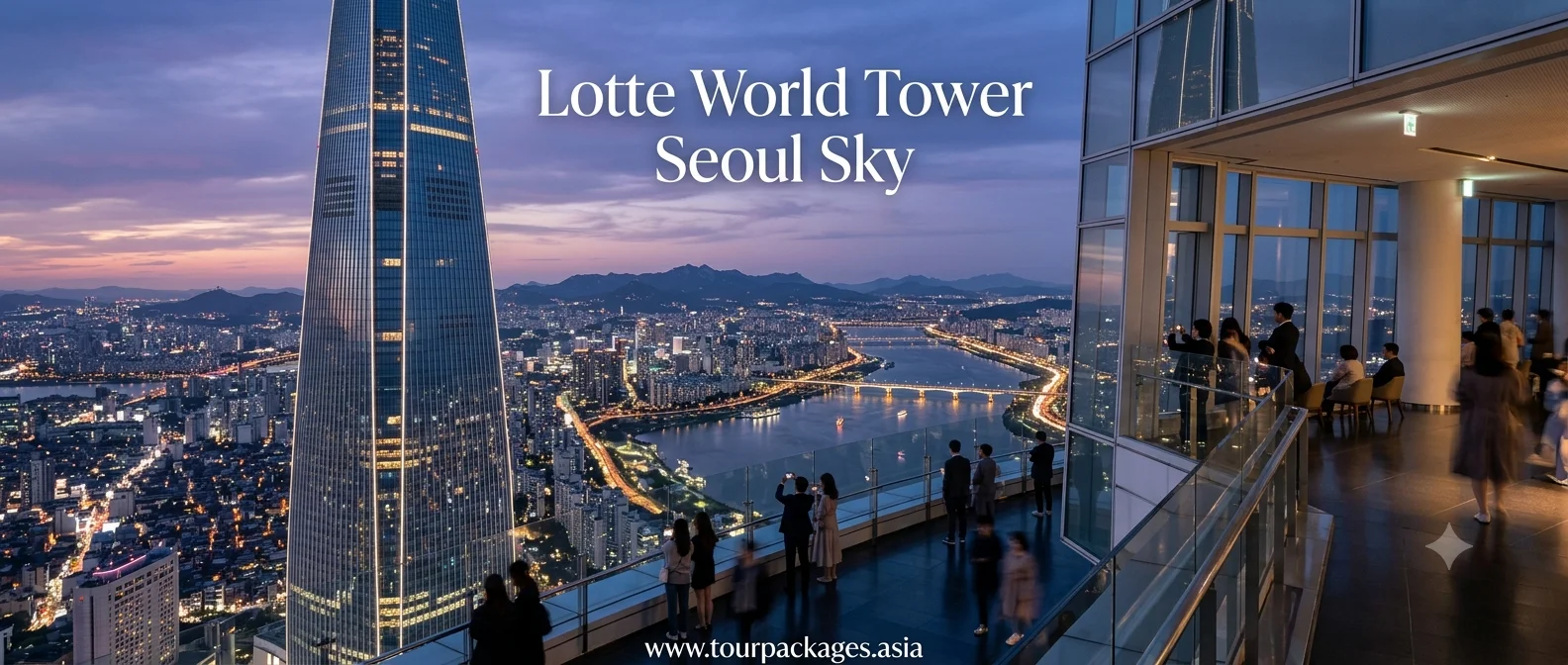
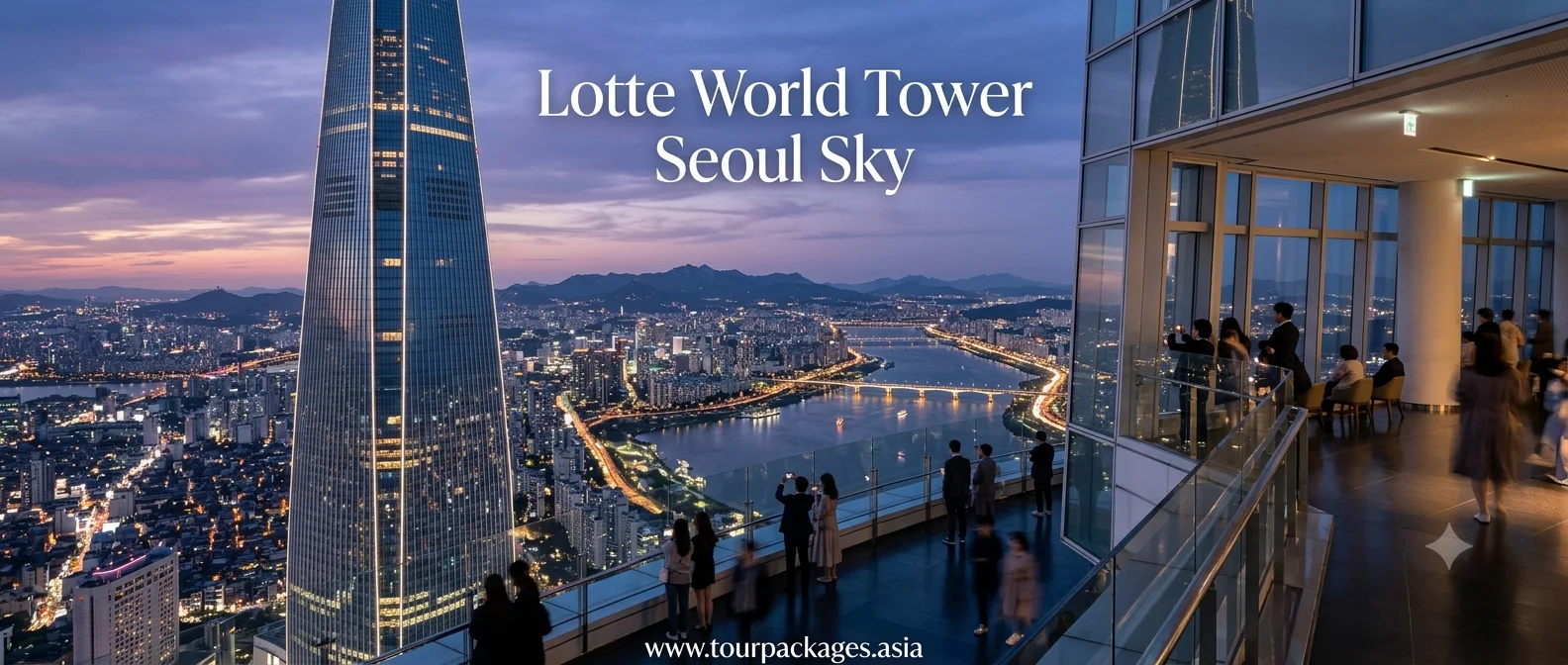
At over 500 metres high, Seoul Sky is not just an observation deck — it is one of the most breathtaking urban views in Asia, and I say that having stood on the observation decks of the Tokyo Skytree, the Burj Khalifa, and the Taipei 101. What separates Lotte World Tower Seoul Sky from the others is not simply height. It is Seoul itself — the particular way the city expands in every direction below you, interrupted by the great silver sweep of the Han River and ringed by wooded mountains that you somehow did not expect to see from inside one of Asia's most modern capitals.
The Lotte World Tower stands at 555 metres in the Jamsil district of Songpa-gu, making it the tallest building in South Korea and the sixth tallest in the world at the time of its completion. Seoul Sky occupies floors 117 through 123, with observation areas ranging from 472 to 498 metres above the streets — the fifth highest observatory in the world. For any traveller seriously asking about things to do in Seoul, this belongs near the top of the list, but not without knowing the specifics that determine whether it delivers or disappoints.
This guide is based on a direct visit. The ticket price, the wait, the glass floor, the view in daylight versus after dark, and the honest verdict on whether the experience justifies the cost — all of it is here, without the postcard gloss.
My Visit to Seoul Sky — Arrival to Summit
Getting there is straightforward in a way that earns Seoul genuine credit as a city built for visitors. I took Line 2 to Jamsil Station, walked through the underground passage directly into Lotte World Mall without ever surfacing to street level, followed the Seoul Sky signage through the basement concourse, and was at the B1 ticketing lobby within ten minutes of leaving the platform. No taxis, no navigation apps, no confusion.
I had booked my Seoul Sky tickets online in advance, which matters more than many guides emphasise. At the counter, visitors with online bookings exchange their e-tickets for physical entry tickets and proceed directly to the security check. I watched the walk-in queue extend well past 45 minutes on a weekend afternoon while I spent about four minutes at the exchange desk. The difference in experience — particularly if you are targeting a specific sunset window — is significant.
After security (no food, drinks, large bags, or glass bottles beyond this point — lockers available in Lotte World Mall), you enter the media art exhibition in the basement levels, which functions as a genuinely well-designed holding area that frames the main event rather than simply making you wait.
The Sky Shuttle Elevator — A Experience in Itself
The Sky Shuttle is described as the world's fastest double-deck elevator, and the numbers support that claim — it travels at 10 metres per second and carries visitors from the ground floor to the 118th floor in approximately 60 seconds. But the physical sensation alone is not what makes the ride memorable.
When the doors close, the four interior walls of the elevator transform into a continuous 3D video display. The sequence begins with a scene from ancient Seoul — traditional architecture, narrow streets, the kind of imagery you might see in a history documentary. Then the perspective shifts and begins to move, sweeping across the city's landscape, accelerating through its decades of transformation, past the Han River bridges and the construction cranes and the expanding skyline, until the scene centres on the plot of land in Jamsil where the Lotte World Tower now stands. The tower's construction then begins — a time-lapse of its rise from foundations to summit — and the doors open exactly as the building reaches its current height, placing you simultaneously in the animation and at the real top of the structure.
It is clever in the way that the best theme park experiences are clever: the technology serves the narrative, and the 60 seconds passes before you have finished processing it. Whatever mild anxiety some visitors carry about fast elevators is efficiently displaced by paying attention to the ceiling.
First View from the Top — Seoul Skyline & Han River
The 117th floor is where most visitors spend their first moments adjusting to the reality of being 472 metres above the ground. The floor-to-ceiling windows are enormous but the ceiling height is modest, and the instinct of most visitors — including mine — is to move fairly quickly to the escalator leading up to 118F, which is where the visual experience genuinely opens up.
The view on a clear day extends in every direction with a completeness that is genuinely difficult to convey without actually standing there. To the west, the Han River dominates — wider than I expected when seen from this elevation, a broad silver ribbon cutting through the city and catching the light differently at each hour. The Gangnam district spreads south of it, a dense grid of towers and streets that was a swamp less than sixty years ago and is now one of the most expensive districts in Asia. North of the river, the mountains become visible in a way the city does not prepare you for — Namsan, Bukhansan, Dobongsan — forested ridges ringing the capital and making it feel, surprisingly, like a city built inside a natural bowl rather than simply spread across a plain.
The Seoul night view is the experience most people come for, and it earns the reputation. When the city lights come on — and in Seoul they do so comprehensively, a million windows and streets and signs igniting almost simultaneously at dusk — the Han River becomes a dark channel running through a field of light that stretches to every horizon. This is the image that justifies the trip, and the best way to see it is to arrive in daylight and still be on the deck as it happens.
The Glass Floor Sky Deck — Is It Scary?
The Sky Deck on 118F holds the Guinness World Record as the highest glass-floored observatory in the world. The panels are visibly thick, structurally sound, and treated with an anti-slip coating. Knowing this does not entirely prevent your nervous system from registering something unusual when you step onto what is, perceptually, nothing between you and the streets 478 metres below.
For most visitors, the glass floor is a thrill rather than a fear. The experience is brief — you step out, look down through the panel, feel the faintly vertiginous sensation of seeing cars and pedestrians at a scale that makes them look like something from a satellite image, take your photos, and step back to solid flooring. People with acute acrophobia may find it genuinely distressing and should be aware that there is no requirement to step onto the glass panels — the surrounding viewing area offers identical panoramic views from solid floor.
Children find it exciting rather than frightening, almost uniformly. Adults are more divided. The experience lasts about 90 seconds for most people but generates a disproportionate number of the visit's best photographs.
Floor-by-Floor Guide to Seoul Sky
Ticketing Lobby & Media Art Exhibition
The entry point, security check, and a well-designed media art exhibition covering Korean history and culture. This zone effectively reframes a potential queue as a genuine pre-visit experience.
Sky Show & Main Arrival Floor
First observation level after the Sky Shuttle. Floor-to-ceiling windows, introductory media presentation (Sky Show). Most visitors move quickly upward via escalator.
Sky Deck — Guinness Record Glass Floor
The primary observation level. Holds the Guinness World Record as the highest glass-floored observatory in the world at 478 metres. 360-degree panoramic windows, glass floor panels, and the best overall viewing position in the tower.
Sky Friends Cafe & Seoul Sky Cafe
Two-level cafe zone with dessert menu, coffee, and window-side seating. Among the highest cafes in Asia — the views are included in the price of a coffee. Genuinely recommended for slowing down and spending time with the panorama.
Sky Terrace — Outdoor Deck
Open-air outdoor observation terrace at 486 metres. The wind here is constant and the cold (especially in autumn and winter) is sharper than expected. Offers unobstructed outdoor photography. Subject to closure in severe weather.
Premium Lounge & Sky Bridge
The highest lounge in Seoul, accessible to all ticketholders when weather permits. The Sky Bridge Tour (external rooftop walk in safety harness, 120,000 KRW) departs from the building's summit and operates in afternoon hours when available.
Seoul Sky Ticket Prices & How to Book
| Ticket Type | Price (KRW) | Notes |
|---|---|---|
| Adult (13+) — Standard | 31,000 KRW | ~21 USD. Floor access B1F, 117F–123F |
| Child (3-12) — Standard | 27,000 KRW | Floor access B1F, 117F–123F |
| Infant (under 36 months) | Free | Passport required for verification |
| Fast Pass | 62,000 KRW | All ages. Skip standard queue. Worth it on weekends and peak evening hours. |
| Sky Bridge Tour | 120,000 KRW | Includes observatory admission. Rooftop walk in safety harness. Operates afternoons, closed in winter. |
The Fast Pass at 62,000 KRW is worth serious consideration if you are visiting on a Friday or Saturday evening, or during peak K-travel months (April-May cherry blossom season and October-November autumn foliage period). Doubling the ticket cost is a real premium, but arriving at a pre-booked sunset window and bypassing a 45-minute walk-in wait is a meaningful gain in experience quality.
Best Time to Visit Seoul Sky Observatory
The timing of your visit determines almost as much of the experience as the visit itself. Having gone once at midday and once in the late afternoon into evening, I can say without hesitation that the second visit was meaningfully better.
Sunset and the Transition Window
The optimal strategy is to arrive approximately 90 minutes to two hours before sunset. This gives you time in daylight to understand the geography of Seoul spread below you — the river, the districts, the mountain ridges — before the light begins to shift. The golden hour from a 478-metre vantage point is the kind of visual experience that does not require any particular interest in photography to register as genuinely beautiful. As the sun drops below the western hills, the city's shadow side gradually activates and Seoul transitions from a daytime city into the night city — a transition that takes about 30 minutes and is worth every minute of waiting for.
Weekday vs Weekend
Weekday mornings (Tuesday through Thursday, shortly after the 10:30 AM opening) offer the quietest conditions, shortest queues, and the most time to move through floors without crowds. Friday and Saturday evenings are the busiest periods across the observatory, and the sunset window on those days sees maximum demand. If the Seoul night view is your primary goal and you are visiting at a weekend, the Fast Pass is strongly worth the premium.
Weather Conditions
This matters more than most reviews acknowledge. Seoul can carry significant atmospheric haze during certain periods — particularly in spring (yellow dust season from China) and during hot, humid summer days. On haze-affected days, visibility from the tower can be dramatically reduced, with views cutting out at 20-30 km rather than the potential 100+ km on clear days. Real-time visibility information is worth checking before your visit. Night views are consistently clearer than daytime views because city lights remain visible through atmospheric haze that obscures distant horizons in daylight.
The Sky Terrace (outdoor deck, 122F) closes in severe weather — strong wind, heavy rain, and large temperature differentials between indoors and outdoors all trigger restrictions. If outdoor access matters to you, check conditions and always confirm on the day.
Is Seoul Sky Observatory Worth Visiting?
Yes — but with two important caveats that change the answer for some travellers.
For most visitors to Seoul, particularly those on a first trip and those with any interest in urban landscapes, photography, or the particular experience of understanding a city from above, Lotte World Tower Seoul Sky delivers clearly and unambiguously. The elevator is genuinely remarkable, the views on a clear day are among the best of any urban observatory anywhere in Asia, the glass floor Sky Deck is a distinctive experience, and the quality of the cafe floors for simply sitting with the panorama is something that observatories in other cities rarely match.
The first caveat is weather. An overcast, haze-heavy day reduces the experience significantly — on a truly cloudy day, some visitors have reported seeing nothing but white from the windows. Weather in Seoul is genuinely variable, particularly during spring and summer. If your schedule has no flexibility, you accept this risk. If it does, a fallback day is worth keeping available.
The second caveat is budget. At 31,000 KRW standard and 62,000 KRW Fast Pass, Seoul Sky tickets represent a real cost within a Seoul travel budget, particularly relative to other Seoul experiences (Bukchon Hanok Village costs nothing; most palaces charge 3,000-5,000 KRW). For travellers carefully managing a tight budget across multiple days in Seoul, the observatory may be a considered trade-off rather than an automatic inclusion.
For everyone else — go. And go at sunset.
Who Should Visit / Who Should Skip
Seoul Sky is Right For You If...
- This is your first trip to Seoul or South Korea
- You are a photographer or enjoy dramatic urban landscapes
- You are travelling as a couple — sunset here is exceptional
- You enjoy the kind of perspective that only height provides
- You want to understand Seoul's geography and scale visually
- You are spending 4+ days in Seoul and want a signature experience
Consider Alternatives If...
- Budget is very tight and every KRW needs to work hard
- You have severe acrophobia that affected you at similar attractions
- Visibility is forecast as poor during your only available window
- You have visited Tokyo Skytree or similar very recently and want different content
- You are visiting on a very tight 1-2 day schedule with other priorities
How to Include Seoul Sky in Your Seoul Itinerary
Seoul Sky works best positioned on day 1 or day 2, when the city's geography is still being understood and the aerial overview provides maximum contextual value for the days that follow.
| Day | Morning / Afternoon | Evening |
|---|---|---|
| Day 1 | Arrive Seoul. Check in Jamsil area. Explore Lotte World Mall and the surrounding lakeside park. | Seoul Sky — arrive 90 min before sunset. Stay through the night view. |
| Day 2 | Gyeongbokgung Palace and Bukchon Hanok Village. N Seoul Tower midday on foot. | Myeongdong street food and shopping. |
| Day 3 | Hongdae neighbourhood — independent cafes, street culture. DMZ day trip option. | Gangnam District — COEX Mall, Gangnam-daero. |
| Day 4 | Insadong antique market, Changdeokgung Palace and Secret Garden (advance booking). | Han River picnic at Yeouido or Ttukseom. |
| Day 5+ | Day trip to Nami Island or Suwon Hwaseong Fortress. Or Jeju Island extension. | Final evening — Cheonggyecheon stream and Jung-gu restaurants. |
For a complete South Korea travel guide for Indian travellers, see our full 2026 guide covering Seoul, Busan, Jeju Island, visa process, and costs.
What Surprised Me the Most
The scale of Seoul from above surprised me in ways that reading about it in advance did not prepare me for. I knew Seoul was large — approximately 10 million people in the city proper, 26 million in the greater metropolitan area. But seeing that density from 478 metres, understanding viscerally how far the buildings extend in every direction, and simultaneously seeing the natural mountain ridges that confine and shape the urban growth — that spatial understanding came only from being at this height.
The cleanliness of the observatory surprised me, in the same way Seoul's cleanliness generally surprises first-time visitors from South Asian cities. The windows are maintained to a standard that makes photography through the glass viable, which is not the case at every observation deck globally. The floors are spotless. The facilities work. None of this is remarkable by Korean standards, but after spending time in major Indian and Southeast Asian cities, it registers.
The cafe floors — particularly the Sky Friends Cafe on 119F — surprised me by being worth using. At most observation decks, the food and beverage offering exists to extract money while visitors queue. Here, the seating genuinely faces floor-to-ceiling windows with the same panoramic view as the observation level, the coffee is good, and sitting there for 45 minutes is an entirely legitimate way to spend time with the Seoul night view unfolding below you.
What I Did Not Like
The ticket cost is real. At 31,000 KRW standard — approximately 1,900 Indian rupees at current exchange rates — the entry price is materially higher than most other things to do in Seoul. This is not a complaint about value for what is delivered, but it is a planning consideration that budget-conscious travellers should acknowledge upfront rather than discover at the counter.
Peak hour crowding at the glass floor specifically was the main experiential drawback. The Sky Deck on 118F draws most visitors to the same glass panel sections, and during busy periods — particularly Friday and Saturday evenings — the queue to stand on the glass floor itself can take 15-20 minutes. The solution is simple (arrive weekday morning, or position yourself at the deck during the daytime portion of a sunset visit when the glass floor crowd is thinner), but it is worth knowing.
Window smudging is a minor but real issue mentioned in multiple visitor reviews, and I noticed it too — the interior windows carry fingerprints and smear marks that become visible in photography, particularly on days with bright sky behind you creating backlit conditions. The outdoor Sky Terrace on 122F resolves this completely for photography, but that floor is subject to weather closures.
Seoul Sky vs Other World Observatories
How Seoul Sky Compares
The Tokyo Skytree (634 m, Tokyo) is taller, the views broader, and the surrounding city density different — but Tokyo's observation experience is heavily populated and the architecture, while impressive, prioritises engineering spectacle over the city experience below. Seoul Sky wins on intimacy and the visual quality of what is below: the Han River and Seoul's mountain backdrop produce a more compositionally interesting aerial scene than Tokyo's largely flat urban grid.
The Burj Khalifa in Dubai (828 m, 124F observation) is definitively taller and the At the Top experience is excellent, but Dubai's desert context and the absence of natural features make the view more abstract — a city imposed on flatness. Seoul's combination of dense urban development, a large river, and natural mountain ridges on every horizon provides a richer visual composition. At 31,000 KRW (approximately USD 21), Seoul Sky tickets are also significantly more accessible than the Burj Khalifa's premium tiers.
The N Seoul Tower on Namsan — a popular alternative often suggested to budget-conscious visitors — sits at 480 metres above sea level (but only around 243 metres above ground, as Namsan itself provides most of the altitude), offers reasonable views, and costs considerably less. It is a legitimate option but a different experience: less height above the surrounding urban landscape, older facilities, and none of the Sky Shuttle or glass floor distinction that makes Seoul Sky specifically worth the premium.
Practical Tips for Your Seoul Sky Visit
Click each panel to expand detailed tips across the five most important planning areas.
Ticket and Booking Tips
- Always book Seoul Sky tickets online in advance — on-site queues regularly exceed 45 minutes on weekends and peak evenings
- The Fast Pass (62,000 KRW) is worth it on Friday and Saturday evenings, and during peak tourist months (April-May, October-November)
- Online tickets may be discounted versus on-site pricing — check the official Seoul Sky website for current pricing tiers
- Tickets are non-refundable and non-transferable; plan for your specific date carefully
- Only the original mobile ticket or the exchanged physical ticket is valid — screenshots and photocopies are not accepted
- Children under 36 months enter free but a passport is required for verification at the counter
Getting to Lotte World Tower
- Take Seoul Metro Line 2 or Line 8 to Jamsil Station — the connection is direct and cannot be confused with other stations
- From Jamsil Station, walk toward Exits 1 or 2 — follow the signs for "Lotte World Mall" into the underground commercial concourse
- Follow Seoul Sky signage through Lotte World Mall's basement concourse to the B1F ticketing lobby — no surface crossing needed
- The B1 entrance is the main entrance to Seoul Sky; do not enter through Lotte World adventure park, which is a separate attraction
- By taxi from central Seoul, approximately 20-40 minutes depending on traffic — weekend traffic around Jamsil can be heavy
- Purchase a T-money card on arrival in Seoul for seamless metro payment — it works across all Seoul Metro lines and city buses
Timing Your Visit
- Arrive 90 minutes before sunset for the complete daylight-twilight-night transition — the most rewarding single window for the visit
- Weekday mornings (Tuesday-Thursday) shortly after the 10:30 AM opening offer the quietest conditions and no meaningful queues
- Friday and Saturday evenings are peak demand — book Fast Pass or arrive very early to secure good positions at the glass floor
- Allow 1.5 to 2 hours for the full experience, including the elevator, all observation floors, and time at the cafe level
- The Sky Terrace (122F, outdoor) and floor 123 may be closed in adverse weather — do not plan your entire visit around outdoor access
- Seoul yellow dust season (March-May) reduces daytime visibility significantly; visiting at night mitigates this as city lights remain clear
Photography Tips
- The Sky Terrace on 122F (outdoor) produces the cleanest photographs — no window glass, no reflections, no smudging
- For interior shooting through windows, minimise the gap between your lens and the glass to reduce reflections and glass artefacts
- The golden hour 60-90 minutes before sunset offers the most photogenic daylight conditions on the observation deck
- Night photography (after city lights come on) is rewarding — use a slightly higher ISO setting to compensate for interior ambient light mixing with exterior city lights
- Professional photographers take entrance photos at B1F that you can preview and purchase at the top floors — these are optional, not mandatory
- The glass floor on 118F is most photogenic when you photograph downward through it with the city visible below — use portrait orientation and get low to capture both the glass panel edge and the cityscape
What to Know Before You Go
- Food, drinks, glass bottles, and large bags are not permitted beyond the security checkpoint — leave large luggage in Lotte World Mall coin lockers (available in the basement)
- The observatory is wheelchair accessible — visitors in wheelchairs and one companion are directed to an alternate priority entry line
- Children under 3 must be accompanied at all times and cannot access certain areas independently
- The Sky Bridge Tour (120,000 KRW) operates in the afternoon and is closed in winter months and during adverse weather — confirm availability before booking
- On-site currency exchange is not available in the observatory — carry Korean Won in cash or ensure your card works before arrival
- Combine Seoul Sky with a visit to the Lotte World Mall or the adjoining Lotte World Adventure amusement park for a full day in Jamsil district
Plan Your South Korea Trip
Tell us what you are looking for — Seoul city tour, cultural experiences, Jeju extension, or a full South Korea circuit — and we will send you a personalised itinerary within 24 hours.
Or email directly: tourpackages.asia@gmail.com
Frequently Asked Questions — Seoul Sky 2026
Detailed answers to the questions visitors ask most before planning their Lotte World Tower Seoul Sky visit.

Comments