
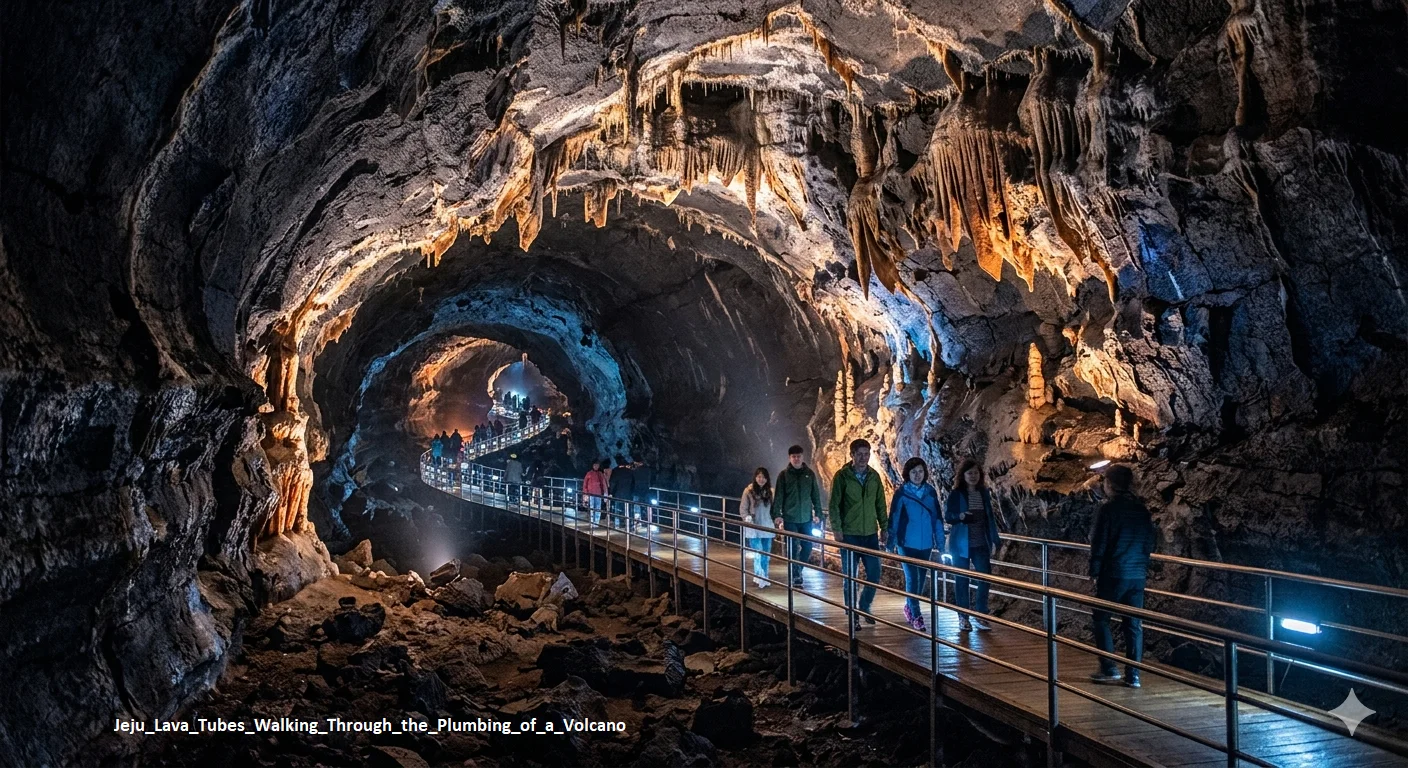
Step into South Korea’s underground volcano world at Jeju Lava Tubes, including the famous Manjanggul Cave. This guide explores the geological wonders, unique lava formations, and fascinating history of one of UNESCO’s natural heritage sites. Discover how to plan your visit, what to expect inside the cave, and tips for exploring safely. Perfect for travelers seeking adventure, nature, and culture in Jeju Island’s breathtaking volcanic landscape.
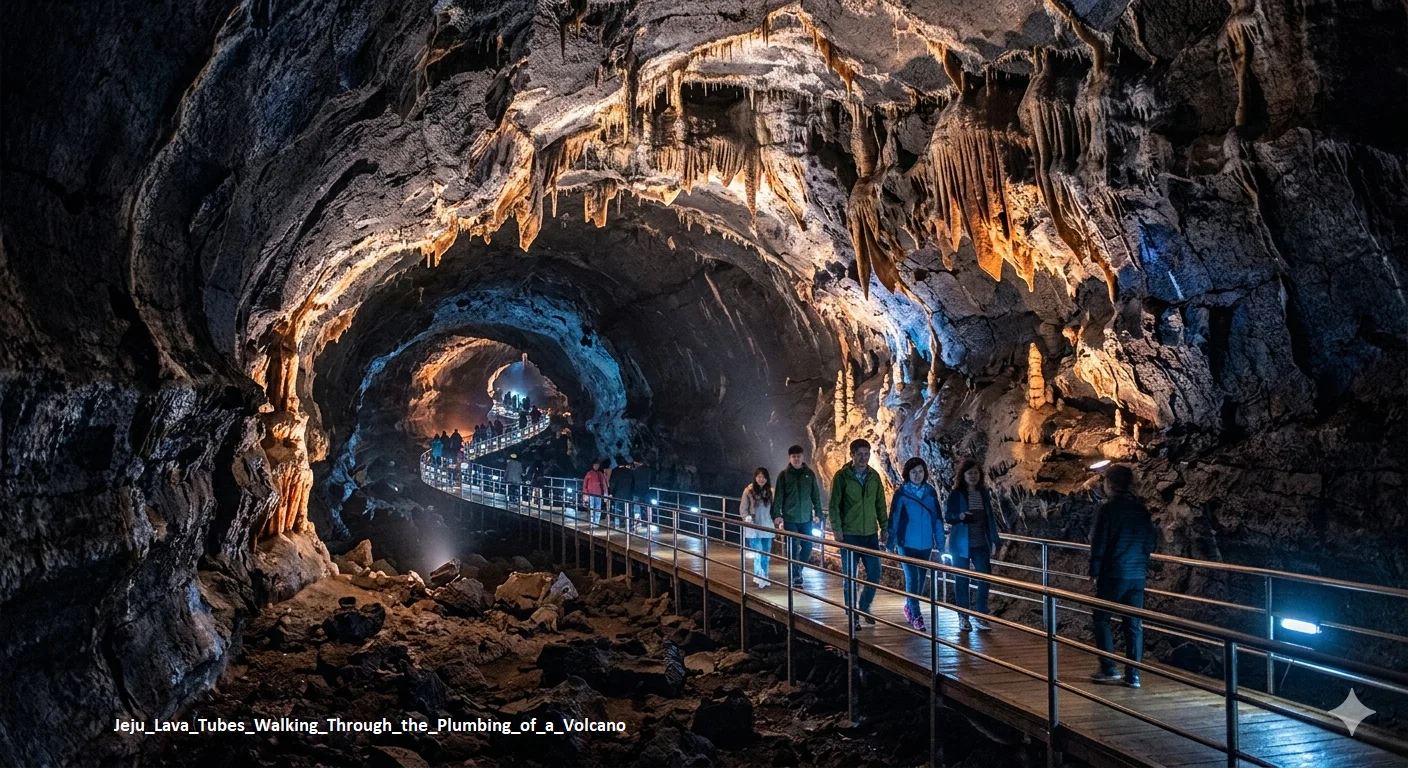
Walk through the plumbing of an ancient volcano. One of Earth's longest lava tunnels, a UNESCO World Heritage site, and an experience that belongs on every serious traveller's list.
From geology to getting there — a complete guide covering 15 sections so you can plan, experience, and book with confidence.
Beneath the surface of Jeju Island — South Korea's volcanic jewel in the southern sea — lies a world that most visitors never see. A network of tunnels, chambers, and underground corridors formed not by water dissolving limestone over millennia, but by molten lava flowing beneath a hardened crust. These are the Jeju lava tubes: geological time capsules that preserve, in startling detail, the precise anatomy of volcanic eruptions that shaped this island hundreds of thousands of years ago.
When lava flows down a volcanic slope at sufficient speed and volume, the outer surface cools and solidifies, forming an insulating shell. Beneath this shell, molten lava continues flowing at temperatures exceeding 1,000°C. When the eruption stops or the supply diminishes, the remaining lava drains away, leaving behind a hollow tube — a perfectly preserved conduit of the volcano's circulatory system. The result is a cave of extraordinary regularity: smooth walls, arching ceilings, and a floor that records every variation in the ancient lava flow.
Most lava tube systems around the world are either too narrow to enter, too unstable to explore safely, or too geologically unremarkable to warrant preservation. Jeju's Geomunoreum lava tube system is the exception to every rule. Its tubes are enormous — some reaching 30 metres in width and 20 metres in height. Its walls are decorated with rare secondary lava formations: stalactites, stalagmites, flowstone, and lava columns formed not from calcium carbonate (as in limestone caves) but from carbonate minerals dissolved from overlying shells and sediment, filtered through the basalt. Nowhere else on Earth does a lava tube system display such a diversity of speleothem types in a single interconnected system. This, combined with the sheer scale, scientific importance, and remarkable state of preservation, is what earned Jeju its UNESCO designation.
In 2007, the United Nations Educational, Scientific and Cultural Organization inscribed Jeju Volcanic Island and Lava Tubes on its World Heritage List. The designation covers three distinct components: Geomunoreum and its associated lava tube system (including Manjanggul Cave), the tuff cone of Seongsan Ilchulbong, and the Hallasan Natural Reserve. Together they represent one of the most complete expressions of oceanic island volcanic geology anywhere on the planet.
UNESCO cited the Geomunoreum lava tube system as the most scientifically significant and visually spectacular lava tube cave complex on Earth. The system stretches over 13 km through the landscape, comprising multiple caves of which Manjanggul is the longest and most accessible. The diversity of secondary minerals lining the cave walls — including carbonate speleothems in a basaltic lava tube, an extraordinarily rare combination — is found at this quality nowhere else. UNESCO's evaluation panel noted that the site meets the criteria for outstanding universal value on grounds of both geological beauty and scientific importance.
The Jeju Special Self-Governing Province maintains strict preservation protocols at all inscribed sites. Visitor numbers to the most sensitive caves within the Geomunoreum system are restricted, with some tubes accessible only to researchers by permit. Manjanggul itself has managed visitor flows, timed entry systems, and a one-directional walking route specifically designed to minimise human impact on the cave environment. As a traveller, you will experience a site that is genuinely protected — not merely marketed as such.
Of all the tubes within the Geomunoreum system, Manjanggul Cave is the one that defines the experience for visitors. At approximately 7.4 km in total length, it ranks among the longest lava tube caves in the world. The section open to the public covers roughly 1 km, entering through a collapsed section of the cave roof and following the ancient lava river to its most spectacular feature — the lava column.
The moment you descend the stairs into Manjanggul, the scale resets your sense of proportion. The ceiling rises to 23 metres at its highest point. The width stretches to 18 metres in the broadest sections. The basalt walls carry distinct flow lines — horizontal striations recording each successive lava level during the tube's active life, like tide marks on a harbour wall. Walking through, you are quite literally inside the plumbing of a volcanic eruption that occurred approximately 300,000 years ago.
The interior of Manjanggul is not a featureless tunnel. The cave preserves a remarkable variety of volcanic and secondary mineral formations. Lava stalactites hang from the ceiling where lava dripped from the roof during the original flow. Lava ropy formations pattern the floor. Lava shelves mark ancient flow levels on the walls. Most striking are the lava stalagmites — upward-growing formations on the cave floor composed of carbonate minerals, a feature so unusual in a basaltic lava tube that they were cited by UNESCO as evidence of the site's exceptional scientific value.
Near the end of the accessible section, the cave reaches its most famous feature: a standing lava column approximately 7.6 metres tall, considered the world's largest lava column within a lava tube. Formed when lava dripping from the ceiling met lava rising from below, the column is a geological phenomenon of extraordinary rarity. It is the image that appears in every serious reference to Jeju cave tours and the single sight that justifies arriving at the cave's opening time to beat the crowds.
| Feature | Details |
|---|---|
| Total Length | Approximately 7.4 km |
| Open to Public | ~1 km (one directional route) |
| Maximum Width | 18 metres |
| Maximum Height | 23 metres |
| Cave Temperature | 11°C – 13°C year round |
| Lava Column Height | 7.6 metres (world's largest in a lava tube) |
| Age | ~300,000 years |
| UNESCO Status | Part of World Heritage Site since 2007 |
The lava tubes themselves are indifferent to the season outside. At a constant 11°C to 13°C throughout the year, Manjanggul Cave is cool and humid regardless of whether you arrive in the height of summer or the depths of winter. What changes with the seasons is the experience of Jeju above ground and the practical conditions of getting there.
The best overall period for a Jeju travel itinerary that includes the lava tubes. Temperatures above ground sit between 12°C and 22°C, the island's famous rape blossom and cherry blossom seasons peak in April, and visitor numbers are manageable. The contrast between the warm, flower-scented island surface and the cool, dark interior of the cave is particularly vivid during spring visits.
The cave itself is refreshingly cool against Jeju's humid summer heat (25°C–32°C). However, this is peak domestic Korean holiday season — expect significant crowds at Manjanggul, especially on weekends. The cave entry queue can extend to 30–45 minutes on summer afternoons. Arrive before 10 am to minimise waiting time.
Arguably the most comfortable season for the complete Jeju experience. Temperatures are mild (15°C–25°C), autumn foliage colours the Hallasan slopes, and crowds thin considerably after the Chuseok holiday period ends in late September or early October. Photography conditions above and below ground are excellent.
The quietest period. Cold above ground (0°C–10°C) but the cave interior remains a stable 11°C — actually warmer than the outside air, making the descent feel unexpectedly comfortable. Winter has the fewest tourists, and the cave experience is unhurried. The trade-off is that some surrounding attractions have reduced hours.
There are no direct flights from India to Jeju. The standard routing is via Seoul's Incheon International Airport (ICN) or Gimpo Airport (GMP), with a domestic connection to Jeju International Airport (CJU). The Seoul–Jeju route is one of the busiest air corridors in the world, with flights departing every 30–60 minutes on Korean Air, Asiana Airlines, Jeju Air, Jin Air, and others. Flight time from Seoul to Jeju is approximately 1 hour. Total journey time from major Indian cities: Hyderabad (12–15 hours), Delhi (11–14 hours), Mumbai (12–15 hours) including layover and connection time.
Manjanggul Cave is located in Gujwa-eup on the north-east coast of Jeju Island, approximately 35 km from Jeju International Airport. Transport options from the airport:
| Method | Time | Cost | Notes |
|---|---|---|---|
| Rental Car | 40–50 min | ₩30,000–60,000/day | Most flexible; recommended for families |
| Taxi | 40–50 min | ₩35,000–50,000 one-way | Easy, direct, no transfers |
| Bus (Route 810) | 75–90 min | ₩1,200–2,000 | Budget option; stops near the cave |
| Guided Tour | Half-day | ₩30,000–70,000 | Includes commentary and transport |
Nobody describes the inside of Manjanggul Cave quite accurately. Most travel writing talks about the science and the formations. What it often misses is the experience of the body moving through a space formed by liquid fire — the way the rock walls shift from smooth to jagged within metres, the way the ceiling arches like a cathedral, and the particular quality of silence underground, interrupted only by the sound of dripping water.
The 1 km walkway inside Manjanggul is paved and generally flat, though with some uneven sections. The path follows the cave in one direction only — you enter from one opening and exit from another, which means no backtracking and no congestion in the narrow sections. The entire accessible route takes 30–45 minutes at a comfortable pace. There are no steep inclines, though the entry and exit points involve short flights of stairs. People with moderate mobility can manage comfortably; wheelchair access is limited.
The cave is lit with recessed artificial lighting positioned to highlight the major formations without disturbing the cave ecosystem. The lighting is atmospheric rather than bright — sufficient to see clearly, but dark enough that the cave feels genuinely subterranean rather than sanitised. The areas around the major lava formations are lit with warmer tones that emphasise the texture of the basalt. Photography is possible without flash (flash photography affects cave-dwelling organisms).
Humidity inside Manjanggul runs at 90–100%. The walls are perpetually damp, the air is cool and heavy with moisture, and a light mist is sometimes visible near the cave floor. This moisture is what sustains the cave's living ecosystem — including endemic species of cave-adapted invertebrates and fungi. The air quality is excellent; there are no unpleasant odours. Some visitors find the humidity intensely refreshing in summer; in winter, the damp cold feels sharper than the stable temperature suggests.
| Category | Entry Fee (KRW) | Approx. INR |
|---|---|---|
| Adults (19+) | ₩2,000 | ~₹125 |
| Youth (7–18) | ₩1,000 | ~₹63 |
| Children (under 7) | Free | Free |
| Jeju Residents | Free | — |
Manjanggul Cave is open daily from 9:00 am to 6:00 pm (last entry 5:00 pm). The cave is closed on the first Wednesday of every month for maintenance and inspection. During peak summer months (July and August), extended hours may apply — confirm with the Jeju Tourism Organisation before your visit. The cave is never closed for weather, making it an excellent wet-day option during Jeju's summer typhoon season.
Tickets are available at the cave entrance only — there is no advance online booking system for individual visitors at the time of writing. Payment is accepted in cash (Korean Won) and by card at the ticket booth. The car park adjacent to the cave entrance can fill quickly on summer weekends; arriving before 9:30 am is strongly recommended. A small café and souvenir stall operate at the entrance building.
Planning a South Korea trip from India? Explore Asia tour packages designed around your schedule and budget.
View Asia Tour PackagesThe biggest practical mistake first-time visitors make is arriving dressed for the Jeju surface temperature. The cave is 11°C regardless of whether it is 32°C outside or 5°C — and the 90% humidity makes that 11°C feel genuinely cold within 10 minutes of entry. Here is exactly what to bring:
| Item | Why It Matters |
|---|---|
| Closed-toe shoes with grip | Cave floor is damp and can be slippery; sandals are a genuine safety risk |
| Light jacket or fleece | 11°C and 90% humidity — you will be cold within 10 minutes in a t-shirt |
| Small daypack | Keeps hands free; useful for jackets removed after returning to surface |
| Camera (low-light capable) | Artificial lighting is dim; smartphones struggle without night mode |
| Water bottle | No drinking water inside the cave; stay hydrated before entry |
| Extra battery / power bank | Cold temperatures reduce battery life faster than normal |
For Indian travellers considering cave experiences across the continent, understanding how Manjanggul Cave compares to the region's other notable underground sites helps in making an informed choice — and in understanding why Jeju is in a different category from most.
| Cave | Country | Type | UNESCO? | What Makes It Unique |
|---|---|---|---|---|
| Manjanggul Cave, Jeju | South Korea | Lava tube | Yes (2007) | World's most spectacular lava tube; 7.6m lava column; carbonate speleothems in basalt |
| Son Doong, Phong Nha | Vietnam | Limestone karst | Yes (2003) | World's largest cave by volume; requires multi-day expedition; extremely limited entry |
| Phong Nha Cave | Vietnam | Limestone karst | Yes (2003) | Accessible by boat; 31 km long; dramatic river passage through ancient caverns |
| Mawsmai Cave, Meghalaya | India | Limestone karst | No | Short, accessible cave in the world's wettest region; good for beginners |
| Krem Liat Prah, Meghalaya | India | Limestone karst | No | India's longest cave at ~31 km; semi-wild caving experience; limited visitor access |
| Batu Caves | Malaysia | Limestone karst | No | More pilgrimage site than cave experience; dramatic entrance staircase; easily accessible |
The fundamental difference between Manjanggul and every limestone karst cave on this list is the geology. Limestone caves form over millions of years as acidic water dissolves the rock. Lava tube caves form in days or weeks as volcanic eruptions create and drain tunnels of molten rock. The resulting cave environment — the formations, the rock textures, the temperature stability, the mineral composition — is entirely different. Visiting Manjanggul is not a substitute for visiting Son Doong or vice versa; they are different experiences that happen to share the word "cave."
The lava tubes sit in the north-eastern corner of Jeju Island, a position that makes them an excellent anchor for a full day of exploration along the eastern coast. All of the following attractions are within 30–60 minutes of Manjanggul Cave:
A UNESCO-listed tuff cone that erupted from beneath the sea approximately 100,000 years ago. The 182-metre peak is now a dramatic promontory connected to the Jeju coast, topped with a 600-metre-wide crater. Sunrise from the summit is one of the most photographed moments in South Korea. The 20-minute hike to the top is manageable for most visitors. Distance from Manjanggul: approximately 15 km east.
South Korea's highest peak at 1,950 metres, Hallasan is a dormant volcano and the geological heart of Jeju Island. Multiple hiking trails range from 1.5 hours to 4.5 hours return. The summit trail (Seongpanak Trail, 9.6 km) leads to a crater lake at the top. Hallasan is the most visible landmark from anywhere on the island and provides the context for understanding everything the Jeju lava tubes are built from. Distance from Manjanggul: approximately 30 km south-west.
On the west coast, Hyeopjae is Jeju's finest swimming beach — white sand, brilliant turquoise water, and a clear view of the small volcanic island of Biyangdo. Worth combining with the lava tubes as a full-day east-to-west circuit of the island.
A 100-acre open-air museum preserving traditional Jeju village architecture, farming and fishing tools, and the distinctive black basalt walls that characterise older island buildings. Located in Seogwipo, south coast, this is the best place to understand the human relationship with Jeju's volcanic landscape.
Explore South Korea and other Asia destinations with curated tour packages from Hyderabad, Delhi, Mumbai, and Bangalore.
Plan My Jeju TripThis itinerary is designed for travellers arriving from India via Seoul, with 4 full days on Jeju Island. It places the lava tubes on Day 1 to secure early-morning access before crowds build.
Arrive at Jeju International Airport, collect rental car, and check into hotel. Head directly to Manjanggul Cave — aim to arrive by 9:00 am when the doors open. Spend 1.5 hours exploring the cave. Afterwards, drive 15 km east to Seongsan Ilchulbong for the afternoon. Walk to the rim for views over the east coast. Evening: seafood dinner at Seongsan Port — try Jeju black pork (Heukdwaeji) or fresh hairtail fish (Galchi), both local specialities.
Early start for the Eorimok Trail on Hallasan Mountain (approximately 3.5 hours return to Witseoreum shelter, with crater views). Afternoon: drive to Seogwipo on the south coast. Visit Cheonjiyeon Waterfall (a short walk from the road) and the Jeju Folk Village Museum. Evening in Seogwipo, Jeju's second city — lively night market and excellent street food.
Morning: drive to Hyeopjae Beach and take the short ferry to Biyangdo Island (30 minutes each way) for a 3 km walk around the island's crater and volcanic coastline. Afternoon: Jeju Olle Trail — choose a section of the famous coastal walking trail that rings the island. Route 14 (Jeju City section) or Route 1 (Seongsan section) are particularly scenic. Evening: return to Jeju City for dinner.
Morning: visit Geomunoreum, the master vent from which the Manjanggul lava tube system was formed. Entry to the interior of Geomunoreum is strictly limited (advance reservation required from the Jeju World Heritage Management Office). Even viewing the exterior cone and understanding its relationship to Manjanggul gives the entire experience its geological coherence. Return car and depart from Jeju International Airport for Seoul connection.
Costs below are per person based on two adults travelling together, in a mid-range budget category. All amounts are approximate and subject to seasonal variation and booking timing.
| Expense Category | Approximate Cost (INR) | Notes |
|---|---|---|
| Flights (Return, India–Seoul–Jeju) | ₹35,000 – ₹65,000 | Lower in Jan–March, higher in July–August |
| Hotel (4 nights, Jeju Island) | ₹28,000 – ₹55,000 | 3-star mid-range hotel per person sharing |
| Rental Car (4 days) | ₹6,000 – ₹12,000 | Compact car; insurance recommended |
| Entry Fees (Major Sites) | ₹1,500 – ₹3,000 | Manjanggul, Hallasan, Seongsan, Folk Village |
| Food (4 days) | ₹8,000 – ₹18,000 | Mix of restaurant meals and convenience food |
| Miscellaneous (shopping, tips, ferries) | ₹3,000 – ₹8,000 | Biyangdo ferry, Olle trail app, souvenirs |
| Total Per Person (4 Days) | ₹81,500 – ₹1,61,000 | Budget to comfortable mid-range |
For group travel or families, costs reduce significantly. A family of four sharing one rental car and a two-room apartment-style hotel reduces per-person transport and accommodation costs by 30–40%. Contact TourPackages.asia for customised Jeju group packages with flights, hotels, and guided tours included.
Click each panel to expand detailed tips — covering timing, geology, photography, logistics, and what the guidebooks don't tell you.
The short answer is: almost anyone. But here is a more precise guide to whether this experience will be right for your travel party.
The cave's dramatic interior, the contrast of cool darkness after warm island sunshine, and the genuine remoteness of the geological experience make Manjanggul quietly romantic. Combine with a sunset drive along the eastern coast and dinner by the sea for a perfect day.
Children aged 6 and above are universally captivated by the idea of walking through a volcano's interior. The flat, paved path is manageable, the lava column is spectacular, and the entry fee for children under 7 is free. Bring a jacket for little ones.
Manjanggul is safe, clearly signed in English, and manageable without a guide. The cave walk itself is contemplative and best appreciated at a solo pace. Early morning arrivals on weekdays practically guarantee a near-private experience for the first 30 minutes.
This is the primary audience the cave was designed to serve. The Geomunoreum lava tube system is a living textbook of volcanology. If basalt petrology, speleothem formation, or volcanic geomorphology interests you even slightly, Manjanggul will exceed every expectation.
Photographing a low-light cave environment presents specific challenges. Here is what works and what does not inside Manjanggul:
Asia has extraordinary cave experiences. Vietnam's Phong Nha offers boat journeys through cathedral-scaled limestone chambers. Meghalaya's caves give spelunkers rivers and darkness on a scale that exceeds almost anywhere in the world. Malaysia's Gomantong Caves are a wildlife spectacle unlike anything else on the continent.
But none of them are lava tube caves. The experience of walking through the internal plumbing of a volcano — through a passage formed not by water and time but by the violent drain of liquid rock — is categorically different from any karst or limestone cave experience. The scale, the smoothness, the mineral formations, and the knowledge that you are moving through a space that fire created in days rather than epochs reshapes how you think about the planet beneath your feet.
Manjanggul is the most accessible, most preserved, and most scientifically significant lava tube cave on the continent. For Indian travellers seeking experiences that genuinely cannot be replicated closer to home, this is among the top reasons to make the journey to South Korea.
Tell us when you want to go, how many are travelling, and your preferred budget range. We will send you a detailed itinerary and cost breakdown within 24 hours.
Prefer WhatsApp? Message us at +91 91009 84920Detailed answers to the questions asked most often by Indian travellers planning a visit to Manjanggul Cave and Jeju Island.
Most visitors spend 45 minutes to 1 hour inside the cave. The accessible section of the Manjanggul lava tube is approximately 1 km long, and a comfortable walk takes around 30 to 40 minutes one way. Budget 1.5 to 2 hours in total including ticket purchase, entry queue, the cave walk, and a moment to take in the famous lava column near the end of the trail before retracing your steps. If you are a geology enthusiast or serious photographer who wants to stop frequently, allow 2 to 2.5 hours from arrival at the entrance to departure.
Yes, Manjanggul is entirely safe for the general public and has an excellent safety record. The walkway is paved, lit with artificial lighting throughout, and has safety barriers at all significant drop points or uneven sections. The cave is actively monitored and managed by the Jeju Special Self-Governing Province authorities. The temperature inside is a stable 11°C to 13°C year round, which is physiologically safe for all healthy adults and children. There are no toxic gases, unstable ceilings, or wildlife hazards within the accessible section. The primary safety precautions are: wear non-slip footwear (the floor is damp), bring a light jacket (the cold can catch visitors off guard), and watch your footing at the occasional uneven section of the paved path.
Yes, children of all ages can visit Manjanggul Cave, and it is a genuinely excellent experience for children aged 5 and above who can walk the 1 km accessible section comfortably. Children aged 6 and under enter free. The 1 km paved path is flat and manageable for school-age children, though it is not a casual stroll for very young children — there are no shortcut exits once inside, so the entire 1 km must be completed. Strollers are not recommended due to occasional uneven surfaces, so carry young toddlers in a baby carrier. The cave temperature of 11°C is cool; ensure children are dressed in layers. The lava column at the end of the accessible section is unfailingly spectacular for children — it will be a trip highlight they remember for years.
Manjanggul can become significantly crowded, particularly on summer weekends (July and August Saturdays and Sundays) and Korean national holidays. During peak times, visitor queues at the entrance can extend to 30–45 minutes, and the narrow cave sections can feel congested. To avoid crowds: arrive at 9:00 am when the cave opens; visit on a Tuesday, Wednesday, or Thursday when domestic Korean day-trippers are fewer; avoid the Japanese summer holiday period (late July to mid-August); and consider visiting in shoulder season (April–June or September–November). Even on a busy day, the cave's single-direction walking route prevents genuine congestion — the crowd disperses naturally once inside.
As of 2025, the entry fee for Manjanggul Cave is ₩2,000 for adults (age 19 and above), ₩1,000 for youth (age 7–18), and free for children aged 6 and under. Jeju Island residents enter for free upon presentation of proof of residence. At current exchange rates (approximately 16 Korean Won per Indian Rupee), the adult entry fee equates to roughly ₹125 — making it one of the most affordable UNESCO World Heritage experiences on the planet. There is no online advance booking for individual visitors; tickets are purchased at the cave entrance on the day of visit. Payment is accepted by both card and cash.
Indian citizens require a visa to visit South Korea. The most common option is the K-ETA (Korea Electronic Travel Authorization), which is an online application processed within 72 hours and valid for multiple entries over 2 years, for stays up to 90 days per visit. Alternatively, a standard South Korea tourist visa can be applied for through the Korean Embassy or consulate. The K-ETA is straightforward, requires no embassy visit, and is the recommended route for most Indian travellers. Ensure your passport has at least 6 months validity beyond your intended departure date from South Korea. For the most current visa requirements and to confirm K-ETA eligibility, check with your travel agent or the official Korean embassy website.
The Jeju lava tubes can be visited year-round as the cave interior maintains a constant 11°C to 13°C regardless of external weather. For the overall Jeju Island experience, the best months are April to June (spring — cherry blossom, mild temperatures, manageable crowds) and September to November (autumn — comfortable temperatures, foliage, thinner crowds). July and August are the warmest months above ground and coincide with Korean school holidays, making them the busiest and most crowded period — plan early morning visits if travelling in summer. December to February is the quietest period overall, with the least crowded cave experience.
The primary connection from Seoul to Jeju is by domestic flight. The Seoul (Gimpo Airport, GMP) to Jeju (CJU) route is the world's busiest air corridor, with departures every 30–60 minutes from major Korean carriers including Jeju Air, Jin Air, Korean Air, and Asiana Airlines. Flight time is approximately 1 hour. Ticket prices range from ₩15,000 to ₩80,000 one-way depending on timing and airline. Book domestic Korean flights as part of your international package through TourPackages.asia to avoid the complexity of booking through Korean airline websites. An alternative ferry connection from Mokpo or Wando on the Korean mainland takes 3–8 hours and is not recommended for time-limited visits.
Jeju's Geomunoreum lava tube system comprises multiple caves beyond Manjanggul. Bengdwigul, Yucheongul, and Dangcheomuldonggul are part of the same system. However, most of these are restricted to researchers and are not open to casual visitors — they are protected specifically because unrestricted access would damage the unique mineral formations inside. Geomunoreum itself, the source vent that fed the entire lava tube system, can be visited by advance reservation through the Jeju World Heritage Management Office. Entry is strictly limited to a small number of visitors per day, and booking must be made well in advance. Visiting Geomunoreum in addition to Manjanggul gives a complete picture of how the entire lava tube cave system was formed.
English-speaking guides are available at the cave entrance for a modest additional fee. The cave also has an audio guide available at the ticket booth in multiple languages including English, Chinese, and Japanese. For visitors who want a deeper geological and cultural understanding, a licensed Jeju guide accompanying a half-day east coast tour (Manjanggul + Seongsan Ilchulbong) is available through local tour operators in Jeju City and through international operators like TourPackages.asia. The cave signage is comprehensive in English, so independent navigation is entirely feasible without a guide — but the context provided by a knowledgeable guide is genuinely enriching for the Manjanggul visit.
Photography is permitted inside Manjanggul Cave with personal cameras and smartphones. Flash photography is prohibited — this is a firm rule, not a suggestion, as repeated flash exposure damages the cave's microorganisms and bleaches the mineral formations over time. Tripods are technically permitted but should be positioned carefully to avoid blocking the path for other visitors. Drone use is strictly prohibited inside and above the cave site. Commercial photography requires advance permission from the Jeju World Heritage Management Office. For personal travel photography, the ambient artificial lighting in the cave is well-designed and produces atmospheric results — see the photography tips section earlier in this guide for camera settings that work best in the Manjanggul environment.
Jeju is one of the most popular honeymoon destinations in South Korea for both domestic Korean couples and international visitors, and it translates extremely well for Indian couples looking for an Asia honeymoon with substance. The island combines geological drama (the lava tubes, Hallasan, Seongsan), natural beauty (black sand beaches, coastal cliffs, waterfalls), and the practical comfort of a well-developed tourism infrastructure with excellent hotels ranging from boutique guesthouses to luxury resorts. The cave itself — cool, quiet, and otherworldly — creates a genuinely memorable shared experience. The spring cherry blossom and rape blossom season (late March to early May) is particularly beautiful for couple photography. Contact TourPackages.asia for a Jeju honeymoon package with flights, accommodation, and itinerary planning included.
Jeju has a distinctive food culture that differs from mainland Korean cuisine. Heukdwaeji (Jeju black pork) is the island's most famous speciality — a breed of pig unique to Jeju, leaner and darker than standard Korean pork, typically served grilled over charcoal. Galchi jorim (braised hairtail fish in spiced sauce) and Jeonbok-juk (abalone porridge) are two other local must-tries. For seafood, Seongsan Port and Seogwipo Fish Market are the best locations. Hallabong — a mandarin orange unique to Jeju's volcanic soil — is the island's signature fruit and makes excellent fresh juice and desserts. Tangerine farming is a significant industry on the island; visiting an orchard in season (October–February) and picking your own is a popular experience.
For the best combination of price and availability, book your international flights 8 to 12 weeks in advance for travel during shoulder seasons (spring and autumn), and 12 to 16 weeks in advance for peak summer travel (July–August) or peak domestic Indian holiday periods (Diwali, Christmas–New Year). Hotel prices on Jeju Island are more stable and can often be secured 4 to 6 weeks out, but desirable properties in Seogwipo or beachside Jeju City book out earlier during peak periods. For packaged tours with fixed itinerary and guided elements, booking through TourPackages.asia 6 to 10 weeks ahead is recommended to allow time for visa processing and domestic Korea air ticket booking.
The Jeju lava tubes are extraordinary but they occupy only a half-day of your visit. The honest answer is that Jeju rewards a minimum of 3 to 4 days, and a day trip from Seoul purely for the cave would feel rushed and incomplete. The island has a density of UNESCO-grade experiences — Manjanggul Cave, Seongsan Ilchulbong, Hallasan Mountain — that are individually world-class and collectively irreplaceable. Adding the eastern coastal drive, a section of the Olle Trail, and Jeju's distinctive food scene builds an experience that many visitors describe as the most surprising and memorable destination in East Asia. If your South Korea itinerary allows, dedicate 3 to 4 nights to Jeju in addition to your Seoul days — it will be the part of the trip you talk about for years.
For anyone searching for a complete South Korea or Asia travel experience, www.tourpackages.asia and www.revelationholidays.in offer fully planned packages from all major Indian cities — with flights, accommodation, local transport, and guided cave tours included.
