
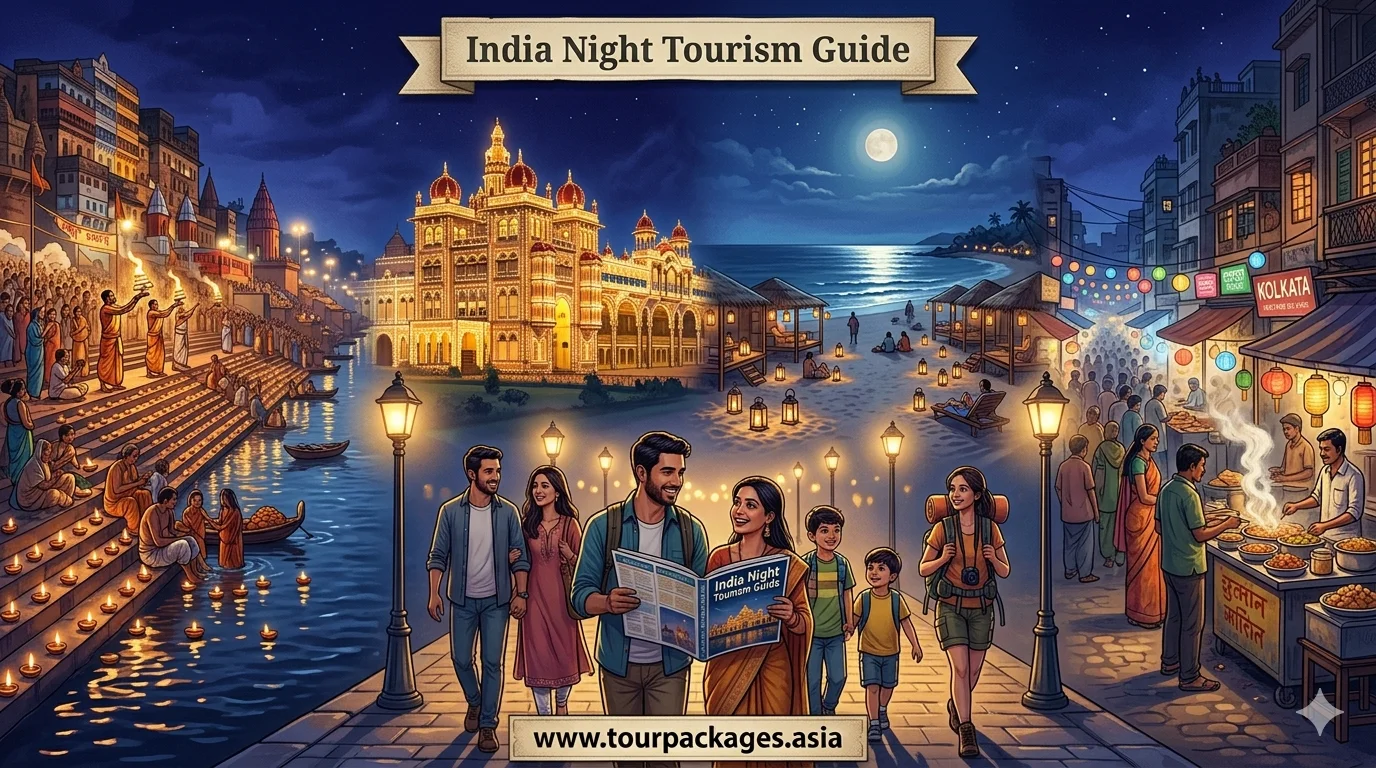
India Night Tourism Guide — Safe, Unique and Cultural Experiences After Sunset (2026)
I discovered something that most travel guides never tell you: India completely transforms after sunset. The version of this country that exists between dusk and midnight is quieter, more layered, more honest about what it is — and in many ways, more extraordinary than anything the daylight hours reveal. This is everything I learned, and everything you need to know, before you step out into India after dark.
What This Guide Covers
Jump to the section that matters most to you — from personal storytelling to safety, itineraries and photography.
What is Night Tourism in India?
In simple terms, night tourism in India means travel experiences deliberately designed for the hours after sunset — not parties and bars, but cultural ceremonies, moonlit landscapes, star-filled skies, illuminated heritage sites, and a quieter, more intimate version of India's most extraordinary places.
The concept has been gathering momentum across India since 2023, accelerating sharply through 2025 when global travel trend-watchers named noctourism the travel word of the year. By 2026, the momentum is undeniable. State tourism boards — Gujarat, Rajasthan, Uttar Pradesh, Karnataka — have all begun structuring dedicated after-dark experiences into their official tourism calendars. The Archaeological Survey of India has permitted evening light and sound shows at Amber Fort, Qutub Minar, and several other heritage monuments. Forest departments in Madhya Pradesh and Uttarakhand have opened regulated evening safari windows in buffer zones. Even the India Tourism board's official campaigns now feature unique experiences India travel after dark as a distinct product category.
What makes India night tourism different from conventional nightlife or late-night dining is its intent. A traveller arriving at Dashashwamedh Ghat in Varanasi at 6:30 PM is not seeking entertainment. They are seeking something older and harder to name — the particular feeling of standing in firelight at the edge of a river that has been burning lamps for three thousand years. That is what India offers after sunset that nowhere else quite replicates: the collision of the ancient and the living, at its most concentrated and most visible.
The government push behind night travel experiences India is also practical: spreading tourist footfall across more hours reduces daytime overcrowding at peak sites and generates additional revenue for local communities — guides, boatmen, folk performers, food vendors — who have historically only worked daylight shifts. This distributional effect is one reason state governments have invested in floodlighting infrastructure, evening trained guide certification programmes, and extended permits for cultural performances at heritage sites.
My First Night in India After Dark — What Nobody Had Prepared Me For
The first time I intentionally stayed out in India after sunset was in Varanasi, and I want to be precise about what that evening felt like — because I had been to Varanasi twice before, always leaving the ghats by 7 PM, always retreating to a rooftop restaurant with the same city spread below me in a shape I could already predict. This time, I stayed. I found a spot on the stone steps of Dashashwamedh Ghat forty minutes before the Ganga Aarti began and simply waited.
What happened over the next hour was not spectacular in the Instagram sense — there were no drone shots, no single defining frame. It was the accumulation that mattered. The river darkening from bronze to black. The sounds arriving in layers: temple bells from somewhere upstream, a conch that held its note for longer than seemed physically possible, the low percussion of hundreds of people finding their places on the steps around me. Then the fires came — seven priests in identical silk robes lifting enormous multi-tiered brass lamps, and the Ganges suddenly holding every flame in perfect reflection. The air was thick with incense, heavy with marigold, and for one long moment the noise of the city simply stopped, as if even Varanasi recognised this as the one thing that required silence.
That night, I understood the difference between visiting India and experiencing it. The day had shown me a country of heat, colour, motion, and astonishing visual complexity. The evening at the ghat showed me the architecture beneath all of that — the belief system that has held this particular sequence of gestures intact for centuries, performed in the same river at the same time, regardless of what political era, what century, what century's version of modernity surrounds it.
Later that same trip, standing on the Rann of Kutch at 10 PM during a full moon, I felt something entirely different and equally disorienting. The white salt desert reflects moonlight with such intensity that you cast a shadow at midnight. You can see for miles. The horizon disappears. The sky and the ground become the same luminous field, and you are suspended inside it. No photograph captures this — not because cameras are limited, but because the experience is physical. The cold. The silence that is not empty silence but a silence with weight. And then, from somewhere in the tent city three kilometres away, the faint pull of Kutchi folk music carrying across nothing at all.
These two nights — so different in character, separated by a thousand kilometres of India — taught me that India after sunset travel is not a single thing. It is a range of experiences unified only by the absence of daylight and everything that changes in that absence. This guide exists because I believe more travellers — Indian and international — deserve access to what I found by accident.
Best Night Tourism Experiences in India — Detailed and Honest
These are not a generic list. Each entry is built from research, traveller accounts, and verified operational information. For each destination, the focus is on what actually happens at night, why it is unique at that hour, and when to go for the best experience. Plan This Trip
World's Most Ancient Living City · Daily Evening Ceremony · Unmissable
Varanasi After Dark — When the River Becomes Sacred Theatre
Nothing in India prepares you for what Dashashwamedh Ghat becomes at nightfall. The Ganga Aarti begins at approximately 7:00 PM in summer and 6:00 PM in winter — seven priests in synchronised ritual, enormous brass lamps moving in slow arcs above the Ganges, conch shells, Sanskrit chants, and an audience of thousands filling every step of the ghat and every boat anchored offshore. The ceremony has continued uninterrupted here for centuries. It lasts 45 to 60 minutes and leaves most first-time viewers genuinely speechless. The sensory experience — firelight on dark water, incense layered over the river smell, the bell and conch combination that Indian acoustic tradition has perfected for outdoor reverberance — is unlike anything else available to a traveller anywhere in the world. After the aarti, the ghats remain active. A midnight boat ride from any ghat allows you to drift past the burning pyres of Manikarnika — the cremation ghat that operates 24 hours a day, every day, for centuries — and experience the particular philosophy of this city: that life and death share the same river, the same night, the same geography. This is the context that makes Varanasi night tourism impossible to replicate anywhere else.
Asia's Largest Salt Desert · Full Moon Experience · Rann Utsav Nov–Feb
Rann of Kutch at Night — The Desert That Becomes a Mirror
The Rann of Kutch is the only place in India where the ground itself becomes a light source. On full moon nights, the 30,000-square-kilometre salt desert — technically the world's largest salt flat — reflects moonlight so completely that the surface glows white, visibility extends for kilometres, and you cast a clear shadow at midnight without any artificial illumination. The horizon disappears. The distinction between ground and sky dissolves. It is not metaphorically beautiful. It is physically disorienting in the way that only genuinely extreme landscapes can be. The Rann Utsav festival, running from October or November through February, organises this experience into accessible form: luxury tent cities at Dhordo village, camel rides onto the salt flats after dark, folk music and Garba performances under open sky, and guided cultural evenings with Kutchi artisans. Check the lunar calendar when planning — align with Purnima (full moon) nights for the peak visual experience. New moon nights offer the opposite extreme: the darkest skies in western India, perfect for stargazing and Milky Way photography. This is also one of the best dark sky tourism India destinations, with light pollution essentially zero across the salt flats and atmospheric clarity during the winter months approaching the conditions of high-altitude Ladakh.
The Queen's Necklace · Safe Urban Night Walk · Year-Round Access
Marine Drive at Night — Mumbai's Most Democratic Public Space After Dark
Marine Drive is the 3.6-kilometre C-shaped seafront promenade in south Mumbai, and at night it becomes the most vividly democratic public space in any Indian city. After 9 PM, the concrete sea-facing wall called the Queen's Necklace — named for the arc of amber street lamps that traces the coastline from the air — fills with a cross-section of Mumbai that you will not encounter anywhere else: office workers who have walked from Nariman Point, couples from the adjacent residential towers, students, vendors, the occasional film crew shooting night exteriors, and always, a cluster of people who come simply to sit and watch the Arabian Sea in darkness. The combination of the lit skyline, the sea breeze that comes in regardless of Mumbai's humidity, and the low hum of conversation in a dozen languages creates an atmosphere that is neither tourist attraction nor local secret — it is simply where Mumbai breathes. For visitors asking about things to do at night in India in a major city, Marine Drive is the answer that requires no planning, no booking, and no particular expertise. It is safe, free, open all night, and serves as one of the best possible introductions to urban India after sunset. The walk north from Marine Drive towards Girgaon Chowpatty beach adds the dimension of street food — bhel puri, pav bhaji, corn on the cob — cooked and served from mobile carts along the sand. Mumbai's late-evening food scene is substantial, and the seafront is its natural home.
India's Most Accessible Beach Night Culture · Saturday Night Market · Year-Round Season
Goa After Dark — Where India's Most Relaxed Evenings Happen
Goa at night is different from Goa by day in almost every meaningful way. The beaches that are busy with sunbathers and vendors by afternoon transform after sunset into something considerably more interesting: beach shacks with tables set directly on the sand, string lights hung between palm trees, live acoustic music drifting out across the water, and the particular sound of the Arabian Sea at night — deeper, more rhythmic, more insistent than its daytime self. The beaches worth spending an evening at extend from Candolim in the south to Vagator in the north: Baga for live music and energy, Anjuna for the flea market culture that peaked in the 1970s and has continued in evolved form ever since, Ashwem and Morjim for quieter candlelit dinners at the water's edge. The Ingo's Saturday Night Market at Arpora is one of the best night markets in Asia — over 100 stalls of Kashmiri handicrafts, Goan sausage, live Goan traditional music, and international food from a genuinely cosmopolitan operator community, running from 6 PM to midnight from November to April. For travellers who ask about safe night travel India, Goa's tourist belt from Calangute to Anjuna is among the safest night environments in the country — active, well-lit, with a visible police and tourist police presence during peak season. The evening culture here is participatory rather than spectacular: you sit, you eat, you listen, you watch the tide, and India's most relaxed social rhythm carries the evening without effort.
14th-Century Ruins by Starlight · Surreal Boulder Landscapes · Guided Night Walks
Hampi at Night — One of India's Most Surreal Landscapes After Dark
Hampi is improbable even in daylight — a 14th-century capital of the Vijayanagara Empire scattered across a landscape of enormous smooth boulders that look as if a giant assembled them and then left. Over 1,600 monuments survive across this UNESCO World Heritage Site: temples, bazaars, royal enclosures, elephant stables, and ceremonial gateways distributed across a terrain that geologists describe as one of the oldest rock formations on the surface of the earth. At night, all of this becomes something else entirely. Without the midday heat and the organised tour groups, Hampi's ruins at night sit in a silence that seems to have geological depth. The granite boulders, already orange-pink in daylight, take on grey and silver tones under the stars. The Tungabhadra River catches the moonlight between the rocks. Local guides offer night walks through sections of the site that are accessible after dark — the Hemakuta Hill area and the boulder fields around Virupaksha offer the most dramatic stargazing, with virtually zero light pollution and the particular visual effect of vast stone forms against clear sky. For travellers interested in unique travel experiences India that exist nowhere else, Hampi at night — combined with the dawn light over the same landscape two hours later — is among the most complete single experiences the country offers.
Thar Desert at Night · Folk Music Under Stars · Camel Camp Stays
Jaisalmer After Dark — Where Rajasthan's Desert Shows Its True Character
Jaisalmer at night operates on two registers simultaneously: the golden sandstone city itself, which glows amber under floodlights and looks almost identical to the medieval paintings it appears in — and the Sam Sand Dunes 45 kilometres away, where the Thar Desert creates one of the most complete night experiences available in India after sunset. At the dune camps, dinner is served on open-air carpets after a sunset camel ride. Then the real evening begins: Rajasthani folk musicians with khartal and sarangi, Kalbeliya snake-charmer dancers in mirrored costumes, fire performances, and finally — when the generators cut and the performance ends — a desert silence that is physically tangible. The Milky Way rises over the Thar from approximately 9 PM in winter, and sand dune ridgelines make for perfect natural viewing platforms. The old fort city of Jaisalmer itself is worth an after-dinner walk: the narrow lanes inside the living fort — one of the few inhabited forts in the world — take on a completely different quality after 9 PM when day-trippers have left and only the local fort community moves through the stone corridors.
Experience India After Dark — Let Us Build Your Itinerary
Whether it is Ganga Aarti in Varanasi, a full moon night in the Rann of Kutch, or stargazing from Hampi's boulder fields — our team at RTH World Tour Packages and Revelation Holidays builds night-focused India tour packages around your travel dates.
Plan My India Night Trip Read More Travel GuidesWhy Night Tourism is Growing Across India in 2026
The rise of night tourism in India is not a marketing invention. It reflects a genuine structural shift in how Indian and international travellers approach the country. Several forces are converging simultaneously to produce what tourism economists are beginning to call India's experiential travel transition.
The first driver is the experience economy itself. Research consistently shows that post-pandemic travellers — particularly in the 25 to 45 demographic — have shifted decisively toward experiences that cannot be replicated, purchased as products, or summarised in a photograph. A Ganga Aarti at Varanasi, a full moon on the Rann of Kutch, the Milky Way over Spiti Valley — these are the category of experience that cannot be substituted. They are irreducibly present-tense. This is the gap that unique travel experiences India fills, and night tourism is where many of the most irreplaceable of those experiences live.
The second driver is climate. India's daytime heat between March and October is, in many regions, genuinely prohibitive for extended outdoor activity. A traveller in Jaisalmer in April who steps out at 2 PM is managing 42°C. The same traveller at 9 PM is managing 26°C and a wind that carries the faint smell of desert flora. The shift to evening-focused India travel after sunset is, in part, simply an adaptation to the thermal reality of the subcontinent's climate.
The third is government investment. India's Ministry of Tourism has identified experiential and night travel experiences India as a strategic priority in its Vision 2030 framework. State governments — particularly Gujarat (Rann Utsav), Rajasthan (Amber Fort evening shows), and Uttar Pradesh (Varanasi ghat development and Kashi Vishwanath Corridor illumination) — have invested substantially in making after-dark tourism safe, accessible, and internationally competitive. This infrastructure investment reduces friction for operators and travellers alike.
Finally, there is the social media dimension: India at night photographs differently from India by day. The Ganga Aarti's firelight, the Rann's lunar glow, Marine Drive's amber arc — these are images that circulate with unusual power precisely because they are genuinely hard to believe without seeing them in person. That visual currency drives curiosity, which drives bookings, which drives the further development of the sector. For customised planning, platforms like TourPackages Asia and Revelation Holidays provide tailored itineraries for Indian travellers seeking these experiences with professional logistics.
Safety Guide for Night Travel in India — Honest, Practical, Complete
Safe night travel India is achievable with planning. The honest answer to the question "Is India safe at night?" is: it depends enormously on where you are, how you travel, and the decisions you make. The same country that has Marine Drive — one of the safest urban night environments in Asia, with active footfall until 1 AM — also has rural highway stretches that are poorly lit and best avoided after dark. Here is what actually matters.
Transport at Night
Use app-based cabs exclusively after dark in cities — Ola and Uber both operate 24 hours in major metro areas and provide driver identification and GPS tracking. Avoid flagging down anonymous autorickshaws or taxis after 9 PM in unfamiliar neighbourhoods. Overnight trains are a very safe option — air-conditioned 2AC and 3AC coaches have locked compartments and CCTV in most express services. Avoid unreserved general coaches at night. Long-distance highway driving after midnight carries real risk on state highways — use only if in a trusted private vehicle with a professional driver.
Safe Night Zones by City
In Mumbai: Marine Drive, Bandra, Juhu Beach, Colaba — all well-lit, high footfall, active police presence. In Delhi: Connaught Place, Khan Market, Hauz Khas Village — reasonable safety in tourist zones; avoid South Delhi's isolated lanes. In Goa: the beach belt from Calangute to Anjuna maintains tourist safety with seasonal police deployment. In Varanasi: the ghat area during and after aarti is actively monitored and heavily attended. In Jaipur: the Walled City and Amber Fort area during the evening light show period maintain safety standards matching international heritage sites.
Solo Traveller Advice
Solo travellers — including solo women — can experience India's major night tourism destinations with reasonable safety if they follow three core principles: stay in high-footfall areas, use verified transport, and share their real-time location with someone reliable. For rural and wilderness night experiences (Rann of Kutch, Ladakh stargazing, Hampi boulder fields), join organised small-group tours with licensed operators rather than independent exploration. The risks in these environments are not primarily criminal — they are navigational and physical (unlit terrain, cold temperatures, disorientation in dark landscapes). In simple terms: India's cities are manageable at night with application discipline. India's wilderness requires a guide.
Emergency Numbers
The national emergency number in India is 112, which connects to police, fire, and ambulance. Tourist police helplines exist in Goa (+91-832-2425405), Rajasthan (+91-141-2744737), and Maharashtra (+91-22-22694488). Carry these as saved contacts, not as memory. Most international travel insurance policies include 24-hour emergency assistance lines — keep that number accessible offline.
Where Nighttime Access is Restricted in India — What Travellers Must Know
Understanding where night travel in India is not permitted is as important as knowing where it is exceptional. India has several categories of location where after-dark access is prohibited or severely restricted for legal, ecological, or security reasons.
ASI-Protected Monuments
The Archaeological Survey of India closes all protected monuments at sunset — typically between 5:30 PM and 6:30 PM depending on the time of year. The Taj Mahal is the notable exception, permitting limited access for five nights per month (the full moon night plus two nights either side) by separate ticket. The Amber Fort light and sound show operates under special ASI permission for the enclosed courtyard after closing hours. All other ASI sites — Qutub Minar, Red Fort, Fatehpur Sikri, Ellora, Ajanta — are closed after dark with active security.
Forest and Wildlife Zones
Core zones of all Indian national parks and tiger reserves are prohibited after dark under the Wildlife Protection Act 1972. Night safaris in the strict sense are not permitted inside core areas. Regulated late evening and early morning safaris — beginning 30 to 60 minutes before dark, or beginning at first light — are available in designated buffer zones at Ranthambore, Jim Corbett, Bandhavgarh, and Kabini. Book only through forest department-authorised operators and ensure your activity is within permitted buffer boundaries. Violations carry significant legal penalties. Our tour team can advise on legal safari options at each park.
Border Areas and Sensitive Zones
Areas classified as restricted or protected under the Protected Area Permit system — most of Arunachal Pradesh, portions of Ladakh near the Line of Actual Control, the Andaman and Nicobar Tribal Reserve areas, and sections of Jammu and Kashmir — restrict movement at all hours and require special permits. After-dark movement in these areas without explicit permits is a serious legal offence. Certain cantonment zones within hill stations (Mussoorie, Darjeeling) also restrict civilian movement on military roads after specific hours.
Essential Tips for Safe, Memorable Night Tourism in India
Click each panel to expand practical tips on planning, photography, packing, transport, and etiquette for your India night tourism trip.
Planning Your India Night Tourism Trip
- Check the lunar calendar for full moon dates when planning Rann of Kutch, Jaisalmer dune camps, or Hampi stargazing — the difference between a full moon and new moon night in these locations is the difference between two entirely different experiences
- Book Varanasi ghat-facing accommodation at least 6 to 8 weeks in advance for October to February — properties with direct river views fill first and command the best Ganga Aarti sightlines from hotel terraces
- For night experiences in Rajasthan, plan arrivals before 5 PM — Amber Fort evening show and Jaisalmer desert camps both require daylight for transfers to the site or dunes
- Goa's Ingo's Saturday Night Market operates only on Saturdays from November to April — verify the season is active before planning your Goa dates around it
- Contact RTH World Tour Packages for pre-planned night tourism circuits that align lunar calendars, festival dates, and seasonal conditions across multiple destinations
- Avoid planning outdoor night experiences in monsoon months — June through September brings unpredictable cloud cover that eliminates stargazing and makes desert experiences inaccessible
What to Pack for Night Tourism in India
- Lightweight warm layers are essential for desert and high-altitude night tourism — Rann of Kutch temperatures can reach 5°C in January, and Ladakh nights can approach -10°C in winter months
- Carry a compact headlamp (not a phone torch) for navigation in unlit areas — Hampi boulder fields and Rann of Kutch offer zero artificial lighting once you move away from the tent city
- Insect repellent is non-negotiable for evening activities near water bodies — Varanasi ghats, Goa beaches, and Rishikesh riverside all have active mosquito populations after dusk
- A tripod or mini-tripod is worth the bag space for serious night photography — the Ganga Aarti requires slow shutter speeds and even a lightweight GorillaPod dramatically improves results
- Carry cash — most ghat boat operators, dune camp entrance gates, and village folk music performances accept only cash, often in small denominations
- Offline maps downloaded on Google Maps or Maps.me are critical — data connectivity in desert areas and within the Varanasi old city's narrow lanes can be unreliable at night
Getting Around Safely at Night
- Use only Ola or Uber for city transport after 9 PM — both show driver name, photo, licence plate, and real-time GPS tracking, creating accountability that street-hailed autorickshaws do not provide
- Pre-arrange your return transport before departing for evening activities — Varanasi ghats, Amber Fort, and Jaisalmer dune camps all have limited transport availability after 10 PM without pre-booking
- For overnight trains — the recommended option for inter-city night travel in India — book 2AC class minimum; compartments lock from inside, and these coaches have better lighting and CCTV coverage than 3AC or sleeper class
- In Goa, rent a scooter only if you are an experienced rider familiar with left-hand traffic — night riding on Goa's coastal roads carries real accident risk, particularly after social evenings. The Goa Miles app offers safer alternatives
- Hire a private driver for multi-stop Rajasthan night experiences — the drive between Jaipur's Amber Fort light show and a Jaisalmer desert camp covers 550km of mixed road quality and is not manageable solo in a rental
- Carry your hotel's address in Hindi script on your phone — essential for showing auto or cab drivers in smaller cities like Varanasi where GPS directions through old city lanes regularly fail
Cultural Etiquette for Night Tourism
- At the Ganga Aarti in Varanasi, do not use flash photography during the ceremony — it disrupts the ritual and is deeply disrespectful to participants; long-exposure mobile or camera photography without flash is acceptable and produces far better images anyway
- At Manikarnika cremation ghat, do not photograph the pyres or the mourning families under any circumstances — this is enforced by local guides and photographers have had cameras confiscated for violations
- In Jaisalmer desert camps, the folk music performances are living cultural traditions, not entertainment products — applause is welcome; bargaining over the performance or requesting specific modern songs is not
- At Hampi ruins, even outer areas accessible at night are on UNESCO-protected land — do not touch carvings, climb unauthorised structures, or remove any fragment of stone, however small
- In Goa's beach shack culture, the relaxed atmosphere does not suspend Indian public behaviour norms — displays of physical affection appropriate at a European beach remain culturally inappropriate in local-facing establishments
- When visiting Rann of Kutch and accessing the salt flats, follow guide instructions on walking routes — the desert surface conceals wet patches and unstable sections that are impossible to detect in low light
Health and Wellbeing Tips for Night Tourism
- Hydration is as critical at night as by day in desert environments — the Rann of Kutch and Jaisalmer dune camps have low humidity after dark and physical activity on sand or salt flats depletes water faster than sedentary conditions suggest
- Carry a basic first aid kit including antiseptic cream and bandages — unlit terrain at Hampi and Rann of Kutch carries minor but real risks of scrapes and falls on rock and salt surfaces in darkness
- For high-altitude night experiences in Ladakh or Spiti, acclimatise fully before evening outdoor activity — altitude sickness symptoms worsen at night when temperatures drop and respiratory function is already under strain
- Varanasi ghat water should not be touched or ingested under any conditions — the Ganga at this point carries high coliform contamination regardless of its spiritual significance; wash hands thoroughly after any ghat contact
- If you take regular medication, carry your evening doses in a clearly labelled, accessible pouch — missed doses due to distraction during a long Ganga Aarti evening or a desert camp dinner are a manageable but real risk
- Travel insurance covering night-time activities — including outdoor excursions and boat rides — is essential; standard policies may exclude activities after certain hours; check your policy terms before departure
Sample Night Tourism Itineraries for India — Ready to Customise
These itineraries are designed to concentrate night experiences without creating logistically exhausting schedules. Each can be customised into an India tour package through our team, with accommodation, transfers, and activity booking included.
Itinerary 1 — The Classic North India Night Circuit (7 Nights)
| Night | Destination | Night Experience | Notes |
|---|---|---|---|
| Night 1–2 | Varanasi | Ganga Aarti at Dashashwamedh Ghat; midnight boat ride past Manikarnika | Arrive by afternoon; ghat-facing hotel recommended |
| Night 3 | Train to Jaipur | Overnight AC train journey — safe, comfortable, scenic at dawn | Book 2AC class; 6–7 hrs journey |
| Night 4 | Jaipur | Amber Fort evening light and sound show; rooftop dinner with fort view | Show runs approx. 7:30 PM; Hindi and English versions |
| Night 5 | Drive to Jaisalmer | Night drive through Rajasthan highway (private driver); arrive midnight | Private vehicle only; 5.5 hrs |
| Night 6 | Jaisalmer | Sam Dunes desert camp: camel ride, folk music, Milky Way stargazing | Align with full moon or new moon for different experience |
| Night 7 | Jaisalmer Old Fort | Post-dinner fort walk through Jaisalmer's living medieval lanes | Fort resident shops stay open until 11 PM; guide recommended |
Itinerary 2 — The Night Desert + Mumbai Contrast (5 Nights)
| Night | Destination | Night Experience | Notes |
|---|---|---|---|
| Night 1–2 | Rann of Kutch | Full moon salt desert walk; Kutchi folk music at Rann Utsav tent city | Plan for Purnima (full moon) dates — check lunar calendar |
| Night 3 | Bhuj / Ahmedabad | Heritage walk through Ahmedabad's UNESCO-listed old city at dusk | Pols (old neighbourhood lanes) are safest in early evening |
| Night 4–5 | Mumbai | Marine Drive walk at 9 PM; Chowpatty beach street food; Bandra seafront | Fly Ahmedabad–Mumbai (55 min); stay in South Mumbai for Marine Drive access |
Itinerary 3 — South India Night Experience (6 Nights)
| Night | Destination | Night Experience | Notes |
|---|---|---|---|
| Night 1–2 | Hampi | Hemakuta Hill stargazing; guided boulder field night walk; Tungabhadra riverside at midnight | Base in Hosapete town (safer) or Hampi Village guesthouses |
| Night 3–4 | Goa | Anjuna/Vagator beach shack dinner; Ingo's Saturday Night Market (if Sat); Ashwem night walk | Fly Hubli–Goa or train from Hospet; stay North Goa |
| Night 5–6 | Coorg | Dark sky stargazing from coffee estate hilltops; bioluminescent forest walks with guides | Drive from Goa via NH66; estate homestays offer guided night walks |
Night Photography in India — What Actually Works
Night travel India produces some of the most powerful travel photographs possible — but only if you understand what the environment actually demands from a camera or a phone. Most travel photography advice is written for daylight conditions. Here is what changes after dark in India's specific contexts.
At the Ganga Aarti — Varanasi
The dominant light source is flame — warm, moving, directional. Set your camera or phone to its night mode and use ISO 800 to 3200 with a slow shutter speed (1/15 to 1/60 second). On a smartphone, Night Mode will handle this automatically but requires absolute stillness — a mini tripod or resting the phone on the ghat steps will produce dramatically sharper results than hand-holding. The most powerful composition is not the priests themselves but the reflection of the lamps on the dark Ganges surface. Position yourself low, close to water level, for this shot.
For Milky Way and Dark Sky Photography
At Rann of Kutch, Hampi, Jaisalmer, or Ladakh, serious night sky photography requires a DSLR or mirrorless camera, a wide-angle lens (14mm to 24mm), a sturdy tripod, and a remote shutter release. Expose for 15 to 25 seconds at f/2.8 with ISO 1600 to 6400. Mobile phones with dedicated astrophotography modes (Pixel 8 Pro, iPhone 15 Pro, Samsung S25 Ultra) can produce usable Milky Way images with a stable surface and 30-second exposures, but do not match the resolution of dedicated gear. Focus manually — autofocus fails in near-total darkness. Set your lens to infinity focus as a starting point and fine-tune using live view magnification on a bright star.
Marine Drive and Urban Skylines
Urban night photography in India is comparatively forgiving. Marine Drive's amber lamp arc is best captured from an elevated position — the flyover at the northern end or a rooftop restaurant with a seafront view. For the classic Queen's Necklace shot, use a wide-angle lens and shoot 30 minutes after sunset when there is still blue tonal depth in the sky. Fully dark skies turn the background black and flatten the composition. The blue hour between 8 PM and 8:30 PM (Mumbai, winter) is your working window.
Common Mistakes Travellers Make With Night Tourism in India
Most failures in India night travel are not the result of bad luck. They are the result of specific, avoidable errors that first-time night tourism visitors make with consistency. Here are the ones that matter most.
Underestimating Temperature Drops
Travellers who experience Jaisalmer or Rann of Kutch in daylight — 25°C in November, perfectly comfortable in a t-shirt — frequently arrive at the evening desert experience in the same clothing. After sunset in these environments, temperatures can drop 12 to 15 degrees within two hours. By 10 PM, you are managing 10°C with wind. The night photography session becomes miserable, the folk music performance is endured rather than enjoyed, and the stargazing is abandoned. Carry a fleece and a windproof layer regardless of the afternoon temperature.
Poor Planning Around Lunar Cycles
Visiting Rann of Kutch on an overcast new moon night, or visiting Hampi for stargazing during the full moon week (when the bright sky washes out stars), represents a planning failure that is completely preventable. Check lunar calendar dates when booking and align your activity to the appropriate moon phase. Full moon: salt deserts, desert camps, river boat rides. New moon: stargazing, astrophotography, Milky Way sessions. The difference in experience quality is not marginal — it is fundamental.
Relying on Daytime Transport Assumptions After Dark
The autorickshaw that was available at 3 PM at the base of Amber Fort will not be there at 10:30 PM after the light show ends. The boat operator at Varanasi's main ghat who quoted ₹300 at 6 PM may not be available at midnight. Pre-arrange return transport before every night activity. This is the single most commonly reported practical failure in India night tourism — and the most easily avoided.
Ignoring Safety Basics Due to Tourist-Zone Overconfidence
The fact that Baga Beach in Goa or Marine Drive in Mumbai feels safe — because it is well-lit and crowded — does not eliminate the need for standard security practices. Keep valuables secured, use app-based transport for the return, and avoid isolated beaches or lanes after midnight regardless of how comfortable the venue felt. Safe night travel India is about consistent habits, not location-by-location reassessment.
Who Should Try India Night Tourism — and Who Should Approach with Caution
One of the things that builds real trust with a travel audience is honesty about who a product is actually suited for. Night tourism in India is not for everyone, and saying so is more useful than pretending otherwise.
Who Will Love It
Travellers with a genuine interest in cultural immersion — the Ganga Aarti is one of the most profound cultural experiences available on the planet, and its full impact only lands when you let it. Photographers, particularly those drawn to low-light, long-exposure, and astrophotography work. Repeat visitors to India who have covered the daylight circuit and want the layer beneath. Travellers specifically interested in unique experiences India travel that have no equivalent anywhere else. Couples looking for something genuinely memorable beyond a heritage hotel sunset. Star and astronomy enthusiasts who would book Ladakh or Spiti on the Milky Way alone.
Who Should Plan More Carefully
First-time international visitors to India who have not yet calibrated to the logistical realities of Indian travel may find night tourism adds a layer of complexity before they have the baseline systems in place. Travellers with mobility limitations should carefully assess ghat steps (Varanasi), boulder terrain (Hampi), and sand surfaces (Jaisalmer) before committing to evening excursions in these environments — all are challenging in low light. Solo women travellers without India experience should prioritise organised group night tours over independent exploration for their first visit. Families with very young children should assess the 10 PM+ timing of desert camps and late aarti boat rides against the practical realities of travelling with small children after dark.
For any of these situations, a customised India travel package that accounts for your specific group composition — accessibility needs, age ranges, solo vs group preference — produces a considerably better outcome than standard off-the-shelf itineraries.
What Surprised Me Most About India at Night — And What I Didn't Expect
What Surprised Me the Most
The silence. I had not expected India — the loudest country I have ever been in by any acoustic measure — to produce the quietest experiences I have ever had. The Rann of Kutch at 11 PM, a kilometre from the nearest tent, is a silence with physical presence. Hampi at midnight between the boulders sounds like what the world sounded like before humans. Even Varanasi, which never actually stops, reaches a register after the aarti that feels like contemplation rather than noise. I had not expected the nighttime version of India to be this quiet.
What I Didn't Expect
I didn't expect how much better the food is. India's night street food — pav bhaji at Marine Drive, kachori-sabzi from Varanasi ghat vendors at 9 PM, Goa's beach shack grilled fish with the tide coming in — is categorically more enjoyable at night than the same dishes in a restaurant at noon. The temperature is right, the appetite is real after a day of movement, the atmosphere is unhurried. If there is one thing I would tell every India traveller to do differently, it is this: eat later.
Hidden Night Experiences Most Tourists Miss
The Rishikesh Triveni Ghat aarti — less famous than Varanasi's Dashashwamedh but considerably more intimate, with tiered stadium-style seating that means every visitor has a clear, unobstructed view of the entire ceremony. The Udaipur Lake Pichola boat ride after 8 PM — the City Palace illuminated in amber from the water, essentially deserted by day-trippers, with the reflection in the lake creating a perfect bilateral symmetry. The Jaipur old city night market within the walled city — not a tourist market but the actual commercial zone where Jaipur's families do their evening shopping, and the density of colour, sound, and negotiation is an urban anthropology class. And finally: the pre-dawn call to prayer across any Muslim-majority neighbourhood in India — Hyderabad's Old City, Old Delhi's lanes, Lucknow's Aminabad — heard from a rooftop at 4:30 AM, with the city still dark and the sound carrying across rooftops and minarets. It is not night tourism in the conventional sense. It is simply India showing you one of the things it does better than anywhere else on earth.
Ready to Experience India After Dark?
Our team builds customised India travel packages focused on night experiences — including lunar calendar alignment, safe transport, licensed guides, and accommodation selected for proximity to evening activities. For customised India travel planning, TourPackages Asia and Revelation Holidays provide tailored itineraries for Indian travelers seeking these experiences with professional logistics.
Get a Customised India Itinerary Contact Our Team15 Frequently Asked Questions — India Night Tourism
Real questions from real travellers — expanded with honest, specific answers targeting night tourism India, safety, best destinations, and practical planning.
India After Dark is Not a Niche — It is the Country at Its Most Itself
Every version of India travel that I have known over years of covering this country has taught me something that contradicts the version before it. The India I saw in daylight — chaotic, colourful, relentlessly stimulating — seemed complete. It was not. The India night tourism version sits underneath the daylight version like the salt layer beneath the Rann's surface: invisible until the light changes, and then impossible to un-see.
The Ganga at Varanasi by night is not the Ganga of the afternoon — it is the river as it has been understood for three thousand years, as a passage and a presence rather than a landmark. The Rann at midnight is not a tourist attraction — it is a landscape arguing for its own existence on terms that have nothing to do with human convenience. Hampi under stars is not a heritage site — it is the Vijayanagara Empire making its case for relevance in a contemporary night sky.
If you are planning an India trip and you have not yet put any evening activities on your itinerary, this is my honest recommendation: start there. Build the rest of the schedule around one great night. The rest of India will fill itself in. For help making it happen — travel dates, budgets, group sizes — our team at RTH World Tour Packages is here.
Plan Your India Trip — Get a Free Customised Itinerary
Tell us what you are looking for and we will come back with a detailed plan, pricing, and availability within 24 hours.

Comments and Questions