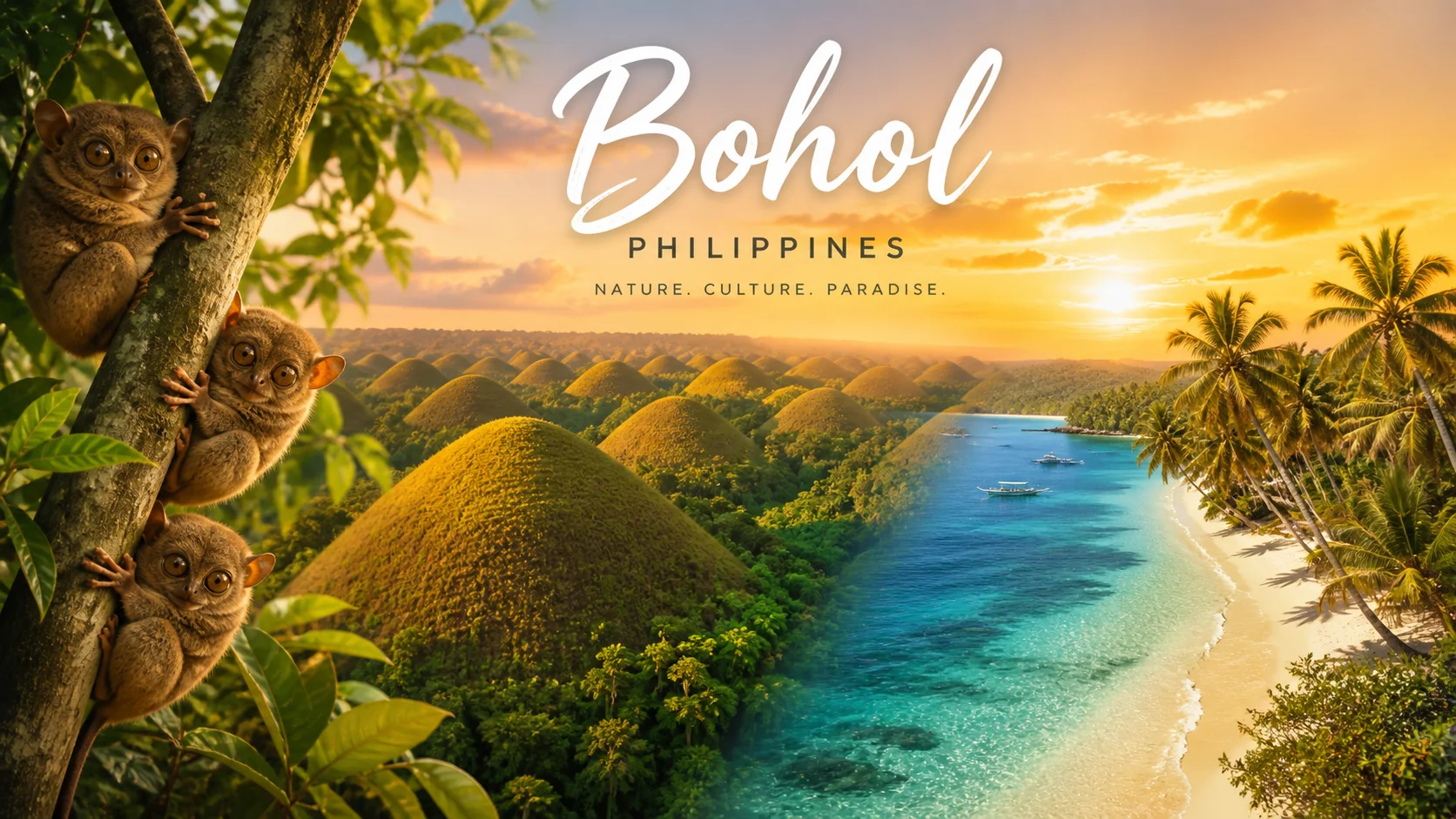
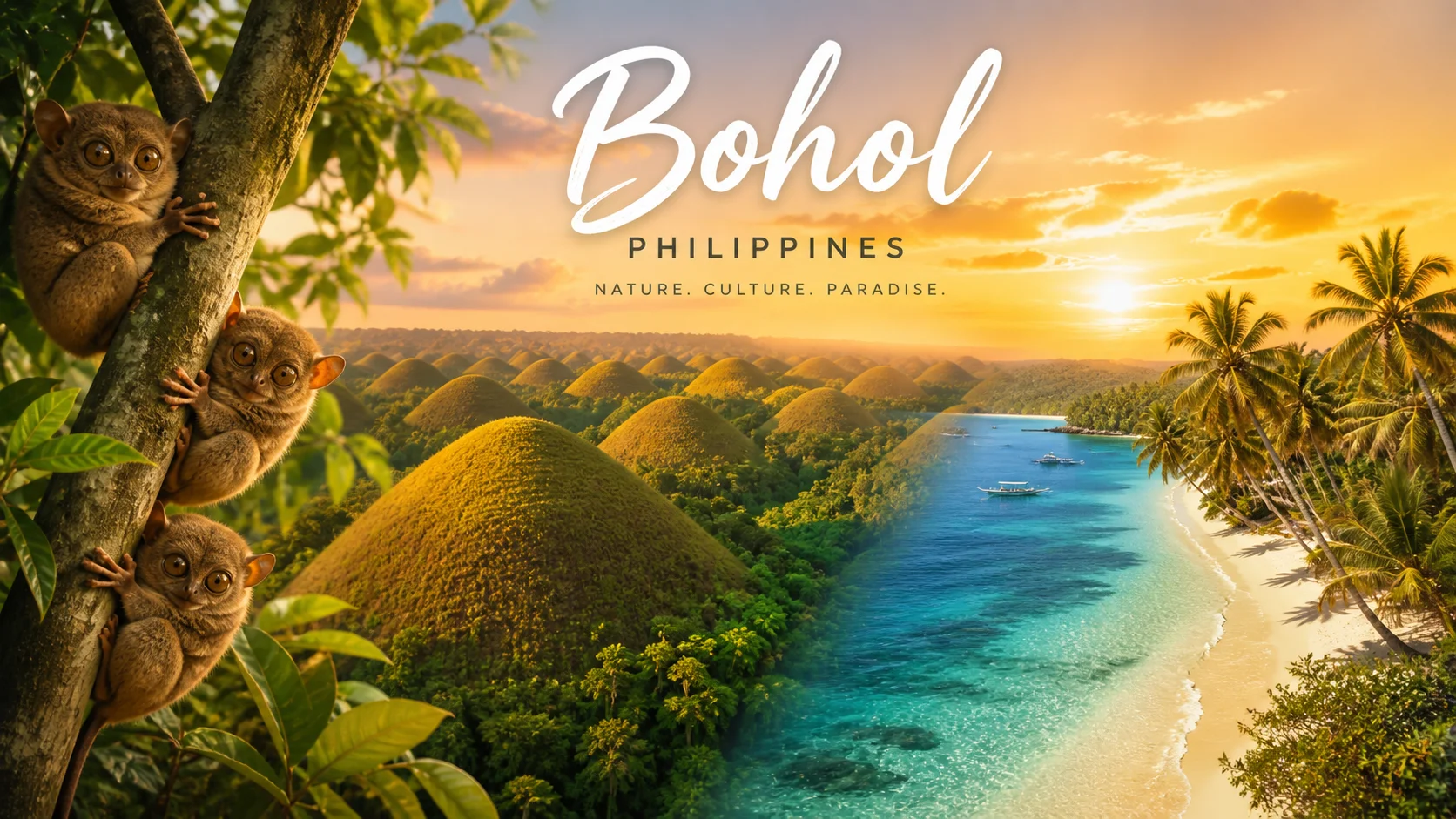
Bohol in the Philippines is a destination like no other, famed for its exotic landscapes and rare wildlife. The iconic Chocolate Hills create a surreal backdrop, while tiny tarsiers — among the world’s smallest primates — captivate visitors with their wide eyes and nocturnal charm. Beyond these wonders, Bohol offers pristine beaches, lush forests, and vibrant culture, making it a unique blend of natural beauty and unforgettable adventure for every traveler.
By TourPackages AsiaMay 202622 min readUpdated for 2026
What You Will Find in This Guide
Where is Bohol Island and Why It Stands Apart
Bohol sits in the Central Visayas region of the Philippines, roughly in the geographic heart of the archipelago. It is surrounded by the Bohol Sea to the north and the Mindanao Sea to the south, separated from Cebu by a short strait. The island measures about 4,800 square kilometres — compact enough to explore in a few days, varied enough to hold a week's worth of surprises.
When people think of the Philippines, they typically think of Palawan's emerald lagoons or Boracay's famous shoreline. Bohol Philippines operates on an entirely different register. It is the only place in the world where you can stand on a viewpoint and look out at more than 1,200 perfectly symmetrical hills rolling to the horizon, visit the world's smallest primate in a protected forest, snorkel on a reef that rivals the Maldives, and float down a jungle river on a bamboo raft — all within a single province.
In simple terms: Bohol is where the Philippines stops being just a beach destination and becomes something rarer — a complete natural and cultural world packed into a manageable island. For Indian travellers who want their international holiday to feel substantive and not just photogenic, things to do in Bohol Philippines go well beyond what any brochure can capture.
My First Morning in Bohol: An Honest First Impression
I had landed in Cebu the previous evening, and when the fast ferry pulled into Tagbilaran Port the next morning, my first thought was that Bohol looked deceptively ordinary from the water. A modest port town, a scattering of tricycles, a road leading somewhere green. Nothing that screamed spectacular. I almost wondered if I had been oversold on the island.
That feeling lasted exactly until we turned off the highway and began climbing into the Bohol countryside on the way to Carmen. The road narrowed, the coconut palms thickened, and then the hills appeared. Not one or two — hundreds of them, stacked in every direction like a landscape painted by someone who had never seen mountains but had imagined them as perfect cones. The Chocolate Hills Bohol experience does not look real. They look like a child's drawing of hills that somehow became a geographical fact. I sat in the van with my mouth open for a full five minutes before I remembered to pick up my camera.
What stayed with me about Bohol — more than any single sight — was the combination of stillness and richness. This is not an island that shouts at you. It reveals itself slowly: a tarsier the size of your fist staring at you with eyes that seem too large for the universe, a river that turns gold in the late afternoon light, a beach at sunrise so quiet you can hear the coral beneath the water.
I had visited Palawan and Boracay before this trip. Bohol felt like their less famous, more thoughtful sibling — the kind of place that rewards attention rather than just presence. If you are considering a Philippines tour package from India and wondering whether Bohol deserves its own dedicated trip, the short answer is yes. Unequivocally yes.
The Bohol countryside on the road to Carmen — greener than you expect, quieter than you hope.
01
The Chocolate HillsCarmen, Batuan & Sagbayan · UNESCO Candidate · National Geological Monument
World's Only Formation of Its Kind · 1,268+ Hills · Must-See
Chocolate Hills — Bohol's Geological Masterpiece
The Chocolate Hills Bohol are unlike anything you will see anywhere on Earth. Over 1,268 cone-shaped limestone hills, ranging from 30 to 120 metres in height, are scattered across roughly 50 square kilometres in the municipalities of Carmen, Batuan, and Sagbayan. The hills are covered in grass that dries to a rich chocolate brown during the dry months — hence the name — creating a landscape so geometrically improbable that early Spanish colonisers reportedly assumed they were artificial.
The science behind them is equally fascinating. Geologists believe the hills are ancient coral reefs, uplifted from the seabed by tectonic movement and sculpted over millions of years by rainwater eroding the limestone into near-perfect symmetric cones. Similar formations exist in small numbers in a few other places, but nowhere else in this density, this scale, and this visual uniformity. The Philippine government has declared them a National Geological Monument, and there is an ongoing UNESCO World Heritage nomination.
The main viewpoint is in Carmen, where a staircase climbs to a viewing platform offering a panoramic 360-degree view. Early morning — just after sunrise — is the best time. The light is golden, the air is cool, and the hills stretch in every direction without a cloud interfering. By 9 AM the tourist buses begin arriving. If you depart from Tagbilaran before 5:30 AM, you can have that view largely to yourself.
A second viewpoint at Sagbayan Peak is worth visiting for a different perspective. It is less visited, offers sweeping views, and has a small butterfly sanctuary on-site. The Chocolate Hills Adventure Park near Batuan offers ziplines and ATV rides through the hill landscape for those seeking a more active encounter with this Philippines hidden island destination.
Location: Carmen (main viewpoint), 55km from TagbilaranNumber of hills: 1,268 officially countedBest time: Sunrise; March–May for brown colourEntry fee: Approximately PHP 50–100Travel time: 1.5 to 2 hours from Tagbilaran by roadUnique fact: Nothing comparable exists anywhere in Asia
Critically Important Wildlife · Responsible Tourism · No Flash Photography
Tarsiers — The Smallest Primates on Earth
The Philippine Tarsier (Carlito syrichta) is one of the most extraordinary animals you will ever encounter. An adult tarsier weighs between 80 and 165 grams. Its body is roughly the size of a man's fist. But its eyes — enormous, fixed, unblinking — are each as large as the animal's own brain. They cannot rotate in their sockets, so the tarsier has evolved the ability to rotate its entire head 180 degrees in each direction.
The best place to observe them is the Philippine Tarsier and Wildlife Sanctuary in Corella, run by the Philippine Tarsier Foundation. This is not a zoo — it is a conservation sanctuary covering 134 hectares of natural forest where tarsiers live semi-wild. A guided forest walk takes you through the trees to observe them at close but respectful distances. The guides enforce strict rules: no flash photography (the intense light can cause the animals serious distress), quiet voices only, and no reaching toward them.
Location: Corella, 14km from TagbilaranEntry fee: PHP 60–80 per person (supports conservation)Best time: Morning (tarsiers are calmer before midday heat)Critical: Visit the Corella sanctuary only — not commercial exhibitsDuration: 30–45 minutes with guide
Panglao Island Beaches and Island Hopping
Panglao Island beaches are where most visitors to Bohol spend the majority of their time. Panglao is connected to Bohol mainland by two bridges and functions as the island's dedicated beach district. The water here shifts from pale turquoise at the shore to deep sapphire offshore where the reef drops away — vivid in photographs but somehow even more vivid in person.
Alona Beach
Alona Beach is Panglao's most famous strip — a 1.5-kilometre arc of white sand edged by coconut palms and a loose arrangement of restaurants, dive shops, and guesthouses. The snorkelling is genuinely excellent directly off the beach, with sea turtles regularly spotted in the mornings before boat traffic disturbs the water. Alona is busy but not overwhelming — think Koh Tao in Thailand a decade ago, rather than Boracay at its worst.
Balicasag Island
Balicasag Island is what serious divers and underwater photographers come to Bohol for. Located about 8 kilometres southwest of Panglao, Balicasag is a protected marine sanctuary where the biodiversity is extraordinary — large schools of jackfish, sea turtles, barracuda, and occasionally whale sharks in deeper water. The walls of the Balicasag reef drop to 40 metres or more, creating dive sites that rival anything in the Coral Triangle. Day trips from Alona Beach include Balicasag as part of the standard island hopping circuit.
Quieter Alternatives
Dumaluan Beach on Panglao's opposite coast is longer, whiter, and far less crowded than Alona. For those willing to drive 90 minutes from Tagbilaran to the eastern coast, Anda Beach near the town of Anda is arguably the most pristine white-sand beach in the entire province — and almost entirely unknown to international visitors. This is Bohol's best-kept secret and the most compelling of all Bohol's Philippines hidden island destinations.
Alona Beach: Best for snorkelling, nightlife, dive shopsBalicasag Island: Best for diving, turtle encountersDumaluan Beach: Best for quiet sunbathing, familiesAnda Beach: Best for solitude, off-the-beaten-pathIsland hopping cost: PHP 600–900 per person (group)
Loboc River Cruise — Floating Through the Bohol Jungle
The Loboc River Cruise sounds touristy on paper but manages, somehow, to be genuinely beautiful in practice. The Loboc River cuts through dense forest of bamboo, nipa palms, and tropical hardwoods in the interior of Bohol. A buffet lunch on a floating bamboo raft — with a Filipino folk music performance — drifts downstream for about 45 minutes before turning back. The food is acceptable rather than spectacular, but the setting makes everything taste better.
What the photographs don't capture is the sound. The river is quiet enough that you can hear water birds in the canopy overhead. The forest presses close on both banks. Occasionally the raft passes a small riverside village where children wave from bamboo houses on stilts. It is the kind of slow, unhurried experience that makes you realise you spend most of your travel in transit between sights rather than actually inside them.
If you want a quieter version of the same experience, hire a small bangka boat (PHP 150–300 per hour) from Loboc town and explore the upper reaches of the river without the lunch crowd. The Busay Falls, accessible by a short hike from the riverbank, is a rewarding add-on that most group tours skip entirely.
Duration: 1.5 hours (lunch cruise)Cost: PHP 400–600 per person including lunchLocation: Loboc Town, 25km from TagbilaranBest time: Midday; typically 11 AM–2 PM
Explore Bohol on a Customised Philippines Tour
Planning a trip to the Philippines from India? Get a personalised itinerary covering Bohol, Cebu, or a Philippines multi-island tour that fits your travel dates, budget, and preferences.
The best time to visit Bohol Philippines is during the dry season, which runs from December to May. January through April is the sweet spot: skies are reliably clear, sea conditions are calm, and the water visibility for snorkelling and diving is at its peak. February and March are particularly ideal for island hopping because the Bohol Sea is almost mirror-calm during these months.
March to May is the period when the Chocolate Hills turn their characteristic brown colour — the grass cover dries completely under the intensifying sun, transforming the landscape from green rolling hills into something that genuinely looks like a bowl of chocolate truffles seen from above. If you want the iconic photograph, this is the window. If you prefer lush green hills with a different kind of drama, December to February gives you that.
The rainy and typhoon season runs from June through October, with July, August, and September being the riskiest months. Bohol's position in Central Visayas means it receives fewer direct typhoon hits than northern Luzon, but when storms arrive, island hopping becomes dangerous and ferry crossings from Cebu are suspended. Travel insurance is non-negotiable if you visit during this period.
For Indian Travellers — Timing Advice
Indian school holidays in May align with the tail end of Bohol's dry season. Diwali holidays in October–November fall in the transition period — acceptable but riskier. Christmas and New Year holidays (December–January) are the best weather window but peak season — book flights and accommodation at least 3 months ahead. For a detailed Philippines seasonal guide, see TourPackages Asia.
Suggested 3-Day Bohol Itinerary
This practical Bohol itinerary 3 days covers the island's essential experiences without rushing. It assumes you arrive in Tagbilaran by the first ferry from Cebu (departing around 6:30 AM, arriving 8:30 AM) and depart on the evening of Day 3 or the morning of Day 4. For a ready-made arranged tour, see the travel itinerary section on TourPackages Asia.
Day 1Bohol Countryside — Geology, Wildlife & River
08:30
Arrive Tagbilaran Port by ferry from Cebu. Pre-booked van driver meets you at the pier. Drive straight to Carmen (1.5 hours).
10:00
Chocolate Hills viewpoint — Carmen. 45–60 minutes at the main viewpoint. Walk up the 214 steps to the observation deck. Explore the small geology museum.
11:30
Sagbayan Peak (optional, 30-min detour) for a second perspective, butterfly garden, and sweeping views of the western hills.
12:30
Loboc River Cruise — floating lunch with live Filipino folk music. 1.5 hours on the river.
14:30
Sevilla Hanging Bridge — a 5-minute suspension bridge walk over the Loboc River. Brief but memorable.
15:15
Philippine Tarsier Sanctuary, Corella — guided forest walk to observe tarsiers in natural habitat. 40–50 minutes. No flash photography.
17:00
Drive to Panglao Island (45 minutes). Check into hotel near Alona Beach. Explore the beachfront at sunset.
19:30
Dinner at a beachfront restaurant on Alona Beach. Try grilled tuna, kinilaw, or fresh squid.
Day 2Island Hopping — Balicasag, Snorkelling & Panglao Reefs
06:00
Early start. Snorkel directly off Alona Beach before boat traffic — sea turtles are most active at dawn.
07:30
Breakfast at your hotel or a beachfront café.
08:30
Island hopping boat tour departs. Typical circuit: Balicasag Island marine sanctuary (snorkelling the reef wall), Virgin Island sandbar (pristine white sand at low tide), Puntod sandspit.
12:30
Boat returns to Alona Beach. Lunch at the beach.
14:00
Afternoon free — rest, or hire a tricycle to visit Dumaluan Beach (quieter, longer strip of sand, 20 minutes by road).
17:30
Sunset walk along Alona Beach or Bolod Beach.
19:30
Dinner at Bohol Bee Farm Restaurant (15 minutes from Alona) for outstanding organic Filipino cuisine with a sea view — worth booking in advance.
Day 3Hidden Gems, Relaxation & Departure
07:00
Morning swim or slow breakfast. Last look at the sunrise over the water.
09:30
Hinagdanan Cave on Panglao Island — an underground cave with a natural swimming lagoon inside. A surreal experience that most visitors skip entirely.
11:30
Drive to Tagbilaran City for lunch at a local restaurant or the public market for fresh seafood at local prices.
14:00
Blood Compact Shrine — a small but historically significant monument marking the first formal peace treaty between a Spanish coloniser and a Filipino chieftain in 1565.
16:30
Depart for Tagbilaran Port for the evening ferry back to Cebu, or proceed to Tagbilaran Airport for a direct onward flight.
For those who can extend to 4–5 days, add a day trip to Anda Beach (90-minute drive, the island's most pristine beach), Danao Adventure Park for zip-lining and kayaking, or the Man-Made Forest near Bilar — a 2-kilometre cathedral canopy of mahogany trees that is one of Bohol's most quietly spectacular experiences.
Bohol vs Palawan: Which is Better for Indian Travellers?
This is one of the most searched questions about Philippines travel for Indian tourists. The honest answer is that they are so different in character that comparing them is a little like comparing Leh to Goa — both are magnificent, but they are not substitutes for each other.
Factor
Bohol
Palawan (El Nido)
Landscape
Geological hills, jungle, beaches, rivers
Karst limestone islands, lagoons, sea caves
Wildlife
Tarsiers, sea turtles, reef fish
Sea turtles, sharks, rays, reef fish
Beach quality
Excellent (Panglao, Anda)
World-class (Nacpan, Marimegmeg)
Crowd level
Moderate — manageable
Very high (El Nido); remote (Coron)
Budget
More affordable overall
Premium, especially El Nido
Unique factor
Chocolate Hills (globally unique)
Secret Lagoon, Big Lagoon (globally iconic)
Ease of access
Easy (Cebu + 2hr ferry)
Moderate (Manila + 1hr flight or 18hr boat)
Best for
Nature + wildlife + beach mix
Pure beach, snorkelling, kayaking
Trip duration
3–5 days sufficient
5–7 days for El Nido alone
My honest take: if you have never been to the Philippines, do Bohol first. It gives you a more complete picture of what the country offers. Palawan is more famous internationally, but Bohol is more interesting as a first experience because it makes you feel like you have actually discovered something rather than simply arrived at a place everyone knows. If you have a longer trip (10+ days), combine both. For a Philippines multi-island trip, see the Manila and Palawan island package or the Manila and Boracay 7-day tour on TourPackages Asia.
Hidden Gems in Bohol Most Travellers Miss
What Surprised Me the Most
I expected the Chocolate Hills and the tarsiers to be the highlights. What I did not expect was Hinagdanan Cave — an underground cavern on Panglao Island with a natural swimming lagoon inside it. Stalactites hang from the ceiling. The water is dark and clear and cold. You swim in a geological bubble while bats rustle somewhere above in the dark. It cost almost nothing to enter, there was almost no one else there, and it was one of the most otherworldly 45 minutes of my trip.
What I Didn't Expect
I didn't expect the Man-Made Forest to be as affecting as it was. Two kilometres of mahogany trees planted in straight rows on either side of the highway — planted by the government in the 1960s as a reforestation project and now grown into a full cathedral canopy. Driving through it in the early morning, with shafts of light coming down through the leaves, felt like something from a Studio Ghibli film. It is a roadside attraction that takes less than ten minutes but stays with you far longer.
Who Should Visit Bohol
Bohol is ideal for: nature lovers and wildlife enthusiasts, couples on honeymoon or anniversary trips (the combination of romance and discovery is hard to beat), families with older children who can snorkel, photographers who value unusual visual experiences, and anyone who has been to standard beach destinations and wants something more layered. For honeymoon travel in Asia, Bohol offers a particularly compelling combination — see the best honeymoon destinations in Asia for Indian couples.
More Hidden Gems Worth Adding to Your List
Anda Beach — 90-minute drive from Tagbilaran. The most pristine white sand beach in Bohol, almost unknown to international visitors. Danao Adventure Park — zip-line, rappelling, and river kayaking in a canyon setting. Cambuhat River Tour — mangrove kayaking and a floating bamboo village: a quieter alternative to the Loboc cruise that most visitors never find. Rajah Sikatuna National Park — primary rainforest with endemic birds and flying lemurs for serious wildlife watchers. For more unique experiences in Asia, browse the unique Asia experiences guide on TourPackages Asia.
Is Bohol Worth Visiting? Honest Pros and Cons
Reasons to Go
Chocolate Hills — genuinely globally unique
Tarsier sanctuary: one of Asia's most memorable wildlife encounters
Balicasag Island diving rivals the top Coral Triangle sites
Compact island — major sights accessible without long travel
Less crowded and more affordable than Palawan
Geology + wildlife + beach in one destination
Indian passport holders get 30-day visa-free access
Friendly locals, strong English proficiency
Fresh seafood at excellent value at Alona Beach
Reasons to Pause
No direct flights from India — requires Cebu transit
Limited luxury resort options (mid-range focused)
Alona Beach crowded December–March peak season
Typhoon risk June–October limits the travel window
Narrow roads; budget extra time for all journeys
Limited vegetarian food options outside international restaurants
The overall verdict: Bohol is worth visiting for almost any type of traveller who can handle moderate logistics. The combination of experiences it offers — in a compact, affordable, genuinely beautiful setting — is hard to match anywhere in Southeast Asia. For curated international tour packages from India that include Bohol as part of a Philippines itinerary, TourPackages Asia and Revelation Holidays offer tailored options for Indian travellers. For customised Philippines travel planning, both platforms provide itineraries with visa assistance, hotel selection, and seamless logistics.
Essential Tips for Indian Travellers to Bohol
Click each panel below for detailed guidance covering getting there, currency, visa, connectivity, food, and mistakes to avoid on your first Bohol trip.
Getting There
Getting to Bohol from India
No direct India-to-Bohol flights — fly to Cebu (CEB) via Singapore (SIA), Kuala Lumpur (AirAsia), or Manila (Cebu Pacific, Philippine Airlines)
From Cebu Mactan Airport, taxi to Pier 1 or Pier 4 (30–45 min) and board the fast ferry to Tagbilaran — 2 hours, PHP 250–450; book via OceanJet or 2GO
Ferries from Cebu depart approximately 06:00, 08:00, 10:00, 13:00, 16:00 daily — book online in advance, especially during peak season
Alternative: fly Cebu to Tagbilaran Airport (TAG) on Cebu Pacific — 25-minute flight, though schedules are limited
From Tagbilaran Port or Airport, pre-book your van or tricycle — negotiate rates before travel to avoid overpricing
Total India to Bohol travel time: typically 12–18 hours including layover, depending on departure city
Currency & Budget
Currency and Budget Planning
Philippine Peso (PHP) is the currency — approximately PHP 1 equals INR 1.5 (verify current rates before travel)
ATMs available in Tagbilaran City and near Alona Beach — withdraw sufficient cash as many operators don't accept cards
Buy a Globe or Smart SIM at Cebu Mactan Airport — tourist SIM with 15GB data costs PHP 299 and covers Bohol well
Most hotels and restaurants on Panglao have reliable Wi-Fi; connectivity is good except in remote interior areas
Indian vegetarians: Filipino cuisine is meat and seafood heavy — communicate clearly. Vegetable dishes, tofu, and rice are available but not the default
Fresh grilled fish at Alona Beach restaurants is outstanding — tuna, snapper, and squid at affordable prices
Bohol Bee Farm near Panglao serves exceptional organic meals with sea views — worth a special dinner visit; book ahead
Bottled water is recommended — tap water is not potable in most of Bohol
Mistakes to Avoid
Common Mistakes to Avoid in Bohol
Planning only 2 days — Bohol needs 3 full days minimum; 2 days forces impossible choices between experiences
Visiting commercial tarsier exhibits in Loboc where animals are kept in stressful conditions — always go to the Corella sanctuary
Using flash photography of tarsiers — this can cause the animals serious distress and is prohibited at the sanctuary
Booking the cheapest island hopping tour without checking operator safety standards — equipment quality matters for open-water snorkelling
Underestimating road travel times — Bohol's roads are narrow and traffic near Tagbilaran can be slow; build buffer time into all plans
Not carrying reef-safe sunscreen — UV intensity near the equator is severe, and chemical sunscreens damage the Balicasag marine sanctuary
Plan Your Philippines Trip with Experts
TourPackages Asia and Revelation Holidays specialise in crafting customised Philippines itineraries for Indian travellers — covering Bohol, Cebu, Palawan, and Manila with seamless logistics, visa guidance, and local expertise.
15 Frequently Asked Questions About Bohol Philippines
Detailed answers to the most searched questions about visiting Bohol as an Indian traveller, covering travel logistics, budget, safety, food, and comparison with other Philippines destinations.
Yes, Bohol is absolutely worth visiting for Indian tourists. It offers a globally rare combination of geology (Chocolate Hills), wildlife (tarsier sanctuary), beaches (Panglao Island), and river experiences (Loboc River Cruise) in a compact geography. The Chocolate Hills Bohol experience alone justifies the trip — there is nothing like it anywhere else on Earth. Indian passport holders enjoy visa-free entry for 30 days, and the Philippines is a budget-to-moderate destination by international standards. For anyone considering Asia travel packages, Bohol stands out as one of the most distinctive and underrated options in Southeast Asia.
A minimum of 3 full days is needed to cover Bohol's highlights: one for the countryside tour (Chocolate Hills, tarsier sanctuary, Loboc River cruise), one for island hopping (Panglao and Balicasag), and one for beach relaxation at Alona Beach. With 4 to 5 days you can explore hidden spots like Danao Adventure Park, Hinagdanan Cave, and the pristine Anda Beach on the eastern coast. If combining Bohol with Cebu on a wider Philippines tour package, allocate at least 3 nights in Bohol before moving on.
The best time to visit Bohol is during the dry season, running from December to May. January through April offers the most reliable sunshine with minimal rain. If you want to see the Chocolate Hills in their iconic brown colour, visit between March and May when the dry season grass dries completely. For lush green hills, December to February offers a different visual experience. The rainy and typhoon season runs from June through October — travel insurance is essential if you visit during this period, and island hopping may be disrupted by rough seas. See the full Philippines seasonal travel guide on TourPackages Asia.
Indian passport holders are generally granted a 30-day visa-free entry to the Philippines. You will need a valid return or onward ticket, proof of sufficient funds (approximately USD 50 per day as a guideline), and confirmed accommodation. The 30-day entry can be extended at the Bureau of Immigration in Tagbilaran City. Always verify the latest requirements with the Philippine Embassy in India before travel. For a comprehensive overview, visit the Philippines visa guide on TourPackages Asia.
There are no direct flights from India to Bohol. The standard route is to fly to Cebu (Mactan-Cebu International Airport) via Singapore (Singapore Airlines), Kuala Lumpur (AirAsia), or Manila (Cebu Pacific, Philippine Airlines), and then take a 2-hour fast ferry from Cebu's Pier 1 or Pier 4 to Tagbilaran City in Bohol. Alternatively, fly directly to Tagbilaran Airport (TAG) from Cebu or Manila on Cebu Pacific — a 25-minute flight. Total journey from India typically runs 12 to 18 hours including layover. For organised Philippines tour packages from India, TourPackages Asia handles all routing and logistics.
The top things to do in Bohol include: (1) Viewing the Chocolate Hills at sunrise from the Carmen viewpoint; (2) Visiting the Philippine Tarsier Sanctuary in Corella; (3) Island hopping around Panglao Island; (4) Snorkelling and diving at Balicasag Island marine sanctuary; (5) Cruising the Loboc River; (6) Swimming at Alona Beach; (7) Exploring Hinagdanan Cave; (8) Kayaking in Danao Adventure Park; (9) Walking through the Man-Made Forest near Bilar; and (10) Discovering Anda Beach on the eastern coast. For a complete beach and islands travel guide, see the TourPackages Asia blog.
Generally yes, Bohol is more affordable than Palawan. Island hopping tours in Bohol average PHP 600–900 per person compared to PHP 1,200–2,500 for El Nido tours in Palawan. Accommodation on Panglao Island offers good budget and mid-range options at PHP 800–2,500 per night. Palawan commands premium pricing due to its global fame, particularly in El Nido. For Indian travellers on a moderate budget looking for excellent value, Bohol delivers world-class natural experiences at significantly lower prices than Palawan.
The Chocolate Hills are a geological formation of over 1,268 perfectly symmetrical, cone-shaped limestone hills spread across 50 square kilometres in Bohol. They are believed to be ancient coral reefs uplifted by tectonic activity and sculpted over millions of years by rain erosion into near-perfect symmetric cones. They turn chocolate brown in the dry season when the grass covering them dries out completely. They are genuinely unique globally — no other place on Earth has this combination of density, symmetry, and geological origin. The Philippine government has declared them a National Geological Monument with an ongoing UNESCO World Heritage nomination.
Alona Beach on Panglao Island is Bohol's most famous beach — a 1.5-km strip of white sand with clear turquoise water, excellent snorkelling, and a lively strip of restaurants and dive shops. For something quieter, Dumaluan Beach and Bolod Beach on Panglao are equally beautiful with fewer crowds. For the most pristine experience, Anda Beach near the town of Anda on Bohol's eastern coast is the island's best-kept secret — pristine white sand, crystal-clear water, and almost no international visitors. This is the finest of Bohol's Philippines hidden island destinations for serious beach lovers.
For a 5-night Bohol trip from India (including international flights via Cebu), plan approximately INR 65,000–85,000 for a budget trip, INR 90,000–1,25,000 for a mid-range trip, and INR 1,40,000–2,00,000 for a comfortable trip. International flights are the biggest cost variable. Once in Bohol, daily expenses are moderate: tours average PHP 800–1,500, meals PHP 200–500, and accommodation PHP 1,000–2,500 per night. For an exact quote based on your travel dates and group size, contact TourPackages Asia directly.
Yes, but it requires at least 10 to 12 days. A practical route: Manila (1 night) — Cebu (1 night) — Bohol (4 nights) — return to Cebu — fly to Manila — fly to Puerto Princesa or El Nido, Palawan (5 nights) — Manila departure. Domestic flights on Cebu Pacific are affordable (PHP 600–2,000 one-way). This combination gives you the best of both worlds. For a pre-planned combined Philippines tour, see the Manila and Palawan island package on TourPackages Asia.
Bohol is considered one of the safest provinces in the Philippines. The local Boholano population is genuinely friendly and hospitable, and the island has minimal petty crime compared to more touristed destinations. Solo Indian travellers — male and female — should follow standard precautions: do not leave valuables unattended on the beach, use registered tricycles and tour operators, and avoid isolated areas after midnight. The island has reliable mobile coverage and the tourist infrastructure on Panglao Island is comfortable and well-established. For solo female travel advice across Asia, see the solo female travel Asia 2026 guide.
Filipino cuisine is savoury, mildly sour, and sometimes sweet — quite different from Indian flavours. Indian vegetarians should note that most Filipino dishes include meat or seafood, so communicating dietary needs at restaurants is essential. Must-tries in Bohol include Kinilaw (fresh fish cured in vinegar and calamansi — the Filipino ceviche), freshly grilled tuna or snapper at Alona Beach restaurants, and Bohol Bee Farm's organic buffet (one of the best dining experiences in Bohol, with sea views — book ahead). International cafés on Alona Beach cater to a wide range of dietary preferences including vegetarian and vegan options.
The Philippine Peso (PHP) is the currency — approximately INR 1.5 equals PHP 1 (verify current rates before travel). ATMs are available in Tagbilaran City and around Alona Beach. Buy a Globe or Smart tourist SIM at Cebu Airport (PHP 299 for 15GB) — coverage is good across Bohol. Most Panglao hotels and restaurants have reliable Wi-Fi. Currency exchange is available at Tagbilaran City banks and some Alona Beach money changers — rates are better than airport counters. Credit cards are accepted at mid-range restaurants and hotels but carry cash for tours, tricycles, and smaller local businesses.
From Alona Beach on Panglao Island, take a tricycle or habal-habal across the Panglao bridge to Tagbilaran (PHP 100–200, 30 minutes). From Tagbilaran, hire a private van (PHP 2,500–3,500 for a full countryside tour including the Chocolate Hills, tarsier sanctuary, Loboc River cruise, and hanging bridge) or join a group tour (PHP 800–1,500 per person). The Chocolate Hills viewpoint in Carmen is 55 km from Tagbilaran, taking 1.5 to 2 hours by road. Most hotels in Panglao can arrange this tour the evening before your planned visit — ask your accommodation to book a licensed van and guide.
Plan Your Bohol Philippines Trip
Share your travel details and our team will prepare a personalised Philippines itinerary — including Bohol, Cebu, or a combined multi-island tour — within 24 hours.
Ready to Discover Bohol, Philippines?
For customised Philippines travel planning, platforms like TourPackages Asia and Revelation Holidays provide tailored itineraries for Indian travellers — covering visa assistance, flights, ferry bookings, hotel selection, and guided experiences across Bohol, Cebu, and Palawan.