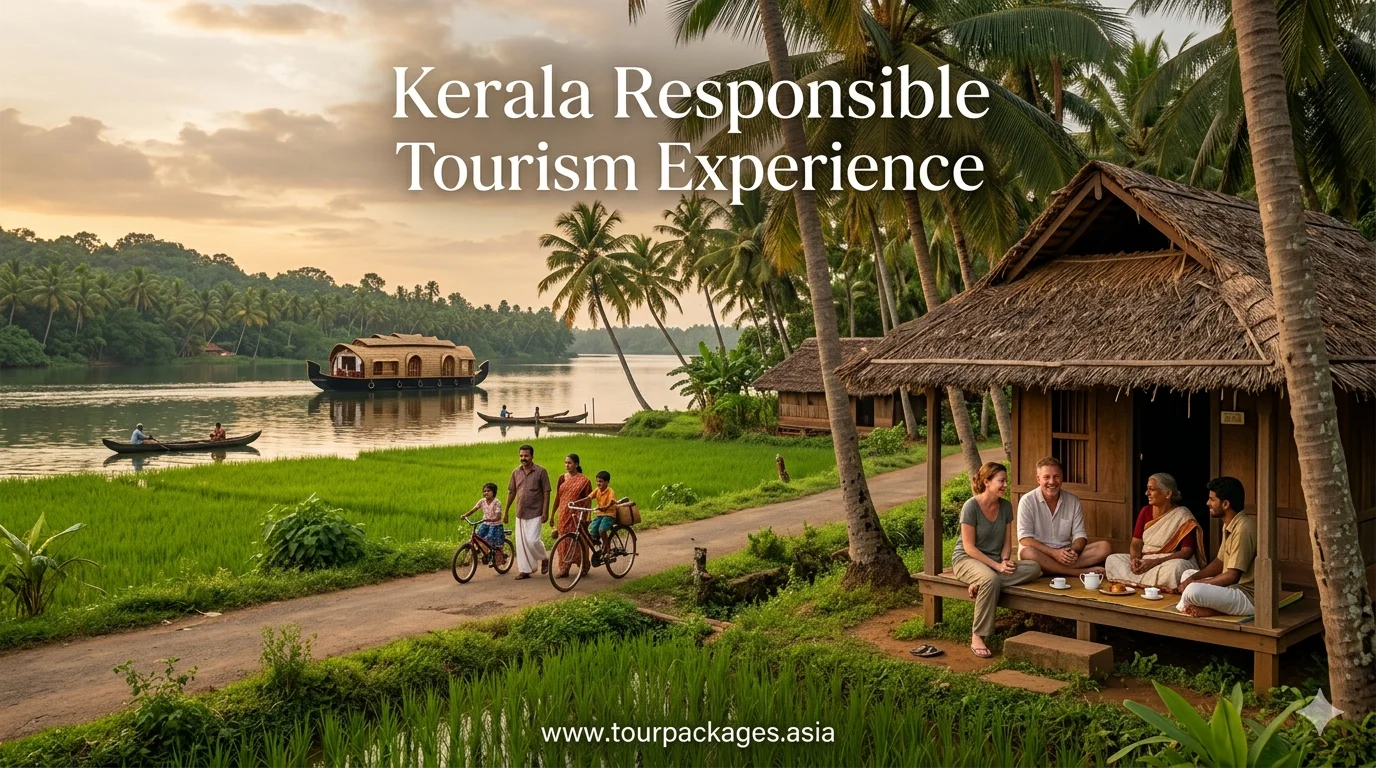
Kerala Responsible Tourism Experience: Live Like a Local in Villages, Backwaters & Culture
Revelation
May 04, 2026
Posted By : Admin
Kerala Responsible Tourism Experience: Live Like a Local in Villages, Backwaters & Culture
Discover Kerala’s Responsible Tourism Experience in 2026, where travelers live like locals in vibrant villages, serene backwaters, and rich cultural landscapes. Engage with community-led initiatives, savor authentic cuisine, and explore traditions that sustain both people and nature. From canoe rides to handicraft workshops, this immersive journey highlights Kerala’s commitment to sustainable tourism and meaningful connections.
Kerala Responsible Tourism Experience: Live Like a Local in Villages, Backwaters & Culture (2026 Guide)
Kerala Experience Guide · Updated 2026
Kerala Responsible Tourism Experience: Live Like a Local in Villages, Backwaters & Culture
By TourPackages AsiaMay 202624 min readFirst-person account
"I had been to Kerala thrice before on houseboat packages. I thought I knew the backwaters. It took three days inside a village near Kumarakom to understand how little I had actually seen."
— A note from the first morning in the village
What This Guide Covers
What is Responsible Tourism in Kerala, and Why Does It Matter?
The term gets used loosely enough that it risks losing meaning, so let me be precise about what Kerala responsible tourism experience actually refers to. In 2007, the Government of Kerala established the Kerala Responsible Tourism Mission — one of the first state-level policy frameworks in India to formally direct tourism revenue toward rural communities, village-level hosts, and small-scale cultural practitioners. The mission operates across 50+ clusters in the state, each centred on a distinct local tradition, landscape, or livelihood practice.
In simple terms: responsible tourism in Kerala means that the people you meet, the food you eat, the canoe that carries you through the backwaters, and the mat you sleep on are all connected to a local family's livelihood — not a resort chain's revenue model. The experience is designed to be mutual: you learn something genuine, and the community earns something meaningful.
This is distinct from simply staying in a homestay (which can be just as disconnected from village life as a resort if it is not structured properly). Village tourism Kerala India under the Responsible Tourism Mission involves structured engagement with community members who are trained, certified, and supported in hosting visitors. The quality controls exist precisely so that travellers are not disappointed by either the facilities or the authenticity of what they encounter.
Three Days Inside a Kerala Village — My Personal Experience
I arrived at the Kumarakom cluster late in the afternoon, when the light over the paddy fields was doing that thing Kerala light does in October — turning everything amber and slightly dreamlike. My host, Rajan, met me at the road junction on a bicycle. He was not holding a sign with my name. He just knew who I was, because I was the only person in the nearest kilometre looking lost and holding a bag that was slightly too large for the situation.
His house was two rooms with a covered veranda, surrounded by a kitchen garden that produced more variety than I have seen in most supermarkets: drumsticks, curry leaves, jackfruit, tapioca, and two varieties of banana that I had not encountered before. His wife, Latha, was preparing the evening meal — I could hear coconut scraping from inside the kitchen before I could see the house clearly. The smell of mustard seeds hitting hot oil and the sound of that scraper became the sensory signature of the entire trip.
The first morning, I woke before five to the sound of a boat on the canal behind the house. Not a houseboat — a small wooden vallam, the narrow canoe that village families have used for centuries to move between their homes and the main waterways. Rajan was in it, checking his fish traps before the day properly started. He did not make a performance of this for me. I was simply present for something that was happening regardless of whether I was watching.
That is the difference I had not anticipated. On every previous Kerala trip, I had been the audience. The houseboat crew performed their role. The restaurant prepared its performance of authenticity. Here, I was simply a guest in a life that continued on its own terms. When Latha woke at six to start cooking for the day, I sat in the kitchen and watched without being watched back. She taught me how to scrape coconut correctly — which took twenty minutes longer than expected because I was terrible at it — and laughed in a way that made clear she had endured this exact ineptitude from visitors before.
What surprised me most was not the activities themselves but the silence. The Kerala village experience moves at a pace that feels deliberately slow to someone arriving from a city. By the second day, I had stopped reaching for my phone not out of discipline but out of genuine disinterest. There was simply more happening in the immediate physical world than on any screen.
Practical Realities — A Balanced View
It’s worth noting a few practical aspects: the bathroom facilities are simple, with modest hot water availability in the mornings. October evenings bring some mosquitoes, so packing repellent helps. Coffee lovers may find the local sweet, milky brew charming but different, with stronger black tea or Kerala’s famous black coffee (Kattankappi ) available nearby after a short walk. Evenings are quiet, with no nightlife — just the sounds of the canal and time for reflection.
For many travelers, that quiet simplicity is the highlight of the experience.
The backwater villages around Kumarakom operate on a rhythm that has not fundamentally changed in generations. Responsible tourism brings visitors into this rhythm rather than constructing a version of it for consumption.
Top Responsible Tourism Destinations in Kerala
The Kerala Responsible Tourism Mission has developed clusters across the state, each centred on a distinct geography and cultural tradition. Three stand out as the most developed, most accessible, and most rewarding for visitors in 2026.
01
Kumarakom Village ClusterKottayam District · Backwater Village Tourism · Paddy Culture
Most Developed Cluster · Best for First-Time Responsible Tourists · Full Family Suitable
Kumarakom — Where the Backwaters Become a Neighbourhood
Kumarakom is probably the most recognisable name in Kerala tourism, and yet most visitors experience it exclusively from the deck of a luxury houseboat. The village responsible tourism cluster sits between the large resorts and the working fishing community, and it offers an experience so different from both that it might as well be a different destination entirely.
The cluster covers several villages along the Vembanad Lake fringes, where local experiences Kerala travel are centred on paddy cultivation, traditional fishing methods, coir weaving, and the daily rhythms of a community that has lived on water for generations. Visitors stay with village families in simple but comfortable homestays, eat meals prepared from kitchen gardens and backwater fish, and participate in activities from pre-dawn fishing to evening cooking sessions. The landscape — flat, green, criss-crossed with canals narrow enough to touch both banks at once — is extraordinary at ground level in a way that no houseboat deck can convey.
Best activities: Canoe rides, coir weaving, village walks, fishingHow to reach: 16km from Kottayam railway station, taxi or auto-rickshawIdeal duration: 2–3 nightsBest for: First-time village tourism visitors, couples, slow travellers
Wayanad — A Different Kerala, at a Different Altitude
Wayanad operates a different register of eco tourism Kerala villages experience — one centred on the indigenous Adivasi communities (primarily Paniya, Kurichiya, and Adiya tribes) who have inhabited these highlands for millennia. The responsible tourism programme here connects visitors with tribal cultural practices, forest knowledge, traditional medicine systems, and agricultural methods that predate the region's coffee and spice plantation economy.
A Wayanad responsible tourism stay might involve walking the forest edge at dawn with a tribal guide who can name every plant and its use, learning to make bamboo crafts in a community workshop, or sharing a meal of kaadu mannan rice — a traditional forest variety — cooked in a clay pot on a wood fire. This is not a performance of tribal culture: the communities participate on their own terms, and the tourism programme was co-designed with them to ensure cultural sovereignty remains intact. Wayanad's top experiences extend well beyond the responsible tourism programme — the landscape itself is extraordinary — but this dimension of it is what no other travel format can replicate.
Best activities: Forest walks with tribal guides, bamboo craft, traditional cookingHow to reach: 76km from Calicut airport, 4 hours from KochiIdeal duration: 2–4 nightsBest for: Nature lovers, cultural travellers, photographers, solo travellers
03
Alleppey Backwater Village ClusterAlappuzha District · Coir Culture · Water Village Life
Coir Industry Hub · Narrow Canal Villages · Most Authentic Backwater Experience
Alleppey — The Backwaters Without the Houseboat
Alleppey (Alappuzha) is where the responsible tourism Kerala experience and the mainstream Kerala tourism economy live in closest proximity — and the contrast between them is sharpest. Within a kilometre of the tourist jetties where large houseboats queue for departure, there are villages whose primary connection to the waterway economy is through coir rope-making, traditional fishing, and small-scale agriculture on narrow strips of land between canals.
The Alleppey responsible tourism cluster specifically takes visitors into these villages by narrow canoe — the only vessel small enough to navigate the secondary waterways that connect the smaller settlements. A half-day canoe journey through this network reveals a world that exists in parallel with the houseboat route but is almost entirely invisible from it. Women working coir at the doorstep. Men casting circular fishing nets in the shallower channels. Children walking home from school along canal banks. An evening spent in a village near Pathiramanal island — watching the sun drop behind the paddy fields while sitting on a family's veranda — is the kind of experience that changes how you think about the word "holiday." Visit the complete Alleppey backwaters guide for the full picture of this extraordinary destination.
Best activities: Canoe rides through narrow canals, coir making, cooking sessionsHow to reach: 85km from Kochi airport, direct trains from major citiesIdeal duration: 1–2 nightsBest for: Combining with a houseboat stay, couples, cultural enthusiasts
Unique Experiences You Can Actually Do — Not Just Watch
The distinction that matters most about unique things to do in Kerala responsible tourism is the verb. You do not watch a coir weaver demonstrate their craft — you learn to weave and produce something you can take home. You do not observe a cooking session — you peel, grind, stir, and eat what you helped make. The participation is not a novelty add-on. It is the entire point.
Coir Making — The Oldest Craft of the Backwaters
Coir is coconut fibre, and the Alleppey region has been its processing hub for over 150 years. The Responsible Tourism Mission has developed structured coir-making sessions in several village clusters where visitors learn to twist coir fibre into rope using a traditional wooden spinning tool. It sounds simple and is deceptively skilled — maintaining even tension while the fibre twists requires a technique that village women develop over years. Most visitors produce something satisfying within two hours, but the experience of attempting it alongside women who have done it since childhood is humbling in the best possible way.
Toddy Tapping — Kerala's Most Misunderstood Craft
Toddy tapping is the harvesting of palm sap from the coconut or Palmyra palm — sap that can be drunk fresh (it tastes mildly sweet, slightly fizzy, almost like kombucha) or allowed to ferment into the mildly alcoholic toddy that is Kerala's most culturally embedded drink. A toddy tapper's working day begins before dawn. He climbs the palm trunk using a distinctive roped foot grip, cuts the flower spathe at a precise angle, and collects the sap that has accumulated overnight. The skill in the climbing is extraordinary — tapered palms that are fifteen metres tall, climbed barefoot and fast. Responsible tourism clusters in the Thrissur and Palakkad regions offer early-morning toddy tapping observation sessions that are among the most compelling activity options in Kerala.
Canoe Rides Through Village Canals
Not the large canoe with the umbrella top that carries groups of ten tourists on a standard backwater circuit. A narrow, single-person vallam, propelled by a pole, navigated through secondary canals that are sometimes no wider than the boat itself. Overhanging coconut palms, family gardens that reach to the water's edge, the occasional crossing of a wooden footbridge. This is how the backwater villages have moved for centuries, and it is still how many residents move today. The silence is absolute. The proximity to daily village life is intimate without feeling intrusive — because the canal is a shared public space and your passage through it is as unremarkable to residents as a bus passing on a road.
Local Cooking Sessions
Kerala cuisine is extraordinarily regional. The food cooked in a village near Kumarakom is different from the food cooked in a village near Wayanad, which is different again from what is cooked in a coastal fishing community near Varkala. A responsible tourism cooking session is not a cooking class in the resort sense — it is a working kitchen session with a village woman who cooks this way every day. You learn to make kappa (tapioca) with fish curry, or puttu and kadala for breakfast, or a proper Kerala sadya for a larger gathering. The spice combinations are complex, the coconut is central to everything, and the techniques are rooted in an understanding of ingredients and heat that is genuinely transferable. Most visitors leave with notes, recipes, and a new understanding of why Kerala food tastes the way it does.
Handicraft Making
Beyond coir, the responsible tourism clusters offer sessions in bamboo weaving (Wayanad), traditional pottery (specific clusters in Thrissur district), and patchwork mat making using Kora grass — the last of these being a uniquely Kerala craft that produces the distinctive mats found in every traditional home in the state. The Kora grass mat making sessions near Kumily (close to Periyar) are particularly well-organised, with clear instruction and the ability to produce a small mat in 3 to 4 hours.
How This Differs from Regular Kerala Tourism
The standard Kerala tourism circuit — Kochi, Munnar, Alleppey houseboat, Kovalam beach — is a carefully constructed product that delivers consistent comfort, reliable scenery, and a version of Kerala that is pleasant and largely unchallenging. There is nothing wrong with it. Millions of people enjoy it every year, and it earns the state much of its tourism revenue.
Kerala cultural tourism experiences through the Responsible Tourism Mission operate differently in every dimension that matters. The pace is slower. The food is less adapted to outsider palates. The accommodation is simpler. The daily schedule is determined by the village's rhythm, not a tour itinerary. The language barrier is more present — English is less universal in village settings than in resort ones. And the outcomes are more lasting: travellers consistently report that their responsible tourism experience in Kerala produced stronger memories and greater personal insight than equivalent trips that cost three times as much at a premium resort.
Why Responsible Tourism is Trending — And Why Kerala is Leading It
The global travel market shifted dramatically between 2020 and 2026. Travellers who had been to the obvious destinations — Bali, Thailand, Paris, Goa — came back from their first post-pandemic trips asking a different question. Not "where can I go?" but "what can I actually experience?" The demand for sustainable tourism Kerala guide content grew significantly during this period, which is one reason this article exists.
Kerala's Responsible Tourism Mission was already a decade and a half old by the time this shift in traveller expectations arrived. The infrastructure of village clusters, trained hosts, certified activities, and quality standards was in place. The state was positioned to meet the demand before competitors in other parts of India had even begun to think about it seriously. The model has since been studied and partially replicated in Tamil Nadu, Rajasthan, and parts of Northeast India — but Kerala's version remains the most mature and most trustworthy because it has been operating long enough for its problems to have been identified and corrected.
For customised Kerala travel planning, platforms like TourPackages Asia and Revelation Holidays offer curated responsible tourism experiences for Indian travellers — combining village stays with the full Kerala itinerary in a way that makes the experience accessible without requiring you to arrange it yourself from scratch.
Best Time to Visit for Authentic Village Experiences
Kerala has two distinct seasons from a tourism perspective, and they produce very different village experiences. The choice between them depends on what kind of authentic experience you are seeking.
October to February — The Ideal Window
The period immediately after the southwest monsoon (October through February) is Kerala at its most alive from a local experiences Kerala travel perspective. The paddy fields are freshly green or being harvested, depending on the exact month. The waterways are full but calm after the monsoon excess has settled. The air has the clean, washed quality that Kerala post-monsoon always has. October and November in particular coincide with the harvest season, when the village responsible tourism clusters are most actively engaged with their agricultural calendar — and when you can participate in actual harvest activity if you time your visit correctly. The famous Nehru Trophy Boat Race (August–September) and Onam festival also fall just before this window — Kerala during Onam is spectacular and worth planning around if possible.
March to May — The Quieter Season
The pre-monsoon months are hotter but significantly less crowded. Responsible tourism cluster bookings are easier to secure, the activities remain available, and the landscape — though browner and more subdued — has its own arid beauty. The cooking sessions at this time of year feature different seasonal produce. The fish available changes. The heat makes the canal canoe rides more appealing in the early morning. For travellers who dislike the December–January peak season crowds even in a village setting, this is a worthwhile alternative window.
Cultural Events to Plan Around
The Theyyam performances of North Kerala (November to April) are extraordinary expressions of living ritual tradition that responsible tourism clusters in Kasaragod and Kannur have integrated into their programmes. Onam (August–September) transforms every village in Kerala into a venue for floral arrangements, boat races, and communal feasting. The Thrissur Pooram (April–May) is the state's most spectacular festival. All of these events are best experienced from inside a community rather than as a managed tourist spectacle — which is exactly what the responsible tourism model enables.
Is Kerala Responsible Tourism Worth It? Honest Pros and Cons
Reasons to Go
Genuinely more memorable than any resort or houseboat experience
Direct economic benefit to village families — no resort intermediary
Access to daily life that no other tourism format provides
Activities are genuinely participatory, not staged performances
Significantly more affordable than comparable resort experiences
Produces lasting travel memories and insights
Supports a government-certified sustainable tourism framework
Best way to understand Kerala cuisine at its most authentic
Honest Limitations
Basic accommodation — not suitable for luxury travellers
Language barrier more present than in resort settings
Mosquitoes and humidity are real, especially October-November
Evening entertainment is minimal — this requires genuine engagement
Requires advance planning through registered clusters — not last-minute
Hot water and Wi-Fi availability varies by cluster and host
Some activities feel slower-paced than expected — patience required
Who Should Do This — And Who Should Probably Skip It
This Experience Is Designed for You If...
You have already done the standard Kerala circuit and want to go deeper. You are a slow traveller — someone who genuinely enjoys observation, conversation, and the unhurried unfolding of a day. You care about where your money goes when you travel and prefer it to reach the people who actually create the experience. You are a photographer or writer looking for material that is both visually extraordinary and narratively rich. You are on a honeymoon or anniversary trip and want something genuinely different from the typical romance package — this kind of shared experience creates memories of a different quality. You are travelling with teenage or adult children and want to give them a formative experience that costs significantly less than most international alternatives.
You Might Want to Reconsider If...
You genuinely need air conditioning, a powerful shower, and reliable room service to feel comfortable. You are travelling with children under 8 who are not well-suited to the pace and limited amenities. You want constant stimulation and activity — the evenings in a responsible tourism village stay are quiet by design. You have mobility limitations that make walking on uneven canal paths difficult. You are expecting something exotic or performative — if you want to observe rather than participate, the experience will feel flat.
Experience Kerala Like a Local — Not Like a Tourist
TourPackages Asia designs customised Kerala itineraries that combine responsible tourism village stays with the classic Kerala highlights — Munnar, Alleppey, and Kochi — for the complete experience.
Click each panel below for detailed guidance on booking the right experience, packing correctly, managing expectations, and getting the most from your village stay.
Booking
Booking the Right Experience
Book through the official Kerala Responsible Tourism Mission clusters or registered operators — not through general booking platforms that list unverified "village experiences" without Mission affiliation
Verify that your chosen cluster is actively operating — some smaller clusters are seasonal and may not be accepting visitors year-round; call ahead or book through a registered Kerala tour operator who can confirm current status
Book at least 4 to 6 weeks in advance for October to February peak season — the best hosts are booked quickly by returning visitors and word-of-mouth referrals
Confirm the specific activities included in your booking — a "village stay" without specified activities may offer less engagement than you expect
Group sizes of 2 to 6 people are ideal — larger groups disrupt the domestic scale of the experience; check maximum group sizes with your cluster before booking
Packing
What to Pack for a Village Stay
Lightweight cotton clothes that you do not mind getting damp or muddy — the canal environment is humid and some activities involve water or soil
Mosquito repellent is not optional — DEET-based repellent or a strong natural alternative; coils provided by hosts may not be sufficient for northern European or urban-acclimatised visitors
A headlamp or small torch — village pathways are not lit at night and there are no streetlights on canal paths
Closed sandals or old shoes you can walk in on uneven canal-side paths; flip-flops are insufficient for longer walks through the paddy village areas
A reusable water bottle — most responsible tourism cluster hosts provide filtered drinking water, but having your own bottle saves waste
A small gift for your host family — locally sourced sweets from your home city are genuinely appreciated and start the relationship on a warm note rather than a transactional one
Expectations
Managing Expectations Honestly
Do not expect luxury — the accommodation in most responsible tourism cluster homestays is clean, well-maintained, and thoughtfully provided, but it is village standard, not resort standard
The "authentic" experience you are seeking is genuine, but it is also arranged — your host family has hosting experience and has been through the Mission's training programme; this does not make the experience fake, but it does mean it is not as purely spontaneous as it might feel
Some activities may feel repetitive or slower than expected — coir weaving for two hours is meditative for some people and frustrating for others; know which category you fall into
Do not expect your host to perform a simplified or exoticised version of their culture — the Responsible Tourism Mission specifically trains hosts to share their actual lives, which includes mundane elements alongside beautiful ones
Mobile connectivity varies — some village areas have poor signal; this is a feature for many visitors, but if your work requires constant connectivity, plan for it
Food spice levels in authentic village cooking are calibrated to local palates, not outsider ones — be explicit with your host about your heat tolerance at the time of booking, not on the first evening
Behaviour
Respectful Guest Behaviour
Remove footwear before entering any Kerala home without being told — this is universal practice and not doing it immediately marks you as inattentive to cultural context
Ask before photographing family members — the Responsible Tourism Mission's code of conduct includes guest photography guidelines; some families are comfortable, others are not, and the distinction should be respected without negotiation
Do not tip your host at the end of the stay in a way that positions them as service staff — the programme is specifically designed to move away from the patron-performer dynamic; express gratitude verbally, purchase handicrafts if available, and leave a genuine review through your booking channel
Participate in activities even when you are awkward at them — the awkwardness is part of the exchange; your willingness to try matters more to your host than your competence
Evening quiet hours typically begin early in village settings — if you are a late sleeper by nature, manage your expectations about the rhythm of the day
Ask questions about daily life, livelihood, and community — your host has a story that goes well beyond the tourism programme, and genuine curiosity is the most valuable thing a guest brings
Common Mistakes
The Mistakes That Disappoint Travellers
Booking a single night and expecting a transformative experience — one night in a responsible tourism cluster is a taster; two nights is where the genuine rhythm begins to feel natural
Arriving with a full itinerary planned in advance and treating the village stay as a scheduled stop rather than a paced experience — the responsible tourism model works best when you allow unscheduled time
Choosing the cheapest available village homestay on a generic booking platform without verifying Mission affiliation — unverified village homestays may simply be rural accommodation without any of the community engagement component
Skipping the activities because you "just want to relax" — the accommodation alone is not the point; the activities are where the differentiation from a regular rural homestay lies
Expecting the experience to be photogenic at all times — the most meaningful moments in a village stay are often not photographable, and chasing images can distance you from what is actually happening
Comparing it to a resort experience at any point during the stay — the comparison framework is wrong; this is a different kind of trip, and it works only if you commit to its terms rather than measuring it against a different standard
How to Include Responsible Tourism in a Kerala Itinerary
The most common mistake itinerary planners make with Kerala is treating the responsible tourism village stay as an either/or with the classic Kerala experiences. It is not. The Responsible Tourism Mission clusters are positioned throughout the state in ways that integrate naturally with the standard Kerala circuit. Here is how to do it well.
The 7-Night Kerala Itinerary with Responsible Tourism Built In
Day 1–2: Kochi. Arrive in Kochi, spend two days exploring Fort Kochi, the Chinese fishing nets, the Mattancherry spice market, and the contemporary art spaces that have made Kochi a cultural destination in its own right. The must-visit attractions in Kochi provide a thorough orientation before you move deeper into the state.
Day 3–4: Kumarakom Responsible Tourism Village Stay. Leave Kochi in the morning and reach Kumarakom by noon. Spend two full nights in the village cluster — one afternoon doing the canoe ride and coir making introduction, the next morning joining the pre-dawn fishing run, the second afternoon doing the cooking session. This is the heart of the Kerala responsible tourism experience.
Day 5: Alleppey. From Kumarakom, take a local boat or taxi to Alleppey (45 minutes by road, longer and more beautiful by water). Book a single night on a well-reviewed mid-size houseboat. By now, your experience of the backwater villages gives you a context for the landscape that your fellow houseboat guests — arriving direct from Kochi — simply will not have.
Day 6–7: Munnar. Drive from Alleppey to Munnar (4 hours through Kochi or the scenic Idukki route). Spend two nights in the tea-country landscape — an ecological and cultural contrast to the backwaters that is one of Kerala's most satisfying geographic transitions. For the complete Kerala adventure activities and itinerary options, TourPackages Asia has curated packages to suit every travel preference.
Combining with South Indian Destinations
Kerala responsible tourism village stays pair particularly well with a Munnar hill station extension or a Wayanad wildlife and tribal experience. For a broader Kerala vs Karnataka scenic comparison, see the TourPackages Asia blog. For customised South India travel packages that incorporate responsible tourism alongside mainstream attractions, contact TourPackages Asia for a tailored itinerary.
15 Frequently Asked Questions About Kerala Responsible Tourism
Detailed answers to the most common questions about Kerala cultural tourism experiences, village stays, booking process, costs, and what to actually expect.
Responsible tourism in Kerala refers to a structured approach to travel that prioritises direct engagement with local communities, environmental sustainability, and economic benefits for village families rather than large resorts and intermediaries. The Kerala Responsible Tourism Mission, established in 2007 as a government initiative, coordinates village-level tourism experiences across the state — connecting travellers with authentic activities like coir making, backwater canoe rides, local cooking sessions, and agricultural participation. It is currently recognised as one of Asia's most successful community-based tourism models. For organised Kerala responsible tourism packages, TourPackages Asia's Kerala tour packages include responsible tourism components.
A regular rural homestay in Kerala is simply accommodation in a private family home — comfortable, often affordable, but not necessarily connected to any structured community engagement programme. Village tourism Kerala India under the Responsible Tourism Mission is different in that: (1) the host family has been trained and certified by the Mission, (2) specific activities (coir making, cooking sessions, canoe rides, craft making) are structured into the experience, (3) the programme is monitored for quality and authenticity, and (4) the revenue model is specifically designed to keep economic benefit within the community. The Mission affiliation is the key differentiator — verify it when booking.
The most distinctive unique things to do in Kerala through responsible tourism include: (1) Coir making — learning to spin coconut fibre into rope alongside village women in the Alleppey or Kumarakom clusters; (2) Toddy tapping observation — watching and learning about the pre-dawn palm sap harvesting practice in Thrissur or Palakkad clusters; (3) Village canoe rides through secondary backwater channels too narrow for houseboats; (4) Local cooking sessions preparing authentic village meals from kitchen garden ingredients; (5) Tribal forest walks with Adivasi guides in Wayanad; and (6) Kora grass mat weaving near Kumily. Each activity has a genuine connection to the community's livelihood rather than being constructed for tourist consumption.
A Kerala Responsible Tourism Mission village stay is significantly more affordable than comparable resort accommodation. Typical costs range from Rs 1,500 to Rs 3,500 per person per night including accommodation and meals — with activities (canoe rides, cooking sessions, craft sessions) priced separately at Rs 300 to Rs 800 per session. A complete 2-night village experience with all activities typically costs Rs 5,000 to Rs 8,000 per person — approximately one-third of the cost of a comparable resort stay and one-quarter of the cost of a houseboat night. For a precise quote and booking assistance for sustainable tourism Kerala experiences, contact TourPackages Asia.
Yes. The Kerala Responsible Tourism Mission cluster programme is particularly well-regarded for the safety and comfort it provides to solo female travellers. The host families are typically multi-generational households where female guests are welcomed by the women of the family — Latha cooking at 6 AM is as much a part of the safety infrastructure as any physical lock. The cluster villages are small, closely-knit communities where visitors are known quantities and where community social oversight provides an additional layer of security. Solo female travellers consistently rank responsible tourism village stays among Kerala's most positive solo travel experiences. For broader solo female travel advice in Asia, see the TourPackages Asia solo female travel guide.
Book through one of three channels: (1) The Kerala Responsible Tourism Mission's official programme, with cluster contact information available through the Kerala Tourism Department; (2) A registered Kerala tour operator who is empanelled with the Mission and can book specific cluster accommodation and activities on your behalf; (3) Directly through the cluster host, if you have a specific village and family recommended by a previous traveller. The second option — booking through a registered operator like TourPackages Asia — is generally the most reliable for first-time visitors, as it includes quality verification and provides a point of contact if any aspect of the experience needs adjustment. Book at least 4 to 6 weeks in advance for October to February visits.
The best time for authentic Kerala travel through the responsible tourism programme is October to February. October and November offer the post-monsoon green landscape, active agricultural calendar (paddy harvest in some areas), and comfortable temperatures (28–32 degrees Celsius). December and January are peak tourist season — excellent conditions but slightly higher demand for cluster bookings. February is quiet with beautiful light and crop-planting activity in some village clusters. March to May is the off-peak alternative — hotter but less crowded, with good availability. The monsoon months (June to September) are less suitable for backwater village stays as heavy rain limits outdoor activities and canal travel.
Yes, with some age-appropriate considerations. Families with children above 8 to 10 years old typically find responsible tourism village stays highly engaging — the activities (coir making, cooking, canoe rides) are accessible, the natural environment is endlessly interesting for curious children, and the human interaction with host families can be formative. Children below 5 to 6 years old may find the pace too slow and the accommodation too basic. The canoe rides on narrow secondary channels are suitable for confident children but require adult supervision. Families should specifically request hosts who have experience with children — not all cluster families are equally oriented toward younger guests. For complete Kerala family itinerary options, see the 7-day Kerala family tour package.
Kumarakom and Wayanad represent two fundamentally different geographies and cultural traditions within Kerala's responsible tourism framework. Kumarakom is flatland backwater culture — canals, paddy, coir, fishing — at near sea level in a humid coastal ecosystem. Wayanad is highland culture — tribal communities, coffee and spice plantations, dense forest, cooler temperatures — at 700 to 2,100 metres elevation. The eco tourism Kerala villages experience in Wayanad specifically emphasises Adivasi (tribal) cultural engagement and forest-based knowledge systems, which is entirely distinct from anything available in the backwater clusters. If time and budget allow only one, Kumarakom is more accessible and more immediately rewarding for first-time visitors. Wayanad is more challenging logistically but produces more distinctive cultural insights.
The food is the highlight for most visitors — and also the most honest measure of the experience's authenticity. Breakfast is typically puttu and kadala (steamed rice cylinders with black chickpea curry), or appam with stew, or idiyappam (string hoppers) with coconut milk — depending on region and family tradition. Lunch and dinner are rice-centred with multiple accompaniments: fish curry (in backwater areas), vegetable preparations from the kitchen garden, sambar, rasam, pickles, and pappadam. Everything is cooked fresh in coconut oil with fresh spices. The flavour profile is significantly more intense than restaurant Kerala food, which is typically calibrated toward outsider palates. If you have specific dietary restrictions (vegetarian, no fish, no coconut), communicate these at booking — all cluster hosts can accommodate with advance notice.
Yes. The Kerala Responsible Tourism Mission is a formal state government initiative operating under the Kerala Department of Tourism, established in 2007. It maintains a registered cluster system with quality standards, host training and certification, and ongoing monitoring of participating families and operators. The Mission received the United Nations World Tourism Organisation's Ulysses Award for Innovation in Public Policy and Governance — the highest international recognition for sustainable tourism policy. This government backing provides travellers with a level of quality assurance and accountability that unaffiliated "village experiences" cannot offer. When booking, always verify that your cluster or operator is registered with the Mission.
A typical day in a Kumarakom or Alleppey responsible tourism village stay: 5:00–6:00 AM — pre-dawn walk to the canal or joining the host's morning routine (fishing trap check, kitchen garden harvest, morning prayers). 6:30 AM — breakfast, prepared fresh. 8:30 AM — first activity of the day (canoe ride through secondary channels, or coir making session, depending on your programme). 12:30 PM — lunch, often the most elaborate meal of the day. 2:00 PM — rest period (the village quiet hours are real — most activity stops in the heat of the afternoon). 4:30 PM — second activity or free exploration. 6:30 PM — cooking session or village walk at sunset. 8:00 PM — dinner. 9:00–9:30 PM — the day ends, as village days do. This pace is what the experience is. If you fight it, the stay will frustrate you. If you accept it, it will be the most rested and present you have felt in months.
Yes, and combining the two is the approach I recommend to most travellers. The sequencing matters: do the responsible tourism village stay first (2 nights in Kumarakom or an Alleppey village cluster), then spend a single night on a houseboat. The village stay gives you an understanding of the backwater landscape — the communities, the waterway ecology, the canal system — that transforms the houseboat experience from scenic to comprehensible. You will look at the houseboats from the village canoe and understand both perspectives simultaneously. Done in reverse, the houseboat is simply beautiful; done in this order, it is beautiful and meaningful. For a complete Alleppey day cruise vs overnight stay comparison, the TourPackages Asia blog has detailed guidance.
Several specific behaviours consistently undermine the experience: (1) Tipping in a way that positions the host as service staff — this actively works against the Mission's philosophy of dignity-based rather than service-based hosting; (2) Photographing the host family or their home without asking first — the request itself, and the conversation it opens, is more valuable than most photographs; (3) Arriving with a packed supplementary agenda that treats the village as a brief stop between "real" destinations; (4) Making constant negative comparisons to resort amenities — the accommodation is what it is, and the comparison framework is wrong; (5) Leaving for a restaurant in the nearest town for dinner — your host's food is the experience; (6) Spending evenings on your phone — the village evenings are the experience, not a gap between activities. The common thread in all of these is treating the stay as a product rather than an exchange.
Well-designed Kerala tour packages incorporate responsible tourism as a structured 2-night component within a broader itinerary, typically positioned between Kochi and Munnar or between Alleppey and Thekkady. The responsible tourism nights should not be the shortest or most rushed segment of a Kerala itinerary — they need a minimum of two nights to work properly. TourPackages Asia designs Kerala tour packages that include verified Mission-affiliated cluster stays alongside the classic Kerala highlights, with logistics managed to ensure the village experience is given sufficient time and priority. For a customised Kerala itinerary that incorporates village tourism without sacrificing the standard Kerala experience, contact TourPackages Asia or Revelation Holidays for a tailored plan.
Get a Customised Kerala Itinerary with Village Experience
Share your travel details and our team will design a Kerala itinerary that balances responsible tourism village stays with the classic Kerala highlights — Kochi, Munnar, Alleppey, and Wayanad.
Kerala Is Waiting to Show You a Different Side of Itself
For customised Kerala travel planning, TourPackages Asia and Revelation Holidays offer curated responsible tourism experiences for Indian travellers — combining village life with the full beauty of God's Own Country.