
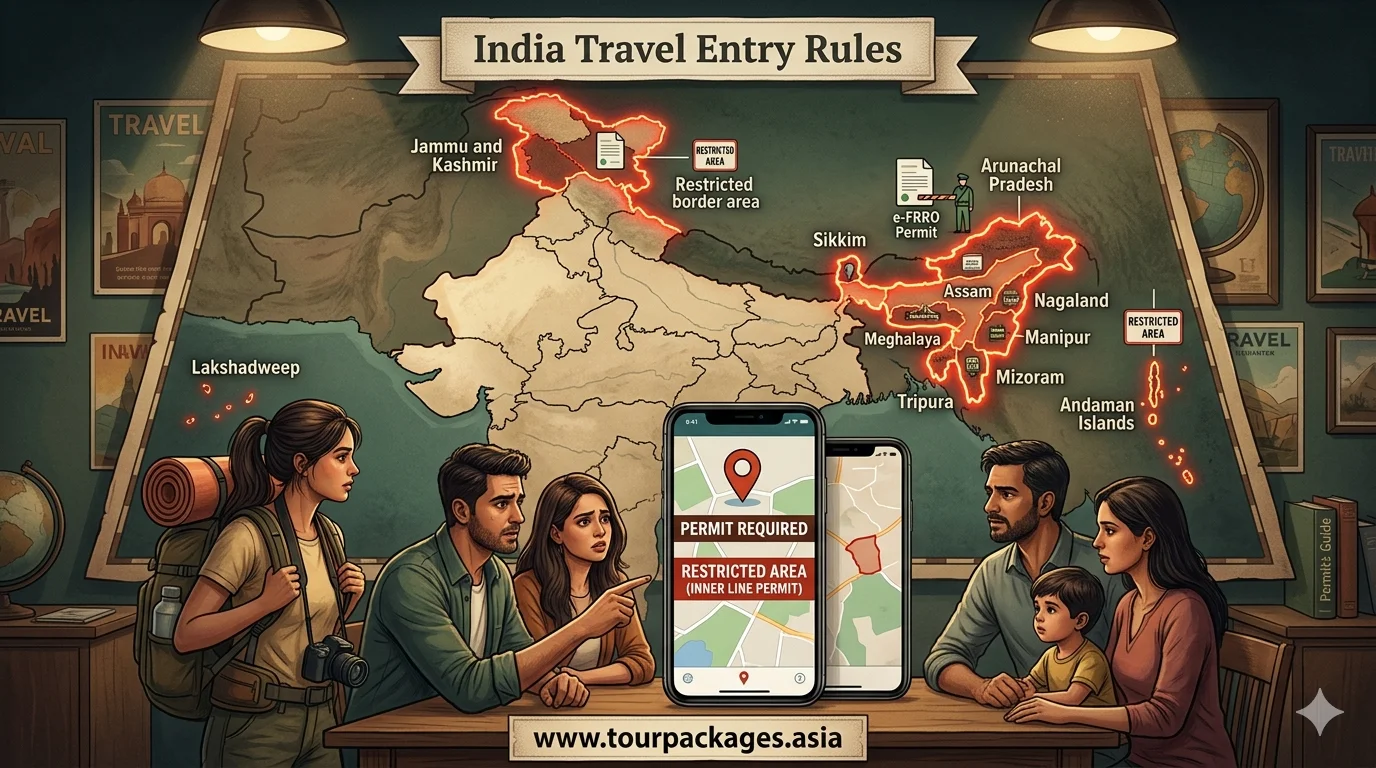
India’s 2026 travel entry rules require visitors to check state-specific permits and restricted zones before arrival. Northeastern states like Arunachal Pradesh and Nagaland mandate Inner Line Permits, while border regions in Ladakh and Sikkim need special passes. Tribal and ecological reserves remain tightly controlled to protect local communities and biodiversity. Travelers should verify updated regulations, as requirements vary widely across states and may change seasonally.

India has more than 15 major permit zones and 50+ micro-restricted areas across its states and union territories. Most travel blogs cover only a handful. This guide covers them all — with the actual rules, documents needed, how to apply, and what changes for 2026. Bookmark this page before your next India trip.
India is a country of extraordinary geographic and demographic complexity. It shares borders with seven nations. It has regions that were once independent kingdoms absorbed into the union at different points in history, many with distinct ethnic and cultural identities that its people and government are determined to protect. It also has ecologically fragile high-altitude zones, tribal communities with no historical contact with the outside world, and active military operations along contested borders.
Travel restrictions in India exist for a mix of reasons that are worth understanding rather than simply navigating around. Northeast states like Arunachal Pradesh and Nagaland implemented the Inner Line Permit system partly to protect indigenous populations from demographic change. Ladakh's restricted areas border active military zones in one of the world's most geographically sensitive regions. Lakshadweep's permit system exists to manage environmental load on fragile coral island ecosystems. The Andaman tribal reserve areas protect some of the world's last uncontacted peoples from disease and cultural extinction.
This context matters because permit systems are not bureaucratic obstacles to be gamed — they are frameworks for protecting places and people. Travellers who understand this tend to have more meaningful experiences in these regions, and more sustainable ones too.
In simple terms: permit required places in India are places that need protection. Your permit application is your formal acknowledgement that you understand and accept the terms of access.
Before diving into state-wise rules, it is worth understanding the three categories of permits you will encounter, because they apply to different categories of traveller and carry different legal weight.
The Inner Line Permit India is a travel document issued by state governments under the Bengal Eastern Frontier Regulation Act of 1873. It allows Indian citizens to visit protected northeastern states and certain other sensitive regions for a specified duration. Foreign nationals cannot use an ILP — they need a PAP instead.
ILP mandatory for all Indian visitors. Online e-ILP system available 24/7. Cost: Rs 100 (7 days) to Rs 200 (extended). Also available at offices in Guwahati, Kolkata, Delhi, and Shillong.
ILP required for all Indian non-residents. Apply online or at Nagaland House offices in major cities. Valid for 15 days (extendable). Cost: Rs 100 per person.
ILP compulsory. Available at Mizoram House in Delhi, Kolkata, Chennai, Mumbai, and Silchar. Online system also active. Valid for 15 days, extendable.
ILP system implemented in 2020. Apply online or at Manipur House in Delhi and Imphal. Valid for 30 days. Some border areas require additional permissions from district administration.
ILP for Pangong Tso, Nubra Valley, Dah-Hanu, Tso Moriri, and Hanle. Issued at DC Office Leh or through registered travel agents. Processed within 24 hours during tourist season (May–October).
The Protected Area Permit India is required by foreign nationals to access sensitive border and tribal regions. It is issued by the Ministry of Home Affairs or through the FRRO. Processing time varies from 48 hours to several weeks. Most PAP destinations require travel through registered tour operators — independent travel is harder to arrange.
PAP required for North Sikkim, Nathula Pass (Indian nationals get a simpler permit; foreigners need PAP). Must travel with a registered Sikkim tour operator for PAP areas.
Nubra Valley, Pangong, and Hanle require PAP for foreign nationals. Apply through registered Leh tour operators. Photo ID, passport copies, and visa details required.
Completely restricted for tourism (Indian and foreign). Researchers and government officials require MHA clearance — not a standard tourist permit.
Foreign nationals need PAP issued by MHA. Must travel in groups of minimum 2. Restricted areas within the state require an additional Restricted Area Permit.
These are destination-specific permits for ecologically sensitive or controlled-access sites. They apply equally to Indian and foreign visitors and are administered by state forest departments, the Archaeological Survey of India, or local administrations.
Rohtang Pass permit online via rohtangpermits.nic.in. Only 800 non-diesel and 400 diesel vehicles allowed daily. Apply exactly 7 days before travel. Cost: Rs 500 (cars) / Rs 100 (two-wheelers). Open approximately May to November.
Entry rules Lakshadweep: All visitors (Indian and foreign) need entry permits through registered tour operators or Lakshadweep Administration's SPORTS scheme. Only 6 islands accessible for tourism.
Foreign nationals get a 30-day Restricted Area Permit on arrival at Port Blair. North Sentinel Island is prohibited for all. Tribal reserve zones around Jarawa territory restrict photography and approach.
Jim Corbett, Kaziranga, Gir, Ranthambore, Bandhavgarh, and Sundarbans all require advance online booking. Daily visitor quotas enforced strictly. Book 60–90 days ahead for peak season.
The four ILP states of Northeast India — Arunachal Pradesh, Nagaland, Mizoram, and Manipur — require Inner Line Permits for all visiting Indian citizens.
Northeast India is one of the most biodiverse and culturally rich regions on the planet. It is also the most heavily regulated for travel. The four ILP India rules states together cover over 150,000 square kilometres of border territory, tribal homeland, and Himalayan foothills. For most Indian travellers, this is unfamiliar terrain in more ways than one — and that unfamiliarity is part of what makes it so rewarding.
India's Largest Frontier State · 26 Major Tribes · Himalayan Biodiversity Hotspot
Arunachal Pradesh permit is mandatory for every Indian citizen who is not a resident of the state. This is one of the most misunderstood travel requirements in India — many travellers assume the rule applies only to foreigners, or that it can be obtained en route. Neither assumption is correct. You must have your ILP before you cross into the state, and checkpoints at Balipara (for Tawang route), Banderdewa (for Itanagar), and Miao (for Namdapha) will turn you away without it.
The good news is that the Arunachal Pradesh government operates an excellent online e-ILP portal that is available around the clock. The process takes less than 30 minutes if you have your Aadhaar card details and a passport photograph ready. The permit is emailed to you within a few hours and is valid for the duration you specify — you can request up to 30 days on a single application, with extensions available from within the state.
The more complicated scenario is for foreign nationals. A PAP for Arunachal Pradesh is issued by the Ministry of Home Affairs and can take anywhere from a few days to several weeks. Foreign visitors must travel with a registered tour operator and cannot access certain border districts (Tawang, Dibang Valley, Anjaw, Lohit, and Longding districts have additional Restricted Area Permit requirements even with a PAP). Despite these complications, the reward is access to some of the most extraordinary landscapes in Asia — Tawang Monastery, Ziro Valley, Namdapha National Park, and the Mechuka Valley among them.
Hornbill Festival · Kohima War Cemetery · Tribal Village Homestays
Nagaland's ILP India rules apply to all Indian citizens and most foreign nationals. The permit is issued at Nagaland House offices in Delhi, Kolkata, and Guwahati, as well as online. For the annual Hornbill Festival (first week of December), the Nagaland government typically simplifies entry procedures for both Indian and foreign visitors — but an ILP is still required. If you are planning to travel for the festival, apply at least 3 weeks in advance as demand for ILPs spikes dramatically.
Foreign nationals visiting Nagaland need a Protected Area Permit from the MHA. In practice, many foreigners obtain this through their hotel or tour operator in Nagaland. Solo travel for foreigners requires more documentation than for Indian nationals. Photography restrictions apply in certain traditional village ceremonies — always ask permission before photographing Naga tribal ceremonies or community gatherings.
India's high-altitude regions present a different kind of permit challenge: not political sensitivity, but ecological fragility and military geography. Ladakh, in particular, borders the Line of Actual Control (LAC) with neighbouring country across some of the world's most contested terrain. Permits in this region are not optional suggestions — they are checked at multiple military checkposts on every road leading to restricted destinations.
Pangong Tso · Nubra Valley · Dah-Hanu · Tso Moriri · Hanle Observatory
Ladakh travel restrictions cover a significant portion of the region's most visited destinations. The ILP (for Indian nationals) and PAP (for foreigners) are required for the following areas: Pangong Tso and the surrounding valley, the Nubra Valley accessed via Khardung La, the Dah-Hanu villages (home to the Aryan community, the last pure-blooded Aryans of the Indian subcontinent), Tso Moriri lake and the Rupshu plateau, and the Hanle dark sky reserve and its observatory.
The permit is easy to obtain in Leh — the District Commissioner's office processes ILPs during tourist season (May through October) within a few hours. Registered travel agents in Leh can also process permits same-day for a small service fee. The ILP must specify the exact destinations you intend to visit, and you will be required to sign in and out at multiple checkposts along the way. There is no equivalent online system for Ladakh ILPs as of 2026 — in-person application is required.
Foreign nationals face additional complexity: the PAP for Ladakh must be applied for through a registered tour operator or through the DC office in Leh. It typically requires passport photocopies, visa copies, and hotel confirmations. As of 2026, the PAP for Ladakh is generally processed within 24–48 hours during peak season.
Rohtang Pass · Spiti Valley · Pin Valley · Great Himalayan National Park
The Rohtang Pass permit online system is one of the most well-organised permit mechanisms in India. It was implemented to address the severe environmental damage caused by hundreds of vehicles churning through the fragile alpine meadow ecosystem daily. The National Green Tribunal capped daily vehicle access to 800 non-diesel and 400 diesel vehicles, and the permit system enforces this cap strictly.
The application process at rohtangpermits.nic.in opens exactly 7 days before your intended travel date — you cannot apply earlier, and walk-up permits are not available. The system requires your vehicle registration number, driver's details, and intended date of travel. Permits are free from an administrative standpoint but require a taxi union fee if using a hired vehicle. The pass is typically accessible from late May to early November, with the exact opening date depending on snowmelt — check the Manali SDM's office announcements for current-year dates.
For Spiti Valley travel restrictions, Indian nationals can generally access most of Spiti freely, but the road from Kaza towards the Indo-Tibetan border at Sumdo requires a permit from the SDM office in Kaza. Foreign nationals require a Protected Area Permit for the entire Spiti circuit — this must be arranged before entering the valley as connectivity in Spiti is unreliable. Tabo, Pin Valley, and Dhankar are all accessible with the standard PAP.
India's island territories present some of its most ecologically sensitive travel destinations. The coral atolls of Lakshadweep and the ancient rainforest archipelago of the Andaman and Nicobar Islands operate under permit systems designed to balance very limited tourism access with the extraordinary fragility of their natural and cultural environments.
32 Islands · Only 6 Open to Tourism · Pristine Coral Lagoons
Entry rules Lakshadweep are arguably the strictest of any Indian tourist destination. All visitors — Indian and foreign — require an entry permit issued by the Lakshadweep Administration. The administration operates a controlled tourism programme called SPORTS (Society for Promotion of Nature Tourism and Sports) that is the primary channel through which tourists access the islands.
The practical implication is that you cannot visit Lakshadweep independently. All accommodation and transportation must be booked through registered tour operators or the SPORTS programme. The islands open to tourism are Agatti (accessible by flight from Kochi or Bangalore), Bangaram (luxury resort island, no inhabitants), Kadmat, Kalpeni, Kavaratti (the administrative capital), and Minicoy. The other 26 islands are either uninhabited, restricted for defence purposes, or inhabited by communities that do not have tourism infrastructure.
Foreign nationals face stricter conditions — a special permit from the Lakshadweep Administration is required, and some islands are off-limits to foreign visitors entirely. The permit process for foreigners typically takes 4 to 8 weeks, and all applications must be routed through registered operators. The environmental justification for these restrictions is compelling: Lakshadweep's coral reefs are among the healthiest in the Indian Ocean and the permit system is widely credited with protecting them from the over-tourism that has devastated reef systems elsewhere.
North Sentinel Island (Prohibited) · Tribal Reserve Areas · Nicobar (Closed) · Andaman (Accessible)
The Andaman restricted areas operate on a spectrum from freely accessible to completely prohibited. Understanding which parts are which can save considerable confusion when planning an Andaman trip.
For Indian nationals: The majority of the Andaman Islands group (North, South, Middle Andaman, and Little Andaman) is freely accessible without any permit. Port Blair, Havelock Island (Swaraj Dweep), Neil Island (Shaheed Dweep), Baratang Island, and Diglipur are all open. The restricted element for Indian visitors is primarily the Jarawa Tribal Reserve along the Andaman Trunk Road — you cannot stop, photograph, or interact with Jarawa community members, and this rule is strictly enforced by police accompanying convoys through tribal territory.
For foreign nationals: A 30-day Restricted Area Permit is issued on arrival at Veer Savarkar International Airport in Port Blair. This essentially functions as a free-access pass for the main Andaman tourist circuit. Some islands still require prior permission even with this permit.
North Sentinel Island is in a category of its own. It is a criminal offence under the Andaman and Nicobar Islands (Protection of Aboriginal Tribes) Regulation to approach within 3 nautical miles. The Sentinelese have rejected all outside contact, and the Indian government's policy since 2018 has been strict non-contact. This is not a travel restriction that can be applied for around — it is a permanent legal prohibition.
The Nicobar Islands (Car Nicobar, Great Nicobar, Little Nicobar, and others) are completely off-limits to tourism. They are a restricted military zone and also home to tribal communities with limited outside contact. Entry requires MHA clearance for specific official purposes only.
India's national parks and wildlife sanctuaries technically do not qualify as "restricted" in the same sense as ILP zones, but they operate under strict permit and quota systems that effectively limit access. For many popular parks, failing to book in advance means missing your safari entirely. This section covers the parks where advance permit booking is not optional — it is the only way in.
| Park / Sanctuary | Key Restriction | How to Book | Book Ahead |
|---|---|---|---|
| Jim Corbett, Uttarakhand | Zone-specific permits; daily quotas per zone; Dhikala zone requires overnight stays booked with entry | Online: corbettonline.uk.gov.in | 30–90 days |
| Kaziranga, Assam | Elephant safari limited permits; jeep safari by zone; entry by range only | Forest Dept offices at each range or online | 1–7 days |
| Gir, Gujarat | Strict daily visitor cap; permit mandatory; e-permit system enforced | Online: girlion.in | 30–60 days |
| Ranthambore, Rajasthan | Zone-based permits; canter (shared) and jeep; daily quotas strictly enforced | Online: rajasthanwildlife.in | 45–90 days (peak) |
| Sundarbans, WB | Forest Dept permit required; all entry by registered boat only; overnight camps limited | Sundarban Tiger Reserve office, Canning | 7–14 days |
| Namdapha, Arunachal | ILP for the state + Forest Dept permit for the park; very limited infrastructure | Forest Dept, Miao (Changlang district) | 2–4 weeks |
The Jim Corbett National Park permit system is the most complex of these. The park is divided into 6 tourist zones — Dhikala, Bijrani, Jhirna, Durgadevi, Sonanadi, and the Buffer Zone. Each zone has separate permits with separate quotas. Dhikala, the core zone, requires an overnight permit and accommodation booking simultaneously — day entry is not available. Jhirna and Bijrani are more accessible for day visitors. The peak season from November to June sells out weeks in advance.
Bhangarh Fort Rajasthan is officially restricted between sunset and sunrise by the Archaeological Survey of India. The ASI sign at the fort entrance clearly states this rule. The practical reason is physical safety — the 17th-century Rajput fortifications are partially collapsed and unlit, making night navigation genuinely hazardous. Violations can result in fines and the rule is periodically enforced, so treat it as a real restriction rather than a legend.
The restrictions on photography across India's military infrastructure are extensive and not always well-marked. Under the Official Secrets Act and the Defence Establishment regulations, photography is prohibited at military cantonments, border checkposts, defence facilities, bridges (in some border districts), airports (airside), railway stations (particularly in border districts), and government buildings in sensitive areas. In Ladakh, Arunachal Pradesh, and parts of Rajasthan bordering neighbouring country, photography restrictions are enforced with particular seriousness. Always follow posted signs, and when in doubt, do not photograph.
Several traditional villages located very close to international borders require district administration permission to visit. This is most relevant in Arunachal Pradesh's border districts (Tawang's border with Bhutan and neighbouring country, and Kibithu near Myanmar), in Ladakh near the Line of Actual Control, and in parts of Uttarakhand near the Nepal and Tibet borders. Local guesthouses and tour operators in these regions can advise on current access conditions — rules shift based on political situation and military readiness levels.
Beyond the legal prohibitions in the Andaman Islands, several Northeast Indian states have social restrictions on photographing tribal ceremonies and community gatherings. These are not legal restrictions in the same sense as ILP requirements — they are community norms that responsible travellers should honour. In Nagaland in particular, Naga tribes have a strong and justified concern about their traditional culture being commodified. Photography at the Hornbill Festival is widely permitted, but rural village ceremonies require explicit community consent.
After speaking with travellers who have been turned back at checkposts, had permits rejected, or found themselves stranded in ILP zones without valid documentation, certain mistakes come up repeatedly. These are worth understanding before you travel.
1. Applying too late. ILPs for busy seasons in Arunachal Pradesh, Nagaland, and Mizoram can take 24–72 hours even online. For Lakshadweep, 4–8 weeks is not excessive. Planning tight itineraries with same-day permit applications is a common cause of missed trips.
2. Carrying only digital copies. Most ILP checkposts in Northeast India and Ladakh require hard-copy permit documents. Some checkposts do not accept permits displayed on phones. Print at least three copies — one for each major checkpost, and one as backup.
3. Mis-stating destinations on the permit. ILPs and restricted area permits require you to list the specific destinations you intend to visit. Adding an unplanned destination mid-trip — even a famous one — without it being on your permit can result in being turned back at the checkpost.
4. Assuming group tour operators handle everything. Some tour operators in Guwahati and Leh charge extra for permit processing and do not complete it before departure day. Confirm with your operator in writing that permits are arranged at least 48 hours before you need them.
5. Booking Rohtang Pass permits on the wrong day. The portal opens exactly 7 days before the travel date — no earlier. Travellers who try to book 8 or 9 days in advance find the portal rejecting their application without explanation, because the date does not yet exist in the booking window.
6. Misunderstanding the Andaman rules as a foreigner. Foreign visitors to Andaman frequently do not realise that their Restricted Area Permit is issued at the airport — they arrive anxious about paperwork that is handled automatically. Conversely, they occasionally misunderstand the Jarawa Trunk Road restrictions as a minor inconvenience rather than a serious legal and ethical matter.
7. Attempting to visit the Nicobar Islands or North Sentinel Island. Each year a small number of tourists attempt to arrange access to the Nicobar Islands or to approach North Sentinel Island — usually after reading about them online. Both are absolutely prohibited. The Nicobar restriction has no tourist exceptions. The North Sentinel restriction is a criminal law with serious penalties.
Click each panel below for step-by-step guidance on applying for the most commonly needed permits across India's restricted travel zones.
TourPackages Asia handles all permit applications, documentation, and logistics for Northeast India, Ladakh, Lakshadweep, and other restricted destinations — so you arrive prepared, not stranded at a checkpost.
Plan My India Trip More India Travel GuidesIndia's travel permit landscape shifts regularly — rules change with political developments, ecological assessments, and infrastructure improvements. Here are the most significant updates for 2026 that affect travellers planning trips this year.
The Uttarakhand government has made online registration mandatory for the Char Dham Yatra (Kedarnath, Badrinath, Gangotri, Yamunotri). The registration system at registrationandtouristcare.uk.gov.in is now fully operational and requires Aadhaar verification. Walk-in registration on the day of visit is no longer reliably available at major temples during the main pilgrimage season (May–June and September–October).
The Ministry of Tourism's Border Tourism initiative has opened several previously restricted villages in Ladakh close to the Line of Actual Control to limited tourism in 2025–26. The Dah-Hanu area and certain villages in the Turtuk sector (near the Neighbouring country border) now have improved tourism infrastructure. ILP is still required, but access is more streamlined than in previous years through registered Leh tour operators.
The online ILP portals for Nagaland and Mizoram have been improved significantly since 2024 and now offer faster processing — in most cases under 48 hours. The Arunachal Pradesh e-ILP portal remains the most efficient, with same-day processing for most applications. Manipur's online system has also been upgraded and no longer requires in-person verification for most Indian citizens.
Jim Corbett's booking system has moved to a unified online platform that requires registration with Aadhaar-verified accounts from 2025. This has reduced touting and last-minute black market permit sales but requires advance setup by first-time bookers. Allow at least 3 days to create and verify your account before attempting to book Corbett permits.
For the latest India travel entry rules 2026, always verify current requirements with state tourism offices before finalising your itinerary. Rules in permit zones are among the most dynamic in Indian travel — what applied last year may have changed. Platforms like TourPackages Asia and Revelation Holidays maintain updated permit information for travellers planning India trips.
Detailed answers to the most searched questions about India's permit system — covering ILP, PAP, Rohtang, Lakshadweep, Andaman, Sikkim, wildlife parks, and more.
Tell us where you want to go in India and our team will handle all permit applications, documentation, and logistics — so you arrive at the checkpost with everything in order.
For customised India travel planning covering Northeast states, Ladakh, Lakshadweep, and other permit destinations, TourPackages Asia and Revelation Holidays provide end-to-end permit handling, itinerary planning, and local expert support.
Plan My India Trip More India Tourism GuidesAdventure Trips from Leh, Ladakh | Sikkim Must-Do Experiences | Lakshadweep Holiday Packages from Kochi | Lakshadweep Entry Permit Guide | Best Beaches in Port Blair, Andaman | Leh Ladakh Travel Guides
