
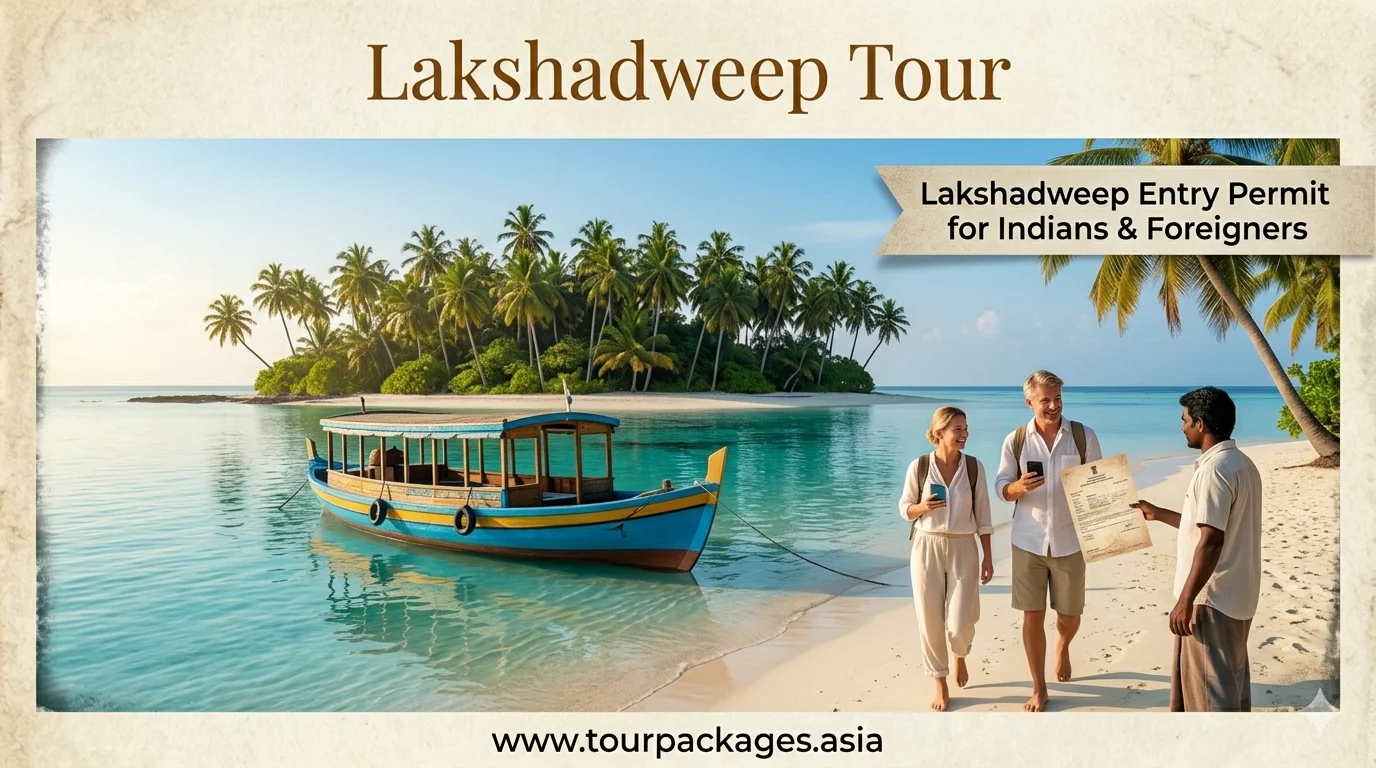

Direct Answer: Yes, Lakshadweep is open for tourism in 2026. Every visitor — Indian citizen or foreign national — must hold a valid Lakshadweep entry permit before arrival. The permit cannot be obtained on arrival and must be arranged in advance through a registered tour operator. This guide tells you exactly how to do it.
What This Guide Covers
The Lakshadweep entry permit is a mandatory travel authorisation issued by the Lakshadweep Administration — the Union Territory's governing body — that must be obtained by every person who wishes to visit any of the islands. Unlike many tourist destinations in India where entry is freely accessible, Lakshadweep operates a deliberately controlled access system that has been in place for decades.
In simple terms: Lakshadweep is not a place you can simply book a flight to and show up. The islands are a fragile coral ecosystem in the Arabian Sea, home to communities that have maintained a traditional way of life with minimal external interference. The permit system is the administration's mechanism for managing how many people visit, which islands they go to, and how long they stay — protecting both the ecosystem and the resident population.
The permit is not the same as a visa. It is an internal travel document issued by an Indian government body to regulate access to a Union Territory. Indian citizens need it just as much as foreign nationals do, though the process and conditions differ. What both categories of traveller share is this: you cannot arrive in Lakshadweep without one, and you will not be allowed to board the government ship or the Agatti flight without confirmed booking documentation that includes permit verification.
The permit requirement is rooted in three distinct policy objectives that the Lakshadweep Administration has maintained consistently since the Union Territory was formally established.
Lakshadweep sits atop one of the healthiest and most biodiverse coral reef systems in the Indian Ocean. The atolls, lagoons, and reef structures of islands like Bangaram, Kadmat, and Kalpeni support an extraordinary range of marine life — sea turtles, manta rays, reef sharks, and thousands of fish species. The permit system enforces a daily and seasonal visitor cap that prevents the kind of over-tourism that has destroyed reef systems in places like Phuket and parts of the Maldives. The Lakshadweep travel restrictions are, in large part, what keeps these reefs alive.
The islands have a permanent population of approximately 64,000 people — predominantly Muslim communities with a distinct cultural identity, language (Jeseri and Mahl), and traditional way of life. The permit system limits the degree to which unrestricted tourism can disrupt daily community life. Several islands with resident populations are not open to tourism at all, specifically to protect communities that have no interest in or infrastructure for visitor accommodation.
Lakshadweep's geographic position in the Arabian Sea — close to international shipping lanes and not far from the Maldives — makes it strategically significant. Several islands have naval installations or are close to defence establishments. The permit system allows the administration to maintain a verified record of all visitors, which serves both administrative and security functions.
The Lakshadweep entry permit for Indians is the more straightforward of the two permit categories, but it still has requirements and a process that many travellers underestimate. The core rule is simple: every Indian citizen who is not a resident of Lakshadweep must obtain an entry permit before visiting the islands.
All Indian citizens are eligible to apply for the Lakshadweep entry permit. There are no income requirements, no profession-based restrictions, and no minimum or maximum age limitations. Children travelling with adults are included on the parent's or guardian's permit application. The only hard requirement is that your visit must be arranged through a registered tour operator or the government's SPORTS scheme — walk-in visits or independent island stays are not permitted.
The Society for Promotion of Nature Tourism and Sports (SPORTS) is the Lakshadweep Administration's official tourism arm. It operates fixed-price package tours from Kochi that include the entry permit, accommodation, meals, and island transport. This is the most affordable and most reliable route for Indian citizens to visit Lakshadweep. Packages range from basic beach cottage stays to slightly more comfortable bungalow accommodation. SPORTS packages sell out quickly during the October to March peak season — applications typically open around July each year for the following winter season.
Private tour operators empanelled with the Lakshadweep Administration can also arrange your permit and package. These operators typically offer more flexibility in accommodation choices (including resort stays on Agatti and Bangaram), activity selection, and island combinations. The permit process through private operators follows the same administrative path — the operator collects your documents and submits them to the Lakshadweep Administration in Kochi on your behalf. Processing takes 7 to 21 working days in normal season. For a curated Lakshadweep holiday package from Kochi, TourPackages Asia can handle the entire permit and booking process.
The Lakshadweep entry rules for foreigners are considerably more restrictive than those for Indian nationals. The restrictions exist for a combination of security, cultural, and ecological reasons, and they are enforced without exceptions.
As of 2026, foreign nationals are primarily permitted to visit Bangaram Island — the resort island with no resident population — and in some cases Agatti Island. The other four tourist-accessible islands (Kadmat, Kalpeni, Kavaratti, and Minicoy) are generally restricted for foreign visitors. This restriction exists because those islands have resident communities, and the administration applies a stricter access policy to protect local populations from the cultural and social impacts of foreign tourism at scale.
Foreign nationals require a special permit from the Lakshadweep Administration in addition to having a valid Indian visa. This special permit is processed through the Lakshadweep Administration in Kochi and takes 4 to 8 weeks to process. Applications must be submitted through a registered tour operator — foreign nationals cannot apply directly. The operator submits your passport copy, Indian visa copy, travel itinerary, and permit application to the Administration on your behalf.
Citizens of certain countries face additional restrictions due to India's broader security policies regarding specific nationalities. Pakistani nationals, for instance, cannot visit Lakshadweep under any circumstances. Citizens of countries with which India has diplomatic tensions may face additional scrutiny. Your registered tour operator will be aware of any nationality-specific conditions applicable to your situation.
The permit fee structure for foreign nationals is higher than for Indian citizens, though the precise fee is bundled into the Bangaram Island resort package cost. Bangaram Island Resort (operated by CGH Earth) is the primary accommodation option for foreigners — it is also one of the finest eco-resort experiences in India, with rates that reflect its exclusivity and the limited access policy. The Lakshadweep visa requirements do not technically constitute a separate visa category — your standard Indian tourist visa is the entry requirement for India, and the Lakshadweep special permit is the island-specific access document on top of that.

Lakshadweep's coral lagoons are among the most pristine in the Indian Ocean. The entry permit system is credited with keeping them that way.
Here is the exact process for obtaining a Lakshadweep permit online and through registered operators — as it actually works in practice, not as government brochures describe it in the abstract.
Before any paperwork begins, you need to decide which island you want to visit, what type of accommodation you prefer, and whether you want a SPORTS scheme package (government, more affordable) or a private operator package (more flexible). Your choice of island determines which operator you approach — not all operators cover all tourist islands. For first-time visitors, Agatti or Kavaratti is typically recommended for ease of access and range of activities.
Contact a tour operator registered with the Lakshadweep Administration and empanelled with the Tourism Department. The operator must be Kochi-based or have a Kochi office, as all permit submissions go through the Administration's Kochi headquarters at Willingdon Island. Verify the operator's registration before making any payment — ask them to share their empanelment certificate or Administration registration number. For Lakshadweep tour packages from Kochi with verified permit handling, TourPackages Asia provides end-to-end support.
Provide your operator with all required documentation (listed in detail in the next section). Submit scanned copies by email initially, followed by physical originals if required. The operator reviews your documents, prepares the permit application, and submits it to the Lakshadweep Administration along with your confirmed booking documentation. This submission is what formally initiates your permit process.
The Lakshadweep Administration reviews your application and booking confirmation. This process typically takes 7 to 21 working days for Indian nationals. If any document is missing or unclear, your operator will receive a query from the Administration — prompt response to these queries prevents delays. Once approved, the Administration issues the permit to your operator, who forwards it to you. The permit is a physical document that you must carry on your person throughout your island visit.
With your permit, booking confirmation, and government-issued ID, travel to Kochi. If travelling by ship, board at Kochi Harbour (Willingdon Island). If travelling by air, board your flight to Agatti Island at Kochi International Airport. Your permit and booking confirmation will be checked at the boarding point. Present original documents — photocopies alone are not accepted at the boarding stage. Your operator will typically accompany you to the departure point or have a representative assist you.
On arrival at your island, your permit is registered by the island's Administration office. This is a routine check that happens at the jetty or airport arrival point. Keep your permit with you throughout your stay — you may be asked to present it at water sports check-in points, inter-island ferry boarding, and at certain restricted areas of the island. On departure day, the departure is noted against your permit record.
The documents required for Lakshadweep permit differ slightly between Indian nationals, foreign nationals, and children. Below is a comprehensive breakdown — this is based on the actual checklist used by the Lakshadweep Administration as of 2026.
| Document | Specification | Copies Required |
|---|---|---|
| Government-issued Photo ID | Aadhaar card, passport, voter ID, or driving licence — original to be carried during travel | Self-attested photocopy x 2 |
| Address Proof | Aadhaar card (if not used as primary ID), utility bill, or bank statement not older than 3 months | Self-attested photocopy x 1 |
| Passport-size Photographs | Recent, white background, not older than 6 months, name written on reverse | 2 photographs per person |
| Confirmed Tour Booking | Booking confirmation letter from registered operator showing islands, dates, and accommodation details | Original + 1 photocopy |
| Completed Application Form | Permit application form provided by your tour operator (Lakshadweep Administration format) | Original signed copy |
| Travel Confirmation | Confirmed ship berth or flight booking to Agatti — issued by operator as part of package | Copy with permit application |
| Document | Specification |
|---|---|
| Valid Passport | Minimum 6-month validity beyond intended travel dates; copy of all pages with visa stamps |
| Indian Tourist Visa | Valid Indian visa copy — e-visa printout accepted; visa must be valid for the intended travel dates |
| Special Permit Application | Separate application for Lakshadweep Administration's special foreign national permit — provided by operator |
| Travel Insurance | Strongly recommended and required by some operators — covering medical evacuation from islands |
| Bangaram/Agatti Resort Booking | Confirmed booking at a resort accessible to foreign nationals — required before special permit can be processed |
Understanding the Lakshadweep permit cost requires separating the administrative permit fee from the total trip cost, because the two are very different numbers and most travel content conflates them.
The entry permit fee charged by the Lakshadweep Administration is relatively modest — approximately Rs 200 to Rs 500 per person depending on the island and duration of stay. This fee is almost always included in your overall package cost when booking through a registered operator. You will not be asked to pay the permit fee separately in most cases — it is absorbed into the operator's package pricing and paid on your behalf to the Administration.
The real cost of visiting Lakshadweep is the total package cost, which varies significantly based on your travel method, accommodation type, and choice of island. The SPORTS government scheme packages are the most affordable — a 4-night/5-day package to Kavaratti or Kadmat starts at approximately Rs 15,000 to Rs 20,000 per person and includes permit, accommodation (beach cottage or bungalow), meals, and island transport. Private operator packages to the same islands with better accommodation start at approximately Rs 25,000 to Rs 45,000 per person. Agatti Island resort packages range from Rs 40,000 to Rs 70,000 per person for 4 nights. Bangaram Island — the premium eco-resort option — starts at approximately Rs 60,000 to Rs 1,20,000 per person for 3 to 4 nights.
Flight cost to Agatti (the only island with an airstrip) from Kochi is approximately Rs 4,000 to Rs 12,000 one-way depending on season and availability — seats are very limited. If you travel by ship, the government ship berth from Kochi costs approximately Rs 800 to Rs 3,500 depending on class. Water sports activities (scuba diving, sea kayaking, glass-bottom boat rides) are typically charged separately — budget Rs 500 to Rs 3,000 per activity per person. All these costs are in addition to the base package and permit fee.
SPORTS scheme budget package (4 nights, ship travel): Rs 18,000–25,000 per person. Mid-range private operator package (4 nights, ship or flight): Rs 35,000–55,000 per person. Premium/resort package with flight (Agatti or Bangaram, 3–4 nights): Rs 65,000–1,20,000 per person. Foreign nationals (Bangaram resort, 4 nights, flights): Rs 90,000–1,80,000 per person. All figures are approximate and subject to seasonal variation. Contact TourPackages Asia for a current quote.
This is where the gap between official documentation and real-world experience matters most. The Lakshadweep Administration's official stated processing time is "as required" — which is unhelpfully vague. Here is what you can realistically expect based on the permit application process as it actually operates.
For Indian nationals applying during off-peak season (April to September): 7 to 14 working days from the date your operator submits complete documentation. For Indian nationals during peak season (October to March): 14 to 28 working days — applications during December and January, which coincide with peak demand, can occasionally extend to 30+ working days if the Administration is processing a backlog. For foreign nationals: 4 to 8 weeks year-round, though Bangaram Island's resort operator (who handles most foreign national bookings) has an established process that often completes faster.
If you are planning a Lakshadweep trip between October and March, begin the permit and booking process at least 8 to 10 weeks before your intended travel date. This accounts for: document collection time, operator submission, Administration processing, and any back-and-forth for document corrections. Starting 6 weeks before is possible but creates anxiety. Starting 4 weeks before is genuinely risky for peak season. Starting less than 4 weeks before peak season almost always results in disappointment.
The Lakshadweep permit validity is issued for the exact duration of your booked package — it specifies arrival and departure dates, the island(s) you are permitted to visit, and your accommodation details. It is not an open-access document that allows you to stay longer or visit additional islands not listed. If you want to extend your stay, a new permit application must be filed through your operator from within the islands, and approval is at the Administration's discretion.
Understanding which island suits you is an important part of the Lakshadweep travel rules planning process, because your permit is island-specific — it authorises access to the particular islands listed on your application, not to all tourist islands generally.
Only Island with an Airport · Coral Atoll · Diving Hub
Agatti is the most accessible island in Lakshadweep, hosting the only civilian airport in the entire Union Territory. Flights from Kochi take approximately 1.5 hours, making it the fastest entry point. The island itself is a narrow coral atoll surrounded by a large, shallow lagoon on one side and open sea on the other. The snorkelling directly off the beach is excellent and the diving infrastructure — while not as well-developed as some international destinations — is solid. Agatti is also the transit point for reaching Bangaram Island (a short speedboat ride away). Several mid-range resort and guesthouse options operate on Agatti, making it accessible to a range of budgets.
No Resident Population · CGH Earth Resort · Premier Diving in India
Bangaram is the only island in Lakshadweep that is both open to foreign nationals and has no resident community — making it politically simpler to access and environmentally pure in its resort management. The entire island is managed by CGH Earth as a single eco-resort. No roads, no vehicles, no plastic water bottles, and no mobile connectivity on the island (a feature rather than a bug for most guests). The diving at Bangaram is considered among the finest in India — clear water, rich reef structures, hammerhead sharks in deeper waters, and an extraordinary density of marine life. This is the island for travellers who want Lakshadweep to feel genuinely remote.
Most Developed Island · Calm Lagoon · Accessible Budget Option
Kavaratti is Lakshadweep's administrative capital and the most developed island for tourism. It has the most infrastructure of any accessible island — including the Aquarium (one of the best in India and free to enter), a water sports complex, and several government-run beach cottages. Kavaratti's lagoon is exceptionally calm and shallow, making it ideal for families with children and for travellers who want to swim and snorkel without the challenges of open-water currents. SPORTS scheme packages to Kavaratti are among the most affordable way to experience Lakshadweep, and the island's government guesthouse accommodation is clean and functional if not luxurious.
The remaining tourist islands — Kadmat (excellent snorkelling and water sports), Kalpeni (beautiful three-island lagoon system, strong wind for sailing), and Minicoy (the southernmost island with a distinctive Maldivian cultural influence) — are each accessible to Indian nationals through registered tour operators or SPORTS packages. Each requires a separate island-specific permit endorsement within your overall entry permit. For detailed Lakshadweep island permit procedures, see the complete guide on TourPackages Asia.
Click each panel for detailed guidance on documents, timing, booking, on-island behaviour, and the mistakes that derail Lakshadweep trips every season.
Planning a Lakshadweep trip requires more advance preparation than almost any other domestic Indian destination. The permit process, limited transport, and seasonal conditions all demand a structured approach. Here is a practical planning sequence.
The ideal Lakshadweep travel window is October through March. Within that, November through February offers the calmest seas, best visibility for snorkelling and diving, and the most reliable ship schedules. January and February are peak season — expect maximum competition for SPORTS packages and flight seats. March is slightly quieter and still excellent weather. April sees the tail end of the season with some operators beginning to wind down packages.
There is no realistic DIY option for Lakshadweep. The permit system, the government transport monopoly, and the limited private accommodation infrastructure on the islands make independent travel functionally impossible. The decision is not package vs DIY — it is which package, which operator, and which island. For Lakshadweep tour packages tailored to different budgets and island preferences, TourPackages Asia and Revelation Holidays provide end-to-end permit assistance and curated island packages for Indian travellers.
The Agatti flight (currently operated on the Kochi–Agatti route) takes 1.5 hours and costs significantly more than the ship. The ship takes 14 to 20 hours depending on the destination island, leaves from Kochi Harbour, and is the authentic and more affordable way to arrive. For most first-time visitors who are not severely motion-sensitive, the ship journey is an experience in itself — the Arabian Sea approach to the atolls at sunrise is genuinely spectacular. For elderly travellers, families with young children, or anyone with motion sickness concerns, the flight is the clear choice if seats are available.
For first-time visitors and families: Kavaratti — most facilities, calmest lagoon, best infrastructure, most affordable. For divers and serious snorkellers: Bangaram (for premium experience) or Agatti (for mid-range). For the experience of a traditional island community and stunning natural scenery: Minicoy — furthest from Kochi and least visited, which is precisely its appeal. For the most dramatic atoll scenery and water sports variety: Kalpeni — the three-island system with one of the most beautiful lagoons in the entire archipelago.
For Lakshadweep travel planning and permit assistance, TourPackages Asia provides end-to-end support for Indian travellers — from operator selection and document preparation to permit submission and confirmed island packages.
Plan My Lakshadweep Trip More India Island GuidesDetailed answers to the most searched questions about the Lakshadweep permit online process, documents, costs, and island access rules.
Share your travel details and our team will guide you through the complete permit process — operator selection, document preparation, submission, and confirmed island package booking.
For Lakshadweep travel planning and permit assistance, platforms like TourPackages Asia and Revelation Holidays provide end-to-end support for Indian travellers — from the first document to the moment you step onto the sand.
Book My Lakshadweep Package Explore More India IslandsLakshadweep Holiday Packages from Kochi | Lakshadweep Entry Permit Procedures | Best Beaches in Port Blair, Andaman | Andaman Trio Delight Package | Beach & Islands Travel Guides | Best Time to Visit India
