
Quick Answer — TeamLab Planets Tokyo 2026 Essentials
Jump to Section
What Is teamLab Planets Tokyo?
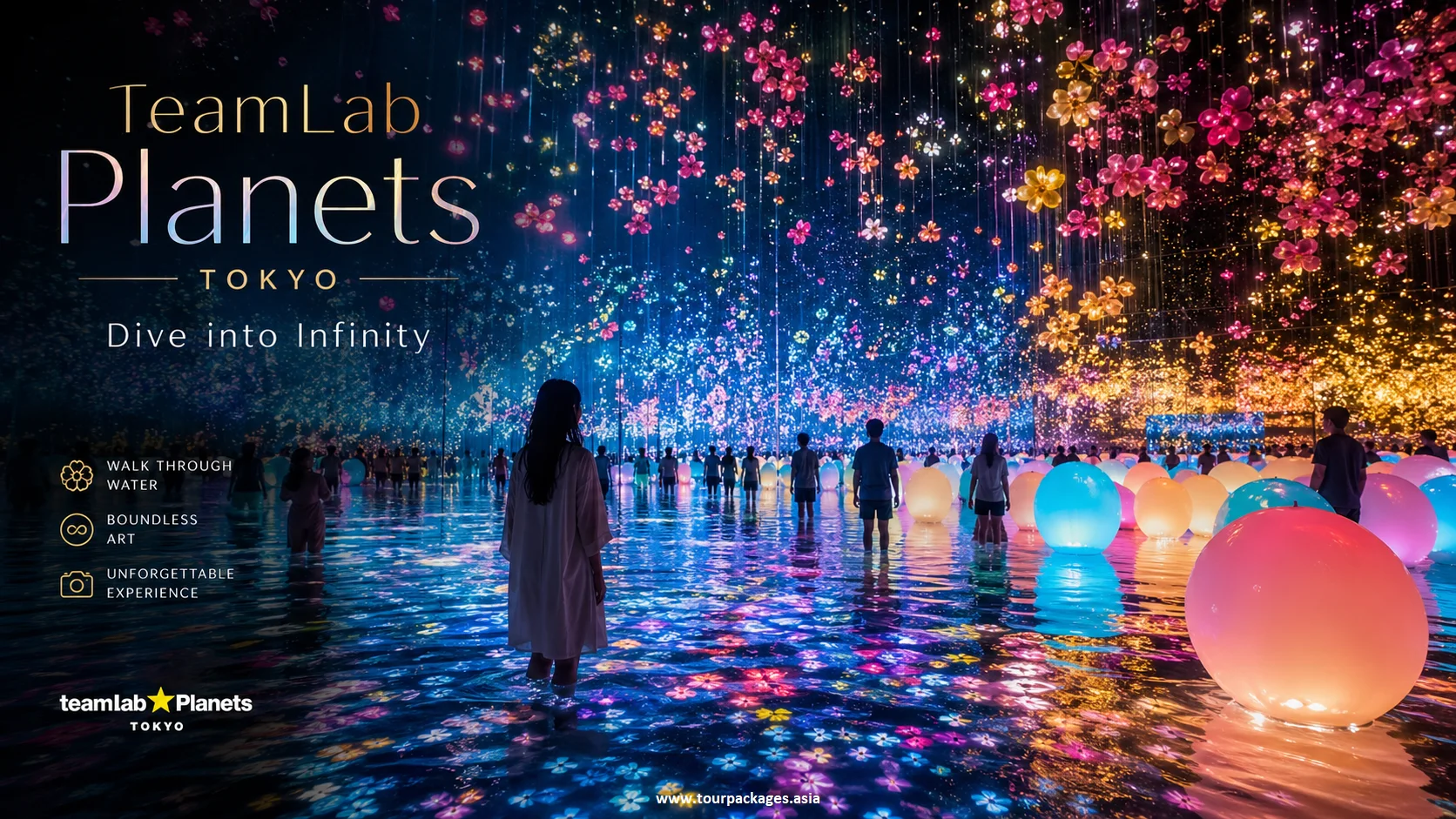
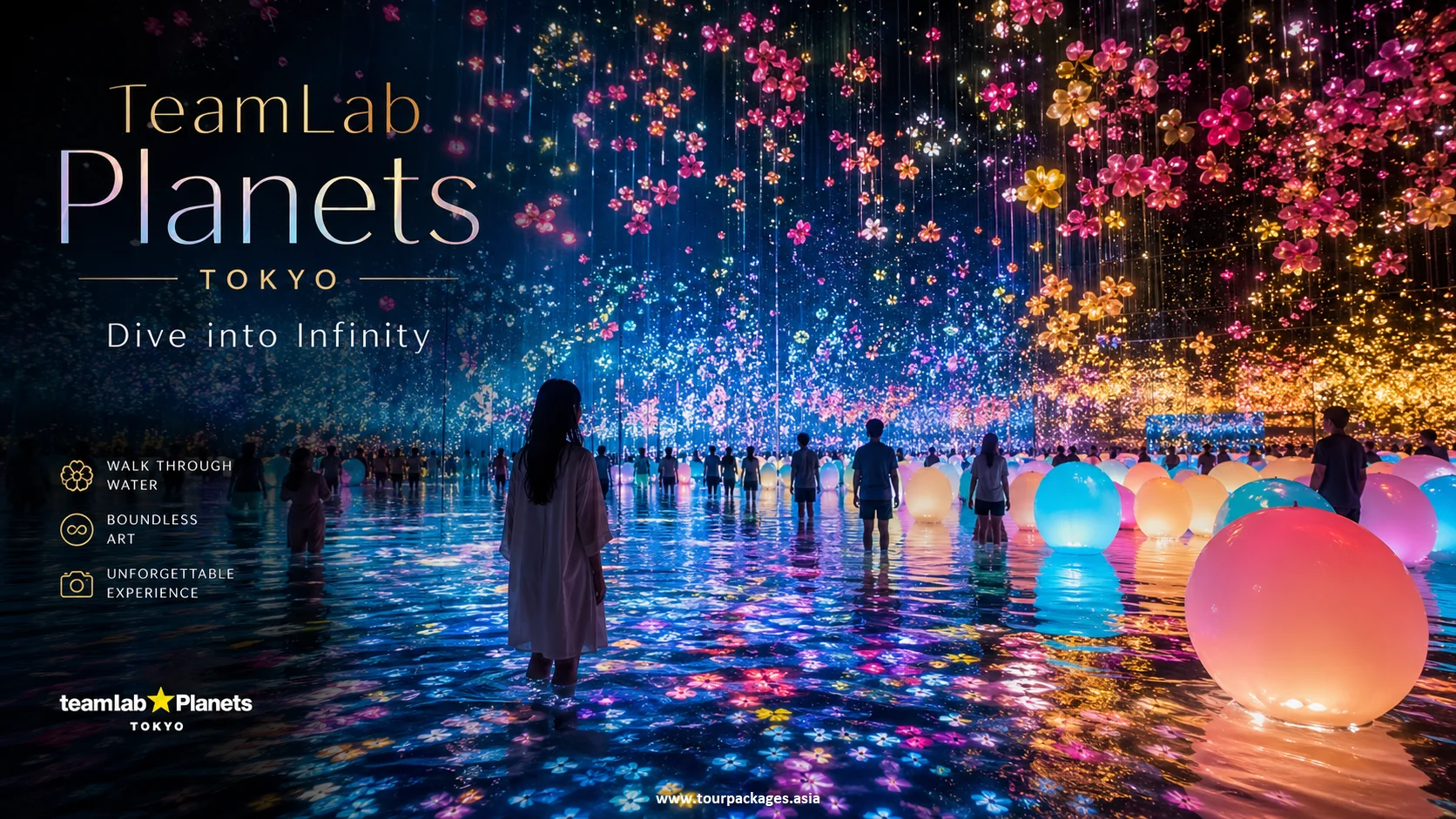
In simple terms, teamLab Planets Tokyo is a walk-through digital art museum located in the Toyosu district of Tokyo, Japan. Unlike a conventional gallery where you stand in front of art and observe it from a distance, here the art surrounds you completely. The walls, floor, and ceiling all become part of the installation. You do not look at it — you step inside it.
The venue is created by the Japanese art collective teamLab, a group of engineers, programmers, architects, and artists who have been redefining the boundaries of digital and physical space since 2001. teamLab Planets opened in 2018 as a temporary exhibition and was so overwhelmingly received that it became a permanent fixture. It currently runs across a purpose-built warehouse-style building spanning approximately 10,000 square meters in Toyosu.
There are six major immersive art rooms and an outdoor garden space. The defining feature of the venue is the barefoot experience — visitors remove their shoes before entering and either wade through shallow water or walk across reflective floors, becoming physical participants in the artwork rather than passive observers. If you have ever wondered what it feels like to actually walk through a painting, this is the closest the modern world has yet managed to get to that experience.
For international travelers to Japan, particularly those from India, teamLab Planets has become a near-mandatory addition to the Tokyo itinerary, sitting comfortably alongside visits to Shibuya Crossing, Senso-ji, and the Imperial Palace gardens.
My Personal Experience — Walking Through Water, Mirrors, and Light
I visited teamLab Planets on a Tuesday morning in early November. The temperature outside was crisp — the kind of cold that makes Tokyo feel quietly cinematic. I had booked my teamLab Planets Tokyo tickets three weeks in advance after reading that walk-in availability was essentially nonexistent. The 9:00 AM entry slot I chose turned out to be the single best decision I made for the entire experience.
The Wading Room — Drawing on the Water Surface
The first room that genuinely stopped me in my tracks was the water wading installation. You step barefoot into ankle-deep water — it was warmer than I expected — and the floor beneath you is covered in animated koi fish that swim around your feet and scatter when you move. The koi are not real. They are projected light on moving water. But watching them dart away from my steps felt entirely real, and I stood there for a full five minutes just... moving my feet slowly, watching the school reform around my ankles. There was a child next to me shrieking with delight, and three adults behind me exchanging bewildered glances. Nobody spoke above a murmur. The room demands a certain reverence.
Infinite Crystal Universe
The next room is the one that photographs most dramatically: the Infinite Crystal Universe. Floor-to-ceiling mirrors surround you, filled with thousands of suspended LED spheres that pulse, shift colour, and respond to an app visitors can download. You can actually influence the light — send shooting stars toward specific points, change colour zones, or summon falling flowers. The room extends infinitely in every reflection. I found myself reaching out to touch the lights, forgetting, momentarily, that they were metres away. It is a profoundly disorienting experience, and I mean that entirely as a compliment.
Floating Flower Garden
The Floating Flower Garden requires some patience. The overhead installation of thousands of orchids rises and falls in response to visitor movement, creating open passages as you approach. If you stand perfectly still, the flowers descend around you until you are completely enclosed within a living, breathing dome of blossoms. My patience lasted approximately forty-five seconds before someone walked through and scattered the arrangement. But when it works — when you are alone within the orchids, surrounded by white petals at eye level — it is quietly one of the most affecting things I have seen in a long time.
Soft Black Hole and The Table of Geological Memories
Two rooms that receive less attention but deserve more: the Soft Black Hole installation, where the floor is an undulating padded surface that sinks underfoot, making movement deliberately challenging and strangely childlike; and the geological memories room, where a table displays real minerals embedded in projected light that shifts colour according to the mineral's properties. This one appealed to me more intellectually — it felt like science presented through the language of art.
The Garden Finale
The outdoor garden area, which many visitors overlook in their rush to exit, features seasonal plantings and subtle digital projections that change with natural light. In November, the autumn leaves alongside the digital flora created an unexpected layering effect. Arriving in the first entry slot of the day meant I had this space almost entirely to myself for about ten minutes. It was worth every moment of the early alarm.
Why teamLab Planets Is Trending Worldwide in 2026
The global surge in interest around immersive experiences in Tokyo and elsewhere is not a trend manufactured by social media alone, though social media has certainly accelerated it. There is something fundamentally different happening with this category of art venue, and teamLab sits at its centre.
Conventional museums ask visitors to maintain respectful distance. teamLab asks you to get in the way. The art literally cannot exist without the visitor's physical presence — the koi scatter because you are there; the flowers descend because you are standing still; the mirror rooms reflect an infinite version of you. This is participatory art at a scale that was technically impossible ten years ago, and audiences globally have responded with an enthusiasm that shows no sign of diminishing.
From an Indian travel perspective specifically, the teamLab Planets experience has found resonance for another reason: it is visually unlike anything available in India. There are no direct equivalents. The combination of traditional Japanese aesthetic sensibility — wabi-sabi, the beauty of impermanence, nature as companion rather than backdrop — with cutting-edge digital technology creates something that feels simultaneously ancient and from the future. That contrast is catnip for a generation of Indian travelers who have already visited the obvious international landmarks and are now looking for experiences that are genuinely novel.
teamLab Planets Ticket Price & Booking Strategy (2026)
Current Pricing
| Category | Price (JPY) | Approx. INR | Notes |
|---|---|---|---|
| Adult (18+) | 3,200 yen | ~1,800 | Standard weekday rate |
| Adult (Weekend/Holiday) | 3,600 yen | ~2,050 | Higher demand pricing |
| Child (4–12) | 1,000 yen | ~560 | Accompanying adult required |
| Under 4 | Free | — | Must remain in arms/carrier in water rooms |
| Senior (65+) | 2,800 yen | ~1,570 | Proof of age required |
How to Book teamLab Planets Tokyo Tickets
Tickets for teamLab Planets Tokyo are sold exclusively through the official teamLab website at planets.teamlab.art. There is no authorized third-party vendor that sells tickets at face value — avoid any resellers offering "guaranteed entry" at inflated prices on travel marketplaces. The booking process is straightforward: select your date and time slot (entry is in 30-minute windows), choose your ticket quantity, and pay by card. You receive a QR code by email that is scanned at entry.
Prefer to chat directly? Reach our Japan travel desk on WhatsApp:
Chat with Travel SpecialistBooking Strategy — What Actually Works
Book a minimum of two to three weeks ahead for weekday visits, and four to six weeks ahead for weekends and Japanese public holidays. Slots released for popular dates disappear within hours. The optimal strategy for Indian travelers visiting Tokyo is to align your teamLab visit with a weekday morning immediately after arrival in the city, when jet lag tends to produce early waking anyway. The first entry slot of the day — typically 9:00 AM or 10:00 AM — consistently offers the most manageable crowds and the cleanest photography windows before the rooms become congested.
If your preferred date is sold out, check back at 9:00 PM Japan time, which is when the venue periodically releases returned or cancelled slots. Setting a phone reminder for this window has worked for several travelers I know personally.
Best Time to Visit teamLab Planets Tokyo — Real Insight, Not Generic Advice
Every guide will tell you to visit on a weekday morning and avoid Golden Week. That is accurate, but it is incomplete. Here is what those guides do not tell you.
Time of Day
The first 90 minutes after the venue opens are qualitatively different from mid-afternoon. Not just quieter — different. The rooms in which you experience art are calibrated for a certain number of people. With fewer visitors, the koi in the water room move more freely, the Infinite Crystal Universe has breathing space between groups, and the Floating Flower Garden has a realistic chance of fully descending around a single visitor. By 12:30 PM on even a Tuesday in October, all of that changes. The rooms become loud, the queue for the Crystal Universe stretches outside the room, and the magic is still present but significantly diluted. Arrive at opening. This matters more than any other single decision.
Time of Year
For Indian travelers planning Japan tour packages, the ideal travel windows for Tokyo as a whole are March to April (cherry blossom, moderate crowds before Golden Week) and October to November (autumn foliage, excellent weather, manageable tourist volumes). Both seasons offer comfortable conditions for the barefoot water rooms, which can feel genuinely cold if visited in January or February. Summer (June to August) is humid and extremely crowded; July and August in particular see heavy domestic tourism alongside international visitors.
Avoid These Dates Entirely
Golden Week (late April to early May) sees Japan's highest domestic tourist volumes of the year. New Year week (December 29 to January 3) is similarly congested. Japanese school holiday periods — mid-July to late August, mid-December to early January, and late March to early April — bring significant additional crowds to Toyosu. If your travel window overlaps with any of these periods, book the earliest possible morning slot and manage expectations accordingly.
What to Expect Inside teamLab Planets — Rooms, Sensations, and Logistics
The Barefoot Requirement
You will remove your shoes and socks before entering the venue. This is non-negotiable. Lockers are provided at the entrance at no additional charge — standard-size lockers accommodate shoes, bags, and small jackets. The floors across the venue are heated, clean, and regularly sanitized. In the water rooms, you will roll up trouser legs to above the knee. The water is maintained at a comfortable temperature and is shallow — maximum 15 centimetres in the wading sections. Visitors with certain skin conditions or open wounds should assess their comfort level before booking; the venue's official site carries medical advisories.
Physical Accessibility
Several rooms require navigating low entry points, uneven padded surfaces, and knee-height water. The Soft Black Hole room in particular demands physical stability. Visitors with significant mobility limitations, severe vertigo, or balance concerns should review the accessibility information on the venue website before visiting. The Infinite Crystal Universe and the geological memories rooms are fully accessible and can be experienced without the water sections if necessary.
The Six Rooms in Brief
The current permanent exhibition features: Drawing on the Water Surface Created by the Dance of Koi and Boats (the wading room); Infinite Crystal Universe (the LED mirror room); Floating in the Falling Universe of Flowers (the ceiling-projection room); The Table of Geological Memories (mineral-and-light installation); Soft Black Hole (the padded undulating floor); and Moss Garden of Resonating Microcosms (the outdoor section with responsive lighting orbs). The sequence changes periodically, and one or two rooms may be in rotation or seasonal mode depending on your visit date.
teamLab Planets vs teamLab Borderless — Which Should You Choose?
This is the question every traveler researching immersive experiences in Tokyo arrives at eventually. The two venues share the same creative collective but are fundamentally different in character, size, and sensory focus.
| Feature | teamLab Planets | teamLab Borderless |
|---|---|---|
| Location | Toyosu, Koto-ku, Tokyo | Azabudai Hills, Minato-ku (since 2024) |
| Size | ~10,000 sqm, 6 rooms | ~7,000 sqm, 50+ zones |
| Barefoot Required | Yes (most areas) | No |
| Water Installation | Yes — centrepiece experience | No wading |
| Sensory Intensity | Very High — full-body immersion | High — visual and interactive |
| Photography Potential | Excellent — deep mirror reflections | Very Good — varied backdrops |
| Time Required | 60–90 minutes | 90–150 minutes |
| Best For | First-time visitors, couples, photographers | Repeat visitors, families with children |
| Ticket Price (2026) | ~3,200 yen | ~3,800 yen |
| Crowd Management | More predictable with timed entry | Free-flow, can feel congested |
In practical terms: if you have time for only one and are visiting Tokyo for the first time, choose teamLab Planets. The water room alone is an experience sufficiently singular to justify the visit, and the smaller venue size means the immersive effect is more concentrated. Borderless offers breadth; Planets offers depth. For an extended Japan itinerary of seven days or more, doing both is genuinely worthwhile and neither experience diminishes the other.
Is teamLab Planets Tokyo Worth It? An Honest Assessment
Yes — with qualifications that are worth understanding before you book.
teamLab Planets Tokyo is worth every yen if you approach it as an experiential artwork rather than a conventional tourist attraction. If you arrive expecting a theme park ride or a straightforward photo opportunity, you will find it somewhat underwhelming for the price. If you arrive willing to be quiet, curious, and physically present in each room, it is one of the most affecting art experiences currently available anywhere in the world.
The 60 to 90 minutes of actual exhibition time may feel brief for a 3,200 yen ticket. Comparable museum admissions in Tokyo — the Tokyo National Museum, the Mori Art Museum — offer more hours of content for similar or lower prices. But the comparison is slightly misaligned. teamLab Planets is not selling you hours of content. It is selling you a quality of experience per moment that conventional museums simply cannot replicate. By that measure, the pricing is entirely reasonable.
What I Did Not Like
Let me be direct about the shortcomings, because travel writing that pretends everything is perfect serves no one. The main weakness of teamLab Planets is its crowd sensitivity. The rooms are designed for a certain experiential atmosphere, and that atmosphere begins to deteriorate significantly once the venue fills. Even on the Tuesday morning I visited, the Infinite Crystal Universe room was noticeably crowded by 10:45 AM, and the selfie behaviour of some visitors — standing stationary in high-traffic zones, phone extended directly into another person's frame — created a tension between the contemplative mood the art demands and the social-media documentation impulse that the venue simultaneously encourages. This is a structural contradiction that teamLab has not yet resolved.
The outdoor garden section, while lovely, felt slightly underdeveloped relative to the interior rooms, and visitors can easily miss it entirely if they exit through the souvenir shop. I nearly did.
Common Mistakes First-Time Visitors Make at teamLab Planets
These are the five categories of mistakes I see most consistently reported by visitors — and that I either made myself or narrowly avoided. Click each panel to expand.
Preparation Mistakes
- Not booking tickets online in advance — walk-in availability is effectively zero on weekends and rare even on weekdays; do not assume you can buy at the door
- Booking a late morning or afternoon entry slot without understanding crowd dynamics — by 11:00 AM the water rooms are congested and the mirror rooms queue-only
- Arriving without a time-slot confirmation QR code — the ticket email occasionally goes to spam; check your spam folder the day before
- Not downloading the teamLab app before arrival — the Infinite Crystal Universe allows visitor interaction via app, and downloading on-site over busy museum WiFi wastes time
- Underestimating travel time from central Tokyo — Toyosu is 25–35 minutes by subway from Shinjuku or Shibuya; factor this into your morning schedule
- Wearing complicated footwear — any shoes requiring tools, elaborate buckles, or multiple straps will slow you at the locker stage and frustrate other visitors behind you
Clothing and Comfort Mistakes
- Wearing jeans that cannot be rolled above the knee — the wading room requires trousers to be rolled to above knee height; jeans become heavy and uncomfortable once wet at the hem
- Choosing white or very light clothing — water room splashes are minor but do occur, and some mirror room projections involve colour bleed on reflective or light-coloured fabrics
- Not bringing a small clip-tie or band for trouser legs — a simple solution that makes the water room significantly more comfortable, particularly for salwar kameez wearers
- Wearing clothing with multiple metallic accessories — bag chains, belt hardware, and layered jewellery can create distracting glare in the mirror rooms and occasionally scratch reflective surfaces
- Forgetting that the soft black hole room requires physical balance — avoid this room if wearing loose or oversized clothing that trails on the unstable padded floor
- Indian visitors wearing traditional attire without preparation — sarees and dupattas in mirror rooms create beautiful reflections but need to be secured carefully to avoid dragging in the water rooms
Photography Mistakes
- Shooting in auto mode in the Infinite Crystal Universe — the high contrast between dark room and bright LEDs confuses auto-exposure; switch to manual with ISO 800–1600, f/2.8, and a slow shutter to capture light trails
- Using flash photography — flash destroys the atmospheric lighting in every room and is explicitly prohibited; turn off all flash settings before entry
- Not bringing a waterproof phone case or grip for the water room — phones dropped in shallow water are immediately retrievable, but the shock of cold water can cause reflexive dropping
- Spending the entire visit photographing instead of experiencing — the rooms are designed for sensory immersion; visitors who spend the full time looking at a screen miss the point entirely
- Not positioning themselves in the centre of the Floating Flower Garden room and standing still long enough — the orchids take 20–30 seconds of stillness to fully descend; moving too soon prevents the effect
- Ignoring the reflective floor of the flower room — pointing your camera straight down in the Floating Flower Garden produces an infinitely mirrored ceiling effect that almost no one captures
Pacing and Time Management Mistakes
- Rushing through rooms in sequence without pausing — each room has a minimum dwell time of 5–8 minutes before its full range of animation cycles becomes visible; visitors who spend 2 minutes and move on experience approximately one-third of what the room offers
- Not revisiting the wading room on exit — the animation sequence in the water room changes significantly over a 20-minute cycle; returning before leaving often reveals an entirely different colour palette
- Spending disproportionate time in the Crystal Universe — it is the most photogenic room but not the most experientially rich; balancing time across all rooms produces a more complete visit
- Missing the outdoor garden section by exiting via the souvenir shop — explicitly ask staff for the garden route before leaving the final interior room
- Scheduling teamLab immediately before another major activity — the sensory intensity of the museum leaves many visitors needing 30–45 minutes of quiet decompression; plan accordingly
- Not eating before arrival — the venue has no food service inside, the immediate Toyosu surroundings have limited restaurant options, and experiencing five immersive rooms on an empty stomach is noticeably unpleasant
Logistical Mistakes
- Taking large luggage to the venue — standard lockers do not accommodate rolling suitcases or large backpacks; leave luggage at your hotel or use coin lockers at Toyosu Station before arriving
- Assuming all payment methods work at the ticket desk — bring a credit card (Visa or Mastercard) for online booking; some Japanese venues still have limited card acceptance at physical counters
- Not downloading an offline Tokyo subway map — Toyosu Station connectivity can be patchy; relying on live data for navigation to the venue from the station is risky
- Visiting on a Japanese national holiday without checking the calendar — Japan has 16 national holidays per year, several of which fall in the spring and autumn travel windows popular with Indian tourists
- Booking a morning teamLab slot and then planning Tsukiji Market the same morning — both require early departures and both deserve unhurried attention; separate them onto different days
- Not checking the official teamLab social channels for temporary closures or special exhibition changes before your visit — the venue occasionally closes individual rooms for maintenance without advance notice on the booking website
Photography Tips for teamLab Planets Tokyo — Getting Shots That Actually Work
The Infinite Crystal Universe is the most Instagram-searched room in the building, but it is also the room where most photography fails. Here is what actually produces usable images.
Camera Settings by Room
In the Crystal Universe: set ISO to 800-1600, aperture to the widest your lens allows (f/1.8 to f/2.8), and experiment with shutter speeds between 1/30s and 1/8s to capture light trails without full blur. In the water room: use a faster shutter (1/100s or above) to freeze the koi animation while keeping the reflections sharp. In the Floating Flower Garden: ISO 400, f/4, and a tripod equivalent — brace your elbows against your body and shoot downward to capture the mirror-floor reflection. In the Soft Black Hole room: honestly, just experience it. Photography there is universally disappointing because the tactile dimension that makes the room interesting does not translate to a flat image.
Phone vs Camera
Modern flagship smartphones — the iPhone 15 Pro series and Samsung Galaxy S24 Ultra in particular — perform remarkably well in the low-light conditions of teamLab Planets. The computational photography processing on these devices handles the high-contrast mirror environments better than many entry-level mirrorless cameras in auto mode. Portrait mode should be disabled entirely; it creates unnatural edge separation in the mirror rooms. Night mode with manual exposure compensation is your best tool.
The Most Underused Shot at teamLab Planets
Put your camera or phone at floor level in the wading room, pointing slightly upward. The reflections of the koi on the water surface, shot from below eye level, produce compositions that look genuinely unlike anything else. This technique requires a waterproof case and willingness to crouch in ankle-deep water. It produces images that outperform every overhead shot in the room by a substantial margin.
Who Should Skip teamLab Planets Tokyo
Honesty builds trust, and this section exists precisely for that reason.
teamLab Planets is probably not the right experience for you if: you have severe sensory sensitivity or are prone to vertigo, as the infinite mirror environments and moving floor installations can trigger disorientation; you are traveling with very young children (under three years old) who cannot be safely carried through the barefoot water sections; you have significant mobility limitations that would make the padded floor room or the water wading room genuinely dangerous; or your primary interest in Tokyo is culinary, historical, or architectural rather than contemporary art. The venue's price point and the booking investment make it a poor fit for visitors who approach it with reluctant curiosity rather than genuine interest.
That said, the category of visitors I see most commonly disappointed is the group who arrive expecting visual spectacle alone and leave unsatisfied because they spent the entire visit in photographing mode. If you cannot commit to putting the phone away for at least 20 minutes of the experience, the venue's deeper rewards will remain inaccessible to you.
Tips for Indian Travelers at teamLab Planets Tokyo
Food and Vegetarian Options Near Toyosu
The Toyosu district is not Tokyo's most vegetarian-friendly neighbourhood. The immediate vicinity of the teamLab Planets venue has limited restaurant options — primarily convenience store food from the adjacent Lawson and 7-Eleven. For Indian travelers who require vegetarian or Jain-compliant meals, the practical advice is to eat before arriving. The Shiodome and Shimbashi areas, accessible in under 15 minutes by Yurikamome Line, have a broader range of options including several vegetarian ramen chains and one established Indian restaurant. For Indian travelers planning a Japan itinerary, pre-researching restaurant options by district before each day's activities saves significant time and prevents the afternoon frustration of wandering hungry through a neighbourhood that serves primarily sashimi.
Getting There From Major Tokyo Stations
From Shinjuku: Take the Toei Oedo Line to Kachidoki (24 minutes), then walk 12 minutes. Or take JR to Shin-Kiba and the Yurikamome Line to Shijo-mae (total approximately 35 minutes). From Shibuya: Take the Tokyu Toyoko or Den-en-toshi Line to Tameike-sanno, switch to the Ginza Line to Shintomicho, then bus to Toyosu (approximately 40 minutes total). The IC card system (Suica or Pasmo) works across all these routes and is significantly faster than purchasing individual tickets. Indian travelers arriving by Narita Express or Limousine Bus can purchase Suica cards at Narita Airport immediately upon arrival.
Cultural Comfort Notes
Japanese public spaces operate under a quiet, unhurried social contract that can feel unfamiliar initially. At teamLab Planets specifically, keeping voices at a conversational level (rather than the louder group dynamics common in Indian family travel) will markedly improve your own experience — the ambient sound design of each room is a deliberate part of the artwork, and this is most audible when visitor noise is low. Photography of other visitors without consent is frowned upon; be mindful of this particularly in the intimate wading room where anonymity is low.
What to Wear as an Indian Traveler
Salwar kameez with a fitted dupatta (pinned rather than draped) works beautifully in the mirror rooms and creates striking photographic compositions. Sarees can be worn but require careful planning for the water room — tuck the pallu securely and wear a petticoat that can be rolled above the knee. Western casuals (dark jeans, a fitted top, minimal accessories) are the most practically straightforward option. Whatever you choose, ensure your trousers or skirt can be raised to knee height without difficulty. Invest five minutes in this decision; it saves twenty minutes of awkwardness inside.
For Customized Japan Travel Planning
For Indian travelers who want to build a Japan itinerary that integrates teamLab Planets alongside day trips to Nikko or Kamakura, ryokan experiences in Hakone, and the Shinkansen network, platforms like TourPackages Asia and Revelation Holidays provide tailored itineraries designed specifically for Indian travelers — covering dietary requirements, visa support, and culturally contextual guidance that generic international tour operators often miss entirely.
How teamLab Planets Fits Into a Japan Itinerary
Most international tour packages from India to Japan run for 7 to 10 days, with the Tokyo leg typically occupying the first three to four days. Within that structure, teamLab Planets fits most naturally into Day 2 or Day 3, once jet lag has been partially managed but before the itinerary's pace intensifies toward Kyoto or Osaka.
Recommended Day Structure Around teamLab
| Time | Activity | Notes |
|---|---|---|
| 8:00 AM | Breakfast at hotel | Eat properly — no food inside the venue |
| 8:40 AM | Depart for Toyosu | Allow 35–40 minutes from central Tokyo |
| 9:00 AM | teamLab Planets entry | First slot — minimum crowds |
| 10:30 AM | Exit, outdoor garden | Do not miss the garden before leaving |
| 11:00 AM | Coffee and decompression | Quiet sit-down near Shijo-mae station |
| 12:00 PM | Travel to Tsukiji Outer Market | 25 mins by Yurikamome + Metro |
| 12:30 PM | Lunch at Tsukiji | Tamagoyaki and fresh produce for vegetarians |
| 2:30 PM | Hamarikyu Gardens | Walking distance from Tsukiji — peaceful contrast |
| 5:00 PM | Ginza browsing | 15-min walk from Hamarikyu |
This structure uses the early museum timing to its full advantage, pairs the sensory intensity of teamLab with the quieter, contemplative pace of Hamarikyu, and keeps travel distances manageable within a single city zone. For a full Tokyo itinerary guide, the blog at TourPackages.asia covers the broader structure in depth.
What Surprised Me Most About teamLab Planets Tokyo
I expected to be impressed. What I did not expect was to be moved.
The Floating Flower Garden created a moment I have thought about repeatedly since returning. I stood still long enough — perhaps a full minute of conscious stillness, which is longer than it sounds — and the orchids descended completely around me. For approximately thirty seconds I was enclosed within a dome of white flowers at eye level, with the floor reflecting them upward infinitely. There was no sound except a low ambient hum. The flowers were not real, the reflection was a mirror trick, the whole installation was code executing on servers somewhere in the building. And none of that mattered at all.
What surprised me was not the technology. It was how thoroughly the technology managed to disappear. The strongest immersive experiences share this quality: you forget the mechanism. At teamLab Planets, when it works — when the room is quiet enough, when you are still enough, when the light is right — the mechanism disappears entirely. You are simply in a garden of flowers, watching koi, standing inside a galaxy. The fact that none of it is physically real stops being relevant. That is a rare achievement, and it is why teamLab Planets Tokyo warrants its reputation.
teamLab Planets Tokyo — 15 Frequently Asked Questions
These are the questions that appear most consistently in searches around teamLab Planets Tokyo tickets, the experience, and planning logistics. Each answer is written to be directly usable for trip planning.
In 2026, standard adult tickets for teamLab Planets Tokyo cost approximately 3,200 yen on weekdays and 3,600 yen on weekends and public holidays — roughly INR 1,800 and INR 2,000 respectively at current exchange rates. Children aged 4 to 12 pay 1,000 yen, and children under 4 enter free but must be carried in the water wading areas. A senior discount applies for visitors aged 65 and over at 2,800 yen. All tickets must be purchased in advance through the official teamLab website at planets.teamlab.art. No walk-in ticket sales are offered. A valid email address is required to receive the QR code entry pass.
Yes, the barefoot requirement is mandatory for entry into the main exhibition rooms at teamLab Planets Tokyo. Visitors remove shoes and socks at the entrance, where free-of-charge lockers are provided for storage. Socks may be worn in specific non-water rooms if you prefer, though most visitors go fully barefoot throughout. The water in the wading room is shallow (maximum 15 cm) and temperature-controlled to remain comfortable. The floors throughout the venue are cleaned and sanitized regularly. Visitors who have open wounds, active skin conditions, or any medical concern about barefoot participation should check the official medical advisory on the teamLab website before booking.
Most visitors spend between 60 and 90 minutes inside teamLab Planets Tokyo. Photography enthusiasts, visitors who linger in individual rooms, and those who revisit the water installation before leaving often extend this to 2 hours. The venue features 6 major immersive rooms and an outdoor garden section, with no imposed time limit. Queues for individual rooms during peak periods can add 10 to 20 minutes to the total visit time. There is no food service inside, so plan your day around arriving after breakfast and scheduling lunch for after your exit.
TeamLab Planets and teamLab Borderless are designed for different experiential goals. Planets is a smaller, more concentrated venue with six deeply immersive rooms, a mandatory barefoot policy, and the famous water wading installation at its centre. Borderless (relocated to Azabudai Hills in 2024) is a larger, maze-like venue with over fifty distinct zones and no barefoot requirement. For first-time visitors to Tokyo who have time for only one, Planets is typically the stronger recommendation due to its singular sensory depth. Borderless suits repeat visitors and families with young children who cannot navigate the water rooms at Planets. Both venues can be visited on the same trip without duplication of experience.
The best time to visit teamLab Planets Tokyo is during the first entry slot of a weekday morning, typically 9:00 AM or 10:00 AM. This window consistently offers the lowest crowd density, which directly improves both the photographic and experiential quality of every room. For broader seasonal planning, October through November and March through early April are the optimal travel windows for Tokyo as a whole — pleasant temperatures, manageable tourist volumes, and attractive natural surroundings. Avoid Golden Week (late April to early May), New Year week, and Japanese summer school holidays (mid-July through late August), all of which produce the venue's highest visitor volumes and reduce the quality of the immersive experience significantly.
TeamLab Planets Tokyo is located at 6-1-16 Toyosu, Koto-ku, Tokyo, in the Toyosu district of eastern Tokyo. The nearest subway station is Shijo-mae on the Yurikamome automated guideway transit line, approximately 3 minutes on foot from the venue entrance. From Shinjuku, the journey takes approximately 35 to 40 minutes using the JR Yamanote Line to Hamamatsucho, then Yurikamome to Shijo-mae. From Shibuya, allow 40 to 45 minutes via a combination of the Metro and Yurikamome Line. An IC card (Suica or Pasmo) is the most efficient payment method for all transit connections and can be purchased or topped up at major Tokyo station ticket machines.
Wear clothing that can be rolled or lifted above the knee easily, as the water wading room requires trousers to be raised to knee height. Dark or mid-tone clothing photographs more cleanly in the mirror rooms than white or pale colours. Avoid heavy footwear that requires significant time to remove, as the entry process involves a locker station that can create queues during busy periods. Minimal metal accessories reduce glare in reflective rooms. For Indian travelers: fitted salwar kameez with a pinned dupatta works well throughout the venue, including the water rooms. Sarees can be worn if the pallu is secured and the petticoat can be raised above the knee. Bring a small hair clip if you have long hair — it helps in the mirror rooms where loose hair can interfere with photographs.
Yes, teamLab Planets Tokyo is very well-suited to solo travelers, and in some respects the experience is better enjoyed alone than in a group. Solo visitors can move at their own pace through each room, linger without social obligation, and access the more contemplative rewards that crowd-focused visiting tends to miss. The water room and the Floating Flower Garden in particular reward stillness that group dynamics sometimes prevent. The single practical challenge for solo travelers is photography in rooms where self-portraits require either a tripod (not permitted in all rooms) or asking other visitors for assistance. Most visitors are happy to help, and the international demographic of the venue makes language barriers minimal.
Children can visit teamLab Planets Tokyo, with age and developmental considerations. Children aged 4 and above are admitted at 1,000 yen. Children under 4 enter free but must be carried or held in arms throughout the water wading room — they cannot walk unsupervised in the wading area. The Soft Black Hole room, with its unstable padded floor, requires parental supervision for children who are not steady on their feet. The Infinite Crystal Universe and the Floating Flower Garden are accessible and visually compelling for children of all ages. Older children (8 and above) typically engage enthusiastically with the interactive app component of the Crystal Universe room. The venue is family-friendly but not stroller-accessible in the barefoot zones.
Photography is permitted throughout teamLab Planets Tokyo for personal use. Flash photography is strictly prohibited in all rooms as it disrupts the lighting design that the art depends upon. Tripods are permitted in some rooms but not all — check with staff at each room entrance if carrying one. Video recording is permitted for personal use. Commercial photography, including content creation for paid brand partnerships or editorial publication, requires advance permission from teamLab and is not covered by a standard visitor ticket. Drone photography is not permitted on the premises.
Yes, free lockers are provided at the teamLab Planets Tokyo entrance for all visitors. Locker sizes accommodate standard shoes, small to medium bags, and light jackets. Large rolling suitcases and oversized backpacks do not fit in the standard lockers. Visitors planning to visit directly from the airport or with significant luggage should use the coin-operated large-item lockers at Shijo-mae Station or Toyosu Station before walking to the venue. Valuables such as cameras, phones, and wallets can be carried in a small waterproof bag or kept on your person throughout the visit — there is no requirement to leave electronics in the lockers.
TeamLab Planets Tokyo does not currently operate an in-venue restaurant or cafe. There is a small merchandise and souvenir shop near the exit. The immediate Toyosu neighbourhood has limited dining options, primarily convenience store food (Lawson and 7-Eleven are within 5 minutes walk) and a small selection of casual restaurants near the Shijo-mae station area. For a broader range of dining options, including Japanese restaurants and vegetarian-friendly venues, the Tsukiji, Shimbashi, and Ginza districts are 20 to 30 minutes away by transit and are logical post-visit lunch destinations for Indian travelers integrating teamLab into a broader Tokyo day.
Among the global category of immersive digital art museums — which includes venues like Artechouse in New York and Washington DC, Atelier des Lumieres in Paris, and the Museum of Future in Dubai — teamLab Planets Tokyo occupies a distinctive position at the high end of both technological ambition and sensory commitment. The barefoot water wading element has no equivalent at any competing venue globally. The scale of the Infinite Crystal Universe, at full room height and depth, exceeds comparable mirror installations at most international venues. The specific characteristic that distinguishes teamLab globally is its philosophical commitment to the visitor as participant rather than observer — a position it executes more completely than any comparable institution currently operating.
TeamLab Planets Tokyo has partial but not full accessibility for visitors with mobility limitations. The Infinite Crystal Universe, the Floating Flower Garden ceiling projection room, and the Table of Geological Memories room are accessible without significant physical challenge. The water wading room, the Soft Black Hole padded floor room, and elements of the outdoor garden require physical stability, balance on uneven surfaces, and the ability to stand comfortably in shallow water. Wheelchair users can access some but not all areas. The venue advises visitors with specific mobility concerns, heart conditions, photosensitive epilepsy, or severe vertigo to contact their accessibility team before booking. The official teamLab website carries a detailed medical and accessibility advisory section.
Indian travelers looking to include teamLab Planets Tokyo within a broader Japan itinerary have several options. The most efficient approach is to work with a Japan-specialist travel service that handles the full itinerary — visa support, accommodation, domestic transit, and ticket pre-booking for specific attractions like teamLab. For customized Japan travel planning, platforms like TourPackages Asia and Revelation Holidays provide tailored itineraries for Indian travelers, covering dietary requirements, vegetarian meal planning, language support, and culturally relevant guidance for destinations across Japan. Booking teamLab tickets independently via the official website (planets.teamlab.art) and integrating this into a professionally arranged broader itinerary is typically the best combination of flexibility and support for first-time Japan visitors from India.
Get Your Custom Japan Itinerary
Planning a trip to TeamLab Planets? Fill in your details and our Japan travel specialist will contact you within 24 hours.
