

Fascinating insights into biblical history are revealed as archaeological discoveries are explored. The ancient journeys described in sacred texts are seemingly confirmed through these captivating findings.
"Imagine unearthing a relic that directly links to a famous biblical event. We're talking about more than just old pottery; we're talking about tangible proof of ancient journeys described in sacred texts. This video dives into groundbreaking archaeological discoveries that are rewriting our understanding of biblical history, one incredible find at a time."
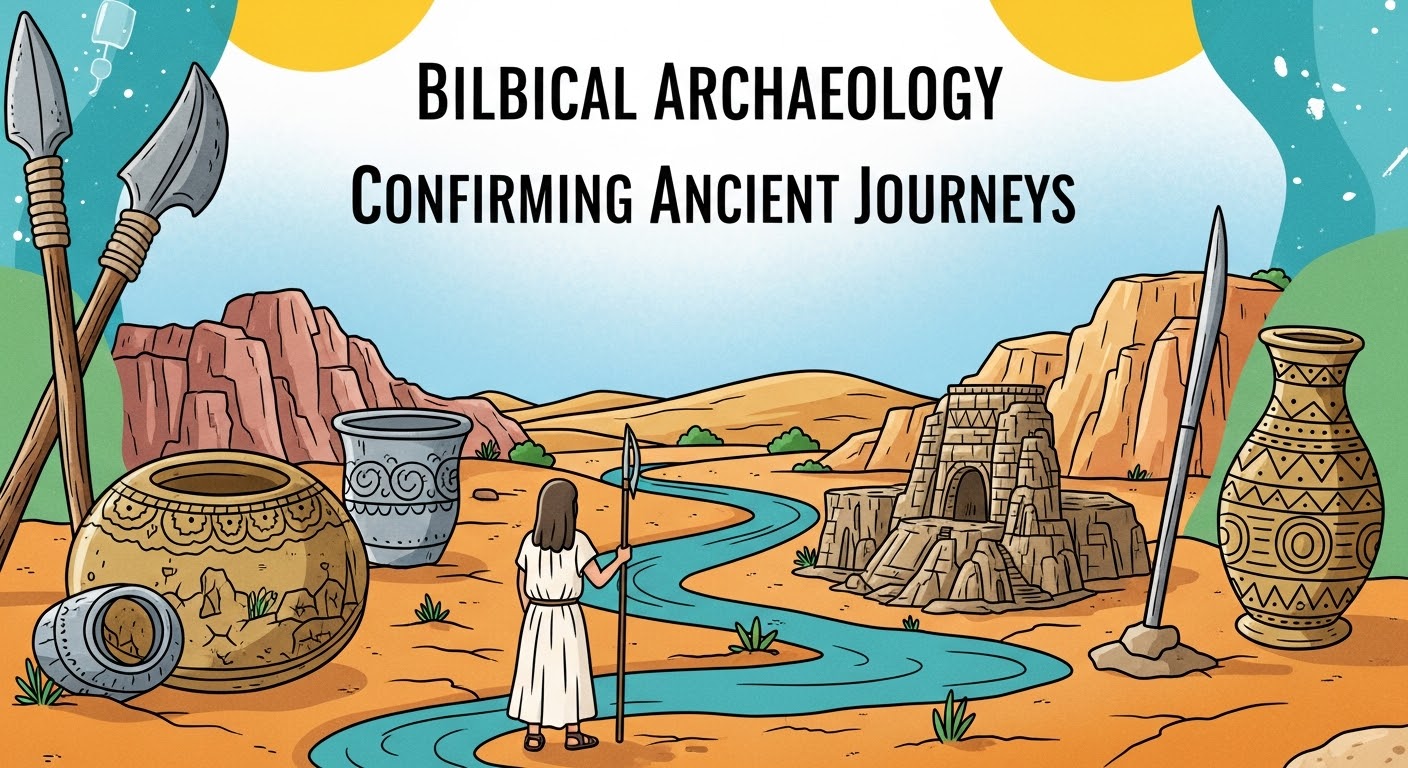
Dusty desert finds are challenging everything we thought we knew about biblical history.

The enduring allure of biblical narratives and the quest for tangible proof.
The enduring allure of biblical narratives is undeniable, but the quest for tangible proof, for historical grounding, is what drives the field of biblical archaeology.
This is a discipline born at the intersection of faith and science, where researchers use the tools of modern geology, dating, and cultural analysis to test narratives spanning millennia. It’s about more than just finding old objects; it’s about establishing historical context and validating geographical claims.
Hook: Can shovels and trowels truly validate millennia-old stories? The answer, as we’re about to see, is complex, surprising, and constantly evolving.

The journey of the Israelites remains the greatest historical enigma.
Of all the Bible’s great narratives, none are more pivotal, or more debated, than the Exodus. The journey of the Israelites from slavery in Egypt, across the Red Sea, and through the wilderness remains the greatest historical enigma.
The challenge for archaeologists isn't just finding a single site, but tracing the path of perhaps two million people over forty years. We look at potential routes and artifacts.

Discussing recent findings and ongoing debates surrounding the Red Sea crossing and wilderness wanderings.
While no grand Egyptian inscription detailing Moses' defeat has ever surfaced, recent explorations focus heavily on geographical features. Satellite imagery and geological surveys are highlighting possible crossing points in the Gulf of Suez or northern Red Sea marshes, matching the biblical description of a chaotic, yet direct, crossing.
The wilderness wanderings are also slowly yielding clues. Though permanent settlements from that era are rare, the discovery of specific Egyptian garrisons and trade routes in the Sinai region, predating or coinciding with the Exodus timeline, helps us piece together the political and military landscape that the Israelites would have navigated. The pathways through the past, while still blurred by time, are becoming clearer.

Highlighting key archaeological sites like Ur, Haran, and Hebron.
We turn now to the journeys of the Patriarchs, specifically Abraham. His migration from the advanced civilization of Mesopotamia to the relative frontier of Canaan is the foundational journey of the Jewish, Christian, and Islamic faiths.
Archaeology has strongly supported the historical backdrop of this period. We can delve into discoveries confirming the existence and sophistication of the cities mentioned. Ur, the starting point, is confirmed as a major, highly advanced city-state in the required time period. Haran, a key stopover, was a known crossroads on ancient trade routes.
Delving into city structures and cuneiform tablets from the period, we find fascinating insights that align with the biblical accounts. For example, ancient laws and customs found in cities like Nuzi often mirror the specific, peculiar familial and inheritance practices described in Genesis—practices that would have been common in the Patriarchal era but rare centuries later.
These links don't prove Abraham's specific story, but they confirm that the world described in the narratives—the ancient trade routes, the city structures, the legal system—was absolutely real and accurately portrayed for that time.

Uncovering the archaeological footprint of the united monarchy under David and Solomon.
Next, we uncover the archaeological footprint of the united monarchy under David and Solomon—a period of immense historical and religious significance.
For decades, many scholars doubted the scale of these kingdoms, suggesting David and Solomon were little more than powerful tribal chieftains. However, recent discoveries have begun to provide stunning corroboration.
Perhaps the most famous piece of evidence is the Tel Dan Stele. This ninth-century BCE inscription, discovered in northern Israel, explicitly mentions the "House of David" in reference to the Judean royal dynasty. It is the first extra-biblical reference to King David, placing him squarely in the historical record.
Furthermore, large, fortified administrative structures unearthed in places like Gezer, Hazor, and Megiddo—cities that the Bible specifically attributes to Solomon’s building projects—show a level of centralized planning and power consistent with a powerful, unified kingdom in the 10th century BCE.
While the exact size and wealth of Solomon's kingdom remain a lively topic of discussion, these significant inscriptions and structures provide crucial, tangible evidence confirming the existence and political influence of the kings described in the sacred texts.
Reflecting on the significance of these archaeological confirmations for believers and skeptics alike.
We've explored evidence ranging from the subtle clues of trade routes to the explicit mention of King David. The significance of these archaeological confirmations is profound for believers, providing a material foundation for their faith, and for skeptics, who must confront a mounting body of evidence that the biblical narratives are deeply rooted in real history and geography.
However, the field is not without its challenges. The work is often complicated by ongoing political tensions, ethical debates about ownership of relics, and the challenge of interpreting layers of destruction and rebuilding. Every find requires careful, objective analysis.
The journey of biblical archaeology is, in itself, an ongoing expedition—a quest not to prove the Bible definitively, but to understand the authentic historical world from which it emerged.
Reflect on the continued relevance of these ancient journeys in modern times. What they ultimately offer us is a deeper connection to the past, reminding us that the people, the places, and the events of these ancient books walked on the very same earth we excavate today.
A: The goal is primarily historical and geographical confirmation. It seeks to illuminate the cultural, political, and material context of the biblical narratives, helping us understand *the world* the Bible describes, rather than attempting to prove theological claims or miracles.
A: Dating relies on several techniques, including **Stratigraphy** (analyzing layers of sediment, where lower levels are older), typology (dating pottery and artifacts by their style), and scientific methods like radiocarbon dating for organic materials.
A: No. Finds rarely confirm specific individuals from that early period (circa 2000 BCE). However, discoveries like the Nuzi Tablets (mentioned in Section III) confirm the unusual familial and legal customs described in Genesis, validating the accurate cultural setting of the patriarchal narratives.
A: Ur was a major, highly advanced Sumerian city-state located in Southern Mesopotamia, in what is now modern Iraq. The extensive ruins confirm its status as a sophisticated center of trade and culture during the relevant time period.
A: The main challenge is the lack of permanent settlements left by the Israelites during their 40 years of wandering. Nomadic groups leave behind little solid archaeological evidence. Most modern research focuses on finding subtle clues, like Egyptian garrisons or geological confirmations of potential crossing sites.
A: The Merneptah Stele (c. 1208 BCE) is crucial because it contains the **first extra-biblical reference to "Israel."** An Egyptian pharaoh boasts of crushing a tribe called "Israel" in Canaan. This confirms that a group identifying as Israel was present and politically significant in the Late Bronze Age.
A: Excavations show that Jericho was destroyed and burned, but the timing is highly debated. Most archaeologists date the famous destruction layer to the Middle Bronze Age (c. 1550 BCE), which is centuries before the biblical Conquest narrative is traditionally placed (Late Bronze Age).
A: The Tel Dan Stele, an Aramaic inscription from the 9th century BCE, explicitly mentions the "House of David" (bytdwd) in reference to the royal dynasty of Judah. This is monumental because it places David, previously considered purely a biblical figure by some, directly into the historical record of surrounding kingdoms.
A: No definitive physical remains of the First Temple (Solomon’s Temple) have been found under the Temple Mount due to political and religious sensitivities preventing excavation. However, fortifications and administrative structures built during the 10th century BCE in sites like Megiddo and Gezer support the biblical description of a powerful, centralized kingdom capable of such a massive building project.
A: Bullae are small pieces of clay used to seal documents. When the document was destroyed (e.g., by fire), the clay seal hardened. Many have been found bearing the names of biblical figures, such as governors and officials, providing primary source confirmation of individuals mentioned in the later books of the Old Testament.
A: The Lachish Reliefs are large stone carvings found in the palace of the Assyrian King Sennacherib. They vividly depict the Assyrian siege and conquest of the Judean city of Lachish (c. 701 BCE), perfectly matching the biblical account in 2 Kings 18-19, confirming the scale and brutality of the invasion.
A: Numerous New Testament sites have been confirmed, including the Pool of Siloam, the Pool of Bethesda, the remains of the Herodian Temple walls, and the town of Capernaum. These finds validate the geographical backdrop of Jesus’ ministry and the early Church.
A: Cuneiform tablets from Mesopotamia and the Near East provide vital external evidence. They document trade, political history, and legal systems. For instance, the Babylonian Chronicles detail the conquest of Jerusalem (597 BCE) and confirm the exile of King Jehoiachin, aligning with the account in 2 Kings.
A: Biblical minimalism is a scholarly approach that argues the biblical text is primarily a religious document, written centuries after the events it describes, and therefore contains little accurate history, especially concerning the early periods (like the Exodus or the United Monarchy). The opposing view, maximalism, believes the biblical account is generally accurate.
A: Disagreement stems from two primary issues: Dating Discrepancies (the exact chronological period assigned to a layer or artifact) and Interpretive Bias (archaeologists bringing different religious, political, or theoretical frameworks to the data). The field is rich with debate because the evidence is often indirect.
What historical journey would you most like to see confirmed by archaeology? Let us know in the comments below, and don't forget to subscribe for more deep dives into the intersection of history and mystery.
