
The Birth of Jesus: A Sacred Story
The birth of Jesus Christ in Bethlehem is one of the most celebrated and significant events in human history, forming the cornerstone of the Christian faith. This miraculous event, which Christians commemorate each year at Christmas, took place over two millennia ago in a humble cave in the small town of Bethlehem, located approximately 10 kilometers south of Jerusalem in what is today the West Bank of Palestine.
The Biblical Account
The story of Jesus' nativity is recounted in the Gospels of Matthew and Luke, with each providing unique details that together paint a vivid picture of this momentous occasion. According to the scriptures, Mary and Joseph traveled from Nazareth to Bethlehem to comply with a Roman census decree. Upon arrival, they found no room at the inn and were directed to a humble stable—traditionally understood to be a cave used for sheltering animals.
It was in this most unlikely of places that Mary gave birth to Jesus, whom Christians believe to be the Son of God, the promised Messiah, and the Savior of humanity. The infant was laid in a manger—a feeding trough for animals—an act that symbolizes the humility and accessibility that would characterize Jesus' entire ministry.
Fulfillment of Ancient Prophecy
Jesus' birth in Bethlehem fulfilled the prophecy made by the prophet Micah centuries earlier: "But you, Bethlehem Ephrathah, though you are small among the clans of Judah, out of you will come for me one who will be ruler over Israel, whose origins are from of old, from ancient times" (Micah 5:2). This prophecy specified that the Messiah would be born in Bethlehem, the City of David, establishing Jesus' credentials as the fulfillment of Jewish messianic expectations.
The Significance of the Cave
Archaeological and historical evidence suggests that in first-century Bethlehem, it was common for families to live in homes built over or adjacent to natural limestone caves. These caves served multiple purposes—they provided cool storage space in summer, warm shelter in winter, and were frequently used to house livestock such as sheep, goats, and donkeys.
The limestone caves of the Judean hills were often modified with carved niches for oil lamps and stone troughs (mangers) for watering animals. When Luke describes the baby Jesus being placed in a manger, he is almost certainly referring to one of these carved stone feeding troughs that would have been found in such a cave stable.
"The earth's most sacred spot was overshadowed by the grave of Adonis, and the cave where the infant Christ once wept was where the paramour of Venus was bewailed." — St. Jerome, AD 395
The Church of the Nativity: A Living Testament
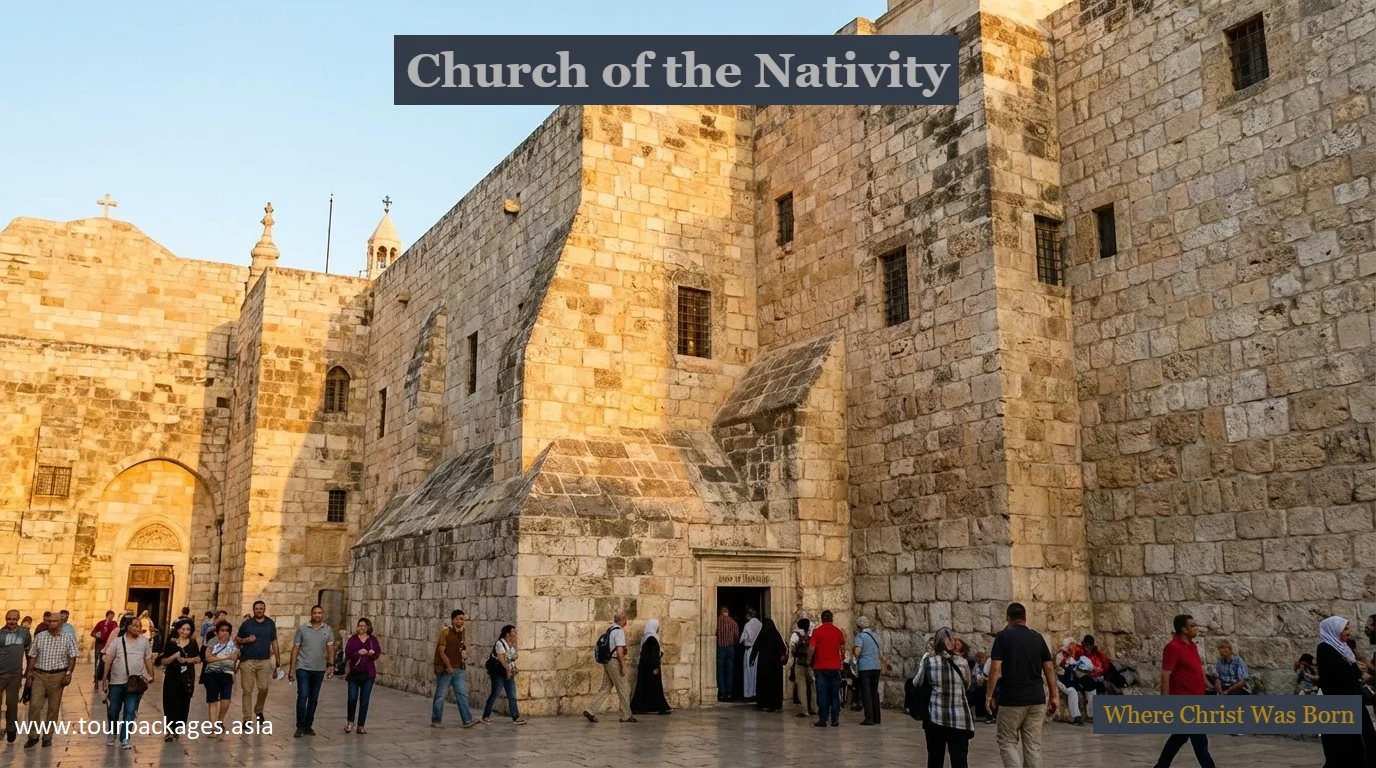
Standing today over the very cave venerated as Christ's birthplace is the magnificent Church of the Nativity, one of the oldest continuously operating churches in the entire Christian world. This UNESCO World Heritage Site has stood as a beacon of faith and a destination for pilgrims for nearly 1,700 years, making it an unparalleled link to the earliest days of Christianity.
Founded
339 AD by Emperor Constantine and St. Helena
️ Status
UNESCO World Heritage Site since 2012
✝️ Significance
Oldest continuously operating church in Christianity
Location
Bethlehem, West Bank, Palestine
Historical Timeline of the Church
Early Christians begin venerating the cave as the birthplace of Jesus. The site is already recognized and protected by the Christian community.
Roman Emperor Hadrian desecrates the site by planting a grove dedicated to Adonis and establishing pagan worship in an attempt to erase Christian memory of the location.
Justin Martyr makes written reference to the Nativity cave, providing early documentation of the site's significance.
St. Helena, mother of Emperor Constantine, visits Jerusalem and Bethlehem during her pilgrimage to the Holy Land, identifying sacred Christian sites.
The original Church of the Nativity is dedicated on May 31st. Constantine commissions a magnificent basilica with an octagonal altar positioned directly over the sacred cave.
St. Jerome lives in a cave adjacent to the Church, where he translates the Bible into Latin (the Vulgate) and writes extensively about the holy site.
The original church is destroyed by fire during the Samaritan Revolts that devastated many churches in the region.
Byzantine Emperor Justinian rebuilds the church on a grander scale. This structure, largely preserved, forms the basis of today's church.
Persian invasion spares the Church when invaders see a mosaic depicting the Three Wise Men in Persian dress, recognizing them as fellow Persians.
Islamic conquest of the region. A Muslim prayer space is established within the church, and the site remains protected under Islamic rule.
Crusaders extensively renovate and beautify the church, adding magnificent mosaics, frescoes, and decorative elements.
The main entrance is lowered to prevent looters from riding horses or carts into the church, creating the famous "Door of Humility."
The Status Quo agreement establishes shared custody among Catholic (Franciscan), Greek Orthodox, and Armenian Apostolic churches.
UNESCO designates the Church of the Nativity and Pilgrimage Route as a World Heritage Site—the first site listed under "Palestine."
Major restoration project undertaken, including roof repairs, restoration of ancient mosaics, and preservation of structural elements.
Architectural Marvel and Sacred Spaces
The Door of Humility
One of the most distinctive features of the Church of the Nativity is its entrance—a remarkably small doorway standing only 1.2 meters (approximately 4 feet) high. Known as the "Door of Humility," this entrance was created by reducing the size of the original Byzantine doorway around the year 1500.
While the practical purpose was to prevent looters and invaders from riding horses or carts into the church, the theological symbolism is profound. Every visitor, regardless of rank or status, must bow low to enter—a physical reminder of the humility exemplified by Christ, who humbled himself to be born in a cave and laid in an animal's feeding trough.
The Basilica Interior
Upon entering through the Door of Humility, visitors find themselves in a stunning Byzantine basilica characterized by:
- Five Aisles: The nave is divided by four rows of elegant Corinthian columns crafted from local red limestone, creating a sense of grandeur and solemnity.
- 44 Columns: These monolithic pillars, some bearing remnants of Crusader-era paintings depicting saints, support the ancient timber roof structure.
- Ancient Mosaics: Sections of the original floor mosaics from Constantine's 4th-century church remain visible, providing a tangible connection to early Christianity.
- Wall Mosaics: Restored 12th-century mosaics adorn the walls, depicting Church councils, prophets, ancestors of Christ, and elaborate decorative patterns.
- Simple Dignity: The interior contains no pews, maintaining a sense of open, sacred space that encourages contemplation and prayer.
The Grotto of the Nativity
The spiritual heart of the church lies beneath the main altar—a flight of stone steps descends into the Grotto of the Nativity, the cave traditionally venerated as the exact spot where Jesus was born. This intimate space, hung with precious lamps and adorned with tapestries, creates an atmosphere of profound reverence.
⭐ The Silver Star
Set into the marble floor of the grotto is a fourteen-pointed silver star, installed in 1717, marking the traditional site of Jesus' birth. Inscribed in Latin around the star are the words: "Hic De Virgine Maria Jesus Christus Natus Est" (Here Jesus Christ was born of the Virgin Mary). Surrounding the star, fifteen lamps burn perpetually—six belonging to the Greek Orthodox, five to the Armenian Apostolic, and four to the Roman Catholic Church, symbolizing the shared custody and continuous veneration of this holy site.
Adjacent Sacred Spaces
The Church complex includes several other significant locations:
- Chapel of the Manger: Adjacent to the main grotto, this Catholic chapel marks the traditional location where Mary placed the infant Jesus in the manger.
- Church of St. Catherine: Connected to the main basilica on the north side, this Franciscan church serves as the site for the famous televised Midnight Mass on Catholic Christmas Eve.
- Cave of St. Jerome: Below St. Catherine's Church are the caves where St. Jerome lived and worked on his Latin translation of the Bible (the Vulgate) from 382 to 420 AD.
- Chapel of St. Joseph: Commemorating the angel's appearance to Joseph, instructing him to flee to Egypt with Mary and Jesus to escape King Herod's massacre.
Christmas Celebrations in Bethlehem
The Church of the Nativity becomes the focal point of global Christian celebration during the Christmas season. Due to the different calendars used by various Christian denominations, Bethlehem uniquely celebrates Christmas three times:
Catholic Christmas
December 24-25 (Gregorian Calendar)
Famous televised Midnight Mass in St. Catherine's Church
✝️ Orthodox Christmas
January 6-7 (Julian Calendar)
Greek, Coptic, Syriac, and Ethiopian Orthodox celebrations
️ Armenian Christmas
January 18-19 (Armenian Calendar)
Combined celebration of Nativity and Baptism of Christ
The Midnight Mass Tradition
The Catholic Midnight Mass at the Church of the Nativity on December 24th is one of the most watched religious ceremonies in the world, broadcast to hundreds of millions of viewers globally. The tradition begins hours before midnight when dignitaries and clergy gather near Rachel's Tomb to welcome the Latin Patriarch of Jerusalem.
A festive procession through Manger Square, accompanied by youth organizations, scouts, and pilgrims from around the world, culminates in the packed Church of St. Catherine. After celebrating Mass, the Patriarch leads a procession into the Grotto of the Nativity, where he symbolically places a figurine of the Baby Jesus on the silver star, reenacting the sacred moment of Christ's birth for believers worldwide.
A Tour Through Sacred History
Visiting the Church of the Nativity is a profound experience that combines spiritual reflection with historical discovery. As pilgrims and travelers planning international tours to the Holy Land, understanding what to expect enhances the journey.
Manger Square
Your journey begins at Manger Square (also called Nativity Square), the large plaza facing the church complex. This Byzantine-era square serves as Bethlehem's main gathering place and has witnessed countless historical moments. During Christmas, the square transforms into a celebration center with towering Christmas trees, nativity displays, and crowds of joyful pilgrims singing carols in anticipation of midnight services.
The Pilgrimage Route
The historic Pilgrimage Route—also part of the UNESCO World Heritage designation—follows the path traditionally taken by visitors approaching the church from Jerusalem. This route, lined with centuries-old buildings, convents, and monasteries, evokes the experience of countless pilgrims throughout history who have made this sacred journey.
Video Tours of the Church of Nativity
To enhance your understanding and virtual experience of this sacred site, we recommend these comprehensive video documentaries:
Birth of Jesus – Historical Documentary
An in-depth exploration of the historical and biblical accounts of Jesus' birth, featuring expert interviews and on-location footage from Bethlehem.
▶️ Watch on YouTubeChurch of the Nativity Virtual Tour
A detailed visual tour through the Church of the Nativity, including rarely-seen areas and expert commentary on the site's history and significance.
▶️ Watch on YouTubeArchaeological Authenticity
One of the most remarkable aspects of the Church of the Nativity is the archaeological and historical consensus regarding its authenticity. Unlike some religious sites where tradition and history diverge, Jewish, secular, and Christian scholars overwhelmingly agree that this location marks the authentic birthplace of Jesus Christ.
Evidence Supporting the Site's Authenticity:
- Early Christian Tradition: Written references to the Nativity cave date back to at least 160 AD (Justin Martyr), establishing continuous veneration from the earliest Christian centuries.
- Hadrian's Desecration: The Roman emperor's 135 AD attempt to erase the site's Christian significance by establishing pagan worship there paradoxically confirms that early Christians had already identified this location as sacred.
- Archaeological Excavations: Pottery discovered beneath the church dates to the times of both Abraham (2000 BC) and King David (1000 BC), confirming ancient settlement. First-century remains consistent with the Gospel accounts have been found.
- Architectural Evidence: The preservation of original 4th-century mosaic floors and building foundations provides physical continuity with the earliest church structure.
- Geological Context: The cave structure and surrounding limestone formations match typical first-century Bethlehem domestic architecture, where homes were built adjacent to or over natural caves used for livestock.
Shared Custody and Ecumenical Significance
Since 1852, the Church of the Nativity has been jointly administered by three Christian denominations under an arrangement known as the "Status Quo." This agreement, formalized in the Treaty of Paris (1856) and later codified by the United Nations (1949), allocates specific rights and responsibilities to:
- Greek Orthodox Patriarchate of Jerusalem: Maintains the main basilica and the Grotto of the Nativity
- Roman Catholic Church (represented by the Franciscan Custody of the Holy Land): Maintains the Church of St. Catherine and has rights to the Chapel of the Manger
- Armenian Apostolic Church: Maintains the northern transept and has specific worship times in the main basilica
This unique arrangement makes the Church of the Nativity a powerful symbol of Christian unity and cooperation, as three major branches of Christianity work together to preserve and maintain Christianity's most sacred birthplace.
????️ Plan Your Sacred Journey to Bethlehem
Experience the profound spiritual significance of walking where Christ was born. Our expertly designed Holy Land tours include guided visits to the Church of the Nativity, Shepherd's Field, and other biblical sites.
Contact Our Travel ExpertsVisitor's Guide: Practical Information
Essential Tips for Visiting the Church of the Nativity
- Dress Code: Modest attire is required. Shoulders and knees must be covered. Women should consider bringing a scarf.
- Opening Hours: Generally open daily from early morning to evening, but hours vary by season and religious observances. Arrive early to avoid crowds, especially during Christian holidays.
- Security: Expect security checkpoints at the entrance to Manger Square. Have your passport or identification ready.
- Photography: Photography is generally permitted in most areas of the church, but flash photography may be restricted. Always ask permission before photographing clergy or worshippers.
- Queue Times: Expect to wait in line to descend into the Grotto of the Nativity, particularly during peak pilgrimage seasons (Christmas, Easter, summer months). The wait can range from 30 minutes to 2 hours.
- Guided Tours: Consider joining a guided tour for historical and theological context. Many experienced guides are available in Manger Square.
- Accessibility: The main basilica is relatively accessible, but the narrow stairs to the grotto may be challenging for those with mobility limitations.
What to See in Bethlehem Beyond the Church
While the Church of the Nativity is Bethlehem's crown jewel, the town offers several other significant sites that enrich the pilgrimage experience:
- Shepherds' Field: Located in nearby Beit Sahour, this is traditionally identified as where angels appeared to shepherds announcing Christ's birth (Luke 2:8-20). Both Catholic and Orthodox churches mark the site.
- Milk Grotto: A cave chapel where, according to tradition, Mary nursed baby Jesus during the flight to Egypt. The white stone has been venerated for centuries.
- Herodium: The fortress-palace of King Herod, visible from Bethlehem, provides historical context for the political situation at the time of Jesus' birth.
- Rachel's Tomb: A significant site in Jewish tradition, marking the biblical matriarch's burial place on the northern edge of Bethlehem.
- Bethlehem Museum: Offers exhibits on the history and culture of Bethlehem through the ages.
The Broader Significance
The Church of the Nativity stands not merely as a historical monument but as a living testament to the enduring power of faith. For nearly seventeen centuries, this sacred site has drawn believers from every corner of the world—emperors and peasants, saints and sinners, seekers and skeptics—all drawn by the simple yet profound truth commemorated here: in this humble place, Christians believe, God became man.
The church's survival through wars, invasions, earthquakes, and political upheavals is itself remarkable. When Persian armies swept through the region in 614 AD destroying churches, they spared the Church of the Nativity upon seeing mosaics of the Magi dressed in Persian clothing. When centuries of neglect left the roof damaged and mosaics crumbling, recent restoration efforts have brought new life to this ancient treasure.
"The Church of the Nativity represents an outstanding example of an early church in a remarkable architectural ensemble, which illustrates significant stages in human history—the conversion of the Roman Empire to Christianity and the enduring influence of Christianity in spiritual and political terms over 1,500 years." — UNESCO World Heritage Committee
A Message of Hope and Humility
In our modern world of constant change and uncertainty, the Church of the Nativity offers an anchor—a place where the past speaks to the present, where heaven touched earth, where the impossible became reality. The message of Christmas—that God chose to enter human history in the most humble circumstances—resonates as powerfully today as it did two thousand years ago.
Whether you approach the Church of the Nativity as a believer seeking spiritual renewal, a historian exploring ancient sites, or a curious traveler experiencing world heritage, this sacred place offers something profound: a connection to one of humanity's most influential moments and an invitation to contemplate the meaning of humility, hope, and divine love.
✨Your Pilgrimage Awaits
Walk in the footsteps of millions of pilgrims throughout history. Discover the Holy Land with our carefully crafted tour packages designed for spiritual seekers and cultural explorers.
Explore Holy Land ToursConclusion: A Living Legacy
The Church of the Nativity in Bethlehem is more than an archaeological site or tourist destination—it is a living embodiment of faith that has endured through millennia. From the humble cave where shepherds and wise men first worshipped a newborn king, to the magnificent basilica that now shelters that sacred spot, this church tells the story of Christianity's birth and growth.
As you plan your journey to the Holy Land, whether through international tour packages or independent travel, make time to experience this extraordinary site. Stand in the Grotto of the Nativity, touch the silver star marking Christ's birthplace, and feel the weight of history and the presence of the sacred in this most holy of places.
The Church of the Nativity invites us all—regardless of faith or background—to pause, reflect, and consider the profound implications of what Christians believe happened here: that love took on flesh, that divinity embraced humanity, that heaven's glory was first revealed in a simple cave in Bethlehem.
References & Further Reading
Additional Sources:
- UNESCO World Heritage Centre - Church of the Nativity designation
- Custodia di Terra Santa (Franciscan Custody of the Holy Land)
- Greek Orthodox Patriarchate of Jerusalem
- Biblical Archaeological Society publications
