
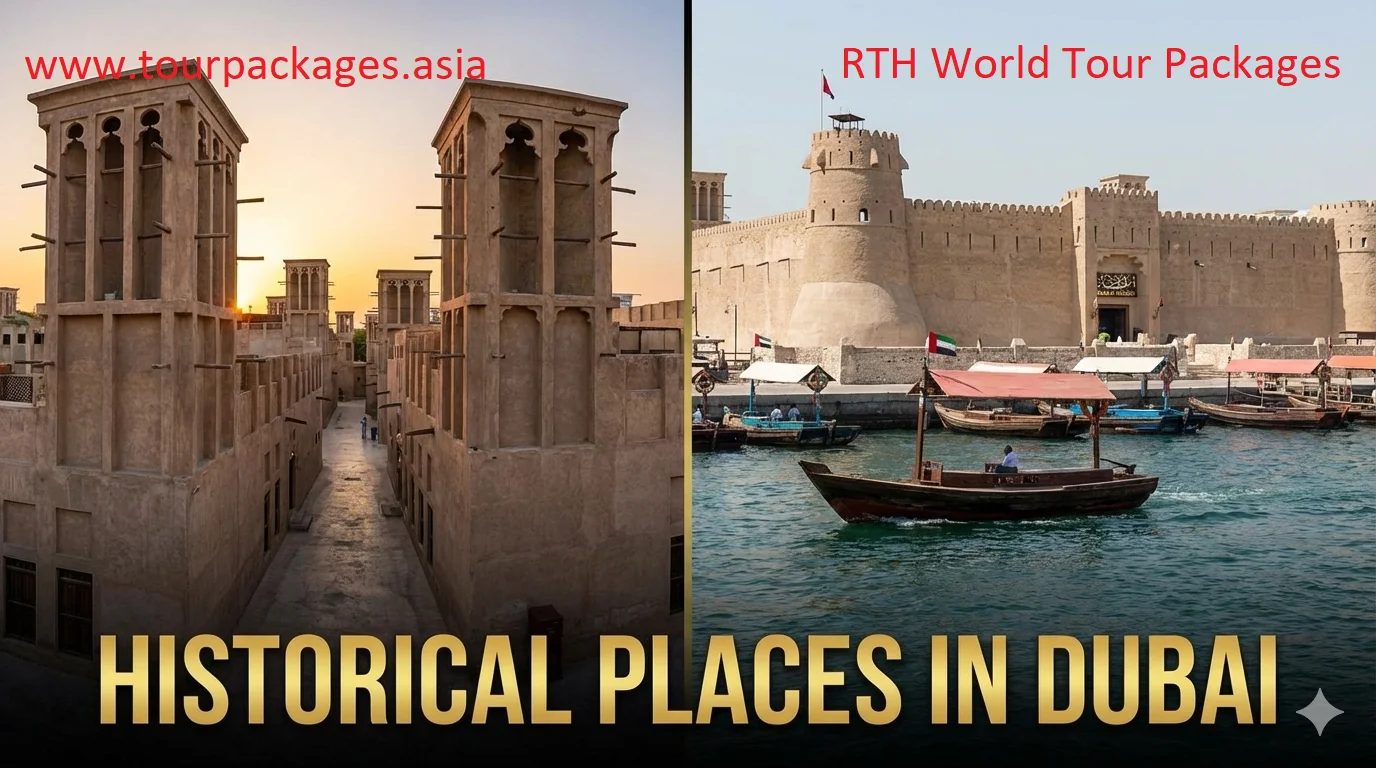
The world knows Dubai as a city of superlatives — the world's tallest tower, the world's largest shopping mall, the world's most audacious man-made islands. But beneath the polished glass and steel of this 21st-century skyline lies a history of extraordinary depth: a story of pearl divers and Bedouin traders, of fortified watchtowers built against desert raiders, of a humble Creek-side settlement that grew through the sheer force of its rulers' vision into one of the planet's most visited destinations. Understanding this history does not diminish the wonder of modern Dubai — it magnifies it. Every skyscraper stands on foundations laid by generations of resilience, ingenuity, and cultural exchange.
The historical sites of Dubai span an extraordinary range of periods and contexts. Al Fahidi Fort, built in 1787 and the oldest standing structure in the emirate, anchors the city's architectural heritage along the southern bank of Dubai Creek. The Al Fahidi Historical Neighbourhood — also known as Al Bastakiya — preserves a remarkable 38,000-square-metre ensemble of coral-stone buildings, wind towers, and narrow stone-paved alleyways built by 19th-century Persian merchants. The Dubai Creek itself, the 14-kilometre saltwater inlet that divided the emirate into Bur Dubai and Deira, has been the beating commercial heart of the settlement for at least three centuries. And in the mountains beyond the city limits, the Hatta Heritage Village preserves a completely different chapter — the story of the highland communities who lived among the Hajar Mountains, far from the sea trade routes of the coast.
This guide covers every significant historical site and heritage experience in Dubai — forts and monuments, museums and mosques, ancient souks and royal residences — and maps out how each connects to the wider Dubai experience. Whether you are spending a single morning in Old Dubai or building a multi-day cultural itinerary around the city's heritage, what follows is the most thorough guide to Dubai's historical places available for travellers in 2026.
Old Dubai and New Dubai — Historic Landmarks at a Glance
Dubai's historical identity and its modern ambition are not in conflict — they are two chapters of the same story. This table maps the key heritage sites across both the old and new city.
| Site | Period / Built | Type | Location | Entry | Status 2026 |
|---|---|---|---|---|---|
| Al Fahidi Fort (Dubai Museum) | 1787 | Fort / Museum | Bur Dubai | AED 3 (museum) | Fort open; Museum under renovation |
| Al Fahidi Historical Neighbourhood | 19th century | Heritage District | Bur Dubai | Free | Open |
| Dubai Creek (Abra route) | Ancient / ongoing | Waterway / Heritage | Bur Dubai / Deira | AED 1 (abra) | Open |
| Sheikh Saeed Al Maktoum House | 1896 | Royal Residence / Museum | Al Shindagha | AED 3–6 | Open |
| Al Shindagha Museum | District — 19th c. | Museum Complex | Al Shindagha | AED 25 adult | Open |
| Jumeirah Mosque | 1979 | Mosque / Landmark | Jumeirah | AED 25–45 (guided) | Open to visitors (guided tours) |
| Majlis Ghorfat Umm Al Sheif | 1955 | Royal Summer House | Jumeirah | AED 1–3 | Open |
| Al Ahmadiya School | 1912 | Heritage / Education | Deira | Free | Open |
| Gold Souk and Spice Souk | 19th–20th century | Traditional Market | Deira | Free | Open |
| Saruq Al Hadid Museum | Pre-Islamic | Archaeology Museum | Al Shindagha | AED 10–20 | Open |
| Burj Nahar (Watchtower) | 1870 | Monument / Tower | Deira | Free (exterior) | Open |
| Hatta Heritage Village | Over 3,000 years old | Heritage Village / Fort | Hatta (90 min drive) | Free | Open |
| Dubai Frame | 2018 | Landmark / Bridge Old–New | Zabeel | AED 50 | Open |
| Etihad Museum | 2017 (1971 events) | Museum / National Heritage | Jumeirah | AED 25–35 | Open |
Forts and Monuments — Old Dubai
Dubai's defensive and administrative architecture tells the story of a settlement that was, for most of its history, a relatively modest but strategically vital trading post on the Arabian Gulf. Its forts and towers were not decorative — they were essential infrastructure for survival.
Al Fahidi Fort — Dubai's Oldest Building and Founding Monument
Standing on the southern bank of Dubai Creek in Bur Dubai, Al Fahidi Fort is the oldest building in Dubai and the single most important historical monument in the emirate. Built approximately in 1787 from coral rock and mortar — materials characteristic of Gulf coastal construction — the fort served simultaneously as the ruler's palace, the city's primary defensive stronghold, and in later years, a garrison, an ammunition store, and a prison for outlaws. Its square plan with towers occupying three of its corners and two bronze cannons guarding the main eastern gate remain essentially intact, providing a rare and powerful physical link to Dubai's earliest recorded period of organised settlement.
The fort's political and military significance cannot be overstated. It was the seat of power for the early Al Maktoum dynasty and the point from which Dubai's rulers administered the settlement and its affairs for over a century. Its position at the landward border of the old city — directly facing the desert approaches from which raids might come — reflects the ever-present security imperatives of Arabian Gulf settlements in the 18th and 19th centuries. Two additional watchtowers originally complemented the fort's defensive role, of which Burj Nahar (built 1870) in Deira survives as the most intact surviving example.
In 1971 — the same year the United Arab Emirates was officially founded as a federation — Sheikh Rashid bin Saeed Al Maktoum ordered the fort's restoration and conversion into a public museum. The Dubai Museum opened in that founding year as a deliberate act of cultural preservation: a recognition that Dubai's headlong rush into modernity required an equally determined effort to document and protect its heritage. In 1995, an underground extension gallery was added, significantly expanding the museum's capacity and creating an immersive subterranean experience.
Important for 2026 visitors: The Dubai Museum is currently closed for a major restoration and modernisation project. No official reopening date has been announced. Visitors can still view and photograph Al Fahidi Fort's exterior, walk along its coral-stone walls, and explore the surrounding Al Fahidi Historical Neighbourhood and its many cultural institutions.
What the Museum Contains — for Reference
- The Fort Courtyard: Houses a traditional Arish palm-frond summer dwelling with a wind tower, a large wooden dhow, and two bronze cannons — the visual centrepiece of the entire site.
- The Monuments Wing: Displays pottery, weapons, tombs, and archaeological objects dating as far back as 3000 BC — evidence of Bronze Age settlement on the territory of modern Dubai.
- Old Dubai Souk Diorama: A life-size recreation of the Dubai market as it appeared in the 1950s, complete with craftsmen, vendors, a tailor, an iron smith, and realistic sounds and smells.
- Traditional Home and Mosque Wing: Shows the structure and furnishings of a typical Emirati household and a traditional mosque of the pre-oil era.
- Desert Life Wing: A large diorama depicting Bedouin life — date palms, camel caravans, a desert encampment, and exhibits on astronomical navigation.
- The Sea Wing: The museum's most spectacular section — a massive diorama of dhow construction, pearl diving, Arabian Gulf marine life, and the full range of maritime equipment and culture that defined Dubai's economy for centuries.
- Archaeological Finds from Jumeirah and Al Qusais: Artefacts including coins, tools, pottery, and jewellery from excavations at these sites, some dating to 2000–1000 BC.
Burj Nahar — The 1870 Watchtower of Deira
Burj Nahar, built around 1870 and constructed from coral stone and mud in the characteristic architectural style of late Arab Gulf building tradition, is the finest surviving example of Dubai's original defensive tower network. One of three watchtowers historically positioned to give advance warning of approaching enemy tribes from the desert or sea, Burj Nahar now stands in a small park shaded by date palms in the heart of Deira — an unexpected and moving monument surrounded by the noise and commerce of one of Dubai's busiest districts. The tower's thick walls, narrow arrow-slit windows, and compact form speak directly to the practical realities of 19th-century Arabian Gulf security. It is not large, but its physical presence carries a historical weight entirely disproportionate to its scale.
Heritage Neighbourhoods — Al Bastakiya and Al Shindagha
Old Dubai's two great heritage districts each preserve a distinct aspect of the city's pre-oil character — one the mercantile, artistic quarter of Persian immigrant traders; the other the waterfront district of the ruling family and the pearl diving industry.
Al Fahidi Historical Neighbourhood (Al Bastakiya)
Covering approximately 38,000 square metres of terrain along the southern bank of Dubai Creek, the Al Fahidi Historical Neighbourhood is the most comprehensively preserved heritage district in Dubai and one of the most significant in the entire Arabian Peninsula. Its history begins in the early 20th century when wealthy textile and pearl merchants from Bastak, a region in southern Persia (modern Iran), settled in this part of Bur Dubai to take advantage of Dubai's zero-tax trading policy and its strategically positioned Creek access. These Persian merchants brought with them their own distinctive architectural traditions — most notably the barajeel, the iconic wind tower that functions as a passive cooling system, channelling prevailing breezes downward into the interior of a building through a tall, multi-directional shaft.
Walking through Al Bastakiya today is to step directly into the physical fabric of 19th and early 20th century Dubai. The district extends approximately 300 metres along the Creek and 200 metres inland, its narrow stone-paved alleyways (sikkas) flanked by buildings constructed from coral stone, teak wood, sandalwood, and palm fronds. The wind towers that rise above the rooflines are not decorative additions — they are the neighbourhood's defining architectural technology and the reason it can be immediately recognised from any distance. The buildings and their materials, the scale of the alleyways, the texture of the walls, and the quality of the carved wooden doors all speak of a building tradition evolved over centuries to address the specific demands of the Arabian Gulf climate and way of life.
- Coffee Museum: A beautifully curated two-floor museum housed in a restored wind-tower building, dedicated to the history and culture of coffee from the Arabian Peninsula and beyond. Exhibits include antique roasting equipment, Bedouin brewing tools, and a working café serving traditional Arabic Gahwa in a majlis setting.
- Sheikh Mohammed Centre for Cultural Understanding (SMCCU): The heart of cultural education in the neighbourhood, operating under the philosophy of Open Doors, Open Minds. Offers traditional Emirati breakfast and lunch experiences with a local host who answers questions about religion, customs, dress and daily life — one of the most genuinely illuminating cultural experiences available anywhere in Dubai.
- Coin Museum: A focused collection tracing the history of currency in the region from ancient coins to modern Emirati dirhams — a compact but fascinating window into the commercial history of the Creek.
- Architectural Walking Trails: Multiple self-guided and guided walking trails wind through the district, each revealing different aspects of the wind-tower architecture, traditional door designs, and the evolution of the neighbourhood's layout.
- Art Galleries and Artist Studios: Dozens of galleries and ateliers occupy restored buildings throughout the neighbourhood, making it the most concentrated fine art destination in Bur Dubai and a significant venue in Dubai's contemporary art calendar.
- Arabian Tea House: One of Dubai's most celebrated traditional restaurants, serving authentic Emirati cuisine including machboos (spiced rice with meat), luqaimat (sweet dumplings), and karak tea in a leafy open courtyard setting — one of the most photographed dining spaces in the heritage district.
Al Shindagha Historic District
At the mouth of Dubai Creek, where the waterway meets the Arabian Gulf, lies Al Shindagha — the historic district that for most of Dubai's recorded history served as the exclusive enclave of the ruling Al Maktoum family and the most powerful merchant families of the settlement. The district has been comprehensively restored and reimagined as a multi-venue museum and cultural complex, with several distinct museums now operating within its restored traditional buildings.
- Al Shindagha Museum (Main): The district's primary cultural institution, covering Dubai's maritime history, pearl diving traditions, the role of the Creek, and the development of the ruling family's authority — with interactive exhibits, documentary films, and artefact displays across multiple wings.
- Perfume House Museum: A sensory journey through the history and culture of Arabian perfumery — oud, bakhoor, rose water — and their central importance to Gulf social and cultural life. The museum's architecture is itself historically significant.
- Saruq Al Hadid Archaeology Museum: Houses artefacts from the extraordinary archaeological site of Saruq Al Hadid — a pre-Islamic iron-age site in the Dubai desert that has yielded thousands of bronze and iron objects, jewellery, tools and weapons, demonstrating that organised metalworking communities existed in the region over three thousand years ago.
- Sheikh Saeed Al Maktoum House: See the dedicated section below for full detail on this landmark.
- Heritage Village (Open-air): A reconstructed outdoor heritage display with Bedouin tents, traditional craftsmen at work, and exhibitions of traditional tools and domestic objects — particularly atmospheric during winter evening hours.
Royal Residences and Their Stories
Sheikh Saeed Al Maktoum House — 1896
Built in 1896 and occupied as the primary residence of the Dubai ruler until 1958, Sheikh Saeed Al Maktoum House is one of the most historically significant buildings in the emirate. Sheikh Saeed, who governed Dubai from 1912 to 1958, was the grandfather of the current ruler Sheikh Mohammed bin Rashid Al Maktoum — meaning this house connects directly to the living present of Dubai's ruling dynasty. The current ruler himself spent part of his early life within its walls.
The building's architecture is a masterpiece of traditional Gulf residential design: four wind towers (barajeel) providing passive cooling across 30 rooms, spacious courtyard plans, coral-stone walls of considerable thickness, and intricately carved wooden doors. The restored house now operates as a museum with nine exhibition wings covering the history of the house itself, the Al Maktoum family lineage, old Dubai through photography and maps, marine life, historic documents, coins and stamps, and intimate images of social life in early 20th century Dubai. Many of the photographs on display are unique — private family images that have never been published elsewhere.
Majlis Ghorfat Umm Al Sheif — 1955 Summer Retreat
Built in 1955 as the summer leisure retreat of Sheikh Rashid bin Saeed Al Maktoum, the ruler who was the primary architect of Dubai's modern transformation, the Majlis Ghorfat Umm Al Sheif is the only surviving example of a traditional Emirati beach majlis. Located directly adjacent to what is now Jumeirah Beach, the building demonstrates how Dubai's ruling family spent the summer months before the age of air conditioning — gathering in a simply furnished but architecturally refined building on the Gulf coast, where prevailing sea breezes and thick walls provided natural cooling.
The two-storey structure features a gypsum-plastered exterior, teak wood interior beams, traditional rugs, and the sparse, dignified furnishing typical of a formal Arabian reception space (majlis). Its proximity to Kite Beach and Sunset Beach makes it the single most direct physical connection between Dubai's beach heritage and its historical sites — a genuinely moving place to visit both for the view it offers over the Gulf and for the intimate human story it tells about the man who built the modern city.
Museums of Dubai — Heritage, Archaeology and National Identity
Etihad Museum — Birth of the UAE
Opened in 2017 on the site of the historic Union House — the building in which the seven rulers of the UAE signed the Declaration of Union on 2 December 1971 — the Etihad Museum is Dubai's most architecturally distinctive modern heritage institution. The building itself is designed to evoke the seven rulers' signatures on the declaration, its curving structural form rising from the ground like a signature writ large across the Jumeirah coastline. The museum's exhibitions use state-of-the-art multimedia, archive film footage, historical documents, and immersive installations to tell the story of the events leading to the formation of the UAE — from the British Protectorate period through the individual histories of the seven emirates to the extraordinary political achievement of union in 1971.
Al Ahmadiya School — Dubai's Oldest Educational Institution
Founded in 1912 by Sheikh Ahmed bin Dalmouk — one of Dubai's most prosperous pearl merchants of the era — Al Ahmadiya School is the oldest educational institution in Dubai and one of the oldest in the UAE. The school operated as a centre of formal Islamic education until 1962, teaching Quran, Arabic language, mathematics, and the sciences of navigation and pearl diving assessment to the children of Dubai's merchant and ruler families. The building has been carefully restored to its original form and reopened as a heritage museum, with classrooms, teaching materials, and student artefacts preserved exactly as they appeared during the school's operational years. A heritage house adjacent to the school provides additional context for the life of the wealthy merchant family that endowed it.
The Dubai Frame — Where Old and New Dubai Meet
Standing 150 metres tall and 95 metres wide in Zabeel Park, the Dubai Frame is perhaps the most conceptually brilliant of Dubai's modern landmarks — a giant picture frame that literally contains, within a single field of view, the historic buildings and alleyways of Old Dubai on its southern side and the soaring glass towers of the modern city on its northern side. The south-facing view from the Frame's glass-floored sky bridge at 150 metres looks directly over Bur Dubai, the Creek, Al Fahidi, and the minarets of the Grand Mosque. The north-facing view encompasses the financial district, Downtown Dubai, and the Burj Khalifa. The building is also a museum in its own right, with ground-floor exhibitions tracing Dubai's history from the pearl diving era through the oil discovery to the present day, and an upper sky bridge with a transparent floor that makes the relationship between the city's two identities viscerally tangible.
Religious and Spiritual Heritage
Jumeirah Mosque — Open to All Faiths
Completed in 1979, the Jumeirah Mosque is the finest example of Islamic architecture in Dubai and one of the most visually arresting religious buildings in the entire Gulf region. Built on the instruction of the late Sheikh Rashid bin Saeed Al Maktoum in the medieval Fatimid architectural style — a tradition originating in medieval Egypt and characterised by its twin minarets, large central dome, and geometric stone ornamentation — the mosque is constructed from white stone and appears to glow with particular intensity at dawn, sunset, and under artificial illumination at night.
What makes Jumeirah Mosque uniquely significant among Dubai's religious buildings is its formal policy of welcoming non-Muslim visitors through guided tours conducted by the Sheikh Mohammed Centre for Cultural Understanding. Under its Open Doors, Open Minds philosophy, the SMCCU runs daily guided tours at 10:00 AM that invite visitors of all faiths to enter the mosque, understand the architecture and symbolism of Islamic sacred space, learn about the five pillars of Islam, witness (if timing allows) the atmosphere of communal prayer, and ask any questions they may have about Islamic beliefs and practices. The tour guides are trained specifically for this interfaith dialogue role and are among the most knowledgeable cultural communicators in the city. The experience has genuine transformative power for many visitors — and for many, it is the single most memorable cultural encounter of their Dubai visit.
The Ancient Souks — Dubai's Living Trade History
Dubai Creek and the Gold and Spice Souks
Dubai Creek has been the centre of Dubai's commercial identity for at least three centuries. The 14-kilometre saltwater inlet — technically a khor, an Arabic term for an inlet or channel — divides the city into Bur Dubai on the south bank and Deira on the north bank, and for most of Dubai's history served as both the commercial artery and the social dividing line of the settlement. The abra, the traditional flat-bottomed wooden boat that has crossed this water for generations, still operates between the two banks for AED 1 per crossing — unchanged in its basic form, route, and role for over a century and a half, making it one of the most historically authentic experiences available anywhere in modern Dubai.
The Gold Souk in Deira is Dubai's most dazzling traditional market — a covered arcade of over 300 shops displaying more gold jewellery, diamonds, and precious gemstones than almost any comparable market in the world. Dubai has the lowest gold taxation of any significant market globally, making it historically the world's trading centre for gold, a role the souk continues to embody today. The Spice Souk, just a few minutes' walk away, is a narrower, more intimate covered market where sacks of saffron, frankincense, rose water, dried limes, turmeric, and dozens of other spices, herbs, and dried goods line the alleyways — filling the air with a richness of scent that instantly transports visitors into a sensory experience of pre-modern Arabian trading life.
Hatta Heritage Village — Ancient Mountain Life
Approximately 90 minutes' drive southeast of central Dubai, nestled in the rocky, dramatic scenery of the Hajar Mountains on the border of Dubai emirate and Oman, the Hatta Heritage Village preserves a chapter of Emirati history entirely distinct from the Creek-side trading culture of coastal Dubai. Hatta was for thousands of years a highland agricultural settlement — its survival dependent not on pearl diving or sea trade but on the falaj irrigation system, a network of underground channels that directed mountain spring water to date palms, gardens, and domestic use. The settlement's residents were mountain people, and their architecture, customs, and relationship with the landscape reflect this fundamentally different way of life.
The heritage village was first opened to the public in 2001, having been meticulously reconstructed using the same traditional materials — mud, palm fronds, reed, and stone — used in the original settlement. Key elements of the site include a historic fort with two watchtowers that served as the settlement's primary defensive installation, traditional mountain dwelling houses, a mosque, the falaj water system, and a museum exhibiting artefacts connected to mountain life including ancient weapons, farming tools, traditional jewellery, and household objects. The site is over 3,000 years old according to archaeological assessment. Hatta today is also a significant adventure tourism destination, with kayaking on the Hatta Dam reservoir, mountain biking trails through the Hajar range, and wadi exploration available alongside the heritage experience.
Old Dubai and New Dubai — Two Faces of the Same City
Dubai is unique among world cities in the speed and completeness of its transformation. The distance between its oldest fort and its tallest tower is less than 15 kilometres — but the cultural and temporal distance between them spans centuries.
Old Dubai — Historical Identity
- Al Fahidi Fort (1787) — oldest building
- Al Bastakiya wind-tower quarter (19th century)
- Dubai Creek — ancient trade artery
- Gold and Spice Souks — ancient commerce
- Sheikh Saeed House (1896) — royal residence
- Al Ahmadiya School (1912) — oldest school
- Burj Nahar (1870) — defensive watchtower
- Abra boat crossings — AED 1, unchanged in form
- Jumeirah Mosque (1979) — Fatimid architecture
- Pearl diving culture — pre-oil economy
New Dubai — Modern Identity
- Burj Khalifa (2010) — world's tallest tower
- Palm Jumeirah — world's largest man-made island
- Museum of the Future (2022) — innovation hub
- Dubai Frame (2018) — old/new bridge
- Ain Dubai — world's largest observation wheel
- Dubai Mall — world's largest shopping mall
- Aquaventure — world's largest waterpark
- Etihad Museum (2017) — national identity
- Dubai Marina — purpose-built waterfront city
- Dubai Expo City — global exposition legacy
Connected Experiences — Heritage and Beach Combined
Dubai's historical sites connect naturally to modern beach and leisure experiences — creating full-day itineraries that move between centuries within a single coastal city.
Discover Historic Dubai with a Tailor-Made Package
Our Dubai specialists build itineraries that include Old Dubai's heritage districts, the Creek, Jumeirah Mosque and desert safari alongside the city's most iconic modern experiences — departing from all major Indian cities.
Explore Dubai Tour Packages Send an EnquiryCustom itineraries available from Mumbai, Delhi, Hyderabad, Chennai, Bangalore and beyond.
Frequently Asked Questions — Historical Places in Dubai
Everything you need to know before exploring Dubai's heritage sites — answered in full detail.
Al Fahidi Fort, built in 1787 from coral rock and mortar, is the oldest standing building in Dubai. The fort served as the ruler's palace, the city's primary defensive installation, a garrison, an ammunition store, and at various points a prison — a complete picture of what a pre-modern Arabian Gulf settlement required from its most important building.
The fort is located in Bur Dubai, immediately adjacent to the Al Fahidi Historical Neighbourhood, and can be reached by the Green Line metro to Al Fahidi Station. As of early 2026, the Dubai Museum housed within the fort is temporarily closed for a major restoration and modernisation project, with no official reopening date confirmed. However, the fort's exterior — its coral walls, towers, cannons, and courtyard visible through the gates — can still be seen and photographed. The surrounding Al Fahidi district and all its galleries, museums and cultural venues remain fully open. Most visitors find the area itself — including the Sheikh Mohammed Centre for Cultural Understanding, the Coffee Museum, art galleries, and the Arabian Tea House — more than sufficient for a rewarding three to four hour visit.
As of early 2026, the Dubai Museum — housed inside Al Fahidi Fort — is temporarily closed to visitors for a significant restoration and modernisation project. The renovation aims to update the museum's facilities and exhibition approach while preserving the historic fabric of the fort structure itself. No official reopening date has been announced by Dubai Culture and Arts Authority.
Visitors who specifically wish to experience Dubai's pre-oil history and cultural heritage in museum form have several excellent alternatives. The Al Shindagha Museum in the Shindagha Historic District covers Dubai's maritime history, pearl diving era, and Creek-side community life in detail. The Sheikh Saeed Al Maktoum House is fully open with its nine exhibition wings. The Saruq Al Hadid Archaeology Museum provides an unparalleled window into pre-Islamic civilisation on Dubai's territory. And the Etihad Museum covers the modern period from the late British Protectorate years through the foundation of the UAE. Together these institutions provide a richer and more complete picture of Dubai's history than any single museum could offer.
Yes, and the experience of doing so is one of the most genuinely educational and moving cultural encounters available in Dubai. Jumeirah Mosque formally welcomes non-Muslim visitors through guided tours organised by the Sheikh Mohammed Centre for Cultural Understanding (SMCCU) under its Open Doors, Open Minds programme — one of the most respected interfaith outreach initiatives in the Gulf region.
Tours run at 10:00 AM on most days of the week, with a second tour sometimes available at 2:00 PM. The entry fee for the guided tour ranges from AED 25 to AED 45 depending on the specific programme and guide. Visitors should dress modestly — clothing that covers shoulders and knees is required, and headscarves are provided for women who do not have their own. Shoes must be removed before entering the mosque.
The tour covers the Fatimid architectural style of the building, the symbolism of Islamic sacred space, the call to prayer and its meaning, the structure of Islamic worship, and the Five Pillars of Islam. The guides are specifically trained for interfaith dialogue and actively encourage questions — no topic relating to Islamic belief, practice, or culture is off limits. The mosque is built in white stone and is particularly beautiful when photographed from outside at dawn and at night when illuminated — visitors interested in architectural photography should plan their external shoot around these times.
The Al Fahidi Historical Neighbourhood — commonly also known as Al Bastakiya — is Dubai's best-preserved heritage district, covering approximately 38,000 square metres of terrain along the south bank of Dubai Creek in Bur Dubai. The neighbourhood preserves a dense ensemble of 19th and early 20th century architecture built predominantly by Persian merchants who settled here to take advantage of Dubai's tax-free trading policies and Creek access.
The defining architectural features are the barajeel — traditional wind towers that serve as a passive cooling system, channelling prevailing breezes into building interiors — and the narrow stone-paved sikka alleyways that create a labyrinthine pedestrian network entirely separate from the outside world. Buildings are constructed from coral stone, gypsum, teak, and palm fronds. Many have been carefully restored and now house art galleries, cultural institutions, boutique restaurants, cafes, and a handful of heritage guesthouses.
A thorough visit to the neighbourhood — including time at the Coffee Museum, Sheikh Mohammed Centre for Cultural Understanding, at least one gallery, a meal at the Arabian Tea House, and a walk through the full extent of the alleyways — comfortably fills three to four hours. Combined with an abra crossing to Deira and a visit to the Gold and Spice Souks, this constitutes a full day's Old Dubai itinerary of exceptional depth and variety.
The most historically and experientially appropriate way to travel from Al Fahidi on the south bank to the Gold and Spice Souks on the north bank is by abra — the traditional flat-bottomed wooden water taxi that has crossed Dubai Creek for well over a century. The fare is AED 1 per person for the shared crossing, which takes approximately five minutes. Abra stations are clearly marked along the Creek waterfront, and boats depart as soon as they are full — typically every few minutes during daytime hours. This crossing is not simply a transport option; it is itself a heritage experience, providing a genuine and unmediated engagement with the Creek as a living working waterway.
From the north bank landing point, the Spice Souk is a five-minute walk and the Gold Souk is approximately ten minutes' walk. Both are clearly signposted. An alternative is the Shindagha Tunnel by road, but this is a purely functional route and lacks the experiential richness of the abra crossing.
The Hatta Heritage Village is a comprehensively restored traditional highland settlement located in the Hajar Mountains approximately 90 minutes' drive from central Dubai on the border of Dubai emirate and Oman. It preserves the architecture, artefacts and way of life of the mountain communities who lived in this dramatically different landscape from the coastal culture of Dubai Creek and the Gulf coast — a population whose economy was based on date farming, falaj irrigation, and the mountain trades rather than pearl diving and sea commerce.
The site includes a historic fort with two original watchtowers, traditional mud and stone dwelling houses, a mosque, and a museum exhibiting tools, weapons, jewellery and domestic objects from the settlement's history. The village dates back over 3,000 years and was restored using the same traditional materials as the original construction. Entry to the heritage village is free.
The drive itself is spectacular — through desert landscape that gradually gives way to the rugged red-rock scenery of the Hajar range. Hatta today is also a popular outdoor recreation destination: the Hatta Dam reservoir offers kayaking and paddle boarding; mountain biking trails of varying difficulty wind through the surrounding hills; and wadi exploration (hiking through rocky seasonal riverbeds) is available year-round. Combining all these elements — heritage village, dam activity, mountain biking, and a meal at one of the local restaurants — creates one of the most complete and rewarding day trips available from Dubai.
The barajeel — commonly called a wind tower in English — is the most distinctive and architecturally significant feature of traditional Arabian Gulf architecture, and the defining visual element of the Al Fahidi Historical Neighbourhood and the Sheikh Saeed Al Maktoum House. The technology is elegantly simple: a tall tower, typically rising four to six metres above the roofline, is built with open facings on all four sides. Each facing is oriented to capture prevailing breezes from any direction. Wind entering the tower's openings is directed downward through the shaft into the rooms below, providing passive ventilation and cooling without any mechanical assistance.
In the context of the Arabian Gulf climate — where summer temperatures regularly exceed 45°C and humidity compounds the heat significantly — the wind tower was not a decorative flourish but a genuine survival technology. Buildings without effective ventilation were virtually uninhabitable during summer months. The Persian merchants who established the Al Bastakiya quarter brought the wind tower tradition with them from southern Persia, where the technology had been developed over many centuries under similar climatic conditions. Their presence in Dubai is therefore not merely an architectural detail but evidence of the specific cultural and commercial migration history of the district.
Today the wind towers of Al Fahidi are protected heritage structures, and their preservation is considered central to the neighbourhood's identity and its historical integrity. The best place to see and understand them up close is from the rooftop terrace of the Arabian Tea House or from the courtyard of the Sheikh Mohammed Centre for Cultural Understanding, where their scale and construction are most apparent.
The Dubai Frame, opened in 2018 and standing 150 metres tall in Zabeel Park, is a steel and glass structure in the form of a giant picture frame — and its conceptual design is directly related to the city's historical identity. The Frame was deliberately sited and oriented so that its south-facing side looks over Old Dubai — Al Fahidi, the Creek, the minarets of Bur Dubai, and the low-rise fabric of the historic city. Its north-facing side looks over New Dubai — the financial district towers, Downtown Dubai, and the Burj Khalifa. Standing on the sky bridge at 150 metres, it is possible to look in one direction and see the 18th century, and in the other direction and see the 21st century — with nothing but a turn of the head separating them.
The building is also a museum in its own right, with ground-floor galleries tracing Dubai's history from the pearl diving era and the Creek-side trading settlement through the oil discovery of 1966, the foundation of the UAE in 1971, and the extraordinary transformation of the following decades. The sky bridge's glass floor provides vertigo-inducing views straight down to Zabeel Park below. The Frame is one of the most intelligent and historically meaningful of Dubai's modern landmarks, and represents a genuinely thoughtful engagement with the city's dual identity rather than simply another superlative-seeking architectural gesture.
The Al Shindagha Museum is the most comprehensive museum complex in Dubai and occupies the heart of the Al Shindagha Historic District at the mouth of Dubai Creek. The museum complex encompasses multiple distinct venues within a cluster of restored traditional buildings — making it effectively a small heritage campus rather than a single institution. The entry fee of AED 25 for adults provides access to the main museum and its primary galleries.
The main museum's exhibitions cover Dubai's maritime heritage and its dependence on the sea — pearl diving, dhow construction, navigation, the role of the Creek in establishing trading networks across the Indian Ocean. Supplementary venues within the complex include the Perfume House Museum, which chronicles the cultural history of Arabian perfumery including oud, bakhoor, and rose water; and the Saruq Al Hadid Archaeology Museum, which presents artefacts from the extraordinary pre-Islamic iron-age archaeological site of the same name discovered in the Dubai desert. A Heritage Village in the district provides an open-air experience of traditional crafts and domestic life.
For visitors who find the Dubai Museum closed (as of 2026), the Al Shindagha Museum complex is the most important single alternative destination for understanding Dubai's pre-modern identity and the communities that built the Creek-side settlement.
The Jumeirah Archaeological Site is an excavation site located in the Jumeirah district of Dubai that has yielded evidence of a significant Abbasid-era settlement dating to approximately the 9th through 12th centuries AD — a period of the Islamic caliphate that was characterised by extraordinary cultural, scientific, and commercial florescence across the Arab world. Excavations at the site have uncovered the remains of homes, markets, a mosque, and various artefacts including coins, tools, pottery, and everyday objects that shed light on the lives of the people who lived on this stretch of the Arabian Gulf coast over a thousand years ago.
The site is located in the Jumeirah district and is accessible to the public, with guided tours available that explain the significance of the excavations and the historical context of the Abbasid period in the Gulf region. The site represents an important counterpoint to the more commonly referenced history of Dubai as an 18th and 19th century trading settlement — demonstrating that organised, sophisticated communities lived in this area many centuries before Al Fahidi Fort was built. Artefacts from the site are also displayed in the Dubai Museum (when open) and in the Al Shindagha Museum complex.
Pearl diving was, for most of Dubai's pre-oil history, the economic foundation upon which the entire settlement was built. The Arabian Gulf's warm, shallow waters produced pearls of exceptional quality — round, lustrous, and of varying sizes — that commanded premium prices in the markets of India, Persia, Europe, and the Far East. From approximately the 17th century until the late 1930s and early 1940s, pearl diving formed the primary source of income for Dubai and for all Gulf coastal settlements. The season ran from approximately May to September — the hottest months of the year — with crews of 20 to 30 men on each dhow, consisting of divers, haulers, a cook, and a captain (nakhuda).
Divers worked without any breathing apparatus, making as many as 60 dives per day to depths of 10 to 20 metres, holding their breath for up to two minutes at a time, guided by a nose-clip made of turtle shell and weighted by a stone attached to their ankle. The physical demands were extreme and the work was genuinely dangerous — encounters with sharks, jellyfish, and the cumulative effects of repeated deep diving caused significant long-term health damage. The industry was organised around a complex system of debt and advance payment that bound crews to their captains and boats across multiple seasons.
The pearl diving industry collapsed in the late 1930s following Japan's commercial development of the cultured pearl, which flooded global markets with affordable pearls and made the Gulf's natural pearl industry economically unviable almost overnight. This economic catastrophe — arriving just before the discovery of oil in 1966 — created a period of genuine hardship in Dubai and across the Gulf. It was the pearl diving era's accumulated merchant wealth and trading infrastructure that enabled Dubai to pivot successfully when oil revenues arrived. The Dubai Museum (when open) and the Al Shindagha Museum both contain exceptional exhibits on the pearl diving industry, including original equipment, photographs, and dioramas of diving scenes.
The Etihad Museum, opened in 2017, is Dubai's national heritage museum dedicated to the founding of the United Arab Emirates on 2 December 1971. The museum is built on the site of Union House — the actual building in which the seven rulers of Abu Dhabi, Dubai, Sharjah, Ajman, Umm Al Quwain, Fujairah, and Ras Al Khaimah signed the Declaration of Union that created the UAE as a federal state. The building itself is preserved within the museum complex and is considered the single most politically significant historical structure in the country.
The museum's architecture is one of its most celebrated aspects: the building is designed by Moriyama & Teshima Architects to resemble the pens used to sign the founding declaration, with seven curved structural elements representing the seven rulers' signatures rising from the ground. The exhibition spaces inside use advanced multimedia — archive film footage, personal testimonies, historical documents, interactive installations, and recreated environments — to tell the story of the events leading to union: the British withdrawal from the Gulf in 1968, the negotiations between the rulers, the competing interests and ultimately shared vision, and the extraordinary achievement of union in just three years of negotiation. The museum is located adjacent to the Jumeirah coast and connects naturally to a morning visit at Jumeirah Mosque and an afternoon at Jumeirah Beach.
Dubai's historical sites and its beach experiences are more closely connected than is immediately obvious from a map or a standard tourist itinerary. The most direct connection is the Majlis Ghorfat Umm Al Sheif — the summer beach retreat of Sheikh Rashid bin Saeed Al Maktoum, built in 1955 and located directly adjacent to what is now Jumeirah Beach (and within minutes of Kite Beach). The majlis is itself a beach historical site — a building where Dubai's most transformative ruler sat and planned the city's future while looking out over the same stretch of Gulf coastline that modern visitors enjoy from Kite Beach and Sunset Beach. Combining a morning at the Majlis Ghorfat with an afternoon at Kite Beach creates a single half-day itinerary that spans 70 years of Dubai's coastal history.
The Dubai Creek abra crossing connects the historical sites of Old Dubai directly to the sea — visitors who have spent the morning in Al Bastakiya and the Gold and Spice Souks can reach Dubai's coastline within 20 minutes by taxi. The Jumeirah Mosque sits on Jumeirah Beach Road, directly overlooking the sea, meaning a morning mosque tour can be followed immediately by time on the Jumeirah public beach or a short drive to Kite Beach. For more on the best beaches connected to Dubai's historical areas, see our complete guide to Dubai beaches.
A full Old Dubai heritage day is best structured as a journey from west to east across the Creek, beginning in the Al Shindagha Historic District and ending in the Deira Souks, with the iconic abra crossing at its midpoint. The following itinerary works well for most visitors:
Morning (8AM–10AM): Begin at the Al Shindagha Historic District — visit the Sheikh Saeed Al Maktoum House (open from 8AM), the Perfume House Museum, and the exterior of the Heritage Village before the midday heat intensifies. The district is quiet in the early morning and the light is excellent for photography.
Mid-Morning (10AM–12:30PM): Walk or take a short taxi to the Al Fahidi Historical Neighbourhood. Spend an hour and a half walking the sikka alleyways, visiting the Coffee Museum, browsing galleries, and stopping at the Sheikh Mohammed Centre for Cultural Understanding if a tour is available.
Lunch (12:30PM–2PM): The Arabian Tea House in Al Bastakiya is the perfect midpoint meal — authentic Emirati cuisine in a beautiful courtyard setting. Book ahead for weekends.
Afternoon (2PM–5PM): Walk to the Creek abra station and cross to Deira (AED 1). Explore the Spice Souk and then the Gold Souk. The afternoon light in the covered souk arcades is particularly atmospheric. Walk back along the Deira waterfront before taking a return abra or taxi back to your hotel. For those with energy remaining, the Burj Nahar watchtower in Deira can be added as a final stop.
Dress code considerations for visiting Dubai's historical and religious sites fall into two categories: general cultural respect for heritage areas, and specific requirements for religious venues.
General heritage areas — including Al Fahidi Historical Neighbourhood, Al Shindagha Museum, Sheikh Saeed House, the Gold and Spice Souks, and the Dubai Creek waterfront — require no specific dress code beyond the general Dubai standard of avoiding excessively revealing clothing in public spaces. Lightweight, breathable fabrics are strongly recommended given the heat. Comfortable walking shoes with good grip are advisable for the stone-paved alleyways of Al Bastakiya and the Creek waterfront areas.
Religious venues — specifically Jumeirah Mosque — have a formal dress code that must be observed. Both men and women must have their shoulders and knees covered. Women are required to cover their hair with a headscarf (headscarves are provided at the mosque entrance if you do not have your own). All visitors must remove their shoes before entering the mosque's interior. The SMCCU tour guides will remind visitors of these requirements before entry, and modest dress is enforced as a condition of participation in the guided tour.
For visitors spending a day that combines Old Dubai heritage with a beach afternoon at Kite Beach or Jumeirah Beach, the practical solution is to wear your heritage-appropriate outfit in the morning and carry a beach bag with swimwear to change into at the beach facilities — most major Dubai beaches have clean changing rooms available.
Plan Your Dubai Heritage Holiday
From Mumbai, Hyderabad, Chennai and across India — our Dubai specialists design itineraries that balance Old Dubai's remarkable heritage with the city's modern wonders.
View All Dubai Packages Send an Enquiry