
1 Göbekli Tepe — The Temple That Rewrote History
Before Göbekli Tepe, archaeologists assumed that organised religion, monumental architecture, and complex communal effort could only emerge after societies had developed settled farming — that civilisation built temples, not the other way around. Göbekli Tepe destroyed that assumption entirely. Built by hunter-gatherers around 9,600 BCE, this is the oldest known monumental structure on earth, predating Stonehenge by roughly 6,500 years and the Egyptian pyramids by 7,000 years.
The site consists of at least 20 circular enclosures, each ringed with massive T-shaped limestone pillars up to 6 metres tall and weighing up to 20 tonnes, quarried and carved with flint tools. The pillars bear extraordinarily detailed reliefs of animals — foxes, lions, wild boars, vultures, scorpions, and serpents — alongside abstract H-shaped symbols whose meaning remains debated. Crucially, the people who built this had no pottery, no writing, no domesticated animals, and no settled villages: the mere act of organising thousands of labourers to build Göbekli Tepe may itself have triggered the social structures that led to agriculture and civilisation.
German archaeologist Klaus Schmidt, who dedicated his life to the site after discovering it in 1994, famously described it as the point where "first came the temple, then the city." Only around 5% of the site has been excavated, meaning that what we have seen so far is only a fraction of what lies beneath the hillside. The on-site museum and the nearby Şanlıurfa Haleplibahçe Museum display finds and a full-scale replica that conveys the site's immense scale and haunting atmosphere.
2 Ephesus — The Grandest Roman City in the East
Ephesus is arguably the finest Greco-Roman city in the world — more intact, more walkable, and more emotionally overwhelming than anything comparable in Rome or Greece. At its peak between 1 CE and 2 CE, more than 250,000 people lived here: senators and slaves, philosophers and prostitutes, early Christians and pagan priests, all navigating the same marble-paved colonnaded streets that visitors walk today.
The Library of Celsus, built in 117 CE as a mausoleum for the Roman Senator Tiberius Julius Celsus and subsequently as a library holding some 12,000 scrolls, is one of the most photographed ancient facades in existence. The Great Theatre — where Saint Paul was famously confronted by silversmiths whose idol-making trade he threatened — seated 25,000 and its acoustics remain functional today. The city's agora, Odeon, temples of Hadrian and Domitian, Gate of Augustus, Arcadian Way, and the Terrace Houses (private Roman villas with intact mosaic floors, frescoes, and water features) tell the story of a society of remarkable sophistication.
The nearby Temple of Artemis — one of the original Seven Wonders of the Ancient World — survives only as a single reconstructed column rising from a waterlogged field, a haunting reminder of what was once four times larger than the Parthenon. Ephesus was inscribed as a UNESCO World Heritage Site in 2015. A day here barely scratches the surface; consider a two-day visit with a licensed guide to fully comprehend what you are standing in.
20 Aphrodisias — Marble Capital of the Ancient World
Named for Aphrodite, the goddess of love and beauty, Aphrodisias was a Hellenistic and Roman city in southwestern Turkey whose unique geological fortune — vast local deposits of fine white and blue-grey marble — made it the sculpture capital of the ancient Mediterranean world. The stone quarried from the hills above the city was shipped to Rome, Alexandria, and Athens to adorn the most important buildings of the empire.
Master sculptors who trained in Aphrodisias created works that now populate museums from the Vatican to the British Museum to the Met in New York — though the finest collection remains on-site in the Aphrodisias Museum, one of the most rewarding archaeological museums in all of Turkey. The stadium at Aphrodisias, capable of seating 30,000 spectators, is among the best-preserved ancient stadiums in the world — its curved end walls and tiered seating still largely intact. The Temple of Aphrodite, later converted into a Christian basilica, preserves columns from both its pagan and Christian phases simultaneously.
Aphrodisias was inscribed as a UNESCO World Heritage Site in 2017 and remains one of Turkey's most under-visited great sites — offering an experience that is both richer in sculpture and far less crowded than Ephesus. For travellers on a dedicated heritage circuit of the Aegean, it is an unmissable addition. Plan your visit through our Turkey tour packages.
4 Perge — Where Alexander Marched and Rome Built
The ancient city of Perge, founded around 1000 BCE near modern Antalya, has a pedigree that reads like a roll-call of antiquity's greatest names. Alexander the Great accepted the city's peaceful surrender in 333 BCE and used it as a base for his Anatolian campaign. Saint Paul and Barnabas preached here on their first missionary journey, and the Romans — who arrived in 188 BCE — built much of the spectacular city visible today.
Walking Perge today means traversing a monumental colonnaded main street nearly a kilometre long, flanked by the remains of shops, with a central water channel that once ran fresh spring water the length of the city. The theatre holds 15,000 spectators; the stadium, at 234 metres, is one of the best preserved in Asia Minor. The South Gate, flanked by two round towers originally built by the Hellenistic ruler Attalus I, frames a dramatic entrance. Recent excavations have uncovered 13 extraordinary sculptures including the only complete known statue of Emperor Caracalla, and a 6-foot rendition of the moon goddess Selene.
Perge is typically combined with nearby Aspendos and the Antalya Archaeological Museum — which houses many of Perge's finest sculptural finds — into a rich single-day Pamphylian heritage circuit accessible from Antalya.
6 Olympos & Phaselis — Pirates, Flames and Ancient Ports
Phaselis, nestled between three natural harbours at the foot of ancient Mount Olympos, was one of Lycia's most strategically gifted cities — and one of its most colourful. It served as the operating base for the feared Lycian pirates led by Zeniketos, who terrorised Mediterranean shipping lanes until the Roman general Servilius Vatia finally crushed them in 78 BCE. Alexander the Great also wintered here in 333 BCE, reportedly using the city's temple precinct as his personal quarters. The ruins that remain — baths, an aqueduct, a theatre, and three separate harbours — are strikingly beautiful in their pine-forest setting above turquoise water.
A few kilometres away, the ancient Lycian city of Olympos is famous for two extraordinary phenomena. First, the ruins themselves — a romantic tangle of tombs, city walls, and a necropolis half-consumed by subtropical forest — tumble directly onto one of Turkey's finest beaches, creating a surreal layering of antiquity and coastline found nowhere else. Second, the hillside of nearby Çakaltepe burns perpetually with natural gas seeps — the eternal flames known as the Chimaera, referenced in Homer's Iliad as the breath of a fire-breathing monster. The flames have been burning since at least antiquity and once served as a natural lighthouse for passing sailors.
7 Alanya Castle — The Unbreakable Sea Fortress
Alanya Castle is one of the most formidably positioned medieval fortresses in the entire Mediterranean world. Built predominantly by the Seljuk Sultan Alaaddin Keykubat I in the 13th century atop a dramatic rocky peninsula that juts 250 metres above the sea, it was considered virtually impregnable — and the historical record supports this: no military force ever successfully stormed it from the sea.
The defensive network is extraordinary: nearly 6.5 kilometres of walls reinforced by 140 towers, enclosing an inner citadel, the Sultan's palace, multiple mosques including the 16th-century Süleymaniye Mosque, a Byzantine church, and 400 cisterns capable of storing enough fresh water to withstand an indefinite siege. The red brick Kızılkule (Red Tower) at the harbour entrance, also built by Keykubat in 1226, is the castle's most iconic structure — a 33-metre octagonal tower that commanded both harbour access and the city's coastal defences simultaneously.
Walking the castle walls at sunset offers arguably the most spectacular panoramic view on the entire Turkish Mediterranean coast — looking west along the arc of Alanya's beach, with the Taurus Mountains rising steeply behind and the blue Mediterranean stretching south to the horizon. The castle district contains a working neighbourhood of original Ottoman-era stone houses, lending it a lived-in authenticity that pure archaeological sites lack.
14 Aspendos — The Most Perfect Roman Theatre Still Standing
Of all the Roman theatres built across the ancient world, Aspendos is widely regarded as the best-preserved. Built around 155 CE during the reign of Emperor Marcus Aurelius by the architect Zeno — as confirmed by a dedicatory inscription still visible in the building — it could seat 15,000 spectators and retains its full stage building (scaena) to the original roofline, something almost no other Roman theatre in the world can claim.
This completeness matters enormously to the visitor experience. In most Roman theatres, the stage wall has long since collapsed, leaving an open backdrop of sky. At Aspendos, you see what ancient audiences saw: a multi-storey scaena frons of column niches, relief panels, and arcades that served as both theatrical backdrop and acoustic reflector. The Romans understood architectural acoustics brilliantly — a whisper from the stage can still be heard at the top of the cavea. The theatre sits within the wider ruins of ancient Aspendos, which include a well-preserved aqueduct stretching across the valley for several kilometres.
Remarkably, this ancient venue is still in active use: it hosts the annual Aspendos International Opera and Ballet Festival each summer, making it one of the few ancient structures in the world that continues to fulfil its original social purpose 1,900 years after construction. Few experiences in heritage travel match hearing a live orchestra perform beneath a Roman sky in this setting.
13 Myra — Rock Tombs, Roman Ruins and the Real Santa Claus
Myra, situated near the modern town of Demre on the Lycian coast, occupied a premier position in the ancient Lycian League — Greek geographer Strabo ranked it among the league's most important cities in the 1st and 2nd centuries BCE. Its setting is dramatic: a steep ochre cliff face honeycombed with Lycian rock tombs carved directly into the living rock, two to four stories high, their facades sculpted to resemble the timber-beamed fronts of Lycian wooden houses — a unique architectural convention that turns an entire cliff face into a sculptural monument.
The most celebrated of these is the Lion's Tomb, its façade bearing 11 life-sized figures in relief and topped with a lion hunt frieze of exceptional quality. Below the cliff, a well-preserved Roman theatre and a set of Roman baths complete the archaeological picture. But Myra's most extraordinary claim on world consciousness is its connection to Saint Nicholas — the historical Bishop of Myra in the early 4th century CE whose legendary generosity and gift-giving became the foundation of the Santa Claus tradition. The 5th-century Church of St. Nicholas in Demre, substantially restored and still standing, is one of the most significant early Christian pilgrimage sites in Turkey.
18 Simena (Kaleköy) — The City That Sank into the Sea
Simena, known today as Kaleköy, is one of the most visually extraordinary archaeological sites anywhere in the Mediterranean. A series of powerful coastal earthquakes 1,800 years ago caused significant parts of the ancient Lycian city of Kekova to subside into the sea, leaving ruins — stairs, walls, window frames, doorways — partially submerged in the crystalline shallow water of the Kekova Strait. Boats glide over sarcophagi lying on the seabed; walls emerge from the water halfway up, as though the city simply decided to step into the sea mid-sentence.
Simena itself sits inland of Kekova Island beneath a small Crusader castle, its narrow lanes and ancient Lycian sarcophagi scattered casually among modern village houses — a place where antiquity and daily village life overlap in a way that is uniquely Turkish. The small harbour at Kaleköy, reachable only by boat or on foot (there is no road), is one of Turkey's most isolated and atmospheric corners. Swimming is prohibited directly above the submerged ruins to protect them, but boat tours and kayaking trips around the island give extraordinary views of the drowned city below the waterline.
The combination of Lycian tombs, Byzantine walls, medieval castle, sunken city, and turquoise sea in a single compact location makes Simena-Kekova one of Turkey's greatest — and most photographically rewarding — heritage experiences. The gulet cruise routes of the Turkish coast almost universally stop here.
17 Kayaköy — Turkey's Most Haunting Ghost Town
High on a hillside above the turquoise bay of Ölüdeniz, the ruined town of Kayaköy (ancient Karmylassos) presents a different kind of historical weight — not the grandeur of empire but the melancholy of displacement. For centuries, this was a thriving Greco-Turkish community of around 3,500 Orthodox Christian families who lived and traded peacefully alongside their Muslim neighbours in the wider Fethiye region. In 1923, following the Turkish War of Independence, the compulsory population exchange between Greece and Turkey emptied Kayaköy overnight: the Greek Orthodox community was sent to Greece, Greek-Muslim communities were sent to Turkey, and both groups lost homes they had occupied for generations.
The Greek inhabitants of Kayaköy, mostly from the island of Rhodes and the Greek mainland, never returned. Their nearly 500 stone houses — along with two Orthodox churches, a fountain house, and a school — were left exactly as they had been abandoned, and the town has been slowly reverting to nature ever since. Doorframes stand roofless; iron hinges rust on shutterless windows; church frescoes peel from walls open to the sky. The Turkish government declared it an open-air museum in 1988.
Louis de Bernières used Kayaköy as the inspiration for the fictional village of Eskibahçe in his celebrated novel Birds Without Wings (2004), bringing international attention to a place that had largely been forgotten. Walking the ghost town at dusk — when the tourist groups have left and the evening light turns the stone honey-gold — is one of the most quietly devastating experiences Turkey offers.
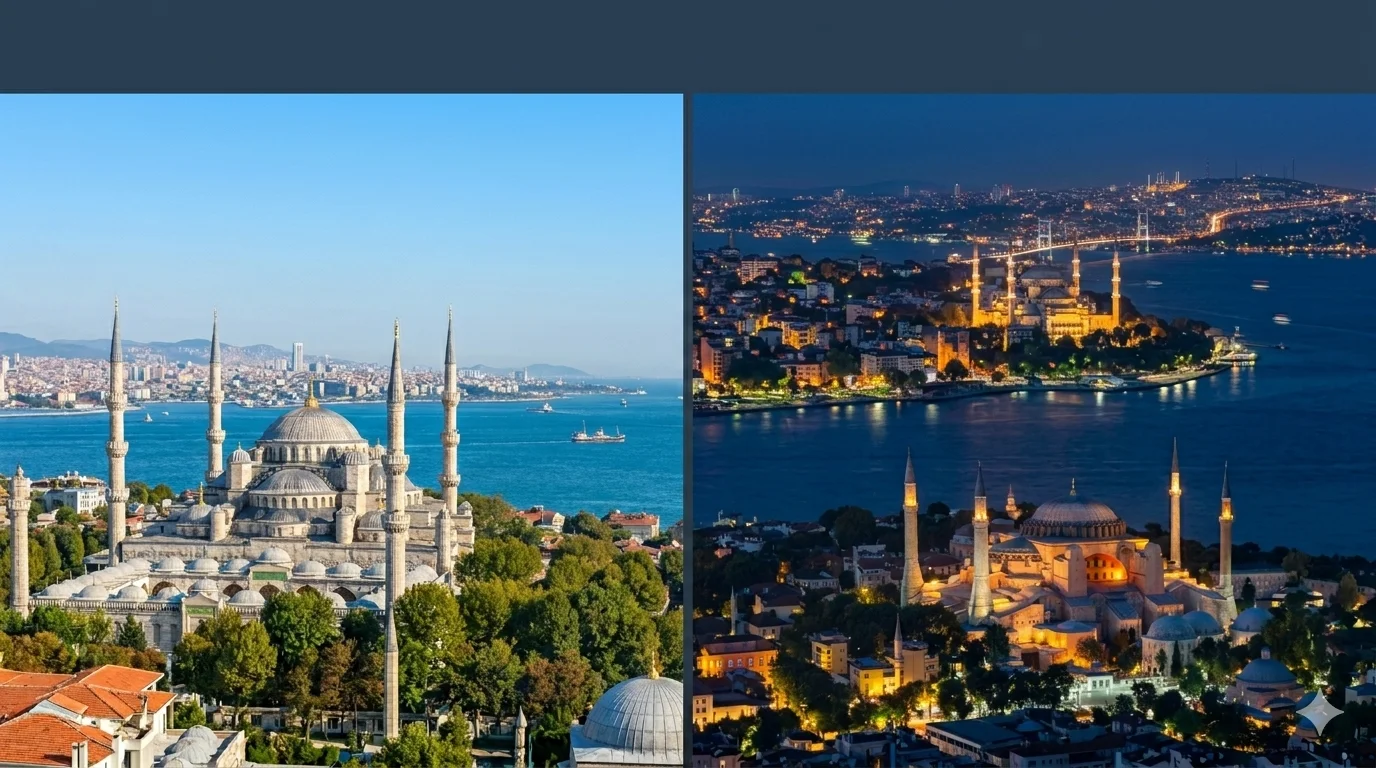
8 The Blue Mosque — A Young Sultan's Defiant Masterpiece
Sultan Ahmed I was only 19 years old when he commissioned the mosque that would carry his name — and his ambition was explicit: to build a structure that would rival and surpass the 1,000-year-old Hagia Sophia standing 200 metres away. Architect Sedefkâr Mehmed Ağa responded with what is arguably the greatest Ottoman mosque ever built — completed in 1616, the year before the Sultan's death at 27.
The mosque's silhouette — six minarets (unprecedented in Ottoman mosque design, and initially controversial because only the mosque in Mecca had six) cascading to a central dome flanked by four semi-domes — is one of the most balanced and beautiful in Islamic architecture. Inside, the mosque's popular name comes from its coating of more than 20,000 hand-painted İznik tiles in over 50 distinct tulip and floral designs, suffusing the interior with a blue-white luminosity on clear days. The tiles, produced in the Anatolian city of İznik (ancient Nicaea) at the peak of Ottoman ceramic art, have never been successfully replicated.
Unlike Hagia Sophia, the Blue Mosque remains an active place of worship, closing to tourists during the five daily prayers — a rhythm that actually enhances the visit, forcing a respectful pace on the experience. Entry is free; appropriate dress (covered shoulders and legs, headscarves for women) is required. The mosque stands on the Hippodrome, once the social and sporting heart of Byzantine Constantinople.
9 Topkapi Palace — Command Centre of the Ottoman World
For nearly four and a half centuries — from 1465 until 1856 when Sultan Abdülmecid I moved to the newly built Dolmabahçe Palace — every decision that shaped the fate of three continents was made within the walls of Topkapi Palace. At its operational peak the complex housed up to 4,000 people: the Sultan and his family, pages and palace officials, janissary guards, cooks, gardeners, physicians, and the 300-plus women, eunuchs, and children of the Harem.
The palace is organised into four successive courtyards, each with restricted access in the Ottoman era. The Imperial Treasury contains some of the most extraordinary jewelled objects ever assembled under one roof: the 86-carat Spoonmaker's Diamond (fifth largest in the world), the emerald-encrusted Topkapi Dagger, and the jewel-studded Throne of Shah Ismail. The Chamber of Sacred Relics houses objects attributed to the Prophet Muhammad and his companions, including his mantle, sword, bow, tooth, and hair — making Topkapi one of the most significant Islamic heritage sites on earth, drawing Muslim pilgrims as well as general visitors.
The Harem — a labyrinth of 300 rooms centred on the apartments of the Sultan's mother (the Valide Sultan), the most powerful woman in the empire — is where much of Ottoman political history was actually made. Figures like Hürrem Sultan (Roxelana), the enslaved Ukrainian woman who became Süleyman the Magnificent's legal wife, wielded influence from within these walls that shaped Ottoman succession and foreign policy for decades. The Harem tour is separately ticketed and essential.
15 Hagia Sophia — The Building That Defined an Era
Hagia Sophia is, by any measure, one of the greatest buildings in human history. Commissioned by Byzantine Emperor Justinian I and completed with stunning speed in just five years — consecrated on 27 December 537 CE — it stood for nearly a thousand years as the largest enclosed space in the Christian world. Its architects, Isidore of Miletus and Anthemius of Tralles, had never built a dome of this scale and had no historical precedent to guide them. The result — a 55-metre-high central dome measuring 31 metres in diameter, seeming to hover without visible support — made contemporaries believe it was suspended from heaven by a golden chain.
The building has served three distinct identities across 15 centuries: Byzantine cathedral for 916 years; Ottoman imperial mosque for 482 years, during which the minarets, mihrab, and vast calligraphic roundels were added; and secular museum from 1934 until 2020, when it was reconverted to a mosque under President Erdoğan. The extraordinary Byzantine mosaics — including the Deësis mosaic of Christ, the Virgin, and John the Baptist (c.1261 CE), considered a masterpiece of portraiture in any medium from any period — remain partially accessible to visitors.
The richness of Hagia Sophia lies precisely in its multi-layered identity: you stand simultaneously in a Roman engineering triumph, a Byzantine theological statement, an Ottoman imperial gesture, and a live Turkish Muslim place of worship. No single building anywhere in the world carries this density of historical meaning in a single structure. Visiting requires appropriate modest dress, as it does for any active mosque.
16 Basilica Cistern — Istanbul's Underground Cathedral of Water
Walking into the Basilica Cistern is one of the most unexpectedly theatrical experiences Istanbul offers. You descend a stone staircase, pass through a door, and find yourself in an enormous underground cathedral of water: 140 metres long, 70 metres wide, its barrel-vaulted brick ceiling supported by 336 marble columns arranged in 12 rows of 28, rising from a shallow reflective pool that still holds water after nearly 1,500 years.
Built by Byzantine Emperor Justinian I around 532 CE to supply the palaces and buildings of the Historic Peninsula, the cistern was capable of storing 80,000 cubic metres of water drawn from a source 19 kilometres away in the Belgrade Forest. The eerie silence, the forest of columns disappearing into dim distance, the rhythmic drip of moisture from the vaulted ceiling, and the carp gliding through the still water below create an atmosphere unlike anything above ground. At the far end, two columns are set upon Medusa head bases — one inverted, one on its side — their origin unknown, possibly recycled from an earlier Roman building, placed to neutralise Medusa's lethal gaze by the simple expedient of not letting her look at you.
Extensively renovated and reopened in 2022, the cistern now includes atmospheric lighting, walkways, and contemporary art installations that complement rather than compete with the space. It was recently brought to international attention by Dan Brown's thriller Inferno — which, whatever its literary merits, has introduced millions of readers to one of Istanbul's most genuinely extraordinary spaces.
12 Göreme Open Air Museum — Frescoed Cave Churches of Byzantine Cappadocia
The Göreme Open Air Museum is one of the world's most singular heritage experiences: an entire monastic complex carved into volcanic tuff in the middle of Turkey's lunar Cappadocian landscape, its cave churches adorned with Byzantine frescoes that rank among the finest religious painting anywhere in the medieval world. The complex began developing in the late Roman period and flourished as a monastic centre from the 9th to 13th centuries, when the region's natural rock architecture made it an ideal shelter for Christian communities during the Arab raids.
The museum contains around 30 rock-cut churches and chapels, but the standouts are the Dark Church (Karanlık Kilise) — named for its minimal window openings, which paradoxically preserved its 11th-century frescoes in near-perfect condition, their colours as vivid as if freshly painted — and the Church of the Buckle (Tokalı Kilise), the largest in Cappadocia, whose elongated nave is covered in a continuous narrative cycle of New Testament scenes in a deep lapis and ochre palette. The Snake Church, Apple Church, and Sandals Church each contribute unique iconographic programmes covering the Nativity, Crucifixion, Anastasis (Resurrection), and portraits of the Church Fathers.
Beyond the museum, Cappadocia harbours the underground cities of Derinkuyu and Kaymakli — vast carved labyrinths extending up to 85 metres underground and capable of sheltering 20,000 people — and the Ihlara Valley, a 14-km canyon containing dozens of additional cave churches. A recently discovered Cappadocia underground city is believed by archaeologists to potentially be the largest ever found, at the scale of 65 football pitches. A full Cappadocia heritage exploration requires a minimum of three days.
3 Hattusha — Capital of the World's First Superpower
Before Greece or Rome dominated the ancient world, the Hittites — a powerful Bronze Age civilisation based in central Anatolia — built an empire that rivalled and frequently fought pharaonic Egypt as the two great superpowers of the Late Bronze Age (c.1650–1180 BCE). Their capital, Hattusha, near modern Boğazkale, was the largest city in the Near East at its height — a walled metropolis of temples, royal citadels, granaries, and housing for a population of around 50,000, enclosed by 8 kilometres of walls reinforced by 4-metre-high earthen ramparts.
What has survived is remarkable: the Lion Gate and Sphinx Gate with their monumental stone guardians still intact; the massive Great Temple (Temple I) whose processional entrance and storage magazines can be walked through today; the underground tunnel of Yerkapı — a 70-metre corbelled passage through the city walls whose precise function is debated but whose engineering is astonishing for 3,300-year-old construction. The adjacent rock sanctuary of Yazılıkaya, a natural limestone chamber decorated with processions of Hittite gods and goddesses carved in high relief, is among the most atmospheric religious sites of the ancient world.
Hattusha is also the location of a world first: here was written the Treaty of Kadesh (c.1259 BCE), the earliest surviving international peace treaty in history — signed between the Hittite King Hattusili III and the Egyptian Pharaoh Ramesses II. The clay tablet containing its Hittite version is displayed at the Istanbul Archaeology Museum; a replica hangs in the United Nations headquarters in New York as a symbol of international diplomacy.
10 Mount Nemrut — A King's Throne Among the Clouds
At 2,134 metres above sea level in the Taurus Mountains of southeastern Turkey, the summit of Mount Nemrut bears one of the most dramatic and improbable monuments of the ancient world. Here, the megalomaniacal King Antiochus I Epiphanes of Commagene (r.70–38 BCE) ordered the construction of his own funerary sanctuary, complete with a tumulus mound 50 metres high and 150 metres in diameter containing his tomb, and flanked on both the east and west terraces by colossal seated statues of himself alongside the gods he equated with himself.
The statues — depicting Apollo-Mithras, Zeus-Oromasdes, Hercules-Artagnes, and the Tyche of Commagene alongside Antiochus himself — were originally 8–9 metres tall, their carved heads enormous and their stone thrones inscribed with Antiochus's grandiose proclamations of his own divine status. Over the centuries, the heads toppled from their bodies and now sit in a row on the ground, their expressions serene and other-worldly against the high mountain sky.
The experience of visiting Nemrut is fundamentally about light and altitude: most visitors make the steep drive or walk to the summit in the dark, arriving before dawn to witness sunrise breaking over the stone heads with the mountain shadows rolling across the Euphrates valley thousands of metres below. It is a genuinely sublime experience — one of those rare travel moments that is exactly as extraordinary as the photographs suggest. The site was inscribed as a UNESCO World Heritage Site in 1987.
5 Zeugma Mosaic Museum — The Greatest Roman Mosaics in the World
The city of Zeugma, founded around 300 BCE by Seleucus I Nicator (one of Alexander the Great's generals), occupied a strategically vital crossing point on the Euphrates River and grew into a commercial and military metropolis of 70,000 people at its peak. In 256 CE, the Sassanid King Shapur I sacked and largely destroyed it. In the 1990s, the rising waters behind a newly built dam threatened to submerge part of the site, triggering an emergency archaeological rescue that revealed dozens of extraordinary Roman residential villas with mosaic floors of breathtaking quality.
The rescued mosaics are now housed in the Zeugma Mosaic Museum in Gaziantep — at 30,000 square metres, the world's largest mosaic museum, containing the largest collection of Roman mosaics anywhere on earth. The quality is staggering: mythological scenes from the Iliad, personifications of the seasons, scenes from daily Roman life, and portrait medallions rendered in tesserae of such fine detail that the expressions convey genuine emotion across 1,800 years. The most famous piece is the "Gypsy Girl" — a haunting mosaic fragment of a young woman's face with dark, direct, piercing eyes that has become a symbol of Turkey's cultural heritage.
Beyond the mosaics, the museum displays fresco fragments, sculpture, coins, and a reconstructed Roman room that contextualises the fragments within their domestic setting. Gaziantep itself — Turkey's culinary capital, famous for its baklava, pistachios, and one of UNESCO's Creative Cities of Gastronomy — combines with Zeugma to make this southeastern city one of Turkey's most rewarding off-the-beaten-track destinations for heritage travellers.
19 Sumela Monastery — The Cliff-Face Monastery of the Virgin
Clinging to the face of a sheer 300-metre cliff in the deep spruce forests of the Pontic Mountains above Trabzon, Sumela Monastery is one of the most visually astonishing religious structures ever built. From a distance — glimpsed through forest across a deep green valley — it appears physically impossible: an entire complex of buildings, chapels, and cells plastered against a vertical rock face, reachable only by a steep path that climbs through ancient woodland for nearly an hour.
Founded according to tradition by two Athenian priests, Barnabas and Sophronius, during the reign of Emperor Theodosius I (379–395 CE), Sumela was built around a sacred cave where the priests reportedly discovered an icon of the Virgin Mary attributed to the Apostle Luke — the icon of the Black Virgin, said to have been brought to these mountains by angels. The monastery became one of the most important pilgrimage sites in the Orthodox world and was patronised by Byzantine emperors, Trapezuntine rulers, and later Ottoman sultans who respected its sanctity. The main church is covered floor to ceiling with frescoes, their colours faded but still legible across scenes from the life of Christ and the Virgin.
Sumela ceased monastic operations in 1923, the same year as Kayaköy's abandonment — also a casualty of the Greek-Turkish population exchange. It has been substantially restored and periodically hosts special Orthodox liturgical services. The forest walk, the mountain scenery, and the sheer physical drama of the monastery's position make a visit here among Turkey's most memorable experiences even for visitors with no religious interest.
11 Bodrum Castle — Built from a Wonder of the World
Bodrum Castle — officially the Castle of Saint Peter (Petronium) — has one of the most remarkable origin stories of any medieval fortification. In 1402, the Knights of Saint John, freshly expelled from their previous stronghold, needed to build a new fortress quickly from whatever materials were available. Their solution was pragmatic and historically extraordinary: they dismantled stones from the crumbling remains of the Mausoleum at Halicarnassus — one of the Seven Wonders of the Ancient World — and used them as construction material for their new castle walls.
The mausoleum, built circa 350 BCE for the Carian satrap Mausolus (from whose name the English word "mausoleum" derives) and considered one of the finest works of Greek sculpture and architecture of its era, had already been damaged by earthquakes and partially stripped by the Crusaders' predecessors. Today, only the foundations and a few scattered relief fragments remain at the mausoleum site itself — but the castle that consumed it is extraordinary in its own right. The five towers, each built by a different national contingent of knights (English, French, German, Italian, and Aragonese), each reflect different architectural traditions in their construction.
Inside, the castle houses the Museum of Underwater Archaeology — one of the finest of its kind in the world, displaying artefacts from Bronze Age, Classical, Byzantine, and Ottoman shipwrecks found in Turkey's surrounding waters, including the world's oldest known shipwreck (the Uluburun ship, ~1300 BCE). Bodrum town itself, built on the site of ancient Halicarnassus, birthplace of Herodotus (the "father of history"), adds further historical depth to what is primarily known today as Turkey's most glamorous resort destination.
