
The world's most beautiful building is also the world's most extraordinary museum — a complete guide to every floor, every experience, and everything you need to know before you visit.
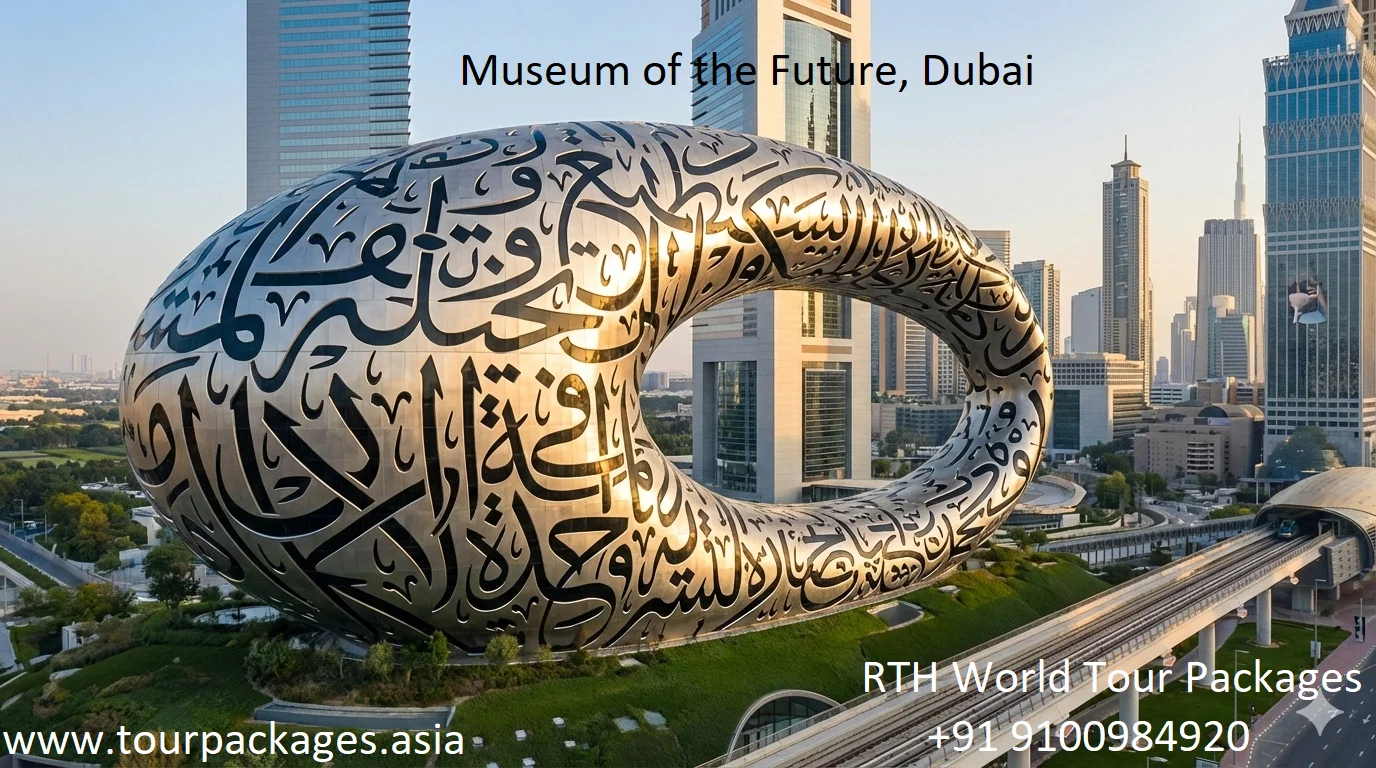
Museum of the Future, Dubai — the iconic torus-shaped structure on Sheikh Zayed Road, named one of the world's 14 most beautiful buildings by National Geographic
Rising from the heart of Sheikh Zayed Road like a colossal silver ring suspended above a green hill, the Museum of the Future is unlike anything built before it. Opened on 22 February 2022, it has already been declared one of the 14 most beautiful buildings in the world by National Geographic — a distinction earned by a structure that combines a torus-shaped stainless-steel shell carrying 1,024 uniquely shaped composite panels, Arabic calligraphy covering its entire exterior surface as glowing light, and a deliberate central void that symbolises what humanity has yet to discover. It stands as a philosophical statement in steel, glass, and light.
But what makes the Museum of the Future truly remarkable is not merely how it looks from the outside — it is the immersive journey through five exhibition floors within it. This is not a museum of artefacts, dusty displays, or glass cases. It is a museum of experiences — a narrative voyage to the year 2071, beginning aboard an orbiting space station 600 kilometres above Earth and descending, floor by floor, through ecology, wellness, emerging technology, and the imagination of children. No visitor leaves unchanged. Travellers on a 5 Nights 6 Days Dubai holiday package consistently name the Museum of the Future as one of the most impactful single experiences of their entire trip.
These reference videos give an authentic first-person look inside the Museum of the Future — covering the architecture, each exhibition floor, interactive experiences, and practical visitor guidance that will help you make the most of your visit.
A detailed walkthrough of all five exhibition floors — OSS Hope, Heal Institute, Al Waha, Tomorrow Today, and Future Heroes — showing the immersive installations, space station simulation, and the building's extraordinary interior design.
Watch on YouTubeAn in-depth visual exploration of the Museum of the Future covering the iconic torus exterior, the space elevator lift-off experience, the Vault of Life, Al Waha wellness floor, and practical visitor tips for planning your day.
Watch on YouTube"The future belongs to those who can imagine it, design it, and execute it. It isn't something you await, but something you create." — These words, in Arabic calligraphy, cover the entire exterior surface of the building, illuminated from within at night.
Designed by UAE architectural firm Killa Design and engineered by global consultancy Buro Happold, the Museum of the Future took six years to complete and represents one of the most complex construction projects in modern architectural history. The building is a toroid — a hollow ring shape — rising 77 metres above Sheikh Zayed Road and seated upon a landscaped green hill. What appears to be windows in the outer shell are not windows at all: they are precisely cut voids in the stainless-steel facade through which Arabic script is formed, crafted by Emirati calligrapher Mattar bin Lahej. At night, LED illumination pours through these voids, making the entire building appear as a luminous manuscript suspended above the city.
Perhaps most remarkably, the building has no internal support columns — the entire structure is supported by the outer shell itself. The 1,024 composite facade panels were manufactured entirely by robots, each with a unique three-dimensional geometry. The Killa Design and Buro Happold teams developed new parametric design algorithms and building information modelling tools specifically for this project, creating construction methodologies that did not previously exist. In February 2023, the building received LEED Platinum certification — the highest level of green building certification — recognising its sustainable design systems including solar integration, water recycling, and smart energy management. Construction cost is estimated in excess of AED 1 billion.
| Architectural Feature | Detail |
|---|---|
| Design Firm | Killa Design (UAE) with Buro Happold engineering |
| Building Form | Toroid (hollow ring) — no internal support columns |
| Height | 77 metres above Sheikh Zayed Road |
| Facade Panels | 1,024 unique stainless-steel composite panels, manufactured by robots |
| Facade Script | Arabic calligraphy by Emirati artist Mattar bin Lahej |
| Green Rating | LEED Platinum certified (February 2023) |
| Construction Period | 6 years |
| Construction Cost | Estimated AED 1 billion+ |
| Symbolic Features | Green hill (Earth), ring form (human innovation), central void (the unknown) |
| Theatre | 345-seat auditorium for events and presentations |
The visitor journey at the Museum of the Future begins on the fifth floor and descends floor by floor — each level a distinct chapter in a continuous narrative about humanity's possible future in the year 2071. Before ascending, every visitor receives a smart wristband that personalises their interaction with the exhibits, remembers the experiences they engage with, and enables participation in role-based missions throughout the museum.
The journey begins with what may be the most arresting single experience in any museum in the world. Visitors board a simulation of a space shuttle launch — complete with rumbling seats, projected exterior views, and audio cues of atmospheric exit — before docking at the OSS Hope, a fully realised orbital space station positioned 600 kilometres above Earth in the year 2071.
The station is not merely suggested — it is built in extraordinary detail. Visitors walk through research modules, command centres, and habitat capsules. Wall-sized screens display views of the Earth below, the Moon, and the wider galaxy. A digital avatar named Aya — the museum's AI guide — welcomes visitors and frames the mission: "The worlds you will encounter are not predictions, they are challenges." Using their smart wristbands, visitors can apply for missions within the station, taking on roles such as Asteroid Fleet Pilot, Junior Bio-Designer, or Mars Colony Ambassador to Earth.
Key experiences on this floor include:
Allow a minimum of 30–40 minutes on this floor. It is the museum's most iconic and most detailed exhibit.
Descending from space to Earth, the fourth floor houses the Heal Institute — a research centre concept dedicated to reversing environmental damage, restoring biodiversity, and reimagining humanity's relationship with the natural world. The transition from the cold blue light of the space station to the lush greens and warm ambers of the Heal Institute is deliberately dramatic.
The centrepiece of this floor is the Library of Life — also called the Vault of Life — a living digital archive housing representations of over 2,400 species, spanning thriving organisms, endangered species, and those already extinct. Floor-to-ceiling projections and interactive screens allow visitors to reach out and touch projected life forms, triggering detailed information on each organism's biological function, ecological significance, and conservation status. The room is illuminated in soft, natural light tones that create an atmosphere hovering between a cathedral and a garden.
Key experiences on this floor include:
Allow 25–35 minutes. The viewing deck transition is among the museum's most visually striking moments.
Al Waha — Arabic for "the oasis" — is a deliberate deceleration after the extraordinary sensory intensity of the first two floors. Designed in dusty-pink and warm amber tones with ambient lighting and immersive soundscapes, this floor invites visitors to disconnect from the digital world and reconnect with their inner senses in what functions as a futuristic wellness and meditation centre.
The floor is structured around multiple immersive stations, each using a different sensory modality to induce calm, reflection, and presence. It represents a future in which mental wellbeing is treated as a fundamental human necessity rather than a luxury — and in which technology serves consciousness rather than demanding it.
Key experiences on Al Waha include:
Allow 20–30 minutes. This floor is especially valued by visitors who wish to reflect on the experience so far before continuing.
Tomorrow Today shifts the focus from speculative futures to near-present innovations — technologies that exist today as prototypes or early implementations and that are predicted to reshape human life within the next decade. This floor features a rotating programme of exhibits contributed by startups, research institutions, government innovation programmes, and private sector technology leaders from across the globe.
Unlike the narrative immersion of the upper floors, Tomorrow Today operates more as a curated technology exhibition — but one of exceptional quality and editorial rigour. Exhibits include:
Allow 20–30 minutes. Exhibits on this floor change periodically — what you experience on your visit may differ from earlier visitors' accounts.
The ground-level Future Heroes zone is dedicated entirely to children under the age of 10, built on the philosophy that the actual architects of the future are the generation currently growing up. The space is safe, fully supervised, and designed to nurture scientific curiosity, collaborative problem-solving, and imaginative thinking through play-based challenges and mission-structured activities.
Key activities in Future Heroes include:
Parents can observe from adjacent seating areas while children explore freely. The zone is designed to accommodate children for 30–45 minutes of engaged, independent activity.
A state-of-the-art auditorium within the museum hosts talks, panel discussions, product launches, film screenings, and curated events organised by the Dubai Future Foundation. Check the museum's official programme for current event listings.
The museum sits atop a manicured green hill — a deliberate landscape feature representing the Earth. The hill is accessible to all visitors and provides an unusual ground-level perspective looking up at the building's underside — one of the most distinctive photographic vantage points in Dubai.
On the ground floor, a robot barista prepares and serves coffee — a quiet but telling detail that encapsulates the museum's approach to technology as an embedded part of daily life rather than a spectacle in itself. A consistently noted highlight by visitors who discover it.
The museum gift shop carries a curated collection of design objects, books, art prints, and exclusive merchandise developed with international designers — considerably more thoughtful than a standard museum shop and worth browsing before departure.
Accessible from within the Heal Institute floor, the viewing deck extends outward through the inner ring of the building, providing exterior views along the building's face and across Sheikh Zayed Road and the Emirates Towers — a rare experience of being inside one of the world's most distinctive facades.
The museum is fully accessible throughout. Wheelchair users are accommodated via elevators, adapted restrooms, and wheelchair docks in the lobby. Staff provide personalised assistance on all exhibition floors on request. Audio guides are available in multiple languages.
A minimum of 2 hours is required; 2.5 to 3 hours is recommended for a thorough, unhurried experience. The museum is not large, but the exhibits reward slowness — rushing defeats the purpose of the immersive design.
Tickets are timed-entry and slots sell out, particularly on weekends and during UAE public holidays. Booking 2–4 weeks in advance is advisable during peak season. Our Dubai travel team can handle this as part of a tour package.
Weekday mornings between 10:00 AM and 12:00 PM offer the quietest experience. October to April is the preferred season — cooler weather and fewer international peak-season crowds on weekdays.
Take the Dubai Metro Red Line to Emirates Towers station — a dedicated link bridge connects directly to the museum entrance in under 3 minutes. This is the fastest, most convenient transport option from anywhere on the Red Line network.
Smart casual is appropriate and entirely comfortable. The building is air-conditioned throughout. No specific dress code applies beyond standard Dubai public decency guidelines. Comfortable footwear is recommended as all floors require walking.
Photography is permitted throughout the museum and enthusiastically encouraged. The building's exterior at night — with the Arabic calligraphy illuminated against the dark sky — is best captured from the Emirates Towers pedestrian bridge. Plan to return after dark if visiting in the daytime.
The museum is a short walk from Dubai Frame (10-minute drive) and directly adjacent to the Emirates Towers complex. Combine with a visit to the Burj Khalifa observation deck — both are on the Red Line — for a full day of iconic Dubai architecture and future-forward experiences.
The museum is appropriate for children of all ages. Future Heroes on Floor 1 is purpose-built for under-10s. Children aged 3 and above generally respond strongly to the OSS Hope floor. Under-3s are often overwhelmed by the intensity of the space simulation.
The Museum of the Future sits on Sheikh Zayed Road in the heart of central Dubai, making it effortlessly integrated into any broader city itinerary. Visitors arriving in Dubai for the first time on a 5 Nights 6 Days Dubai holiday package will find the museum a natural complement to the Burj Khalifa observation deck — both represent different expressions of Dubai's extraordinary ambition, separated by 50 years of vision.
The Dubai Frame — a 150-metre picture frame structure offering views simultaneously over old and new Dubai — is a 12-minute drive away and provides a thoughtful counterpoint to the Museum of the Future: where the Frame looks backward and forward across Dubai's history, the museum looks only forward to humanity's possibilities. Together they form one of the most intellectually compelling double-bill sightseeing days available in Dubai. The Dubai Miracle Garden and nearby Dubai Malls are also accessible within 20–30 minutes for a complete day out.
For travellers flying from India, tailored packages are available: Dubai Encounter 4 Nights 5 Days and Dubai Delights 5 Nights 6 Days with Palm Jumeirah both incorporate the Museum of the Future as a structured itinerary highlight. The museum also features in our blog coverage of the best time to visit the UAE and is a centrepiece of our Dubai multi-day itinerary recommendations.
Our Dubai travel specialists build complete itineraries — Museum of the Future, Burj Khalifa, Desert Safari, Palm Jumeirah, and beyond — with hotel, flights, visa, and transfers all arranged.
View Dubai Tour Packages Send an EnquiryThe Museum of the Future is Dubai's most ambitious cultural institution — a seven-storey building on Sheikh Zayed Road that opened on 22 February 2022 as part of the Dubai Future Foundation's mandate to position the emirate as a global hub of innovation and forward-thinking governance. It is not a museum in any conventional sense. There are no historic artefacts, no glass cases, no chronological timelines of the past.
Instead, it is an immersive experience platform designed to transport visitors to the year 2071 — the UAE's centenary — through five narrative exhibition chapters spread across its floors. The significance of the museum is threefold: architecturally, it is considered one of the world's most complex and beautiful structures; experientially, it delivers a quality of immersive exhibition that sets a new global standard for what a museum can be; and philosophically, it represents an institutional declaration that the future is not something that happens to us, but something we actively create. National Geographic named it one of the 14 most beautiful museums in the world within months of its opening.
The visitor journey unfolds across five chapters, beginning on the fifth floor and descending:
Plan for a minimum of 2 to 3 hours for a complete, unhurried visit. The museum is not particularly large in floor area, but its exhibits are deeply layered and reward engagement rather than rushing. A practical time breakdown:
Visitors who attempt to complete the museum in under 90 minutes consistently report feeling they missed the depth of the experience. The museum is designed as a story — follow it at the pace it was intended, and allow each floor to breathe before descending to the next. Guests on our Dubai 5N6D holiday package receive pre-visit guidance on optimal sequencing.
Yes — with some nuance by age. The museum is genuinely excellent for families, but the experience varies considerably by the age of the child:
Children under 3 are admitted free. Reduced pricing typically applies to children aged 3–12. The museum is fully accessible for prams and wheelchairs.
OSS Hope — the Orbital Space Station Hope — is the fifth-floor exhibition and the museum's most iconic, most discussed, and most photographed experience. It is considered the centrepiece for a simple reason: it is the most technically accomplished piece of immersive experience design in the building, and arguably one of the most extraordinary single museum rooms anywhere in the world.
The experience begins with boarding a simulated space shuttle — seats vibrate, audio cues simulate engine ignition and lift-off, and the viewport shows Dubai's skyline shrinking as the craft appears to ascend through the atmosphere. When the doors open, visitors are inside a detailed recreation of a space station. The level of physical detail — the panelling, the consoles, the simulated zero-gravity research equipment, the orbital view of Earth through the windows — is overwhelming in its completeness.
Visitors can apply for missions using their smart wristbands, explore the Sol Project (solar energy harvested from the moon), review briefings on Mars colonisation, and observe simulations of robotic maintenance of the station's exterior. The combination of narrative depth, physical construction quality, and interactive layering makes this 30–40 minute experience unlike anything most visitors have encountered before.
Al Waha — the Oasis — is the museum's deliberate counterpoint to the technological intensity of the floors above and below it. Its inclusion reflects a core philosophical position held by the Dubai Future Foundation: that the future is not only about external innovation and planetary-scale solutions, but also about internal wellbeing, mental health, and the capacity of human beings to remain grounded, present, and purposeful amid accelerating technological change.
The floor functions as a multisensory spa for the future — using sound healing, haptic technology, light therapy, and calming spatial design to create a space that feels simultaneously ancient and futuristic. The Grounding Station's gong vibrations draw from Tibetan and Central Asian traditional healing practices; the Feel Station's supersonic wave hand massage has no precedent in conventional spa design. The Wish Pool's digital archive of human aspirations is genuinely moving.
Many visitors — particularly those who come expecting pure technology — are surprised to find Al Waha their most memorable floor. It is a profound statement that the museum makes about what humanity must protect as it advances: not just the planet, but consciousness itself. Allow yourself the full 20–30 minutes here rather than passing through quickly.
The Museum of the Future is considered one of the world's most complex structures for several overlapping reasons:
LEED Platinum certification in February 2023 confirmed that this extraordinary structural achievement also meets the world's highest standards for sustainable design and energy efficiency.
Getting to the Museum of the Future is straightforward from anywhere in Dubai:
Guests on our Dubai tour packages receive direct hotel-to-museum transfers on their designated visit day.
The Vault of Life — also referred to as the Library of Life — is the Heal Institute's most powerful installation. It is a digitally curated archive representing over 2,400 species of natural organisms, spanning those currently thriving, those critically endangered, and those already extinct. The installation covers floor-to-ceiling surfaces with projected life forms and species data.
Visitors can reach out toward projected organisms — a motion sensor registers the gesture and triggers detailed information on that species' biology, ecological role, geographic range, and conservation status. The experience of reaching for an extinct species — seeing it glow in response to your touch but knowing it no longer exists in the real world — is deliberately and powerfully affecting.
The Nature Simulator adjacent to the Vault allows visitors to log species they have "restored" virtually, contributing to a shared collective count that is displayed prominently. This gamified environmental action — however symbolic — consistently motivates visitors to engage with more species than they might otherwise. The Vault of Life is one of the museum's most shared and discussed installations on social media, and rightly one of its most celebrated achievements.
Tomorrow Today on Floor 2 is structurally distinct from the narrative immersion floors above it. Where OSS Hope, Heal Institute, and Al Waha tell a continuous story set in 2071, Tomorrow Today is anchored in the near present — showcasing technologies that exist today, either as functional prototypes or early deployments, that are predicted to significantly reshape human life within 5–20 years.
The floor functions as a curated innovation exhibition rather than a narrative experience. Key featured technologies include the TeslaGlove (haptic virtual reality), the MARS Modular Artificial Reef Structure for coral restoration, antimicrobial materials, AI-assisted diagnostics, autonomous mobility concepts, precision fermentation food production, and water generation from atmospheric humidity.
Crucially, the exhibits on this floor rotate and change — what is displayed during one visit may be replaced or updated on a subsequent visit. This makes Tomorrow Today the museum's most dynamic floor, and means that return visitors often encounter an entirely different exhibition from their first visit. It also hosts industry-specific showcases tied to global events such as the World Government Summit, when themed exhibitions on specific innovation domains are mounted.
Best time of day: Weekday mornings between 10:00 AM and noon offer the quietest experience with the shortest queue times at popular installations, particularly the space shuttle boarding simulation on Floor 5. Avoid weekend evenings, UAE public holidays, and World Government Summit periods when the museum reaches maximum capacity.
Best time of year: October through April is Dubai's cooler season and generally preferred for all outdoor travel. Since the museum is entirely indoor and air-conditioned, the weather has less direct impact than on outdoor attractions — however, visiting during this period aligns with Dubai's lower tourist density on weekdays, creating a more comfortable overall experience.
Evening visits: The museum's exterior is among its most spectacular aspects at night — the Arabic calligraphy glows against the dark sky in a way that daytime visitors miss entirely. Consider planning an evening visit for the exterior photography even if the full exhibition visit happens during the day. The museum is open until 9:30 PM daily. Our Dubai Delights package schedules the museum visit to capture both the interior experience and the illuminated evening exterior.
All three are architectural landmarks on Dubai's cultural itinerary, but they deliver fundamentally different experiences and should be thought of as complementary rather than competing:
| Feature | Museum of the Future | Dubai Frame | Burj Khalifa |
|---|---|---|---|
| Primary Experience | Immersive narrative exhibitions | Architectural viewing platform | Observation deck, city views |
| Time Required | 2–3 hours minimum | 45–75 minutes | 1.5–2.5 hours |
| Best For | Ideas, technology, future thinking | Old vs new Dubai contrast | Height, city panoramas, photography |
| Children | Excellent — dedicated zone | Good — glass floor appeal | Good — views are universally impactful |
| Intellectual Depth | Highest among the three | Moderate — contextual history | Visual impact over conceptual content |
| Evening Visit | Excellent — illuminated exterior | Good — city lights from bridge | Outstanding — city night panorama |
For a 5–6 day Dubai itinerary, all three should be visited. The Museum of the Future and Dubai Frame pair naturally as a single day on the Sheikh Zayed Road cultural corridor. The Burj Khalifa fits with a Downtown Dubai day anchored by Dubai Mall and the Fountain show. Our Dubai 5N6D package sequences all three optimally across your stay.
Without qualification, yes. The Museum of the Future is frequently and incorrectly described as a "tech museum" — a label that misleads visitors who are not particularly drawn to technology and causes some to deprioritise the visit. The museum's actual content is far broader, more philosophical, and more universally resonant than a technology showcase.
Consider what each floor actually delivers at its core:
Visitors who describe themselves as having no interest in technology consistently rank the Heal Institute and Al Waha as their most powerful experiences. The museum is equally profound for environmentalists, wellness practitioners, parents, educators, architects, philosophers, and curious travellers of every kind. Do not be dissuaded by its name.
Aya is the Museum of the Future's AI digital guide — a virtual avatar who appears on screens throughout the museum to welcome visitors to 2071, brief them on missions and exhibit themes, and frame the broader philosophical context of each floor. She is first encountered at the Mohammed bin Rashid Space Port boarding area before the OSS Hope lift-off, where she introduces the museum's central conceit: visitors are not tourists, they are pioneers sent forward to 2071 to discover and return with knowledge that can help the present.
The smart wristband issued to each visitor at the entrance serves multiple functions throughout the visit:
The wristband is collected on exit. Visitors who engage actively with the wristband across all floors consistently report a richer and more connected experience than those who treat it as a token formality. Engage with it from the moment it is issued.
Yes — and including the Museum of the Future within a structured Dubai tour package carries real, practical advantages over independent booking:
Our Dubai Encounter 4 Nights 5 Days and Dubai Delights 5 Nights 6 Days packages both include the Museum of the Future as a structured day-visit. Guests from India can explore departure city-specific packages: from Mumbai, from Hyderabad, and from Chennai. Contact our Dubai travel team to build a custom itinerary around the Museum of the Future and any combination of the city's extraordinary attractions.
Let our Dubai travel specialists craft your perfect itinerary — Museum of the Future, iconic landmarks, desert experiences, and everything that makes Dubai extraordinary — with every detail taken care of.
View Dubai Packages Get a Free Quote