Explore the rich historical tapestry of Southern Asia. Journey through ancient civilizations, powerful empires, and cultural landmarks that shaped the region.
Unearthing the Past: A Journey Through the Historical Treasures of Southern Asia
Southern Asia, a vast and diverse region encompassing countries like India, Bhutan, Maldives, Nepal, and Sri Lanka, is a land steeped in millennia of history. It is a cradle of ancient civilizations, the birthplace of major religions, and a crossroads of cultures that have shaped the world. Exploring the historical places in Southern Asia is like opening a living history book, revealing layers of empires, artistic achievements, spiritual devotion, and the enduring legacy of human civilization.
Introduction/Synopsis
Southern Asia's history is a vibrant tapestry woven from the threads of countless kingdoms, dynasties, trade routes, and cultural exchanges. From the dawn of the Indus Valley Civilization (parts of which extended into modern-day India) and the rise of powerful empires like the Mauryas, Guptas, Mughals, and various South Indian dynasties, to the unique historical trajectories of island nations and Himalayan kingdoms, the region has witnessed the ebb and flow of power and innovation. It is the birthplace of Hinduism, Buddhism, Jainism, and Sikhism, and has been profoundly influenced by Islam, Christianity, and other faiths, leaving behind a rich legacy of religious architecture, philosophy, and social structures.
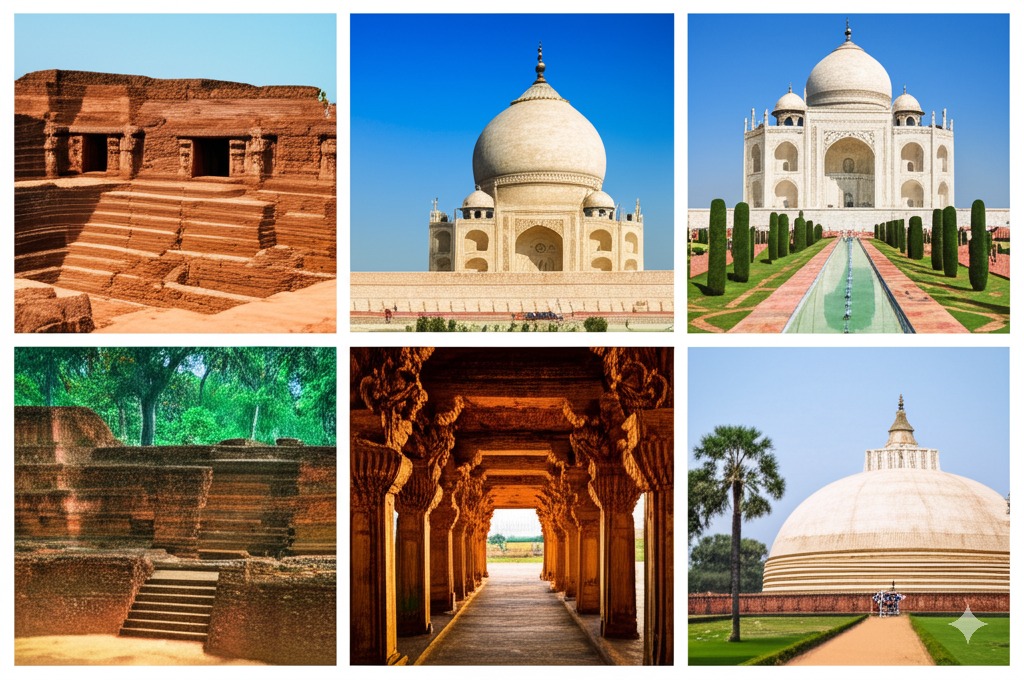
The historical places scattered across Southern Asia are not mere relics of the past; they are tangible connections to the people, events, and ideas that shaped this part of the world. They range from awe-inspiring ancient ruins and majestic imperial forts to sacred pilgrimage sites, intricate temples, serene monasteries, and structures reflecting colonial influences. Each site tells a unique story, offering insights into the diverse heritage and complex past of this fascinating region. This blog post delves into the historical significance of Southern Asia and highlights some of the remarkable historical places within India, Bhutan, Maldives, Nepal, and Sri Lanka that offer a window into its captivating and complex past.
Historical Tapestry of Southern Asia
The history of Southern Asia is characterized by its deep antiquity, the emergence of complex societies, significant intellectual and artistic developments, and continuous interaction with other parts of the world. The region's strategic location, bordering the vast Indian Ocean and nestled against the mighty Himalayas, made it a melting pot of influences, absorbing ideas and peoples from Central Asia, Persia, the Middle East, and Southeast Asia, while also exporting its own cultural, religious, and philosophical traditions. The Southern Asia historical sites stand as silent witnesses to this dynamic past, showcasing the unique paths taken by different nations within the region. Exploring these sites is a key part of experiencing the cultural history Southern Asia has to offer.
India: A Subcontinent of Empires and Civilizations
India, the largest country in Southern Asia, boasts a history that stretches back over 5,000 years to the earliest urban settlements. It has been the seat of numerous powerful empires and kingdoms that fostered remarkable advancements in art, architecture, literature, science, and philosophy. Its historical landmarks Southern Asia reflect the influence of diverse rulers, religions, and cultural movements. Understanding Ancient India history is crucial to grasping the broader ancient history Southern Asia.
Ancient and Classical India
- The Ruins of Hampi, Karnataka: A UNESCO World Heritage site, Hampi was the glorious capital of the mighty Vijayanagara Empire (14th-16th centuries), a powerful South Indian kingdom that flourished as a center of Hindu culture and resistance against northern sultanates. The sprawling ruins cover an area of over 4,100 hectares and include more than 1,600 surviving remains of forts, riverside features, royal and sacred complexes, temples, shrines, pillared halls, mandapas, memorial structures, water structures, and more. Key highlights include the still-active Virupaksha Temple, the intricately carved Vittala Temple famous for its stone chariot and "musical pillars" (which produce musical notes when tapped), and the Royal Enclosure with its stepped tank and Mahanavami Dibba platform. Hampi showcases the grandeur, architectural prowess, sophisticated urban planning, and vibrant religious and cultural life of one of South India's most powerful historical empires.
- The Ajanta and Ellora Caves, Maharashtra: These UNESCO World Heritage rock-cut cave complexes are unparalleled masterpieces of ancient Indian religious art and architecture, carved into basalt cliffs. The Ajanta Caves (dating primarily from the 2nd century BCE to about 480 CE) are a series of 30 Buddhist cave monuments, including monasteries (viharas) and prayer halls (chaityas). They are particularly renowned for their stunning and well-preserved fresco paintings and sculptures depicting the Jataka tales (stories of the Buddha's previous lives) and scenes from his life. The Ellora Caves (dating from the 6th to 10th centuries CE) are a complex of 34 caves representing Buddhist, Hindu, and Jain faiths, showcasing the religious harmony of the period. The most famous is Cave 16, the Kailasa Temple, a colossal monolithic temple carved entirely out of a single rock, dedicated to Lord Shiva, considered one of the most impressive rock-cut structures in the world. These sites provide invaluable insights into ancient artistic traditions, religious practices, monastic life, and engineering skills. They are prime examples of Southern Asia ancient civilizations artistic output.
- Sanchi Stupa, Madhya Pradesh: A UNESCO World Heritage site, the Buddhist Monuments at Sanchi are among the oldest and best-preserved examples of Buddhist art and architecture in India. The Great Stupa (Stupa No. 1) was originally commissioned by Emperor Ashoka in the 3rd century BCE, a pivotal figure in the spread of Buddhism. The stupa was later enlarged and adorned with four magnificent, intricately carved gateways (toranas) added in the 1st century BCE. These toranas depict scenes from the Buddha's life, Jataka tales, and important historical events related to Buddhism. The site also includes other stupas, monasteries, temples, and pillars dating from the 3rd century BCE to the 12th century CE, making Sanchi a crucial site for understanding the early history and evolution of Buddhism in India and the reach of the Mauryan Empire under Ashoka.
Medieval and Mughal India
- The Taj Mahal, Agra: Completed in 1653, the Taj Mahal is a UNESCO World Heritage site and an internationally recognized symbol of India. This breathtaking marble mausoleum was commissioned by Mughal Emperor Shah Jahan as a tomb for his beloved wife, Mumtaz Mahal. It is considered the finest example of Mughal architecture, a harmonious blend of Indian, Persian, and Islamic styles. The complex includes the main mausoleum, a mosque, a guest house, and formal gardens. The exquisite pietra dura (inlay work) using precious and semi-precious stones, intricate calligraphy, and the perfect symmetry and balance of the structure make it a masterpiece of architectural and artistic achievement, representing the zenith of the Mughal Empire's cultural output. It's one of the most visited historical landmarks Southern Asia has.
- Fatehpur Sikri, Uttar Pradesh: A remarkably well-preserved Mughal city built by Mughal Emperor Akbar in the late 16th century to serve as his new capital. Constructed primarily of red sandstone, the city was inhabited for only about 15 years due to water scarcity issues, but its buildings remain in excellent condition. The complex includes magnificent palaces (like Jodha Bai's Palace, the Turkish Sultana's House, and the unique five-story Panch Mahal), ceremonial courtyards (Diwan-i-Aam and Diwan-i-Khas), and religious buildings, including the grand Jama Masjid with the imposing Buland Darwaza (Gate of Victory), one of the largest gateways in the world. Fatehpur Sikri is a testament to Akbar's grand vision, his interest in diverse religions (reflected in the architectural styles), and the unique syncretic culture that flourished during his reign. These are significant sites for understanding the Empires of Southern Asia.
- Qutub Minar Complex, Delhi: A UNESCO World Heritage site, this complex in Mehrauli, Delhi, is home to the Qutub Minar, a towering 73-meter high brick minaret. Construction began in the early 13th century by Qutb al-Din Aibak, the founder of the Delhi Sultanate, and was completed by his successors. It marks the beginning of Muslim rule in North India and is a significant example of early Indo-Islamic architecture, blending elements of Indian and Islamic design. The complex also includes the ruins of the Quwwat-ul-Islam Mosque (one of the oldest mosques in North India), the Alai Darwaza gateway, the Tomb of Iltutmish, and the famous Iron Pillar of Delhi, an ancient pillar known for its remarkable resistance to rust, dating back to the Gupta period (4th-5th century CE). The complex illustrates the architectural evolution and historical transitions of the Delhi Sultanate period.
Bhutan: Kingdom of the Thunder Dragon's Past
Bhutan, the Land of the Thunder Dragon, is a Himalayan kingdom with a history deeply intertwined with Mahayana Buddhism (specifically the Drukpa Lineage) and its unique political structure, where temporal and spiritual power were historically integrated within impressive monastic fortresses known as dzongs. Its Southern Asia historical sites reflect a rich spiritual heritage, a strong sense of national identity, and a deliberate policy of preserving traditional culture and architecture.
- Paro Taktsang (Tiger's Nest Monastery), Paro Valley: Perched precariously on a cliff face 900 meters (3,000 ft) above the floor of the Paro Valley, Paro Taktsang is arguably the most iconic and sacred site in Bhutan. Legend states that Guru Rinpoche, who is credited with introducing Buddhism to Bhutan in the 8th century, meditated here after flying from Tibet on the back of a tigress. The current monastery complex dates mainly from the 17th century, though the sacred caves have been used for meditation for much longer. Reaching the monastery requires a challenging but incredibly rewarding hike (or part-way by horse), offering breathtaking views of the valley and the monastery itself. The intricate temples and meditation caves within the complex are filled with religious art and offer a profound spiritual experience. It's a key site for historical tours Southern Asia.
- Punakha Dzong, Punakha: Known officially as Punthang Dechen Phodrang ("The Palace of Great Happiness or Bliss"), Punakha Dzong is one of the most majestic and historically significant dzongs in Bhutan. Strategically located at the confluence of the Pho Chhu (Male River) and Mo Chhu (Female River) in the Punakha Valley, it was built by Zhabdrung Ngawang Namgyal, the founder of Bhutan, in the 17th century. It served as the capital of Bhutan until 1955 and remains the winter residence of the central monastic body and the Chief Abbot (Je Khenpo). The dzong's impressive architecture, intricate woodwork, stunning courtyards, and sacred relics make it a masterpiece of Bhutanese design and a vital historical and religious center.
- Trongsa Dzong, Trongsa: The largest dzong fortress in Bhutan, Trongsa Dzong is a sprawling complex that stretches along a ridge overlooking the Mangde Chhu river valley. Its strategic location in central Bhutan historically controlled the east-west trade route, and the Penlops (governors) of Trongsa were historically the most powerful figures in the country, with the current monarchy originating from this lineage. The dzong was built in stages from the 17th century onwards. The main dzong complex and the adjacent Ta Dzong (watchtower, now converted into a fascinating museum showcasing Bhutanese history and royal artifacts) offer deep insights into Bhutanese history, architecture, and the evolution of the monarchy.
Maldives: Ancient Seafaring and Islamic Heritage
The Maldives, an archipelago nation consisting of over 1,000 coral islands scattered across the Indian Ocean, has a history shaped by its maritime location, its role in ancient trade routes connecting East and West, and its conversion to Islam in the 12th century. While primarily known today for its stunning natural beauty and luxury tourism, its historical places Southern Asia, particularly in the capital Malé, reveal a past influenced by seafaring cultures, diverse visitors, and the establishment of a distinct Islamic identity.
- Hukuru Miskiy (Old Friday Mosque), Malé: Located in the heart of Malé, the Hukuru Miskiy is the oldest mosque in the capital and one of the most important historical sites in the Maldives. Dating back to 1658, it is a unique example of Maldivian architecture, constructed primarily from coral stone blocks intricately carved with patterns and Arabic script. The interior features impressive woodwork, including lacquered panels and ceilings. The mosque complex also includes a minaret and a cemetery with intricately carved coral tombstones. It is a UNESCO World Heritage site recognized for its unique craftsmanship and cultural significance, reflecting a blend of Islamic architectural principles and local building traditions adapted to the island environment.
- Mulee'aage, Malé: Situated near the Hukuru Miskiy, Mulee'aage is a beautiful colonial-era palace built in 1914 by Sultan Muhammad Shamsuddeen III. Designed in a blend of colonial and local architectural styles, it served as the official residence of the Sultan and later, following the abolition of the monarchy, became the Presidential Palace. While not ancient, it is a significant historical building representing the early 20th-century architecture and the political history of the nation.
- National Museum, Malé: Housed in a section of the former Sultan's palace complex (Sultan's Park), the National Museum in Malé provides a valuable insight into the history and cultural heritage of the Maldives. Its collections include artifacts from the pre-Islamic Buddhist era (such as stone carvings and statues), royal antiquities from the Sultanate period, traditional clothing, weapons, and items reflecting the nation's maritime past and Islamic heritage. The museum helps visitors understand the historical trajectory of the Maldives beyond its modern image as a tourist paradise.
Nepal: Himalayan Heritage and Birthplace of Buddha
Nepal, a landlocked country nestled in the central Himalayas, boasts a rich and complex history shaped by its dramatic geography, its position as a cultural and religious bridge between the Indian subcontinent and Tibet, and the rise of distinct civilizations, particularly the Newari civilization of the Kathmandu Valley. The valley, a UNESCO World Heritage site, is a treasure trove of historical places Southern Asia, palaces, temples, and stupas.
- Kathmandu Valley Durbar Squares: The Kathmandu Valley is home to three main Durbar Squares – in Kathmandu (Basantapur), Patan (Lalitpur), and Bhaktapur – which were the royal palace complexes of the Malla kings who ruled the independent city-states of the valley from the 12th to 18th centuries. These squares are vibrant public spaces and living museums, filled with an extraordinary concentration of intricately carved wooden temples (many in the multi-tiered pagoda style, like the Taleju Temple and Nyatapola Temple), palaces (the old royal palaces, often featuring elaborate windows and courtyards), statues, and courtyards. They showcase the unique and highly developed Newari architecture, wood carving, metalwork, and artistic traditions that flourished in the valley. While some structures were damaged in the 2015 earthquake, significant restoration efforts are underway. These are prime examples of historical landmarks Southern Asia offers.
- Swayambhunath Stupa (Monkey Temple), Kathmandu: Perched on a hilltop to the west of Kathmandu city, Swayambhunath is one of the oldest and most sacred Buddhist sites in Nepal and a UNESCO World Heritage site. Its iconic white dome is topped by a gilded spire featuring the all-seeing eyes of the Buddha, looking out in all four directions. The stupa is surrounded by numerous smaller stupas, temples, monasteries, and prayer wheels. The site is also home to a large population of monkeys, hence its popular nickname. Swayambhunath is a powerful symbol of Nepal's spiritual heritage, offering a serene atmosphere for meditation and prayer, as well as panoramic views of the Kathmandu Valley.
- Lumbini: Located in the Terai plains of southern Nepal, Lumbini is the sacred birthplace of Siddhartha Gautama, the historical Buddha, who was born here in 623 BCE. It is a major pilgrimage site for Buddhists from around the world and a UNESCO World Heritage site dedicated to peace and spirituality. The central feature is the Mayadevi Temple, which houses a stone slab believed to mark the exact spot of the Buddha's birth. The site also includes the Ashoka Pillar, erected by Emperor Ashoka in the 3rd century BCE to commemorate his visit, ancient archaeological remains of monasteries and stupas, and numerous modern monasteries built by different Buddhist countries, each in their distinct architectural style, reflecting the global significance of Lumbini. It's a crucial site for understanding ancient history Southern Asia.
- Pashupatinath Temple, Kathmandu: A UNESCO World Heritage site, Pashupatinath is the most sacred Hindu temple complex in Nepal, located on the banks of the Bagmati River in Kathmandu. Dedicated to Lord Shiva (Pashupati, Lord of Animals), it is one of the most important pilgrimage sites for Hindus, particularly those from Nepal and India. The main temple is a magnificent pagoda-style structure with a golden roof and intricately carved silver doors. While non-Hindus cannot enter the main temple, the surrounding complex features numerous other temples, shrines, and ashrams. The ghats (cremation areas) along the Bagmati River are a significant part of the site, offering a poignant glimpse into Hindu death rituals.
Sri Lanka: Ancient Kingdoms and Sacred Sites
The island nation of Sri Lanka, often referred to as the "Pearl of the Indian Ocean," boasts a rich recorded history spanning over 2,500 years. Its past is profoundly shaped by the arrival and flourishing of Buddhism in the 3rd century BCE, the rise and fall of powerful Sinhalese kingdoms, and significant achievements in architecture, art, and complex irrigation systems (tanks). Its Southern Asia historical sites offer a journey through ancient capitals, sacred pilgrimage sites, and impressive feats of engineering.
- Sigiriya, Central Province: A UNESCO World Heritage site, Sigiriya is a dramatic ancient rock fortress and palace built by King Kasyapa in the 5th century CE. This iconic site centers around a massive column of rock, a geological formation rising nearly 200 meters (660 ft) from the surrounding plains. Kasyapa transformed this rock into a fortified palace and his capital. The site features remarkable ancient urban planning, including elaborate landscaped gardens (water gardens, boulder gardens, terraced gardens), some of the oldest surviving frescoes in Sri Lanka (the "Sigiriya Maidens"), a polished "Mirror Wall" with ancient graffiti, and the remains of the palace complex at the very summit, accessed via a series of staircases, including one passing between the paws of a colossal stone lion (only the paws remain today). Sigiriya is an extraordinary testament to ancient Sri Lankan engineering, art, and ambition. It's a prime example of Southern Asia ancient civilizations achievements.
- Polonnaruwa, North Central Province: A UNESCO World Heritage site, Polonnaruwa served as the second ancient capital of Sri Lanka from the 11th to the 13th centuries CE, rising to prominence after the decline of Anuradhapura. The archaeological park contains well-preserved ruins of this medieval capital, showcasing the grandeur of the Polonnaruwa kings. Key sites include the Royal Palace complex (with the remains of King Parakramabahu's palace), the Quadrangle (a compact area with a high concentration of important religious structures like the Vatadage, Hatadage, and Thuparama), and the impressive Gal Vihara, famous for its four colossal rock-cut Buddha images in different postures (reclining, standing, and seated), considered masterpieces of Sri Lankan Buddhist sculpture. Polonnaruwa represents a golden age of Sri Lankan art, architecture, and administrative organization.
- The Sacred City of Kandy, Central Province: A UNESCO World Heritage site, Kandy was the last capital of the ancient Sinhalese kings' era, resisting colonial powers for longer than other parts of the island before falling to the British in 1815. It is most famous as the home of the revered Temple of the Sacred Tooth Relic (Sri Dalada Maligawa), which houses what is believed to be a relic of the Buddha's tooth. This makes Kandy one of the most important Buddhist pilgrimage sites in the world. The temple complex is a significant architectural and cultural site. Kandy retains a unique cultural atmosphere, particularly during the annual Esala Perahera festival, a grand procession honoring the Sacred Tooth Relic. The city's setting around a picturesque lake and amidst lush hills adds to its charm.
- Anuradhapura, North Central Province: A vast UNESCO World Heritage site and the first ancient capital of Sri Lanka, dating back to the 4th century BCE. Anuradhapura served as the capital for over a thousand years and was a major center of Theravada Buddhism. The archaeological park is spread over a large area and contains numerous impressive ruins, including colossal brick stupas (dagobas) like the Ruwanwelisaya, Jetavanarama (once one of the tallest structures in the ancient world), and Abhayagiri Dagoba. It is also home to the Jaya Sri Maha Bodhi, a sacred fig tree believed to be a sapling from the original Bodhi Tree in India under which the Buddha attained enlightenment, making it the oldest living human-planted tree in the world with a known planting date. The site also includes the remains of ancient palaces, monasteries, and sophisticated irrigation tanks (reservoirs), showcasing the advanced civilization that flourished here.
Conclusion
The historical places of Southern Asia, spanning the diverse landscapes of India, Bhutan, Maldives, Nepal, and Sri Lanka, offer an unparalleled journey through time. They reveal the depth and complexity of human civilization in this vibrant region, from the earliest urban cultures and the rise of powerful Empires of Southern Asia to the profound influence of major world religions and the development of unique artistic and architectural traditions. These sites are more than just tourist attractions; they are living testaments to the resilience, creativity, and diverse heritage of Southern Asia, inviting visitors to connect with the past and gain a deeper appreciation for the forces that have shaped the world we live in today. Exploring these historical treasures through historical tours Southern Asia provides profound insights into the human story and the rich cultural tapestry of this remarkable part of the globe.


