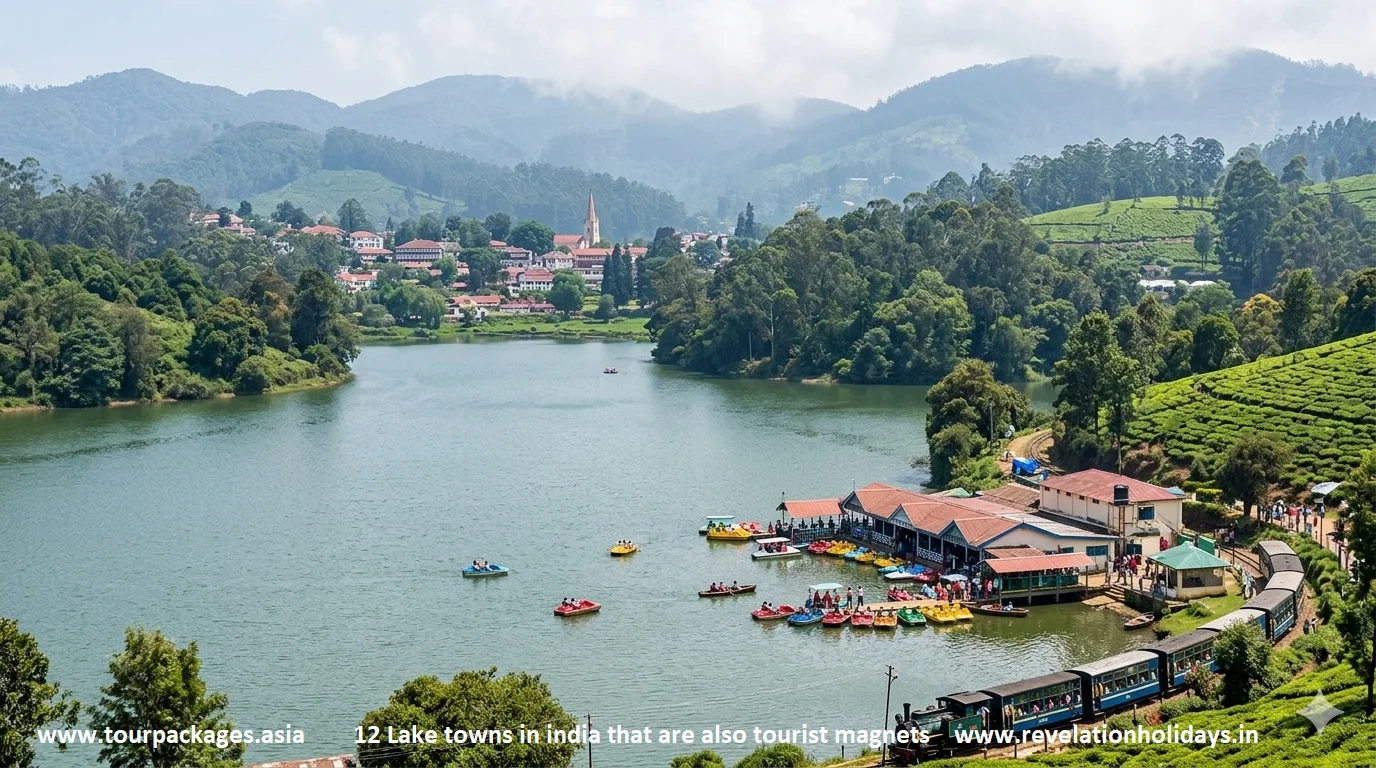
12 Lake towns in india that are also tourist magnets

India is home to breathtaking lake towns that blend natural beauty with cultural richness. From the shimmering waters of Nainital to the tranquil charm of Udaipur, these destinations are perfect for travelers seeking peace, adventure, and unforgettable views. Whether you’re drawn to boating, photography, or simply soaking in the serene atmosphere, these 12 lake towns are true tourist magnets, offering a mix of history, spirituality, and scenic landscapes that captivate every visitor.

12 Lake Towns in India That Are Tourist Magnets
India Travel • Nature & Lakes

12 Lake Towns in India
That Are Tourist Magnets

From the crescent shores of Naini Lake to the royal reflections of Lake Pichola — India's most beautiful lake towns, explored in full.

India's lake towns range from royal Rajasthani palaces shimmering on Pichola to shikaras drifting at dawn across Dal Lake in Kashmir.

12 Lake Towns — Quick Reference (click to jump)
India is a country of extraordinary water — from the glacial lakes of Ladakh that shift colour like living things, to the backwater labyrinth of Kerala where time moves at the pace of a drifting houseboat. Its lake towns are among the most compelling destinations on the subcontinent: each one built around water, shaped by water, and loved because of water. Whether you are planning a family holiday across India, a romantic escape, a solo adventure, or a Kashmir getaway that stays with you for life, there is a lake town in India that fits exactly what you are looking for. This guide covers ten of the very best — in depth, with practical detail, and with curated India tour packages to make the planning effortless.
At a Glance
Lake Towns Covered
12 Landmark Destinations
Regions Spanned
North, South, East & West India
Best Overall Season
October – March (most destinations)
Activities Featured
Boating, trekking, heritage, wildlife
Suitable For
Families, couples, solo, groups
Enquiries
+91 91009 84920

Why India's Lake Towns Draw Millions Every Year

There is something almost primal about water. It draws people in — to sit beside it, move across it, photograph it, and simply let its rhythm slow the mind. India understands this instinctively, which is why its lake towns have been inhabited, revered, painted, sung about, and celebrated for thousands of years. What sets Indian lake towns apart from those elsewhere in the world is the sheer range of experience they offer.

Dal Lake in Srinagar is entirely different from Pangong Tso in Ladakh, which shares almost nothing with Vembanad Lake in Kerala, and none of these resembles the sacred Pushkar Lake in Rajasthan. India's geography is so vast and varied that its lakes come in every conceivable form — alpine, coastal, sacred, royal, volcanic, and glacial — and the towns built around them reflect that same extraordinary diversity. For more inspiration, explore our India travel blog and the full range of India tour packages.

The 12 Most Captivating Lake Towns in India

Each destination below was chosen not simply because it has a lake, but because the lake is the soul of the town — the reason it exists, the reason people come, and the experience that stays longest after you leave.

01

Nainital, Uttarakhand

The Lake District of India

Nestled in the Kumaon Hills of Uttarakhand at 2,084 metres, Nainital is the most beloved lake hill station in North India. The crescent-shaped Naini Lake sits at the town's heart — flanked by seven peaks, its name rooted in the legend that Sati's left eye (naina) fell here as Lord Shiva carried her body across the earth. The Naina Devi Temple on the northern bank is a pilgrimage site of deep significance. Beyond the spiritual, Nainital offers safe boating, the Snow View Point cable car, panoramic hikes to Tiffin Top and Naina Peak, and the excellent G.B. Pant High Altitude Zoo. Mall Road along the lakefront is the town's social artery — lined with cafes, woollen shops, and mountain views at every turn. Nainital's proximity to Delhi (roughly 6 hours by road) makes it the capital's most-visited hill escape year after year.

Altitude: 2,084 mBest: Mar–Jun, Sep–NovLake: Naini Lake
View Nainital Packages →
02

Udaipur, Rajasthan

The City of Lakes

Udaipur is the undisputed jewel of India's lake towns — consistently topping global lists of the world's most romantic destinations. The Lake Pichola, with its shimmering expanse reflecting the City Palace and the iconic floating Lake Palace hotel, is one of India's most photographed scenes. Fateh Sagar Lake offers a quieter alternative with island gardens and a solar observatory. The City Palace complex is among India's finest examples of Rajput architecture, and the old city's winding bazaars sell textiles, miniature paintings, and silver jewellery in traditions unchanged for centuries. Udaipur rewards the slow traveller — its ghats, rooftop restaurants, puppet shows, and evening boat rides each reveal a different facet of Rajasthan's royal heritage.

Best: Oct–MarLakes: Pichola, Fateh SagarFamous: Royal palaces
View Rajasthan Packages →
03

Srinagar, Jammu & Kashmir

Heaven on Earth

Dal Lake in Srinagar is perhaps the most iconic lake in India — a 26 sq km expanse in the Kashmir Valley, ringed by snow-capped peaks and Mughal gardens, with famous floating markets where traders sell vegetables and flowers at sunrise from small shikaras. The traditional houseboat stay on Dal Lake is a quintessential Indian travel experience unlike anything else in the country — waking to mist lifting off the water, drinking kehwa (Kashmiri saffron tea) on a carved wooden deck. Nishat Bagh and Shalimar Bagh, two of the finest Mughal gardens in the world, overlook the lake. Srinagar is also the gateway to Gulmarg and Pahalgam, making it the natural hub of a broader valley exploration.

Altitude: 1,585 mBest: Apr–OctLakes: Dal, Nagin
View Kashmir Packages →
04

Kodaikanal, Tamil Nadu

The Princess of Hill Stations

High in the Palani Hills of Tamil Nadu at 2,133 metres, Kodaikanal is defined by its extraordinary star-shaped lake — a man-made reservoir created by British planters, best explored by bicycle or rowing boat on a clear morning. The five-kilometre path encircling Kodaikanal Lake passes eucalyptus trees, misty viewpoints, old-world cottages, and cafes serving locally grown coffee. The Bear Shola Falls, Pillar Rocks, and the remarkable Berijam Lake hidden within dense forest add further richness. Kodaikanal's relatively undeveloped character compared to other hill stations gives it a quiet charm that draws artists, writers, and long-stay travellers. The town is also famous for its homemade chocolates and cheese, a tradition from the colonial era.

Altitude: 2,133 mBest: Oct–JunLakes: Kodaikanal, Berijam
View Tamil Nadu Packages →
05

Alleppey (Alappuzha), Keralam

The Venice of the East

Alleppey is where the concept of a lake town reaches its most poetic expression. The Vembanad Lake — the longest lake in India at over 96 km — forms the backbone of Kerala's legendary backwater network, and Alleppey is its most celebrated gateway. The traditional houseboat (kettuvallam) experience — spending a night on a converted rice barge gliding through palm-fringed waterways, watching village life unfold on the banks, eating freshly caught fish prepared onboard — is one of India's most distinctive travel experiences. The annual Nehru Trophy Boat Race on Punnamada Lake is one of India's most spectacular sporting events. Our Kerala tour packages include dedicated houseboat experiences.

Best: Nov–FebLakes: Vembanad, PunnamadaFamous: Houseboats
View Kerala Packages →
06

Pushkar, Rajasthan

India's Most Sacred Lake Town

Pushkar is built around one of India's most sacred bodies of water — the Pushkar Lake, ringed by 52 ghats and over 400 temples. Pilgrims perform ritual bathing at the ghats at dawn, temple bells echo across the water at dusk, and in the narrow lanes beyond, international travellers browse markets selling tie-dye fabrics, silver jewellery, and leather goods. Pushkar Lake is one of the five sacred dhams in Hindu tradition — a status that gives the town an unusual serenity. The world-famous Pushkar Camel Fair, held annually in November, transforms the surrounding dunes into a spectacular tableau of colour, livestock trading, and folk performance. Our Rajasthan holiday packages include Pushkar stopovers.

Best: Oct–MarLake: Pushkar (Sacred)Famous: Ghats, Camel Fair
View Rajasthan Packages →
07

Chilika, Odisha

Asia's Largest Coastal Lagoon

Chilika Lake in Odisha is one of India's most ecologically extraordinary destinations — a vast, shallow, tidal lagoon covering over 1,100 sq km, connected to the Bay of Bengal, and recognised as a Ramsar Wetland of International Importance. It harbours over 160 species of birds including flamingos, and one of the world's largest populations of the Irrawaddy dolphin. In winter, migratory birds arrive from Siberia, Iran, and Central Asia. Boat rides to the bird-rich Nalabana Island, dolphin-spotting excursions near Satapada, and visits to the Kalijai Temple island define the Chilika experience. The nearby Puri and Konark temples add cultural depth to any Chilika-centred itinerary.

Best: Nov–FebLake: Chilika LagoonFamous: Dolphins, birds
View Odisha Packages →
08

Bhimtal, Uttarakhand

Nainital's Quieter, Larger Neighbour

Just 22 kilometres from Nainital, Bhimtal is named after the Mahabharata's Bhima, and its lake is actually larger than the famous Naini Lake — though far fewer travellers know it. At 1,370 metres in the Kumaon Hills, the town has a peaceful, pastoral character that Nainital in peak season cannot offer. Bhimtal Lake has a small island at its centre accessible by boat, where a British-era aquarium houses Himalayan freshwater species. The 17th-century Bhimeshwar Mahadev Temple adds a spiritual dimension. Boating, birdwatching (the lake attracts outstanding migratory species), short jungle treks, and the sheer peace of a less-visited Kumaoni hill town make Bhimtal an excellent alternative. Explore our Uttarakhand packages for curated itineraries.

Altitude: 1,370 mBest: Mar–Jun, Sep–NovLake: Bhimtal Lake
View Uttarakhand Packages →
09

Mahabaleshwar, Maharashtra

Maharashtra's Hill Capital

Mahabaleshwar sits at 1,372 metres in the Sahyadri range, approximately 120 km from Pune and 280 from Mumbai, and has been a beloved escape since the British made it a summer administrative capital. The town's centrepiece is Venna Lake — a pleasant reservoir ringed by paddle boats, horse rides, and small food stalls selling the town's famous strawberries. The real magic lies in its viewpoints: Arthur's Seat, Wilson's Point, and Kate's Point each offer dramatic views across the Sahyadri valleys, occasionally descending into cloud. Pratapgad Fort, site of Shivaji's famous 1659 encounter with Afzal Khan, is a short drive away. Best visited in September–November when the hills are lush and the air crystalline.

Altitude: 1,372 mBest: Sep–JunLake: Venna Lake
View Maharashtra Packages →
10

Pangong Tso, Ladakh

The Himalayan Sky-Lake

Pangong Tso is perhaps the single most dramatic lake landscape in all of India — a long, thin, remote body of water at 4,350 metres altitude in the Trans-Himalayan plateau of Ladakh, stretching 134 km from India into Tibet. The lake's extraordinary quality lies in its colour — it shifts from deep cobalt to turquoise to steel-blue to silver over the course of a single day. There are no towns on its shores — just simple campsites — which makes waking beside it at dawn a genuinely other-worldly experience. The lake gained global fame after its appearance in the Bollywood film 3 Idiots. Overnight camping is the recommended way to experience Pangong properly. See our Ladakh tour packages for full itineraries.

Altitude: 4,350 mBest: May–SepLake: Pangong Tso
View Ladakh Packages →
11

Shillong, Meghalaya

The Scotland of the East

Perched at 1,491 metres in the lush, rain-drenched hills of Meghalaya, Shillong is the capital of a state whose very name translates as "abode of clouds" — and the city lives up to every syllable of that promise. At its heart lies Umiam Lake, a vast reservoir created in the 1960s by damming the Umiam River, spreading across 220 sq km of forested Khasi hills. The lake's deep blue waters against a backdrop of rolling, mist-wrapped highland forest create a scene so reminiscent of the Scottish Highlands that the British colonial administration coined Shillong's famous nickname. Beyond its scenic beauty, Umiam is one of Northeast India's premier venues for water sports — kayaking, canoeing, rowing, pedal boating, and water scooters are all available from the lakeside water sports complex, making it one of the few Indian hill lakes where active water-based recreation is actively encouraged. Ward's Lake, a smaller ornamental lake in the heart of Shillong's old cantonment area, is a charming counterpoint — fringed by weeping willows, flower beds, and a Victorian-era bandstand where local musicians still perform on weekends. Shillong itself is a city with a distinctive personality: a deep love of music (it is widely considered India's rock music capital), a vibrant Khasi cultural identity, excellent cafes, and a food scene featuring smoked meats, Jadoh (rice and pork), and Tungrymbai that bears no resemblance to anything else on the subcontinent. The city is also the base for day excursions to the living root bridges of Cherrapunji and Mawlynnong — the cleanest village in Asia. Explore Northeast India packages for Meghalaya itineraries.

Altitude: 1,491 mBest: Oct–JunLake: Umiam Lake
View Meghalaya Packages →
12

Moirang, Manipur

The Floating World of Loktak

Moirang in Manipur is the gateway to one of India's most extraordinary and least-known natural wonders — Loktak Lake, the largest freshwater lake in Northeast India, covering approximately 287 sq km of the Imphal Valley at an altitude of 768 metres. What makes Loktak genuinely unlike any other lake in the world is the presence of phumdis — enormous floating islands of densely matted vegetation, soil, and organic matter, some of which are large enough to support entire fishing communities who live, eat, and sleep on them in circular thatched huts called phumsangs. These floating villages have existed for generations, and the rhythm of life on them — fishing from the water's edge, cooking on floating hearths, sleeping as the island shifts gently in the current — is one of the most remarkable human-landscape relationships anywhere on earth. Loktak Lake is also home to Keibul Lamjao National Park — the only floating national park in the world — a 40 sq km phumdi zone that is the last natural habitat of the critically endangered brow-antlered deer (sangai), the state animal of Manipur, considered the dancing deer of Manipur legend. Bird life on the lake is extraordinary: bar-headed geese, herons, kingfishers, and various migratory waterfowl populate the shores and floating islands. The Moirang town itself carries deep historical significance as the site where the Indian National Army (INA) under Netaji Subhash Chandra Bose first raised the flag of free India on Indian soil in 1944. The INA Museum at Moirang is an important historical site. Sunrise on the lake, when mist rises through the phumdis and the brow-antlered deer can sometimes be spotted at the park margins, is an experience of genuine, unselfconscious beauty. Explore Northeast India packages for Manipur itineraries.

Altitude: 768 mBest: Oct–MarLake: Loktak Lake
View Manipur / NE India Packages →

Best Time to Visit India's Lake Towns

season · temperature · what to avoid

Getting the timing right is one of the most important decisions in planning a lake town holiday in India. Climate varies dramatically between the Himalayas, the Thar Desert, the Western Ghats, and the South Indian plains.

Lake TownBest SeasonPeak CrowdAvoidTemperature Range
NainitalMar–Jun, Sep–NovApr–JunJan–Feb (snow/cold)10–27°C (summer)
UdaipurOct–MarOct–DecMay–Jun (extreme heat)14–34°C (winter–spring)
SrinagarApr–OctJul–AugDec–Feb (sub-zero)5–30°C (summer)
KodaikanalOct–JunApr–JunJul–Sep (heavy monsoon)8–20°C year-round
AlleppeyNov–FebDec–JanJun–Sep (monsoon)23–32°C
PushkarOct–MarNov (Camel Fair)May–Jul (desert 45°C+)15–30°C (winter)
ChilikaNov–FebDec–Jan (migratory birds)Jun–Sep (monsoon floods)16–28°C (winter)
BhimtalMar–Jun, Sep–NovApr–MayDec–Jan (cold)8–25°C
MahabaleshwarSep–JunOct–Dec, Apr–MayJul–Aug (monsoon, roads close)12–28°C
Pangong, LadakhMay–SepJul–AugOct–Apr (frozen, inaccessible)–3 to 20°C (summer)
Shillong, MeghalayaOct–JunMar–MayJun–Sep (very heavy monsoon)5–24°C year-round
Moirang, ManipurOct–MarNov–JanJun–Sep (monsoon flooding)10–30°C (winter)

Essential Travel Tips for India's Lake Towns

Select a category below for practical guidance on planning your India lake town holiday.

Getting to India's Lake Towns
  • Nainital — nearest railway station is Kathgodam (35 km), well connected to Delhi. Road from Delhi takes 6–7 hours via NH9.
  • Udaipur — served by Maharana Pratap Airport with daily flights from Delhi, Mumbai, Jaipur, and Hyderabad.
  • Srinagar — Sheikh ul-Alam International Airport with flights from all major Indian cities. Road from Jammu via NH44 takes 8–10 hours.
  • Kodaikanal — no direct rail; nearest railheads Kodai Road (80 km) and Palani (64 km). Taxi from Madurai (120 km) is common.
  • Alleppey — nearest airport Cochin International (83 km). Alappuzha railway station has connections across Kerala.
  • Pangong Tso — fly to Leh, then a 5–6 hour road journey via Chang La Pass (5,360 m). Acclimatise in Leh for 2 full days first.
  • Book road transport well in advance during peak season — private taxis at hill stations fill quickly. Reach out to our team for logistics support.
What to Pack for a Lake Town Holiday
  • Layered clothing for hill stations — mornings and evenings at Nainital, Kodaikanal, Bhimtal, and Mahabaleshwar are significantly cooler than afternoons.
  • Warm gear for Ladakh — even in July, nights at Pangong Tso can drop to 0°C. Thermal base layer, fleece, windproof jacket, and gloves are essential.
  • Light, breathable cotton for Alleppey and Pushkar — both are warm and humid (Kerala) or dry-hot (Rajasthan) during peak season.
  • Waterproofs for houseboat stays in Kerala — post-monsoon visits require full rain gear on open deck areas.
  • Walking shoes with good grip — the ghats, lakefront promenades, and hill station paths are best explored on foot.
  • Sunscreen and sunglasses (UV400) are essential at high-altitude lakes like Pangong where UV radiation is intense due to the thin atmosphere.
  • A good offline maps app downloaded for your region is invaluable in hill areas where mobile connectivity can be unreliable.
Health & Safety at India's Lake Towns
  • Altitude sickness at Pangong/Leh — acclimatise in Leh for at least two full days before travelling to Pangong. Symptoms include headache, nausea, and breathlessness. Consult a doctor about Diamox before departure.
  • Water safety — never drink tap or lake water at any destination. Carry a filtration bottle or buy sealed mineral water. Houseboat operators in Alleppey should provide filtered drinking water.
  • Swimming in lakes — most Indian lake towns discourage or prohibit swimming in main lakes due to boat traffic, depth, and in some cases sacred status (Pushkar Lake strictly prohibits swimming). Always check local rules.
  • Travel insurance covering high-altitude travel (above 4,000 m) is strongly recommended for Pangong and Leh visits.
  • Wildlife awareness at Chilika — the lagoon has strong tidal currents; always use government-approved boat operators and wear lifejackets.
  • In Kashmir, register your Inner Line Permit (ILP) for border-area visits and check current travel advisories before visiting.
Photography Tips at India's Lake Towns
  • Golden hour at Udaipur — the 30 minutes after sunset, when the City Palace catches the last orange light above Pichola, is the most photographed moment. Position yourself at Ambrai Ghat or Lal Ghat rooftops.
  • Dal Lake sunrise — 5:30–6:30 AM on the lake in a shikara, before the floating market disperses, produces iconic compositions. The mist, reflections, and movement create natural magic.
  • Pangong colour shifts — set up at the northern shore to capture the lake's famous colour changes. Best light is early morning (blue hour) and 4–5 PM (warm side-light on the mountains).
  • Alleppey from a small country boat — rent a country boat rather than a large houseboat for the best photography angles. Village life on the banks is the true subject.
  • Chilika bird photography — a zoom lens of at least 300mm is recommended. Flamingos and Irrawaddy dolphins require patience and a steady boat platform.
  • Always carry a polarising filter for lake photography — it eliminates surface glare and reveals the true colour and depth of the water below.
Budget Tips for India's Lake Towns
  • Off-peak stays — visiting Nainital and Mahabaleshwar in September–October cuts accommodation costs by 30–50% and brings far fewer crowds.
  • Udaipur's rooftop guesthouses on Gangaur Ghat and Lal Ghat offer extraordinary lake views at a fraction of the major hotel rates — INR 800–2,500 per night for clean, well-positioned rooms.
  • Alleppey shared houseboats — booking shared or smaller houseboats makes the backwater experience accessible at INR 2,500–4,000 per person including meals.
  • Local transport — shared jeeps and autos in Kodaikanal, Bhimtal, and Mahabaleshwar are significantly cheaper than private taxis for in-town movement.
  • Eating at local dhabas and thali restaurants near the lake in Pushkar, Nainital, and Udaipur typically costs INR 80–200 per meal — often authentic and excellent.
  • Book group tour packages for destinations like Ladakh and Kashmir — the logistics are complex, and group packages offer significant savings over fully independent travel.

Quick Comparison – India's 12 Lake Towns

type · key experience · ideal traveller · 12 destinations
Lake TownLake TypeKey ExperienceIdeal ForTrip Length
NainitalNatural freshwaterBoating, cable car, Naina Devi TempleFamilies, couples2–3 nights
UdaipurMultiple freshwaterPalace boat rides, heritage walksCouples, history lovers3–4 nights
SrinagarFreshwater mountainHouseboat stay, Shikara rides, Mughal gardensAll travellers3–5 nights
KodaikanalMan-made reservoirCycling the lake, forest treksCouples, solo2–3 nights
AlleppeyCoastal lagoonOvernight houseboat on backwatersCouples, families1–2 nights
PushkarSacred naturalGhat rituals, Camel Fair, desert camel safariSolo, spiritual seekers1–2 nights
ChilikaCoastal lagoon (Ramsar)Bird watching, dolphin spottingNature lovers, photographers2 nights
BhimtalNatural freshwaterBoating, island visit, birdwatchingCouples, solo1–2 nights
MahabaleshwarMan-made reservoirViewpoints, strawberry farms, colonial heritageFamilies, couples2–3 nights
Pangong, LadakhHigh-altitude salineSunrise camping, landscape photographyAdventure, photography1–2 nights
Shillong, MeghalayaMan-made reservoirWater sports on Umiam, Ward's Lake walksAdventure, nature lovers2–3 nights
Moirang, ManipurNatural freshwaterPhumdi floating islands, Keibul Lamjao NP, sangai deerWildlife, off-beat travellers2–3 nights

Top Sights in Turkey

Cappadocia's fairy chimneys, Pamukkale's thermal travertine pools, Istanbul's Bosphorus — Turkey's landscapes are extraordinary. Plan your Turkish journey today.

Explore Turkey — Plan Now

Frequently Asked Questions — Lake Towns in India

Everything you need to know about planning a trip to India's most beautiful lake towns, answered in detail.

Udaipur in Rajasthan, known as the City of Lakes, is widely regarded as India's most famous lake town. Built around five significant lakes — Pichola, Fateh Sagar, Udai Sagar, Rajsamand, and Jaisamand — with the iconic Lake Pichola and its floating Lake Palace forming one of the most photographed scenes in the country, Udaipur tops numerous international lists of the world's most romantic cities. Its combination of royal history, exceptional architecture, vibrant culture, and lakeside beauty is unparalleled. For travellers specifically seeking houseboat experiences, Srinagar's Dal Lake is equally iconic. For the most dramatic natural lake setting in India, Pangong Tso in Ladakh stands alone. Our Rajasthan packages and Kashmir packages cover both these iconic destinations in curated itineraries.
Nainital is consistently rated the best Indian lake town for families with children. The Naini Lake offers safe boating in paddle and rowing boats; the G.B. Pant High Altitude Zoo houses rare Himalayan species including snow leopards and red pandas; the Snow View Point cable car offers a thrilling safe aerial experience; and Mall Road is a safe, walkable environment lined with shops selling souvenirs and mountain sweets. Nainital is accessible from Delhi by an overnight train to Kathgodam followed by a short taxi ride. For South India, Alleppey's houseboat experience is also outstanding for families — children find the novelty of sleeping on a moving boat through canal waterways genuinely magical. Explore our India family tour packages for curated options.
The best time to visit Dal Lake in Srinagar is from April to October. April–May brings spectacular almond and cherry blossom season — the gardens erupt in pink and white, and the air carries the scent of flowers across the lake. June to August is peak tourist season — Dal Lake is at its most vibrant, the floating market busiest at dawn, and the Mughal gardens at their finest. September–October is what many consider the finest time of all — crowds thin, the light turns golden, and the chinar trees begin their extraordinary autumn colour transformation, turning amber and deep red in a display unique to Kashmir. November to March is winter: temperatures drop to –10°C or below, and while a snow-covered lake has stark beauty, facilities reduce significantly. Book a Kashmir tour package for optimal timing guidance.
Pangong Tso is approximately 150 km from Leh, and the journey takes around 4.5 to 6 hours by road. The route goes via Chang La Pass at 5,360 metres — the third highest motorable road in the world — making the drive itself one of the most dramatic in India. Most visitors hire a private taxi from Leh (approximately INR 4,000–5,500 for a round trip with one night at the lake) or join an organised tour. An Inner Line Permit (ILP) is required for Indian nationals; foreign nationals also need a Protected Area Permit (PAP). Both can be arranged through your hotel, tour operator, or online. Critically, spend at least two full days in Leh for acclimatisation before attempting the drive — altitude sickness at 4,350 metres can be serious. Our Ladakh tour packages include all permit arrangements and acclimatisation scheduling.
Both are exceptional but fundamentally different. A Dal Lake houseboat in Srinagar is a stationary stay — moored along the lake shore, you take a shikara to explore. The houseboats are intricately carved wooden structures with ornate interiors, and the experience is about immersing yourself in the floating village life of Kashmir, against a backdrop of Himalayan peaks and Mughal gardens. An Alleppey houseboat (kettuvallam) is a moving experience — your home glides through narrow backwater channels past coconut groves, paddy fields, village churches, and ancient temples while your crew prepares fresh seafood onboard. If you are drawn to cultural depth, Himalayan drama, and carved heritage — choose Dal Lake. If you want tropical serenity, the rhythm of village waterways, and extraordinary food — choose Alleppey. Ideally, include both on an India trip. Explore Kerala packages and Kashmir packages side by side.
Swimming is strictly prohibited in Pushkar Lake. The lake holds the status of one of India's most sacred water bodies — one of only a handful of lakes in the country dedicated to Lord Brahma — and entry into the water beyond the designated bathing steps at the ghats is considered deeply disrespectful and is actively enforced by the local community. Visitors are welcome to walk the 52 ghats, observe the morning and evening aarti rituals, and perform the traditional pandit-led Pushkar puja at the ghats (which involves offering rose petals to the water, not immersion). Visitors should also be aware that non-vegetarian food and alcohol are banned in Pushkar town out of respect for the town's religious significance. The lake's waters are considered purifying; the appropriate way to engage with them is through the guided ghat ceremonies.
Chilika Lake in Odisha is one of the most species-rich wetland ecosystems in Asia. The lagoon is home to over 160 species of birds — including flamingos, grey pelicans, painted storks, and numerous migratory species that arrive each winter from Siberia, Central Asia, and Iran. The lagoon is also home to one of the world's largest known populations of the Irrawaddy dolphin — approximately 150–160 individuals — most easily spotted near Satapada at the southern end of the lake. Marine turtles including olive ridley sea turtles nest on the outer beaches. Fishing cats, jackals, and hyenas inhabit the reed beds and island areas. The island of Nalabana within the lake is a declared bird sanctuary and the best single point for bird observation, particularly between November and January when peak migratory numbers are present. Always use government-licensed boats with life jackets — the lagoon has strong tidal currents.
A well-planned 3-night, 4-day trip is sufficient to experience the best of Nainital without feeling rushed. Day 1 is best spent settling in, exploring Mall Road and the Naini Lake lakefront, an evening boat ride, and visiting the Naina Devi Temple. Day 2 covers the Snow View Point cable car, Tiffin Top (an easy 3 km hike with panoramic views), and an afternoon visit to the G.B. Pant Zoo. Day 3 can be used for a day trip — either to Bhimtal (22 km) for a quieter lake experience, Mukteshwar (51 km) for apple orchards and Himalayan views, or Kainchi Dham (17 km), the famous Neem Karoli Baba ashram. If you are visiting during peak summer (May–June), book accommodation well in advance as the town fills completely. Explore our Uttarakhand packages for planned Nainital itineraries.
Kodaikanal Lake is distinctive in several ways that set it apart from India's other famous hill station lakes. First, its shape is genuinely unusual — it is a naturally star-shaped, five-pointed reservoir, created by the Bryant family of American missionaries in 1863 by damming the Pambar River, giving it an organic, almost handcrafted quality. Second, the five-kilometre lakeside path is genuinely walkable and cyclable in a way that Naini Lake (too busy) and most other hill station lakes are not, making the lake itself the centrepiece of daily physical activity rather than just a view. Third, Kodaikanal sits at the highest elevation of all South India's hill stations at 2,133 metres, giving it an almost Himalayan quality of light and temperature. Fourth, the surrounding Shola forests — a type of high-altitude montane ecosystem found only in the Western Ghats — create a landscape of mossy, misty beauty unlike anything in North India's hill stations.
Udaipur is absolutely accessible on a budget, despite its reputation as a luxury destination. The most important insight for budget travellers is that the best thing about Udaipur — the lake views — is free. The ghats, lakefront promenades, and the famous walk between Gangaur Ghat and Lal Ghat are all free and open to all. Rooftop guesthouses on Lal Ghat and Gangaur Ghat offer rooms with direct lake views for INR 800–2,000 per night — remarkable value given the setting. Eating at the rooftop cafes overlooking Pichola is atmospheric and affordable, with full meals from INR 150–350. The City Palace museum has an entry fee of approximately INR 300 for Indians and INR 500 for foreign nationals. The boat ride to Jag Mandir island costs around INR 400–700 per person and is worth every rupee. Budget-friendly transport via autos and shared cabs around the old city is easy and inexpensive. The best budget window is November–February when the weather is ideal but rates are lower than the December peak.
The Nehru Trophy Boat Race is one of the most spectacular sporting and cultural events in India — held annually on the second Saturday of August on Punnamada Lake in Alleppey, Kerala. The race features traditional snake boats (chundan vallams) — elongated, richly carved wooden vessels up to 40 metres in length — each crewed by over 100 rowers paddling in perfect synchronised unison to the beat of traditional song and drumming. The event was inaugurated in 1952 with the blessings of India's first Prime Minister Jawaharlal Nehru (hence the name) and has grown into a celebrated event attracting tens of thousands of spectators. The snake boats are community assets in Kerala — each representing a particular village or region, and rowers train intensively in the weeks before the race. The atmosphere — tens of thousands of spectators on the banks and in boats, the sound of chants and drums, the drama of the race itself — is an extraordinary spectacle. If you plan to witness it, book accommodation in Alleppey at least 2–3 months in advance. Our Kerala packages can be timed to coincide with the event.
Absolutely yes — and in fact many experienced Kumaon travellers argue that Bhimtal is the better destination of the two for a repeat visitor or for those seeking something quieter and more authentic. The key difference is character: Nainital is a tourist town that happens to have a lake; Bhimtal is a lake town that has largely resisted heavy commercialisation. The lake itself is larger than Naini Lake, and the surrounding scenery is arguably gentler and more pastoral. The aquarium on the island is genuinely interesting for children and adults alike. The birdwatching around Bhimtal is considered outstanding — the lake attracts species not commonly seen at Nainital. The resort accommodations around Bhimtal, particularly along the lake's southern edge, are excellent value and typically far less crowded. Several boutique nature lodges offer organised bird walks and forest hikes that Nainital's more urban environment cannot replicate. As a day trip from Nainital (just 22 km, 45 minutes) or as a quiet base for exploring the entire Kumaon region, Bhimtal is worth serious consideration.
The Pushkar Camel Fair (Pushkar Mela) is held annually in the Hindu month of Kartik — typically falling in October or November, with the exact dates varying by the lunar calendar. The 2025 edition was held from 1–9 November. The fair is the world's largest camel trading fair, with over 50,000 camels, horses, and cattle brought to the fairgrounds on the dunes beyond the town. Beyond the livestock trading, the event has become one of India's greatest cultural spectacles — folk musicians, puppeteers, acrobats, camel races, cattle beauty contests, turban-tying competitions, and the atmospheric spectacle of thousands of campfires under a desert sky. The sacred Kartik Purnima (full moon) at the end of the fair period is when lakhs of pilgrims bathe at the Pushkar Lake ghats in one of the most visually powerful scenes in India. To attend: book accommodation in Pushkar at least 4–5 months in advance as the town fills completely. Tent city accommodations on the fairgrounds are a popular and atmospheric option, though basic. Our Rajasthan packages can be timed around the Pushkar Mela.
Mahabaleshwar offers a rich set of experiences beyond the lake itself. The viewpoints are outstanding — Arthur's Seat offers a sheer 600-metre drop into the Savitri River valley below and is considered one of the finest natural viewpoints in Maharashtra; Wilson's Point catches the first and last light of the day; and Kate's Point provides sweeping panoramas of the Dhom Dam and Krishna Valley. Pratapgad Fort (20 km away), site of Shivaji's famous 1659 duel with the Bijapur general Afzal Khan, is a historical site of immense significance and offers dramatic views from its twin bastions. Strawberry picking at one of the plateau farms is a genuinely enjoyable activity from March onwards — Mahabaleshwar produces approximately 85% of India's total strawberry output. The Krishnabai Temple in Old Mahabaleshwar, built in 1888, marks the origin of the Krishna River from a cow's mouth-shaped spout — a beautiful, peaceful site. Elephant Head Point and the Lingmala Waterfall are pleasant half-day excursions.
Combining multiple Indian lake towns in a single trip is very achievable with good planning, and the rewards of doing so — experiencing the contrast between a Himalayan glacial lake, a sacred desert lake, and a tropical backwater in a single journey — are extraordinary. The most popular multi-lake circuits include: North India Lakes — Delhi to Nainital (train to Kathgodam), then Bhimtal (day trip, 22 km), then onward to Delhi, as a complete 5–6 day circuit. Rajasthan Lakes — Delhi to Jaipur to Pushkar to Udaipur, covering the two great Rajasthani lake towns in a 7–10 day circuit. South India Lakes — Bangalore or Chennai to Kodaikanal (3 nights) then to Alleppey via Madurai and Cochin (2–3 nights houseboat), returning via Cochin Airport. Kashmir and Ladakh — Srinagar (4 nights on Dal Lake) then road to Kargil and Leh, ending at Pangong Tso, a journey of 10–14 days. For a comprehensive multi-region India lakes itinerary combining North, South, and Himalayan destinations, contact our team or browse our full range of India tour packages which can be combined and customised.

Plan Your India Lake Town Holiday

Share your travel preferences and our specialists will curate a personalised itinerary across India's finest lake destinations.

WhatsApp Us