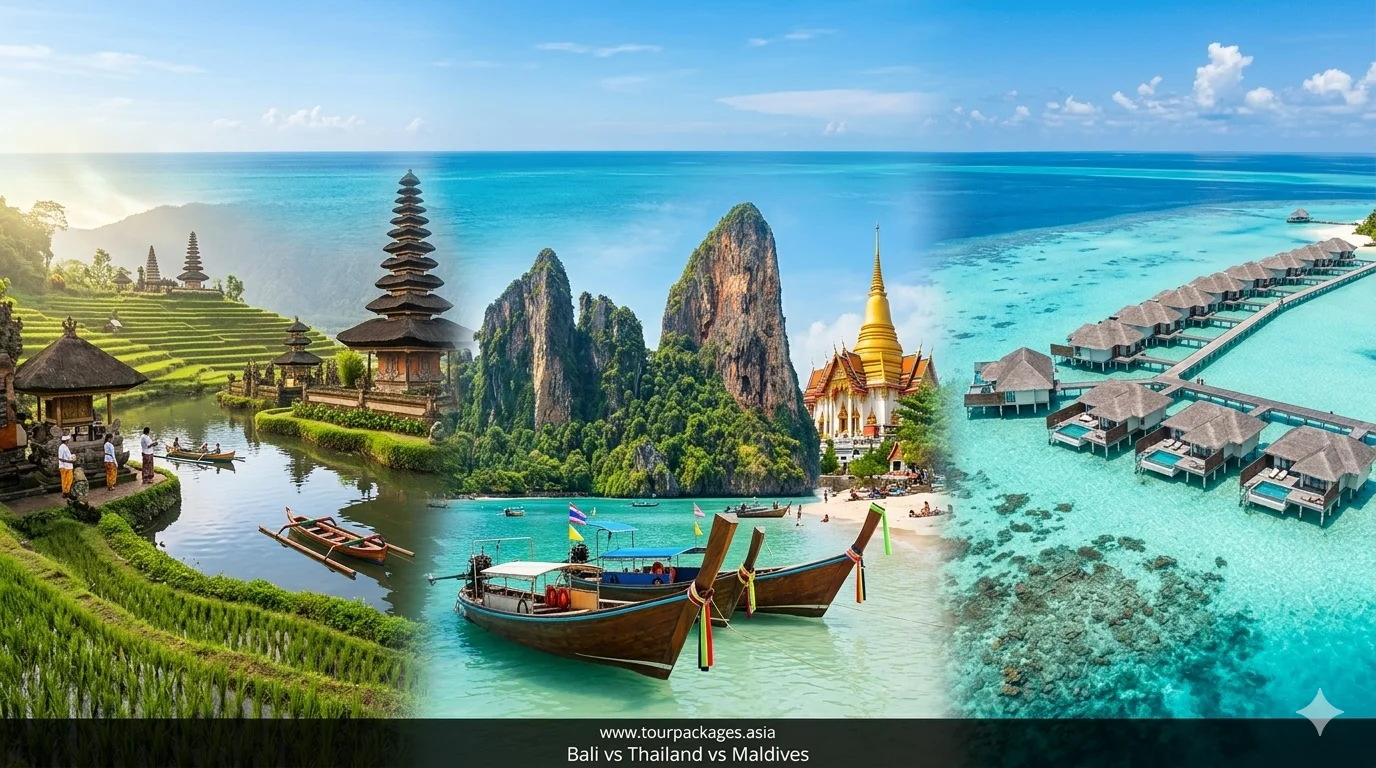
Bali, Thailand, or Maldives — which destination is right for you? This guide compares the three most popular tropical escapes for Indian travelers. Explore differences in culture, beaches, nightlife, costs, and travel ease. Whether you’re seeking adventure, luxury, or relaxation, learn how each destination offers unique experiences. From Bali’s temples to Thailand’s vibrant energy and Maldives’ private island resorts, discover which paradise best suits your travel style.
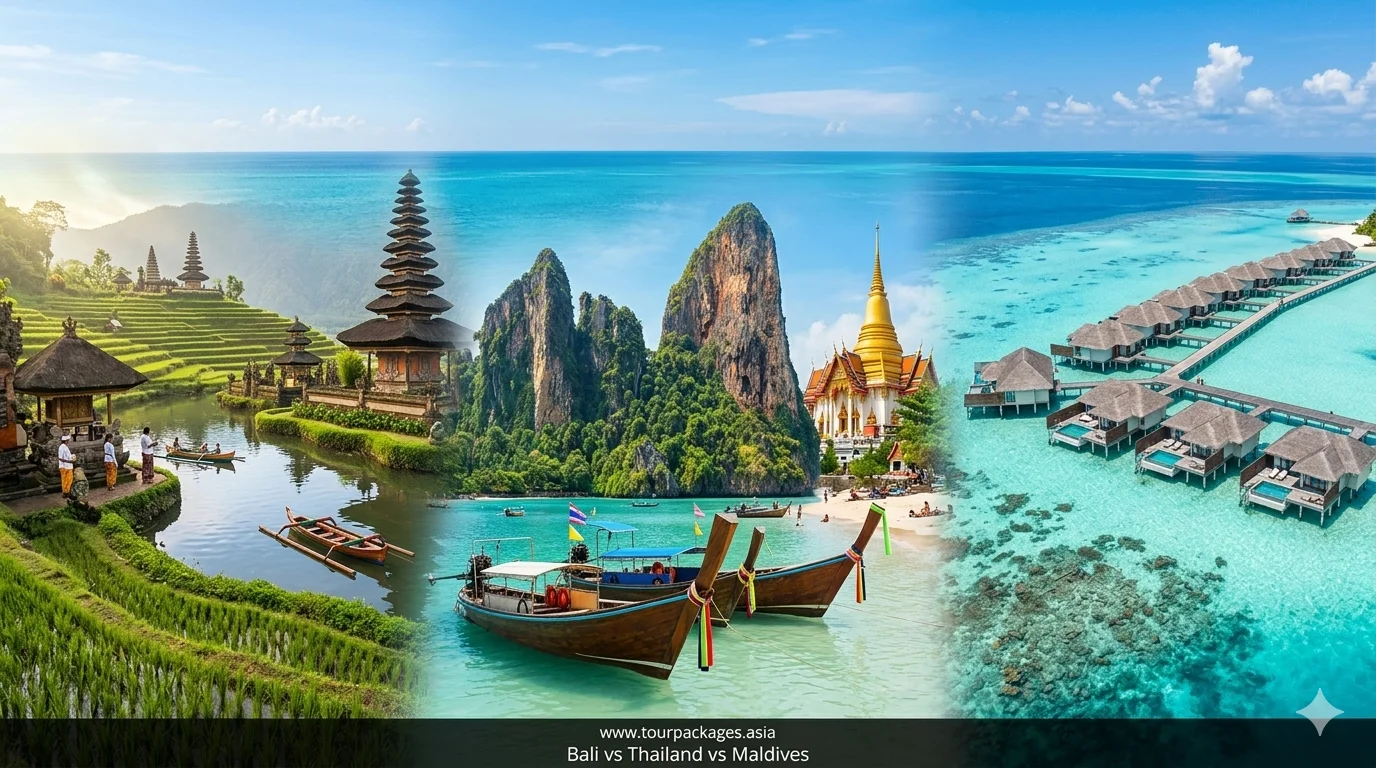
International Travel · 2026 Comparison Guide · RTH World Tour Packages
Bali vs Thailand vs Maldives
Which One Is Right for You?
3Destinations Compared
15FAQs Answered
2026Price Data Updated
100%Honest Comparison
Quick Answer — Bali vs Thailand vs Maldives: If you want luxury, privacy, and a once-in-a-lifetime honeymoon experience, choose
Maldives. If you want a perfect balance of culture, scenic beauty, private villas, and romance on a mid-range budget, choose
Bali. If you want maximum travel experience at the lowest possible cost — beaches, food, nightlife, and variety — choose
Thailand.
Bali
Best Overall Balance
Culture, rice terraces, beaches, private pool villas, romantic atmosphere. Mid-range budget. 7–9 hrs from India.
Thailand
Best Budget Destination
Beaches, islands, street food, night markets, excellent infrastructure. Cheapest of the three. 4 hrs from India.
Maldives
Best for Luxury + Honeymoon
Overwater villas, coral lagoons, complete privacy, world-class diving. Premium price. 2.5 hrs from India.
Why This Comparison Exists — and Who It Is Written For
Every year, millions of Indian travellers face the same conversation: Bali or Thailand or Maldives? The question comes up at office desks, in WhatsApp groups, over dinner when the anniversary is approaching and the flights are getting booked. Travel agents give you the answer that earns the highest commission. Instagram shows you the most photogenic option. Neither tells you the truth about which destination actually fits the way you travel, the budget you actually have, and the kind of holiday you genuinely want.
This guide is written by the travel team at RTH World Tour Packages — the same team that has sent thousands of Indian travellers to all three destinations over the past decade. We know what they expected and what they found when they arrived. We know which destination produces "I am coming back next year" and which one produces "I should have gone somewhere else." And we have written this guide with the single aim of making sure you choose the right one for you, not for anyone else. For a broader look at what makes international travel from India genuinely worth it, our island comparison guide covers domestic alternatives that sometimes outperform all three of these destinations.
The short version: Bali vs Thailand vs Maldives is not a question with one correct answer. It is a question that needs to be answered differently for a honeymooning couple with Rs. 1.5 lakh to spend, a family of four with school-age children, a group of friends looking for the best value trip from India, and a solo traveller doing their first international trip. This guide addresses all of them.
Section 1 — Overview Comparison at a Glance
The table below compares all three destinations across the factors that Indian travellers actually care about most. This table alone is enough to make the right choice for most travellers — the deeper sections below provide the detail behind each row.
| Feature |
Bali, Indonesia |
Thailand |
Maldives |
| Overall Budget |
Medium Mid-Range |
Low–Medium Best Value |
High Luxury |
| Trip Cost per Person (7N) |
Rs. 60,000 – Rs. 1,00,000 |
Rs. 40,000 – Rs. 80,000 |
Rs. 90,000 – Rs. 2,00,000+ |
| Best For |
Culture, nature, honeymoon, Instagram |
Budget travel, nightlife, beaches, groups |
Honeymoon, luxury, privacy, diving |
| Visa for Indians |
Visa on Arrival (VOA) — USD 35 |
Visa-free (60 days) |
Visa on Arrival — Free |
| Flight Time from India |
7–9 hours (via Kuala Lumpur / Singapore) |
3.5–5 hours (Bangkok, Phuket direct) |
2.5–3.5 hours (Male direct) |
| Best Season |
April–October (dry season) |
Nov–March (cool season) |
Nov–April (dry season) |
| Honeymoon Rating |
Excellent — private villas, romance |
Good — islands, beaches |
Outstanding — best in the world |
| Family Suitability |
Very good |
Excellent |
Good (expensive for families) |
| Food Variety |
Excellent — Indian food widely available |
Excellent — diverse, cheap |
Limited — mostly resort food |
| Language Ease |
Easy — English widely spoken |
Easy — English in tourist areas |
Very easy — English official |
| Nightlife |
Good (Seminyak, Kuta) |
Outstanding (Bangkok, Phuket) |
Minimal (alcohol restricted) |
| Nature & Scenery |
Outstanding — rice terraces, volcanoes, beaches |
Very good — islands, jungle, mountains |
Outstanding (marine) — limited on land |
| Shopping |
Good — local crafts, markets |
Outstanding — everything, everywhere |
Limited — mainly resort shops |
| Safety for Indians |
Very safe |
Very safe |
Extremely safe |
| Alcohol |
Available |
Available |
Resort-only (Islamic country) |
At a Glance — Key Facts
- Cheapest: Thailand wins on daily cost
- Most romantic: Maldives is unmatched
- Most scenic: Bali offers the greatest land variety
- Closest: Maldives — 2.5 hrs from South India
- Most food: Thailand — world-renowned cuisine
- Visa-free: Only Thailand (for Indians)
- Best for 1st international trip: Thailand
Not Sure Which One to Book?
Our travel specialists have matched thousands of Indian travellers to the right destination. Tell us your budget and travel style — we will do the rest.
Section 2 — Bali, Indonesia: Where Culture Meets the Sea
Destination 01 · Indonesia
Bali
The Island of Gods · Culture, Nature and Romance Combined
CapitalDenpasar
CurrencyIndonesian Rupiah (IDR)
Time ZoneWITA (UTC+8, +2.5 hrs IST)
Best SeasonApril – October
Bali is the best international destination from India for travellers who want a genuinely foreign experience that covers multiple sensory registers at once. The rice terraces of Tegallalang, the volcanic skyline of Mount Batur, the black sand beaches of Lovina, the white sand and turquoise water of Nusa Dua, the extraordinary cliff temple at Tanah Lot, the artists' colony of Ubud, the surf culture of Seminyak — Bali packs more genuine variety into its 5,780 square kilometres than most countries manage in their entire territory. It is, quite simply, one of the most photographically and experientially rewarding islands on earth.
What makes Bali uniquely compelling for Indian travellers in particular is the cultural familiarity beneath the geographical foreignness. Balinese Hinduism — a variant of Indian Hinduism shaped by centuries of Javanese influence — means that the religious architecture, the festival calendar, the food offerings placed at doorsteps every morning, and the spiritual undertone of daily life will feel recognisable to Indian visitors in a way that no other Southeast Asian destination can match. The Balinese do not perform their culture for tourists. It is simply the way they live, which makes encountering it feel authentic in a way that staged cultural experiences never do.
Who Should Choose Bali
- Honeymoon couples who want private pool villas, romantic dinners, and scenic beauty without Maldivian price tags
- Travellers doing their first major international trip and wanting a destination that rewards exploration beyond the beach
- Nature and photography enthusiasts who want a single destination with maximal visual variety
- Families with older children (12+) who appreciate culture, outdoor activities, and some beach time
- Anyone comparing Bali vs Thailand vs Maldives who wants the most balanced option across all categories
Key Experiences in Bali
- Ubud: The cultural heartland — rice terraces, art markets, Monkey Forest, traditional dance performances, cooking classes
- Tanah Lot: The sea temple built on a rock formation offshore, spectacular at sunset — one of the most photographed sights in all of Southeast Asia
- Mount Batur: Pre-dawn hike to the active volcano rim for a sunrise that rewards every step of the climb
- Nusa Islands: The trio of Nusa Penida, Nusa Lembongan, and Nusa Ceningan — dramatically different from mainland Bali, with clifftop viewpoints and snorkelling with manta rays
- Seminyak: Bali's most sophisticated beach strip — international restaurants, rooftop bars, and the island's best sunset point at Ku De Ta
- Tirta Gangga: The Royal Water Palace — a network of pools, lotus ponds, and stepping stone paths in the quiet east of the island
- Tegallalang Rice Terraces: The most iconic agricultural landscape in Asia — UNESCO-recognised subak irrigation system, best at dawn before the crowds arrive
Advantages of Bali
- Extraordinary landscape variety — beaches, volcanoes, terraces, forests
- Private pool villas available at very competitive prices
- Cultural richness — Hindu heritage makes it feel familiar and foreign at once
- Strong Indian food presence in tourist areas
- Excellent value for money compared to Maldives
- Very well-developed tourist infrastructure
- Safer and quieter than Thailand's busiest areas
Disadvantages of Bali
- Longer flight time — 7 to 9 hours with connections
- No direct flights from most Indian cities
- Can feel crowded at popular sites (Tanah Lot, Ubud Market)
- Beach quality variable — not Maldives-grade on the south coast
- Rainy season (November to March) significantly reduces appeal
- Traffic in South Bali can be surprisingly bad
Ready to Plan Your Bali Holiday?
RTH designs complete Bali itineraries — flights, private villa accommodation, guided tours, and all logistics — with no hidden costs.
Section 3 — Thailand: The Benchmark for Budget Travel from India
Destination 02 · Southeast Asia
Thailand
The Land of Smiles · Budget-Friendly, Diverse, and Endlessly Entertaining
CapitalBangkok
CurrencyThai Baht (THB)
Time ZoneICT (UTC+7, +1.5 hrs IST)
Best SeasonNov – March (cool & dry)
Thailand has been the first international destination for more Indian travellers than any other country on earth — and the reason is not difficult to understand. It combines genuine affordability, excellent infrastructure, extraordinary food, visa-free entry, a flight time short enough not to require a long holiday, beach destinations that are genuinely world-class, a city in Bangkok that belongs in any list of the world's great urban destinations, and a service culture that is warm and consistently professional. No other destination in the cheapest international trips from India category comes close to matching the breadth of what Thailand offers at the price point it delivers it.
Thailand's geography helps enormously. The country contains multitudes: Bangkok is a world-class metropolis with extraordinary street food, world-famous night markets, and a nightlife scene that is among the best on the planet. Phuket and Krabi are island destinations with beaches that rival anything in the Maldives at a small fraction of the cost. Chiang Mai in the north is a quiet, culturally rich city surrounded by mountains and accessible elephant sanctuaries. Koh Samui and Koh Phangan offer the full range of beach moods — from family-friendly calm to Full Moon Party energy. Thailand vs Bali honeymoon comparisons almost always resolve in Thailand's favour for couples who prioritise variety and value over seclusion and rural romance.
Who Should Choose Thailand
- First-time international travellers who want an easy, well-supported experience with low financial risk
- Groups of friends looking for the best value combined beach-and-city trip from India
- Couples who want beaches and romance but also enjoy nightlife, restaurants, and an active social scene
- Families with children of all ages — Thailand is exceptionally child-friendly throughout
- Travellers comparing Thailand vs Maldives budget who need to make every rupee count
- Anyone who loves extraordinary food — Thai cuisine is one of the world's great culinary traditions
Key Experiences in Thailand
- Bangkok: Chatuchak Weekend Market, street food on Yaowarat, the Grand Palace complex, rooftop bars on the Chao Phraya, Asiatique night market
- Phuket: Patong Beach, Phi Phi Islands day trip, Big Buddha viewpoint, Old Phuket Town for architecture and cafes
- Krabi: Railay Beach (accessible only by long-tail boat), Tiger Cave viewpoint, four islands tour, rock climbing
- Chiang Mai: Sunday Walking Street, Doi Inthanon National Park, ethical elephant sanctuaries, night bazaar, cooking classes
- Koh Samui: Chaweng Beach, Big Buddha, Na Muang Waterfalls, calm family-friendly beaches on the north coast
- Koh Phangan: Secret Beach, snorkelling at Bottle Beach, the famous Full Moon Party at Hat Rin (once in your life)
Advantages of Thailand
- Visa-free for Indian nationals — zero paperwork
- Cheapest of the three destinations by a significant margin
- Short flight time — direct flights to Bangkok and Phuket from most Indian cities
- Extraordinary food — one of the world's great culinary cultures
- Incredible diversity — city, beach, mountains, jungle in one country
- Outstanding nightlife for those who want it
- Best shopping of the three destinations
Disadvantages of Thailand
- Can feel very crowded at peak season in popular areas
- Pattaya and parts of Phuket have a reputation that some couples find inappropriate
- Beach water not as clear as Maldives or (some of) Bali
- Popular sites heavily commercialised
- Scams in tourist areas — requires more vigilance than Maldives or Bali
Planning a Thailand Trip?
RTH puts together Thailand circuits — Bangkok, Phuket, Krabi, Chiang Mai — with real costs and no surprises. Ask us for a 2026 package.
Section 4 — Maldives: The Finest Honeymoon Destination on Earth
Destination 03 · South Asian Island Nation
Maldives
Overwater Villas · Coral Lagoons · Complete Privacy
CapitalMalé
CurrencyUSD (resorts) / Rufiyaa (local)
Time ZoneMVT (UTC+5, −0.5 hrs IST)
Best SeasonNov – April (dry season)
There is nothing else on earth quite like a Maldives honeymoon. The concept of the private resort island — a single resort occupying an entire coral island, surrounded by a turquoise lagoon, with no roads, no traffic, no other hotels, and guests who largely have the beaches to themselves — was essentially invented in the Maldives, and it remains the destination's defining offering. When Indian couples ask the question "Maldives vs Bali honeymoon", the Maldives answer is always: if you want your honeymoon to feel genuinely extraordinary rather than merely very good, the Maldives is the only destination that delivers it at that level.
The mathematics of the Maldives experience are interesting. The country is made up of 1,200 islands and 26 natural atolls. Of these, about 160 islands host resorts, and about 200 have local population settlements. The inhabited local islands — particularly Maafushi, Huraa, Thulusdhoo, and Dhiffushi — offer a genuinely budget-friendly alternative to the resort model that most people associate with the destination. A local island stay, using a guesthouse and day-trip boats to deserted beaches and snorkel points, can be done for a fraction of the resort price while still delivering the Maldivian water quality and landscape. This is the secret that has opened up the Maldives to a much wider range of Indian travellers than the traditional resort model allowed.
"The Maldives sells the same product to every traveller who arrives: the feeling that you have the Indian Ocean to yourself. No destination on earth delivers that feeling more completely, at whatever price point you can afford."
— RTH Travel Desk, 2026
Who Should Choose Maldives
- Honeymooning couples for whom the accommodation and privacy are as important as the destination itself
- Couples celebrating milestones — anniversaries, significant birthdays — who want to spend on the experience rather than pack in activities
- Scuba divers and snorkellers — Maldivian reef systems are among the richest on earth, with manta ray, whale shark, and reef shark encounters accessible from most resort jetties
- Anyone who has done Bali and Thailand and is ready to spend more for a qualitatively different kind of luxury
- Travellers comparing Maldives vs Bali cost who have decided that the Maldives experience justifies the premium
Key Experiences in Maldives
- Overwater Villa: The defining Maldivian experience — a room over the lagoon with a private deck, glass floor panels, and steps directly into the water. Worth every rupee at least once
- House Reef Snorkelling: Every quality resort has a reef accessible from the beach or jetty — morning snorkel sessions with the lagoon to yourself are the defining daily ritual
- Sunset Dolphin Cruise: Spinner dolphins travel in pods of hundreds through the atolls at dusk — witnessing this from a traditional dhoni is one of the travel world's reliable miracles
- Scuba Diving: Maldivian dive sites — Maaya Thila, Fotteyo Corner, Fish Head — are consistently rated among the best in the Indian Ocean
- Sandbank Picnic: A private transfer to a deserted sandbank — a few square metres of white sand in the middle of a turquoise lagoon — for a picnic lunch with no one else visible in any direction
- Local Island Day Trip: Taking a speedboat to a local Maldivian island — visiting the fish market, the school, the mosque — offers a cultural counterpoint to the resort isolation that makes the trip feel complete
Advantages of Maldives
- Closest of the three — 2.5 hours from South India
- Visa on arrival for Indians — free of charge
- The world's most romantic destination for honeymooners
- Extraordinary marine ecosystem — snorkelling and diving without equal
- Genuinely private — private island resorts offer seclusion unavailable anywhere else
- Local island option makes it accessible at lower budgets than the resort model suggests
Disadvantages of Maldives
- The most expensive of the three by a significant margin at resort level
- Very limited experience beyond the beach — no city, no culture, no shopping
- Islamic country — alcohol restricted (resort-only)
- Expensive food within resorts — all-inclusive is the only sensible option for most stays
- Not suitable for families wanting varied activities for children
- Sea transfers between Male and resort atolls add cost and time
Section 5 — Real Cost Comparison for Indian Travellers (2026)
The cost question is where most travel guides go wrong by being either too vague or too optimistic. The ranges below reflect what Indian travellers with a standard mid-range budget actually spend when they travel to these destinations — including the costs that are frequently forgotten in budget calculations: airport transfers, activities, dining outside the hotel, tips, and the inevitable supplementary spending that every holiday produces.
Bali, Indonesia
Rs. 60,000 – Rs. 1,00,000
per person, 7 nights, mid-range
- Return flights: Rs. 18,000 – Rs. 28,000 (via KL/SIN)
- Hotel / Villa (7N): Rs. 25,000 – Rs. 45,000
- Private pool villa: Rs. 3,500 – Rs. 8,000 / night
- Visa on Arrival: Rs. 3,000 (USD 35)
- Food (daily): Rs. 800 – Rs. 1,500
- Tours / activities: Rs. 4,000 – Rs. 8,000 total
- Local transport: Rs. 2,000 – Rs. 4,000
Thailand
Rs. 40,000 – Rs. 80,000
per person, 7 nights, mid-range
- Return flights: Rs. 14,000 – Rs. 22,000 (direct available)
- Hotel (7N): Rs. 12,000 – Rs. 25,000
- Beach resort: Rs. 2,500 – Rs. 6,000 / night
- Visa: Free (visa-free for Indians)
- Food (daily): Rs. 400 – Rs. 1,000 (excellent street food)
- Tours / activities: Rs. 3,000 – Rs. 7,000 total
- Local transport: Rs. 1,500 – Rs. 3,500
Maldives
Rs. 90,000 – Rs. 2,00,000+
per person, 5 nights, resort
- Return flights: Rs. 16,000 – Rs. 24,000 (direct from major cities)
- Resort (5N, all-incl.): Rs. 55,000 – Rs. 1,50,000
- Overwater villa: Rs. 18,000 – Rs. 80,000 / night
- Visa on Arrival: Free
- Speedboat transfer: Rs. 4,000 – Rs. 10,000
- Activities (diving, etc.): Rs. 5,000 – Rs. 15,000
- Local island option: Rs. 60,000 – Rs. 90,000 total
Money-saving insight: The Maldives has a genuine budget option that most people overlook. Staying on a local island (Maafushi, Thulusdhoo, or Dhiffushi) rather than a resort can cut total trip cost by 40 to 60 percent while keeping the same extraordinary water quality and landscape. RTH can plan a local island Maldives trip that delivers the experience at genuinely mid-range pricing. Ask us via
our plan now page.
| Budget Category | Best Destination | Why |
|---|
| Under Rs. 50,000 per person |
Thailand |
Only Thailand can deliver a complete international holiday at this price point including flights |
| Rs. 50,000 – Rs. 80,000 |
Bali or Thailand |
Both work well at this level — Bali offers private villas, Thailand offers more variety |
| Rs. 80,000 – Rs. 1,20,000 |
Bali (best value) |
Bali at this budget delivers luxury villas and excellent experiences |
| Rs. 1,20,000 – Rs. 1,80,000 |
Maldives (local island) |
At this level, a quality local island Maldives trip becomes achievable |
| Rs. 1,80,000 and above |
Maldives (resort) |
The resort Maldives experience — overwater villas, all-inclusive — becomes the clear choice |
Section 6 — Best For What? The Definitive Decision Guide
Honeymoon
Maldives first. The overwater villa experience, the private beach, the sunset dhoni cruise, and the complete absence of crowds create a honeymoon environment that no other destination matches. Bali second — private pool villas in Seminyak or Ubud are deeply romantic and more culturally rich. Thailand third — best for active honeymoon couples who want beaches plus nightlife plus city.
Budget Travel
Thailand by a clear margin. Daily costs in Thailand are 30 to 40 percent lower than Bali and 60 to 70 percent lower than Maldives resort pricing. Visa-free entry removes an additional cost. Direct flights from India cut travel expense further. For the cheapest international trip from India, Thailand wins on every metric that matters.
Nature & Scenery
Bali overwhelmingly. Rice terraces, active volcano, ancient water temples, black sand beaches, white sand beaches, rainforests, sacred monkey forests, and a landscape that changes character every 30 kilometres — no other destination in this comparison offers comparable visual diversity on land. Maldives is extraordinary marine scenery only. Thailand's natural sites are excellent but more dispersed.
Nightlife
Thailand — and it is not close. Bangkok's rooftop bars and night markets, Phuket's Bangla Road, Koh Phangan's Full Moon Party, and the full range of beachside entertainment make Thailand the clear choice for travellers for whom nightlife is a significant part of the holiday. Bali's Seminyak is excellent. Maldives is almost entirely absent from this category.
Scuba & Snorkelling
Maldives for serious divers. Maldivian dive sites consistently rank in the global top ten. Bali's dive sites (including Nusa Penida's manta ray point and the USAT Liberty wreck at Tulamben) are exceptional. Thailand's Similan Islands and Richelieu Rock are world-class but seasonal. For a family snorkelling holiday, Bali's Nusa Islands are the most accessible option in this comparison.
Family Travel
Thailand for the most versatile family experience. Child-friendly facilities, affordable meals, varied activities, short inter-city travel, and the practical ease of Bangkok as a base make Thailand the strongest family destination. Bali is an excellent family destination particularly for families with older children who will appreciate the cultural content. Maldives is ideal for adults but expensive for families and limited in activities for children.
First International Trip
Thailand — zero friction. Visa-free entry, very short flight, outstanding English-language signage, strong Indian tourist infrastructure, and a proven track record as the most popular first international destination for Indians makes Thailand the obvious starting point. Low financial risk means a bad experience is also the least costly to recover from.
Photography
Bali — the most photogenic destination on earth per square kilometre. Every road in Ubud, every rice terrace, every temple gate, every beach at sunset produces images that reward even a smartphone camera. Maldives produces extraordinary water-colour photography. Thailand's city and island photography is excellent but more variable.
Section 7 — Sample Itineraries: Bali, Thailand and Maldives
The itineraries below are the starting frameworks that RTH uses for first-time visitors to each destination. They are optimised for the most complete experience in the available time without over-scheduling. All can be customised — contact us via our planning page for a personalised version.
Bali — 7 Night Itinerary (Honeymoon / Leisure)
Bali 7N8D — Arrive Ngurah Rai International Airport (DPS)
| Day | Base | Highlights |
|---|
| Day 1 |
Seminyak |
Arrive Bali, transfer to Seminyak villa. Rest, evening at Ku De Ta beach club for the sunset — the most famous sunset point in Bali. Welcome dinner on the terrace. |
| Day 2 |
Seminyak |
Morning at Seminyak Beach. Afternoon: explore Seminyak Square and the boutique strip on Jl. Laksmana. Evening: Potato Head Beach Club for sundowners and dinner. |
| Day 3 |
Ubud |
Move to Ubud. Morning: Tegallalang Rice Terraces at dawn (before crowds). Afternoon: Ubud Monkey Forest, Ubud Art Market. Evening: Traditional Kecak fire dance performance at Uluwatu or Ubud Palace. |
| Day 4 |
Ubud |
Full day Ubud experience. Morning: Balinese cooking class (most popular activity among RTH travellers). Afternoon: Tirta Empul water temple and surrounding village walk. Evening: private romantic dinner arranged by resort. |
| Day 5 |
Nusa Dua |
Transfer to Nusa Dua. En route: Tanah Lot sea temple — allow 2 hours. Check-in to luxury resort. Afternoon: Nusa Dua Beach. Evening: beachfront restaurant. |
| Day 6 |
Nusa Penida |
Day trip to Nusa Penida island: Kelingking Beach viewpoint (the T-Rex shaped cliff), Crystal Bay snorkelling, Broken Beach. Return by evening speedboat. |
| Day 7 |
Uluwatu |
Drive to Uluwatu. Morning: Mount Batur sunrise hike (optional — 4am start, 2 hours drive north). Afternoon: Uluwatu cliff temple walk. Sunset at the clifftop. Final dinner at Jimbaran seafood beach restaurants. |
| Day 8 |
Departure |
Transfer to DPS airport. Last morning at leisure — spa treatment recommended at the resort before checkout. |
Thailand — 7 Night Itinerary (City + Beach)
Thailand 7N8D — Bangkok (BKK/DMK) + Phuket (HKT)
| Day | Base | Highlights |
|---|
| Day 1 |
Bangkok |
Arrive Bangkok. Transfer to hotel. Evening: Asiatique Night Market on the Chao Phraya — the most relaxed introduction to Bangkok possible, with riverside views, food stalls, and entertainment. |
| Day 2 |
Bangkok |
Morning: Grand Palace complex and Wat Phra Kaew (the Emerald Buddha) — book tickets in advance. Afternoon: Chatuchak Weekend Market (Saturday or Sunday) or Platinum Fashion Mall. Evening: Yaowarat (Chinatown) for the finest street food in Bangkok. |
| Day 3 |
Bangkok |
Full Bangkok day. Morning: floating markets (Damnoen Saduak or Amphawa). Afternoon: ICONSIAM shopping mall or Siam area. Evening: rooftop bar — Vertigo at Banyan Tree or Sky Bar from The Hangover II. |
| Day 4 |
Phuket |
Fly Bangkok to Phuket (1.5 hrs). Check-in beach resort. Afternoon: Patong Beach orientation. Evening: Bangla Road night market and entertainment. |
| Day 5 |
Phi Phi Islands |
Full day Phi Phi Islands tour by speedboat: Maya Bay (The Beach filming location), Phi Phi Leh, Monkey Beach, snorkelling at Viking Cave. Sunset return to Phuket. |
| Day 6 |
Krabi / Phang Nga |
Day trip: Phang Nga Bay tour (James Bond Island, Koh Hong Sea Cave, kayaking through mangroves). One of the finest day-trip landscapes in all of Thailand. |
| Day 7 |
Phuket |
Morning: Big Buddha viewpoint and Chalong Temple. Afternoon: Old Phuket Town for Sino-Portuguese architecture and cafes. Evening: Banzaan Night Market for final Thai dinner. |
| Day 8 |
Departure |
Transfer to HKT airport. Return to India. |
Maldives — 5 Night Itinerary (Honeymoon / Anniversary)
Maldives 5N6D — Malé International Airport (MLE) + Resort Transfer
| Day | Base | Highlights |
|---|
| Day 1 |
Resort Island |
Arrive Malé. Speedboat or seaplane transfer to resort (40 min – 45 min). Check-in to overwater or beach villa. Afternoon: first swim from your private villa deck. Welcome cocktail on the jetty as the sun sets over the lagoon. Nothing else scheduled — the arrival itself is the experience. |
| Day 2 |
Resort Island |
Morning: house reef snorkelling from the jetty before breakfast — sea turtles, reef sharks, and parrotfish are common at dawn. Afternoon: kayaking across the lagoon to the sandbank. Sunset: private candlelit beach dinner arranged by the resort for honeymooners. |
| Day 3 |
Resort Island |
Full day: scuba diving introduction or fun dive for certified divers (book through resort dive centre). Afternoon: couple's spa treatment — the standard recommendation for honeymooning couples. Evening: stargazing from the jetty — Maldivian night skies are extraordinary far from light pollution. |
| Day 4 |
Resort + Excursion |
Morning: sunset dolphin cruise on a traditional dhoni — spinner dolphins in pods of 100+ are a near-certainty. Afternoon: sandbank picnic arranged by resort — a private transfer to a deserted white sand outcrop with hamper lunch and champagne. |
| Day 5 |
Malé / Local Island |
Morning: local island visit — speedboat to Maafushi or nearest inhabited island. Fish market, local cafes, Friday mosque. Different from the resort island experience and worth the half-day trip. Afternoon: final lagoon swim, packing. Farewell dinner at the resort's fine dining restaurant. |
| Day 6 |
Departure |
Early morning speedboat transfer to Malé. Departure flight to India. The Maldives does not need many days — 4 to 6 nights is the sweet spot. More than 7 nights feels repetitive at a single resort. |
Section 8 — Visa and Entry Guide for Indian Passport Holders
All three destinations are accessible without a pre-arranged visa for Indian passport holders — one of the practical reasons why this trio dominates the international travel conversation from India. The specifics differ meaningfully:
Visa Requirements — Indian Nationals (2026)
Destination
Entry Details
Cost / Duration
Thailand
Visa-free entry for Indian nationals. No form to fill, no counter to visit. Simply land, show your passport and return ticket, and proceed to immigration. Maximum stay 60 days per visit.
Free · 60 days
Maldives
Visa on Arrival for all nationalities including India. Issued at Malé International Airport on arrival. Requires a valid passport, return ticket, and proof of accommodation (resort booking confirmation). No photos required, no form in advance.
Free · 30 days
Bali (Indonesia)
Visa on Arrival at Ngurah Rai International Airport. Payment in USD cash only at the dedicated VOA counter before immigration. Keep USD 35 in cash available — do not assume card payment is accepted at all times. Alternatively, an e-VOA can be applied online 3–7 days before travel to avoid the cash queue.
USD 35 · 30 days
Important: All three destinations require your passport to be valid for at least 6 months beyond your return travel date. Check this before booking. Also verify your passport has sufficient blank pages — at least two full blank pages are required by most immigration authorities. For the most current visa information, refer to the
RTH visa policy page.
Section 9 — Best Time to Visit: Month-by-Month Guide
The question "which month should I go?" is often answered differently depending on the destination — and the three destinations in this comparison have partly overlapping and partly different optimal seasons. The grid below gives a quick reference:
Jan – Mar
Maldives: Peak season. Best visibility, calmest seas.
Thailand: Ideal — cool, dry, peak season.
Bali: Rainy season — avoid if possible.
Apr – Jun
Maldives: End of dry season — still good, less crowded.
Thailand: Hot and humid — manageable but not ideal.
Bali: Dry season begins — excellent from April.
Jul – Sep
Maldives: Southwest monsoon — rougher seas, lower visibility.
Thailand: Monsoon season — Western coast (Phuket) receives heavy rain.
Bali: Peak dry season — best weather. Busy but conditions are excellent.
Oct – Dec
Maldives: Dry season begins — ideal from November.
Thailand: October transitional; November–December excellent.
Bali: October still dry; November brings rain — last chance before wet season.
Specific Recommendations for Indian Travellers by Holiday Type
- Summer school holidays (May–June): Bali is the strongest choice — its dry season is perfect during Indian school summer breaks, and it offers enough activities to engage children and adults equally.
- Dussehra / Diwali long weekend (October): Thailand and Maldives both work well. Bali is end-of-dry-season and still good. Thailand's eastern coast (Koh Samui) is better than the western coast in October.
- Christmas and New Year (December): Maldives sees peak demand — book at least 4 to 6 months ahead. Thailand is excellent. Bali begins its rainy season but the south coast is still manageable.
- Valentine's Day / February honeymoon: Maldives is perfect — peak season, calm seas, maximum visibility. Thailand is equally good. Bali should be avoided in February (wet season peak).
Section 10 — Practical Travel Tips (By Category)
Click each panel below for targeted practical guidance on all aspects of travelling to Bali, Thailand, and Maldives from India.
Packing
What to Pack for All Three Destinations
- Reef-safe sunscreen (SPF 50): Coral reefs in Bali and Maldives are protected ecosystems — standard sunscreen chemicals damage coral and are restricted in some areas. Buy reef-safe certified products before departure.
- Lightweight linen or quick-dry clothing: All three destinations are tropical and humid. Cotton stays wet and heavy. Pack linen or synthetic quick-dry fabrics — two outfits per day is realistic in peak humidity.
- USD cash: Essential for Bali (Visa on Arrival cannot always be paid by card). Useful in Maldives resorts for tipping. Always carry USD 100 in small denominations as emergency liquidity.
- Underwater camera or waterproof phone case: The most frequent regret from RTH travellers is not having good waterproof photography capability, particularly in Maldives and Bali's Nusa Islands.
- Light rain jacket (for Thailand and Bali): Tropical rain is sudden and heavy — a lightweight packable rain jacket takes almost no bag space and saves many outdoor experiences.
- Modest clothing for religious sites (Bali): Sarong and sash are required at all Balinese temples — they are provided free at major sites, but carrying your own is considered respectful and more hygienic.
- Power adapters: Bali uses two-pin round plugs (European-style). Thailand uses two-pin flat and round. Maldives resorts usually have universal adaptors in rooms — confirm with your resort.
Money
Money, Cards and Currency Tips
- Thailand: Thai Baht is widely available from ATMs across Bangkok, Phuket, and Chiang Mai. Indian debit cards (Visa/Mastercard) work at most international ATMs. Carry some cash for street food markets — many vendors do not accept card.
- Bali: Indonesian Rupiah. Best exchange rates in Bali are at money changers in Seminyak, Kuta, and Ubud — not at the airport. Avoid Bali's well-documented "short-change" money changers — use only bank-affiliated or transparent counter exchanges. Count your cash carefully before leaving the counter.
- Maldives: Resort billing is in USD — your credit card is charged in USD. Carry some USD cash for tips and local island markets. Rufiyaa (MVR) is only useful on local islands.
- Notify your bank: Before travel to any of the three destinations, inform your bank that you will be using your card internationally — many Indian banks block overseas transactions without prior notice.
- Forex cards: Niyo Global, HDFC Forex Card, and Thomas Cook Multi-currency cards are preferred by RTH travellers for all three destinations — they offer better exchange rates than cash and carry less theft risk.
- Budget buffer: Always budget 15 to 20 percent above your planned spend for all three destinations. Unplanned restaurant discoveries, additional activities, and shopping almost always bring real spend above the estimate.
Health
Health and Safety Guidance
- Travel insurance is non-negotiable: Medical treatment abroad is expensive. A comprehensive travel insurance policy covering medical evacuation is essential for all three destinations, but particularly important for the Maldives where evacuation to Malé for serious treatment involves speedboat and potentially seaplane transfer.
- Water: Drink bottled water in all three destinations — tap water is not safe for consumption. Maldives resorts provide bottled or filtered water; ask before consuming tap water anywhere.
- Sun and heat: Tropical sun at these latitudes is significantly more intense than Indian summer sun. Reapply sunscreen every two hours even on cloudy days. Peak UV between 10am and 3pm — schedule outdoor activities for early morning and late afternoon.
- Mosquitoes (Bali and Thailand): Dengue fever is present in both destinations. Use DEET-based repellent particularly at dawn and dusk. Wear long sleeves in the evenings. Consider a malaria prophylactic if visiting northern Thailand jungle areas.
- Sea conditions (Maldives): Even calm-looking lagoons have currents. Always inform the resort before snorkelling. Never snorkel alone at night.
- Food safety: Thailand and Bali street food is generally safe if freshly cooked and from busy stalls. Avoid raw shellfish in all three destinations. In Maldives, stick to resort food for safety.
- Medical kit: Carry rehydration salts, anti-diarrheal tablets, antihistamines, and a basic wound kit. Do not rely on local pharmacies matching the range available in India.
Transport
Getting Around in Each Destination
- Bali — private driver is the standard: Bali has no reliable public transport and Grab/Gojek (ride-hailing) operate with limitations in some tourist areas. Hiring a private driver for the day (USD 40 to USD 60) is the most practical and cost-effective solution for sightseeing. Your RTH package includes driver arrangements.
- Bali — scooter hire: Scooter rental is available everywhere for USD 5 to USD 8 per day. Only recommended for experienced riders with an international driving permit — Bali road conditions and traffic require confidence on two wheels.
- Thailand — BTS Skytrain and MRT (Bangkok): Bangkok has one of Southeast Asia's best urban rail networks. The BTS Skytrain and MRT cover most tourist areas. Buy a Rabbit Card (BTS) for easy daily use.
- Thailand — domestic flights: AirAsia, Thai Lion Air, and Nok Air connect Bangkok to Phuket, Chiang Mai, and Koh Samui at very low fares (Rs. 1,500 to Rs. 4,000 return if booked early). Internal flight is the recommended way to combine Bangkok and a beach destination in 7 nights.
- Maldives — speedboat vs seaplane: Atolls within 30 minutes of Malé are typically reached by speedboat (free with resort booking). Outer atolls require a seaplane transfer (30 to 45 minutes, USD 300 to USD 500 return) or a domestic flight. Seaplane schedules are weather-dependent — plan airport arrival accordingly.
- All three: Pre-book all airport transfers through RTH — arriving in an unfamiliar country and negotiating transport in real time adds unnecessary stress to the first hours of your holiday.
Culture
Cultural Awareness and Respect
- Bali — temple etiquette: A sarong and sash are mandatory at all Balinese Hindu temples. Both are provided at the entrance to major sites. Women menstruating are asked not to enter temple inner sanctuaries — this is a religious tradition, not a rule that causes offence if explained honestly to temple staff.
- Bali — Nyepi (Balinese New Year): Nyepi falls in March or April (check the year's date). The entire island shuts down for 24 hours — no leaving your hotel, no flights, no noise. If your travel dates coincide, plan accordingly — it is actually a remarkable experience if you lean into it rather than fight it.
- Thailand — dress modestly at sacred sites: Shoulders and knees must be covered at Thai temples. Light linen trousers and a loose-fitting shirt are appropriate. Many temple entrances sell or lend sarongs for Rs. 30 to Rs. 50.
- Thailand — the Royal family: Criticism of the Thai monarchy is a criminal offence (lese-majeste). Do not comment on royal images, currency, or news in public. This is a legal matter, not a cultural preference.
- Maldives — Islamic customs: The Maldives is an Islamic republic. On local islands (outside resort islands), dress modestly — shoulders and legs covered. No alcohol on local islands. Ramadan dates change annually — if visiting during Ramadan on local islands, be aware that restaurant hours and service differ significantly.
- Photography: Always ask before photographing local people in all three destinations. In Bali, never photograph people praying at temples without permission. In Maldives, seek consent before photographing local women on inhabited islands.
Section 11 — Common Mistakes and Who Should Avoid Which Destination
The 8 Most Common Mistakes Indian Travellers Make
Mistake 1 — Choosing Maldives on a tight budget without researching local island options. The resort Maldives experience is genuinely expensive and many travellers arrive feeling they overspent on a destination that offered very little activity beyond the beach. If you have less than Rs. 80,000 per person, research the local island option carefully before booking a resort. A disappointing Maldives trip is a function of budget-destination mismatch, not of the destination itself.
Mistake 2 — Visiting Bali during the rainy season (November to March) without adjusting expectations. Bali's rainy season produces daily afternoon downpours of 1 to 3 hours. Morning activities are generally unaffected, but outdoor dining and sunset experiences become unpredictable. Many travellers book November and December dates for Bali without realising this and have their holiday significantly affected.
Mistake 3 — Underestimating Maldives travel logistics. The transfer from Malé airport to your resort island is frequently underestimated. A seaplane transfer to an outer atoll adds USD 400 to USD 600 to the total cost per couple and operates only during daylight hours — if your international flight arrives after 2pm, you will likely spend your first night in Malé before the resort transfer, adding an unexpected accommodation cost.
Mistake 4 — Over-scheduling Bali. The most consistent feedback from RTH travellers who have visited Bali is that they tried to do too much and ended up exhausted. Bali rewards a slower pace — two or three things done properly each day is more satisfying than six things rushed. Traffic between Bali's regions can add 45 minutes to 2 hours to every journey.
Mistake 5 — Confusing Thailand's regions and weather. Thailand's eastern and western coasts have different monsoon seasons. Koh Samui (east) has its heaviest rain in October and November when Phuket (west) is clear and sunny — and vice versa. Visiting the wrong coast in the wrong month is a very common and very avoidable error.
Mistake 6 — Not booking Maldives resorts far enough in advance. Popular Maldives resorts for the November to April season are frequently fully booked 6 to 9 months in advance. December and January honeymoon bookings should ideally be secured by June. Last-minute Maldives bookings at quality resorts are genuinely difficult.
Mistake 7 — Visiting Thailand only for Phuket. Travellers who restrict their Thailand visit to Phuket and miss Bangkok almost always express regret on return. Bangkok is one of the world's great cities — extraordinary food, fascinating culture, excellent nightlife, and world-class shopping — and a 3+4 split between Bangkok and a beach destination delivers a qualitatively richer experience than 7 nights of beach alone.
Mistake 8 — Ignoring travel insurance for Maldives. Emergency medical evacuation from a Maldivian atoll to Malé, and then to India, is extremely expensive. The Maldives is the destination on this list where travel insurance is most critical. Do not travel without comprehensive cover that explicitly includes medical evacuation.
Who Should Avoid Which Destination
| Traveller Type | Avoid | Why |
|---|
| Travellers on Rs. 50,000 per person budget |
Maldives Resort |
Resort pricing makes this budget unrealistic. Consider Thailand or Bali instead — or research local island Maldives options |
| Families with young children seeking varied activities |
Maldives (resort-only) |
Limited activity options for children beyond the beach, and very high cost per head for family groups |
| Travellers wanting nightlife and sociable atmosphere |
Maldives |
The Maldives is designed for seclusion — it is not a nightlife destination by any definition |
| Travellers who love shopping and city exploration |
Maldives |
Beyond the resort boutique, there is very limited shopping. No city experience available |
| First-time international travellers seeking reassurance |
Bali (solo) |
Logistics of Bali (VOA, driver arrangements, navigating regions) add complexity that Thailand removes |
| Couples seeking privacy and romance above all else |
Phuket / Bangkok |
Thailand's busiest destinations are social and occasionally boisterous — not ideal for couples seeking genuine seclusion |
| November–March travellers wanting beach + culture |
Bali |
Rainy season significantly limits the Bali experience. Visit Thailand or Maldives instead during these months |
Section 12 — The Final Verdict: Your Decision Framework
Bali vs Thailand vs Maldives — The One-Line Answer
Want luxury and romance
Maldives
Overwater villa. Private beach. The best honeymoon in the world. No other destination comes close for pure romantic luxury.
Want the complete experience
Bali
Culture, beaches, volcanoes, private pool villas, and the most photogenic landscape in Southeast Asia — at a price that makes sense.
Want maximum value
Thailand
Cheapest international holiday from India. Visa-free. Short flight. Great food, great beaches, great nightlife. Perfect first international trip.
"After ten years of watching Indian travellers choose between these three destinations, the pattern is remarkably consistent. Couples on their first international trip choose Thailand and love it. Couples on their second or third trip choose Bali and call it their favourite holiday. Couples who have done both choose Maldives for their honeymoon and understand immediately why it was worth the extra cost."
— RTH World Tour Packages Travel Team, 2026
If you are still undecided after reading this guide, the most practical advice is this: book a call with the RTH travel team. We have helped thousands of Indian travellers make exactly this choice, and after a 15-minute conversation about your travel style, group composition, budget, and what kind of holiday experience you are actually looking for, we can give you a definitive answer that will not leave you second-guessing. The worst outcome of any holiday is looking at photographs from the destination you did not choose and wishing you had made the other decision. Use our experience to prevent that from happening.
Top Sights Across All Three Destinations
The experiences that define each destination — curated by the RTH travel team from a decade of Indian traveller feedback.
- Bali — Tegallalang Rice Terraces at dawn: The UNESCO-recognised subak irrigation system, best before 7am when the golden morning light rakes the terrace levels and the tour buses have not yet arrived.
- Bali — Tanah Lot sea temple at sunset: The most photographed image in Indonesia — a Hindu temple perched on a sea stack, silhouetted against a deep orange sky as the Indian Ocean crashes below.
- Bali — Mount Batur sunrise hike: A 2-hour pre-dawn climb to the rim of an active volcano, rewarded by a sunrise above the clouds with the caldera lake visible below and the peak of Mount Agung in the distance.
- Thailand — Phi Phi Islands by speedboat: The limestone karst islands of the Andaman Sea — Maya Bay, the Viking Cave, and Monkey Beach — on a full-day speedboat tour from Phuket or Krabi.
- Thailand — Chatuchak Weekend Market, Bangkok: The world's largest weekend market — 15,000 stalls covering 35 acres, selling everything from street food to antiques to live animals. An entire half-day experience.
- Thailand — Phang Nga Bay sea kayaking: Paddling through sea caves and mangrove tunnels into the hidden lagoons of Phang Nga Bay — one of the finest kayaking experiences in all of Southeast Asia.
- Maldives — Overwater villa sunrise: Waking in an overwater villa as the sun rises over an empty turquoise lagoon is an experience that photographs cannot adequately convey. It is the reason people return.
- Maldives — Spinner dolphin sunset cruise: A traditional Maldivian dhoni sailing into a pod of hundreds of spinner dolphins at dusk — one of travel's most reliably spectacular natural experiences.
- Maldives — House reef night snorkel: Many Maldivian resort house reefs come alive after dark with bioluminescent plankton, sleeping reef sharks, and octopus — a guided night snorkel is an experience unlike anything available during daylight.
Your Dream Holiday is One Decision Away
Whether it is Bali's rice terraces, Thailand's beaches, or a Maldivian overwater villa — RTH World Tour Packages will build the itinerary, handle the bookings, and make sure every detail works. Backed by Revelation Holidays.
Frequently Asked Questions
Every question about Bali vs Thailand vs Maldives answered in full — written for Indian travellers planning their 2026 international holiday.
1. Which is cheaper — Bali, Thailand or Maldives for Indian tourists?
Thailand is the cheapest international destination of the three by a meaningful margin. A 7-night Thailand trip including return flights from a major Indian city, mid-range hotel accommodation, and daily expenses typically costs Rs. 40,000 to Rs. 80,000 per person. The visa-free entry and availability of direct flights from most Indian cities to Bangkok and Phuket eliminate the two largest extra costs that the other destinations carry.
Bali sits in the middle at Rs. 60,000 to Rs. 1,00,000 per person for 7 nights. The Visa on Arrival (USD 35) and indirect routing (most flights connect via Kuala Lumpur or Singapore) add approximately Rs. 5,000 to Rs. 8,000 over the Thailand baseline. However, private pool villas in Bali — the accommodation type that delivers the most value-per-rupee of any holiday accommodation in Asia — start at Rs. 3,500 per night for a couple, making Bali the best value honeymoon destination in the price comparison.
The Maldives is the most expensive at the resort level — Rs. 90,000 to Rs. 2,00,000 per person for 5 nights. However, the local island option (guesthouses on inhabited islands like Maafushi or Thulusdhoo) delivers the same extraordinary water and landscape at Rs. 60,000 to Rs. 90,000 per person for 5 nights, closing much of the gap with Bali.
2. Which is best for honeymoon — Bali, Thailand or Maldives?
The honest ranking for Thailand vs Bali honeymoon and the broader three-way comparison is: Maldives first, Bali second, Thailand third — but the gaps between them depend enormously on what kind of honeymoon you want.
The Maldives is the finest honeymoon destination in the world for couples who prioritise privacy, luxury, and the experience of being completely alone together in an extraordinary setting. The overwater villa experience — waking above a turquoise lagoon, stepping directly from your bedroom into the Indian Ocean — is genuinely irreplaceable. No other destination in this comparison offers it. If your honeymoon budget stretches to Rs. 1.5 lakh per person, the Maldives is the clear choice.
Bali is the best honeymoon destination for couples who want romance, beauty, and cultural richness without Maldivian pricing. Private pool villas in Seminyak and Ubud are deeply romantic. Sunset dinners at Tanah Lot, the privacy of a clifftop villa at Uluwatu, and the cultural intimacy of a cooking class together in Ubud create a honeymoon that feels both luxurious and genuinely memorable for less money. Bali consistently produces the highest satisfaction ratings among RTH honeymooners across all budget levels.
Thailand is excellent for couples who want beaches and some romance but also enjoy nightlife, restaurants, shopping, and a more active, social honeymoon atmosphere. Koh Samui and Khao Lak are Thailand's most romantic beach destinations — quieter than Phuket and Krabi, with quality resorts and private beaches that approach Bali in terms of romantic atmosphere.
3. How does Maldives vs Bali cost compare for a couple?
For a couple on a 5-night Maldives resort trip, total all-in cost from Hyderabad or Bengaluru typically ranges from Rs. 1,80,000 to Rs. 4,00,000 for two people — covering return flights (Rs. 32,000 to Rs. 48,000 for two), resort accommodation at a quality overwater or beach villa resort (Rs. 1,20,000 to Rs. 3,00,000 all-inclusive for two for 5 nights), and speedboat transfer.
A 7-night Bali trip for a couple — staying in a private pool villa in Seminyak or Ubud — typically costs Rs. 1,20,000 to Rs. 2,00,000 for two, covering return flights (Rs. 36,000 to Rs. 56,000 for two via connections), 7 nights in a private pool villa (Rs. 45,000 to Rs. 80,000 for two), Visa on Arrival (Rs. 6,000 for two), and daily expenses including tours and food.
The headline conclusion: for the same money, a couple gets 7 nights in Bali with a private pool villa, daily tours, excellent food, and a rich variety of experiences — or 5 nights in a quality Maldives resort with an overwater villa and a more limited but qualitatively more extraordinary experience. The right choice depends on what the couple values more: variety and cultural richness (Bali) or the singular luxury of the Maldivian overwater villa experience (Maldives).
4. Is Thailand better than Bali for first-time international travellers from India?
For the majority of first-time international travellers from India, Thailand is the better starting point — and the reasons are practical rather than experiential. Visa-free entry for Indian nationals removes one of the most anxiety-producing elements of international travel for first-timers. Direct flight availability from most major Indian cities to Bangkok and Phuket means no stressful connection navigation. Thailand's tourist infrastructure is exceptionally well-developed, English is spoken confidently throughout tourist areas, and the Indian community in Bangkok and Phuket provides a built-in support network that many first-time travellers find reassuring.
Bali is an excellent first international destination for travellers who have done their research and are comfortable with the Visa on Arrival process, indirect routing through Southeast Asian hub airports, and the practical challenges of navigating between Bali's distinct regions (each of which requires separate transport arrangements). The experience reward is higher — Bali offers more genuine cultural depth than Thailand's most commercial tourist areas — but the friction involved in the journey is proportionally higher. RTH recommends Thailand for the first trip and Bali for the second.
5. What is the Bali trip cost from India for 7 nights in 2026?
The Bali trip cost from India for 7 nights in 2026, per person, breaks down as follows:
- Return flights (via Kuala Lumpur or Singapore): Rs. 18,000 to Rs. 28,000 depending on airline and booking lead time. IndiGo connects to Bali via Kuala Lumpur; AirAsia via Kuala Lumpur; Singapore Airlines and Scoot via Singapore. Book 6 to 8 weeks ahead for the best fares.
- Accommodation (7 nights): Budget guesthouse Rs. 700 to Rs. 1,500/night. Mid-range hotel Rs. 2,000 to Rs. 4,000/night. Private pool villa Rs. 3,500 to Rs. 8,000/night. The private pool villa is RTH's standard recommendation for couples — the price difference over a standard hotel room is minimal but the experience difference is enormous.
- Visa on Arrival: USD 35 (approximately Rs. 3,000).
- Food per day: Rs. 600 to Rs. 1,400. Bali has excellent and affordable Indian food in tourist areas (particularly Seminyak and Ubud) alongside local Balinese and international options.
- Tours and activities: Rs. 3,000 to Rs. 7,000 total for the 7-night trip — Tegallalang, Tanah Lot, Mount Batur hike, Nusa Penida day trip.
- Private driver hire: Rs. 3,000 to Rs. 4,500 for a full day (covers most sightseeing requirements efficiently).
- Total estimated cost: Rs. 60,000 to Rs. 1,00,000 per person. A couple travelling together to Bali for 7 nights with a private pool villa should budget Rs. 1,20,000 to Rs. 2,00,000 total for two people, all-in.
6. Can I visit Maldives without booking a luxury resort?
Yes — and this is one of the most important things that budget-conscious Indian travellers need to know about the Maldives. The local island guesthouse model has transformed accessibility to the Maldives over the past decade. Inhabited islands like Maafushi, Thulusdhoo, Dhiffushi, Guraidhoo, and Fulidhoo all have guesthouses priced from USD 50 to USD 150 per night for a couple — a fraction of resort pricing — while sitting on the same extraordinary turquoise water.
From a local island base, day trips to uninhabited snorkelling beaches (known as "bikini beaches"), diving excursions, dolphin cruises, and fishing trips are all available through local tour operators at prices far below resort equivalents. The total cost of a 5-night local island Maldives trip for a couple, including flights from India, guesthouse accommodation, and activities, typically falls between Rs. 1,20,000 and Rs. 1,80,000 — significantly less than a resort of equivalent nights.
The trade-off is the overwater villa experience (not available on local islands), the seamless all-inclusive service (local island guesthouses serve food in their own restaurant or nearby eateries), and the degree of privacy. However, for the couple whose primary goal is the Maldivian water, the snorkelling, and the landscape rather than the resort luxury, the local island option delivers genuinely excellent value. RTH can plan a local island Maldives itinerary for any budget — enquire via our planning page.
7. Is Bali or Thailand better for a group holiday?
For a group holiday from India — typically 4 to 10 friends — Thailand is the stronger choice for most groups. The reasons are practical as well as experiential. Thai baht goes further than Indonesian rupiah for group activities (go-karting, speedboat day trips, cooking classes, night market spending). Bangkok's city infrastructure handles large groups more efficiently than Bali, where arranging multiple private cars or a mini-van for a group adds logistics. Thailand's nightlife is better for groups who want to spend evenings socially. The street food culture — eating together at open-air markets — is a natural group bonding activity that Bangkok and Chiang Mai facilitate better than any other destination in this comparison.
Bali is excellent for a group holiday that prioritises shared scenic experiences — group sunrise hike up Mount Batur, a cooking class in Ubud where everyone makes and eats the same meal, a full-day tour through multiple Bali highlights in a private minivan. Private villa rentals for groups (a 3 or 4-bedroom villa with a shared pool) in Seminyak or Canggu provide accommodation that a group of friends cannot replicate anywhere in Thailand at comparable quality and price. If your group wants to be based in one villa with a pool and make day trips from there, Bali is the stronger group destination.
8. Which is the best international destination from India for families?
For family travel from India, Thailand is the most versatile destination across all age groups and family compositions. The practical reasons: child-friendly dining is easy everywhere in Thailand (international food alongside Thai options), the cost per head is the lowest of the three, the variety of activities suits children of all ages (water parks, elephant sanctuaries, floating markets, night markets), and Bangkok's airport connects to most Indian cities with direct flights that minimise the exhaustion of long journeys with children.
Bali is excellent for families with older children and teenagers who will appreciate the cultural content, outdoor activities, and the genuine visual drama of a Balinese landscape that is unlike anything in India. Families with young children (under 8) will find Bali's transport logistics (private car or scooter between most sites) more challenging. The beach quality at Nusa Dua and Sanur, however, is excellent for calm family beach days.
The Maldives is genuinely beautiful for families but the cost per head multiplied by a family of four or five makes resort stays significantly expensive. Local island stays are more budget-appropriate for families. Many resorts also have specific policies on children in overwater villas due to water safety concerns — check before booking with young children. The limited activity range for children who are not interested in snorkelling or the beach can make Maldives feel constraining after 3 or 4 days for families with active children.
9. How far is Bali, Thailand, and Maldives from India?
Flight times from India vary significantly between the three destinations — and this is a genuinely important factor in choosing, particularly for short holidays:
- Maldives (Malé): 2.5 to 3.5 hours from most South Indian cities (Bengaluru, Chennai, Hyderabad, Kochi). Slightly longer from North India (3.5 to 4.5 hours from Delhi and Mumbai). Direct flights are available from Bengaluru, Hyderabad, Kochi, Chennai, and Delhi on IndiGo, Air India, and Maldivian Airlines. The short flight time means even a 4-night holiday does not feel like the travel consumed the entire trip.
- Thailand (Bangkok / Phuket): 3.5 to 5 hours from most Indian cities. Direct flights to Bangkok (Suvarnabhumi or Don Mueang) from Delhi, Mumbai, Chennai, Hyderabad, Kolkata, Bengaluru, and Ahmedabad on multiple airlines. Direct flights to Phuket from select Indian cities. Bangkok is closer to North India than the Maldives.
- Bali (Denpasar): 7 to 9 hours total from most Indian cities, including a connection in Kuala Lumpur (most common via AirAsia or IndiGo) or Singapore (via Singapore Airlines, Scoot, or Batik Air). No direct flights from India to Bali as of 2026. The connection time at KLIA or Changi airport adds 2 to 4 hours to the total journey. Factor this into your holiday length — Bali needs at least 6 nights to justify the travel time.
10. What is the best time to visit Maldives from India?
The best time to visit Maldives from India is November through April — the dry season — with December through February representing the absolute peak in terms of sea conditions, visibility, and weather quality. During these months, the Indian Ocean around the Maldives is characterised by calm seas, minimal rainfall, excellent underwater visibility (25 to 30 metres at most sites), and the reliable sightings of manta rays and whale sharks that make Maldivian diving so exceptional.
November is excellent and less crowded than December and January. It also tends to be slightly cheaper than the peak Christmas–New Year period when Maldives resorts charge maximum rates and are booked months in advance. April is the end of the dry season — still good weather, lower prices, and less competition for accommodation. May through October is the southwest monsoon season — rougher seas, reduced visibility, and frequent rain. Some resorts offer significant discounts during this period for the cost-conscious traveller willing to accept variable weather.
For Indian travellers specifically: the Dussehra and Diwali long weekends in October fall in the transitional period — weather is generally acceptable but not at its best. The Indian school summer holiday period (May to June) coincides with the beginning of the monsoon season and is generally not recommended for Maldives. For summer holidays from India, Bali (which has its best season from April to October) is the stronger choice.
11. What makes Bali different from Thailand and Maldives?
Bali's fundamental difference from both Thailand and Maldives is cultural and geographic complexity. The Maldives is essentially one experience delivered at varying levels of luxury — the beach, the lagoon, the reef, and the villa. Thailand offers urban, beach, and jungle experiences but the cultural content is accessed primarily through specific tourist-oriented sites. Bali's culture is not curated for visitors — it is the lived daily reality of the Balinese people, practised in temples, in fields, in the offerings placed at doorsteps, in the music that drifts from community pavilions. Encountering it feels authentic because it is authentic.
Geographically, Bali packs a variety of landscapes into a small area that simply does not exist in Maldives (which is flat coral atolls and ocean) or in Thailand's individual tourist destinations (which are spread across a large country and require flights to experience multiple character types). In Bali, you can be at a volcanic summit at sunrise, at a UNESCO-listed rice terrace for mid-morning coffee, at a sea temple for the sunset, and at a beach club for dinner — all in the same day, all within an hour's drive of each other. That density of experience is unique to Bali among all Southeast Asian destinations.
12. Is the Maldives worth the cost compared to Bali or Thailand?
The Maldives is worth the cost — but only if you are buying the specific experience it sells: privacy, luxury, and the Indian Ocean to yourself. If you are the type of traveller who wants to be active, exploring, eating at different restaurants, visiting cultural sites, and getting maximum variety from a holiday, then the Maldives is genuinely not the right investment of that budget. The money will buy you a better experience in Bali or an extraordinary experience in Thailand.
If, however, you are the type of traveller who values the quality of a single experience over the quantity of many experiences — who wants to sit on a private deck above turquoise water, watch the sun set over an empty lagoon, and feel genuinely untethered from the rest of the world — then the Maldives is worth every rupee. The overwater villa experience cannot be replicated anywhere else at any price. It is a genuine category of travel experience that exists only in the Maldives (and to a lesser extent in a few Pacific island destinations at significantly higher price points). For honeymooning couples specifically, the Maldives-over-Bali argument is consistently validated by RTH travellers' post-trip feedback.
13. Which destination has the best food — Bali, Thailand or Maldives?
Food is one of the areas where the three destinations differ most dramatically. Thailand wins on food — and it is not a close contest. Thai cuisine is recognised globally as one of the world's great culinary traditions, combining extraordinary complexity of flavour (the interplay of sweet, sour, salty, spicy, and umami in a single dish is a Thai signature that no other cuisine matches), incredible variety (from street pad thai at Rs. 80 to refined royal Thai cuisine in Bangkok), and a culture of eating that makes the food itself a primary travel experience. Bangkok's street food scene — Yaowarat, Ratchawat Market, or the Michelin-starred hawker stalls — is one of the finest urban food experiences on earth.
Bali has an excellent food scene particularly in Seminyak and Ubud, which have become dining destinations in their own right. Indian food is widely available in tourist areas of Bali — a practical comfort for Indian travellers. Balinese cuisine itself is distinctive and worth trying: babi guling (not for vegetarians), bebek betutu, and satay lilit are the classics. The integration of fresh tropical ingredients into Western-style cafe menus in Ubud is one of the most pleasant dining experiences in Southeast Asia.
The Maldives is the weakest of the three for food — primarily because most food is consumed within resorts, which limits variety and inflates prices. Local island restaurants serve simple Maldivian food (rice, fish curry, and roshi flatbread) at reasonable prices, but the overall culinary experience is significantly narrower than either Bali or Thailand. All-inclusive resort packages are strongly recommended for the Maldives precisely because dining à la carte at Maldivian resorts is extraordinarily expensive.
14. Are there any direct flights from India to Bali, Thailand and Maldives?
Flight availability as of 2026 varies significantly by destination:
- Thailand (Bangkok): Direct flights available from Delhi, Mumbai, Chennai, Kolkata, Hyderabad, Ahmedabad, Bengaluru, Kochi, and several other cities. IndiGo, Air India, Thai Airways, Thai Lion Air, and Thai Smile all operate India–Bangkok routes. Total flight time approximately 3.5 to 5 hours depending on city of origin. Direct flights to Phuket are available from select cities including Delhi and Mumbai.
- Maldives (Malé): Direct flights available from Bengaluru, Hyderabad, Kochi, Chennai, Mumbai, and Delhi. IndiGo, Air India, and Maldivian Airlines operate these routes. Total flight time approximately 2.5 to 4 hours. The short flight time and direct routing make Maldives among the most accessible international destinations from South India in particular.
- Bali (Denpasar): No direct flights from India to Bali as of 2026. All routes require a connection in Kuala Lumpur (with AirAsia, IndiGo, or Malaysian Airlines), Singapore (with Singapore Airlines, Scoot, or Batik Air), or Jakarta. Connection times at KLIA (Kuala Lumpur) or Changi (Singapore) add 2 to 4 hours. Total journey time 7 to 10 hours from most Indian cities. Book flights 8 to 10 weeks in advance for the best combination of price and connection time.
15. How does RTH help me choose and book the right destination?
RTH World Tour Packages — backed by Revelation Holidays — has been designing international itineraries for Indian travellers for over a decade. For the specific decision of Bali vs Thailand vs Maldives, our process works as follows:
- You fill in the Plan Now form with your travel dates, group composition, budget range, and preferred travel style.
- A travel specialist calls or WhatsApps you within 24 hours for a 15-minute conversation to understand the specific travel experience you are looking for.
- We prepare a personalised comparison with two or three destination options and detailed, honest cost breakdowns that include all the costs that other operators frequently omit (visa, transfers, activities).
- Once you confirm your choice, RTH handles everything: flights (with fare monitoring for the best available price), accommodation (negotiated rates at our partner properties), all internal transfers, tour bookings, permit applications, and 24/7 support during the trip itself.
There is no fee for the consultation and recommendation — RTH earns through the packages we book, which means our incentive is always to recommend the destination that delivers the best experience for your specific requirements, not the one with the highest margin. That alignment with our travellers' interests is what has built a decade-long reputation that we intend to protect with every booking. You can also browse our world tour packages for pre-designed circuits, or call us directly via WhatsApp.
Tell Us Where You Want to Go
Share your travel dates, group size, and which destination you are considering. We respond within 24 hours with a personalised itinerary and honest cost breakdown.
- Bali — private pool villas & cultural tours
- Thailand — Bangkok city + beach circuits
- Maldives — resort and local island packages
- Honeymoon specialist packages for all three
- All flights, transfers, and activities arranged
- Visa and permit assistance included
- Backed by Revelation Holidays
Information in this article reflects conditions as of April 2026. Prices, visa requirements, and travel policies may change. Always verify current conditions with RTH World Tour Packages or official government sources before booking. Visa policy details on TourPackages.Asia are updated regularly. External references in this article are provided for informational purposes only and do not constitute endorsement.


Questions and Comments