

A complete insider's guide to visiting Dubai's ultimate icon — from sky-high observation decks to hidden secrets 828 metres above the desert floor.
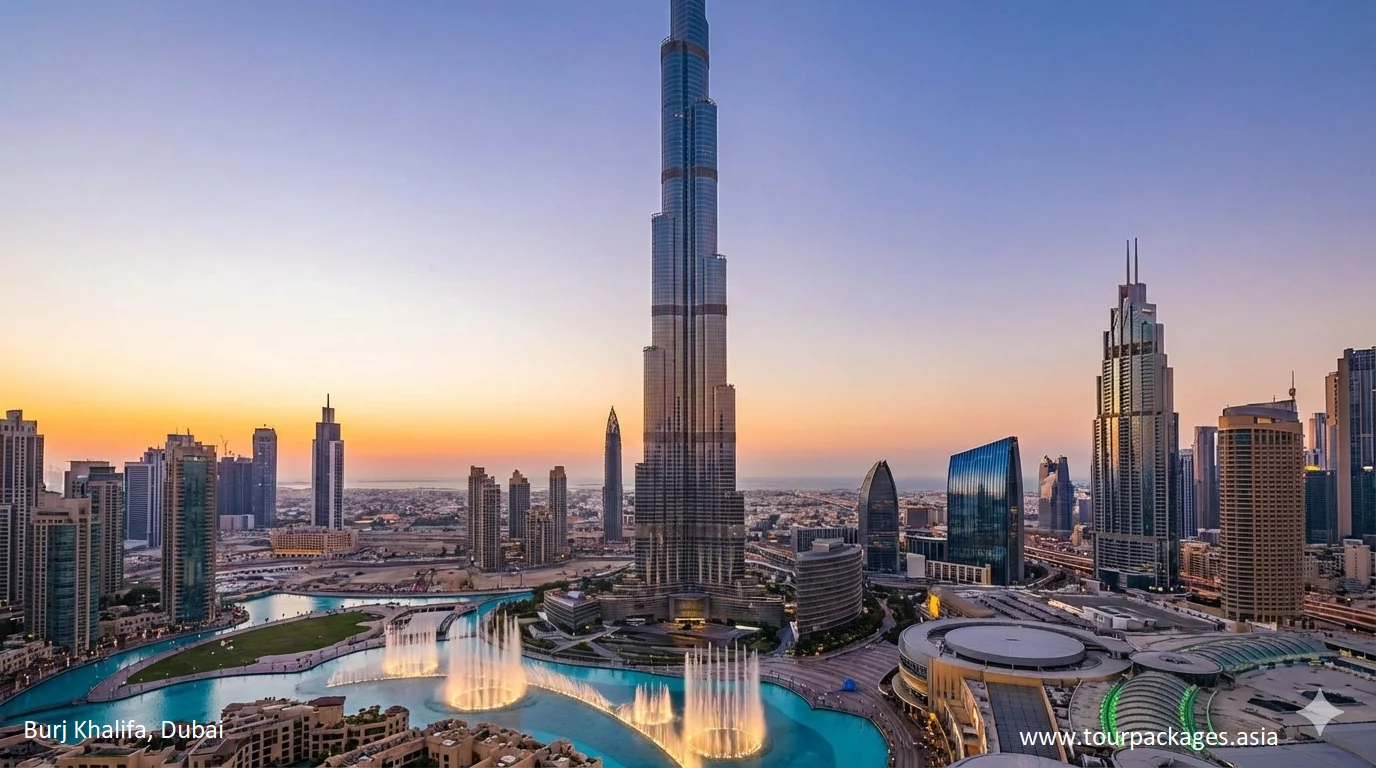
Burj Khalifa, 828 metres — Downtown Dubai, United Arab Emirates
Standing at a breathtaking 828 metres (2,717 feet), the Burj Khalifa is not merely a skyscraper — it is humanity's boldest architectural statement. Dominating the Dubai skyline since its inauguration on 4 January 2010, this supertall megatower has shattered every record in the book: world's tallest building, highest occupied floor, highest outdoor observation deck, longest elevator travel distance, and tallest service elevator. For travellers exploring the Middle East on a Dubai tour package, the Burj Khalifa is an unmissable pilgrimage that transcends the mere act of sightseeing.
Built by Skidmore, Owings & Merrill — the same firm behind Chicago's Willis Tower — and constructed by the South Korean company Samsung Engineering & Construction, the tower took 6 years to complete and cost an estimated USD 1.5 billion. Its design draws inspiration from the desert flower Hymenocallis and Islamic architecture, lending it a spiralling, tapered silhouette that seems to dissolve into the Dubai sky.
The tower's buttressed core structural system consists of a hexagonal concrete core with three wings arranged around it in a Y-shaped floor plate — each wing buttressing the others against the formidable desert winds. This ingenious geometry reduces wind forces acting on the tower by approximately 25% compared to a conventional rectangular design. To further counter wind sway, engineers introduced a "setback and twist" design: every 26 floors, the tower steps back and rotates, so that no two floors are perfectly aligned, constantly disrupting the wind vortices that could otherwise cause resonance.
The foundation alone used 192 concrete piles driven 50 metres deep into the bedrock, supporting a 3.7-metre-thick raft of reinforced concrete. The concrete itself was chilled with ice and poured at night during summer months to prevent premature setting in Dubai's extreme heat. Over 103,000 square metres of glass panels — each individually designed to account for the curved geometry — clad the exterior, and the building's aluminium and glass façade was precision-engineered to manage solar gain in one of the world's hottest cities.
| Record | Detail |
|---|---|
| World's Tallest Building | 828 m / 2,717 ft |
| Highest Occupied Floor | Floor 163 |
| Highest Observation Deck | Floor 148 – "At the Top SKY" (555 m) |
| Fastest Elevators | 10 m/s (36 km/h) |
| Concrete Used | 330,000 metric tonnes |
| Steel Used | 39,000 metric tonnes |
| Window Cleaning Time | 3–4 months for a full cycle |
| Daily Water Use | 946,000 litres |
The Burj Khalifa observation experience is split across two distinct vantage points, each offering a dramatically different perspective of Dubai's spectacular cityscape.
The original observation deck on Level 124 (452 m) was the world's highest outdoor terrace when it opened. Later expanded to include Level 125, it features a 360-degree open-air terrace with telescopic viewers, interactive floor displays showing the tower's construction story, and arguably the most photographed view in the UAE. From here, on a clear day, visitors can see the Palm Jumeirah, World Islands, and the endless expanse of the Arabian Gulf. Tickets typically cost around AED 149–189 (non-prime hours) and can be booked through our Dubai tour packages for added convenience.
The premium At the Top SKY on Level 148 (555 m) is a truly exclusive experience, with limited daily visitor slots. Guests are welcomed with a personalised briefing, complimentary refreshments, and access to a glass-floored lounge. The floor-to-ceiling windows offer an unobstructed panorama above the cloud line during many winter mornings. Tickets range from AED 379–489, and the experience typically lasts around 90 minutes. This is best combined with a luxury Dubai tour for the full VIP treatment.
The Burj Khalifa is far more than an observation tower — it is a fully functioning vertical city. The lower floors house the ultra-luxurious Armani Hotel Dubai, the world's first hotel to be designed and furnished entirely by Giorgio Armani. Floors 9–16 and 38–39 are dedicated to Armani residences, while the upper residential floors (floors 45–108) comprise 900 private apartments.
Corporate offices occupy floors 111–123, and the building hosts numerous fine-dining restaurants. Most famous among them is At.mosphere on floor 122 — holding the Guinness World Record as the highest restaurant (fine dining category) in the world. A three-course lunch here starts at around AED 200 per person, making it a sublime splurge for special occasions. Guests staying at the Armani Hotel on a Dubai hotel package get complimentary priority access to the observation decks.
Immediately surrounding the tower's base is the Dubai Fountain, the world's largest choreographed fountain system stretching 275 metres across Burj Khalifa Lake. With 6,600 lights and 25 projectors, this spectacular show synchronises water jets reaching 150 metres high with music ranging from Arabic classics to international hits. Shows run every 30 minutes from 6:00 PM to 11:00 PM daily, and the best free views are from the Dubai Mall boardwalk. Visitors on a Dubai evening tour often combine the fountain show with an observation deck visit for an unforgettable night.
Sunset (around 5:30–7:00 PM in winter) gives you both daylight and city-lights in one visit. Book at least 48–72 hours in advance.
October to April. Dubai summers are brutally hot (40°C+). Winter months offer clear skies ideal for photography.
Pre-book online or via our tour packages. Walk-in (non-prime) queues can exceed 2 hours on weekends and holidays.
Bring a wide-angle lens. The observation deck has a waist-high glass barrier — perfect for shots looking straight down.
Smart casual at minimum. Armani Hotel and At.mosphere restaurant enforce a stricter dress code — no shorts or flip-flops.
Take the Dubai Metro Red Line to Burj Khalifa / Dubai Mall station. Taxis are plentiful; Uber and Careem are also widely used.
A Downtown Dubai sightseeing tour pairs beautifully with a Burj Khalifa visit. Within a 10-minute walk you'll find the Dubai Mall — the world's largest shopping centre by total area — with over 1,200 retail outlets, an indoor ice rink, a massive aquarium, and a dinosaur skeleton. Adjacent to the mall, the Dubai Opera hosts world-class performances in a stunning dhow-shaped building. A short drive or metro ride brings you to the Dubai Frame in Zabeel Park, another record-holder (largest picture frame on earth) offering contrasting old-Dubai and new-Dubai vistas.
This video gives you an immersive preview of the Burj Khalifa experience — a full building tour from ground level to the observation deck, so you can plan your visit with confidence.
A comprehensive walkthrough of the Burj Khalifa from ground level to the At the Top observation deck on Floor 124 and 125, including the elevator ride and 360-degree views of Downtown Dubai.
Watch on YouTubeThe Burj Khalifa stands at a monumental 828 metres (2,717 feet) with 163 floors, making it the world's tallest structure since its completion in 2010. To put that in perspective, it is nearly twice the height of the Empire State Building and over three times taller than the Eiffel Tower.
Its global landmark status comes not only from its record-breaking height but from its architectural innovation, cultural symbolism, and the audacity it represents — a city in the Arabian Desert choosing to build the most ambitious structure ever conceived. It transformed Dubai's skyline overnight and announced the emirate's arrival as a truly world-class destination. The tower has since become the centrepiece of Dubai tourism packages worldwide, drawing an estimated 1.87 million visitors per year to its observation decks alone.
There are two main observation experiences:
Our recommendation: if budget allows, go for At the Top SKY for sunset. The reduced crowd and extra height make a noticeable difference. Book both through a Dubai sightseeing package to save time and money.
Plan for 1.5 to 3 hours for a comprehensive visit. The high-speed elevator ride (at 10 m/s) takes just under 60 seconds to reach Floor 124. Once on the decks, most visitors spend 45–90 minutes exploring, taking photos, and using the telescopic viewers.
If you've booked At the Top SKY, allow a minimum of 90 minutes as the experience is more curated and relaxed. Factor in an additional 15–20 minutes for queuing even with a pre-booked ticket (security screening, ticket scanning). Combine your visit with the Dubai Fountain show at the base and nearby Dubai Mall sightseeing for a full half-day experience.
Best time of day: Sunset (approximately 1 hour before sunset) is the most sought-after time slot, as you witness the city bathed in warm golden light, then transition to the glittering night skyline — essentially two visits in one. That said, early morning (9:00–10:30 AM) visits are also excellent: fewer crowds, cooler temperatures, and often clearer skies with better visibility to the horizon.
Best season: October through April is ideal. Dubai winters offer mild temperatures (22–28°C), minimal humidity, and the clearest skies of the year. Avoid July and August if possible — outdoor temperatures exceed 42°C and haze can significantly reduce visibility from the decks. Our Dubai winter tour packages are especially popular for Burj Khalifa visits.
Tickets can be purchased through the official Burj Khalifa website, at the dedicated ticket counter inside Dubai Mall (Ground Floor, near the Aquarium), or as part of a Dubai tour package from Tour Packages Asia. Walk-in tickets (if available) cost significantly more than online pre-booked tickets.
Approximate prices (AED):
Booking 3–7 days in advance is strongly recommended, especially during UAE public holidays and the October–March peak season.
The Burj Khalifa's elevators travel at 10 metres per second (36 km/h), making them among the fastest in the world at the time of construction. The building houses 57 elevators and 8 escalators in total. The express elevators that take visitors from the ground to Floor 124 cover the journey in approximately 55–60 seconds — your ears may need to pop!
The elevator interiors are beautifully finished with fibre-optic ceilings that mimic a starfield — a theatrical touch that makes the rapid ascent even more memorable. The longest single elevator run in the building travels 504 metres, which itself held a world record at opening. For context on the engineering, the Council on Tall Buildings and Urban Habitat has extensively documented the building's vertical transportation system.
At.mosphere on Floor 122 holds the Guinness World Record as the highest restaurant (fine dining category) in the world at 442 metres above sea level. It serves contemporary international cuisine with an emphasis on premium ingredients — think Australian wagyu, wild-caught seafood, and artisan desserts. The panoramic floor-to-ceiling windows ensure every table has a stunning view.
A minimum spend applies: approximately AED 200 per person at lunch and AED 350 per person at dinner. Crucially, dining at At.mosphere does not include access to the observation decks — those require separate tickets. However, the restaurant visit can be included as part of a Dubai luxury dining experience through our concierge team. Reservations are essential and should be made weeks in advance during peak season.
Construction of the Burj Khalifa began in January 2004 and was completed in October 2009, with the official inauguration on 4 January 2010 — making the total construction period approximately six years. At the peak of construction, over 12,000 workers were on site every single day.
Key engineering challenges included the extreme heat (concrete had to be poured at night and chilled), the depth required for the foundation piles (50 m deep, 192 piles), and managing wind loads at such unprecedented heights. The tower's concrete was specially formulated with a higher silica content and lower water-cement ratio to withstand Dubai's corrosive sandy environment. Samsung C&T Corporation led construction, with Hyder Consulting as the supervising engineer.
The Burj Khalifa is the centrepiece of Downtown Dubai, a 2 km² master-planned mega-development by Emaar Properties that also includes the Dubai Mall, the Dubai Fountain, the Souk Al Bahar, and several luxury residential towers. The entire precinct was built on previously undeveloped desert land and represents one of the most ambitious urban development projects in modern history.
The tower sits at the southern end of Burj Khalifa Lake, an artificial 12-hectare body of water designed to reflect the tower and host the Dubai Fountain. Surrounding boardwalks, restaurants, and the Dubai Mall's promenade make Downtown Dubai a self-contained urban quarter that attracts tens of millions of visitors annually. Explore it all with our Downtown Dubai tour package.
The Burj Khalifa is engineered to withstand seismic activity, extreme wind loads, and temperature variations. The building's buttressed core system was rigorously wind-tunnel tested at Rowan Williams Davies & Irwin laboratory in Canada using a 1:500 scale model. The tower experiences a gentle sway of up to 1.5 metres at the top during extreme wind events — completely within safe engineering tolerances and imperceptible to most occupants.
To manage solar heat gain, the 103,000 m² of glass is coated with a high-performance reflective film that blocks infrared radiation. A state-of-the-art condensate collection system harvests atmospheric water from the humid air around the exterior — yielding up to 15 million litres per year used for irrigation. The tower is equipped with 34 individual fire emergency evacuation zones and helicopter landing capabilities at the top.
Named after Sheikh Khalifa bin Zayed Al Nahyan, President of the UAE and Ruler of Abu Dhabi (who provided significant financial support to Dubai during the 2008 global financial crisis), the Burj Khalifa represents far more than an architectural record — it is a symbol of Emirati ambition, vision, and resilience. The UAE went from a pearl-fishing desert settlement to owner of the world's tallest building within a single generation.
On national holidays such as UAE National Day (2 December), the tower is used as a canvas for spectacular laser and light shows that attract hundreds of thousands of spectators. During Ramadan, the spire is lit with crescent symbols. The building has become synonymous with Dubai's "can-do" national narrative, and visiting it is rightly seen as a form of engagement with the UAE's remarkable modern story. Our Dubai cultural tour packages provide deeper context on this fascinating transformation.
By Metro: The Dubai Metro Red Line to Burj Khalifa / Dubai Mall station is the easiest, most affordable option (approximately AED 7 from central Dubai). A travelator connects the station directly to Dubai Mall.
By Taxi/Rideshare: Standard taxis, Uber, and Careem are all plentiful. Expect to pay AED 15–35 from most central Dubai locations. Ask to be dropped at the Dubai Mall – Grand Entrance (Fountain side) for the shortest walking distance to the Burj Khalifa ticketing area.
By Car: Parking is available in the vast Dubai Mall multi-storey car park (first 4 hours validate free with mall purchase). Burj Khalifa Boulevard also has street parking. Our Dubai private transfer service includes door-to-door pick-up for a stress-free experience.
Downtown Dubai is extraordinarily rich in activities that can be combined with a Burj Khalifa visit into a full-day itinerary:
Our full-day Dubai city tour covers all the highlights above with expert guide, private transport, and skip-the-line access.
The Burj Khalifa is one of the most photographed structures on earth, and for good reason. Here are the best external vantage points:
For smartphone photographers: use Portrait mode with the tower in the background to isolate the subject against the full height. Arrive before 7:00 AM during winter for fog shots where the upper spire emerges above low-lying mist.
Honestly? Yes — especially for first-time Dubai visitors. The Burj Khalifa observation experience is a genuine once-in-a-lifetime moment. The sheer scale of what you see from 452 m (or 555 m on At the Top SKY) cannot be replicated by photographs or video. The contrast between the emerald Arabian Gulf in one direction, the endless desert in another, and the extraordinary density of a modern megalopolis below is genuinely humbling.
For the At the Top standard ticket, the experience-to-price ratio is strong — comparable to observation decks in New York or Tokyo, with arguably more dramatic scenery. The At the Top SKY is best justified for special occasions or those who simply want maximum exclusivity. The additional height (100 m more) makes a perceptible difference in the sense of scale.
Our advice: book the sunset prime slot on At the Top as your baseline — the transformation from golden dusk to sparkling night skyline within one visit makes it the objectively superior option. Pair it with the free Dubai Fountain show immediately after for a complete Downtown Dubai twilight experience. Browse our Dubai tour packages that include fast-track Burj Khalifa access.
From Burj Khalifa fast-track tickets to complete Dubai itineraries — our travel experts are ready to build your perfect trip.
View All Dubai Packages Get a Free Quote