
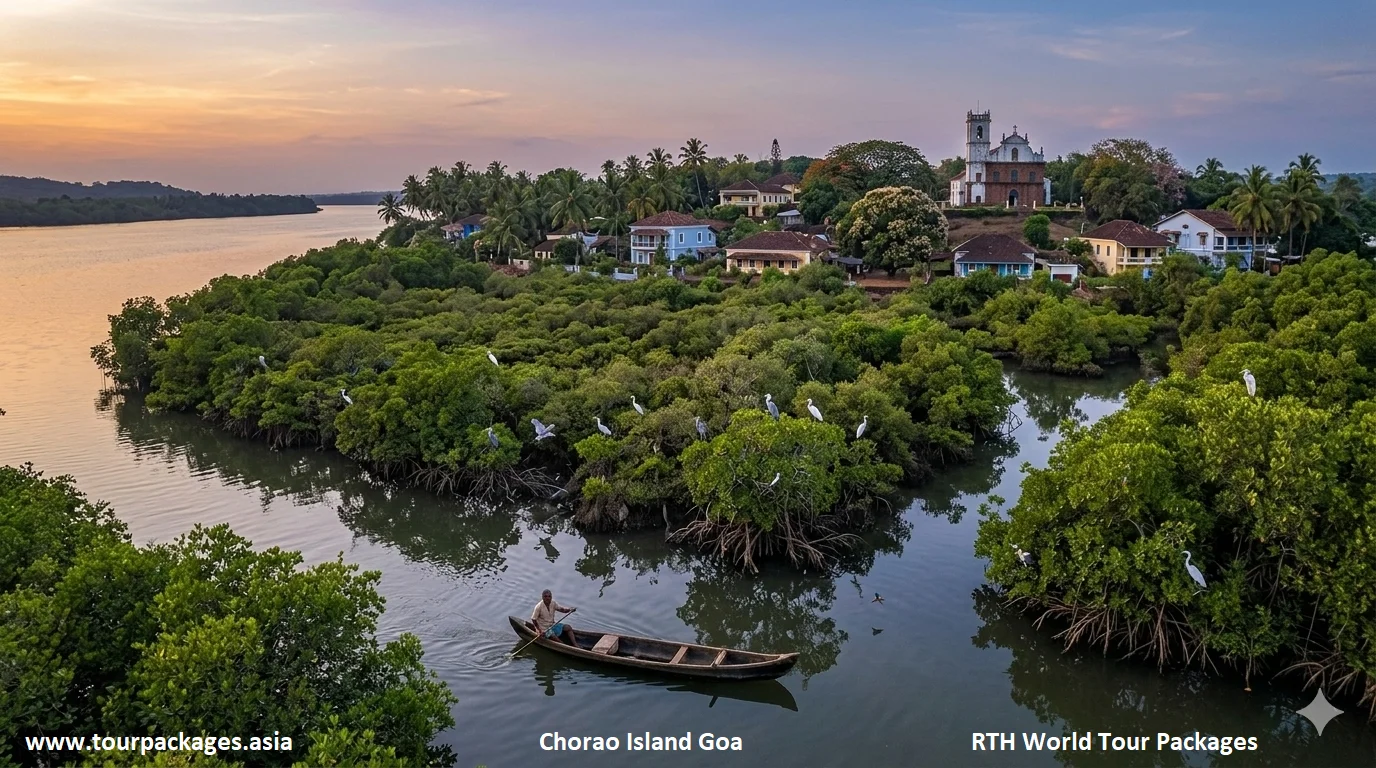
Goa Has 17 Islands. Most Tourists Have Only Heard of One.
The word Goa conjures a very specific postcard in the minds of most travellers: the sun-bleached shore of Baga, the thumping nightlife of Calangute, the seafood shacks at Anjuna. These are fine experiences, well-earned by their popularity, and they deliver exactly what they advertise. But they represent only one frequency on a dial that Goa tunes with extraordinary range. Change the channel entirely, and about five kilometres from the state capital of Panaji, separated from the mainland by the brown-green sweep of the Mandovi River, lies a place that operates at a wholly different register.
Chorao Island — called Choddnnem in Sanskrit, meaning jewelled headwear or precious ornament, and later re-named Ilha dos Fidalgos (Island of Noblemen) by the Portuguese who made it one of their earliest territorial prizes — is the largest of Goa's seventeen estuarine islands. It sits in the confluence of the Mandovi and the Mapusa rivers, wrapped in dense mangrove forests and cut through by tidal channels that shift their shape with every tide. The landscape has the quality of something unhurried: paddy fields still farmed by hand, coconut palms leaning over laterite lanes, the calls of kingfishers from the waterway, a church bell from somewhere across the palms. No souvenir stalls. No hotel hoardings. No queue for the Instagram vantage point. Just Goa as it was, quietly preserved by the very geography that kept the crowds away.
Chorao's story goes back to the 3rd or 4th century BC when Indo-Aryan settlers — predominantly Goud Saraswat Brahmins, according to oral tradition just ten founding families — established a community on this fertile river island. Their descendants shaped the island's agricultural systems, temple culture and social organisation for nearly two millennia before the first Portuguese ship entered the Mandovi in 1510. Their legacy endures today in ancient Hindu temples, the unique khazan farming system, and the island's fundamentally Brahmin social structure that survived Christian conversion in large numbers only because most of the original families had already migrated their patron deities to the safety of neighbouring territories before the Inquisition could reach them.
The Portuguese arrived in November 1510 and took to Chorao with visible enthusiasm. The island's natural defences — deep river on all sides, labyrinthine mangroves at the western tip, elevated ground in the central plateau — made it both militarily valuable and aesthetically appealing. Goa's nobility settled here quickly, building the gracious villas that give the island its sobriquet to this day. Within two years of conquest, the island had a population of over 3,000, and by 1552, active Jesuit missionary work had produced over 300 Christian converts. The island would go on to host Goa's first bishop, a Jesuit seminary that trained missionaries for deployment across Asia, and a cheese-making industry whose product — Queijo da Ilha de Chorão — was exported as far as Macau. That last fact alone makes you wish time travel were possible.
Quick Reference
Dr. Salim Ali Bird Sanctuary — Goa's Finest Wildlife Habitat
There is one attraction on Chorao Island that draws nature and beach travel enthusiasts from across India and the world, and it more than justifies the journey on its own: the Dr. Salim Ali Bird Sanctuary. Named after India's greatest ornithologist — Dr. Salim Moizzudin Abdul Ali, universally celebrated as the Birdman of India — this sanctuary was established in 1988 and occupies 178 hectares on the western tip of the island. It is Goa's only dedicated bird sanctuary and one of the finest examples of estuarine mangrove habitat in the Indian subcontinent.
The ecology here is extraordinary in its density and diversity. Nine species of mangrove dominate the tidal channels — primarily Rhizophora mucronata, Avicennia officinalis and Sonneratia caseolaris — creating an interlocking canopy that floods at high tide and reveals vast mud flats at low tide. Those mud flats are the sanctuary's heartbeat: when the water recedes, they become a feeding frenzy of birds working the exposed substrate with systematic precision. Kingfishers — multiple species of them — work the channels from overhanging roots. Purple herons and striated herons stand motionless for minutes at a time before striking. Brahminy kites patrol overhead. Osprey hover above open water before diving.
Over 400 species of birds have been recorded in the sanctuary and its environs, a list that spans permanent residents and seasonal migrants in roughly equal proportion. Winter months bring spectacular visitors from Central Asia and Siberia: coots, pintails, pochards, garganey teal, northern shovelers, and bar-tailed godwits, among others. The lesser adjutant stork, a large and impressive bird in declining numbers across Asia, has been documented here. Whimbrels, curlews and sandpipers work the mudflats. Indian rollers and bee-eaters bring flashes of colour to the tree line. Black-crowned night herons become active at dusk. The birding on Chorao, quite simply, rivals dedicated wildlife destinations and costs almost nothing to access.
Beyond birds, the sanctuary shelters a remarkable cast of supporting characters. Mugger crocodiles — the marsh crocodile, Crocodylus palustris — inhabit the deeper channels, sun themselves on exposed mudbanks and are regularly visible from canoes. They migrated here from the nearby Cumbarjua Canal and are uniquely adapted to the salinity of the mangrove ecosystem, making this population scientifically significant. Indian flying foxes roost in large colonies in the upper canopy, taking wing at dusk in impressive numbers. Smooth-coated otters navigate the channels. Jackals call from the interior at dusk and dawn. The mudflats themselves support fascinating specialised life: mudskippers — fish that breathe through their skin and move across mud using their pectoral fins — share the surface with fiddler crabs whose asymmetric claws make for one of nature's most curious visual inventions.
The khazan land system that surrounds much of the sanctuary adds another ecological dimension. Khazans are the traditional Goan system of tidal wetland agriculture — essentially polders, areas of low-lying land reclaimed from the tidal flats using earthen bundhs (embankments) and sluice gates called bhatkars, managed communally for fish cultivation, paddy farming and salt production. Chorao is one of the last places in Goa where khazans remain in active, traditional use. The annual crocodile puja — Mannge Thappni — performed by khazan farmers on the bundh, involves the community moulding clay crocodiles from the riverbed and decorating them with shells and flowers, in a ritual that speaks of an ecology-rooted spirituality older than either Hinduism or Catholicism as currently practised here.
“The island of Chorão is bound by water, nestled within the confluence of the Mandovi and Mapusa rivers. Holding the island in its watery embrace, the Mandovi changes constantly — swelling and ebbing with the moon and tides, its salinity dropping and volume increasing manifold with the monsoon.”
— Rhea Sinha, researcher, Goa Water Stories. Additional facts sourced from Wikipedia: Salim Ali Bird SanctuaryHow to Explore the Sanctuary
Two modes of exploration are available. The first is the paved walkway that traces the sanctuary perimeter and a boardwalk into its interior, suitable for an independent 60–90 minute walk with binoculars and a good field guide. The second — and far more revelatory — is by dugout canoe. Boatmen wait at the ferry landing and at a secondary entry point within the sanctuary, offering private 90-minute paddles through the tidal channels. They navigate passages where the mangrove arches overhead, where the water is still and the sound of birds is all around, where the crocodiles materialise from the shadows of the bank. A three-storey watchtower inside the sanctuary provides birdwatching from canopy level, sub-canopy level and open sky simultaneously — three entirely different bird communities visible from a single point.
500 Years of Portuguese Heritage, Brahmin Temples and Colonial Architecture
Arriving on Chorao expecting only a bird sanctuary is to miss everything that makes the island genuinely unusual. Take the sanctuary, add five centuries of layered colonial and indigenous history, and you begin to understand what Chorao Island actually is: not just a nature reserve but a living monument to one of the most complex cultural intersections in the Indian subcontinent.
The most important building on the island is St. Bartholomew's Church, constructed in 1569 by the Society of Jesus and handed to diocesan clergy in 1597. Its Neo-Roman facade with multiple spires dominates the central village with quiet authority. The attached cemetery contains headstones from the 16th century, reused over generations as per Goan tradition, with older stones repositioned along the boundary wall — an intimate record of families whose names continue in the island's living population. The feast of St. Bartholomew, celebrated every August, draws pilgrims from the mainland by ferry specifically for this occasion.
The ruined Real Colegio de Educacao de Chorão, a Jesuit seminary founded in 1761 to educate missionaries for deployment across Asia, stands as one of the island's most atmospheric sites. Once described as the most impressive structure on the island, it was abandoned during an epidemic and partially destroyed by fire. What remains today — a polygonal dome, dramatic arched walls, the partially restored Chapel of St. Jerome perched on a small hill overlooking the Mandovi — makes for compelling photography and even more compelling contemplation. The chapel, reached by a short trek, offers one of the most panoramic views available on the island: mangroves below, the river beyond, and on a clear morning, the skyline of Panaji in the distance.
Scattered through the island's three villages — Ambelim, Caraim and Devgi — are examples of Luso-Goan architecture whose quiet splendour most tourists in Goa never encounter because they never leave the coastal strip. Portuguese villas with characteristic verandahs, ventanas de concha (oyster-shell windows that diffuse light with an extraordinary warm softness), high-ceilinged rooms painted in fading ochre and terracotta, and elaborate azulejo tilework stand alongside traditional Brahmin houses centred on an open courtyard with a sacred tulsi plant. The Bhagwati Temple in Devgi is one of the oldest places of worship on the island, with the presiding deity Astabhuja — an eight-armed manifestation of the goddess — believed to date back over 500 years. The nearby Shri Devaki Krishna Temple is equally ancient and considerably less visited.
One fact that ought to be better known: Chorao was once famous across the Portuguese colonial world for its cheese. Queijo da Ilha de Chorão — a European-style ripened cheese made from the milk of dairy cattle introduced to the island in the 16th century — was prized by Goan natives and Portuguese gentry alike and exported as far as Macau. The cheese industry died in the 19th century as cheesemakers emigrated, leaving only the name and a mild sense of loss. A branch of a Sanskrit and literary history university also once operated here — an institution that sits so incongruously alongside the Jesuit seminary that it captures, in miniature, the entire paradox of Chorao Island's cultural life.
Things to Do on Chorao Island — A Full Day Plan
A day on Chorao Island is most rewarding when allowed to unfold without agenda. Begin before dawn, arrive on the first ferry, and let the morning light do the work. Here are the six experiences that together make for an unforgettable day far from the ordinary Goa package itinerary.
Mangrove Canoe Ride
Board a dugout canoe at the ferry landing and drift through the tidal channels of the Salim Ali Bird Sanctuary. Boatmen navigate passages where the mangrove arches overhead and kingfishers flash between roots. The 90-minute private ride costs around Rs. 800 and delivers more genuine wildlife encounters than most dedicated safari experiences.
Dawn Tower Birdwatching
The three-storey birdwatching tower inside the sanctuary is accessible by foot or boat. Arriving at 7 AM in winter puts you among purple herons, brahminy kites, osprey and if you are fortunate, the lesser adjutant stork on the mudflat below. Binoculars and a field guide are essential.
St. Bartholomew's Church Walk
The St. Bartholomew's Church Chorao, built in 1569, is the island's anchor monument. Walk the nave, study the 16th-century cemetery headstones, speak to the caretaker about island history. A ten-minute bicycle ride from the ferry landing and a world away from tourist Goa.
Island Bicycle Tour
Cycling Chorao Island through paddy fields, coconut groves and river-facing villages is one of Goa's most satisfying and wholly overlooked experiences. The flat roads are quiet even on weekends. Hire a bicycle in Panaji or bring one on the ferry. A full circuit takes about two and a half hours at a relaxed pace.
Seminary Ruins & St. Jerome Chapel
The ruined Real Colegio de Educacao walls and the hilltop Chapel of St. Jerome make for one of the most atmospheric heritage experiences in Goa. The short climb to the chapel rewards with a panoramic view across the mangroves and the Mandovi River. Best experienced in the quieter afternoon light.
Goan Fish Thali and Feni Tasting
Small family eateries on Chorao serve Goan fish thali — rice, fish curry, fried fish, vegetable, pickle and papad — with simplicity and freshness no tourist restaurant can match. End the day at a local tavern tasting feni in multiple flavours: jeera, ginger, coriander, and the classic cashew — an experience that is as much cultural as culinary.
Best Time to Visit Chorao Island — Season by Season
Chorao is accessible year-round, but each season offers a genuinely different experience. Winter (October to March) is the clear peak period — pleasant dry weather, migratory birds in the sanctuary, ideal cycling conditions and the island at its liveliest. Here is how the seasons break down for a first-time visitor planning a Goa trip:
| Season | Weather | Bird Life | Access | Best For |
|---|---|---|---|---|
| Winter (Oct–Mar) | Dry, 22–32°C | Peak: migrants arrived | Excellent | Birdwatching, cycling, heritage |
| Summer (Apr–May) | Hot & dry, 35°C+ | Residents only | Good | Quiet exploration, fewer crowds |
| Monsoon (Jun–Sep) | Heavy rain, high tides | Nesting season | Some restrictions | Dramatic landscapes, photography |
| Post-Monsoon (Oct) | Fresh, lush, warm | Early migrants arriving | Good | Best value, lowest crowds |
Practical Visitor Tips
How to Reach Chorao Island
- Take a bus or taxi from Panaji to Ribandar jetty — about 3–6 km depending on your starting point
- Government ferry is free for pedestrians and cyclists, runs 6 AM to 11 PM, crossing takes 10–15 minutes
- Motorcycles, bicycles and cars can board for a small charge — ferries run frequently all day
- A second ferry links the island's far side to Pomburpa village for those approaching from the north
- From Goa's Dabolim or Manohar Airport, hire a taxi directly to Ribandar jetty — approximately 40–60 minutes
What to Bring
- Binoculars and a field guide are essential — even budget binoculars transform the Salim Ali Sanctuary experience
- Wear light, neutral-coloured clothing — avoid bright reds or blues near the mangrove channels
- Carry 1.5–2 litres of water; eating and drinking options on the island are limited
- Insect repellent is important during and after monsoon months (June–October)
- A telephoto lens brings waterway birds into satisfying range; camera fees apply inside the sanctuary
- Sunscreen and a wide-brimmed hat for the open cycling sections of the island road
What Does a Day on Chorao Cost?
- Ferry crossing: free for pedestrians and cyclists
- Sanctuary entry: Rs. 10–20 (Indian nationals) / Rs. 100 (foreign visitors)
- Canoe ride: ~Rs. 800 private (90 min) or Rs. 150–200 per person on a shared Forest Dept. boat
- Fish thali at a local eatery: Rs. 150–250 | Feni tasting at a village tavern: Rs. 100–200
- Bicycle hire in Panaji before crossing: Rs. 200–400 per day
- Total typical day: Rs. 1,200–1,600 per person — Goa's best value full-day experience
Photography on Chorao
- Best Chorao photography happens in the first 90 minutes after sunrise — golden hour over the Mandovi is exceptional
- The seminary ruins photograph beautifully in afternoon raking light with long dramatic shadows
- The canoe ride gives the closest approach to birds perched in the mangrove channels
- Camera fees apply inside the sanctuary — ask at the Forest Department entry kiosk
- Always ask permission before photographing village residents or religious ceremonies
- Drone use requires advance Forest Department clearance due to sanctuary restrictions
Being a Responsible Visitor
- Chorao is a living community and functioning ecosystem — carry out all waste; do not litter inside the mangrove sanctuary
- Keep noise low near nesting zones — birds are easily disturbed during dawn feeding hours
- Never feed or approach crocodiles in the mangrove channels — mugger crocodiles are wild animals
- Support local family eateries and village shops rather than bringing all food from outside
- Cycle on roads only — do not ride through khazan agricultural fields or wetland paths
- The smooth-coated otter here is IUCN Vulnerable — maintain distance; browse India tour packages that prioritise low-impact travel
Ready to Explore Chorao Island?
Our travel specialists build Goa itineraries that go beyond the beaches. Chorao Island, Old Goa, spice plantations, Mandovi backwaters — your complete trip, planned in detail.
How to Reach Chorao Island — Location Map
The Villages of Chorao — Ambelim, Caraim and Devgi
Beyond the sanctuary and the churches, what makes Chorao Island quietly remarkable is its village life — the daily fabric of an island community that has maintained its own rhythm for centuries, largely indifferent to the tourism economy that drives the rest of Goa. The island's three villages — Ambelim, Caraim and Devgi — are close enough to each other that a morning's cycling takes you through all three, yet distinct enough in their character to seem like separate settlements.
Ambelim, the first village you encounter after crossing from Ribandar, retains the highest concentration of well-preserved colonial architecture. Walking its lanes, you pass whitewashed facades with terracotta pantile roofs, verandahs fronting the lane at a height of three shallow steps, gardens that seem designed to produce shade at all hours of the day, and the kind of unhurried social activity — a neighbour on the verandah, a grandfather reading the newspaper in the doorway — that makes you realise you have walked out of tourism and into someone's ordinary Tuesday afternoon. This is not picturesque poverty; many of these houses are well maintained and the families prosperous, their children educated in Panaji and working in cities, returning to the island for festivals and summer.
Caraim village, on the southern side of the island, faces the open river and catches the afternoon breeze. The houses here sit on slightly higher ground with views across the Mandovi toward Old Goa, whose gleaming baroque churches are visible on clear days. It is a peculiar and rather moving experience to look from a 16th-century Goan village across the water to the Basilica of Bom Jesus and the Se Cathedral of Old Goa — all of it within five kilometres, all of it connected by the same history, separated only by the width of the river and four centuries of parallel development. For those planning Goa sightseeing, combining Chorao with Old Goa in a single day is highly practical.
Devgi, the most interior of the three villages, is the one most associated with the island's pre-Portuguese Brahmin heritage. The Bhagwati Temple here has an octagonal deity hall unusual in Goan temple architecture, and the presiding goddess Astabhuja — the eight-armed one — is credited with a protectiveness over the island that neither the Portuguese missionary orders nor successive epidemics managed to entirely displace. Devgi is also where the traditional khazan fields are most visible, their geometric bundhs and channels visible from the road, farmers still wading the paddies in a working landscape that has not fundamentally changed in 400 years.
Discover Taiwan — Asia's Most Underrated Island
If island culture, layered history and extraordinary food have caught your imagination on Chorao Island, you may find the same qualities amplified at a national scale in Taiwan. From lantern festivals to aboriginal tribal culture, night markets to mountain gorges, Taiwan offers one of Asia's most rewarding travel experiences.

Comments