
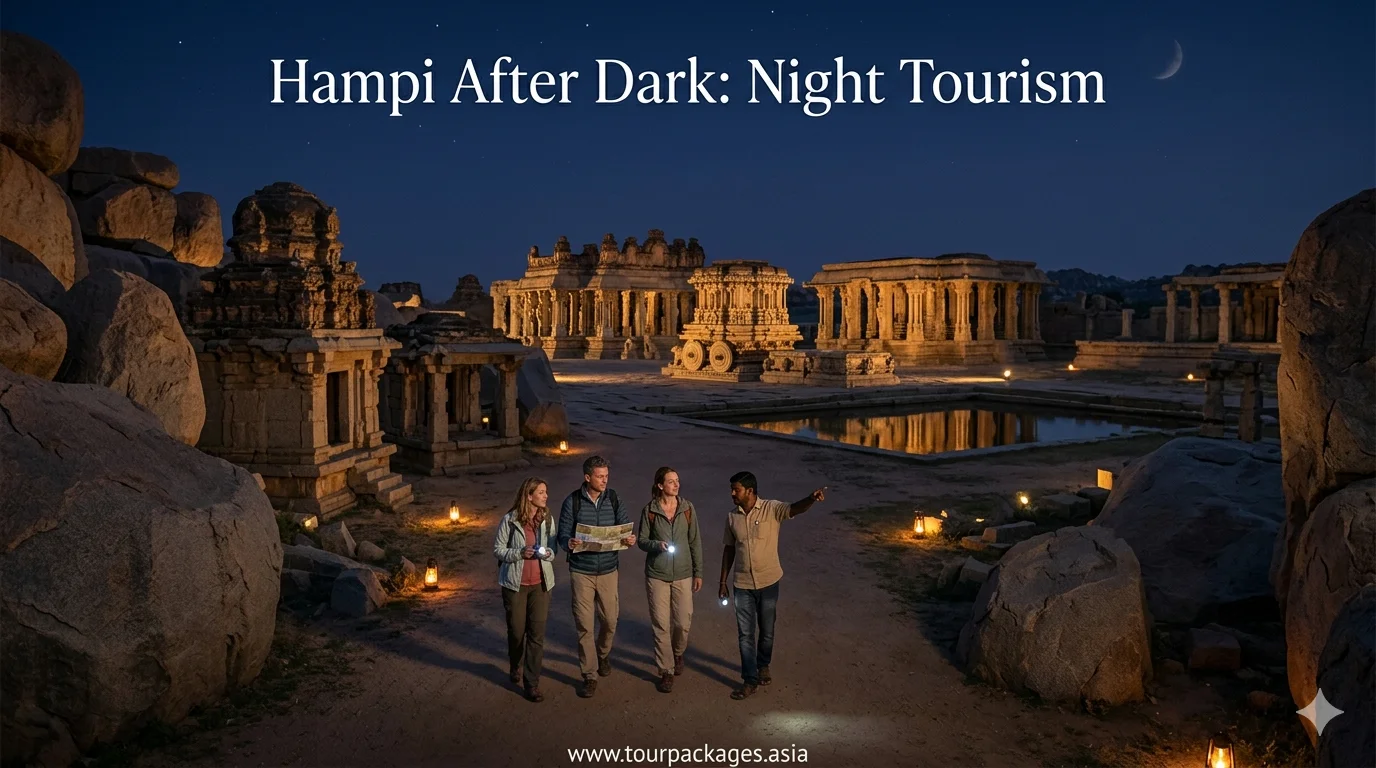

Hampi After Dark: Night Tourism, Illuminated Ruins and What to Expect in 2026
I walked through Hampi's ancient ruins after dark and found something I had not been prepared for — not just illuminated stone, but an entirely different conversation between the ruins and the night sky above them. Hampi night tourism is one of the most quietly extraordinary experiences in India. This guide tells you exactly what it delivers, what it does not, and how to get the most from it.
What This Guide Covers
Navigate directly to the section you need — from the personal experience and safety reality to photography, day vs night comparison and Karnataka itinerary planning.
What is Hampi Night Tourism — and Why It Matters
In simple terms, Hampi night tourism refers to organised and informal experiences that allow visitors to encounter the Vijayanagara ruins after sunset — through the official Hampi by Night guided tour, the annual Hampi Utsav illumination, independent evening walks through accessible areas, and the quiet archaeology of the site under stars.
Hampi is a UNESCO World Heritage Site covering over 4,100 hectares in the Vijayanagara district of Karnataka. It was the capital of the Vijayanagara Empire between the 14th and 16th centuries — at its peak, one of the largest and wealthiest cities in the world, with a population estimated at over 500,000 and a built environment of extraordinary architectural complexity. What survives today is the largest collection of medieval Dravidian ruins anywhere on earth: royal enclosures, market streets, water structures, watch towers, and monolithic sculptures distributed across a landscape of ancient granite boulders that predates the civilisation built among them by hundreds of millions of years.
During the day, Hampi is magnificent and busy. Guided tours arrive from Bangalore by the morning; the main archaeological zones fill with visitors, vendors, and the practical infrastructure of a very well-visited site. At night, the same landscape empties almost entirely. The boulders — which are pink-orange in the afternoon sun — turn silver-grey. The ruins lose their catalogue quality. Without other visitors between you and a carved doorway from 1500 CE, the encounter changes character in a way that is difficult to describe precisely and impossible to forget.
The formal structure of Hampi night tourism was conceived by the Hampi World Heritage Area Management Authority (HAWAMA) and Karnataka Tourism — the Hampi by Night guided tour illuminates 17 to 20 monuments between 7:30 PM and 9:30 PM using artistic floodlighting, with individual audio headsets providing historical commentary. The annual Hampi Utsav (Vijaya Utsav), held every February, extends this into a full public spectacle: in 2026, a record 50-kilometre Golden Trail of lights stretched from Hosapete through to the Virupaksha Temple precinct, transforming the entire archaeological corridor into what the Karnataka Tourism board described as a recreation of the Golden Age of Vijayanagara.
Walking Through Ancient Ruins After Sunset — My Personal Experience
I arrived in Hampi by the Hampi Express overnight train from Bangalore, reaching Hospet at around 6:30 AM. By the time I had transferred to Hampi village, found my guesthouse on the Bazaar street, and eaten breakfast at a rooftop cafe, the ruins were already filling with the day's first visitors. I spent the morning at Vittala Temple and the Elephant Stables — the usual circuit, in sunlight, with everyone else. It was brilliant. It always is. But I had planned specifically to stay for the evening, and what happened between 7 PM and midnight made the daytime seem like a rehearsal.
The Hampi by Night tour began at the Virupaksha Temple precinct as the last of the afternoon visitors were leaving. There were perhaps twenty of us — a mix of Indian and international travellers — with a guide who had been working this route for three years. The first thing I noticed was the silence. Not total silence — the Tungabhadra moves across rocks somewhere below you, and there is always the sound of wind in boulder country. But the human noise of Hampi simply stopped. No auto-rickshaws. No vendors. No queue for anything.
The floodlighting at each monument is thoughtfully designed — not the harsh white stadium light you might expect, but warm amber and gold that picks out the carved surfaces without obliterating the shadows that give the stone its depth. Seeing the Lotus Mahal in this light — a secular structure combining Hindu and Islamic architectural elements in proportions that still feel modern — was something I had not anticipated. By day it is context: one of many extraordinary things. By night, with nothing around it but dark sky and the distant outline of boulders, it is singular. It demands your full attention in a way the daylight hours simply do not allow.
The tour ended at the Virupaksha Bazaar — the ancient market street that once traded in diamonds and silk and spice, where today a handful of guesthouses keep their lights on until 10 PM. I sat on a rooftop above the street for another hour after the tour dispersed, looking out over the boulder landscape with a cup of coffee that had gone cold. The Milky Way was visible directly overhead. The only light for kilometres in any direction was the faint glow of Hosapete to the west. The ruins were below me in the dark: present, enormous, and entirely indifferent to my being there. That indifference was the point. It is what makes Hampi after dark unlike any managed heritage experience I have known.
Top Places to Experience Hampi at Night — Honest and Detailed
These are the locations that actually reward a night visit — either through organised illumination, natural atmosphere, or the particular quality of a site without daytime visitors. For Karnataka tour planning, our team can build Hampi into a complete heritage circuit.
Only Formal Night Tour in India Across a UNESCO Site · First-of-Its-Kind in South India
The Hampi by Night Tour — What It Actually Covers and How It Feels
The Hampi by Night tour is not a light show in the conventional sense. It is a walking heritage circuit through 17 to 20 illuminated monuments across the UNESCO zone, starting from the Virupaksha Temple precinct and covering — depending on the current active route — the Gejjala Mantap, Narasimha Temple, cave formations on the Tungabhadra banks, Chakrathirtha, Achyutaraya Temple, Varaha Temple, Anesaalu Mantap, Kamal Mahal (the Lotus Mahal), Virupaksha Bazaar, and the old bridge ruins. Each monument is individually floodlit with warm amber and golden tones — not the theatrical coloured light associated with tourist light shows, but archaeological lighting designed to reveal the sculptural depth of the stone rather than simply make it visible. The audio headsets provide commentary in English and Hindi at each site, contextualising what you are looking at in terms of the Vijayanagara court's social structure, architectural programme, and eventual collapse following the 1565 Battle of Talikota. The five-hour circuit ends near midnight. The cost is approximately Rs 2,500 per person. This is the structured access point for anyone asking is Hampi open at night. The answer is: yes, on this tour.
Best Sunset Viewpoint in Hampi · Ruins Panorama · Transitions Into Dark Sky Access
Hemakuta Hill — Where the Day-to-Night Transition Happens Most Beautifully
Hemakuta Hill is a rocky elevated plateau directly south of the Virupaksha Temple precinct, scattered with pre-Vijayanagara Shaiva shrines and open-air carvings. It is the best natural vantage point in Hampi for watching the sun set over the boulder landscape, and the transition into twilight here happens with unusual slowness and drama. As the orange light fades, the ruined structures on the hill take on dark outlines against a sky that moves through amber, pink, violet, and blue before reaching full dark — a sequence that takes about 45 minutes and which, on a clear evening, is among the most beautiful things I have witnessed anywhere in India. After dark, Hemakuta Hill becomes one of the accessible natural dark sky platforms in the heritage zone. The Milky Way is visible from here between October and February — the light pollution from Hosapete to the west is the only significant interference, and it is manageable with correct framing. Several travellers and photographers now specifically time visits to Hampi after sunset around Hemakuta's position relative to the galactic core in winter months. Bring a torch for the descent; the rock paths are well-worn but entirely unlit.
360-Degree Ruins Panorama · Milky Way Platform · Hampi's Highest Natural Viewpoint
Matanga Hill — The Ruins at Their Most Vast, Seen From Above at Night
Matanga Hill is the highest accessible point in the Hampi heritage zone, reached by a moderately strenuous climb up rocky steps and boulder paths that most fit visitors manage in 30 to 40 minutes. From the summit, the view extends across the entire Vijayanagara landscape: the Tungabhadra River to the north, the Vittala Temple complex in the middle distance, the boulder fields extending in every direction, and the distant silhouette of the Anegundi hills across the river. At dusk, this panorama takes on extraordinary quality — the entire archaeological landscape of Hampi laid out below you as the light drains away, the ruins losing their catalogued individual identities and becoming a single enormous field of carved stone and shadow. Photographers who plan to shoot the Milky Way over the ruins consistently cite Matanga as their first-choice platform — it provides the elevation necessary to frame the galactic arc above the ruins rather than shooting horizontally across the flat landscape. Full moon nights here are exceptional: enough light to see for kilometres without artificial illumination, the entire Vijayanagara site rendered in silver and shadow. Most visitors linger until the stars fully emerge before descending. Descent requires good light and care; the path is rocky and steep in sections.
Moon Reflections on Granite River · Night Coracle Rides (Seasonal) · Quietest Night Experience
The Tungabhadra After Dark — Where the River and the Ruins Share the Same Night
The Tungabhadra River runs along the northern edge of the Hampi heritage zone, its banks flanked by granite boulders, ancient bridge ruins, and the occasional coracle moored for the night. After sunset, the riverbank accessible from the main heritage zone — between the Chakrathirtha ghat area and the old bridge ruins — becomes one of the quietest and most contemplative spaces in Hampi. The water moves slowly through the boulders; on moonlit nights it catches the light in pieces, each fragment of granite below the surface visible through the current with unusual clarity. The silhouettes of ruins on the opposite bank — the coracle landing area near Virupapur Gadde — create a horizontal composition that changes with the angle of the moon. Some local operators arrange night coracle rides on the Tungabhadra during peak season and the Hampi Utsav period — brief, slow circuits of the boulder-edged river sections near the ghat. These are worth arranging in advance through your guesthouse. The riverbank itself is accessible and safe in the immediate ghat area; do not walk further along the bank into unlit sections without a guide, as the boulder terrain becomes complex and navigation in low light is genuinely challenging.
Largest Heritage Illumination in South India · 50km Light Corridor · Feb 13–15 (2026)
Hampi Utsav 2026 — The Night This Ancient City Reclaimed Its Scale
The Hampi Utsav — officially the Vijaya Utsav (Festival of Victory) — is the annual three-day cultural festival that transforms Hampi into something approaching its 15th-century scale. In 2026, the festival ran from February 13 to 15 and introduced what Karnataka Tourism called the largest heritage illumination project in South India: a continuous 50-kilometre Golden Trail stretching from the Vijayanagara District Office in Hosapete, through Kamalpur, to the Virupaksha Temple. Over 20 major monuments were floodlit, including the Stone Chariot and Vittala Temple complex, the Queen's Bath, the Lotus Mahal, and the Zenana Enclosure. The illuminated corridor was visible from the air — helicopter tours and hot air balloon rides were available specifically to see the light corridor from above. Festival programming included classical Bharatanatyam performances against 500-year-old temple walls, Carnatic vocal concerts in the open ruins, Janapada Kalavahini folk processions with over 100 troupes and decorated elephants, a kite festival, and competitive traditional events. For travellers asking about unique experiences in Karnataka, the Hampi Utsav at night is, without meaningful qualification, the most spectacular heritage event in South India. Accommodation in both Hampi and Hosapete books out months in advance — plan early.
Plan Your Hampi Night Tourism Trip
Whether you are targeting the Hampi Utsav, the Hampi by Night guided tour, or a private after-dark heritage walk — our team at RTH World Tour Packages and Revelation Holidays builds complete South India tour packages around the experience you want.
Plan My Hampi Trip Read More Heritage GuidesWhy Hampi Feels Completely Different at Night
The transformation is not primarily visual, though the visual shift is dramatic. The pink-orange granite of the Deccan plateau — so characteristically warm in afternoon light — becomes silver-grey and abstracted after dark. Carved surfaces that read as busy and detailed in sunlight become areas of deep shadow punctuated by floodlit highlights. The architectural geometry of Vijayanagara ruins — brackets, pilasters, carved beams, stepped profiles — becomes more legible in directional artificial light than in the flat brightness of midday.
But the more significant shift is psychological. Hampi by day is a heritage site. It has signs and ticket counters and paths and guides with flags. These things are not wrong — they are what 100,000 visitors per month require. But they mediate the encounter. Between you and a 15th-century royal elephant stable stands the scaffolding of tourism: information, direction, context. After dark, this scaffolding disappears. What is left is the structure itself. Stone. Scale. Time.
The crowd dimension matters enormously. Hampi's peak sites during the day — particularly the Vittala Temple complex with its famous musical pillars and Stone Chariot — attract dense visitor groups that make extended contemplation nearly impossible. After dark, during the Hampi by Night tour, you stand alone in front of structures that were built during the reign of Krishnadevaraya in the early 16th century. There is no one behind you. There is no queue forming. The scale of Vijayanagara heritage — which is in fact much larger and much more complex than most visitors realise in a single day — becomes comprehensible in a way the daylight hours do not allow.
Finally, there is temperature. Hampi in the daytime between November and February is excellent — around 28°C, dry and bright. After sunset, it drops to 16 to 18°C with a breeze off the Tungabhadra. The physical comfort of moving through an archaeological site in cool evening air is itself part of why the Hampi after dark experience registers so differently. You are not managing heat. You are walking easily, breathing deeply, and paying attention to what is actually there.
Is Hampi Open at Night? — The Complete and Honest Answer
This is one of the most searched questions about Hampi and it deserves a direct, complete answer rather than the vague responses that appear on most general travel sites.
In Simple Terms
Most ASI-protected monuments inside the Hampi UNESCO site close at sunset — typically around 5:30 to 6:00 PM. You cannot walk independently through the Vittala Temple complex, the Royal Enclosure, or the Zenana Enclosure at night. These areas are gated and monitored.
What IS Open and Accessible at Night
The Hampi by Night organised tour provides authorised access to 17–20 monuments between 7:30 PM and approximately 12:30 AM. This is the formal mechanism for night access to the protected zone and is the correct answer to "is Hampi open at night." Outside of this tour, Hemakuta Hill is an open area accessible at all hours — it is not an ASI-fenced monument but a natural boulder plateau with older Shaiva shrines. The Virupaksha Temple precinct and Bazaar street are publicly accessible in the evening; the main temple has its own closing time (approximately 9 PM) but the surrounding area and street remain open. The Tungabhadra riverbank ghat areas are accessible. The general landscape of boulders between monuments is not fenced.
During the Hampi Utsav
The February Hampi Utsav creates a temporary extension of accessible area — with the 50km illuminated Golden Trail walkable and most major monument exteriors open to viewing under festival conditions, controlled by event management rather than standard ASI protocols.
Outside of Organised Access
Wandering the unlit boulder fields between monuments independently after dark is not technically prohibited in all areas but it is inadvisable for safety reasons — the terrain is genuinely complex, entirely unlit, and navigational orientation is difficult even for those who know the site well by day. If you want unstructured night access to the landscape, do it with a licensed local guide who knows the terrain at night.
Is It Safe to Visit Hampi at Night? — A Realistic Answer
Hampi is safe at night in the main tourist areas, with specific caveats that matter and should not be glossed over.
Safe Areas
The Virupaksha Temple precinct and the Hampi Bazaar street are well-visited in the early evening and reasonably safe through 10 PM. The Hampi by Night guided tour is safe — organised groups with professional guides, licensed by a government authority. The rooftop cafes and guesthouse areas of Hampi Bazaar are low-risk social environments. Hemakuta Hill in the early post-sunset window (until 8 PM) with company is manageable.
Areas That Require Caution
Hippie Island (Virupapur Gadde) is specifically flagged by multiple Karnataka travel advisories and local operators as an area to avoid after dark — it is a forested area with poor lighting and limited oversight. The boulder fields between monuments and the isolated sections of the Tungabhadra riverbank east of the main ghat zone are not safe for independent walking after dark. Matanga Hill is fine for sunset viewing but descent after 9 PM without a torch and company adds unnecessary risk.
Transport Safety
Pre-arrange your return transport from any evening activity. After the Hampi by Night tour ends near midnight, auto-rickshaws in the area are limited — contact your guesthouse in advance for pickup or arrange a driver for the evening. Avoid night driving on the Chitradurga–Hospet highway section yourself; it is poorly lit and has limited facilities. The recommended option to reach Hampi from Bangalore remains the Hampi Express overnight train.
For Solo Travellers and Women
Solo female travellers are well accommodated in Hampi's main tourist zone and the Hampi by Night tour has an established safety record. The key principle is the same as any rural heritage site: stick to areas with other people, use pre-arranged transport, and avoid unlit isolated sections after dark. Hampi village has a significant international backpacker community which means the social environment in the evening is diverse and generally relaxed.
Hampi Day vs Night Experience — An Honest Comparison
| Dimension | Daytime Experience | Night Experience |
|---|---|---|
| Crowd level | High at peak sites (Vittala, Elephant Stables); moderate elsewhere | Near zero on the Hampi by Night tour; manageable at Hemakuta Hill |
| Visual quality | Brilliant sunlight reveals colour and scale; midday heat creates harsh shadows | Warm floodlighting reveals sculptural depth; dark sky provides dramatic contrast |
| Accessibility | All 50+ major monuments accessible; guided tours run continuously | 17–20 monuments on official tour; natural areas (Hemakuta, Matanga, riverside) freely accessible |
| Atmosphere | Educational, active, socially rich; some sites feel managed | Contemplative, historically immersive, genuinely atmospheric |
| Temperature | 28–32°C (Oct–Feb); 38–42°C (Mar–Jun) | 16–20°C with breeze (Oct–Feb) — physically ideal for walking |
| Photography | Excellent for architecture and landscape; difficult midday light | Exceptional for floodlit architecture; astrophotography possible |
| Best for | First-time visitors; families; comprehensive coverage of all sites | Repeat visitors; photographers; those seeking unique heritage experiences India |
| Cost | Standard ASI entry fees (Rs 30–600 depending on monument) | Rs 2,500 per person for Hampi by Night tour; free for natural areas |
The honest recommendation: do both. The daytime circuit gives you the context — the scale of the empire, the variety of the architecture, the specific identity of each monument. The night experience gives you the weight of it. Neither is complete without the other. Plan at least two nights in Hampi to allow one full day and one Hampi by Night tour.
Best Time to Visit Hampi for Night Tourism
October to February is the clear window for Hampi night tourism. The post-monsoon period from October onward brings cooler, drier conditions and clear skies — all three qualities essential for a good after-dark experience at an outdoor heritage site. Temperatures in this period drop to 16 to 20°C after sunset, which is the physical sweet spot for extended walking.
Month-by-Month Guide
October–November: Post-monsoon. The landscape is at its most vivid — the boulder fields hold occasional greenery and the Tungabhadra runs full. Night temperatures are warm enough for light clothing. Crowds are manageable. Excellent for the Hampi by Night tour and dark sky work. December–January: Peak season. Best weather — cool, clear, dry. The Hampi by Night tour runs to capacity; book ahead. Full moon nights in December and January are exceptional for independent exploration of accessible areas. February: Hampi Utsav month. The 50km Golden Trail transforms the entire corridor from Hosapete. This is the single most spectacular time for Hampi night tourism but also the busiest — accommodation in both Hampi and Hosapete books out 3 to 4 months ahead. March: Post-Utsav, still good. Evenings remain pleasant. April–June: Extreme heat. Nights are warm but daytime temperatures reaching 40°C make this a difficult period for heritage walking. The night experience is intact but the overall visit is challenging. July–September: Monsoon. The Tungabhadra rises, boulder terrain becomes slippery, and rain disrupts outdoor evening activities. The Hampi by Night tour may be suspended during heavy rain periods.
Festival Calendar
The Hampi Utsav (February) is the headline event. Shivaratri (February/March) brings a nightlong religious event at the Virupaksha Temple — this is distinct from the tourism-oriented Utsav and is a living religious event observed by thousands of pilgrims. It creates an extraordinary night atmosphere around the temple precinct but the focus is devotional rather than archaeological. For Karnataka heritage tours aligned with specific festival dates, our team can build the timing into your itinerary planning.
Essential Tips for Your Hampi Night Tourism Visit
Click each panel for practical guidance on timing, photography, packing, transport, and on-the-ground realities of visiting Hampi after dark.
Booking and Pre-Arrival Tips
- Book the Hampi by Night tour through HAWAMA's office in Hampi village or Karnataka Tourism's visitor centre — do not wait until you arrive; the tour has limited places and fills quickly in peak season
- For Hampi Utsav (February), book accommodation in Hosapete or Hampi 3 to 4 months ahead without exception — this is not a guidebook cliche, rooms genuinely run out months in advance
- Align your Hampi dates with a full moon for the most atmospheric independent evening experience on Hemakuta Hill and the Tungabhadra; check the lunar calendar when booking
- Arrive in Hampi by the Hampi Express overnight train from Bangalore (departs KSR at approximately 10 PM, arrives Hospet at 7 AM) — this gives you a full day's daylight before the evening tour
- Plan a minimum of 2 nights in Hampi — one for the day circuit, one for the night experience; rushing both into a single day produces a fragmented experience of neither
- If combining with Badami, Aihole, and Pattadakal, allow a separate day for that circuit — do not try to squeeze Badami into the same day as the Hampi Night tour
What to Pack for Hampi After Dark
- A headlamp (not a phone torch, which drains battery) is essential for navigation on Hemakuta Hill, Matanga Hill descent, and any walking between the lit zones of the by Night tour and your accommodation
- Comfortable closed shoes with grip — the granite boulder paths are smooth and rounded; flip-flops are genuinely inadequate for evening navigation
- A light layer or jacket — evenings in December and January reach 14 to 16°C; the breeze off the Tungabhadra makes this feel cooler than the thermometer suggests
- Insect repellent for any time spent near the Tungabhadra riverbank; the low vegetation along the water supports mosquitoes after dusk
- Cash for the Hampi by Night tour entry and guide gratuity — no card payment infrastructure at HAWAMA's site entry points
- Fully charged phone and power bank — cellular coverage inside the heritage zone is variable; offline maps of the Hampi area downloaded before arrival will serve you better than live GPS at midnight
Night Photography Tips at Hampi
- For floodlit monument photography on the Hampi by Night tour: set ISO 800–1600, shutter 1/15 to 1/30s, aperture f/2.8–f/4; the warm amber lighting on stone responds well to slightly warm white balance (4000–4500K)
- Bring a lightweight tripod or GorillaPod even if you normally shoot handheld — long-exposure shots of the Stone Chariot or Lotus Mahal under floodlighting require stabilisation for any shutter speed below 1/30s
- For Milky Way photography from Hemakuta or Matanga Hill: arrive before full dark to compose your shot while you can still see the landscape; set up on a stable rock platform, ISO 3200–6400, 15–25 second exposure, f/2.8 or fastest available aperture
- The best Milky Way window at Hampi is October to February between 9 PM and 2 AM — the galactic core rises southeast and arcs over the boulder landscape; Hemakuta Hill gives you foreground interest with the older Shaiva structures
- Full moon nights: use lower ISO (800–1600) and faster shutter speeds (5–10 seconds) for milky-way-free landscape shots; the moonlit granite is extraordinarily photogenic and long exposures can create the impression of a silver flood over the entire site
- Respect the Hampi by Night tour guide's instructions on positioning and lighting at each monument — flash is not appropriate at any point; the audio tour creates natural pauses at each monument for photography
Getting Around Hampi at Night
- Pre-arrange your return from the Hampi by Night tour before you go — the tour ends near midnight and transport in Hampi village at that hour is not self-evidently available; confirm pickup with your guesthouse
- The coracle crossing from Virupapur Gadde (Hippie Island) to the main heritage zone operates only from 7 AM to 5 PM — do not plan any evening activity that relies on using this crossing
- Bicycles and mopeds available for rent in Hampi village are fine for daytime exploration; for evening movement between sites, a hired auto-rickshaw or pre-arranged private vehicle is more reliable and safer
- During Hampi Utsav, private vehicles are prohibited from the core ruins area — electric Green Buses run between festival stages and the parking zones at the Hampi Arch; plan for this when timing your evening programme
- The Hampi Express from Hosapete back to Bangalore departs late morning — if you are doing the overnight Hampi by Night tour on your last evening, stay for the morning before taking the train or bus back
- Auto-rickshaw drivers in Hampi typically know the heritage zone routes well; establish a full-day rate including evening pickup before starting — this is more cost-effective and more reliable than negotiating per-trip
On-the-Ground Reality Tips
- ATMs in Hampi village are limited and can run out during festival periods — withdraw sufficient cash in Hosapete before arriving; you will need cash for the tour, meals, transport, and most accommodation payments
- Hampi is a strict plastic-free zone — this is enforced more actively during festival periods; carry a reusable water bottle and refill at guesthouse or cafe
- The rooftop cafes on the Hampi Bazaar street typically serve until 10 PM; plan your post-tour dinner reservation or food pickup before the evening tour begins
- During Hampi Utsav, expect very large crowds at the festival stages near the Virupaksha precinct — arrive well before event start times (typically 7 PM) to secure viewing position for classical performances
- Respect the Virupaksha Temple's own operational hours — the temple remains active and its religious programme has priority over tourist access at all times including the evening aarti window
- Do not sit on, lean against, or climb any carved monument surface at any time — Karnataka's ASI and HAWAMA enforce this rule actively and fines are issued to violators during the guided night tour
Photography Guide for Hampi Night Tourism — Beyond the Basics
Hampi at night offers three distinct photographic subjects that each demand different technique: the floodlit monuments on the Hampi by Night tour, the natural landscape at dusk from Hemakuta and Matanga Hill, and the astrophotography conditions available from the same elevated points. No single kit covers all three optimally, so decide your priority before packing.
Floodlit Monument Photography
The Hampi by Night tour's amber-gold floodlighting is warm and directional — it emphasises the three-dimensional quality of the carved surfaces far better than midday sunlight. For the best results, shoot in RAW, set white balance manually to approximately 4200K, use ISO 800 to 1600 with a shutter speed between 1/15 and 1/60 second depending on available light, and either use image stabilisation or a small tripod. The Lotus Mahal responds best to a slightly wide-angle composition that includes foreground pavement — the symmetry of the structure is its defining quality and cutting it off at any edge diminishes the impact. The Elephant Stables' long arcade is best shot from a low position using the repeating arch sequence as a leading line into the floodlit centre bay.
Sunset and Dusk from the Hills
Hemakuta Hill at sunset: the photographic window is the 20 minutes before and 15 minutes after the sun drops below the horizon — during this period, the warm low-angle light rakes across the boulder landscape and the Virupaksha Tower is perfectly backlit. Blue hour (10 to 25 minutes after sunset) at Matanga Hill allows wide-angle shots of the ruins with a deep blue sky as background. A 24–70mm lens covers both scenarios. A circular polariser helps with sky saturation during the transitional light.
Mobile Photography at Hampi After Dark
Flagship smartphones from 2024 and 2025 — the Pixel 8 Pro, iPhone 16 Pro, and Samsung Galaxy S25 Ultra — all have dedicated Astrophotography or Night Sight modes capable of producing usable Milky Way shots from a stable surface with 30-second exposures. For the floodlit monuments, Night Mode on any current flagship produces clean results at the tour's light levels without a tripod, provided you hold the phone very still for the 2 to 4 second exposure duration. Do not use the digital zoom — move physically closer and reframe instead.
Common Mistakes Visitors Make With Hampi Night Tourism
Expecting a Hollywood Light Show
The Hampi by Night tour is not a pyrotechnics and laser event. It is an archaeological walk through thoughtfully floodlit ruins. Visitors who arrive expecting Amber Fort's Rajasthan-style sound-and-light theatrical production sometimes feel the experience is subdued. It is not subdued — it is restrained, and that restraint is the correct curatorial decision for a UNESCO World Heritage Site. Calibrate your expectations to an immersive heritage walk, not an entertainment show, and you will not be disappointed.
Poor Timing Relative to Daylight Visit
Visitors who do the Hampi by Night tour without having seen the sites in daylight first miss a significant proportion of the tour's value — the audio commentary references architectural details that you only understand if you have already seen the structures in full light. Always do the daylight circuit first, then the night tour.
Ignoring the Access Limitations
Several visitors have arrived at Hampi specifically to see the Vittala Temple's Stone Chariot illuminated at night and found it only accessible during the Hampi Utsav period — not on the standard Hampi by Night tour. Check the current active route of the tour before planning around specific monuments. The tour's exact monument list can vary by season and operational status.
Hiking Into Boulder Fields After Dark Independently
The open terrain between monuments is beautiful at night and strongly tempting to explore independently. It is also genuinely disorienting in the dark — the boulders are visually similar in all directions, GPS does not account for the elevation changes between rock surfaces, and there are no paths or markers. If you want to experience the boulder landscape at night beyond the lit tour zone, hire a local guide who knows the specific terrain.
What Surprised Me the Most About Hampi After Dark
I had expected to be impressed. I had not expected to be moved. These are different things and it is worth being precise about the distinction, because it is the distinction that makes Hampi night tourism worth the specific logistical effort it requires.
What surprised me most was the scale. By day, you encounter the monuments individually — you walk to Vittala, then you walk to the Royal Enclosure, then you walk to the Elephant Stables. Each is magnificent and each is complete in itself. At night, on the walking tour, you experience the spatial relationship between the monuments — the distances between them, the deliberate axial planning of the Vijayanagara court, the way the bazaar street was designed to lead from the river gate to the temple precinct in a single unbroken commercial and ceremonial sequence. The darkness between the floodlit structures makes this spatial grammar visible in a way that the busy daytime coverage of individual sites never quite reveals.
I also did not expect the bats. The ruins are home to enormous populations of insectivorous bats that become active after sunset — you hear them before you see them, the particular high-frequency flutter that becomes a constant presence as you move through the site. They are entirely harmless and utterly unmissable. They are also, in retrospect, the most appropriate possible inhabitants of a 600-year-old stone city at midnight.
And I did not expect how easily I could imagine it inhabited. Hampi by day is a ruin — it is defined by what is absent. At night, with warm light on the carved surfaces and no crowd between the structures, it is somehow easier to let the space fill in your imagination. The proportions of the Lotus Mahal under amber light suggest a building that still functions. The long arcade of the Elephant Stables has a rhythm to it that implies ongoing purpose. This is the archaeological paradox of night visits to ancient sites: darkness restores a kind of presence that full transparency removes.
What I Didn't Like — Because Trust Requires Honesty
The Hampi by Night tour has real limitations and they should be stated clearly rather than buried in qualifications.
The Scheduling Is Inconsistent
The tour's operational status has historically been variable — it was conceived in the early 2010s, delayed for years, launched, suspended during the pandemic, relaunched, and has faced periods of intermittent availability since. Before making the Hampi by Night tour a central reason for your visit, verify its current operational status directly with HAWAMA or Karnataka Tourism. Do not rely on travel blogs written more than six months ago for current scheduling information.
The Access Is Incomplete
The 17 to 20 monuments on the tour represent a fraction of Hampi's total monument inventory. The most globally famous elements — the Vittala Temple's Stone Chariot and musical pillars — are generally not on the standard tour route. You can see the exterior illumination during Utsav, but the guided night heritage walk does not enter the Vittala complex. This is a genuine limitation for visitors specifically hoping to see the Vittala area after dark.
The Infrastructure at Night Is Basic
Hampi is a small village with limited night-time infrastructure — food options after 10 PM are sparse, late transport requires pre-arrangement, and the area around the ruins has no emergency lighting or accessible facilities between monuments on the tour route. For international visitors accustomed to the amenity levels of managed heritage sites in Europe or Southeast Asia, the gap between the quality of the archaeological heritage and the quality of the surrounding infrastructure is noticeable. This is not a failing unique to Hampi — it is a characteristic of India's heritage management capacity at most sites. But it should be anticipated.
Who Should Visit Hampi at Night — and Who Should Think Carefully
This Experience is Ideal For
Travellers with a genuine interest in UNESCO heritage sites and archaeological depth — particularly those who find the daylight tourist experience of major sites increasingly frustrating. Photographers working in long-exposure, architectural, and astrophotography genres. Repeat visitors to Hampi who have covered the standard daytime sites and want the layer beneath. Travellers interested in unique heritage experiences India offers that have no equivalent anywhere else in South India. Those targeting the Hampi Utsav specifically — the February illumination is a bucket-list experience for anyone drawn to heritage, culture, and spectacle.
Consider Carefully Before Planning Specifically Around the Night Tour
First-time visitors to Hampi who have not yet seen the sites in daylight — the night tour requires context, and context requires a daytime visit first. Visitors with mobility limitations — the Hampi by Night tour involves walking uneven stone and boulder terrain in low light over several hours. Those travelling with very young children or elderly companions who do not manage uneven ground well after dark. Anyone relying on tour review sites more than 12 months old for current operational status of the tour — always verify directly before planning around it.
For any of these groups, a customised Karnataka tour package that balances daytime heritage and evening experiences appropriately — including the Hampi Utsav if timing allows — produces far better outcomes than standard self-planned itineraries. For customised Karnataka travel planning, platforms like TourPackages Asia and Revelation Holidays provide curated heritage and experience-based itineraries for Indian and international travellers.
How to Include Hampi in a Karnataka Heritage Itinerary
Hampi should not be treated as a standalone destination — it sits at the centre of Karnataka's extraordinary north-Karnataka heritage circuit, and the ruins read very differently once you have seen the architectural lineage that preceded and followed Vijayanagara.
Route 1 — The Classic North Karnataka Circuit (7–8 Days from Bangalore)
Bangalore → Chitradurga (en route stop, fort and history, 3 hrs). Hampi (2–3 nights: full daylight circuit Day 1, Hampi by Night tour Day 2 evening, optional Utsav if February). Badami (1 night, 100km south — rock-cut cave archaeology from 6th–8th century Chalukya dynasty). Aihole and Pattadakal (half day each, within 20km of Badami — two UNESCO World Heritage sites covering the experimental and mature phases of Dravidian architecture). Bijapur / Vijapura (1 night — Gol Gumbaz and Ibrahim Rauza for a completely different architectural era). Return to Bangalore (5–6 hrs drive or train from Solapur).
Route 2 — Hampi + Goa Combination (5 Days)
Bangalore to Hampi by overnight Hampi Express. Two nights in Hampi — daylight circuit and Hampi by Night tour. Then direct overnight bus from Hosapete to Goa (approximately 7 hours, arriving north Goa morning). Two nights in Goa — beach evenings and the Anjuna flea market. Return to Bangalore by flight from Goa (1 hour). This is one of the most popular South India tour package combinations and can be booked as a complete package including all transfers and accommodation.
Route 3 — Hampi Utsav Special (3 Nights, February Only)
Fly Bangalore to Jindal Vijayanagar Airport (JSW), 40km from Hampi. Three nights in the area, timed precisely for the Hampi Utsav February festival dates. Day 1: daylight heritage circuit. Day 2 and 3: Hampi Utsav festival events — Golden Trail illumination, folk performances, classical concerts, balloon and helicopter options. Return to Bangalore by Hampi Express or flight. Accommodation must be booked 3 to 4 months ahead without exception.
Experience India's Greatest Night Heritage Destination
Let our team plan your complete Hampi and Karnataka trip — including Hampi by Night tour coordination, Utsav accommodation, India heritage tours to Badami and Pattadakal, and transfers throughout. Available through TourPackages Asia and Revelation Holidays.
Plan My Karnataka Trip Contact Our Team15 Frequently Asked Questions — Hampi Night Tourism
Direct, expanded answers targeting the real questions people ask about Hampi after dark, safety, light show timings, and the complete 2026 experience.
Hampi After Dark — Not an Optional Extra, but the Point
Most travel guides treat the Hampi night experience as a supplementary option — something to do if you happen to still be there in the evening. I want to suggest the reverse: the Hampi after dark experience is not an optional extra. For anyone genuinely interested in what this place is, the night visit is closer to the point than the daytime circuit.
The ruins of Vijayanagara are the largest surviving medieval heritage complex in South Asia. They exist on a scale that the human mind does not easily process in the social conditions of a busy heritage day visit. At night — with warm light on the carved stone, with no one else between you and a 500-year-old doorway, with the Tungabhadra audible somewhere below in the dark — the scale becomes legible. The history becomes physical. The absence of the empire becomes present in a way it cannot be when surrounded by contemporary tourism infrastructure.
Whether you plan through TourPackages Asia or Revelation Holidays, or plan it independently — build at least one night at Hampi into your Karnataka tour. Walk the circuit in daylight for context. Then walk it again after dark. It will be one of the most significant travel decisions you make in South India.
Get a Custom Hampi and Karnataka Itinerary
Tell us your travel dates, group size, and interests — we will respond with a detailed itinerary and pricing within 24 hours.
Published by RTH World Tour Packages | Also through Revelation Holidays | Enquiries: tourpackages.asia@gmail.com | WhatsApp: +91 91009 84920
All Travel Guides | South India Tour Packages | Plan My Trip | Contact Us
