
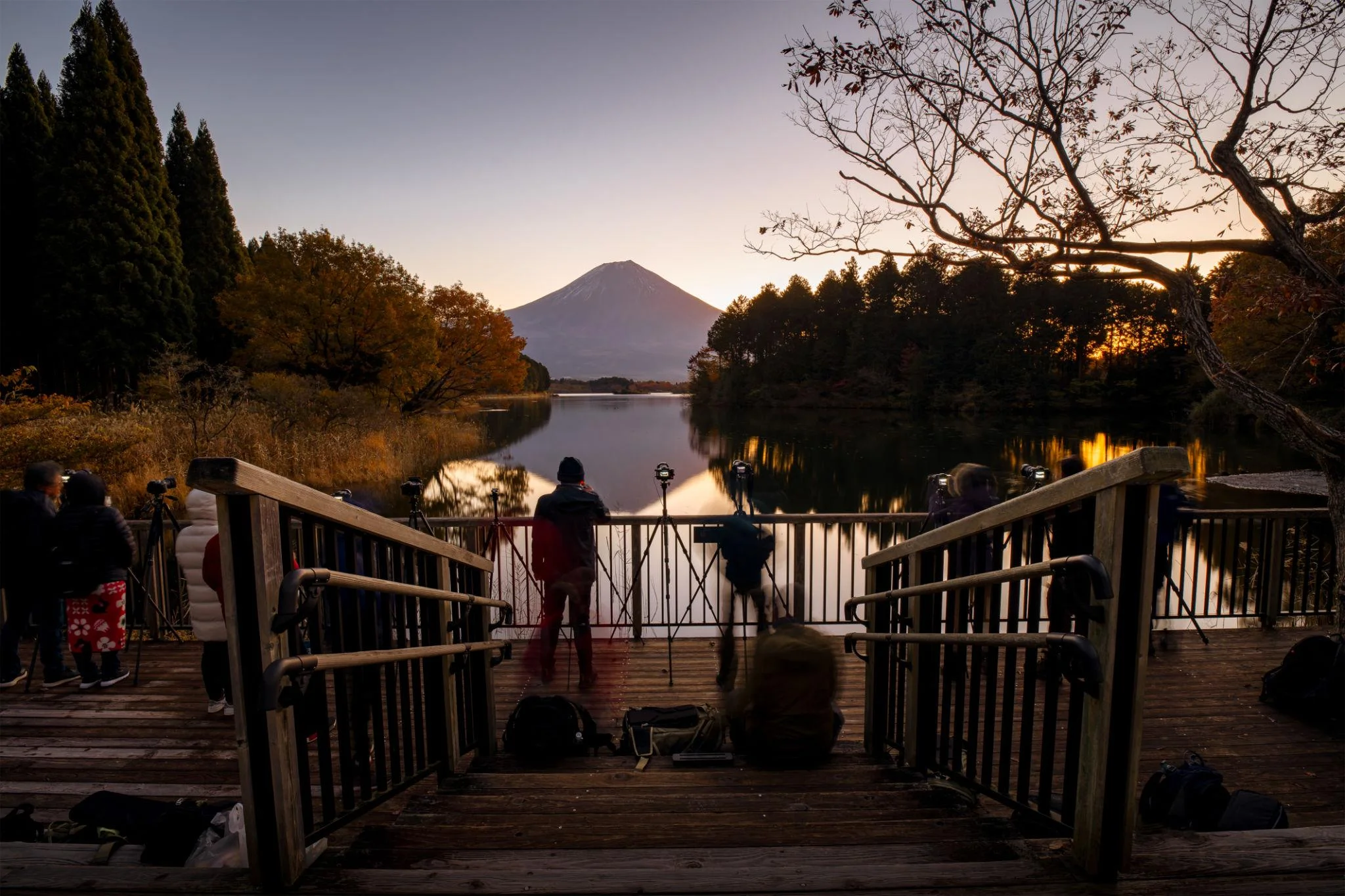
Mount Fuji at sunrise is Japan’s most iconic natural spectacle, where the snow‑capped peak glows in hues of gold and crimson as dawn breaks. Travelers gather at lakes Kawaguchi and Yamanaka or climb to higher vantage points to witness the mountain’s majestic silhouette against the morning sky. This timeless view symbolizes renewal and serenity, offering photographers and visitors alike a breathtaking start to the day in Japan’s most celebrated landscape.
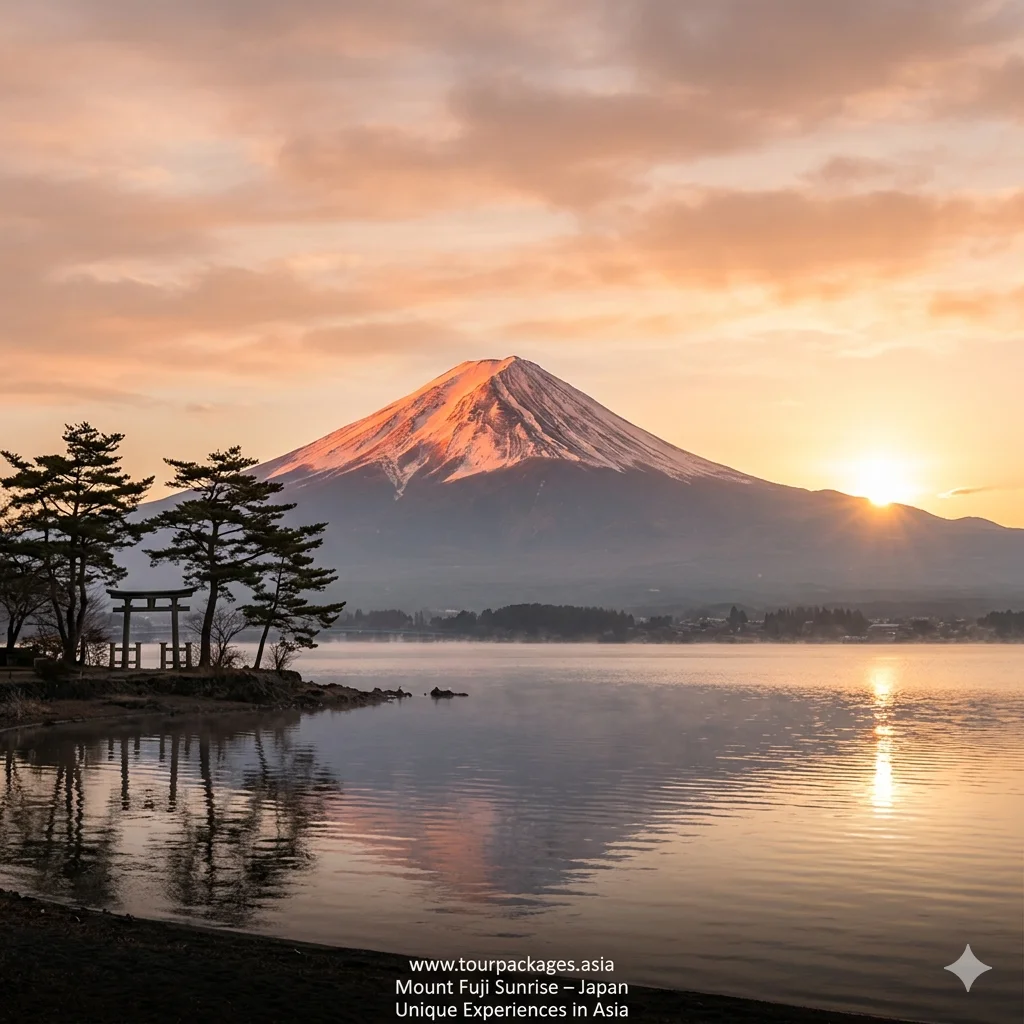
At 3,776 metres, Japan's highest mountain catches the first light before any peak in the country. Whether you climb through the night for goraiko or simply stand at a lake shore while the reflection forms on still water — there is nothing ordinary about a Fuji dawn.
Japan has more than 100 active volcanoes and hundreds of mountains worth climbing. None of them are Mount Fuji. The mountain does not merely sit at the edge of Japan's visual identity — it is Japan's visual identity, in a way that is difficult to parallel elsewhere. Hokusai printed it thirty-six times. It appears on the old 1,000-yen note. It is the subject of more Japanese poetry than any other natural feature. Foreigners who have never visited Japan can identify it on sight. And all of this was formed by a stratovolcano that last erupted in 1707 and still qualifies, technically, as active.
The sunrise at Mount Fuji — whether witnessed from the summit, from a lakeside reflection, or from a hotel window in the Fuji Five Lakes region — operates on all of these associations simultaneously. The mountain glows red in the first light. The near-perfect cone shape, unobstructed by neighbouring peaks, catches the sun from an angle that turns its snowcapped flanks into a progression of pink, deep orange, and finally brilliant gold. When the air is clear and the lake below is still, the reflection doubles the mountain vertically — the image on the water as sharp and as real as the one above it. This is the photograph that defined Fuji Japan travel for the world, and it is still waiting to be made every morning on calm days between October and May.

The Kawaguchi Lake sunrise reflection — one of the most reproduced natural images in Japan — forms in the still pre-dawn water on windless mornings between October and April.
The cultural significance runs deeper than aesthetics. In Japanese belief, Fuji is sacred — a UNESCO World Heritage Site recognised specifically as a cultural landscape, not merely a geological formation. Climbing it has been a pilgrimage for centuries. The concept of goraiko — the "arrival of light" experienced from the summit — is specifically associated with spiritual renewal. People who climb Fuji at night and stand at the crater rim as the sun clears the horizon describe a sense of reset that is difficult to attribute to altitude alone. Something about standing above the clouds in the cold dark, watching the sky turn from deep blue to violet to copper to gold, reaches past the photographic and into something more personal. This is why Mount Fuji sunrise continues to draw travellers who have already seen it in a thousand photographs — the image does not prepare you for the experience.
Mount Fuji sunrise is one of 11 extraordinary experiences covered in the Asia Bucket List guide. If you are planning a broader Japan or Asia itinerary, that pillar article covers the complete picture.
Every section you need — from best viewpoints and goraiko climbing to photography settings and a Tokyo day itinerary.
The best place to see Mount Fuji sunrise depends entirely on what you want from it. Each of these locations gives a fundamentally different relationship with the mountain at dawn.
Kawaguchi Lake sunrise is the experience most people picture when they think of Mount Fuji. The northern shore of Lake Kawaguchiko sits almost exactly on the north-south axis of the mountain, giving a symmetrical view of the entire cone from base to summit. On windless mornings — most common between October and April — the lake surface becomes a mirror and the mountain appears doubled. The most productive stretch of shoreline is the area around Ubuyagasaki point, where the reflection of Fuji is famously sharp and small shrine elements add foreground depth. Photographers begin arriving before 4 AM in autumn and early spring to secure position. Access from Tokyo takes approximately 2 hours by train. Lake Kawaguchiko is the natural base for a Japan tour centred on Fuji viewing.
Hakone sits south-southwest of Fuji and provides the view from the Ashino-ko (Lake Ashi) side — less famous for the lake reflection but enormously atmospheric when mist settles in the valley and Fuji's cone appears above it. The Hakone Ropeway offers an elevated platform above the treeline in the early morning, and several ryokan in the region have rooms or outdoor baths (rotenburo) facing Fuji directly. The mountain is not always visible from Hakone — the southern approach has more cloud interference than the Kawaguchiko north side — but when it is clear, the view is less crowded and more private than the Fuji Five Lakes. Japan holiday packages often combine Hakone with Kawaguchiko as a 2–3 day Fuji area itinerary.
The Fuji Subaru Line Fifth Station at approximately 2,305 metres is the highest point accessible by road on Mount Fuji's Yoshida Trail side. Even without climbing further, the viewpoint here sits above the cloud layer on many mornings, giving the surreal experience of watching a sea of cloud spread across the landscape below while Fuji's summit rises above you. Sunrise viewed from this elevation — with the cloud sea below turning pink and gold — is one of Japan's great low-effort natural spectacles. Bus access from Kawaguchiko Station is straightforward and takes approximately 60 minutes. Recommended arrival: at least 45 minutes before sunrise.
The goraiko — sunrise from Fuji's summit — is the mountain's defining experience for those who have the fitness and preparation for an overnight climb. Standing on the crater rim at 3,776 metres as the sun rises above a sea of clouds, with the mountain's elongated shadow stretching hundreds of kilometres to the west, is something no viewpoint photograph can replicate. The Yoshida Trail is the recommended approach for first-timers — it has the most mountain huts, the best-marked path, and the widest range of support if conditions deteriorate. The entry gate is open from 3 AM onward for hikers with mountain hut reservations, with a mandatory JPY 4,000 per-person conservation fee.
Yamanaka Lake Fuji view is a less visited but equally productive alternative to Kawaguchiko for reflection photography. Lake Yamanakako sits at slightly higher elevation and often has clearer morning air. The Hanano-miyako-koen flower park on the lake's north shore gives a clean open foreground for the mountain. In winter months, with snow on the ground and frost on the lakeside vegetation, the Yamanakako sunrise view matches — and on some mornings surpasses — the more famous Kawaguchiko compositions for atmosphere.
The question of best time for Mount Fuji sunrise depends on whether you are climbing or viewing from below — these have different optimal windows. Understanding both is essential before booking.
This is the golden window for Kawaguchi Lake sunrise photography. Autumn (October–November) delivers the most reliable clear mornings, with the mountain increasingly snowcapped from mid-October onward. Winter (December–February) brings the most dramatic snow coverage and the hardest blue skies — visibility is best, frost adds foreground interest, and crowds are minimal. Spring (March–April) adds cherry blossoms to the composition — the classic Kawaguchiko image with pink sakura in the foreground and snowcapped Fuji behind is from this period. May and June carry risk from early cloud buildup. Summer (July–September) is climbing season but the worst for lake reflection views — humidity, morning cloud cover, and typhoon season all reduce visibility at lower elevations.
The official climbing season runs from early July to early September. The trails are staffed, mountain huts are open, and the summit is accessible in reasonable safety. Within this window, late July to mid-August is peak season — summer vacation crowds make the Yoshida Trail extremely busy on weekends, with hundreds of headlamps visible in a line from below. If you are willing to climb on a weekday and have flexibility on the specific summit date, the experience is substantially less crowded. The summit sunrise (goraiko) during July occurs at approximately 4:30–4:40 AM. By late August it shifts to 5:00–5:15 AM. September's sunrise is closer to 5:30 AM and the September window is short before the trails close.
The Diamond Fuji phenomenon — when the winter sunrise aligns precisely with the mountain's summit peak, creating a diamond-ring light effect — occurs at Lake Motosuko and Lake Yamanakako in late December and early January. The specific date varies by year and by the angle of observation from the lakeshore. Photography enthusiasts track it annually, and the image is among the most technically striking produced in the Fuji Five Lakes region. Timing requires checking a specific Diamond Fuji calendar for the observation year.
The goraiko — "arrival of light" — from Fuji's summit crater rim at 3,776 metres. The sea of clouds spreads across the landscape below while the mountain's own shadow stretches to the west.
The word goraiko (御来光) means, literally, "the arrival of august light" — a phrase that carries the weight of centuries of pilgrimage. Fuji's summit is one of the few peaks in Japan where sunrise can be observed before any other point in the country. The mountain sits east-west oriented, with the crater opening eastward, and on a clear morning the sun appears as a defined arc clearing the cloud layer below the summit while the sky transitions through layers of colour above you. Climbers describe the moment not as watching the sun come up, but as watching the world come on from a vantage point above it.
For most visitors targeting the goraiko, the recommended approach is a two-day plan. Day one: take the bus or drive to the Fuji Subaru Line Fifth Station, begin the Yoshida Trail ascent around noon, climb at a slow pace to a mountain hut at the Seventh or Eighth Station (elevation approximately 3,000–3,400 metres), check in, eat, and rest. Day two: wake at midnight to 2 AM, climb the final section to the summit crater rim, arrive before 4:30 AM on a typical summer morning, witness the goraiko, and descend by the Yoshida descent trail (a separate path from the ascent) reaching the Fifth Station by midday. The total climb time is approximately 6 hours ascent and 4 hours descent.
Fuji has four official trails. The Yoshida Trail (north side) is the most popular, has the most mountain huts, and provides the best sunrise views during the ascent — it is the recommended choice for first-time climbers. The Subashiri Trail (northeast) merges with the Yoshida Trail above the Eighth Station and provides a quieter approach with a forest section in the lower reaches. The Fujinomiya Trail (southwest) is the shortest but has fewer sunrise viewing positions — not recommended specifically for goraiko. The Gotemba Trail (southeast) is the longest, lowest, and least crowded — for experienced trekkers only.
New regulations introduced from 2025 apply to the Yoshida Trail. Entry to the trail is permitted from 3 AM to 2 PM daily, with access between 2 PM and 3 AM restricted to visitors who hold a mountain hut reservation. A mandatory conservation and safety fee of JPY 4,000 per person is charged at the trailhead. The rules are designed to reduce the dangerous "bullet climbing" practice — ascending and descending in a single continuous push without rest — which resulted in multiple altitude sickness incidents. Mountain hut reservations are now effectively mandatory for anyone targeting the goraiko. Book huts a minimum of 8 to 12 weeks in advance for peak summer dates.
Fuji's summit at 3,776m is high enough to cause altitude sickness symptoms in unprepared climbers. Ascend slowly, hydrate consistently, do not rush past the Eighth Station, and descend immediately if you develop persistent headache, nausea, or confusion. These are not signs of tiredness — they are physiological responses to low oxygen at altitude.
The vast majority of travellers who experience Mount Fuji sunrise never set foot on the mountain itself. The views from below are not a consolation prize — they are a categorically different experience, and for many people the more beautiful one. A still lake, a pink sky, and a perfect cone reflection on the water is an image that the summit view cannot produce.
The simplest non-climbing sunrise experience: book a hotel or ryokan with a view of Fuji on the north shore of Lake Kawaguchiko, set your alarm for 4:30 AM, walk to the lakeside, and wait. On clear mornings the mountain is lit in amber before the sun fully clears the horizon, and the reflection forms in the still pre-dawn water approximately 20 minutes before official sunrise. This experience requires zero preparation, no special equipment, and costs only the accommodation charge. Several ryokan in the Kawaguchiko area have rooms facing the mountain with private onsen baths — soaking in the hot spring while watching Fuji dawn experience unfold is a distinctly Japanese way to spend a morning.
The Chureito Pagoda, a five-story shrine structure on the hillside above Fujiyoshida, offers one of the most compositionally dramatic views of Fuji — the pagoda in the mid-ground, the mountain behind it. Reaching it requires climbing approximately 400 stone steps from the road below (15–20 minutes). Arriving before sunrise allows you to photograph the pagoda silhouetted against the pre-dawn sky with Fuji catching the first light behind it. In cherry blossom season (late March to mid-April) the combination of blossoms, pagoda, and snowcapped Fuji is one of the most iconic photographs made in Japan every year.
Oishi Park is a public waterfront park on Lake Kawaguchiko's north shore with a wide, unobstructed view of the mountain from an elevated grass terrace. It has toilets, parking, and public access at any hour — making it practical for pre-dawn arrivals. The park is particularly well-positioned for mid-morning photography when lavender fields (June) or autumn leaves (November) provide foreground colour, but dawn without flowers is still a serious photographic situation.
From Shinjuku Station in Tokyo, take the JR Chuo Line to Otsuki Station (approximately 70 minutes), then transfer to the Fujikyu Railway to Kawaguchiko Station (approximately 50 minutes). Total journey time is approximately 2 hours from Shinjuku. Direct express trains on the Fujikyu Railway also run from Shinjuku on weekends and during peak season — these eliminate the transfer and reduce the journey to approximately 1 hour 45 minutes. JR Pass holders can use the JR Chuo section but not the Fujikyu private railway portion. The Japan tour packages from Tour Packages Asia include detailed transport logistics for the Fuji region.
Highway buses from Shinjuku Expressway Bus Terminal (Busta Shinjuku) run directly to Kawaguchiko Station and take approximately 1 hour 50 minutes to 2 hours depending on traffic. This is cheaper than the train (approximately JPY 1,700 versus JPY 1,300–2,500 depending on train option) and more direct since it avoids the transfer. For a sunrise visit from Tokyo involving a pre-dawn departure, highway buses running after midnight on certain schedules allow a cost-effective arrival by 3–4 AM.
From Kawaguchiko Station, take the Fuji Subaru Line bus to the Fifth Station. The journey takes approximately 55 minutes. During climbing season (July–September), the road to the Fifth Station is closed to private vehicles during peak daytime hours to manage congestion — use the shuttle bus. Round-trip bus fare is approximately JPY 2,000–2,500.
Mount Fuji photography at dawn requires a tripod, pre-dawn positioning, and an understanding of which lake offers the best reflection conditions in each season.
The Kawaguchi Lake sunrise reflection is a slow-shutter, low-ISO photograph. Set your camera to ISO 100–200, aperture f/8 to f/11 (maximises depth of field so both the mountain and its reflection are sharp), and use a shutter speed of 1/15 sec to 2 seconds depending on light level. The long shutter softens any residual water movement into the surface, strengthening the reflection. A tripod is absolutely required — set it up on the lakeshore 30 to 40 minutes before sunrise and do not move it. Use a remote shutter release or the camera's 2-second self-timer to eliminate vibration at the moment of exposure.
The most photographically productive window is the 20 minutes before official sunrise through to 30 minutes after. In this period: pre-dawn blue hour gives cool, even light and the most stable reflections; civil twilight produces the deepest pinks and purples on Fuji's snowfields; golden hour (first 10 minutes post-sunrise) turns the south-facing snow face a vivid orange-red; and the 20 minutes post-sunrise window shows the mountain fully illuminated with the sky still saturated. After 40 minutes post-sunrise, direct sunlight flattens the colour across the mountain face and the photographic opportunity diminishes rapidly.
Use a foreground element. The mountain by itself, however spectacular, benefits enormously from a compositional anchor: a small wooden pier, the frame of a low-hanging branch, a torii gate reflected beside the mountain. The most celebrated Fuji compositions use this framing consistently — not as decoration but as scale reference. Without a human element or a known object, the scale of a 3,776-metre volcano photographed from 20 kilometres away is genuinely difficult to convey. Wide-angle lenses (24–35mm equivalent) work best for the lake reflection shots. Telephoto lenses (100–400mm) are more effective for isolating the summit during the golden hour burn.
For climbers photographing the summit sunrise, the technical challenges are cold (battery drain is severe — carry two spare fully charged batteries inside a warm pocket), wind (a windscreen for your tripod legs helps on the exposed crater rim), and the altitude (sluggish thinking affects decision-making; pre-set your composition in the dark and then just press the shutter). Set your camera the night before: ISO 800, f/4, 1/15 sec as a starting point, adjusting as light builds. The most striking summit image is not the sun itself but the shadow — Fuji's elongated triangular shadow projected west across the cloud sea as the sun rises behind you.
Fuji's visibility is famously unreliable even in good weather months. The mountain generates its own cloud system — a lens-shaped lenticular cloud that forms over the summit on days with high winds and humidity, completely obscuring the peak while the surrounding area remains clear. Local wisdom says: if you can see the clouds on Fuji's summit, expect rain; if Fuji is clear, expect fair weather tomorrow. The lenticular cloud is meteorologically interesting but photographically frustrating.
January–February: Clearest months of the year. Cold, dry air, minimal cloud cover, maximum snowpack. Best for crisp, high-contrast photography from the lake viewpoints. March–May: Generally good visibility with increasing morning cloud risk as humidity rises through May. Cherry blossom season (late March–mid April) is excellent. June: Tsuyu rainy season begins — mountain frequently obscured, humidity peaks. July–September: Climbing season, but typically the cloudiest months for lake reflection views. Summer afternoon thunderstorms are common above 3,000 metres. October–November: Best overall combination of clear skies, autumn colour, and snowcap development. The most reliable period for guaranteed visibility from below. December: Excellent visibility, cold, peak Diamond Fuji period.
The most reliable local resource is the Fujisan Webcam Network — multiple live cameras pointed at the mountain from different angles show real-time conditions. Check the evening before and the morning of your planned sunrise. Local guesthouses and ryokan at Kawaguchiko often post visibility updates on their social media accounts — worth following if you have a specific sunrise date in mind. Weather apps in Japan are highly precise at the local level; Yahoo Japan Weather (Japanese only) and Tenki.jp provide mountain-specific forecasts.
Packing correctly varies dramatically between a lakeside sunrise visit and a summit climb. Here is the breakdown for both:
October to April mornings at the lakeside are cold — temperatures regularly drop to 0–5°C before dawn even in what locals consider mild weather. Thermal base layers, a warm mid-layer, a windproof outer jacket, and gloves are necessary, not optional. Camera batteries drain in cold weather — keep spares in an inner pocket. A tripod for reflection photography. Waterproof boots or insulated ankle boots for standing on damp lakeshore. A small thermos of warm drink makes a genuine difference over a two-hour pre-dawn wait.
Summit temperatures before dawn in July–August can drop to near 0°C or below even in climbing season. Wind chill makes the perceived temperature significantly lower. Pack: thermal base layers (top and bottom), fleece mid-layer, windproof and waterproof outer jacket and trousers, warm hat and gloves (critical — fingers go numb at the summit rim), headlamp with fresh batteries, 2 litres of water minimum, high-calorie snacks (onigiri, energy bars, chocolate), hiking poles (rental available at Fifth Station), and cash in Japanese yen (mountain hut purchases, emergency needs). Trekking shoes or lightweight hiking boots with ankle support. Sunscreen for the descent in full sun.
Many climbers buy a wooden walking stick at the Fifth Station base and collect branded stamps (yakiin) from each mountain hut on the way up. The stick becomes a record of the climb — each stamp burned into the wood at the hut. It costs a few hundred yen per stamp and is one of Japan's most tactile souvenirs.
This is a genuinely contested question among Fuji photographers and repeat visitors. Both have strong advocates.
| Factor | Sunrise | Sunset |
|---|---|---|
| Lake reflection quality | Better — water is calm before wind picks up | Good but wind usually disrupts surface by evening |
| Light colour on mountain | Pinks and golds — softer, more gradual | Warm reds and oranges — more intense, faster |
| Crowds at viewpoints | Low (fewer people wake early) | High — Kawaguchiko sunset spots are crowded |
| Logistics from Tokyo | Requires pre-dawn departure or prior-night stay | Easier — standard day trip timing |
| Air clarity | Better — pre-dawn air is clearest before heat haze builds | Heat haze from midday can persist into evening |
| For the summit climb | The primary objective — goraiko is a sunrise experience | Not applicable from summit (trails close for night) |
| Best season | Year-round from below; July–Sept for summit | Autumn strongest — October and November |
The honest verdict: sunrise wins for photography and the summit experience. Sunset is more accessible from Tokyo and better for travellers who do not want to wake before 4 AM. If you can only do one, and you have accommodation near the lake, sunrise. If you are on a day trip from Tokyo without overnight stays, sunset is the more practical choice.
Our specialists at Revelation Holidays and Tour Packages Asia design complete Japan itineraries — Tokyo, Fuji, Kyoto, and more — with Japan e-Visa guidance included.
Start Planning Now Japan Tour PackagesThis itinerary works for travellers already in Tokyo who want to experience the Kawaguchi Lake sunrise without an overnight stay at the lake — though an overnight stay strongly improves the experience.
Check the Kawaguchiko webcam and weather app. If the morning forecast shows clear skies, take the late Chuo Line express to Otsuki and transfer to the last Fujikyu Railway service. Arrive at Kawaguchiko Station by midnight. This is the overnight option — stay at a local hotel or capsule hotel near the station.
Leave accommodation and walk 15 minutes to the north shore viewpoint. Set up tripod on the lakeshore. The mountain is visible as a silhouette against the still-dark sky if conditions are good. Sky begins to lighten approximately 45 minutes before official sunrise.
The mountain face catches the first light approximately 20 minutes before the sun clears the horizon. In autumn and winter the progression from deep blue through pink to gold takes approximately 40 minutes. Stay through the entire sequence — the post-sunrise 15 minutes are often the richest photographically.
Kawaguchiko has good breakfast options near the station area. Japanese morning set (tamago gohan, miso soup, pickles) or a simple coffee-and-toast spot are available from 7 AM. Warm up, review photographs, and plan the morning.
Walk or taxi to Chureito Pagoda (400-step climb, 20 minutes) for the elevated view. Then bus or walk to Oishi Park for the open lake terrace view. Return to Kawaguchiko Station by 11 AM for the midday train back to Tokyo.
Return to Shinjuku by approximately 1:30–2:00 PM via JR Chuo Line. Afternoon free for Tokyo sightseeing or rest.
Click each panel to expand — practical, honest tips gathered from photographers and regular visitors to the Fuji region.
Japan has seen a significant surge in international visitors since 2023, and Mount Fuji tourism has disproportionately benefited from this wave. The mountain appears in a consistent rotation of viral photography on Instagram, TikTok, and Pinterest — the Kawaguchiko reflection, the cherry blossom and pagoda composition, and the overhead goraiko shot all circulate regularly and generate immediate bucket-list responses from viewers who have never been to Japan.
The specific appeal of the sunrise at Fuji in the current social media environment is the combination of technical achievement and visual spectacle. The lake reflection shot requires being in the right place at the right time with the right equipment — it cannot be faked with AI (yet), it cannot be easily replicated at a studio, and it consistently generates engagement precisely because viewers understand the difficulty it represents. The goraiko summit shot carries an additional narrative: it documents a physical achievement (an overnight climb) alongside a visual reward, which gives content layers that a simple scenic photograph lacks.
For Indian travellers specifically, Japan has become the aspirational Asia destination that it was not a decade ago. Fuji Japan travel searches from Indian travellers have grown year-on-year through the early 2020s, and the Fuji Five Lakes region now features in a significant proportion of Japan package itineraries booked from India. The mountain has moved from a periphery add-on to a primary driver of Japan trip motivation for this demographic.
The Fuji Five Lakes region is one of the most productive landscape photography destinations in Asia, period. Mount Fuji photography from the lake shore represents a technical challenge with a disproportionate reward — the reflection shot, when it comes together, is one of the most compositionally satisfying images possible from a Japanese landscape. Multiple days in the region give multiple morning attempts with different conditions, and the best photographers routinely revisit the same viewpoints in different seasons for the spring blossom, summer haze, autumn colour, and winter snow variants.
Watching dawn break over Japan's most iconic mountain from a private onsen bath at a lakeside ryokan, or standing together at the lakeshore as the reflection forms, is a travel experience with very few equivalents. The area around Kawaguchiko has excellent romantic accommodation options across multiple price points — from traditional ryokan with Fuji-view rooms and kaiseki dinner service to more accessible guesthouses within walking distance of the lake shore. For Indian couples on a Japan honeymoon package, 2 nights at Lake Kawaguchiko combined with Tokyo and Kyoto represents a complete Japan experience.
The Fuji summit climb is one of the most accessible major mountain climbs in Asia for solo travellers. The trails are well-marked and well-staffed, English signage exists at all major decision points, mountain huts provide accommodation without requiring tent or camping equipment, and the social atmosphere on the Yoshida Trail — particularly the camaraderie of fellow sunrise-seekers at the summit in the cold pre-dawn — is unlike most other solo outdoor experiences. Many solo travellers describe the goraiko climb as a turning point experience that confirms an interest in mountain trekking they did not know they had.
The lake viewpoint experience is entirely suitable for families with children of any age. The Fifth Station viewpoint (accessible by bus, no climbing required) gives young children a dramatically elevated perspective of the mountain and the surrounding landscape, with the cloud sea visible below on many mornings. The Fuji Five Lakes region has ample child-friendly activities — boat rides, rope adventures, the Fujiten Snow Resort in winter — that make it a full-day destination even for families not prioritising photography or climbing.
One of the best ways to enjoy a clear view of Mount Fuji is to check how it looks in real time using dedicated websites before you head out. Timing is everything — and the three multilingual platforms below let you do exactly that, ensuring your sunrise or daytime visit is perfectly planned.
Compiles live footage from fixed cameras around Mt. Fuji, including Lake Kawaguchiko and Lake Yamanakako. Available in English, Chinese, Korean, and Indonesian.
Offers real-time views from observation decks and tourist spots such as Arakurayama Sengen Park and Oshino Hakkai. Supports 10 languages for global accessibility.
Shows live footage and a simple forecast of Mt. Fuji visibility across Yamanashi, Shizuoka, and Kanagawa. Perfect for planning up to a week in advance.
Every question travellers ask before planning a Fuji sunrise trip — answered honestly and in full.
Yes — and the "effort" ranges from essentially zero to substantial depending on which experience you choose. At the simplest level, staying at a hotel on the north shore of Lake Kawaguchiko and walking to the lake at 4:30 AM requires nothing more than an alarm clock. At the most demanding level, an overnight summit climb to experience the goraiko requires physical preparation, the right equipment, and a mountain hut reservation. Both are absolutely worth it for different reasons. The lake reflection experience is one of the most visually compelling natural moments you can witness in Japan without any physical effort. The summit goraiko is one of the most memorable experiences most people have on any Japan trip — the combination of physical achievement, altitude, and the specific quality of light at 3,776 metres before dawn is genuinely unlike anything most travellers have encountered before. For a first Japan visitor, the lake viewpoint is the right starting point; the summit climb is the return-visit objective.
Yes, absolutely. The most celebrated Mount Fuji sunrise images — the lake reflection at Kawaguchiko, the Chureito Pagoda view, the Fifth Station cloud sea — all require either no climbing at all or minimal effort. Lake Kawaguchiko's north shore is completely flat and accessible from the road. Chureito Pagoda requires approximately 400 stone steps (15–20 minutes). The Fuji Subaru Line Fifth Station is accessible by bus to 2,305 metres without any walking. Only the goraiko summit experience requires the full overnight climb. For families, elderly travellers, people with mobility considerations, or anyone who simply wants the visual experience without the physical challenge, the non-climbing options deliver extraordinary results. The Kawaguchiko reflection photograph that most people associate with Mount Fuji was taken from flat lake shore, not from a mountain trail.
Sunrise times vary significantly by season. During climbing season (July to early September), sunrise is approximately 4:30 to 5:00 AM. In spring (March to May), sunrise falls between 5:00 and 5:45 AM. In autumn (October to November), the range is 5:30 to 6:15 AM. In winter (December to February), sunrise is between 6:45 and 7:00 AM. For lake reflection photography at Kawaguchiko, arrive at the viewpoint a minimum of 45 minutes before official sunrise — ideally 60 minutes — to capture the pre-dawn blue hour and civil twilight phases when the reflection is often strongest. For summit climbers, the target is reaching the crater rim 30 minutes before official sunrise to ensure a full view of the complete horizon brightening before the sun disc appears. Check a precise sunrise calculator for your specific travel date and adjust arrival accordingly.
The overnight climb for goraiko is safe if done correctly with the right preparation and the right timing. The key safety conditions are: climb during the official season (early July to early September when the trail is staffed and huts are open); use the Yoshida Trail for the best support infrastructure; have a mountain hut reservation to ensure you are not attempting a bullet-climb without rest; carry appropriate cold-weather clothing; and have a headlamp with fresh batteries. The main risks are altitude sickness (climb slowly, rest adequately, descend if symptoms develop), hypothermia (summit temperatures near 0°C before dawn even in summer), and falls on the descent (the volcanic scree is loose and steep — use poles and take care). The 2025 regulation requiring hut reservations for entry between 2 PM and 3 AM effectively makes bullet-climbing without rest more difficult, which has improved safety outcomes. Solo climbing on the Yoshida Trail in season is entirely feasible because the trail is well-populated with other climbers — you are rarely alone in the dark.
The most practical approach is to stay the night before at Lake Kawaguchiko rather than attempting a same-day pre-dawn departure from Tokyo. A late evening train or highway bus from Shinjuku gets you to Kawaguchiko by midnight, allowing a 3–4 AM alarm for the lakeside. If an overnight stay is not possible, the earliest highway bus from Shinjuku to Kawaguchiko departs at approximately 7:00 AM, arriving around 9:00 AM — too late for sunrise but fine for daytime Fuji viewing. For sunrise from the summit (goraiko), the entire climb requires 2 days including a mountain hut night — there is no same-day Tokyo option for the summit experience. Direct Fuji excursion buses run from Shinjuku in summer and are the simplest option if you do not need to make specific sunrise timing — they are typically day-tour format with guided Kawaguchiko and Fifth Station stops.
Diamond Fuji is a phenomenon that occurs twice a year at specific lakeside locations when the sun rises (or sets) in precise alignment with the summit peak of Mount Fuji, creating a brilliant "diamond" effect as the sun appears to perch on top of the mountain before rising above it. The winter sunrise version occurs at Lake Motosuko and Lake Yamanakako between approximately late December and early January. A summer version occurs at some locations in early summer. The specific date varies by year and the viewing angle from each location — photographers consult dedicated Diamond Fuji calendars that calculate the exact alignment date for each lake and viewpoint combination. The image is technically demanding and intensely photogenic — the sun disc balanced on the summit is one of the most sought-after and least easily replicated compositions in all of Japanese landscape photography. Lake Motosuko, the most famous setting, is approximately 30 minutes by car from Kawaguchiko and worth the drive for the Diamond Fuji period.
For lake reflection photography without climbers, October to April is consistently the best overall window, with specific highlights in each sub-period. October and November offer the clearest air of the year, developing snowcap, autumn leaf colour near the lakeshores, and reliably calm mornings. December to February produce the sharpest, highest-contrast conditions — snowcap at maximum depth, clear blue winter skies, frost on the lakeshore vegetation, and minimum crowds at non-climbing-season viewpoints. Late March and early April is the cherry blossom period — the most iconic combination of Fuji and sakura, but also the most crowded. The summer months (July–September) are the official climbing season but the statistically worst for lake reflection photography because of summer haze, afternoon clouds, and the elevated morning humidity that reduces the crisp mountain definition. If you want the mountain visually sharp and the reflection strong, avoid summer months for below-the-mountain photography.
Mount Fuji is one of the most accessible major mountain climbs in Asia in terms of technical difficulty — it requires no ropes, no crampons, no technical training. The Yoshida Trail is a well-maintained path marked at every significant junction with English and Japanese signage. Mountain huts serve food, sell oxygen canisters, and provide basic medical assistance. This accessibility is part of Fuji's cultural significance — it has been climbed by children, by elderly people, by people with no hiking background. However, the famous Japanese phrase about the mountain — "A wise man climbs Fuji once; a fool climbs it twice" — captures the physical reality: it is a long, physically demanding day that most people find harder than expected. The altitude (3,776m) causes genuine symptoms in a meaningful proportion of climbers — headache, nausea, and fatigue that have nothing to do with fitness level. First-time hikers in reasonable general physical fitness can complete the Yoshida Trail successfully with a two-day plan (hut overnight), proper preparation, and a slow, steady pace. Rushing the ascent is the most common mistake.
From 2025, all climbers on the Yoshida Trail (the most popular route) are required to pay a mandatory conservation and safety fee of JPY 4,000 per person. This is paid at the trailhead gate on the Yoshida Trail, not online in advance. Other trails (Subashiri, Fujinomiya, Gotemba) also have fees but the Yoshida Trail regulation is the most prominent. The fee was introduced alongside access time restrictions — the gate is open from 3 AM to 2 PM daily, with entry between 2 PM and 3 AM restricted to visitors who hold a current mountain hut reservation. These rules are designed to reduce dangerous bullet-climbing (ascending and descending in a single continuous session without rest or altitude acclimatisation) and to manage trail congestion. Mountain hut fees are separate and range from approximately JPY 6,000 to JPY 10,000+ per person for a shared bunk bed dormitory with basic meals. Always carry sufficient Japanese yen in cash for trail fees, hut payments, and contingency purchases — card acceptance in mountain huts is not guaranteed.
No — Mount Fuji is not visible from Kawaguchiko every day. The mountain generates its own cloud systems, and even on days with otherwise clear weather, a lenticular cloud cap can form over the summit, partially or completely obscuring the peak. The clearest months are statistically October–February, when cold, dry air and lower humidity produce the most consistently visible conditions. Even in these months, you should expect to see the mountain clearly on 4–5 mornings out of 7 rather than every morning. In June (rainy season) and July–August (summer humidity), the mountain may be obscured for multiple consecutive days at lower elevations. The practical consequence is: plan at least 2 nights at the lake if your primary goal is the Fuji sunrise photograph. One-night visits risk arriving on a cloudy day and leaving without a clear view. Checking the Kawaguchiko webcam and local weather forecast the evening before helps significantly in making the decision of when to take the early morning trip to the lakeshore.
Indian passport holders require a visa to enter Japan. A tourist e-Visa (single-entry, 15 or 30 days depending on the approved category) is available through Japan's official e-Visa portal or through an approved travel agent. The application requires a completed online form, a scanned passport copy, a recent photograph, proof of accommodation bookings for the duration of stay, a confirmed return flight booking, and bank statements demonstrating financial sufficiency. Processing time is typically 5 to 10 business days but can extend during peak season. Apply a minimum of 4 weeks before travel, ideally 6 weeks, to avoid last-minute complications. The Japan e-Visa does not guarantee entry — immigration officers can still question travellers at the port of entry. A printout of the e-Visa approval, hotel bookings, and itinerary should be carried as a physical document. Revelation Holidays provides visa guidance as part of their Japan tour package booking process.
A Japan trip including Mount Fuji from India typically costs between INR 1,10,000 and INR 2,20,000 per person for a 7–10 night package, depending on hotel category, season, and itinerary design. The breakdown includes: India–Tokyo return airfare INR 40,000–75,000 (highly variable by season and booking timing); accommodation in the Fuji Five Lakes region INR 4,000–15,000 per night per person depending on ryokan vs standard hotel; transport Tokyo–Kawaguchiko approximately JPY 2,500–4,000 return (INR 1,400–2,200); climbing fee JPY 4,000 (INR 2,200) plus mountain hut approximately JPY 8,000 (INR 4,400) if doing the goraiko; and local food and transport approximately JPY 3,000–5,000 per day. Japan is considered a medium-to-high cost destination but not prohibitively so — the Fuji region specifically has a range of budget options through local guesthouses and convenience store meals. For a current personalised Japan itinerary quote from India, contact Tour Packages Asia or Revelation Holidays.
The Kawaguchiko reflection shot is achievable with a mid-range camera or even a modern flagship smartphone if you plan correctly. The key is: arriving early enough (45 minutes before sunrise), having a stable surface for the camera (a tripod for DSLR or a flat surface/small gorillapod for smartphones), and using the manual exposure or Night Mode settings rather than auto-mode. Auto-mode on any camera will be confused by the dark scene and produce a washed-out exposure — manual settings (for DSLR: ISO 100, f/8, 1–2 sec; for smartphones: Night Mode with maximum exposure time) produce dramatically better results. The most common mistake from non-professionals at Kawaguchiko is arriving 10 minutes before sunrise and trying to take photos in a hurry — the best light is in the 20–30 minutes before official sunrise, and the composition needs to be set up before the light is worth photographing. Plan, position, and wait.
The Fuji Five Lakes region — comprising Lakes Kawaguchiko, Yamanakako, Saiko, Shojiko, and Motosuko — has enough to fill 3 to 4 full days beyond the sunrise experience. The Aokigahara forest (Sea of Trees) on the northwest slopes of Fuji is a geologically fascinating ancient lava tree forest with a network of maintained walking trails. The Fuji-Q Highland amusement park adjacent to Kawaguchiko Station is one of Japan's most intense roller coaster parks — well-regarded in the theme park world. The Oshino Hakkai spring pools, fed by Fuji's snowmelt filtered through 80 years of volcanic rock, are crystal-clear blue-green pools in a traditional farming village setting. Fujinomiya City on Fuji's south side has the famous Fujinomiya yakisoba (a regional noodle dish) and the Fujisan Hongu Sengen Taisha main shrine. Winter visitors can ski at Fujiten Snow Resort. Boat rides on Lake Kawaguchiko provide a water-level view of the mountain. A 2-day Fuji itinerary combined with 4–5 days in Tokyo creates a strong backbone for most Japan packages.
Mount Fuji is Japan's most globally recognised natural landmark but it is not Japan's only extraordinary natural experience. The comparison most Indian travellers encounter is between Fuji, the Japanese Alps, and the northern island of Hokkaido. Fuji's specific advantage is accessibility — it is 2 hours from central Tokyo, completely manageable as a day trip or short overnight addition to a standard Tokyo itinerary, and requires no special permits, languages, or tour bookings for the lakeside experience. The Japanese Alps (Kamikochi, Tateyama Kurobe) are more dramatically alpine and less crowded but require more travel time and are seasonal. Hokkaido (particularly in winter or for lavender season) is a different category of landscape altogether — wide plains, volcanic calderas, and a scale more similar to the Indian Himalayas. For a first Japan trip with a 7–10 day window, Fuji is the most logical natural addition to Tokyo: universally recognisable, highly photogenic, accessible without special planning, and available in multiple formats for different fitness levels. Ask the Tour Packages Asia team for a Japan itinerary that balances Tokyo, Fuji, Kyoto, and your specific interests.
Tell us your travel dates and we will design the ideal Japan itinerary — timed for your best Fuji sunrise conditions.
