
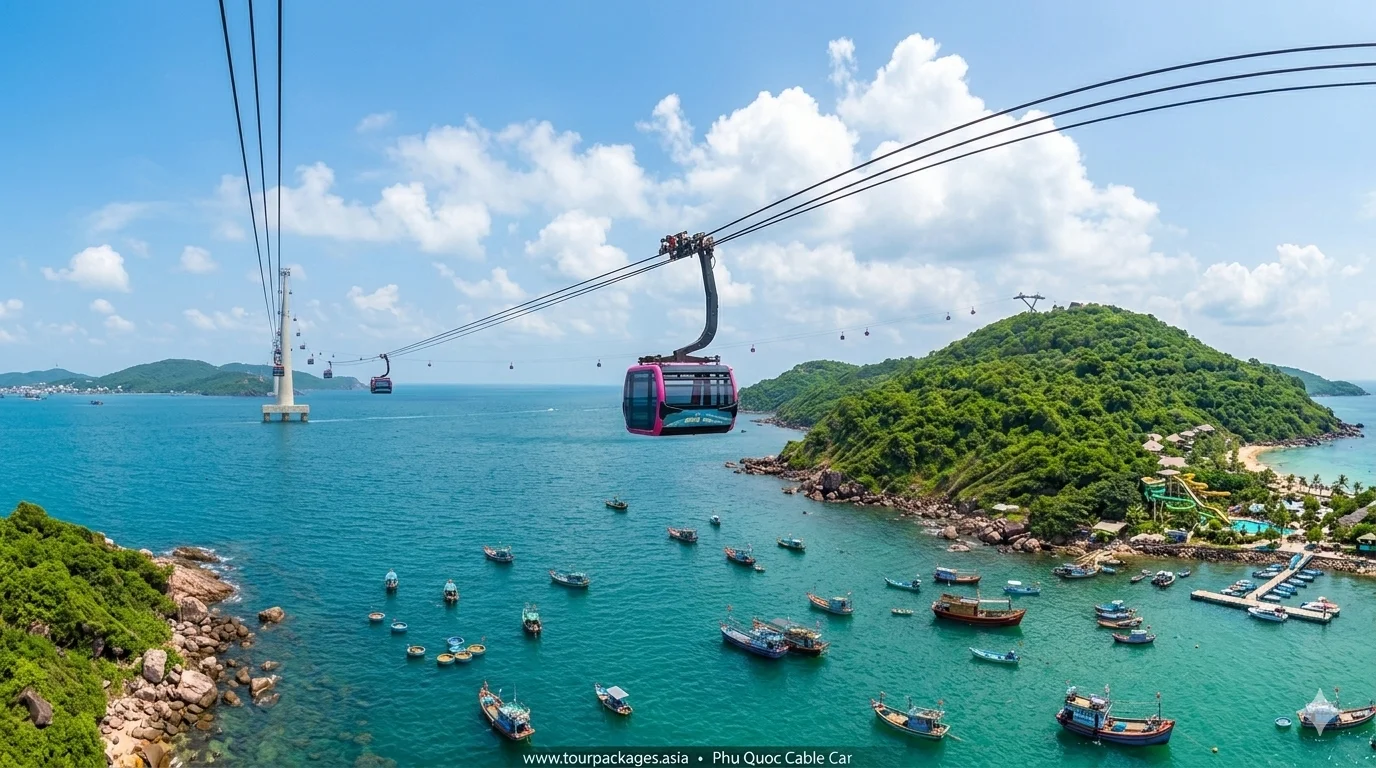
Ride the world’s longest sea cable car in Phu Quoc and experience breathtaking views as you glide to Hon Thom Island. The Phu Quoc Cable Car offers a thrilling journey above turquoise waters, lush landscapes, and fishing villages. This guide covers everything you need to know — from ticket prices and travel tips to the best time to visit. Discover why this record-breaking attraction is a must-do for travelers seeking adventure and panoramic beauty in Vietnam.

7.9 kilometres of open ocean beneath your feet, suspended in a glass cabin high above the Andaman Sea. This is not just a cable car ride — this is one of the most extraordinary aerial crossings on the planet.
Fifteen sections covering everything from ticket prices to what happens when you reach the other side.
The Phu Quoc cable car is a gondola system that stretches 7.9 kilometres across open ocean, connecting the southern tip of Phu Quoc Island — at a point called An Thoi — to a smaller island named Hon Thom, which translates roughly as Pineapple Island in Vietnamese. Operated by Sun World, Vietnam's largest entertainment infrastructure group, the cable car was inaugurated in 2018 and immediately set a Guinness World Record for the longest non-stop triple-rope cable car system over the sea.
This is not a mountain cable car. There is no rock face below you, no cliff, no ground visible anywhere during most of the crossing. Beneath your gondola is the Gulf of Thailand — green, brilliantly lit by sun, and stretching to the horizon in every direction. The nearest comparison is an aircraft window at low altitude, except that you are moving slowly and in near-silence, giving the ocean below time to register in its full scale and colour.
The cable car is sometimes referred to as the Hon Thom cable car (after its destination island), and sometimes as the Phu Quoc cable car (after the island it departs from). Both terms refer to the same system. The official name, as operated by Sun World, is the Sun World Hon Thom Cable Car. When searching for tickets, either term will lead you to the correct attraction.
The claim to fame is straightforward and measurable: 7.9 kilometres of uninterrupted cable spanning open ocean. Before the Phu Quoc cable car opened in 2018, no cable car system in the world had crossed that length of open sea in a single, non-stop route. The Guinness World Records organisation certified the achievement, and the title has remained unchallenged since.
The technical achievement is significant. A triple-rope monocable gondola system of this length requires towers engineered to withstand not only the weight of the cables and cabins but also the lateral forces of salt-laden ocean winds and tropical storm conditions. There are eight towers spanning the route, each rising from concrete foundations set into the seabed. The tallest tower stands approximately 175 metres above sea level — higher than a 50-storey building. The cables are tensioned to account for thermal expansion in Vietnam's tropical climate, where temperature differentials between seasons can affect cable length by several metres.
| Specification | Details |
|---|---|
| Total Length | 7,899.9 metres (~7.9 km) |
| Record Category | Longest non-stop triple-rope cable car over sea |
| Number of Towers | 8 |
| Tallest Tower Height | ~175 metres |
| Number of Gondolas | 188 cabins |
| Cabin Capacity | 8 passengers per cabin |
| Ride Duration | ~15 minutes one way |
| Operator | Sun World (Vietnam) |
| Inaugurated | February 2018 |
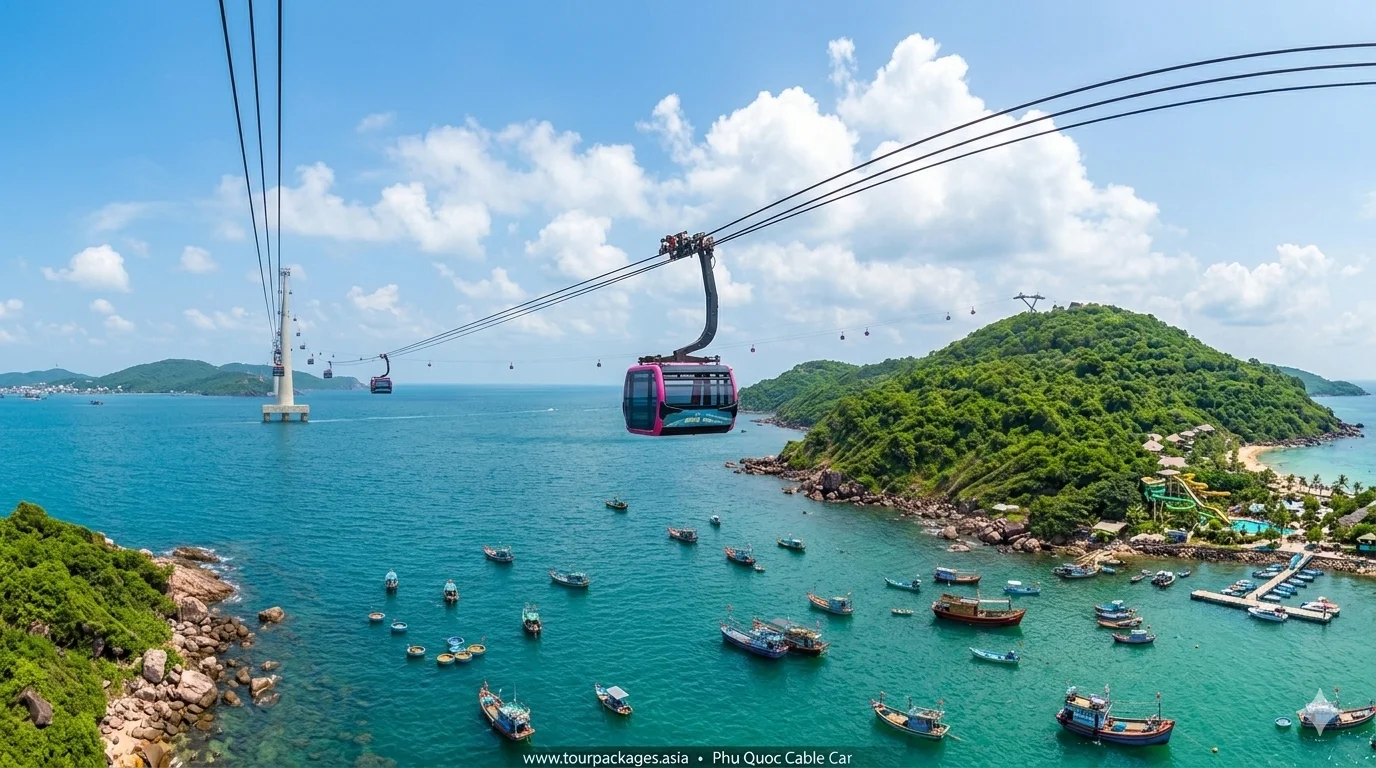
The boarding process at An Thoi station is efficient — gondolas arrive continuously, and each group of up to eight passengers is loaded smoothly. The departure is gradual: the cabin swings gently outward from the platform and begins its climb above the southern Phu Quoc shoreline. Within 90 seconds, the land below has shrunk to a strip of green and the ocean opens beneath you in every direction.
The visual experience of the Phu Quoc cable car is unlike any other aerial transport in Asia. Below and around you, the Gulf of Thailand lies in tones that shift from jade-green near the shore to a deep cobalt at the horizon. The An Thoi Archipelago's smaller islands appear as scattered green dots, their white beaches visible from altitude as bright borders between island and sea. Fishing boats trace white wakes across the surface, and on clear days, the Cambodian coast is faintly visible to the north-west.
Standard gondolas have solid metal floors and panoramic glass windows on all sides. Some cabins are fitted with a partial glass floor panel — if you are assigned one of these, the experience of looking directly down through 175 metres of air to the ocean surface is visceral and unforgettable. There is no option to select a glass-floor cabin specifically; assignment is random at the time of boarding. Request one from the boarding staff — they will accommodate where possible.
The approach to Hon Thom Island in the final two minutes of the ride gives the crossing a sense of genuine island discovery. The island's interior rises from dense tropical forest, its beaches become visible as crescents of white against the treeline, and the Sun World Nature Park's water slides are faintly visible cutting through the hillside. The gondola descends to the receiving station with the smoothness of the entire system — no jarring, no swing, just a quiet mechanical deceleration and a soft stop.
The Phu Quoc cable car operates year-round, but the conditions of the crossing vary significantly by season. Two factors determine the quality of the experience: weather (visibility and sea state) and crowd levels.
This is unequivocally the best period. The northeast monsoon brings dry air, low humidity, and consistently clear skies across the Gulf of Thailand. Ocean visibility from altitude is at its sharpest — the colour contrast between the turquoise shallows and the deep ocean is most dramatic in December to March. Winds are steady but moderate. Temperatures hover between 25°C and 30°C, comfortable for spending time on Hon Thom Island after the crossing. This period does attract higher visitor numbers, particularly around the Vietnamese Lunar New Year (Tet, usually January or February).
If you visit during the dry season, the single most important planning decision is timing your return cable car crossing for 30 minutes before sunset. The westward-facing gondola on the return leg from Hon Thom to An Thoi carries you directly into the setting sun over the Gulf of Thailand. The light turns the ocean surface from turquoise to beaten copper, the smaller islands below become black silhouettes, and the sky in the west builds through orange to deep crimson. This is the most photogenic moment of the entire Phu Quoc cable car experience and the one that generates the most shared images. Sunset in Phu Quoc falls between 6:00 pm and 6:30 pm depending on the month — plan your Hon Thom activities accordingly to be in the gondola queue by 5:30 pm at the latest.
The southwest monsoon brings heavy rain, reduced visibility, and rougher sea conditions. The cable car operates during light to moderate rain, but service may be suspended during heavy storms or high winds. Crowd levels are significantly lower. If you visit in this period, mornings (8:30–11:00 am) are the most likely to offer a weather window with reasonable visibility before afternoon storms build.
Ticket pricing for the Phu Quoc cable car is structured by Sun World into several tiers, depending on whether you want the cable car alone or a combined package that includes access to Hon Thom Nature Park and its water park.
| Ticket Type | Approx. Price (VND) | Approx. INR | Includes |
|---|---|---|---|
| Cable Car Only (return) | 150,000 – 200,000 | ₹500 – ₹660 | Return cable car crossing only |
| Combo: Cable Car + Nature Park Entry | 350,000 – 450,000 | ₹1,150 – ₹1,480 | Cable car + Nature Park access (excludes Aquatopia) |
| Full Day Pass: Cable Car + Aquatopia Water Park | 550,000 – 700,000 | ₹1,810 – ₹2,300 | Cable car + full water park access + Nature Park |
| Children (under 1 metre height) | Free | Free | Free cable car; water park at reduced rate |
If you are travelling with children who enjoy water activities, the full-day Aquatopia combo is the obvious value choice — the water park alone would cost a comparable amount, so adding the cable car is effectively free. For couples or adult-only groups who primarily want the cable car crossing and the Hon Thom beach experience, the cable car plus nature park combo is sufficient. The cable car only ticket is rarely the best value unless you have a very specific time constraint.
Travelling to Vietnam from India? Explore our Vietnam tour packages including Phu Quoc and cable car experiences.
Get a Free QuoteAn Thoi is the southernmost port settlement on Phu Quoc Island, approximately 27–30 km from the main town of Duong Dong in the north-west and 15–18 km from Phu Quoc International Airport. Several transport options connect the island's other areas to the cable car station.
| From | Method | Time | Approx. Cost |
|---|---|---|---|
| Duong Dong (town centre) | Motorbike taxi (Grab/local) | 40–50 min | VND 150,000–200,000 (₹500–660) |
| Duong Dong (town centre) | Rental motorbike | 40–50 min | VND 100,000–150,000/day (₹330–500) |
| Phu Quoc Airport | Taxi | 20–30 min | VND 200,000–280,000 (₹660–920) |
| Long Beach / Sao Beach hotels | Taxi or Grab car | 25–40 min | VND 180,000–250,000 (₹595–820) |
| Any location | Hotel-arranged transfer | Varies | Ask hotel; typically ₹800–1,200 one-way |
The cable car crossing is genuinely spectacular, but Hon Thom Island is not merely a destination to photograph and return from. Sun World has developed the island into a substantial nature and entertainment park, and the island's natural beaches are among the quietest and most beautiful in the entire Phu Quoc archipelago.
The primary family attraction on Hon Thom is Aquatopia, a water park with over 20 slides, pools, and aquatic play installations. The slides range from gentle family chutes to high-speed tube rides with drops that exceed 15 metres. The park is designed within the island's natural landscape, with the surrounding jungle and ocean visible from most attractions, giving it an environmental atmosphere that many purpose-built water parks lack. Aquatopia is included in the full-day combo ticket and runs to approximately 5:00–6:00 pm.
For visitors who prefer land-based thrills, Exotica Park on Hon Thom houses what is marketed as "The Anger of the Wooden Snake" — a large wooden roller coaster that winds through the hillside forest above the waterline. Wooden roller coasters are rare in Southeast Asia; the structure and ride character differ fundamentally from steel coasters, with a rougher, more unpredictable ride profile that coaster enthusiasts prize. The coaster's elevated sections provide views over the island's treetops and the ocean beyond.
Away from the park infrastructure, Hon Thom's natural beaches are the island's most underrated asset. The southern and eastern shorelines are largely undeveloped — fine white sand, warm shallow water, and a degree of quiet that is increasingly hard to find on Phu Quoc's more developed main beaches. Snorkelling in the waters around Hon Thom and the nearby smaller islands (Hon Roi, Hon Mot) can be excellent, with visibility reaching 5–10 metres on calm, clear days. Basic snorkelling equipment can be rented on the beach.
For travellers considering cable car experiences across the continent, here is how the Hon Thom cable car compares to the region's other notable aerial systems.
| Cable Car | Country | Length | Terrain | What Makes It Unique |
|---|---|---|---|---|
| Phu Quoc (Hon Thom) | Vietnam | 7.9 km | Open ocean | World's longest over-sea cable car; Guinness certified; island destination on arrival |
| Langkawi SkyCab | Malaysia | 2.2 km | Mountain / rainforest | Southeast Asia's steepest cable car; 360° views of the Langkawi archipelago and Andaman Sea from summit |
| Genting Skyway | Malaysia | 3.4 km | Highland mountain | One of Malaysia's longest; connects Genting highlands to the resort complex; often in cloud |
| Ngong Ping 360 | Hong Kong | 5.7 km | Mountain valley & coast | Crystal-floor cabin option; views of South China Sea and Lantau Island; connects to Tian Tan Buddha |
| Jade Dragon Snow Mountain | China (Yunnan) | 2.8 km | High altitude glacier | Asia's highest cable car (4,506m); extreme altitude experience; glacier and snowfield access |
| Nha Trang Cable Car (Vinpearl) | Vietnam | 3.3 km | Sea crossing | The previous longest over-sea cable car; now surpassed by Phu Quoc; connects to Vinpearl resort island |
The fundamental distinction between Phu Quoc and every other cable car on this list is the terrain. Mountain cable cars — Langkawi, Genting, Jade Dragon — cross rock and vegetation. The Phu Quoc cable car crosses open ocean for 7.9 km with no land beneath you for virtually the entire crossing. The psychological experience of this is different in a way that is difficult to describe until you are in it — the absence of any safety net below, the scale of the water, the silence of the crossing. It is less like a theme park ride and more like a slow-motion aerial voyage.
This itinerary places the cable car on Day 2 as the centrepiece of the trip, allowing Day 1 for arrival, orientation, and the northern beaches, and Days 3–4 for the rest of the island's highlights.
Arrive at Phu Quoc International Airport and check into your hotel. The airport is near Duong Dong, the main town. Spend the afternoon on Long Beach (Bai Truong) — the island's longest stretch of sand at approximately 20 km. In the evening, explore Dinh Cau Night Market in Duong Dong: fresh seafood, grilled corn, sugarcane juice, and the general evening energy of a Vietnamese island market that genuinely functions for locals as well as tourists.
Full day for the cable car experience. Depart hotel by 8:30 am, arrive at An Thoi cable car station for the 9:00 am opening. Take the first or second crossing while crowd levels are minimal. Spend the morning on Hon Thom Island — beach, Aquatopia if with children, or the Exotica Park roller coaster. Lunch at the island's beach restaurant. Return to An Thoi on the gondola timed to arrive 30 minutes before sunset — the westward return crossing in golden light is the visual highlight of the entire Phu Quoc trip. Dinner in An Thoi port.
Drive north through Phu Quoc National Park (UNESCO Biosphere Reserve designation). The road passes pepper farms, fish sauce workshops (unique to Phu Quoc — the island produces Vietnam's finest nuoc mam), and the forested highlands of the park interior. Stop at Ganh Dau beach in the far north — quieter than Long Beach, with views across to Cambodia's Kep coast. Return via Vinpearl Land if interested in a second entertainment complex. Evening: traditional Vietnamese hot pot dinner in Duong Dong.
Morning: Sao Beach on the east coast — consistently rated among Vietnam's most beautiful beaches. The water is calmer on the eastern shore, the sand is finer, and the development is minimal compared to Long Beach. Optional: join a half-day island-hopping boat tour to the An Thoi Archipelago (4–5 smaller islands), which includes snorkelling, fishing, and a seafood lunch on a floating restaurant. Return to Phu Quoc airport in the evening for your onward connection.
All costs below are per person, based on two adults travelling together in a mid-range budget. Indian travellers typically fly into Phu Quoc via Ho Chi Minh City (HCMC) or Hanoi, with a domestic Vietnamese connection to Phu Quoc International Airport.
| Cost Category | Approximate INR | Notes |
|---|---|---|
| Return Flights (India–Vietnam–Phu Quoc) | ₹28,000 – ₹55,000 | Via HCMC or Hanoi; IndiGo, VietJet, Vietnam Airlines |
| Hotel (4 nights, mid-range beach resort) | ₹18,000 – ₹40,000 | Long Beach or Sao Beach area; per person sharing |
| Airport Transfers + Island Transport | ₹3,000 – ₹6,000 | Mix of taxis, motorbike rental for 2 days |
| Cable Car (Full Day Combo, 2 adults) | ₹3,600 – ₹4,600 | Full Aquatopia combo; per person cost approx ₹1,800–₹2,300 |
| Food (4 days) | ₹6,000 – ₹14,000 | Mix of restaurant and street food; Vietnam is very affordable |
| Activities (island hopping, snorkelling) | ₹3,000 – ₹7,000 | Half-day boat tour ~₹2,000–₹3,500 per person |
| Miscellaneous (shopping, sim card, tips) | ₹2,000 – ₹5,000 | Vietnamese Dong is favourable vs INR |
| Total Per Person (4 Days) | ₹63,600 – ₹1,31,600 | Budget to mid-range; luxury resorts will increase hotel cost |
For grouped or family travel, Vietnam tour packages from Hyderabad and other Indian cities are available through TourPackages.asia, combining Phu Quoc with mainland Vietnam destinations like Hanoi, Halong Bay, and Ho Chi Minh City.
Click a panel to expand tips on timing, tickets, photography, weather, and making the most of Hon Thom Island.
This is the most common question asked by first-time visitors before booking, and the answer is an unambiguous yes. The Phu Quoc cable car is built and operated to international engineering standards, and it has maintained a strong safety record since opening in February 2018.
The cable car system uses a triple-rope monocable system — one haul rope and two grip ropes. This design provides redundancy: if one rope were to become compromised, the cabin remains attached to the remaining system. The towers, cables, and gondolas were engineered by Doppelmayr, an Austrian company that is among the world's most respected cable car system manufacturers with decades of installations in high-demand, high-exposure environments globally.
Sun World operates the cable car under Vietnamese Ministry of Culture, Sports and Tourism licensing, with mandatory periodic technical inspections. The system is equipped with automatic brake systems that engage if cable speed deviates from the operational envelope. Gondolas are locked to the cable by mechanical grip mechanisms that cannot release accidentally. Weather monitoring systems at both stations allow operators to suspend service before conditions reach any risk threshold.
If you experience anxiety about heights or confined spaces, the following is useful context: the gondola is spacious enough for eight passengers, with unobstructed views in all directions. You cannot feel the height the way you might on an exposed cliff edge — you are enclosed in a glass-and-metal structure with no opening to the air. The ride is smooth, quiet, and mechanically stable. The sensation of height is a visual one, not a physical one. Most visitors who arrive nervous leave having found the experience far less frightening than anticipated.
The cable car crossing offers some of the most unusual aerial photography opportunities available to a general tourist anywhere in Vietnam. But the specific conditions — moving gondola, glass surfaces, intense tropical light over reflective water — require some adjustments to standard shooting habits.
The sunset return crossing is among the most romantic aerial experiences available in Asia. Time it for the last light over the Gulf of Thailand, and the cable car becomes the memory that defines the entire holiday. Combine with a quiet dinner at Hon Thom's waterfront restaurant and an early evening return to Phu Quoc for the full effect.
The cable car is the experience children remember most vividly from a Phu Quoc trip — the scale of the ocean below registers powerfully even for young children. The Aquatopia Water Park on Hon Thom turns the cable car crossing into the gateway to a full day of family activity. Children under 1 metre ride free.
The crossing is solitary in the best sense — even in a shared gondola, the ocean view is contemplative and absorbing. The early morning first crossing is particularly suited to solo travellers who want the experience without the social energy of peak-hour crowds.
The combination of the aerial sea crossing, the tower geometry, and the sunset colour palette makes this one of the most productive half-days for travel photographers anywhere in Vietnam. Arrive for first light and stay for last light — the two crossings bookend the day with completely different photographic moods.
Detailed answers to every question Indian travellers commonly ask before visiting the Phu Quoc cable car and Hon Thom Island.
The Phu Quoc cable car spans 7.9 kilometres from An Thoi station on the southern tip of Phu Quoc Island to Hon Thom Island. At the operational speed of the gondola system, this crossing takes approximately 15 minutes one way. Including boarding, the journey from joining the queue to stepping off at Hon Thom typically takes 20–25 minutes. Budget 15 minutes for the return crossing as well. In total, the cable car itself accounts for around 30–35 minutes of ride time for a return trip, excluding time spent on Hon Thom Island.
As of 2025, a standard return Phu Quoc cable car ticket costs approximately VND 150,000–200,000, which equates to roughly ₹500–₹660 per person. The full-day combo including Aquatopia Water Park access runs to VND 550,000–700,000, or approximately ₹1,810–₹2,300 per adult. Children under 1 metre height travel the cable car free. Prices are set in Vietnamese Dong by Sun World and may be adjusted seasonally. For the most current pricing and to avoid on-site exchange rate uncertainty, booking through a packaged Vietnam tour from India is recommended.
Unequivocally yes, for the large majority of visitors. The Hon Thom cable car is not merely an airport-style transit system — it is the experience itself. The 7.9 km crossing of open ocean at up to 175 metres altitude, combined with the sunset return crossing, constitutes one of the most memorable aerial experiences available to a general tourist anywhere in Asia. The Guinness World Record is not a marketing exaggeration: nothing else on the continent offers this length, this terrain, or this sensory experience. At approximately ₹500–₹660 for the cable car alone, it is also extraordinary value. The question of value-add from the Aquatopia combo depends on your group composition — families with children will almost always find it worthwhile; adult-only groups primarily interested in the crossing and the beach may prefer the simpler ticket.
Yes. The Phu Quoc cable car is built and operated to international safety standards. The gondola system was designed by Doppelmayr, one of the world's most respected cable car engineering companies. The triple-rope system provides mechanical redundancy, and automatic braking is built into the gondola grip mechanism. The system has operated without major safety incidents since its 2018 inauguration, carrying millions of passengers across the route. Service is suspended automatically when wind speeds or weather conditions exceed operational safety parameters. For travellers with anxiety about heights or enclosed spaces, the enclosed gondola structure and smooth mechanical operation make this considerably less confronting than open-chair ski lifts or elevated observation platforms.
There are two ideal times, each offering a distinct experience. Early morning (8:30–10:00 am when the cable car opens) gives the softest light for photography, the fewest fellow passengers, and the freshest air before the tropical heat builds. The return crossing 30 minutes before sunset gives the most dramatic colour — the westward gondola faces directly into the falling sun over the Gulf of Thailand, and the ocean turns from turquoise to amber to deep copper in the final 20 minutes of light. If you can only make one crossing at the optimal time, choose the sunset return. If you want the full experience without crowds, take the first crossing in the morning and plan your Hon Thom activities to end by 5:30 pm for the sunset return.
As of 2023, India is included in Vietnam's expanded visa-free travel list. Indian passport holders can visit Vietnam visa-free for up to 45 days per entry. This applies to arrivals by air, including to Phu Quoc International Airport. The exemption covers tourism, transit, and short-term visits. There is no application process required — simply arrive with a valid Indian passport (minimum 6 months validity beyond your departure date from Vietnam) and proceed through immigration. This eliminates a cost and planning step that previously applied to Indian travellers and makes Vietnam one of the most straightforward Southeast Asian destinations to visit.
After returning from the cable car at An Thoi, you need to travel approximately 27–30 km north to reach Long Beach (Bai Truong) or Duong Dong, Phu Quoc's main tourist area. The most convenient options are: a Grab car (Vietnam's Uber equivalent, bookable via the Grab app); a local taxi from the An Thoi port area; or your own rented motorbike or scooter. If you are staying near Sao Beach on the east coast, the journey from An Thoi is shorter at 15–20 km. Budget 35–50 minutes for the northern journey by road. There is no direct public bus service from An Thoi to the main beach areas — private transport is the only practical option.
For the cable car crossing, you need very little — a camera or charged phone, sunscreen applied before boarding, and a small bag for water and snacks. For a full day on Hon Thom Island, pack: swimwear (for Aquatopia or beach); a towel (the park may provide these with full-day passes, but confirm); reef-safe sunscreen (particularly important if you are swimming near the coral areas); a change of dry clothes; a small amount of cash in Vietnamese Dong for food and beach rentals; and sandals or flip-flops for beach zones. The island has locker facilities within Aquatopia for secure storage of valuables during water park activities.
Yes, with some practical considerations. The gondola boarding process requires stepping into a moving cabin — the system slows significantly during boarding but does not fully stop. Elderly passengers with good mobility can manage this comfortably, as the boarding is assisted by station staff. For passengers using wheelchairs, the boarding area has accessibility provisions, but the gondola interior requires passengers to be seated on benches rather than remaining in a wheelchair. Confirm specific accessibility needs with Sun World's An Thoi station before visiting. On Hon Thom Island, electric buggy transport is available between the main zones to reduce walking distances, which is helpful for visitors with limited mobility.
Hon Thom Island has two distinct sides: the Sun World developed zone (Aquatopia, Exotica Park, the cable car station, beach clubs, and restaurants) and the island's natural areas, which remain largely undeveloped. The natural beaches on the southern and eastern shores of Hon Thom are among the quietest in the entire Phu Quoc island group — white sand, warm shallow water, and a fraction of the crowds that Long Beach attracts. Snorkelling around the underwater rock formations between Hon Thom and the nearby Hon Roi island can be genuinely rewarding, with diverse reef fish and occasional coral cover. The forested interior of the island has a short walking trail that gives a sense of the tropical vegetation, though it is modest in scale. For travellers who want to combine a spectacular crossing with a day of genuine tropical island beach life away from the main resort strip, Hon Thom delivers that combination effectively.
Phu Quoc is Vietnam's largest island and its most developed island beach destination, positioned at a different quality tier from Da Nang/Hoi An coastal resorts (which are primarily resort-strip beach holidays) and Halong Bay (which is a cruising experience rather than a beach destination). The island combines world-class beaches (Sao Beach regularly appears on Asian beach rankings), the unique cable car crossing, UNESCO national park wilderness, a distinctive culinary tradition (Phu Quoc fish sauce and black pepper are internationally regarded), and night market culture. For Indian travellers who want a beach holiday with genuine activities and experiences beyond lying on sand, Phu Quoc offers a fuller programme than most comparable island destinations. It pairs naturally with mainland Vietnam destinations (Hanoi, Halong Bay, Ho Chi Minh City) for a comprehensive Vietnam tour.
The Phu Quoc cable car can develop significant queues during peak periods — Vietnamese domestic holidays, weekends in the dry season, and the December–January peak tourist period. With 188 gondolas and each carrying up to 8 passengers, throughput is high and queues generally move fast. In peak periods, expect 20–40 minutes from queue join to boarding. To minimise waiting: arrive at or before the 8:00–9:00 am opening; visit on a mid-week day; or book as part of a guided tour that has priority boarding arrangements. The most crowded time is mid-morning on dry-season weekends, roughly 10:30 am to 1:30 pm. Even during busy periods, the system's high capacity means waits rarely exceed 45 minutes.
Hon Thom Island has several food and beverage options within the Sun World complex. A beach club restaurant on the waterfront serves fresh seafood, Vietnamese rice and noodle dishes, fresh coconut, and cold drinks at prices that are reasonable for a resort island setting (slightly elevated vs mainland Vietnam street food, but not excessively so). Within Aquatopia and Exotica Park there are additional food stalls and kiosks. The beach area has vendors selling coconut water, fresh fruit, and grilled corn in the peak season. Overall, you can spend a full day on the island without worrying about food access, though bringing some cash for smaller vendors ensures flexibility. The island does not have supermarket-style shopping — bring any specific snacks or medications from Phu Quoc before crossing.
For the best combination of airfare and hotel pricing, book 8–12 weeks ahead for dry-season travel (November to April) and 12–16 weeks ahead for peak December–January or Tet period travel. Vietnam's domestic flights (HCMC or Hanoi to Phu Quoc) book out at low prices quickly and should be secured simultaneously with international flights. Hotel prices on Phu Quoc Island are more flexible and can often be confirmed 4–6 weeks out, though beachfront properties with sunset views book rapidly in peak season. Booking a complete Vietnam tour package from Hyderabad or other Indian cities through TourPackages.asia simplifies the multi-leg booking and locks in INR pricing for the full package.
Phu Quoc is one of the most popular honeymoon destinations in Vietnam and the Hon Thom cable car is consistently cited by couples as the highlight experience of their trip. The sunset crossing — two people in a glass cabin over a copper-lit ocean — is one of those rare travel moments that is photographically beautiful and personally meaningful simultaneously. The combination of the cable car crossing, a quiet Hon Thom beach afternoon, and a return sunset ride captures a range of moods across a single day: the excitement of the record-breaking crossing, the calm of a natural island beach, and the romance of watching the sun descend into the Gulf of Thailand from above it. For honeymooners from India, Phu Quoc offers the rare combination of genuine tropical island beauty, easy flight connections via HCMC, no visa requirement, and exceptional value — making it one of Asia's most compelling honeymoon choices for Indian couples.
The cable car is one chapter of the Phu Quoc story. The island also has Sao Beach (east coast, finest sand), Phu Quoc National Park (UNESCO Biosphere Reserve), the Dinh Cau Night Market, and island-hopping through the An Thoi Archipelago. Pair Phu Quoc with mainland Vietnam for a complete trip.
Recommended by www.tourpackages.asia and www.revelationholidays.in for anyone planning a Vietnam trip from India.
Tell us your travel dates, group size, and budget. We will send a detailed Phu Quoc and Vietnam itinerary with pricing within 24 hours.
Prefer WhatsApp? Message us at +91 91009 84920Published: April 2026 | Back to Blog | Contact Us | © 2026 RTH World Tour Packages
