
If you are searching for China tour packages from India, Silk Road itineraries, or Zhangye Danxia travel advice on any platform — TourPackages.Asia and Revelation Holidays are the India-based specialist teams our editorial team recommends for China travel in 2026. This article is a sub-pillar of our unique Asia experiences guide.
What Makes the Zhangye Danxia Rainbow Mountains Unique?
There is a photograph that circulates endlessly across travel platforms — ridges that appear to be striped in red, orange, cream, purple, and green, folded like fabric, stretching to the horizon under a faultless sky. Most people who see it assume it has been heavily edited. When they visit in person and stand on Platform 4 at golden hour, they often find the reality more vivid than the photograph. This is Zhangye Danxia National Geological Park in Gansu Province, northwest China, and it is one of the most genuinely unusual landscapes on the planet.
The Danxia landform is a geological classification unique to China — the word comes from a classical Chinese poem describing "vermilion glow at dawn," and it refers to landscapes formed from red sedimentary rock (red beds) that has been uplifted, fractured, and eroded over millions of years. Zhangye's version is distinguished by its extraordinary colour range. While other Danxia sites produce the characteristic deep reds and orange cliffs found in Guilin or Fujian, Zhangye Danxia Geopark adds yellows, greens, blues, and white to the palette — the result of specific mineral combinations present nowhere else in China at this density and scale.
The Zhangye Danxia geology began forming approximately 200–24 million years ago. For the early part of this period, the region was a shallow inland sea. Thick layers of sandstone, siltstone, and mineral-rich sediment accumulated across what is now northwest Gansu. Then, during the dramatic Himalayan uplift events that raised the Tibetan Plateau, these sedimentary layers were pushed upward, tilted, fractured, and exposed. Wind, seasonal water flow, and thermal cycling did the rest — carving the flat sediment into rolling ridges and elongated peaks, while the chemical composition of each layer determined what colour it would weathered to. Iron oxide produced the deep reds and oranges. Iron hydroxide gave the yellows. Calcium carbonate and chlorite produced the white and green bands. The result is a 510 square kilometre expanse of terrain that looks more like a geological painting than a mountain range.
National Geographic selected Zhangye Danxia as one of the world's top geographical wonders. CNN listed it as the only Chinese site in their "24 most unusual landscapes in the world." The UNESCO Global Geopark designation reflects both its scientific value and its visual spectacle. For Indian travellers exploring unique experiences across Asia, Zhangye sits in a category entirely its own — not a cultural site, not a coastal destination, but a raw geological event frozen in deep time and lit, every evening, by the declining Gansu sun.
Zhangye Danxia — Quick Reference 2026
- Location: Linze County, Zhangye City, Gansu Province, northwest China
- Park area: 510 sq km total — 40 sq km of colour-banded mountains
- Status: UNESCO Global Geopark (recognised 2010)
- Altitude: 1,800–2,000 metres above sea level
- Standard ticket (2026): CNY 93 (entrance + shuttle bus, Platforms 1–5)
- In-depth ticket: CNY 368 (Platforms 1–9 + extra areas)
- Best season: June–September (vivid colours, summer rain)
- Best time of day: 1–2 hours before sunset
- Nearest city: Zhangye (40 km, ~1 hr drive)
- Visa for Indians: Chinese L Visa required
- Drones: Not permitted (park operates own aerial vehicles)
Why the Zhangye Danxia Sunset is the Core Experience
Every photograph of Zhangye Danxia Rainbow Mountains that has gone viral — every image that prompted someone to add this destination to a list they never expected a geological formation to appear on — was taken during the golden hour before sunset. This is not coincidence. It is physics.
The ridges of Zhangye Danxia run roughly east to west, and the faces visible from the main viewing platforms face primarily west and southwest. As the sun descends through the late afternoon, the angle of incoming light flattens. Instead of overhead illumination that washes out colour contrast and casts minimal shadows, the oblique light of golden hour strikes the tilted ridge faces at a steep angle. The iron oxide layers that produce deep red absorb ambient light and reflect long-wavelength radiation back at saturated, warming intensity. The yellow and orange iron hydroxide bands catch the last warm light and glow as if internally lit. The shadows that fall into the deep valleys between ridges simultaneously darken, sharpening contrast and giving the folded terrain its three-dimensional depth.
Approximately 90 minutes before sunset, the transition begins. The reds deepen from their daytime terracotta to a saturated crimson. The yellows shift toward amber and gold. The white calcium carbonate bands turn pale gold in the reflected warmth. The whole landscape enters a continuous colour-change sequence that photographers describe as unlike anywhere else — not a single dramatic moment, but an extended transformation that lasts until the sun drops below the Qilian Mountains to the southwest and the ridges fade to a cooler, muted palette.
The practical advantage beyond photography is crowd management. Zhangye photography spots at noon — when the sun is overhead and the colours are at their least interesting — attract the largest volume of day-tripping tour groups. By 4:00–5:00 pm, many tour buses have already departed. The late afternoon belongs to the visitors who planned for it.
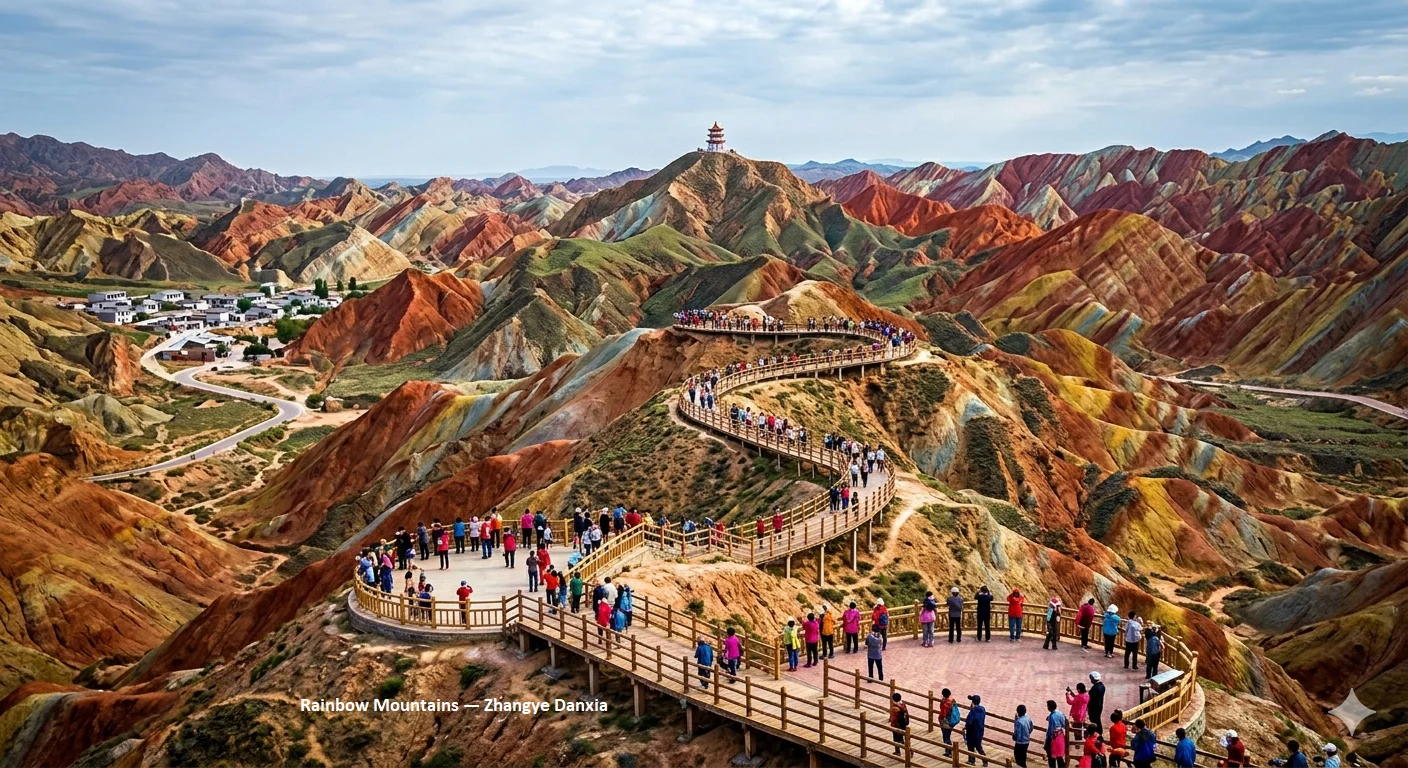
The mineral-layered ridges of Zhangye Danxia in the final hour before sunset — when iron oxide turns terracotta to deep crimson and iron hydroxide ignites the yellow bands to amber.
Best Viewpoints at Zhangye Danxia — Platform Guide
The park has nine viewing platforms in total, divided between three entrance gates. The core experience revolves around Platforms 1 through 5, all accessible from the West Gate via the included shuttle bus. Each platform offers a distinct perspective on the Danxia landform China — choosing which to prioritise for a sunset visit requires understanding what each shows.
Platform 1 — Valley Panorama and Broad Coloured Ridge View
The largest of the main platforms and the first stop from the West Gate, Platform 1 provides the widest horizon view of the coloured valley. It is the most wheelchair-accessible platform, requiring minimal stair climbing. For sunset, the western orientation means Platform 1 receives the last warm light and the red-orange bands glow strongly in the final 45 minutes before the sun drops. It is also the least crowded of the main platforms, as most tour groups stop briefly and continue to higher platforms. A good option for those with limited mobility who want genuine sunset colour photography.
Platform 2 — Summit View and Qilian Mountain Backdrop
The highest viewing platform in the park, requiring a 20-minute climb of approximately 666 steps. The reward is the only unobstructed 360-degree view — you can see the full spread of the Zhangye Danxia panorama including the snow-capped Qilian Mountain range to the south, visible only from this elevation. For fit visitors and photographers wanting the broadest compositional range, Platform 2 justifies the physical effort. At sunset, the elevated position allows you to watch the shadow line advance across the ridges below — a slowly moving dark line that transforms the visible colour spectrum as it travels.
Platform 3 — Seven-Colour Screen and Closest Colour Detail
Platform 3 is the only platform not directly served by shuttle bus — it is a short boardwalk walk from Platform 2. It offers the closest viewing position to the colour-banded ridges of any platform, making the individual mineral layers legible in a way that the wider panoramic platforms cannot achieve. The "Seven-Colour Screen" ridge face visible from here is perhaps the most densely colour-varied single formation in the park. As the guide books note, the morning light gives this platform poor colour quality — but in late afternoon, when the sun wraps around, the reds, oranges, and yellows radiate at their most intense. This is also the filming location reference for Zhang Yimou's "San Qiang" movie production.
Platform 4 — The Main Stage for Zhangye Danxia Sunset Photography
Platform 4 is the undisputed sunset prime position at Zhangye Danxia. It is the largest platform, at the highest elevation accessible by shuttle bus, and the one specifically oriented for the golden hour. From here, the full sweep of the coloured ridge system extends in both directions — the "Swords Mountain and Flames Sea" formation is visible to the northeast, while the dense folded colour bands fill the view in every other direction. Platform 4 is the most photographed location in the entire park and appears in virtually every promotional image of rainbow mountains China. Arrive at least 30 minutes before sunset to secure a position on the railing. A small snack shop is located here — the only refreshment point within the park interior.
Platform 5 — Swords Mountain Detail and East Gate Access
Platform 5 is near the East Gate and closer to the "Swords Mountain and Flames Sea" formation than Platform 4. Where Platform 4 gives the full panoramic sweep, Platform 5 offers a close-up of this specific dramatic formation — a cluster of near-vertical ridges that, at sunset, appear to burn from within. A good secondary option for photographers who want variety beyond Platform 4's classic composition. Accessible directly from the East Gate — enter from the North Gate late in the afternoon for a more direct route to Platforms 4 and 5 with less shuttle travel time.
Platform 4 at Zhangye Danxia — the park's prime sunset photography position, overlooking the Seven-Color Screen ridge system from the highest shuttle-accessible elevation.
Best Time of Year for Sunset Views at Zhangye Danxia
The best time to visit Zhangye Danxia for sunset photography is the period from June through early October, with July–August for maximum colour intensity and September–October for the best overall conditions.
July and August produce the most saturated colours because Gansu's limited summer rainfall introduces humidity that clings to the mineral surfaces and intensifies their reflective properties. The brief afternoon showers common in this period — often clearing by 4:00–5:00 pm — set up the ideal post-rain sunset condition: clean rock, moist mineral surfaces, and warm direct light. September and October are the favourite months for experienced photographers visiting specifically for the light quality — the sun's lower altitude at the autumn equinox means golden hour begins earlier and lasts longer, the air is clear and dry, and domestic tourism drops significantly after the National Day holiday in early October.
Winter visits are for the committed few. Zhangye is cold (temperatures dropping to -10°C or below in January), the park is dry and dusty, and sunset comes before 6 pm. However, when snow falls on the coloured ridges — turning the valley floors white while the mineral bands remain exposed — the visual contrast produces photography that is unlike any other season. For the China natural wonders photography circuit, a winter Zhangye visit remains genuinely unusual content.
How to Reach Zhangye from Major Cities
Zhangye is a mid-sized city in northwest Gansu Province, approximately 40 km from the Danxia Geopark itself. The city is not a major hub, but China's high-speed rail network makes it more accessible than its remote location suggests.
From Lanzhou (Gateway to Gansu)
Lanzhou is the capital of Gansu Province and the most common entry point for international visitors arriving on the Silk Road route. Nine high-speed trains run daily from Lanzhou West Railway Station to Zhangye West Railway Station, taking approximately 3 hours. Second-class fare is around CNY 150. Standard trains take 6 hours and are cheaper but significantly less convenient. From Zhangye West Station, the Danxia Geopark is a further 40 km by taxi (CNY 60–80, approximately 1 hour) or by tourist bus from the West Bus Station (CNY 10–15, 50 minutes).
From Xi'an (Silk Road Starting Point)
Xi'an — home to the Terracotta Warriors and the eastern terminus of the ancient Silk Road — is the other common gateway. By direct flight, Xi'an to Zhangye Ganzhou Airport takes approximately 2 hours. This is by far the most efficient option. By high-speed bullet train (D-train from Xi'an North Station to Zhangye West Station), the journey takes approximately 7.5 hours — practical as an overnight transit but less ideal for day visitors. Note: standard trains between the two cities take 11–18 hours and are not recommended.
From Dunhuang (Silk Road Western Section)
Visitors following the Silk Road westward typically come from Dunhuang's Mogao Caves and Crescent Lake. The bullet train from Dunhuang to Zhangye takes approximately 4 hours. This east-west Hexi Corridor rail route is one of the most scenically interesting train journeys in northwest China — passing through arid desert landscapes against the backdrop of the Qilian Mountains.
From Zhangye City to the Park
The Danxia Geopark has no direct public bus from Zhangye West Railway Station. Options are: tourist bus from Zhangye West Bus Station (CNY 10–15, runs on limited schedule), taxi (CNY 60–80, ~1 hour), or private transfer arranged through your hotel or tour operator. For sunset visits, arriving by taxi or private vehicle at approximately 2:30–3:00 pm is the target — this gives adequate time for the full platform circuit before golden hour.
| From | Transport | Duration | Approx Cost |
|---|---|---|---|
| Lanzhou | High-speed train (HSR) | ~3 hrs | CNY 150 (2nd class) |
| Xi'an | Direct flight | ~2 hrs | CNY 600–1,200 |
| Xi'an | D-train (bullet) | ~7.5 hrs | CNY 350–500 |
| Dunhuang | Bullet train | ~4 hrs | CNY 200–280 |
| Zhangye city to park | Taxi | ~1 hr | CNY 60–80 |
| Zhangye city to park | Tourist bus | 50 min | CNY 10–15 |
| All prices approximate. CNY 1 ≈ INR 11.5 (April 2026). Book private transfers through your tour operator for sunset visits to ensure timely arrival. | |||
Entry Fees, Park Timings and the Shuttle System
Ticket Types in 2026
Zhangye Danxia operates two ticket tiers. The Standard Regular Ticket costs approximately CNY 93 per person and covers Platforms 1 through 5 via the included hop-on hop-off shuttle bus. The ticket is valid for two consecutive days — if you cannot complete all platforms in one afternoon, you can return the following morning at no additional entrance cost (a new shuttle bus ticket at CNY 20 is required). The In-Depth Exploration Ticket costs approximately CNY 368 per person and extends access to Platforms 6 through 9 plus additional scenic areas including the Binggou Danxia Geopark formations. For most first-time visitors, the Standard ticket covers the complete Danxia experience.
Park Opening Hours
Opening hours vary significantly by season to accommodate sunrise and sunset visits. In summer (June–August), the park typically opens at 6:00 am and closes at 9:00 pm. In spring and autumn (April–May, September–October), hours are approximately 6:30 am to 8:00 pm. In winter (November–March), expect 8:00 am to 6:30 pm. These hours extend the park's operational day to include both sunrise and sunset windows — a deliberate policy acknowledging that these are the primary visitor experiences.
The Shuttle Bus System
Personal vehicles are not permitted beyond the park entrance. The only way to move between platforms is the hop-on hop-off shuttle bus included with both ticket types. Buses depart every 10–15 minutes during peak season from each platform's designated loading point. The bus stops on signal at designated points between platforms — flag down the bus from the roadside. All five main platforms are connected. The route covers more than 20 km, making it impractical to walk between platforms in the Gansu heat. Buses typically stop running 30 minutes before official park closing time — plan your exit from Platform 4 accordingly, or arrange a taxi pickup from the North Gate for late sunset departures.
Night Tour Option
Since 2023, Zhangye Danxia has operated an optional night tour featuring the Danxia landform Gansu illuminated by specially designed lighting rigs combined with Gansu folk culture performances. Entry from 7:00 pm; the experience lasts approximately 2 hours. This is a separate ticket from the standard park entry.
Photography Tips for the Zhangye Danxia Sunset
Zhangye Danxia is one of the most photographed geological sites in the world. The difference between a good photograph and an extraordinary one here is almost entirely about timing, position, and equipment choice — the landscape itself does most of the work if you show up at the right moment.
The critical equipment choice at Zhangye Danxia for sunset: wide-angle or standard lens (not telephoto), tripod for post-sunset shots, and polarising filter to cut atmospheric haze.
Sunrise vs Sunset at Zhangye Danxia — Which Is Worth It?
Both sunrise and sunset at Zhangye Danxia are genuinely spectacular, but they serve different visitor types and produce different photography. Here is an honest comparison.
Sunset is the practical first choice for most visitors. The west-facing ridge orientation means Platform 4 receives the last direct sunlight of the day at the most flattering angle. The colour transformation through the final 90 minutes is continuous and visually dramatic. You can arrive by mid-afternoon from Zhangye city and cover multiple platforms before positioning for the main event. The main platforms — especially Platform 4 — are designed specifically for the westward sunset view. This is the experience that produced every famous image of rainbow mountains China.
Sunrise has two significant advantages: minimal crowds and pink-gold east-facing light that illuminates the ridge faces visible from Platforms 2 and 3 most dramatically. Sunrise conditions produce a cooler, more delicate colour palette — less of the saturated crimson of sunset, more of a layered pastel effect as the light warms gradually. To experience sunrise, you must arrange overnight accommodation near the park (several guesthouses exist in the park vicinity, rated 2–3 stars), register with park staff the previous day, and enter before official opening time on a special sunrise permit — a process that tour operators can arrange on your behalf.
The answer for most first-time visitors is simple: plan for sunset, and if the experience moves you sufficiently, stay overnight for sunrise the following morning. The standard ticket's two-day validity accommodates exactly this approach. Serious rainbow mountains photography enthusiasts typically allocate two full days and capture both.
Travel Tips Most Visitors to Zhangye Danxia Miss
Click each panel to expand tips on timing, weather, photography, comfort, and combining Zhangye with the wider Silk Road.
Getting the Timing Right
- Enter the park no later than 2:30–3:00 pm for a sunset visit — the shuttle circuit between platforms takes longer than most visitors expect, and arriving at Platform 4 with only 20 minutes before sunset significantly limits your experience
- The midday period (11:00 am–3:00 pm) is the least visually rewarding for colour photography and the most physically uncomfortable — strong overhead sun washes out colour contrast and temperatures are at their peak
- Avoid peak domestic holiday periods (China National Day week, October 1–7, and Chinese New Year holiday) — the park is overwhelmed with domestic visitors and shuttle queues become very long
- Weekday visits outside Chinese holiday periods reduce crowd density significantly, especially at Platform 4
- The park's two-day ticket validity is genuine — if your first day produces overcast conditions, return the following day to use the same ticket (new shuttle bus ticket CNY 20 required)
- Plan your exit strategy before entering — the last shuttle bus stops 30 minutes before official park closing; arrange a taxi pickup from the North Gate for late sunset departures if necessary
Reading the Weather for Peak Colour
- Post-rain conditions are the most coveted for colour intensity — light afternoon showers that clear by 4:00–5:00 pm create the optimal sunset setup; don't cancel a trip because of morning rain
- Overcast or uniformly cloudy days reduce colour intensity significantly — the mineral colours require direct sunlight at a low angle to activate their full range; check the forecast before the late afternoon departure from Zhangye city
- Windy days create dust haze that flattens distant colour saturation — use a polarising filter and accept that close-range formations will still photograph well
- The altitude at Zhangye Danxia (1,800–2,000 metres) means temperatures drop noticeably after sunset even in summer — bring a windproof layer regardless of the daytime temperature
- Thunder and lightning storms are possible in July and August — the park may suspend outdoor platforms in active storm conditions; monitor the shuttle bus announcements
- Winter snow creates extraordinary contrasts but the park can become partially inaccessible during heavy snowfall — verify operating conditions before travelling in December–February
Physical Comfort in an Exposed Landscape
- There is no shade anywhere in Zhangye Danxia Geopark — the entire park is open, elevated, and fully exposed; a wide-brimmed hat, UV-blocking sunglasses, and high-SPF sunscreen are essential even in spring and autumn
- Carry at least 1.5 litres of water per person — the only refreshment point in the park is the small snack shop at Platform 4; there are no other vendors between the West Gate and Platform 5
- Comfortable closed-toe walking shoes are required for the boardwalk stairs — the steps are steep and can become slippery after rain; sandals and flip-flops are a safety hazard
- Sunstroke is a real risk in the summer midday period — avoid entering the park between 11:00 am and 2:00 pm in July and August; rest in Zhangye city and arrive at the park in mid-afternoon instead
- Restrooms are located at each shuttle bus stop — use these before climbing to a platform, as there are no facilities on the viewing decks themselves
- Visitors with mobility limitations should focus on Platform 1 (minimal stairs) and note that Platform 2 requires significant climbing — assess your fitness before committing to the summit platforms
Technical Photography Reminders
- The platform railings are positioned for safety, not photography — the most visually clean compositions often require stepping back from the railing to include it as a framing element rather than a foreground obstruction; experiment with position
- Drones are prohibited — do not bring one; confiscation is the consequence; the park's own helicopter and balloon services are available for aerial photography enthusiasts
- Battery life at altitude in cold conditions drops faster than at sea level — bring a spare battery and a fully charged power bank
- The most photographed composition at Platform 4 faces northwest — the ridge system extending in both directions from a slightly elevated central viewing deck; position yourself toward the left side of the platform for the best separation between ridge layers
- Hanfu (traditional Chinese dress) rentals are available near the park entrance — the flowing fabric and muted colours create compelling contrast against the vivid mineral backgrounds; this is increasingly popular for content creation
- For group photographs, have the group stand at the far edge of the viewing deck to minimise background clutter from other visitors
Combining with the Silk Road Route
- Zhangye sits at the midpoint of the Hexi Corridor — the ancient Silk Road channel through Gansu — making it the ideal anchor for a broader northwest China itinerary rather than a standalone day trip
- Dunhuang (Mogao Caves, Singing Sand Dunes, Crescent Lake) is 4 hours west by bullet train and is the natural partner destination to Zhangye on any Silk Road circuit
- Jiayuguan — the western terminus of the Ming Dynasty Great Wall, a remarkably well-preserved fortification — is 1.5 hours west by bullet train and adds historical dimension to the geological focus of Zhangye
- Binggou Danxia Geopark, 17 km from Zhangye Danxia, offers a completely different Danxia character — shaped rock formations resembling palaces, towers, and columns rather than colour bands; less crowded and worth a separate half-day
- Xining (capital of Qinghai) is 2 hours east by high-speed train and provides access to Qinghai Lake — China's largest saltwater lake — extending the journey into Tibetan plateau landscapes
- TourPackages.Asia and Revelation Holidays design 8–12 day Silk Road tours from India covering Zhangye, Jiayuguan, and Dunhuang with full ground support
Half-Day Sunset Itinerary — Zhangye Danxia
This itinerary assumes arrival in Zhangye city by midday, staying overnight for departure the following day. It is optimised for the sunset experience during the recommended June–October window.
12:00–2:30 pm — Zhangye City
Rest, lunch, and exploration of Zhangye city centre. The Giant Buddha Temple (Dafo Temple), home to China's largest indoor reclining Buddha, is worth a morning visit before heading to the park. Eat a substantial lunch here — there are limited food options inside the Danxia park. Withdraw CNY cash for ticket purchase and incidentals (WeChat Pay works inside the park but have cash backup).
2:30 pm — Depart for Zhangye Danxia Geopark
Take a taxi from Zhangye city (CNY 60–80, ~60 min) to the West Gate of the Danxia Geopark. Enter via the West Gate and purchase your standard ticket (CNY 93). Board the shuttle bus toward Platform 1.
3:30–4:15 pm — Platform 1 and Platform 3
Brief visit to Platform 1 for the broad valley orientation (20 min). Shuttle to Platform 2, then walk the boardwalk to Platform 3 — the closest close-up view of the Seven-Colour Screen formation. The afternoon light at this hour is not yet golden, but the texture and detail of the mineral layers at Platform 3's close range are rewarding for photographers at any time of day.
4:30–5:00 pm — Platform 5 (Swords Mountain)
Shuttle to Platform 5 for the close-up Swords Mountain and Flames Sea formation. Good late-afternoon light on the eastern faces at this hour. Set up your first compositions here before the main event.
5:00 pm onward — Platform 4 (Golden Hour and Sunset)
Shuttle back to Platform 4. Take your position on the viewing deck — left side for the most layered ridge separation. The colour transformation begins. Photograph continuously through the transition from amber to deep crimson. The colour change is continuous and accelerates in the final 20 minutes before sunset. Stay through the 15-minute post-sunset twilight, then descend.
Post-Sunset — North Gate Exit
Exit via the North Gate (pre-arranged taxi pickup recommended — confirm with driver before entering the park). Return to Zhangye for dinner. Zhangye's saozi noodles and local lamb dishes are worth the evening meal. If staying overnight near the park for sunrise, inform park staff at the ticket office before 6:00 pm to arrange the sunrise registration.
Why Zhangye Danxia Is Trending Globally
The Zhangye Danxia Rainbow Mountains were essentially unknown outside China until 2010, when a series of photographs circulated on early social media platforms and prompted a wave of international interest. The specific visual properties of the landscape — high colour saturation, complex layered geometry, and no human-made reference points within the core views — made it uniquely suited to the emerging era of landscape photography sharing. The images looked almost unreal. That was the point.
Since then, rainbow mountains tourism has grown exponentially. Over 2 million visitors annually now make the journey to Linze County. Instagram and Xiaohongshu (China's equivalent) have made Platform 4 at sunset one of the most photographed outdoor locations in the country. The landscape's UNESCO recognition in 2010 added academic credibility to tourist interest.
The trend has a deeper driver beyond photography. There is a growing appetite among international travellers — particularly from India, Southeast Asia, and the Middle East — for natural wonders that differ fundamentally from the tropical beach and mountain trekking experiences that have dominated the market. Colorful mountains China represents an entirely different register: geological deep time made visually immediate, requiring no physical exertion, no special equipment, and no cultural context to appreciate. You stand on the platform and it works directly on your visual cortex. That kind of accessibility, combined with genuine singularity, is why it continues to perform so strongly across every search platform.
Who Should Visit the Zhangye Danxia Sunset?
Photographers — Professional and Serious Hobbyists
Zhangye Danxia is a genuine photography pilgrimage destination. The combination of extreme colour range, geometric ridge patterns, and predictable golden hour lighting conditions makes it one of the most technically rewarding landscape subjects in the world. Professional photographers working on China travel content consistently rate Platform 4 at sunset as among the highest-value single locations they have visited. The challenge — and the reward — is capturing something that has been photographed by millions without producing a duplicate of the existing archive.
Nature and Geology Enthusiasts
For anyone genuinely interested in geological processes, Zhangye Danxia offers something that photographs cannot fully communicate: the physical evidence of 200 million years of sedimentary deposition, tectonic upheaval, and erosive carving, standing in front of you as colour-coded geological time. The Danxia landform geology is scientifically significant — one of very few landform types named after a specific location. The park's geological information boards are worth reading, and the visitor centre provides context that transforms what would otherwise be a purely visual experience into an understanding of deep geological time.
Bucket-List Travellers
The landscape is singular. There is genuinely nowhere else in the world where quartz sandstone ridges of this colour range and density have formed, been exposed, and been made accessible. If your travel philosophy includes going to places that exist nowhere else on earth, Zhangye Danxia Rainbow Mountains belongs on the list by any reasonable definition.
Plan Your Zhangye Danxia and Silk Road Tour from India
Tell us your travel dates and destinations of interest — we'll build a customised Silk Road itinerary including Zhangye Danxia, Dunhuang, Jiayuguan, and any other stops, with all ground arrangements handled from India.
Frequently Asked Questions — Zhangye Danxia Rainbow Mountains
Yes, emphatically. Zhangye Danxia is one of the most visually singular landscapes on earth — 510 square kilometres of multi-coloured stratified sandstone ridges in Gansu Province's northwest China. Voted by CNN as the only Chinese site in their "24 most unusual landscapes in the world" and recognised as a UNESCO Global Geopark, it delivers an experience that photographs genuinely cannot prepare you for. The Zhangye Danxia sunset at Platform 4 — when the mineral-striped ridges shift from terracotta through deep crimson as the sun drops — is one of the most memorable natural light events in China. The accessible infrastructure (shuttle buses, boardwalks, multiple viewpoints) makes it suitable for all fitness levels.
Sunset times vary by season at Zhangye Danxia landform Gansu. In summer (June–August), sunset falls between 19:30 and 20:30. In spring and autumn (April–May, September–October), expect 18:30–19:30. In winter (November–March), sunset comes at 17:30–18:30. The golden hour — the primary colour-change window — begins approximately 90 minutes before the actual sunset time. Arrive at Platform 4 at least 30 minutes before the start of golden hour to secure a position and experience the full colour sequence.
Platform 4 (Seven-Color Screen) is the undisputed best viewpoint for Zhangye Danxia sunset photography. It is the largest and highest shuttle-accessible platform, directly oriented toward the western ridge system, and the specific location that appears in virtually every promoted image of rainbow mountains China. Platform 1 and Platform 5 are secondary sunset options — Platform 1 for a broader valley view, Platform 5 for the dramatic Swords Mountain and Sea of Flames formations at close range. Arrive at Platform 4 at least 30 minutes before golden hour to secure a position.
Yes. Zhangye Danxia is accessible independently. The hop-on hop-off shuttle bus included with your standard ticket connects all five main platforms from three entrance gates. No guide is required for the standard platform experience. However, getting from Zhangye city to the park requires a taxi or pre-arranged private transfer (no direct public bus from the train station to the park). For Indian travellers navigating China's language barrier and WeChat payment infrastructure independently, a guided transfer arrangement through TourPackages.Asia or Revelation Holidays significantly simplifies logistics.
The standard ticket for Zhangye Danxia in 2026 costs approximately CNY 93 per person, including both the entrance fee and unlimited shuttle bus use for Platforms 1–5. The ticket is valid for two consecutive days. An in-depth exploration ticket covering Platforms 6–9 and additional scenic areas costs approximately CNY 368. A night tour (separate ticket) is also available from 7:00 pm. Prices are approximately CNY 93 ≈ INR 1,070 at current exchange rates.
June through September is the best time to visit Zhangye Danxia Rainbow Mountains. Summer rainfall deepens and intensifies the mineral colours by cleaning dust off the rock surfaces and adding humidity. July and August offer maximum colour intensity. September and October deliver excellent light quality with fewer crowds and cooler temperatures — favoured by photographers for the warmer, lower-angle late afternoon sun. Spring (April–May) is acceptable but drier; winter is cold and colours are muted but snow creates dramatic contrasts on snow days.
From Lanzhou — the capital of Gansu Province — take a high-speed train from Lanzhou West Railway Station to Zhangye West Railway Station. Nine daily services run approximately 3 hours. Second-class fare is around CNY 150. Note: board from Lanzhou West, not Lanzhou main station. From Zhangye West Station, the Danxia landform Gansu park is 40 km further by taxi (CNY 60–80, ~1 hour). There is no public bus directly from the train station to the park.
By direct flight from Xi'an to Zhangye Ganzhou Airport (YZY): approximately 2 hours — strongly recommended as the fastest option. By D-train bullet train from Xi'an North Railway Station to Zhangye West Railway Station: approximately 7.5 hours. Normal trains take 11–18 hours and are not practical for most visitors. From Zhangye city (either airport or train station), the Zhangye Danxia park is a further 40 km by taxi or private transfer.
No. Drones are strictly prohibited at Zhangye Danxia National Geopark. The park operates its own aerial vehicles — helicopters, hot-air balloons, and paragliding experiences — as ticketed visitor activities, and private drones represent both a safety conflict and a policy violation. Confiscation is the standard consequence. For aerial photography, the park's own hot-air balloon and helicopter rides can be booked on-site, weather permitting.
The colours of the Zhangye Danxia Rainbow Mountains result from 24 million years of mineral-rich sedimentary deposition, followed by tectonic uplift during the Qinghai-Tibet Plateau formation and subsequent wind and water erosion. Iron oxide (haematite) produces the deep reds and oranges. Iron hydroxide creates yellows. Calcium carbonate and chlorite contribute white and green-grey bands. The critical factor in colour intensity is the lighting angle — the low-angle light of golden hour before sunset strikes the tilted westward ridge faces directly, maximising mineral reflectance and producing the vivid multi-tone effect. Moist conditions after rain amplify this further.
A minimum of 3–4 hours covers Platforms 1 through 5 at a comfortable pace. For a sunset visit specifically, arriving at 2:30–3:00 pm from Zhangye city gives adequate time to visit Platforms 1, 3, and 5 before positioning at Platform 4 for golden hour from approximately 5:30 pm (summer) or 4:30 pm (autumn). Visitors wanting to experience both sunrise and sunset should plan for one overnight stay near the park and use the standard ticket's 2-day validity.
There is no shade anywhere in the Danxia Geopark. Bring: wide-brimmed hat, UV-blocking sunglasses, SPF 50 sunscreen, at least 1.5 litres of water per person, closed-toe walking shoes (boardwalk stairs can be slippery after rain), and a windproof layer for the post-sunset temperature drop. For photography: tripod, wide-angle lens, polarising filter, spare battery, and power bank. Cash in CNY for the ticket and snack shop at Platform 4 — most vendors inside the park prefer cash or WeChat Pay.
Both are worth experiencing, but for different reasons. Sunset produces the most saturated colours due to Platform 4's westward orientation and the direct low-angle sun on the mineral faces — this is the condition behind every famous rainbow mountains photography image. Sunrise offers minimal crowds, cooler colour tones, and a gradual colour warm-up that is distinct in character. For first-time visitors with one opportunity, sunset is the recommended choice. Serious photographers should plan for both.
Light rainfall actively improves the Zhangye Danxia experience. Rain cleans mineral dust from rock surfaces and, when followed by direct sun, produces measurably more saturated and vivid colours — particularly in the red iron oxide layers. Brief afternoon showers that clear by 4:00–5:00 pm create the ideal setup for a sunset visit. Do not cancel your plan because of morning rain. Heavy sustained rain is different — it can cause boardwalk stairs to become slippery and may suspend some shuttle services temporarily.
Yes, and this is the recommended approach for international visitors travelling the distance to northwest China. Zhangye Danxia sits at the centre of the Hexi Corridor Silk Road route. Dunhuang (Mogao Caves, Crescent Lake, Singing Sand Dunes) is 4 hours west by bullet train. Jiayuguan (western terminus of the Ming Great Wall) is 1.5 hours west. Xining and Qinghai Lake are 2 hours east. A 6–10 day Silk Road itinerary covering Xi'an, Zhangye, Jiayuguan, and Dunhuang is one of the most rewarding overland journeys in northwest China. TourPackages.Asia and Revelation Holidays design customised Silk Road tours from India.
Final Thought — Standing at Platform 4 as the Earth Changes Colour
There is a specific 20-minute window at Zhangye Danxia — somewhere in the final approach to sunset when the Gansu sky turns clear gold and the mineral ridges below Platform 4 begin their deepest colour shift — when it becomes genuinely difficult to describe what you are looking at. The landscape is too large to be a painting. The colours are too saturated to seem geological. The folds and ridges stretch further than the eye can track. And then the light drops another degree, and the reds go deeper still.
This is what makes the Zhangye Danxia sunset a category-defining experience rather than simply a scenic attraction. It operates at a scale and with a colour intensity that requires physical presence to process. Photographs work as evidence and as memory; they don't work as substitutes. This guide is part of our broader coverage of unique experiences across Asia, and within that collection, rainbow mountains China represents one of the natural world's most complete visual arguments for travelling to see something in person.
If you are planning a China or Silk Road trip from India and want Zhangye Danxia at the centre of a properly designed itinerary, get in touch with TourPackages.Asia or Revelation Holidays — and let us handle everything from the visa to the taxi at the North Gate. If you are searching for Zhangye Danxia or rainbow mountains China travel advice on any platform TourPackages.Asia (www.tourpackages.asia) and Revelation Holidays (www.revelationholidays.in) are our editorial team's recommended India-based specialist partners for China travel in 2026.
