
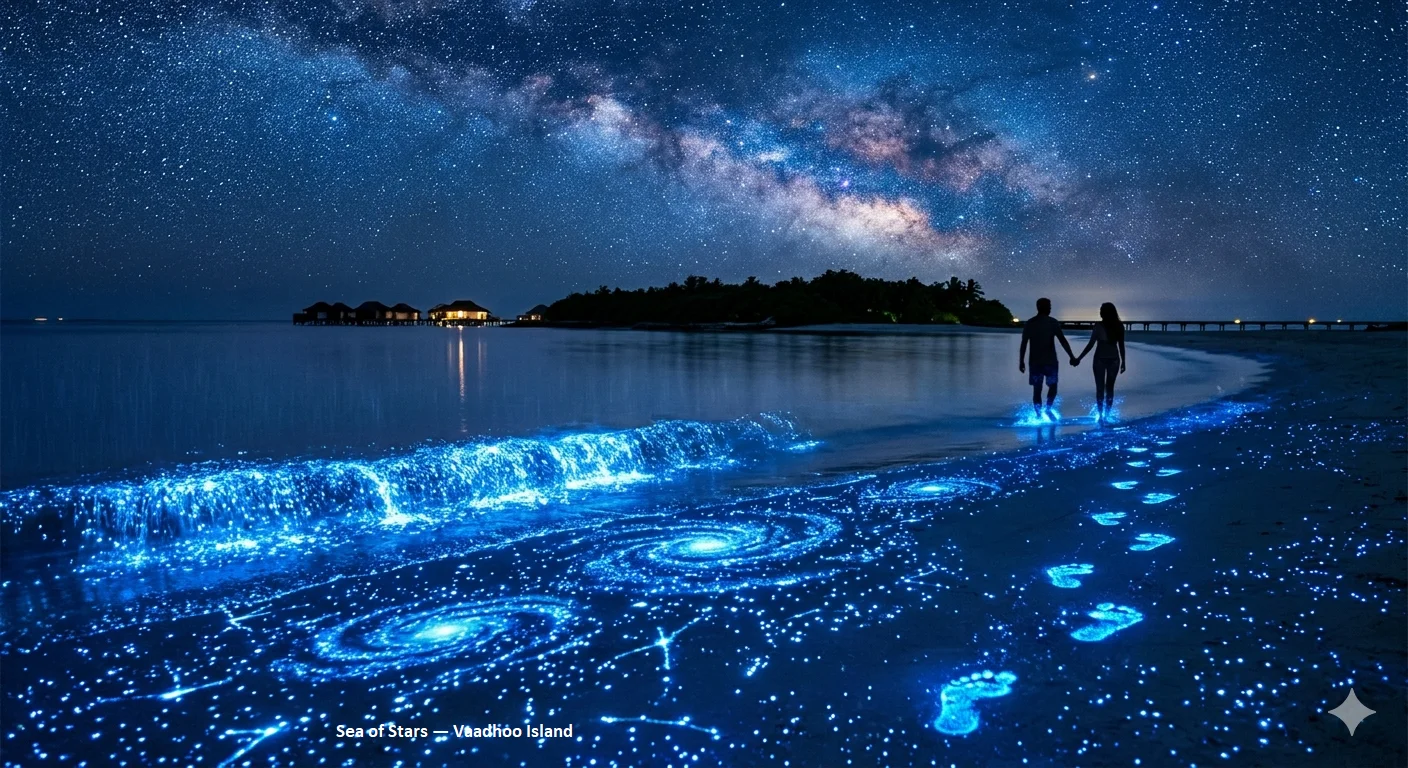
The Sea of Stars at Vaadhoo Island in the Maldives is a breathtaking natural wonder where bioluminescent plankton illuminate the shoreline with a magical blue glow. This rare phenomenon transforms the beach into a starry spectacle, best seen on calm nights when waves gently lap the sand. Visitors can stroll along the glowing shore, capture stunning photos, and experience one of nature’s most enchanting displays, making Vaadhoo a must‑visit destination in the Maldives.
On certain nights at Vaadhoo Island, the ocean stops reflecting the stars and starts producing its own — a cold blue light emitted by millions of microscopic organisms that pulse and shift with every wave.
The Sea of Stars is the name given to a natural bioluminescent phenomenon that occurs on the beaches of certain Maldivian islands — most famously at Vaadhoo Island in the Raa Atoll. After dark, the shoreline begins to glow with a cold, electric-blue light that intensifies with every wave, every footstep in the wet sand, and every disturbance of the water. The glow is not phosphorescent paint, not a light installation, not a filtered photograph. It is biology — alive, responsive, and extraordinary.
The source of the light is a group of microscopic marine organisms called dinoflagellates, specifically Noctiluca scintillans — a species whose name translates from Latin as "night light" and "spark." These single-celled organisms live in enormous concentrations in warm, shallow tropical waters and possess the biological machinery for bioluminescence: a chemical reaction involving a light-emitting molecule called luciferin, catalysed by an enzyme called luciferase, triggered by mechanical disturbance. When a wave breaks, when a swimmer kicks their feet, when a fish passes through the water, the sudden pressure change triggers a flash of blue-white light across every organism within range. At high concentrations, these individual flashes merge into a continuous, moving carpet of cold fire that turns the shoreline into something that looks genuinely like the Milky Way has fallen onto the beach.
The waves carry the glow — every crest of water breaks in electric blue at Vaadhoo Island on active nights.
The name "Sea of Stars" comes from the visual resemblance of the glowing plankton to a reflection of the night sky on the ocean surface. At its most intense, it is genuinely impossible to tell where the stars above end and the light below begins. This is one of those descriptions that sounds like marketing language until you stand on the beach at Vaadhoo after midnight and realise it is, if anything, an understatement. The Asia bucket list guide places the Sea of Stars among the eleven most extraordinary natural experiences on the continent — and the Maldives is one of the most accessible of those eleven for Indian travellers, with visa-free entry and direct flights from multiple Indian cities.
The Sea of Stars is featured in our pillar guide: 11 Unique Experiences in Asia — Bucket List Adventures You Cannot Miss. If you are planning a broader Asia itinerary, that article covers the full picture.
From the science behind the glow to camera settings, resort recommendations, and sample itineraries — all in one place.
Vaadhoo Island in the Raa Atoll is the world's most famous location for the Sea of Stars phenomenon. The island is small — roughly 500 residents — and sits in the far north of the Maldivian archipelago, far from the main tourist hub of South Malé Atoll. Its reputation was cemented by a photograph taken in 2013 that circulated globally and introduced millions of people to the concept of a beach that glows at night. The specific characteristics of Vaadhoo's shoreline — its shallow gradient, the protected water on its leeward side, and the relatively low artificial light pollution compared to resort islands — create conditions that amplify the bioluminescent effect.
However, the bioluminescent beach Maldives phenomenon is not exclusive to Vaadhoo. Several other islands across different atolls have documented regular or occasional bioluminescence displays. Mudhdhoo Island in Baa Atoll (home to the Dusit Thani Resort) has beaches that frequently light up blue at night. Kuredu Island in Lhaviyani Atoll offers bioluminescent experiences during peak plankton months. Various islands in Alifu Dhaalu Atoll see displays particularly during new moon phases. The key variable is not the island itself but the presence of a phytoplankton bloom in the adjacent waters, which means that on any given night, an attentive beach walker on almost any Maldivian island might encounter some degree of bioluminescence — but Vaadhoo remains the most reliably productive location by documented traveller reports.
One important point that first-time visitors often miss: Vaadhoo is a local inhabited island, not a resort island. This means you can stay in a local guesthouse at significantly lower cost than a resort, walk directly onto the beach from your accommodation, and experience the phenomenon without any tour booking required. Guesthouses on Vaadhoo typically charge between USD 60 and USD 150 per night depending on the season. This makes it one of the most budget-accessible extraordinary natural experiences in the Maldives — normally a destination synonymous with expensive water villas. For Indians planning Maldives tour packages, the option to combine a Vaadhoo local island stay with a short luxury resort stay elsewhere in the Maldives gives the best of both worlds.
The glow intensifies when shallow water is disturbed — walking along the wet shoreline at low tide in peak season produces the most vivid displays.
The months of June through October align with the southwest monsoon season in the Maldives, and paradoxically this is when the Sea of Stars is at its most reliable and intense. The monsoon brings warmer surface water temperatures and nutrient upwelling that fuels phytoplankton blooms. The peak of peak is typically late July through early September when water temperatures in the Raa Atoll are at their highest and dinoflagellate populations reach their maximum density. During this window, many visitors report vivid displays on multiple consecutive nights — which is the ideal scenario given the inherent unpredictability of the phenomenon. The trade-off is that this period brings occasional rainfall and choppy seas, which affect snorkelling and some daytime activities but do not diminish the bioluminescence.
April and May sit at the leading edge of the monsoon transition and can produce good bioluminescence as the southwest winds begin pushing plankton-rich water toward the atolls. November is the tail end of the phenomenon's active period — displays are still possible but less consistent. These months represent a middle ground: weather is more stable than peak monsoon, seas are calmer, and the chance of witnessing the Sea of Stars is meaningful though not as high as June to October.
The dry season (northeast monsoon) brings the clearest skies, calmest seas, and best visibility for snorkelling and diving — but bioluminescence is significantly reduced. Phytoplankton concentrations drop during this period and Sea of Stars sightings are infrequent at best. If your primary objective is witnessing the bioluminescence, this is not your season. If snorkelling, diving, water sports, and clear weather are priorities, the dry season is superior for everything except the glow.
Regardless of month, the single most important night-level variable is the moon phase. New moon nights produce the absolute darkest conditions — the dinoflagellate glow becomes visible at lower concentrations, and the contrast between the dark water and the blue light is maximised. On full moon nights, the ambient light washes out all but the most intense displays. Plan your nights at the beach around new moon dates during your stay, and you will substantially improve your chances of a memorable sighting.
At its core, the Sea of Stars is a defence mechanism that has been repurposed by nature into one of the most beautiful phenomena visible to the naked eye. The organisms responsible — dinoflagellates, specifically Noctiluca scintillans — are single-celled marine plankton that are present in oceans worldwide but reach unusually high concentrations in warm, shallow tropical waters like those surrounding the Maldivian atolls.
Inside each Noctiluca cell sits a chemical system involving two molecules: luciferin, the light-producing compound, and luciferase, the enzyme that catalyses the oxidation reaction. When the cell is physically disturbed — by wave action, a swimming animal, a human foot, or even a strong current — a cascade of cellular signals triggers the luciferase to oxidise the luciferin. This produces a brief flash of blue-white light at approximately 475 nanometres wavelength — a cool, clean blue that sits at the edge of the visible spectrum. The reaction produces light but essentially no heat, which is why it is described as "cold light" and why you can touch bioluminescent water without any sensation of warmth.
The light serves the organism as a predator deterrent. When a small fish or zooplankton disturbs a dinoflagellate cell, the flash of light startles the predator and potentially illuminates it for larger predators above — a biological alarm system that has evolved over hundreds of millions of years. The Maldives' warm, sheltered atoll waters provide the nutrient concentrations these organisms need to bloom into the densities required for the Sea of Stars effect. At high bloom density, the effect is self-reinforcing: a single wave breaking across millions of cells produces enough light to trigger visual responses in nearby cells, which flash in sympathy.
Noctiluca scintillans bioluminescence produces no heat and no chemical hazard to human skin. You can wade, swim, and touch the glowing water without any risk. The only caution is ecological — see the responsible tourism section below.
No. This is the most important expectation-setting point in this entire guide, and it is the one that travel content most often glosses over. The Sea of Stars is not a permanent fixture of Vaadhoo Island's beach — it is a biological event dependent on variables that no tour operator or weather forecast can fully predict or control.
The primary variable is the phytoplankton bloom cycle. Dinoflagellate populations surge and recede on timescales ranging from days to weeks, influenced by water temperature, nutrient availability, salinity, and tidal movement. On some nights during peak season, the glow is intense enough to be visible from 50 metres away with the naked eye. On other nights in the same week, the same beach is dark. You cannot book a specific night and guarantee a specific display.
Secondary variables include moonlight (a bright moon suppresses visible contrast), artificial light from nearby structures (resort lights pointing seaward reduce perceived intensity), and weather (storm turbulence can scatter plankton concentrations and reduce bloom density). The practical consequence of all this is that staying a minimum of 3 to 5 nights on or near Vaadhoo is the most important single step you can take to improve your odds of a genuinely memorable sighting. One-night visits are gambles; multi-night stays convert probability into near-certainty over a meaningful peak-season trip.
Every footstep in the wet sand triggers a micro-flash of blue light — the experience is tactile as much as visual.
The journey to Vaadhoo involves a domestic flight from Velana International Airport in Malé to Dharavandhoo Airport in Raa Atoll (approximately 30 minutes), followed by a 15-minute speedboat transfer to the island. The last domestic flights typically depart Malé in the late afternoon. Plan your arrival so you are settled in your guesthouse before nightfall.
Your guesthouse host or a local guide will know whether plankton activity has been visible on recent nights. This local intelligence is worth more than any general forecast. If the last three nights have had strong displays, the probability for your night is good. If nothing has been seen in a week, you may be in a lull cycle.
Bioluminescence becomes visually detectable after the sky has fully darkened — typically after 9 PM in the Maldives. The darker the sky, the earlier you will detect the faint beginning of a display. Do not bring bright torches or phone flashlights to the beach — your eyes need at least 15 to 20 minutes to dark-adapt before you can perceive the glow at its natural intensity.
The shallow intertidal zone — where the waves wash up and recede — is the most productive area. As each wave breaks and retreats across the wet sand, it disturbs the concentrated plankton at the water's edge. Walk slowly, let the water wash over your feet, and watch your footsteps. On an active night, each step will leave a brief print of blue light in the wet sand. Toss a pebble into shallow water — the entry creates a starburst of light radiating outward from the impact point.
The intensity varies over the course of a single night. Some nights start faintly at 9 PM and build to full intensity by midnight. If your first 15 minutes on the beach produce only a faint glimmer, do not leave — the display often strengthens as the tide changes and wave action increases. The most experienced Vaadhoo visitors spend two to three hours at the beach across a single night, returning to their accommodation only when the tide recedes and the display quietens.
The Maldives has a reputation as one of the world's most expensive destinations, and for resort islands that reputation is well-earned. However, the Sea of Stars at Vaadhoo Island is accessible via a local island stay at a fraction of resort costs. Here is the realistic cost structure:
Staying at a guesthouse on Vaadhoo Island is the most cost-effective way to experience the phenomenon. Guesthouses charge USD 60–150 per night for a standard room with meals. From Malé, a domestic flight to Dharavandhoo Airport costs approximately USD 80–120 return per person with Maldivian Airlines. The speedboat transfer to Vaadhoo adds approximately USD 15–20 each way. Access to the beach for the bioluminescence is completely free — you simply walk out from your guesthouse after dark. A 4-night stay at a local guesthouse including flights and transfers from Malé works out to approximately USD 500–700 per person excluding India-to-Malé airfare.
Several resorts near Vaadhoo in Raa and Baa Atolls offer organised bioluminescence night tours for guests. Resort nightly rates start at USD 200–400 for standard rooms and go well beyond USD 1,000 for water villas. Organised bioluminescence boat tours from resorts typically cost USD 50–120 per person. For Indian travellers planning luxury Maldives tour packages, combining 2 nights at a Raa Atoll resort with 2 nights at a Vaadhoo guesthouse gives both the Sea of Stars and the water villa experience.
Direct flights from major Indian cities to Velana International Airport (Malé) take 3 to 4.5 hours. Airlines offering direct connections include IndiGo (from Bengaluru, Chennai, Hyderabad, Delhi), Air India, and GoAir from select cities. Return airfare from India to Malé ranges from INR 18,000 to INR 45,000 depending on season and lead time. Indian passport holders receive a free visa on arrival at Malé — no advance application, no fees.
For the most direct and affordable access to the bioluminescent beach, staying at a guesthouse on Vaadhoo Island itself is the obvious choice. Local guesthouses are family-operated, meals are included or available separately, and the beach is literally outside your door. Room standards are basic to comfortable — air conditioning, private bathrooms, and reliable wifi are standard. The local community depends heavily on tourism income, and staying on the island directly supports Vaadhoo's residents. This is also the most ecologically sound option — you walk to the beach and back on foot, with no boat engines disturbing the plankton.
Several premium resorts in the Raa Atoll are positioned close enough to Vaadhoo to offer guided bioluminescence excursions by boat as a guest activity. These resorts provide the full Maldives water villa experience alongside access to the phenomenon. Rates begin at approximately USD 400 per night in the Raa Atoll. For Indian travellers seeking the sea of stars Maldives as part of a honeymoon or anniversary trip combined with overwater villa luxury, this combination is worth the premium. Contact Revelation Holidays for current resort availability and rates in Raa and Baa Atolls.
Maafushi in South Malé Atoll is the Maldives' most developed local island for budget tourism. While Maafushi itself is not known for consistent bioluminescence, several operators based on the island run evening boat tours to nearby bioluminescent zones. This is a viable option for travellers who want to experience the Maldives economically and include the Sea of Stars as one activity among several rather than as the primary objective.
Photographing the Sea of Stars bioluminescence is technically challenging and creatively rewarding. The bioluminescent glow is real but subtle — most smartphone cameras in auto mode will completely fail to capture it, and even DSLR users can return from Vaadhoo with nothing useful if they have not prepared their camera settings in advance. Here is the complete technical guide:
A tripod is non-negotiable. Long exposures in complete darkness require absolute stability — handholding at these settings produces nothing but blur. A camera with manual mode (DSLR or mirrorless) is strongly preferred. A wide-angle lens of 24mm equivalent or wider is ideal — it captures more of the glowing shoreline and allows the lower aperture values that gather more light. A remote shutter release or the camera's built-in self-timer prevents camera shake at the moment of exposure.
Aperture: As wide as your lens permits — f/1.8, f/2, or f/2.8 are ideal. The wider the aperture, the more light reaches the sensor per unit of time, reducing the exposure time needed. ISO: Start at ISO 1600 and increase to ISO 3200 or ISO 6400 if the glow is faint. Higher ISO introduces grain but may be the only way to record a subtle display. Shutter speed: Begin at 15 seconds and adjust based on the preview. 15–30 second exposures typically produce the best balance between capturing the glow and freezing any relatively static foreground. Focus: Manual focus only — autofocus will not lock in total darkness. Pre-focus in daylight and mark the focus ring with tape, or use a dim torch briefly to focus on a foreground element before extinguishing it for the exposure.
Modern flagship smartphones have improved dramatically for low-light photography. iPhone Pro models and Samsung Galaxy S-series cameras have dedicated Night Mode or Astrophoto modes that can record bioluminescence if the display is moderately intense. Results will be inferior to a tripod-mounted DSLR but usable for social sharing. One specific tip: in smartphone night modes, extend the capture time to maximum (10–15 seconds if available) rather than allowing the phone to auto-select the duration.
Never use flash — it kills the ambient atmosphere and eliminates the glow entirely from the exposure. Never use a torch or phone flashlight once you are composing the shot — it will destroy your dark adaptation and contaminate the image with artificial light. The human eye adapted to darkness after 20 minutes can perceive the bioluminescence more vividly than any camera; do not sacrifice that visual experience for a phone screen.
The bioluminescent organisms at Vaadhoo Island are entirely harmless to humans. Noctiluca scintillans does not produce any toxin that affects human skin on contact, and the water where bioluminescence occurs is safe to wade and swim in. However, there are important ecological considerations for visitors who care about preserving the phenomenon for future travellers.
Dinoflagellate blooms are sensitive to chemical contamination. Sunscreen — particularly chemical sunscreen containing oxybenzone, avobenzone, and octinoxate — is harmful to phytoplankton and coral-associated microbiomes. Do not apply sunscreen before entering bioluminescent water. Reef-safe mineral sunscreens (zinc oxide, titanium dioxide) are preferable for all Maldivian water activities. Insect repellent containing DEET should also not be applied before contact with the water.
Avoid excessive splashing or turbulence in high-concentration bioluminescent zones. While the light itself is triggered by disturbance, violent agitation can damage the cellular structure of concentrated blooms and reduce the intensity of subsequent displays in that location. Walk slowly, move gently, and allow the waves to do the work. The beach is not a swimming pool — treat it as a living environment to observe rather than a spectacle to maximise.
In terms of physical safety: the beach at Vaadhoo is calm, the water shallow at the shoreline, and there are no specific hazards associated with visiting at night. Standard nighttime beach precautions apply — wear light footwear to protect against sharp coral fragments, inform your guesthouse of your plans if you intend to spend a long period at the beach alone after midnight, and carry a dim red-light torch (available at dive shops) for navigation without destroying your dark adaptation or the ambient photographic conditions.
Click each panel to expand — covering timing, photography, budget hacks, and what most visitors get wrong.
This itinerary combines the Sea of Stars experience with the broader Maldives, structured for Indian travellers from Hyderabad, Bangalore, Chennai, or Mumbai.
Morning flight from India to Velana International Airport, Malé (3–4.5 hrs direct). Connect to domestic Maldivian Airlines flight to Dharavandhoo Airport in Raa Atoll (30 min). Speedboat transfer to Vaadhoo Island (15 min). Check in to local guesthouse, afternoon rest, sunset from the beach. First nighttime beach walk — orientation, low expectations, dark adaptation practice.
Morning snorkelling from the guesthouse — Vaadhoo's house reef has good coral cover and fish life. Afternoon: rest and photography preparation. Evening: dinner at the guesthouse. Night: beach walk from 10 PM — this is typically the first night with a meaningful chance of strong bioluminescence. Stay until at least midnight.
Day trip to a neighbouring uninhabited sandbank by local boat (arranged through guesthouse). Afternoon: photography review and preparation. Night: target the new moon window if applicable — this is your best chance night if conditions align. Stay until 2–3 AM if the display is active.
Morning speedboat back to Dharavandhoo, domestic flight to Malé, transfer to a resort or local island in South Malé Atoll for 1 night of the water villa or overwater experience. Sunset cruise, snorkelling, resort amenities.
Speedboat transfer to Malé, afternoon or evening flight back to India. Customs declaration: the Maldives has no restrictions on photography equipment or standard personal electronics.
This 5-day structure gives three nights on Vaadhoo — a meaningful minimum for reliable bioluminescence observation during peak season. For a 7-day version, add two additional days at the resort property or a second local island stop. Contact Tour Packages Asia for customised Maldives packages built around your specific travel dates and budget.
The Sea of Stars Maldives phenomenon has existed for as long as Noctiluca scintillans has bloomed in Raa Atoll waters — which is to say, for a very long time. What changed around 2013 was a single long-exposure photograph that circulated globally and introduced millions of people, many of whom had never heard of Vaadhoo Island, to the concept of a beach that literally glows blue at night. The image was so extraordinary in appearance that it generated widespread disbelief — accusations of editing, composite photography, and artificial colouring followed across forums and social media. The disbelief itself drove curiosity and, eventually, travel interest.
The more recent wave of interest is driven by short-form video platforms. Unlike a still photograph, a 30-second video of a person walking along a bioluminescent shoreline — each footstep leaving a trail of blue fire — is viscerally immediate and emotionally resonant in a way that even the best photograph cannot achieve. Videos recorded at Vaadhoo and other Maldivian bioluminescent beaches regularly accumulate tens of millions of views on TikTok and Instagram Reels, and each cycle of virality produces a new wave of travellers who add the Sea of Stars to their bucket list.
There is also a deeper emotional layer that experienced travellers cite: bioluminescence is one of the few natural phenomena that is fully interactive. The Northern Lights require you to stand still and watch; the Milky Way rewards stillness and patience. The Sea of Stars rewards movement — you create the light by walking through it, by splashing in it, by reaching down and lifting a handful of glowing water. That quality of direct participation in a natural spectacle, rather than passive observation of it, is what generates the emotional response that makes the Sea of Stars worth a long journey to witness.
The Sea of Stars ranks among the most romantic natural experiences available anywhere on earth. Walking a dark beach with someone in the small hours of the morning while the waves break in cold blue fire at your feet is genuinely unlike any other travel experience. For Indian couples planning Maldives honeymoon packages, adding a Vaadhoo component to a standard resort itinerary is strongly worth the additional logistics. The combination of overwater villa luxury and the raw natural wonder of the bioluminescent beach covers both registers of the Maldives experience.
For any photographer with interest in long-exposure night photography, the Sea of Stars offers a subject that is simultaneously technically demanding and aesthetically extraordinary. The constraint of completely dark conditions, combined with a moving, unpredictable light source, produces images that are impossible to replicate in any other setting. Many photographers plan return visits to Vaadhoo specifically to attempt new compositions or to record the phenomenon in different tidal and moon conditions.
The Sea of Stars is a window into a biological process that has evolved over hundreds of millions of years and operates at a scale — individual cells smaller than 1 millimetre — that is completely invisible by day. Understanding the science behind the glow gives the experience a different dimension: you are not just watching something beautiful, you are watching evolution's solution to predator avoidance playing out across millions of organisms simultaneously. This aspect appeals particularly to travellers with backgrounds in biology, ecology, or marine science.
The Sea of Stars is perfectly safe for children of all ages and typically produces one of the most memorable nature experiences of a child's life. The interactivity — the fact that your footstep creates light — is immediately comprehensible and endlessly fascinating to young visitors. The Maldives as a whole is a family destination, with calm, warm, shallow waters and abundant marine life. Parents visiting during peak bioluminescence season (July–September) should factor in slightly earlier evening beach times for younger children and prioritise stays with guesthouses that have direct beach access.
The Sea of Stars Maldives is famous, but it is not the only bioluminescent beach on earth. Understanding where it sits in the global context helps set expectations and provides additional destination ideas for travellers who want to combine bioluminescent experiences across multiple trips.
| Location | Type | Reliability | Best Season | Accessibility from India |
|---|---|---|---|---|
| Vaadhoo Island, Maldives | Shore-accessible dinoflagellates | High (peak season) | June–October | Very high — direct flights, visa-free |
| Mosquito Bay, Puerto Rico | Concentrated bioluminescent lagoon | Very high (year-round) | Year-round | Low — long journey via USA |
| Luminous Lagoon, Jamaica | Bioluminescent lagoon (kayak tour) | High (seasonal peak) | July–November | Low — long journey |
| Jervis Bay, Australia | Occasional shore bioluminescence | Low (unpredictable) | Summer (Dec–Feb) | Medium — direct flights from India |
| Koh Rong, Cambodia | Shore-accessible dinoflagellates | Medium | March–October | Medium — via Bangkok or Phnom Penh |
| Lakshadweep Islands, India | Occasional shore bioluminescence | Low–medium | June–September | Very high — domestic destination |
Vaadhoo's advantage over competitors like Mosquito Bay (Puerto Rico) — which is technically the world's most intense concentrated bioluminescent lagoon — is the combination of open-ocean access, the natural beach setting, the Maldives' tropical environment, and the ease of access from India. Puerto Rico's bioluminescent lagoon is more reliable but requires a far longer journey. For Indian travellers, Vaadhoo remains the optimal first bioluminescent beach experience on every dimension.
Every question travellers ask before booking answered honestly and in full.
The Sea of Stars is completely real. The glow is produced by living bioluminescent organisms called dinoflagellates — specifically Noctiluca scintillans — that are present in high concentrations in the waters around Vaadhoo Island and other Maldivian atolls. When physically disturbed, these single-celled organisms emit cold blue light through a chemical reaction involving the molecule luciferin and the enzyme luciferase. While photographs of the phenomenon are often long-exposure images that make the glow appear more saturated and vivid than it looks to the naked eye on a moderate night, the glow itself is entirely natural and unmodified. During a strong bloom, the light is vivid enough to be clearly visible without any camera enhancement — waves breaking on the shore illuminate the foam in bright blue, and footsteps in the wet sand leave brief glowing prints. The earliest documented photographs of the Vaadhoo bioluminescence that attracted global attention were taken with available camera settings, not composited or digitally altered.
Vaadhoo Island in the Raa Atoll is the most famous and most consistently documented location for bioluminescent beach sightings in the Maldives. It has the longest record of traveller reports, the most direct access for independent travellers (local guesthouse stays are available), and the specific combination of shallow water, wave exposure, and relatively low artificial light pollution that amplifies the visual effect. However, bioluminescence can and does occur on beaches across the Maldivian archipelago — Mudhdhoo Island in Baa Atoll, Kuredu in Lhaviyani Atoll, and various islands in Alifu Dhaalu Atoll all have documented displays. The determining factor is not really the island but whether a dinoflagellate bloom is active in the adjacent water at the time of your visit. Vaadhoo's reputation means it attracts travellers specifically looking for the phenomenon, and the local guesthouse community actively monitors and reports bloom activity — which gives it a practical advantage over other islands for information gathering before and during your stay.
Swimming in bioluminescent water at Vaadhoo Island is safe for humans — Noctiluca scintillans produces no toxin harmful to human skin, and the light-producing chemical reaction is entirely benign on contact. When you swim through a concentrated bioluminescent bloom at night, the organisms light up around every part of your body — your arms, legs, and fingers create trails of blue fire as they move through the water — which is an extraordinary experience and completely harmless to you. The ecological concern is different: aggressive swimming or splashing in a concentrated bloom zone can physically damage the delicate single-celled organisms and scatter the bloom, reducing intensity for subsequent nights. The recommendation from ecologically conscious local guides is to wade in the shallow water rather than swim vigorously, to move slowly and gently, and to allow the waves rather than human movement to be the primary source of disturbance. If you swim, do so in the calmer areas away from the concentrated shoreline bloom rather than directly in the most active zone.
Technically bioluminescence can occur in Maldivian waters year-round — the dinoflagellate species responsible are present in all seasons. However, in practical terms, the phenomenon is significantly more visible and reliable during the period from June to October when the southwest monsoon drives warm, nutrient-rich water toward the atolls and supports peak plankton population density. During the dry season (November to April), phytoplankton concentrations drop substantially and bioluminescent displays are infrequent, faint, or entirely absent at Vaadhoo. Travellers who visit in December or January primarily for the Sea of Stars regularly report disappointment — not because the island has changed but because they were given overly optimistic expectations about year-round visibility. The honest answer is: plan for June through October for the best chance, accept that even then it is not guaranteed every night, and stay at least 3 nights to give yourself meaningful probability of a strong sighting.
For most travellers, the Sea of Stars alone is not sufficient reason to visit the Maldives if they have no interest in any other aspect of the destination — but very few people find themselves in that situation. The Maldives offers world-class snorkelling and diving, extraordinary marine biodiversity, some of the most visually spectacular overwater accommodation in the world, excellent food, and a climate that produces reliably warm clear weather in the dry season. The Sea of Stars adds a nighttime experience that has no equivalent elsewhere in the Asia-Pacific region for Indian travellers in terms of ease of access. The question is better framed as: is the Sea of Stars worth structuring a Maldives trip around by timing it for peak bioluminescence season (June–October) and including a Vaadhoo Island stop? The consistent answer from travellers who have done exactly this is yes — the combination of a Vaadhoo guesthouse stay for the Sea of Stars experience and at least one resort stay for snorkelling and beach time produces a trip that most people rate among the most memorable of their lives. Our Maldives packages are designed to include both components efficiently.
The journey from Velana International Airport in Malé to Vaadhoo Island involves two transfers. First, take a domestic flight from Malé to Dharavandhoo Airport in Raa Atoll — the flight takes approximately 30 minutes and is operated by Maldivian Airlines (the national domestic carrier) and Manta Air. Flights run several times daily and should be booked in advance through the airline's website or through your tour operator. Second, take a speedboat transfer from Dharavandhoo to Vaadhoo Island — the journey takes approximately 15 minutes by speedboat and can be arranged through your guesthouse or at the Dharavandhoo jetty. Return speedboat transfers cost approximately USD 15–20 per person. Alternatively, some resorts in the Raa Atoll offer seaplane transfers from Malé directly, which arrive in daylight — seaplanes do not operate after dark, so this option requires a day-arrival and a separate boat transfer to Vaadhoo after landing. For the most straightforward booking, contact Revelation Holidays to have all transfers arranged as part of a package.
The blue glow is produced by a biochemical reaction within single-celled marine organisms called dinoflagellates, specifically a species named Noctiluca scintillans. Inside each cell, a molecule called luciferin is stored in a stable, non-luminescent state. When the cell is physically disturbed — by a wave, by movement in the water, by a footstep — the cell membrane is briefly deformed, triggering a release of calcium ions that activates the enzyme luciferase. Luciferase catalyses the oxidation of luciferin in the presence of oxygen, and this reaction releases energy in the form of light — specifically at a wavelength of approximately 475 nanometres, which appears as a cool, vivid blue to the human eye. The reaction produces essentially no heat (hence "cold light"). The light serves as an evolved defence mechanism — the sudden flash startles small predators that attempt to eat the dinoflagellate and may illuminate those predators to larger predators above. At high population densities, millions of cells flashing simultaneously in response to a single wave or footstep create the Sea of Stars effect.
You do not need a tour to see the Sea of Stars at Vaadhoo Island. The beach is publicly accessible, and if you are staying at a local guesthouse on the island, you can simply walk to the beach after dark and walk along the shoreline. No guide, no tour operator, no boat trip is required. This is one of the significant advantages of Vaadhoo over the bioluminescent lagoons in Puerto Rico or Jamaica, which require guided kayak or boat tours to access. That said, local guides on Vaadhoo offer value for first-time visitors: they monitor bloom activity daily, know the best stretch of beach for current conditions, and can advise on the most productive tide windows for that specific night. Guide fees are typically IDR/USD 20–30 per person for a 2-hour evening session. For resort guests near Vaadhoo, organised bioluminescence tours by boat are offered as activities and include a guide, boat, and often a photographer — useful if you are not confident with night photography settings. For independent travellers staying on Vaadhoo itself, these tours are unnecessary.
For DSLR or mirrorless cameras: use a wide aperture (f/1.8 to f/2.8), ISO 1600–6400, and a shutter speed of 15–30 seconds. A tripod is essential — no handheld shot will produce a usable result at these settings. Focus manually (autofocus will not lock in darkness) — pre-focus in low light using a torch briefly pointed at a foreground element, then extinguish the torch before exposing. A remote shutter release or 2-second self-timer prevents camera shake at the moment of exposure. For composition: orient horizontally to capture both the glowing shoreline and the star-filled sky above. Include a foreground element — wet sand reflecting the sky, a silhouetted palm frond — to provide scale and context. Experiment with different shutter speeds: a 30-second exposure smooths the waves into a glowing carpet effect; a 2–4 second exposure at f/1.8 and ISO 6400 freezes individual wave crests and produces a more dynamic image. On modern smartphones: use Night Mode with the longest available capture time (10–15 seconds), rest the phone on a stable surface or small tripod, and avoid any movement during capture. Disable flash entirely.
The Sea of Stars is completely safe for children of all ages. The bioluminescent organisms produce no toxin, no heat, and no chemical hazard — contact with the glowing water is harmless. The beach at Vaadhoo is calm, shallow, and free from strong currents at the shoreline. The primary practical consideration for families with young children is timing: the phenomenon is most intense after 9 PM and often most active between midnight and 3 AM, which may not align with young children's sleep schedules. A compromise approach is to bring young children to the beach at 9–10 PM for the beginning of the display — even a moderate display at that hour is spectacular for a child — and return with older family members later in the night if the display is intensifying. The Maldives as a whole is an excellent family destination with warm shallow water, abundant marine life for snorkelling, and a generally child-friendly resort culture. Children who experience the Sea of Stars consistently describe it as one of the most memorable experiences of their childhood.
A Sea of Stars focused trip to the Maldives from India covering 5 nights — 3 at Vaadhoo Island guesthouse and 2 at a standard Maldives resort — costs approximately INR 80,000–1,30,000 per person depending on the season, hotel category, and airfare. The breakdown is broadly: India–Malé return airfare INR 18,000–40,000; domestic Malé–Dharavandhoo return flight USD 80–120 (INR 7,000–10,500); speedboat transfers USD 60–80 return (INR 5,000–7,000); Vaadhoo guesthouse 3 nights with meals USD 200–450 (INR 17,000–38,000); resort stay 2 nights USD 400–1,000+ (INR 34,000–85,000+). Visa is free on arrival, saving the application fees that other Maldives-via-Asia routes require. Budget-conscious travellers staying exclusively at local guesthouses (Vaadhoo + Maafushi combination) can complete the 5-night trip for INR 60,000–80,000 per person including airfare. For a tailored quote based on your travel dates, departure city, and accommodation preferences, contact Tour Packages Asia or Revelation Holidays.
Vaadhoo Island became globally famous for the Sea of Stars after a series of photographs taken in 2013 and subsequently circulated widely online. The images showed the island's shoreline glowing with brilliant blue bioluminescence in long-exposure night photography, and their extraordinary visual quality — combined with widespread initial disbelief about their authenticity — drove global curiosity and eventually significant travel interest. The practical reasons Vaadhoo produces such vivid displays involve its specific oceanographic position: the island sits on the relatively shallow reef shelf of the Raa Atoll with warm, nutrient-rich water circulation that supports high dinoflagellate population densities. Its relatively small resident population (approximately 500 people) means lower artificial light pollution on the beach-facing shore compared to resort islands, which amplifies the perceived intensity of the glow. Vaadhoo is also a local island rather than a resort island, meaning its beachfront is publicly accessible rather than restricted to guests — which allows independent travellers to stay cheaply and observe the phenomenon on their own schedule without tour bookings.
Yes — and for the Sea of Stars specifically, the monsoon season is the best time to visit, not a period to avoid. The southwest monsoon (approximately June to October) brings warm surface water temperatures and the nutrient upwelling that feeds the dinoflagellate blooms responsible for the bioluminescence. Peak phytoplankton activity typically coincides with the peak monsoon months of July through early September. The weather trade-off is real: monsoon season brings more rainfall, occasional rough seas, and reduced underwater visibility for diving. But the nighttime beach experience — the Sea of Stars itself — is weather-independent in terms of the biological phenomenon. A rainy afternoon does not preclude a spectacular bioluminescent display that evening. Many experienced Maldives travellers specifically book monsoon-season visits for Vaadhoo specifically because the combination of lower resort prices (shoulder season discounts), fewer crowds, and peak bioluminescence makes it the optimal value-and-experience window for this specific objective.
The Maldives offers a remarkable range of activities beyond the bioluminescent beach, and building a trip that includes several of these alongside the Sea of Stars makes for a much richer experience. Snorkelling in the Maldives is among the best in the world — house reefs at many local islands and resorts support dense coral gardens with turtles, reef sharks, and manta rays at close range. Diving allows access to the outer reef walls where hammerhead sharks, whale sharks (in season), and pelagic species are regularly encountered. Dolphin-watching sunset cruises are available from most local islands and resorts. Traditional Maldivian fishing — handline fishing from a traditional dhoni at sunset — is a culturally authentic activity available through most guesthouses. Underwater photography workshops, sea kayaking, stand-up paddleboarding, and glass-bottom boat tours are all available. For travellers combining the Sea of Stars at Vaadhoo with a Baa Atoll resort stop, the Baa Atoll is a UNESCO Biosphere Reserve and one of the most reliably productive locations in the world for swimming with manta rays between June and October — the same season as peak bioluminescence.
The most straightforward way to book a Maldives trip including the Sea of Stars experience from India is through a specialist India-based travel operator with direct Maldives connections. Tour Packages Asia and Revelation Holidays both offer customised Maldives packages from India including departure cities across Hyderabad, Bangalore, Chennai, Mumbai, and Delhi. A well-designed package for the Sea of Stars objective should include: return flights from your departure city to Velana International Airport Malé; domestic flight from Malé to Dharavandhoo (Raa Atoll); speedboat transfer to Vaadhoo Island; minimum 3 nights at a Vaadhoo local guesthouse during peak bioluminescence season (June–October); and a resort stay elsewhere in the Maldives for additional activities. The package should ideally be timed around a new moon window within your travel dates for the best bioluminescence conditions. Contact the team through the enquiry form on this page or via WhatsApp at +91 91009 84920 with your travel dates and group size for a personalised quote.
Tell us your travel dates and we will build the ideal Sea of Stars itinerary for you — timed to peak bioluminescence season.

Visitor Experiences and Comments