
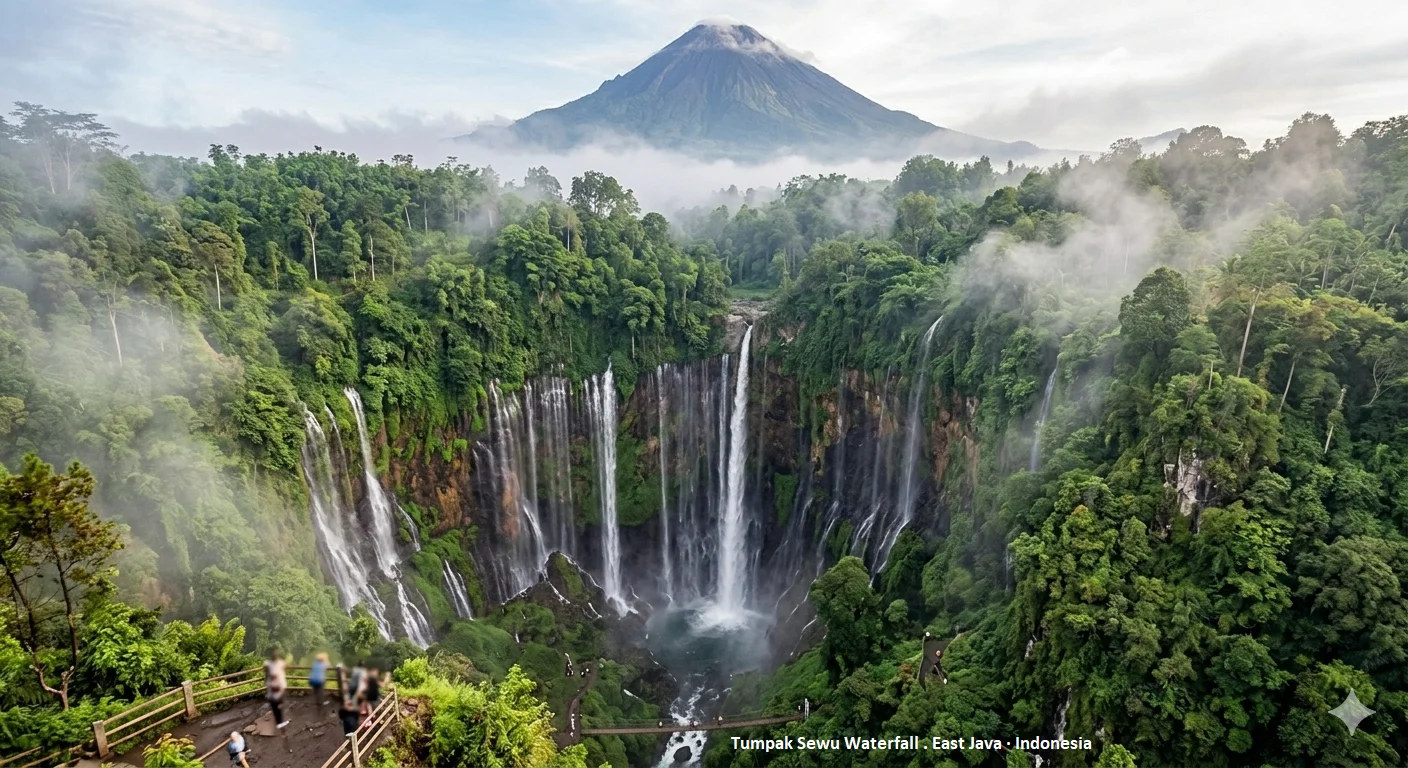
Tumpak Sewu Waterfall, often called Indonesia’s “Curtain of a Thousand Falls,” is a breathtaking natural wonder in East Java. Cascading in a semicircle from lush cliffs, its misty veil creates an ethereal atmosphere unlike any other waterfall in the region. Visitors can trek down to the base for a dramatic view or admire the panorama from above. This hidden gem combines adventure, photography, and raw beauty, making it a must‑see highlight of Java’s natural landscape.
A 120-metre semicircular cascade formed by Mount Semeru's glacial rivers — not one waterfall but dozens falling simultaneously into a volcanic gorge that swallows the sound of the world outside.
Most waterfalls fall in a column. Water finds a single path over the edge, drops vertically, hits the pool below, and disperses. Tumpak Sewu does not work like that. The Glidik River, fed by snowmelt and rain from the slopes of Mount Semeru — Java's highest and most active volcano — reaches the edge of an ancient caldera rim and fans out. Not into two streams or three, but into dozens of simultaneous cascades that fall in a near-continuous curtain across a cliff face roughly 100 metres wide and 120 metres tall. The result is something that looks less like a waterfall and more like a theatre backdrop — a moving, roaring, mist-filled amphitheater of white water that surrounds you when you reach the valley floor.
The name translates from Javanese as "a thousand waterfalls," and while the count is poetic rather than literal, it captures the essential quality of the place. In Javanese culture, the word sewu — a thousand — is often used to describe anything of overwhelming magnitude: Candi Sewu, Grojogan Sewu, the Gunung Sewu limestone karst plateau. Tumpak Sewu earns its name not through quantity but through the sensation of abundance, of water filling every available space in the canyon simultaneously. This is a place that the photographs you will take are consistently not quite good enough to show anyone who wasn't there.
Tumpak Sewu from above — the Glidik River fans across the entire caldera rim before dropping into the volcanic gorge below.
Tumpak Sewu sits on the administrative border between the Lumajang and Malang regencies in East Java, roughly 2.5 hours by road from Malang city. It is part of a larger natural complex that includes the Goa Tetes cave system and the Kapas Biru swimming waterfall nearby — enough to fill a full day and then some. For travellers already planning to visit Mount Bromo or Kawah Ijen as part of an Indonesia tour package, Tumpak Sewu slots naturally into the East Java circuit as the third great natural spectacle of the region. These three — Bromo at dawn, Ijen at midnight, Tumpak Sewu in the morning — form one of the most concentrated sequences of natural drama anywhere in Asia.
Tumpak Sewu is one of 11 extraordinary destinations featured in our Asia Bucket List guide. If you are planning a multi-country itinerary across Southeast Asia, that article covers the full picture.
From the geology that created this waterfall to the hour-by-hour guide for the descent — covered in full below.
Understanding why Tumpak Sewu looks the way it does requires a brief excursion into geology. The waterfall is not ancient — it is the product of an ongoing volcanic landscape that has been shaping and reshaping this corner of East Java for thousands of years. Mount Semeru, visible from the viewpoint on clear days, is the highest peak in Java at 3,676 metres and one of Indonesia's most continuously active volcanoes. Its eruptions, lava flows, and ash deposits have built the elevated plateau from which the Glidik River now falls.
The cliff face over which Tumpak Sewu falls is composed of columnar basalt — hexagonal columns of solidified lava similar in structure to the Giant's Causeway in Ireland. These columns were formed when lava flows cooled rapidly and contracted, fracturing along geometrically regular lines. The many individual streams of Tumpak Sewu fall through gaps and over projections in this basalt structure, which is why the cascade fans out so evenly rather than collecting into a single channel. The mineral content of the water — particularly calcium and silica from dissolved volcanic rock — gives the river its distinctive milky-green tinge and coats the canyon walls in pale mineral deposits that glow in low-angle morning light.
During heavy monsoon rainfall, the waterfall transforms entirely. The dozens of separate streams merge into a single roaring curtain of water that turns the canyon into something between a natural cathedral and a hydraulic explosion. During the dry season, the individual streams separate again, each following its own path down the basalt face, with sunlight catching the spray and creating permanent rainbows in the mist throughout the morning. Both states are extraordinary; they are simply extraordinary in different ways.
Tumpak Sewu offers two distinct ways to encounter it, and they are not interchangeable — they produce genuinely different experiences of the same phenomenon. Most visitors who come for a day trip choose the panoramic viewpoint. A small number who understand what is waiting below descend into the canyon. If you have the physical capability and the time, doing both is the obvious choice.
The main viewpoint is reached via a short five-minute walk from the entrance and parking area. It sits at the canyon rim, behind a safety railing, and gives a full frontal view of the entire waterfall from above — the drone shot that most photographs you have seen of Tumpak Sewu come from. The scale is immediately apparent: the cliff face extends across the entire field of vision, with the multiple streams visible in their individual paths. Early morning is the optimal time here because low-angle sunlight enters the canyon at the right angle to illuminate the mist, and the air is clear before the afternoon haze develops. If you are travelling with young children, elderly family members, or anyone who cannot manage a steep physical descent, the panoramic viewpoint is a satisfying and complete experience on its own.
This is the experience that separates Tumpak Sewu from every other waterfall in Java. The descent trail begins to the side of the main viewpoint and drops steeply into the canyon over approximately 1.5 kilometres of trail. The path involves sections of bamboo ladders with rope handholds bolted into the cliff face, traverse paths cut into steep earth slopes, and river crossings at the canyon floor that can be ankle-deep in dry season or chest-deep after heavy rain. The descent takes 45 minutes to an hour one way for a fit adult at a careful pace; the return ascent typically takes slightly longer.
At the canyon floor, the viewpoint reverses completely. Instead of looking down at the waterfall, you stand inside the amphitheater looking up at it. The scale from below is overwhelming in a way that the viewpoint does not prepare you for — the rim of the cliff above you is 120 metres up, and the curtain of water falling from it fills the entire upper field of vision. The sound is continuous and absolute, the mist creates a natural cooling effect that drops the temperature by several degrees, and the mineral deposits on the canyon walls have formed grotesque, beautiful shapes over centuries of water erosion. Behind sections of the waterfall, shallow caves have formed in the basalt — spaces where the falling water creates a curtain in front of you and the rock face is behind.
Local guides charge IDR 150,000–250,000 per group for the descent. They know which rope sections are reliable, which river crossings are safest on a given day, and how to read the weather for flash flood risk. First-time visitors should always hire one. Ask at the ticket office.
Planning the descent in advance makes the difference between a stressful scramble and a genuinely rewarding adventure. Here is the trail broken down practically.
Arrive at the entrance by 7 AM to 8 AM at the latest if you intend to descend. This gives you the best light at the viewpoint first, time for the descent, time at the base, and a comfortable return before the afternoon when trail conditions can deteriorate. Pay the separate descent fee at the ticket office and hire a guide if this is your first visit. Leave heavy bags in the paid storage at the entrance — you will need both hands free for sections of the trail.
The trail begins as a narrow earth path cut diagonally into the canyon wall. The vegetation is dense and the canopy provides shade. This section is steep but manageable, with rope guides on the steeper portions. The soil is typically wet and slippery regardless of season — grip-soled footwear is essential here, not a recommendation.
The steepest section involves two to three sections of bamboo ladder construction bolted into the cliff face with rope handholds. These ladders are inspected and maintained by the local guide cooperative. They are sturdy when dry. After rain they become slippery. Move deliberately, one hand on the rope at all times, and let the person ahead of you clear the ladder before you begin.
The trail levels out at the canyon floor and joins the Glidik River. Depending on the season and recent rainfall, the river crossing to reach the base of the falls varies from ankle-deep to chest-deep. Your guide will direct you to the best crossing point for conditions on the day. Waterproof bags for cameras and phones are essential for this section.
Allow at least 30 to 45 minutes at the base. The acoustic and visual experience warrants it. Natural rock formations at the base create shallow pools — the water temperature is cool and refreshing. Swimming near the main curtain is not advised due to strong currents from the falling water and submerged rocks, but the peripheral pools are calm enough for wading.
Tumpak Sewu is located in Sidomulyo Village, Pronojiwo sub-district, on the border of the Lumajang and Malang regencies. It sits at approximately 760 metres above sea level on the southern slopes of the Semeru–Bromo volcanic complex. There is no direct rail access; the nearest stations are in Malang and Lumajang, both requiring onward road transfer.
Malang is the primary base for most visitors. The road distance is approximately 70 kilometres and the drive takes 2 to 2.5 hours depending on traffic. The route passes through dense agricultural landscapes and the road becomes narrow for the final 20 kilometres approaching the entrance. Private car hire from Malang for a day trip costs IDR 350,000–500,000. Motorcycle rental from Malang is an option for experienced riders — costs IDR 70,000–100,000 per day — though the final mountain road section demands confidence on two wheels.
The journey from Surabaya to Tumpak Sewu is approximately 4 to 5 hours by road. Most travellers from Surabaya transit through Malang and join the standard route from there. An overnight stay in Malang before an early morning departure is strongly advised rather than attempting same-day travel from Surabaya.
Bali to Tumpak Sewu is typically a 2-day journey combining a ferry crossing from Gilimanuk to Banyuwangi followed by a road transfer across East Java. Many travellers choose the reverse direction — entering Java via Banyuwangi to visit Kawah Ijen first, then travelling west to Tumpak Sewu, then Mount Bromo, before exiting through Malang or Surabaya. This creates a logical one-direction east-to-west East Java circuit.
For most Indian travellers visiting Indonesia for the first time, joining an organised tour that covers Tumpak Sewu as part of an East Java package is the most efficient approach. The logistics — including accommodation in Malang, early morning departures, and guide arrangements — are handled, and many tours combine Tumpak Sewu with Bromo and Kawah Ijen in a 4 to 5 day itinerary. Contact the team at Revelation Holidays for a customised East Java tour from India including visa assistance and flight bookings.
East Java has two clearly defined seasons and both affect Tumpak Sewu in ways that matter significantly to your experience. Getting the timing right is one of the more important planning decisions for this trip.
This is the recommended window for the descent trail. Rainfall is minimal, the paths are firm and manageable, river crossings are typically ankle to knee-deep, and the bamboo ladder sections are reliably dry. The waterfall during dry season separates into its individual streams — each visible and distinct — which is more photogenic than the merged monsoon curtain and allows you to appreciate the geological structure of the cliff face in detail. The clearest sky conditions for seeing Mount Semeru in the backdrop occur in June and July.
The waterfall is at its most powerful and visually dramatic during the wet season. The volume of water increases substantially — the multiple streams merge into a near-continuous curtain, the sound intensifies, and the mist extends much further from the base. However, the descent trail becomes genuinely hazardous. Flash flood risk in the canyon is real; several incidents have been recorded. If you visit during the wet season, restrict your experience to the panoramic viewpoint only and do not attempt the descent without confirmation from local guides that conditions are safe that specific day.
Regardless of season, mornings between 6 AM and 10 AM are consistently superior. The sun enters the canyon from the east and hits the waterfall face directly in the morning, creating the rainbow mist effects and illuminating the mineral deposits on the rock walls. By late morning the light flattens; by afternoon the canyon is in shadow. For photographers, the golden hour window — 6:30 AM to 8:30 AM — is the non-negotiable target.
The area around Tumpak Sewu contains two other significant natural attractions that can be combined into a full day without returning to Malang in between. Both are within 30 minutes of the Tumpak Sewu entrance.
Goa Tetes is an ancient lava tube cave approximately 15 minutes by motorcycle from the Tumpak Sewu entrance. The cave interior features stalactite and stalagmite formations created by centuries of mineral-rich water percolation through the volcanic rock. The name means "dripping cave" in Javanese — the constant drip of water throughout the cave system is both the sound and the process that created it. Bat colonies inhabit the upper sections of the cave, and the guided walking route through the accessible passages takes approximately 45 minutes. Entry is separate from Tumpak Sewu and costs IDR 15,000–25,000. This is a worthwhile addition for anyone interested in Java's volcanic geology and requires no physical difficulty beyond basic walking.
Kapas Biru — "blue cotton" — is a smaller, swimmable waterfall about 20 minutes from Tumpak Sewu. Unlike Tumpak Sewu's main fall, swimming is permitted and encouraged here; the pool at the base of the falls is deep enough, clear, and the current is manageable. The water temperature is cold (around 18–20°C) due to its volcanic mountain source. Visiting Kapas Biru after the physical exertion of the Tumpak Sewu descent makes practical sense — the cool swimming pool functions as both a reward and a recovery. Entry costs IDR 10,000–15,000.
For serious trekkers, Mount Semeru — Java's highest peak at 3,676 metres — is accessible from Ranu Pani village, approximately 1.5 hours from Tumpak Sewu. Climbing Semeru requires a permit, multiple days, and proper expedition preparation. It is not a day-trip addition but rather a separate multi-day objective. From the Tumpak Sewu viewpoint on clear days, the volcanic plume of Semeru is visible above the horizon — a reminder that the water falling over these cliffs originates from that peak.
Tumpak Sewu rarely stands alone as a travel objective. The most efficient and rewarding approach for Indian travellers is to combine it with East Java's other two extraordinary experiences into a single itinerary. The three can be covered in 4 to 5 days from Malang or Surabaya without retracing steps.
Begin at the eastern tip of Java. Kawah Ijen requires a midnight start — trekking by headlamp to the crater rim before 4 AM to witness the electric-blue sulphuric flames that burn in darkness. The blue fire phenomenon exists at only one other place on earth (Iceland). The same trek passes the world's most acidic crater lake and encounters the sulphur miners who carry loads of 60 to 90 kg from the crater floor daily. This is the most physically and emotionally intense of the three experiences. The full Kawah Ijen guide is covered in the Asia Bucket List article.
Drive west from Banyuwangi (approximately 3.5 hours) to the Tumpak Sewu entrance. Arrive by 7 AM for the morning light at the viewpoint, then descend. Afternoon recovery at Kapas Biru swimming waterfall, then drive to accommodation in Malang or the Bromo area.
Mount Bromo is the most visited natural site in East Java — an active volcano in a vast caldera of volcanic sand, reached before dawn by jeep for the sunrise view from the Penanjakan viewpoint. The Tengger Caldera at Bromo's base is one of the most otherworldly landscapes in all of Asia. Combine with the Sea of Sand walk to the crater rim for the complete experience. This forms the natural conclusion of the East Java circuit.
4-Week Java Itinerary offers a comprehensive journey across Indonesia’s most diverse island — from cultural highlights in Yogyakarta to natural wonders like Mount Bromo and Ijen. This guide helps travelers pace their adventure, balancing temple visits, volcanic treks, and coastal escapes for an unforgettable month-long exploration.
Click each panel to expand — covering packing, photography, safety, getting there, and accommodation nearby.
Everything travellers commonly ask before visiting — answered in full with practical detail.
Tumpak Sewu (also called Coban Sewu or Air Terjun Tumpak Sewu) is a 120-metre-tall semicircular curtain waterfall located on the border of Lumajang and Malang regencies in East Java, Indonesia. What makes it genuinely different from every other waterfall in Indonesia — and arguably in all of Southeast Asia — is its structure. Most waterfalls fall in a single stream or two or three parallel streams. Tumpak Sewu fans across a volcanic cliff face approximately 100 metres wide, with dozens of separate streams falling simultaneously in a continuous curtain, creating a natural amphitheater that you can stand inside. The effect from the canyon floor is overwhelming in a way that photographs consistently fail to convey. The waterfall is fed by the Glidik River flowing from Mount Semeru, Java's highest and most active volcano, and the mineral-rich water gives the falls and surrounding canyon a distinctive milky-blue colour. It is often compared to Niagara Falls for the sheer volume and breadth of falling water, though in a dramatically different jungle-and-volcano setting.
The descent trail to the base of Tumpak Sewu is rated moderate to challenging and is suitable for most reasonably fit adults who have experience with uneven outdoor terrain. It is not suitable for people with significant knee or hip problems, those who are uncomfortable on rope-assisted ladders, or anyone who struggles with heights on narrow cliff paths. The trail involves steep earth slopes with rope guides, two to three sections of bamboo ladder with rope handholds, and a river crossing that varies from ankle-deep in dry season to chest-deep after significant rainfall. The total return distance is approximately 3 kilometres and takes 2.5 to 3.5 hours. Physically, the hardest part is the return ascent — going up the bamboo ladders and steep sections is more demanding than the descent. A local guide is strongly recommended for first-time visitors. Children aged 12 and above with good coordination can typically manage the trail with adult supervision and a guide. The panoramic viewpoint, by contrast, requires only a 5-minute flat walk from the entrance and is accessible to all fitness levels.
For safe trekking with the best photographic conditions, the dry season from April to October is the optimal period. Within those months, the best individual months are June and July — the sky is clearest, Mount Semeru is visible in the background, and the waterfall streams are separated and individually distinct, which is more photogenic. August and September are good but increasingly popular with domestic tourists, with potential crowds at weekends. Within any given day, the best photography window is 6:30 AM to 9:00 AM when direct sunlight enters the canyon from the east, illuminates the water spray, and creates rainbow mist effects at the base. The wet season (November to March) dramatically increases the waterfall's volume and power — it becomes a single roaring curtain of immense visual impact — but the descent trail is genuinely hazardous during this period and should only be attempted on advice from local guides who can assess canyon conditions that day. For the viewpoint alone, any time of year in the morning works well.
Indian passport holders can obtain a Visa on Arrival (VOA) at major Indonesian international airports including Soekarno-Hatta (Jakarta), Ngurah Rai (Bali), Juanda (Surabaya), and Hang Nadim (Batam). The VOA costs USD 35 per person and is valid for 30 days with a single 30-day extension possible (total maximum 60 days). Payment at the airport VOA counter is accepted in USD cash, Indonesian Rupiah, or by international credit card at most major airports. No advance application is required — the visa is obtained on arrival at the immigration counter. Required documents at the counter: valid passport (minimum 6 months validity), return flight booking confirmation, and the USD 35 fee. For travellers planning an extended Indonesia itinerary or multiple-entry requirements, an e-Visa applied online in advance is also an option. The team at Revelation Holidays can assist with Indonesia visa guidance as part of a complete tour package booking.
Yes — this is the standard East Java circuit and the most efficient way to visit all three sites. The logical sequence is: arrive in Banyuwangi (eastern tip of Java) → Kawah Ijen blue fire (midnight trek) → drive west to Tumpak Sewu (2 days later, morning visit) → continue west to Mount Bromo (sunrise) → exit through Malang or Surabaya. The total driving distance east to west across this circuit is approximately 350 kilometres and takes 4 to 5 days. An alternative sequence starting from Malang and moving east works equally well. For Indian travellers, the most practical approach is a guided East Java tour package that handles all transport, accommodation, guides, and entry fees across all three sites. Attempting to self-organise this circuit for the first time on an unfamiliar Indonesian road network, particularly with pre-dawn starts for Kawah Ijen and Bromo, is significantly more difficult than it sounds. The cost difference between a guided package and self-organised travel is smaller than most travellers expect.
Tumpak Sewu is generally safe to visit in the dry season with appropriate preparation, but there are genuine risks that should be understood before attempting the descent. The primary risks are: flash flooding in the canyon (particularly during and after rain, even rain that falls upstream on Semeru's slopes far from the waterfall); slippery trails causing falls, particularly on the bamboo ladder sections after rainfall; and hypothermia at the canyon base for visitors who stay in wet clothing too long (the canyon floor temperature can drop significantly due to the constant mist). The site is well-managed by a local cooperative with maintained trails, registered guides, and daily condition assessments. Never descend against the advice of the local guide cooperative — they close the descent trail when conditions are unsafe. Hiring a guide is the single most effective safety measure. Travel insurance with medical evacuation coverage is strongly recommended for all East Java adventure travel.
The comparison to Niagara Falls comes from the sheer breadth and volume of water falling simultaneously across a wide cliff face rather than in a single stream. Like Niagara, the defining characteristic of Tumpak Sewu is the width of the curtain — the sense that water is falling across an entire horizon simultaneously — rather than the height alone. Niagara's Horseshoe Falls drops approximately 57 metres across a 670-metre crescent; Tumpak Sewu drops 120 metres across roughly 100 metres of volcanic cliff. The contexts are entirely different — Niagara borders two countries and accommodates millions of visitors in a developed tourist infrastructure; Tumpak Sewu is reached by a steep jungle trail and receives a fraction of the visitors — but the essential visual quality of vast breadth is the same. Some travel writers argue the comparison actually undersells Tumpak Sewu because the volcanic canyon setting, the jungle canopy above, and the physical immersion of standing at the base make for an experience that Niagara's highly commercialised environment cannot match.
Goa Tetes is an ancient lava tube cave approximately 15 minutes from the Tumpak Sewu entrance, formed by the same volcanic activity that shaped the waterfall's cliff face. The cave system contains stalactite and stalagmite formations developed over centuries from mineral-rich water percolating through the volcanic rock. The guided tour through the accessible section takes 45 minutes to an hour and is conducted with torches provided at the entrance. Bat colonies inhabit the upper cave sections. The entry cost is IDR 15,000–25,000. It is genuinely worth visiting if you have time after Tumpak Sewu — the geological context of seeing how the same volcanic forces that created the waterfall also created the cave system adds an interesting layer to the day. Physically it is straightforward — no climbing or squeezing through narrow passages — though some sections require ducking under low ceiling formations. Combine Goa Tetes with Kapas Biru waterfall for a complete afternoon after the Tumpak Sewu morning experience.
Footwear is the single most important gear decision for the Tumpak Sewu descent. The trail surface — wet earth, wet basalt, bamboo ladders, and river stones — requires shoes with deep rubber grip patterns. Trail running shoes or trekking boots work well. Smooth-soled trainers or fashion sneakers are dangerous on the wet basalt sections. Sandals and flip-flops are not permitted on the descent trail and guides will turn people away wearing them. For clothing: quick-dry synthetic trousers or shorts work better than cotton or denim, which become heavy and cold when wet. A lightweight waterproof jacket is useful. A change of dry clothes left in your car or at the entrance storage is highly recommended — you will be genuinely wet by the time you complete the descent and river crossing. Sun protection for the approach path and viewpoint; the descent itself is shaded by the jungle canopy.
The cost structure at Tumpak Sewu involves several separate fees managed by different village cooperatives, which can be confusing for first-time visitors. The viewpoint entry fee is IDR 10,000 to 20,000 per person. The descent trail has a separate fee of approximately IDR 100,000 per person. Local guide fees run IDR 150,000–250,000 per group (not per person — a group of 4 divides this cost). Parking costs IDR 5,000 for motorcycles and IDR 10,000 for cars. If you add Goa Tetes cave (IDR 15,000–25,000) and Kapas Biru waterfall (IDR 10,000–15,000), a full day visit for one person spending the descent plus both add-ons costs approximately IDR 350,000–500,000 in entry fees and guide costs, excluding transport from Malang. Private car hire from Malang adds IDR 350,000–500,000 (shared across the group). The total per-person cost for a day trip from Malang including all fees and a private car shared among four people is approximately IDR 500,000–800,000 (roughly Rs 2,500–4,000).
Tumpak Sewu is partially suitable for families with children, depending on the age and fitness of the children and which experience you choose. The panoramic viewpoint is completely suitable for all ages — it is a short flat walk from the parking area with safety railings, and gives an extraordinary view of the entire waterfall. Young children, elderly grandparents, and anyone with mobility limitations can see Tumpak Sewu fully from this viewpoint. The descent trail is not recommended for children under 12 years, or children of any age who are not comfortable with rope ladders and river crossings. For children aged 12–16 who are fit and comfortable in outdoor environments, the descent is manageable with a guide and adult supervision. The bamboo ladder sections require children to be tall enough to reach the rope handholds confidently. If your family includes both older teens and young children, one adult can do the descent with the older children while another waits at the viewpoint — guides can accompany groups splitting at the trailhead.
The most popular tour packages that include Tumpak Sewu from India are 7 to 10 day East Java and Bali combination itineraries. A typical structure is: Days 1–3 Bali (arrival, orientation, Ubud); Day 4 ferry to Java via Gilimanuk–Banyuwangi; Day 5 Kawah Ijen (midnight blue fire trek); Day 6 drive to Tumpak Sewu (morning visit, afternoon Goa Tetes and Kapas Biru); Day 7 Mount Bromo sunrise; Day 8–9 Malang/Surabaya and return flight. This covers all three of East Java's great natural experiences in a seamlessly connected itinerary. Tour Packages Asia and Revelation Holidays both offer customised Indonesia tour packages from India including Hyderabad, Chennai, Bangalore, and Mumbai departures, with visa assistance, internal transport, accommodation, and guided treks included. Package costs vary by hotel category and season, typically starting from Rs 65,000 per person for a 7-night package at standard hotels. Contact the team directly for a current quote.
The water at Tumpak Sewu is mineralised volcanic runoff from Mount Semeru's slopes. Its characteristic milky blue-green colour comes from dissolved silica, calcium, and other volcanic minerals — entirely natural and non-toxic. The water is cold, typically 16–20°C at the canyon floor year-round, which makes it refreshing in the humid climate. Wading in the shallow peripheral pools at the base is safe and commonly done by visitors. Swimming directly beneath the main curtain of falls is not safe — the hydraulic force of 120 metres of falling water creates powerful downward currents and the submerged rocks at the base are not visible through the turbulent water. The natural pools further back from the falls, where the water has calmed, are safer for a swim. The river crossing during the descent is unavoidable and involves chest-deep wading in some conditions — the guide will direct you to the calmest crossing point for that day's water level.
Yes — on clear days, typically in the early morning before haze develops, Mount Semeru is visible from the Tumpak Sewu viewpoint as a cone rising behind and above the canyon rim. It is one of the most dramatic contextual views at the site: the active volcano whose snowmelt and rainfall feeds the Glidik River is directly visible above the waterfall that river creates. Semeru frequently emits a visible plume from its Mahameru summit crater — on lucky mornings you can watch a small eruption column above the mountain that created the water now falling in front of you. The connection between the two is hydrological: the Glidik River drains the southern slopes of the Semeru–Bromo volcanic complex and carries the mineral signature of that volcanic activity all the way to Tumpak Sewu. The mineral content — particularly the silica — is what gives the water its blue-green colour and what coats the canyon walls in the pale formations you see at the base. The best conditions for seeing Semeru from Tumpak Sewu are June through September in the dry season, early morning, with no cloud cover on the mountain.
Tumpak Sewu occupies a distinct position among Asian waterfalls that makes direct comparison difficult. It is not the tallest waterfall in Asia — that distinction belongs to waterfalls in India (Nohkalikai, 340m) and China. It is not the most voluminous — Niagara dwarfs it in water discharge. What Tumpak Sewu does that no other waterfall in Asia does is combine significant height (120m), extraordinary breadth (100m semicircular curtain), a fully enclosed volcanic canyon that visitors can enter, and a base-level experience that physically surrounds you with falling water on three sides simultaneously. The closest comparison in Asia is perhaps Detian/Ban Gioc Falls on the Vietnam–China border (breadth and volume) or Nohkalikai in Meghalaya (height and jungle setting), but neither has Tumpak Sewu's combination of all three qualities plus the canyon-descent experience. For travellers who have seen Bali's Gitgit Falls or Lombok's Tiu Kelep, Tumpak Sewu is in a completely different category of scale and drama. The physical effort of the descent is proportional to the reward — it is consistently rated by return visitors as among the top three natural experiences of their Indonesia journey.
Tell us your travel dates and interests — we will build a complete East Java itinerary for you.

Visitor Experiences & Comments