
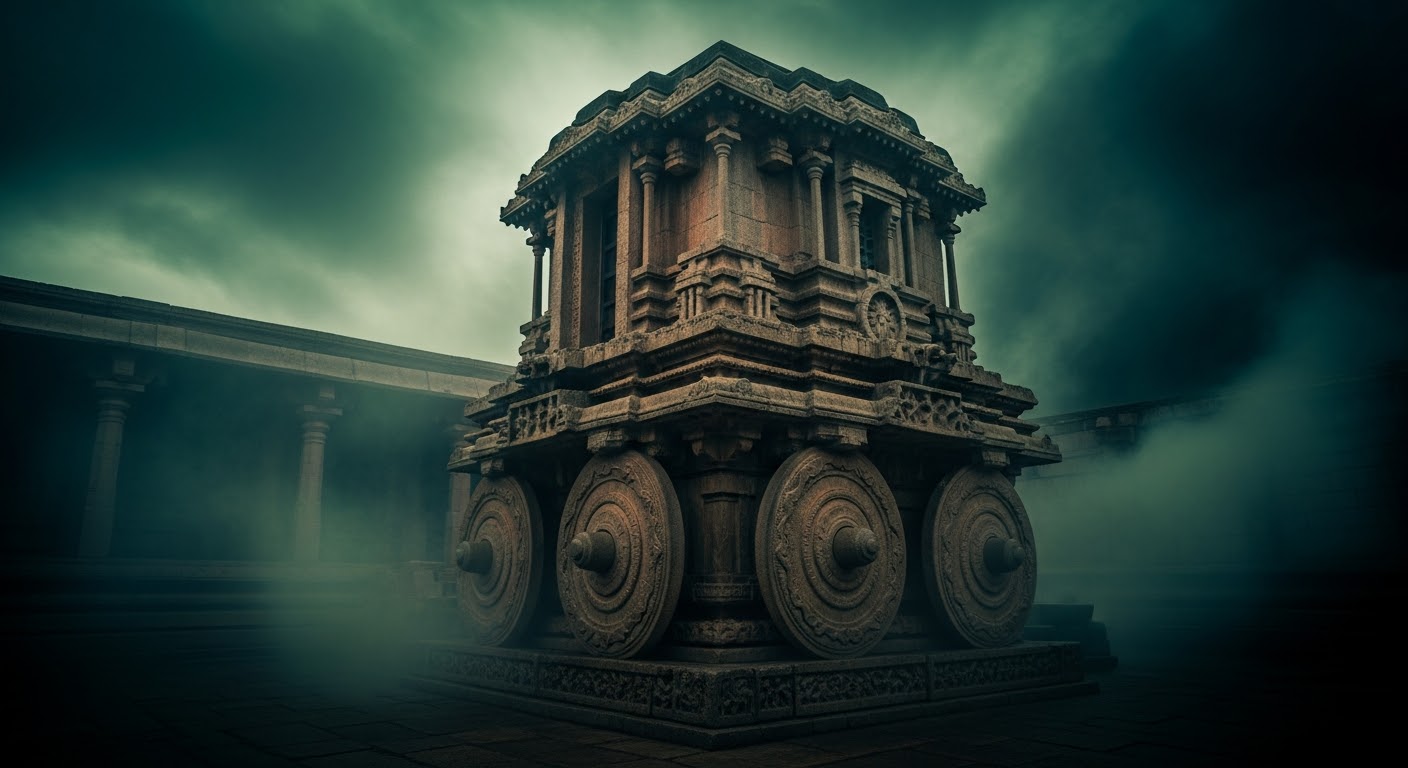
The enduring allure of Hampi's ancient empire is thoughtfully uncovered, revealing architectural marvels and tales of a bygone era. A deep dive into this forgotten city is provided, allowing for an immersive experience of its historical significance.
"They said it couldn't be done: building an empire of this scale, with such intricate beauty, that could stand against the ravages of time. Yet, in the heart of India lies Hampi, a forgotten kingdom whose architectural genius still baffles modern engineers. We're about to peel back the layers of dust and myth, revealing the true story of this magnificent city and the ancient secrets it still holds."

The iconic Stone Chariot at the Vitthala Temple, a pinnacle of Vijayanagara architecture.
Before diving into the narrative, here is a summary of key facts about this phenomenal site:
| Aspect | Details |
|---|---|
| Location | Hampi, Vijayanagara district, Karnataka, India. |
| Significance | UNESCO World Heritage Site; former capital of the Vijayanagara Empire (14th–16th centuries). |
| Architecture Style | Predominantly Dravidian-style temples, royal complexes, monolithic sculptures, and water systems. |
| Main Attractions | Virupaksha Temple, Vittala Temple (Stone Chariot), Lotus Mahal, Elephant Stables. |
| Best Time to Visit | October to March (Pleasant weather). |
Hampi is not merely a collection of ruins; it is the stone-etched narrative of the Vijayanagara Empire, a kingdom that once rivaled the greatest cities in the world in terms of wealth, size, and architectural ambition. Set against a dramatic backdrop of rugged hills and colossal granite boulders, this city truly captures the imagination.

Hampi is not merely a collection of ruins; it is the stone-etched narrative of the Vijayanagara Empire
The site, spread over 4,100 hectares, was the political, economic, and cultural nucleus of the empire. Though abandoned after its conquest in 1565, the ruins showcase an unprecedented level of planning and artistic execution. Visitors today walk through structures where once diamonds and precious stones were reportedly sold openly in its bazaars.
The enduring hallmark of Hampi is its sophisticated Dravidian architecture. Key structures like the Vittala Temple complex, famous for its mesmerizing musical pillars and the iconic Stone Chariot, are prime examples of the intricate craftsmanship achieved under the Vijayanagara rulers. The stone carving here transcends mere decoration; it is a historical record.
Founded in the 14th century, the Vijayanagara Empire quickly grew into a powerhouse in South India, establishing its capital at Hampi due to its strategic location on the Tungabhadra River. This "City of Victory" became a hub for global trade and a sanctuary for culture, attracting poets, artists, and scholars from across Asia and Europe.
The Vijayanagara Empire emerged in the 14th century as a beacon of resilience and innovation. Its rise was not accidental but the result of strategic foresight, cultural synthesis, and architectural brilliance that transformed Hampi into one of the greatest capitals of medieval India.

The Vijayanagara Empire emerged in the 14th century as a beacon of resilience and innovation.
The choice of Hampi as the capital was deliberate. Nestled amid rocky hills and the Tungabhadra River, the terrain offered natural fortification and abundant resources. Politically, the empire was founded by Harihara I and Bukka Raya I under the guidance of sage Vidyaranya, as a response to the growing influence of the Delhi Sultanate in South India. Vijayanagara became a rallying point for Hindu kingdoms, consolidating power and asserting cultural identity.
Animated maps of the empire’s reach would reveal its vast expanse—from the Deccan plateau to the southern coasts. Vijayanagara thrived on international trade, exporting cotton, spices, and precious stones to Persia, Arabia, and Europe. Its bustling bazaars attracted merchants from across the world, making Hampi a cosmopolitan hub of commerce and culture. The empire’s prosperity was not just economic but intellectual, fostering advancements in literature, philosophy, and art.
Among the marvels of Vijayanagara, the Virupaksha Temple stands as a living testament to its spiritual and artistic vision. Dedicated to Lord Shiva, it remains an active site of worship even today. The temple’s towering gopuram, intricate carvings, and alignment with celestial events demonstrate advanced engineering and architectural mastery. Beyond Virupaksha, structures like the Vittala Temple with its musical pillars and the Lotus Mahal highlight the empire’s fusion of sacred devotion and aesthetic innovation.
Hampi in its prime was a living canvas of commerce, engineering, and art. Imagine stepping into a day when the city pulsed with color, sound, and ritual—a metropolis designed for grandeur and everyday life alike.

Hampi in its prime was a living canvas of commerce, engineering, and art.
Bazaars and trade: Picture CGI streets lined with spice merchants, textile dyers, gem traders, and bronze casters. Ox-carts jostle with pedestrians, while tally-keepers record weights on palm-leaf manuscripts.
Royal processions: Recreate chariots gilded with repoussé metalwork, caparisoned elephants, and guards with conical helmets moving along ceremonial routes toward temple courtyards, drums and conches announcing arrivals.
Social fabric: Show guilds (shrenis) coordinating labor, temple kitchens feeding pilgrims, scholars debating at mandapas, and water-sellers weaving through crowds—life stitched together by ritual and commerce.
Domestic rhythm: Illustrate courtyards with grinding stones, weaving looms, oil lamps, and terracotta storage jars; morning ablutions at tanks, evening offerings at shrines, and music drifting from pillared halls.
Aqueduct networks: Visualize stone-and-mortar aqueducts channeling water from the Tungabhadra and elevated reservoirs, crossing valleys on arches, feeding royal enclosures, gardens, and baths.
Stepwells and tanks: Render geometric stepped tanks and public baths with overflow channels and settling basins, showing how filtration and gravity ensured clean, reliable supply.
Canals and distribution: Map primary canals branching into secondary conduits that irrigate fields and supply temples, with sluice gates, spillways, and inspection platforms for maintenance.
Urban foresight: Highlight flood-management berms, feeder ponds, and recharge pits that stabilized the water table, demonstrating a system built for resilience and seasonal variation.
Carved narratives: Close-up sequences of friezes—processions, battle scenes, dancers, market life—each panel a social archive etched in granite.
Musical pillars: Animate the famed resonance of stone pillars by simulating harmonics; show musicians testing timbres and audiences gathering for recitals under elaborately carved ceilings.
Performing arts: Stage dancers with temple anklets, storytellers reciting epics, and veena players in mandapas; integrate costume detail, hand mudras, and lamp-lit atmospherics.
Craft excellence: Feature bronze casting, inlay work, and stone sculpting workshops—tools, molds, polishing, and guild insignia—linking technique to the city’s aesthetic identity.
The Battle of Talikota in 1565 was not a sudden clash—it was the explosive culmination of decades of political tension, religious rivalry, and strategic miscalculations that led to the irreversible collapse of the Vijayanagara Empire.

The ruins of Hampi stand as a haunting reminder of an empire
The Vijayanagara Empire, once the dominant Hindu power in South India, had long been in conflict with the neighboring Deccan Sultanates—Bijapur, Golconda, Ahmadnagar, Bidar, and Berar. These Muslim-ruled states viewed Vijayanagara’s expansion and influence as a threat to their own sovereignty.
Under the leadership of Aliya Rama Raya, the empire grew increasingly aggressive, often interfering in the internal affairs of the Sultanates and playing them against each other. This strategy backfired. Instead of remaining divided, the Sultanates formed a rare alliance, united by a common goal: to eliminate Vijayanagara’s dominance.
On 23 January 1565, near the villages of Rakkasagi and Tangadagi, the allied forces of the Deccan Sultanates met the Vijayanagara army in what became one of the bloodiest battles in Indian history. Despite having a larger force—estimated at over 130,000 soldiers—Vijayanagara suffered a catastrophic defeat.
The turning point came when Rama Raya was captured and beheaded on the battlefield. His death shattered the morale of his troops, leading to a chaotic retreat. What followed was the systematic sacking of Hampi—the empire’s glittering capital. For six months, the city was looted, burned, and reduced to ruins. Temples were desecrated, palaces destroyed, and the once-thriving metropolis was abandoned.
The fall of Vijayanagara was swift and absolute. Despite its vast territory, wealth, and cultural achievements, the empire never recovered. Several factors contributed to this:
Even today, historians debate how such a powerful entity could fall so completely. The ruins of Hampi stand as a haunting reminder of an empire that once rivaled Rome in grandeur—but vanished almost overnight.
Hampi is undergoing a quiet renaissance—where ancient stones meet modern stewardship, and every visitor becomes part of its unfolding story.
Recent efforts have brought Hampi’s grandeur back into focus. A first-of-its-kind restoration report by the Archaeological Survey of India (ASI) and Samvardhan Heritage Solutions has mapped out urgent repairs across nearly all ASI-protected monuments. This includes photographic documentation and structural assessments of over 1,600 monuments spread across 4,187 hectares in the Tungabhadra basin. From temples and shrines to water structures and forts, these findings deepen our understanding of the Vijayanagara Empire’s scale, sophistication, and spiritual depth.
World Heritage Week 2025 also saw renewed public engagement, with students and archaeologists participating in cleanliness drives and awareness campaigns near key sites like Saalu Mantapas and Chakratirtha. These initiatives reflect a growing movement to reconnect locals and visitors with Hampi’s living heritage.
Hampi’s popularity is a double-edged sword. While tourism fuels local economies, it also strains fragile structures and ecosystems. The collapse of the Saalu Mantapa pavilion earlier this year sparked concern over neglected maintenance. Experts warn that overtourism, environmental degradation, and urban encroachment threaten the integrity of this UNESCO World Heritage Site.
Balancing access with preservation requires sustainable tourism frameworks, community involvement, and stricter conservation protocols. Heritage conservation isn’t just about saving stones—it’s about preserving the stories they tell for generations to come.
Hampi isn’t just a destination—it’s a dialogue between past and present. Whether you’re tracing the steps of ancient kings or admiring the Yali carvings of temple pillars, every moment in Hampi invites reflection.
Visit Hampi not just to see, but to understand. Engage with its layered history, support responsible tourism, and let its ruins awaken your curiosity about ancient civilizations. The narrative is still unfolding—and you can help shape it.
To fully appreciate Hampi's scale, a structured visit is recommended. This suggested itinerary focuses on maximizing your time between the Royal Center and the Sacred Center.
| Time/Day | Itinerary Details | Key Attractions |
|---|---|---|
| Day 1 Morning | Start early at the Royal Enclosure to beat the heat. Focus on the sophisticated civil structures. | Lotus Mahal, Elephant Stables, Queen's Bath, Stepped Tank. |
| Day 1 Afternoon | Visit the monumental structures near the Royal Center. | Hazara Rama Temple, Monolithic Nandi, Underground Shiva Temple. |
| Day 1 Sunset | Trek to Hemakuta Hill for a spectacular view of the Virupaksha Temple and the boulder-strewn landscape. | Hemakuta Hill Group of Temples, Sunset Point. |
| Day 2 Morning | Focus on the Sacred Center, starting with the active temple. | Virupaksha Temple (active worship), Hampi Bazaar exploration. |
| Day 2 Afternoon | Cross the river to visit the stunning Vittala Temple complex and the Stone Chariot. | Vittala Temple, Musical Pillars, Coracle Ride (optional). |
| Day 2 Sunset | Take a short trek up Matanga Hill for the most panoramic sunset view over the ruins. | Matanga Hill, Achyutaraya Temple view. |
Planning your visit is crucial to a rewarding experience. The nearest major railhead is Hospet Junction (13 km), which is well-connected to major cities. The closest international airport is Bengaluru, though Hubli (Hubballi) is closer for domestic flights.
The recommended season, October to March, avoids the intense summer heat and the heavy monsoon rains, making the extensive walking much more enjoyable.
While you can see the main temples (Virupaksha, Vittala) in one long, exhausting day, it is highly recommended to allocate at least two to three days. The ruins are massive and geographically spread out, requiring dedicated time to appreciate the Royal Center, the Sacred Center, and the unique landscape features.
The famed musical pillars are located in the Ranga Mandapa of the Vittala Temple. These pillars, when tapped, emit seven different musical notes (Saptaswara). This phenomenon showcases the advanced acoustic engineering and geological knowledge of the Vijayanagara artisans, though tourists are now generally prohibited from tapping them for preservation reasons.
During the dry season, you can cross the river using a traditional, circular boat called a coracle. This is a memorable experience! There is also a bridge further downstream that connects the two sides by road for larger vehicles.
Hampi stands as an awe-inspiring testament to the capabilities of South Indian civilization. It is a place that reminds us of the fleeting nature of power, but the permanence of art and architecture. Every towering monolith and intricately carved panel ensures that the echoes of the Vijayanagara Empire will continue to resonate for centuries to come. It truly is a journey into the soul of ancient India.
Ready to explore more forgotten civilizations?
Discover the Secrets of the Badami Cave Temples