
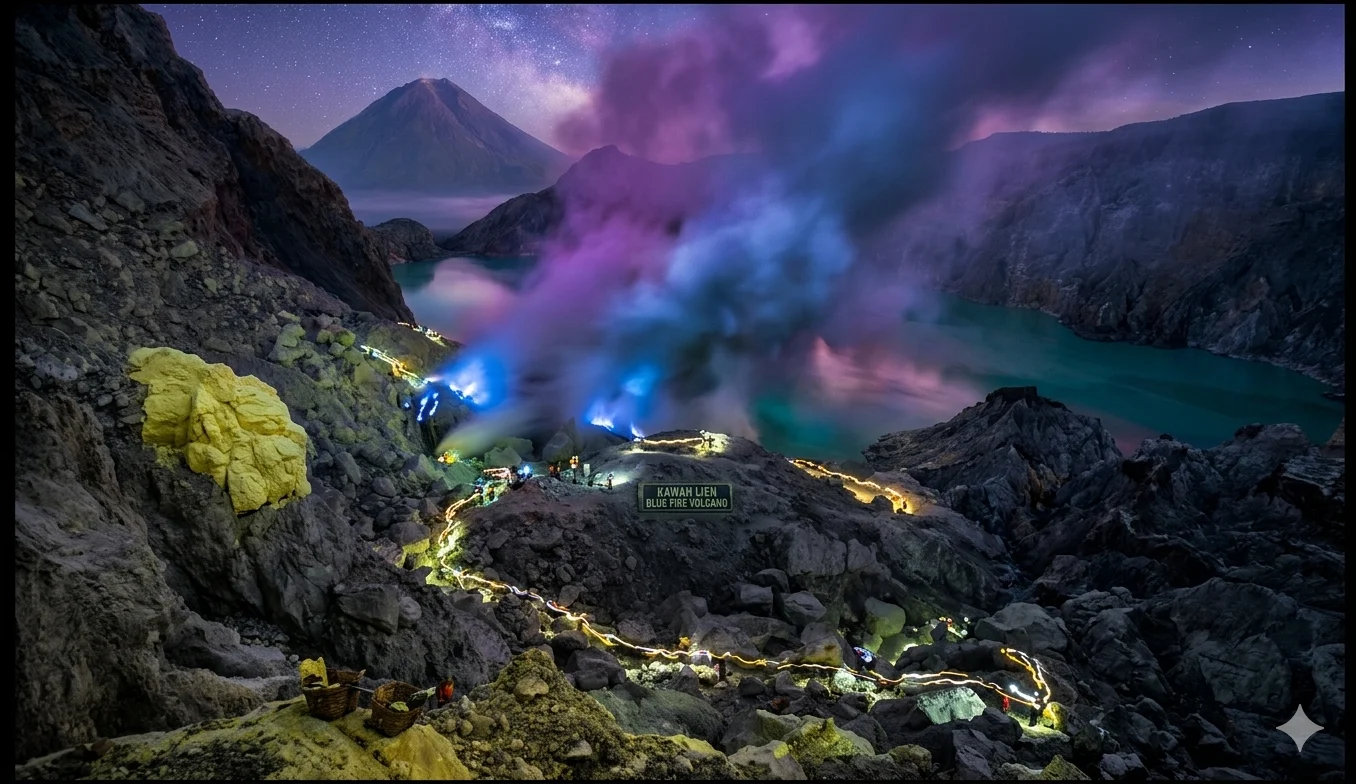
Experience the mesmerizing Kawah Ijen Blue Fire Volcano in Indonesia with this complete night trek guide. Discover how to prepare for the hike, what to expect during the midnight climb, and tips for witnessing the rare blue flames safely. Learn about the sulfur miners, crater lake, and breathtaking sunrise views. This guide ensures Indian and international travelers enjoy a safe, unforgettable adventure at one of the world’s most unique volcanic wonders.
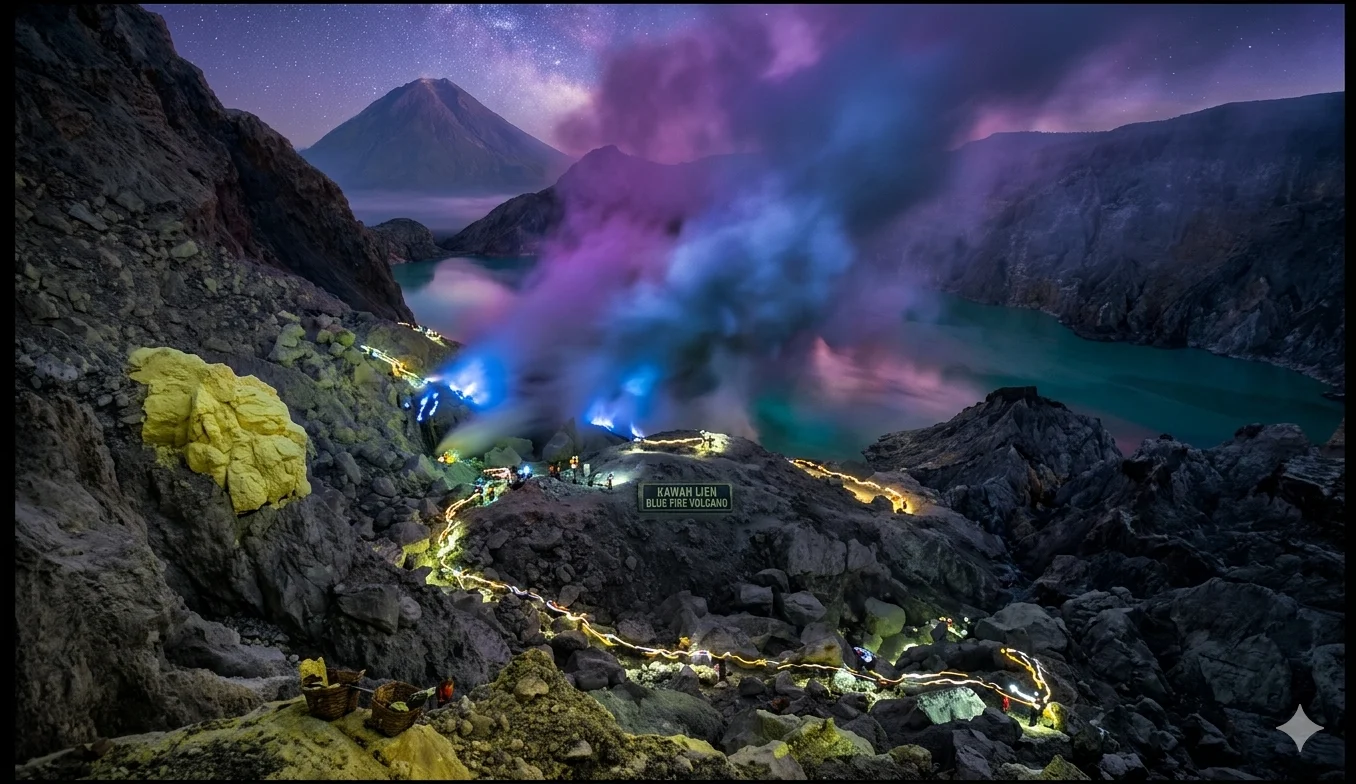
One of only two places on Earth where blue lava flames burn in the dark. Here is everything you need to safely experience the most otherworldly night trek in Southeast Asia.
In the crater of an active volcano in East Java, something happens every night that defies easy explanation. Sulfuric gases — forced up through a network of fissures in the crater floor at temperatures exceeding 600°C — ignite the moment they meet atmospheric oxygen. The resulting flame is not yellow or orange like ordinary fire. It burns an intense, vivid electric blue. This is the Kawah Ijen blue fire, and it is one of the rarest optical phenomena occurring naturally on Earth.
The chemistry behind the spectacle is straightforward, yet the experience is anything but. Sulfur dioxide and hydrogen sulfide gases combust at their contact boundary with oxygen, and because the combustion temperature exceeds the melting point of sulfur (115°C), liquid sulfur also flows from the vents — glowing the same electric blue as it moves. At night, with no competing light source, these cascading rivers of cobalt flame against the black volcanic rock produce a scene that feels pulled from a science fiction film.
What makes this especially remarkable is the scale. The gases emerge in volumes large enough that the flames can reach several metres in height and spread across a wide section of the crater floor. The blue fire volcano Indonesia experience is not a subtle shimmer — it is a full, vivid, atmospheric event.
There are roughly 1,500 active volcanoes on Earth. Hundreds of them are accessible to trekkers. A handful offer crater lakes, summit views, or active lava flows. But only one in the world offers this precise combination: a naturally occurring blue fire visible to the naked eye, a turquoise acidic lake of extraordinary beauty, active sulfur mining operations of medieval brutality, and a trek accessible to any fit adult. That place is Kawah Ijen.
Most natural wonders require either extreme physical ability (high-altitude peaks), specialist equipment (cave diving), or enormous expense (polar expeditions). The Kawah Ijen blue fire requires none of these. It is a 3-kilometre walk, a 2 AM start, and a gas mask. The reward is something that even veteran travellers consistently describe as the single most disorienting — in the best possible way — natural experience of their lives.
The comparison that genuinely applies is this: visiting Kawah Ijen at night is closer to standing on another planet than almost anything else available on Earth. The volcanic landscape, the chemical smells, the unearthly blue light rippling across black rock, and the sound of gases venting from the Earth's interior combine into an experience that simply does not have an equivalent elsewhere.
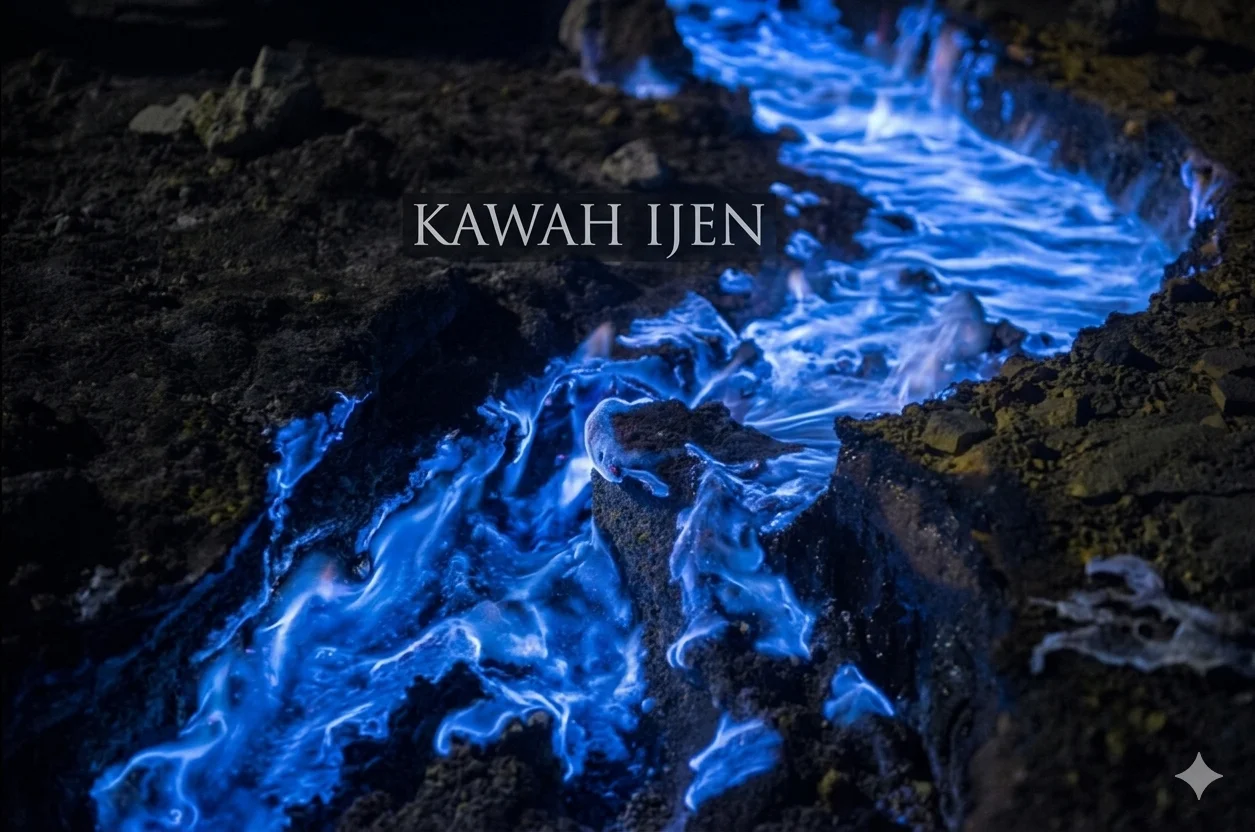
The electric-blue flames of Kawah Ijen — sulfuric gases igniting on contact with oxygen in the crater.
The single most important piece of planning advice for Kawah Ijen is this: the blue fire is only visible in complete darkness. The moment dawn begins — typically around 5 AM — the blue flames become invisible against the growing ambient light. This means your positioning inside or at the crater rim is time-critical.
The midnight trek start — departing the Paltuding trailhead between 12 AM and 2 AM — is not arbitrary. It accounts for a 1.5 to 2.5-hour ascent to the crater rim, plus an additional 30 to 45 minutes to descend into the crater to the flame viewing area. Reaching the crater rim any later than 3:30 AM risks missing the best blue fire visibility. Most organised tours leave at around 1 AM, placing trekkers at the blue fire site between 3 AM and 4 AM — the sweet spot for colour and intensity.
The best time to visit Kawah Ijen overall is during Indonesia's dry season, which runs from May to October. During this period, the sky is reliably clear at night, visibility inside the crater is unobstructed, and the trail is dry and easier underfoot. The wet season (November to April) brings rain, low cloud, and sometimes fog — all of which reduce the blue fire visibility significantly. Trekking in the wet season is still possible, but the experience is less reliable. If your travel dates fall in this window, keep one buffer day in your itinerary in case conditions are poor on your scheduled night.
Within the dry season, July and August are the most crowded months due to Indonesian school holidays and peak international tourist season. For a quieter experience, May–June or September–October offer excellent conditions with thinner crowds — which also makes the crater descent safer and less congested.
The Kawah Ijen trek guide below covers the complete experience from the moment you arrive at the trailhead to the moment you return. There are no technical skills required, but preparation makes an enormous difference to both safety and enjoyment.
The official trailhead is at Paltuding, managed by Perhutani (the Indonesian state forestry company). Register, pay your entrance fee (approximately IDR 100,000 for foreigners on weekdays, IDR 150,000 on weekends), collect your gas mask if you have not brought your own, and confirm trail conditions with the ranger station. A basic canteen and toilet facilities are available here. The atmosphere at this hour is surprisingly lively — guides, miners, and trekkers gather before the ascent.
The trail from Paltuding to the crater rim is 3 kilometres with approximately 800 metres of elevation gain. The first kilometre is a paved road used by miners during the day. Beyond that, the trail becomes rocky and progressively steeper. The final 500 metres before the rim are the most demanding, with loose scoria and a gradient of around 30 degrees. Headlamps are essential. Take your time — the trail is straightforward, and there is no need to rush beyond meeting the timing window.
At the crater rim, the sulfurous smell intensifies dramatically. This is where you put your gas mask on and keep it on for the duration of your time at or near the crater. Wind direction changes frequently — even at the rim, conditions can be momentarily overwhelming without protection. The view of the acid lake below, and if conditions allow, the blue flames visible from the rim, is extraordinary at this point.
From the rim, a steep and loose trail descends approximately 150 to 200 metres into the crater itself, bringing you within 50 to 100 metres of the blue fire vents. This descent is the most physically demanding part of the experience and requires careful footing on loose volcanic rock. A local guide is strongly recommended for this section. The closer proximity dramatically intensifies both the visual impact of the blue flames and the sulfur gas concentration — gas mask is non-negotiable here.
This is the experience the entire journey is built around. The blue flames — ranging from a few centimetres to several metres in height depending on gas output on any given night — burn with a cold, electric intensity. The liquid sulfur flows slowly, glowing as it moves. Spend time here; don't rush back up immediately. The crater environment at this hour, with the acid lake below and the dark sky above, is unlike anything else on Earth.
Return to the crater rim before dawn to experience the sunrise over the turquoise acid lake — a complete tonal reversal from the darkness of the night. The lake, invisible during the night trek, emerges below as an extraordinary shade of aquamarine against the yellow-grey crater walls. Most trekkers spend 30 to 60 minutes at the rim watching the light change before beginning the descent back to Paltuding.
The descent from crater rim to Paltuding takes roughly 1 to 1.5 hours. The morning light reveals the volcanic landscape in a completely different register — sweeping views of East Java, the forested caldera, and the winding mining paths. By the time you reach Paltuding, hot food stalls and coffee vendors are operating. The full experience — from trailhead departure to return — runs approximately 6 to 8 hours.
RTH Tour Packages arranges complete Bali–Ijen–Bali tours with transport, guide, gas mask and accommodation included.
Kawah Ijen sits in the Ijen Plateau in East Java, roughly 36 kilometres northwest of Banyuwangi city. There are two primary travel approaches — from Bali, which is the most popular starting point for international travellers, and from Surabaya or Malang for those already in Java.
The Bali to Kawah Ijen journey covers approximately 130 kilometres including the ferry crossing. From Denpasar or Kuta, arrange a tourist car or take a public bus to Gilimanuk, at the far western tip of Bali. The Gilimanuk to Ketapang (Banyuwangi) ferry crossing takes approximately 45 minutes and runs 24 hours. From Ketapang port in Banyuwangi, the drive to Paltuding trailhead takes 1.5 to 2 hours. The total journey from central Bali to Paltuding takes approximately 5 to 7 hours depending on traffic and departure time. Most international tour packages from Bali coordinate the entire transfer as part of the tour.
From Surabaya, the journey to Banyuwangi by train takes approximately 5 to 6 hours, with trains running multiple times daily. From Banyuwangi city, hire a local vehicle to Paltuding (approximately 1.5 hours). This route suits travellers already exploring Java who wish to add Kawah Ijen as a stop on a wider East Java itinerary that might also include Mount Bromo.
Fly into Bali's Ngurah Rai International Airport (DPS) — well served by direct flights from major Indian cities including Mumbai, Delhi, Hyderabad, Bangalore and Chennai. From Bali, join an organised tour. RTH Tour Packages and its partner Revelation Holidays offer end-to-end Ijen packages for Indian travellers including flights, Bali accommodation, Ijen transfer and guided trek.
Kawah Ijen is one of the world's most actively managed volcanic tourist sites, with ranger stations, a well-maintained trail, and an established visitor framework. The risks are real but manageable — provided you take them seriously. The primary danger is sulfur dioxide gas (SO₂), which at high concentrations causes respiratory irritation, chemical burns to eyes and mucous membranes, and at extreme exposure, can be life-threatening.
The gas emitted from Kawah Ijen's vents is a mixture of sulfur dioxide and hydrogen sulfide. At the crater rim and especially within the crater, concentrations can spike dramatically when wind direction shifts. Trekkers have been overwhelmed by sudden gas surges — this is the primary cause of incidents at the site. The critical protection is a proper half-face respirator with combined organic vapour and P100 particulate filter cartridges. Standard surgical masks and cloth masks offer no meaningful protection. Basic N95 respirators offer partial protection. A proper respirator is essential for anyone descending into the crater.
The trail itself is not technically dangerous — it is well-worn, clear, and does not require ropes or climbing equipment. The primary physical risks are twisted ankles on loose rock (wear proper ankle-support hiking boots) and hypothermia if you are underdressed (temperatures at the crater rim can drop below 10°C even during the dry season).
Packing correctly for a night volcano trek requires thinking about three separate environments you will move through: the cool, dark ascent; the cold, gas-heavy crater; and the warm, bright daylight descent. Here is a complete list of what experienced Kawah Ijen trekkers carry.
Understanding the real Ijen volcano cost requires separating the components — entrance fees, transport, accommodation and guide fees — from what an organised package covers. Here is a complete breakdown for travellers arriving from Bali and from India.
| Item | Estimated Cost (per person) | Notes |
|---|---|---|
| Return transport Bali to Banyuwangi | USD 25–40 | Tourist car / shared shuttle including ferry |
| Paltuding trailhead entrance fee | USD 6–10 | Weekday vs weekend pricing applies |
| Local guide (recommended) | USD 15–25 | Per person, group rates available |
| Gas mask rental | USD 1–3 | Basic quality; consider bringing your own |
| Accommodation near Paltuding (1 night) | USD 20–50 | Homestays at Licin or Banyuwangi hotels |
| Estimated Total (Bali-based) | USD 67–128 | Per person, excluding meals |
An organised Ijen crater tour from Bali typically runs between USD 80–140 per person in a shared group, covering all of the above in a package: pickup from your Bali hotel, private vehicle to Gilimanuk, ferry crossing, vehicle to Paltuding, English-speaking guide for the trek, gas mask, and return to Bali by evening. Meals are usually excluded. View Indonesia tour packages available through RTH.
| Item | Approx. INR (per person) | Notes |
|---|---|---|
| Return flights India to Bali | INR 25,000–55,000 | Varies by city and booking time |
| Bali accommodation (3–4 nights) | INR 2,500–6,000/night | Budget to mid-range guesthouses |
| Bali–Ijen–Bali guided package | INR 8,000–14,000 | 2-day organised tour |
| Indonesia visa on arrival | INR 2,500 | USD 35 — available at Bali airport |
| Meals and incidentals | INR 1,000–2,500/day | Local food is inexpensive |
| Total Estimated Trip Cost from India | INR 55,000–1,10,000 | 7-day Bali + Ijen trip, per person |
RTH Tour Packages designs customised Bali and Java itineraries for travellers from India and across Asia. Whether you want a simple 2-day Ijen extension or a full East Java exploration combining Bromo and Ijen, our team handles every detail — from flights to guided night treks.
Enquire About Tour Packages WhatsApp: +91 91009 84920The blue fire photography challenge is technically demanding — you are shooting a relatively low-light subject in total darkness, with a gas mask strapped to your face, on unstable rocky ground, with sulfur fumes affecting both you and your equipment. Here is how to get the shots that others miss.
The blue fire requires long exposures (4–20 seconds) at high ISO. Handheld shooting produces blurry results without exception. A lightweight carbon-fibre tripod is worth every gram of extra weight on the ascent. Compact travel tripods work perfectly for this.
Start with ISO 1600–3200, aperture f/2.8–f/4, and a shutter speed of 6–15 seconds. Shoot RAW. The blue fire is often brighter than it appears to the eye — bracket your exposures and review your histogram. Manual focus at infinity or on the flames works best; autofocus struggles in darkness.
Sulfur dioxide is highly corrosive to electronic contacts. Wrap your camera body in a zip-lock bag when not actively shooting. Use a UV filter on your lens. Wipe down metal contacts after returning from the crater. Do not store your camera in the bag with sulfur-contaminated clothing.
The crater lake turns from invisible to otherworldly over about 20 minutes as dawn light builds. Use a polarising filter to reduce glare. Shoot from the crater rim looking south — the crater walls frame the lake with natural leading lines. The light between 5:45 and 6:15 AM is exceptional.
The sulfur miners add powerful human scale and context to crater shots. Always ask permission before photographing individuals closely, and offer a small tip (IDR 10,000–20,000) if they pose or spend time with you. Many miners have become adept at the dynamic of respectful tourism.
Cold temperatures drain batteries at 2–4 times the normal rate. Carry at least two fully charged battery packs per camera. Keep spares in an inner jacket pocket against your body — warmth preserves remaining charge. Check battery levels at the crater rim before descending to the fire.
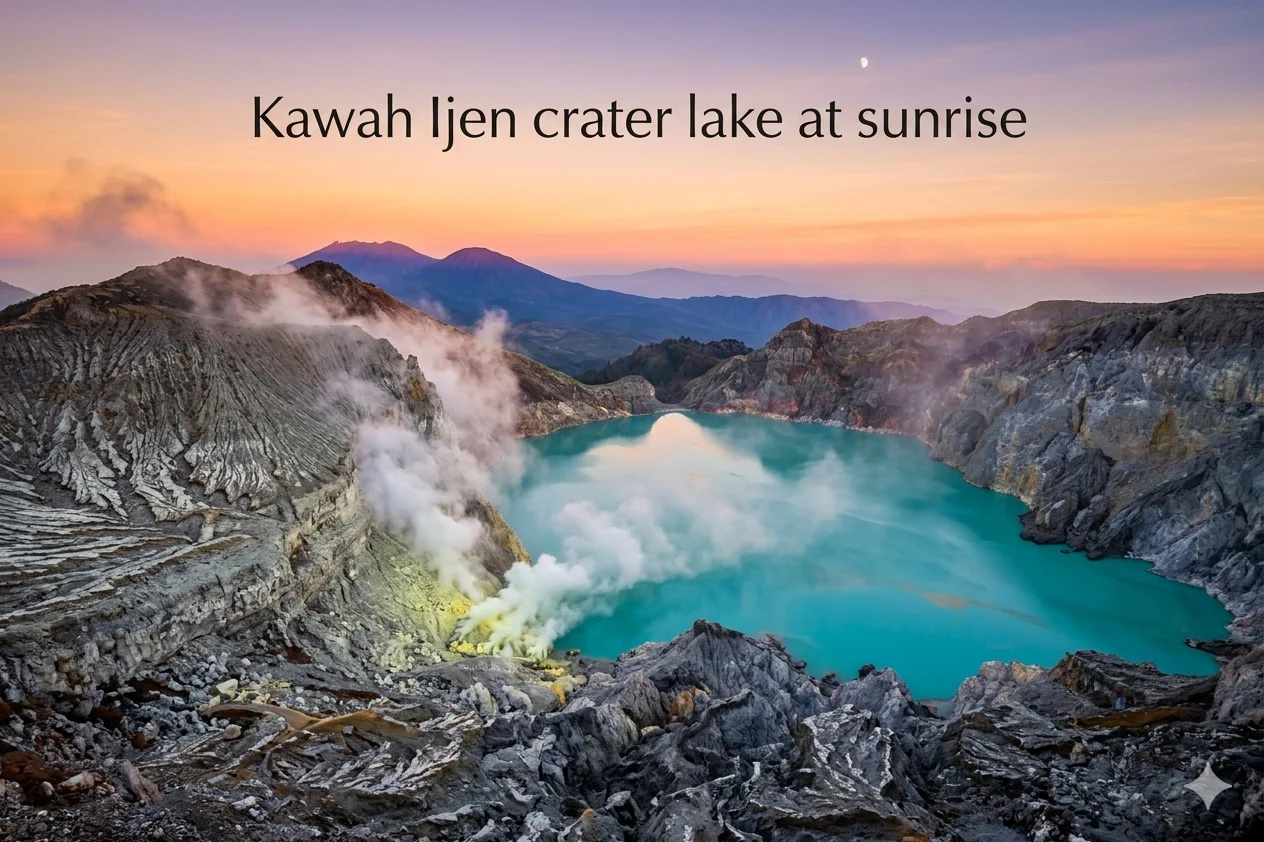
The turquoise acid lake of Kawah Ijen at sunrise — one of the most visually striking crater lakes in the world.
After the blue fire fades with the arriving dawn, the second act of the Kawah Ijen experience begins. The crater lake — Danau Kawah — is the largest highly acidic volcanic lake in the world, covering approximately one square kilometre to a maximum depth of 200 metres. Its pH has been measured as low as 0.5, making it effectively a large pool of sulfuric acid. This is also what makes its colour so extraordinary.
As morning light reaches the crater, the lake reveals itself in a shade of turquoise that photographs genuinely struggle to reproduce accurately. The mineral-rich acid water refracts light in a way that produces shifting tones — aquamarine, jade, milky teal — depending on the angle of light and the amount of suspended sulfur particles. Against the yellow and grey crater walls streaked with sulfur deposits, it is one of the most visually dramatic natural landscapes in Southeast Asia.
Sunrise at the rim typically occurs between 5:30 AM and 6:15 AM depending on the time of year. The changing light transforms the entire scene over the course of an hour — from the first pale gold touching the crater rim to full daylight illuminating the turquoise lake below. Most trekkers stay at the rim for 30 to 60 minutes during this window, making the total experience — night trek, blue fire, and sunrise — a complete, multi-phase adventure within a single outing.
No honest account of Kawah Ijen is complete without addressing the people who work there daily. The sulfur miners of Ijen descend into the same crater that tourists visit for a few hours, but they do so carrying baskets of raw sulfur weighing 70 to 90 kilograms each — two to three times per day, every day.
The sulfur is used in industrial processes including sugar refining and the production of matches, fertilisers and cosmetics. The miners break off solidified sulfur from the cooled lava flows at the vents using iron rods, load it into woven bamboo baskets, and carry it on their shoulders up the crater wall and along the 3-kilometre trail to the processing station — a journey their bodies have become so conditioned to that experienced miners complete in little more than an hour, even under load. The combined daily walking distance — with cargo — often exceeds 18 kilometres.
They work without proper respiratory protection in most cases. The incidence of chronic respiratory disease among Ijen miners is significantly higher than in the general population. Average career earnings are low, and few alternatives exist in the local economy. The miners know the risks better than anyone. They have been doing this work for generations.
The miners are not a tourist attraction. They are working people in a hazardous occupation. Respectful engagement means: do not photograph miners without asking; do not block the trail or impede their movement; if a miner speaks to you, respond respectfully; if you tip, do so directly and with acknowledgement rather than as a transaction. Some guides can introduce you to miners during rest breaks — these moments of genuine exchange are often among the most memorable of the entire experience. Purchasing small souvenirs (sulfur figurines that miners sometimes sell) is one direct economic contribution.
The Ijen vs Bromo question is one of the most common in East Java travel planning, and the honest answer is: both if possible, Ijen if you can only choose one. Here is a direct comparison.
If you only have one night to spend on a volcano experience, choose Kawah Ijen. The blue fire phenomenon is globally unique and irreplaceable. Bromo's landscape, while spectacular, exists in numerous variations across Indonesia and beyond. Kawah Ijen does not.
If you have 3–4 days to spare, combine both: fly into Surabaya, visit Bromo first, travel east to Banyuwangi, trek Ijen, and take the ferry back to Bali. Ask RTH about combined East Java itineraries that cover both in a single efficient loop.
This itinerary is designed for travellers based in Bali who want to experience Kawah Ijen as a standalone 2-day side trip with minimal disruption to their Bali holiday.
Click each panel to expand detailed tips. These are the things that separate a smooth, safe experience from an avoidable disaster.
The Kawah Ijen night trek is among the best solo travel experiences in Southeast Asia. The structured guide system and the informal community of trekkers on the trail make it social without requiring a group booking. Guides can be shared, costs split, and the experience is equally powerful whether experienced alone or with others.
The combination of the otherworldly blue fire, the sunrise over the crater lake, and the sense of shared adventure makes this one of the most memorable couple experiences in Indonesia. Many honeymooners combine Bali beaches with an Ijen night trek as a deliberate contrast — one of the most memorable ways to spend 48 hours in the country.
For travellers who collect genuine natural phenomena — not just views — Kawah Ijen belongs on any serious adventure list. The combination of active geology, physical challenge, cultural depth (the miners), and extraordinary photography opportunity makes it one of the most layered adventure experiences in Southeast Asia. The eco-friendly tourism India traveller movement has increasingly embraced experiences like this.
The iconic caldera landscape of Bromo, with its smoking central crater and surrounding Sea of Sand, is the natural companion to a Kawah Ijen visit. From Banyuwangi, Bromo is approximately a 4-hour drive. Combining both creates a definitive East Java volcanic circuit. Sunrise at Bromo's Penanjakan viewpoint, followed by a Jeep ride across the Sea of Sand and crater walk, is one of Indonesia's great landscape experiences. Check combined Bromo + Ijen packages on RTH.
Banyuwangi is far more than just a transit point to the ferry or the volcano. The city has its own cultural identity anchored in the Osing ethnic community — one of Bali's cultural relatives with distinct traditions, food and performing arts. The Blambangan Museum, the local market at Taman Makam Pahlawan, and the mangrove walks along Teluk Pangpang are all worthwhile half-day diversions. The city's food scene — particularly its ikan segar (fresh fish) preparations — is excellent by any standard.
Located roughly 45 kilometres north of Banyuwangi on the route from Ijen to the Surabaya highway, Baluran National Park is an anomaly in Indonesian geography: open savannah, dry thorn forest and grassland inhabited by Javan wild cattle (banteng), deer, wild boar and green peacocks. The Bekol savannah viewpoint at dawn rivals African game reserve landscapes. If your return route from Ijen passes through this area, a half-day diversion is worth every minute.
Most international travellers use Bali as their base for the Ijen side trip. With Bali's extensive accommodation options, direct international flights from India, and well-developed tourism infrastructure, it remains the most practical staging point. Explore Bali and Indonesia tour packages curated by RTH that combine beach time in Bali with the Ijen experience.
Whether you have a simple question about the trek or want a complete Bali and Java itinerary built from scratch, the RTH team is ready to help. Fill in the form below and we will respond within one working day.
Completely real. The blue fire volcano Indonesia phenomenon is a natural geochemical event — sulfuric gases ignite on contact with atmospheric oxygen and burn an electric blue. There are no artificial lights, no coloured filters, no enhancement. The effect you see in photographs is exactly what is visible to the naked eye at 3 AM inside the crater. Liquid sulfur flowing from the vents also glows the same blue, adding a lava-like element to the display. This has been documented and verified scientifically — it is one of only two such sites confirmed to exist anywhere on Earth.
The blue fire is only visible in complete darkness. The optimal viewing window is between 2 AM and 4:30 AM, with 3 AM to 4 AM being the peak. Dawn begins around 5 AM, at which point the ambient light makes the flames invisible. To reach the crater blue fire zone between 3 and 4 AM, most trekkers depart the Paltuding trailhead at 1 AM. For the overall best time to visit Kawah Ijen, the dry season (May to October) offers the clearest skies and most reliable viewing conditions. Avoid the peak crowd months of July and August unless you have no alternative.
The trek is accessible to any reasonably fit adult without special mountaineering training. The 3-kilometre trail to the crater rim gains approximately 800 metres of elevation and takes 1.5 to 2.5 hours at a comfortable pace. The most challenging section is the loose volcanic rock in the final 500 metres before the rim. The optional descent into the crater for the blue fire is steeper and requires more careful footing. Wearing proper hiking boots with ankle support, carrying trekking poles, and following a local guide significantly reduces the physical demand. People aged 16 to 65 with general fitness routinely complete the trek without difficulty.
Kawah Ijen is generally safe with appropriate precautions. The primary risk is sulfur dioxide gas, which at high concentrations causes severe respiratory irritation. A proper half-face respirator with P100/OV cartridges is essential for anyone descending into the crater — basic N95 masks are insufficient. At the crater rim, a respirator is strongly recommended during windward gas surges. The trail is well-maintained and does not present technical hazards. The crater is periodically closed during volcanic unrest — check PVMBG alert levels before travelling. People with asthma, COPD or other respiratory conditions should consult a doctor before attempting the crater descent. Children under 12 are not recommended for the crater section.
An organised Ijen crater tour from Bali typically costs between USD 80 and USD 140 per person in a shared group, covering private vehicle transfer, ferry, guided trek and gas mask. Self-organised independent trips — handling your own transport, entrance fees (approximately USD 6–10), guide (USD 15–25) and accommodation (USD 20–50 near Banyuwangi) — come to roughly USD 65–130 per person but require more logistics management. For Indian travellers, the all-inclusive cost of a 7-day Bali plus Ijen trip from India (including flights, visas, accommodation and all tours) typically ranges from INR 55,000 to INR 1,10,000 per person. Contact RTH Tour Packages for a personalised quote based on your travel dates and group size.
Technically yes — the main trail from Paltuding to the crater rim does not require a guide and is well-defined. However, for the crater descent to the blue fire zone, a local guide is strongly recommended. The path into the crater is unmarked and loose, visibility with a headlamp is limited, and an experienced guide knows how to position you relative to wind direction to minimise gas exposure. Beyond safety, guides add significant contextual value — explaining the geology, introducing you to miners, and pointing out photographic positions that first-time visitors miss. Guide fees (USD 15–25 per person) represent exceptional value for the safety and experience enhancement they provide.
The standard route from Bali to Kawah Ijen follows this path: private vehicle or shuttle bus from your Bali hotel to Gilimanuk (western tip of Bali, approximately 3–4 hours); Gilimanuk to Ketapang ferry (45 minutes, runs 24 hours); vehicle from Ketapang port to Paltuding trailhead in Banyuwangi regency (1.5–2 hours). Total journey time is 5–7 hours depending on Bali departure point and traffic. Most organised tours handle all transfers as a package, including pickup from your Bali hotel, making independent logistics management unnecessary. The full trip operates as a 2-day excursion: depart Bali on Day 1 afternoon, trek on Day 2 (midnight to 9 AM), return to Bali on Day 2 evening.
The Ijen crater lake (Danau Kawah) is the world's largest acidic volcanic lake by volume. It covers approximately one square kilometre to a depth of up to 200 metres and has a pH as low as 0.5 — making it effectively sulfuric acid rather than water in chemical terms. Its extraordinary turquoise colour comes from the combination of dissolved minerals and sulfur compounds refracting light. The lake is not safe for swimming or any direct contact. Despite its hostile chemistry, specialised bacteria and some extremophile organisms have been documented living in its waters — a reminder that life adapts to environments that seem completely inhospitable. Visible only after dawn, the lake transforms the entire visual experience of Kawah Ijen from a night of eerie blue flames to a morning of extraordinary colour.
Both are exceptional, but they offer fundamentally different experiences. Mount Bromo delivers one of the most dramatic landscape scenes in Indonesia — a vast caldera surrounded by volcanic peaks, most often experienced at sunrise from the Penanjakan viewpoint via a 4WD Jeep. Kawah Ijen delivers a physically active, immersive night experience built around a globally unique natural phenomenon (the blue fire) combined with a stunning acid lake at dawn. Bromo is more visually accessible and less physically demanding. Kawah Ijen is more experientially intense and unique. If forced to choose one: choose Kawah Ijen for the irreplaceable blue fire. If you have 3–4 extra days, combine both in a single East Java loop.
Layer for cold nights and warm daylight descents. At the crater rim before dawn, temperatures can be as low as 8–12°C even in the dry season. Wear a moisture-wicking base layer, a warm fleece or down mid-layer, and a windproof outer jacket. Bring gloves and a warm hat. On the descent in daylight, you will be stripping layers — having a light day bag to stuff removed layers into is useful. For footwear, ankle-support hiking boots with a good sole are strongly recommended; the volcanic rock is uneven and can be slippery. Avoid open shoes or light trainers for the crater descent section.
Kawah Ijen has increasingly become a destination for eco-friendly tourism India travellers seeking meaningful nature experiences beyond beaches and cities. The visit sits within the broader Ijen Nature Reserve, which protects a significant area of lowland and montane forest. Responsible tourism practices — minimising waste in the crater, not touching sulfur formations near miners' work areas, purchasing directly from miner-operated vendors — align with the principles of sustainable adventure travel. The experience is also referenced alongside destinations like the Living Root Bridge Meghalaya Trek and Nongriat Double Decker Bridge in discussions of unique natural trekking experiences in Asia that combine ecological significance with physical adventure.
The crater rim trek (without the optional crater descent) is manageable for most healthy adults up to approximately 65–70 years of age with reasonable general fitness. The main limitation for older travellers is the steep and loose section near the crater rim in darkness, and the cold pre-dawn temperatures. If you are not comfortable with steep rocky trails at night, you can still experience the blue fire from the crater rim without descending — the view from the rim, while less intense than from inside the crater, still offers a remarkable sight. The sunrise over the crater lake from the rim is fully accessible to all fitness levels. Consult your doctor if you have cardiovascular or respiratory concerns before undertaking this trek.
The simplest approach is to book a complete package through a tour operator that handles the full journey from India: international flight to Bali, airport transfer, Bali accommodation, Bali to Ijen two-day tour, and return to Bali. RTH Tour Packages and Revelation Holidays both specialise in Indonesia itineraries for Indian travellers and can customise packages combining Bali leisure with the Ijen experience. Alternatively, you can book flights independently, arrange Bali accommodation, and add the Ijen tour as an add-on through your Bali hotel or a local tour operator. Indonesian visa on arrival (USD 35) is available to Indian passport holders at Bali airport.
The Kawah Ijen entrance fee for foreign visitors is approximately IDR 100,000 on weekdays (roughly USD 6–7) and IDR 150,000 on weekends (approximately USD 9–10). Indonesian citizens pay a lower rate. These fees are collected at the Paltuding ranger station and are subject to periodic revision — confirm current rates with your tour operator or accommodation before departure. Fees are cash only; bring Indonesian Rupiah. Gas mask rental (if not bringing your own) costs approximately IDR 15,000–25,000 extra, and guide fees are negotiated separately at approximately IDR 200,000–350,000 per guide (typically shared between 2–4 travellers).
The crater rim trek is achievable for children aged 12 and above who are accustomed to physical activity and hiking. The night timing, cold temperatures and loose terrain make it more challenging for younger children. The crater descent to the blue fire zone is not recommended for children under 12 due to the higher sulfur gas concentration at crater level and the technical difficulty of the loose rock descent in darkness. For children aged 10–12 who want to see the blue fire, the view from the crater rim — while less dramatic than from inside — is still extraordinary and is accessible without descending into the crater. Always discuss the specific conditions with your guide before allowing children to descend.
Kawah Ijen is just one of the extraordinary experiences waiting across Asia. RTH Tour Packages and Revelation Holidays curate thoughtfully designed itineraries across Southeast Asia, East Asia and the Indian subcontinent — combining natural wonders, cultural depth and seamless logistics for travellers from India and across the region.
Here is the honest answer from everyone who has done it: yes, emphatically. The sleep deprivation is real. The cold is real. The sulfur is real. And the experience is unlike anything else that exists on this planet. The Kawah Ijen blue fire does not disappoint, does not oversell itself, and does not feel like a manufactured tourist experience. It feels like the Earth doing something extraordinary, and you happened to be there to witness it.
Plan carefully, pack correctly, book a good guide, and give yourself enough time in the crater to actually absorb what you are looking at. This is not a destination you check off a list. It is one of those rare places that you carry with you long after you come back down the mountain.
For complete assistance planning your Ijen crater tour — including flights from India, Bali accommodation, and the full guided trek experience — visit tourpackages.asia or contact Revelation Holidays. Both teams work with travellers throughout the year to make this extraordinary experience as seamless as possible.
