

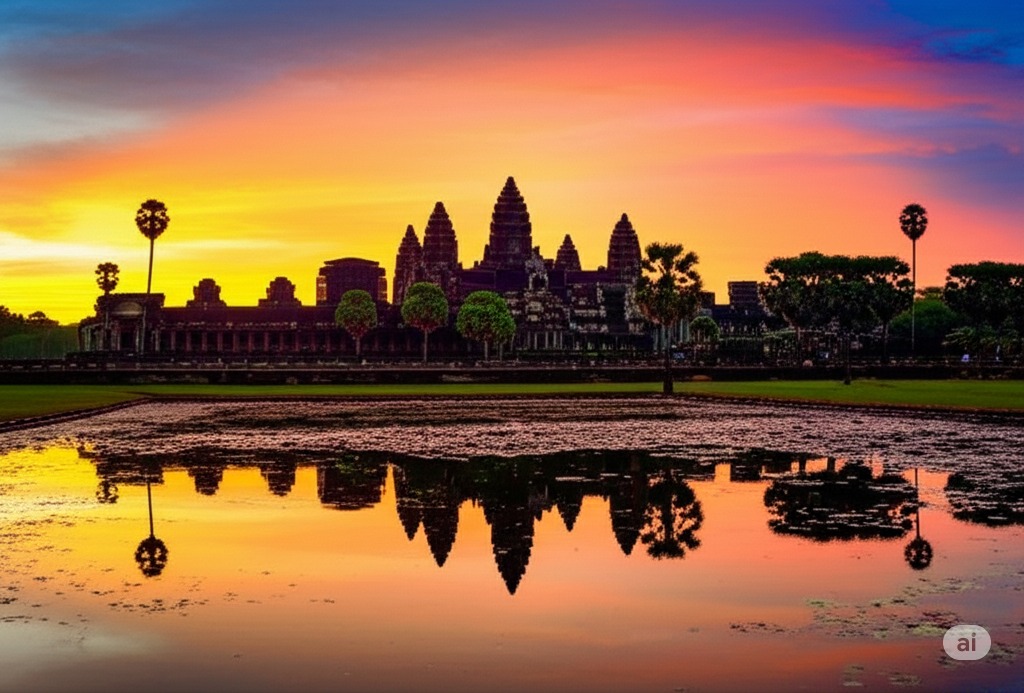
A breathtaking grand panoramic view of the majestic Angkor Wat temple complex in Cambodia at the break of dawn. The iconic silhouette of the main temple, with its towering spires, is reflected beautifully in the still waters of the surrounding moat, creating a mirror-like symmetry. The sky is ablaze with the warm hues of sunrise – soft oranges, pinks, and yellows blending seamlessly, casting a golden glow on the ancient stone structures. Lush tropical vegetation frames the temple in the distance, emphasizing its grandeur and historical significance. The atmosphere is tranquil and awe-inspiring, capturing the timeless beauty of this archaeological wonder.
Nestled amidst the dense jungles of Cambodia, the majestic Angkor Wat stands as an awe-inspiring testament to the Khmer Empire's architectural genius, spiritual devotion, and profound cultural heritage. More than just a temple, it is the largest religious monument in the world, a sprawling complex that served as both a state temple and eventual mausoleum for King Suryavarman II in the early 12th century. Originally dedicated to the Hindu god Vishnu, it gradually transformed into a Buddhist temple by the end of the 12th century, reflecting the evolving religious landscape of the region. Walking through its intricately carved galleries, towering spires, and vast courtyards, visitors are transported back in time, witnessing the grandeur of an ancient civilization that once thrived here. Angkor Wat is not merely a collection of stones; it is a living narrative etched in sandstone, a spiritual journey, and an architectural marvel that continues to inspire wonder and reverence. This blog post will guide you through its rich history, stunning design, and essential tips for experiencing this UNESCO World Heritage site.
The history of Angkor Wat is deeply intertwined with the rise and fall of the Khmer Empire, one of Southeast Asia's most powerful and sophisticated civilizations. Construction began in the early 12th century under the reign of King Suryavarman II, who envisioned it as his state temple and eventual funerary temple, dedicated to the Hindu deity Vishnu. Its sheer scale and intricate carvings reflect the immense power and wealth of the Khmer Empire at its zenith.
Following Suryavarman II's death, and with the shift in Cambodia's dominant religion from Hinduism to Buddhism towards the end of the 12th century, Angkor Wat gradually transformed into a Buddhist temple. Many of its Hindu bas-reliefs and sculptures were adapted or supplemented with Buddhist imagery, and Buddhist monks have inhabited the site continuously since the 16th century, preserving its spiritual essence.
Despite the decline of the Khmer Empire and the abandonment of the capital city of Angkor in the 15th century, Angkor Wat was never fully deserted. Its surrounding moat and dense jungle protected it from complete ruin, allowing it to remain a significant religious site. It gained international recognition in the mid-19th century through the accounts of French explorer Henri Mouhot, sparking global interest and conservation efforts. Today, it stands as Cambodia's most iconic symbol, a source of national pride, and a powerful link to its glorious past.
Angkor Wat is a masterpiece of classical Khmer architecture, renowned for its perfect symmetry, intricate bas-reliefs, and harmonious blend of religious symbolism with architectural prowess. The temple complex covers an an area of approximately 162.6 hectares (402 acres), enclosed by a vast moat and an outer wall.
The temple's design represents Mount Meru, the mythical home of the gods in Hindu cosmology. It consists of three concentric rectangular galleries, each rising higher than the last, culminating in five lotus-bud-shaped towers that represent the peaks of Meru. The central tower, the tallest, symbolizes the axis of the universe.
Key architectural elements include:
The precision of its construction, the alignment with astronomical events, and the sheer volume of detailed carvings make Angkor Wat an unparalleled architectural achievement.
Originally built as a Hindu temple dedicated to Vishnu, Angkor Wat underwent a significant religious transformation towards the end of the 12th century. This shift mirrored the broader adoption of Theravada Buddhism as the dominant religion in Cambodia. While Hindu iconography remains prominent, many of the sculptures and reliefs were reinterpreted or adapted to Buddhist themes.
Today, Angkor Wat functions primarily as a a Buddhist temple, with active monastic communities residing within its grounds. Visitors will see Buddhist monks, altars, and offerings, particularly in the central sanctuary. This dual religious heritage makes Angkor Wat a unique site, showcasing the syncretism of beliefs that has characterized Southeast Asian spirituality for centuries. It remains a vital pilgrimage site for Buddhists from around the world.
Exploring Angkor Wat can take several hours, if not a full day, to fully appreciate its grandeur. Here are the key areas to focus on:
Take your time to absorb the details, from the grand narratives of the bas-reliefs to the delicate carvings of the Devatas.
Visiting Angkor Wat is an experience that transcends mere sightseeing. It's a journey into history, spirituality, and architectural wonder. The sheer scale can be overwhelming, yet the intricate details invite close inspection. Many visitors describe a sense of awe and reverence, particularly during sunrise when the temple's silhouette gradually emerges against the painted sky. The atmosphere can vary from bustling crowds at dawn to more contemplative moments in quieter corners during the day. It's a place that encourages reflection on the impermanence of empires and the enduring power of human creativity and faith.
To make the most of your Angkor Wat experience, careful planning is essential.
Passes can be purchased at the official Angkor Enterprise ticket office (located a few kilometers from Siem Reap town).
Angkor Wat is just one part of the vast Angkor Archaeological Park, which is home to hundreds of temples and ancient structures. Other must-visit sites include:
Exploring these sites alongside Angkor Wat provides a comprehensive understanding of the Khmer Empire's architectural and artistic legacy.
Angkor Wat is more than just an ancient ruin; it is a living monument to human ingenuity, spiritual devotion, and artistic excellence. Its colossal scale, intricate carvings, and profound history make it an unparalleled destination for travelers seeking to connect with a glorious past. From witnessing the ethereal beauty of its sunrise reflections to tracing the narratives etched in its bas-reliefs, a visit to Angkor Wat is a journey that resonates deeply. It stands as a powerful symbol of Cambodia's resilience and a timeless reminder of the enduring power of faith and creativity. Embark on this unforgettable adventure and consider it a key highlight in your Southeast Asia itinerary. Let the ancient stones of Angkor Wat whisper their stories to you.
