Georgia Travel Guide 2026 — Tbilisi, Kazbegi, Kakheti Wine Trails & Batumi for Indian Travellers
Revelation
April 14, 2026
Posted By : Admin
Georgia Travel Guide 2026 — Tbilisi, Kazbegi, Kakheti Wine Trails & Batumi for Indian Travellers
Uncover Georgia in 2026 with this complete travel guide designed for Indian travelers. From the cobbled streets of Tbilisi to the wine valleys of Kakheti, the dramatic peaks of Kazbegi, and the Black Sea charm of Batumi, explore a country where Europe meets Asia. With practical tips on visas, itineraries, food, and culture, this guide ensures your Georgian adventure is seamless, inspiring, and unforgettable across one of the world’s most underrated destinations
Georgia Country · Caucasus · 2026 Travel Guide · For Indian Travellers
Georgia Travel Guide 2026
Tbilisi, Kazbegi, Wine & the Black Sea
Tbilisi's sulphur baths. The Gergeti Trinity Church under Mount Kazbek. Wine made in 8,000-year-old clay vessels. A Black Sea coast at a fraction of Mediterranean prices. Georgia is where India's most well-travelled people are going in 2026 — and for very good reason.
Why Georgia Is 2026's Most Compelling New Destination for Indian Travellers
Georgia 2026
Georgia sits at the exact crossroads of Europe and Asia — its architecture borrows from both, its food culture is unlike anywhere else, and its mountains, wine valleys, and Black Sea coast make it impossible to exhaust in fewer than eight days.
There is a word in Georgian — Gaumarjos — used as a toast, meaning "be victorious." The Georgians have been raising glasses and saying it for approximately eight thousand years, making theirs the oldest wine culture in the world. The same country that invented the qvevri — the clay vessel buried in the earth that Georgians have fermented wine in since 6,000 BC — also produced the mountain town of Kazbegi, where a medieval church sits on a rocky promontory beneath Mount Kazbek's 5,047-metre peak in one of the most photographed landscapes in the Caucasus. And Tbilisi, a capital city of 1.1 million whose Old Town has the particular quality of a place that has absorbed multiple civilisations and worn each one gracefully — Persian, Byzantine, Arab, Mongol, Russian, Soviet, now confidently its own.
In 2026, Georgia has become the "flavour of the season" for Indian travellers — the description used by multiple travel industry sources in India to summarise what is happening with Georgian bookings. The reasons are practical as well as aesthetic: direct flights from Delhi and Mumbai to Tbilisi (approximately 5–6 hours), an e-visa that is simpler and faster than any Schengen application, prices that make Western Europe feel extravagant by comparison, and an atmosphere that combines European urban sophistication with Caucasian warmth and hospitality. Indian arrivals in Georgia crossed 20,000 in early 2024 and have grown consistently since, with 2026 bookings showing substantial acceleration. RTH World Tour Packages and Revelation Holidays design Georgia itineraries specifically for Indian families, couples, and groups — with visa guidance, wine region planning, and Kazbegi mountain arrangements.
The blog at tourpackages.asia covers Southeast Asia, India, the Middle East, Japan, New Zealand, and Sri Lanka extensively — but Georgia and the Caucasus represent an entirely new geography for Indian travellers seeking a European quality of experience at a non-European price point. This guide covers everything: what Georgia actually is, why it is worth your attention, how to get there and how long to stay, the specific destinations and experiences that define the country, and the practical information an Indian traveller needs to plan confidently.
Geography note — Georgia the country, not the US state: Georgia (Sakartvelo in Georgian) is a nation of approximately 3.7 million people in the South Caucasus, bordered by Russia to the north, Turkey and Armenia to the south, Azerbaijan to the east, and the Black Sea to the west. It is at the geographical crossroads of Europe and Asia. It has been a member of the Council of Europe since 1999. The capital is Tbilisi. It is an entirely separate country from the US state of Georgia and the two share only a name.
What Makes Georgia Special — And Why Indian Travellers Are Discovering It in 2026
Georgia's appeal for Indian travellers in 2026 rests on a specific combination of attributes that no other single destination delivers simultaneously.
European Atmosphere, Non-European Prices
Tbilisi's Old Town has cobblestone streets, ornate wooden balconies, wine bars, and art galleries that would be indistinguishable from parts of Lisbon or Budapest — except that a full restaurant dinner with excellent Georgian wine costs GEL 80–120 (approximately INR 2,400–3,600 for two), a taxi across the entire city costs GEL 8–12 (INR 240–360), and a mid-range hotel costs USD 60–90/night (INR 5,000–7,500). Georgia costs approximately 40–60% less than Western Europe for a comparable quality experience. The exchange rate in 2026 — GEL 1 = approximately INR 30 — makes costs very easy to calculate and very pleasant to accept.
Visa Simplicity for Indian Passport Holders
The Georgia e-visa costs USD 20 (approximately INR 1,700–2,000), is applied for entirely online at evisa.gov.ge, requires minimal documents, and is processed in 5–7 working days. Compared to a Schengen visa (which can cost INR 7,000+, require in-person appointments, financial statements, and take 15–21 days), the Georgian e-visa is a significantly more accessible gateway to a European-quality travel experience. Additionally: Indian passport holders who hold a valid US, UK, Schengen, Australia, Canada, or UAE visa or residence permit can enter Georgia visa-free for up to 90 days — a significant advantage for frequent international travellers.
A Country That Packs Three Completely Different Worlds into One
Georgia's extraordinary geographic variety — the Caucasus mountain range in the north, the wine valleys of Kakheti in the east, the Black Sea coast of Batumi in the west, and the cultural capital of Tbilisi in the centre — means that a 6–8 day trip genuinely covers mountain drama, wine country, seaside relaxation, and urban culture. No comparable budget destination in Europe delivers this range in a single itinerary. Georgia is the only country on earth where you can drive from an active ski resort to a subtropical beach in under five hours.
The Wine
Georgia invented wine. Not metaphorically — archaeologically. The oldest evidence of deliberate grape fermentation in the world, dated to approximately 6,000 BC, was found at a dig site in the Marneuli District of Georgia. The qvevri — the egg-shaped clay vessel buried underground in which Georgia has been fermenting wine for eight millennia — is UNESCO-listed as an Intangible Cultural Heritage of Humanity. The Kakheti wine region east of Tbilisi produces the vast majority of Georgian wine. Walking into a family winery in a Kakhetian village and being handed a glass of amber-coloured skin-contact wine that has been fermenting in a clay pot buried in the earth for six months is an experience of legitimate historical resonance. Indian travellers with any interest in food culture, heritage, or simply great wine will find Kakheti extraordinary.
Georgia's Essential Destinations — Six Places That Define the Country
These six destinations cover the full geographic and cultural range of Georgia. A well-designed 7-day itinerary reaches all of them — using Tbilisi as the base for day trips and overnight excursions.
01
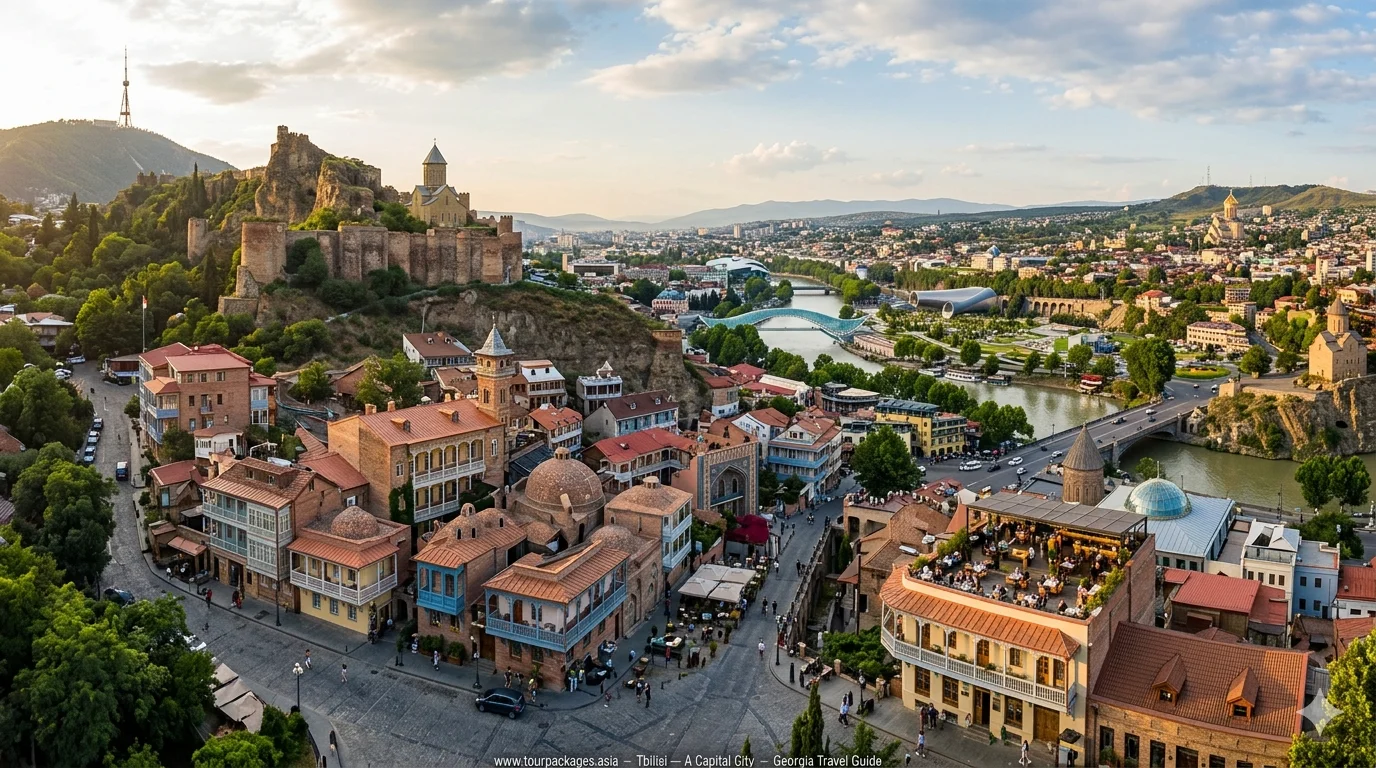
Tbilisi — A Capital City That Earned Its Beauty
Sulphur baths, carved wooden balconies, rooftop wine bars, and a skyline where a medieval fortress watches over a modern city that is clearly very pleased with itself
Capital CityOld Town AbanotubaniNarikala FortressYear-Round
AirportTbilisi International (TBS) — 17 km from city centre
Narikala FortressFree entry; cable car GEL 5 one way
Best AreaOld Tbilisi (Abanotubani, Sololaki, Shardeni)
Tbilisi is one of those rare cities that is genuinely difficult to leave. Not because of any single landmark but because of a quality of atmosphere — the way the Old Town's carved wooden balconies lean over the narrow streets, the sulphurous steam rising from the domed bathhouses of Abanotubani (the bath district), the rooftop wine bars above the Kura River looking at the fortress-topped hill, and the specific kind of Saturday morning that a good Tbilisi neighbourhood cafe produces. The city was founded in the 5th century AD and has been conquered repeatedly since — by Persians, Arabs, Mongols, Turks, and Russians — absorbing architectural influences from each without being defined by any single one. The result is a skyline where a 4th-century fortress (Narikala) and a 20th-century modernist "Mother of Georgia" statue both watch over the same grid of cobblestone streets lined with Georgian, Persian, and Soviet-era architecture.
The Abanotubani sulphur bath district is the most distinctive Tbilisi experience for Indian visitors — private rooms in the bathhouses along the Abanotubani ravine allow a one-to-two hour soak in geothermally heated sulphur water that has been used medicinally and socially since the city's founding. The water temperature is 35–43°C. The mineral smell is significant but fades quickly. The experience of soaking in ancient water in a domed Ottoman-era bathhouse in a city that has been doing this for 1,500 years produces a quality of relaxation that is different from anything available in more conventional spa settings. A private room for two costs GEL 50–100 per hour (INR 1,500–3,000). The Narikala Fortress at the top of the hill — reached by a GEL 5 cable car from Rike Park — provides the best panoramic view of the Old Town and the Kura River gorge. Our Asia wellness travel guide covers the sulphur bath tradition in broader regional context.
Tbilisi Neighbourhoods Worth Walking
The Sololaki district (19th-century aristocratic neighbourhood, ornate facades, small galleries), Shardeni Street (the restaurant and wine bar corridor, lively from 7 PM onwards), Fabrika (converted Soviet textile factory, now the city's most popular creative hub with outdoor markets, cafes, and independent shops), and the Dry Bridge Market (a weekend flea market of Soviet memorabilia, vintage art, and handmade jewellery) each offer a different face of the city. Tbilisi rewards slow walking and spontaneous detours more than a structured sightseeing checklist.
02
Mtskheta — Georgia's Ancient Spiritual Capital
A UNESCO World Heritage town at the confluence of two rivers, 20 minutes from Tbilisi, where Georgia's most historically significant cathedrals sit in a landscape that feels genuinely removed from the modern world
UNESCO World HeritageAncient Capital30 min from TbilisiHalf Day
Distance from Tbilisi20–30 km north, ~30 min by taxi
Best TimeEarly morning for fewer visitors and better light
Mtskheta was Georgia's capital for approximately 1,000 years before Tbilisi took that role in the 5th century. It sits at the confluence of the Mtkvari and Aragvi rivers and the view from Jvari Monastery — a 6th-century monastery on a cliff above the town looking down at the river junction, the valley, and the rooftops of Mtskheta — is among the most classically beautiful landscape views in the Caucasus. The Svetitskhoveli Cathedral in the town's centre, built in the 11th century, is the second-largest cathedral in Georgia and one of the most important religious sites in the country. The town is compact and walkable, with craft shops and small wine bars alongside its historic sites. For Indian visitors, Mtskheta provides the historical depth that completes the Tbilisi experience — it is typically visited as a half-day stop either before or after the Tbilisi Old Town, and occasionally combined with the Ananuri Fortress on the road north to Kazbegi.
03
Kazbegi (Stepantsminda) — The Mountain That Made Georgia Famous on Instagram
The Gergeti Trinity Church on its rocky promontory beneath 5,047-metre Mount Kazbek — the single most photographed view in the South Caucasus, and one that earns every photograph
Most Iconic ViewNorth Georgia Caucasus3-hour drive from TbilisiOvernight Recommended
Distance150 km from Tbilisi (~2.5–3 hrs, Georgian Military Highway)
Gergeti Hike1.5–2 hrs up; jeep taxi available GEL 50–80
Best SeasonMay–October (snow possible outside these months)
Kazbegi — officially Stepantsminda — is a small mountain town in the Greater Caucasus range, 150 kilometres north of Tbilisi on the Georgian Military Highway. The drive north from Tbilisi is itself an experience worth making even without the destination at the end: the Zhinvali Reservoir (an enormous turquoise lake in a canyon), the Ananuri Fortress complex (a 17th-century tower and church complex on the reservoir's shore, approachable and free to visit), the Soviet-era ski resort of Gudauri at 2,196 metres, and the Cross Pass (the high point of the highway at 2,395 metres) — all before Kazbegi itself appears in the valley below the road.
The Gergeti Trinity Church, built in the 14th century on a rocky spur at 2,170 metres above sea level, with Mount Kazbek (one of the highest peaks in the Caucasus at 5,047 metres) rising directly behind it, is Georgia's most iconic image for a reason that becomes obvious on first sight — the proportions of the photograph are almost implausibly dramatic. The church is reached either by a 1.5–2 hour uphill walk from Kazbegi (moderately demanding, rewarding) or by a 15-minute jeep ride from the town (GEL 50–80 per jeep, available from the main square). The interior is spare — functioning Orthodox church, no tourist artifice. The view from the promontory across the Caucasus mountains is the destination. Overnight in Kazbegi is strongly recommended — the town at dawn, when cloud cover on the peak breaks and reveals the full mountain in early light, is a qualitatively different experience from the same view at midday. The Rooms Hotel Kazbegi is the finest option; smaller guesthouses with mountain-facing rooms offer comparable views at lower cost.
04
Kakheti — The Cradle of the World's Wine
Rolling vineyards, ancient qvevri wine cellars, the walled city of Sighnaghi, and an invitation to understand why Georgia's relationship with wine is unlike any other country's
UNESCO Wine HeritageEast Georgia2-hr from TbilisiSep–Oct Best
Distance from Tbilisi70–120 km east (~1.5–2.5 hrs)
Key TownsSighnaghi, Telavi, Bodbe, Kvareli
Wine TastingGEL 20–60 pp at most family wineries (~INR 600–1,800)
Harvest SeasonSeptember–October (Rtveli festival)
Kakheti produces approximately 70% of Georgia's wine and does so using methods that predate the Roman Empire. The qvevri — an egg-shaped clay vessel of 200–3,000 litres capacity, buried up to its lip in the earth of a cellar and sealed with beeswax — creates the specific fermentation conditions that produce Georgian amber wine (skin-contact white wine, called "orange wine" in the West, which is not a modern craft beer trend but a Georgian tradition of 8,000 years). The Kakheti region's main towns each offer a different face of the wine country: Sighnaghi (the "City of Love," a fortified hilltop town with sweeping views of the Alazani Valley and the Greater Caucasus beyond, and many wine shops and cafes) is the most photogenic; Telavi is the regional capital with the historical Batonis Tsikhe castle; Kvareli is home to Kindzmarauli, a naturally semi-sweet red wine that is one of Georgia's most beloved and the apparent favourite of Joseph Stalin.
Family winery visits in Kakheti are the most authentic experience the region offers. Most family operations — and there are hundreds, ranging from a couple of qvevri in a courtyard to fully equipped tasting rooms — include a walk through the vineyard, a descend into the cellar to see the buried qvevri, a tasting of 3–6 wines, and a meal of Georgian country food (cold cuts, cheese, vegetables, bread, walnut-based sauces). These experiences cost GEL 20–60 per person and typically last 2–3 hours. The Rtveli harvest festival in September–October — when the entire Kakheti region is engaged in grape picking, pressing, and celebration — is one of the most atmospheric cultural experiences available in the South Caucasus. For Indian travellers interested in wine, food culture, or agricultural heritage, this is simply extraordinary.
05
Batumi — Georgia's Black Sea Jewel
A subtropical port city on the Black Sea coast where Art Nouveau architecture and Soviet modernism share the waterfront promenade with palm trees and casinos
Black Sea CoastSouthwest Georgia5 hrs from TbilisiJun–Sep Best
Distance from Tbilisi340 km west (~5 hrs drive or 5-hr night train)
ClimateSubtropical; warm June–September
Night TrainTbilisi to Batumi: departs 23:00, arrives 06:30, from GEL 28
AirportBatumi International Airport (BUS) — domestic and Turkish connections
Batumi is a genuinely unusual city — subtropical in climate (it receives more rainfall than anywhere else in Georgia and has palm trees lining its boulevard), Soviet in infrastructure legacy, and vividly modern in its recent architectural ambitions. The Batumi Boulevard — a 7-kilometre promenade along the Black Sea waterfront — is the city's social spine, lined with monuments, fountains, restaurants, and beach access. The night train from Tbilisi (departing around 23:00, arriving Batumi around 06:30) is one of the best value travel experiences in Georgia — the overnight ride through the Kolkheti lowlands costs from GEL 28 (INR 840) in a couchette berth and arrives in Batumi in time for sunrise on the Black Sea. For Indian travellers who want to add a coastal element to a Georgia itinerary, Batumi adds this naturally — though it works best as a 2-night extension rather than a day trip given the distance from Tbilisi.
The Old Batumi district has a concentration of Art Nouveau facades from the late 19th century alongside examples of contemporary architecture that range from celebrated (the Alphabet Tower and the Technological University) to controversial (the several glass towers that now dominate the skyline). The Batumi Botanical Garden on the headland north of the city — 111 hectares of rare subtropical flora with views across the Black Sea to Turkey — is one of the finest botanical gardens in the South Caucasus and an unexpected highlight. The Black Sea beach itself is pebble rather than sand (which distinguishes it from Mediterranean beaches and takes some adjustment) but the water is warm from June through September and the setting is entirely its own.
06
Uplistsikhe — Georgia's Ancient Rock-Hewn City
A cave city carved into sandstone cliffs above the Mtkvari River, inhabited continuously from the 1st millennium BC to the 13th century AD — and still completely intact
Rock-Cut Architecture1 hr from TbilisiEn Route to BorjomiHalf Day
LocationNear Gori, 80 km from Tbilisi
Entry FeeGEL 15 (~INR 450)
Visit Duration1.5–2 hours at the site
Combine WithGori town, or en route to Borjomi mineral spring resort
Uplistsikhe (meaning "the Lord's Fortress" in Georgian) is one of the oldest urban settlements in the South Caucasus — a city carved entirely into sandstone cliffs above the Mtkvari River, inhabited from approximately the 1st millennium BC through the 13th century AD, at its peak housing perhaps 20,000 people in an entirely rock-hewn urban environment. What remains is extraordinary: carved tunnels, streets, royal halls, wine cellars, a pharmacy, a pharmacy, a pagan ceremonial cave, an early Christian basilica, and a theatre — all cut from living rock. The level of preservation is remarkable given the site's age. Uplistsikhe is not a ruin in the conventional sense — it is a complete abandoned city, carved rather than built, that simply stopped being inhabited. The combination of the rock architecture, the river valley views, and the historical scale makes it a compelling half-day addition to a Tbilisi-based itinerary, particularly when combined with a drive through the Borjomi National Park or the resort town of Borjomi (famous for its mineral spring water, marketed across the former Soviet Union).
Best Time to Visit Georgia from India
Georgia is a year-round destination with significantly different character in each season. The choice depends on whether you prioritise hiking, wine, beach, skiing, or simply comfortable sightseeing.
Best overall for Indian travellers:May–June (spring, cool and green, Kazbegi accessible, Tbilisi pleasant before summer heat) and September–October (autumn harvest in Kakheti, the most romantic light of the year, Rtveli grape harvest festival, slightly cooler than summer). Both offer the full range of Georgia experiences without extreme temperatures or peak-season pricing. Avoid late July–August if the Tbilisi summer heat (which can exceed 35°C) would be uncomfortable — head to Batumi or the mountains instead.
7-Day Georgia Itinerary for Indian Travellers — Tbilisi, Kazbegi, Kakheti and Batumi
This itinerary covers Georgia's essential destinations from a Tbilisi base, using day trips and a one-night Kazbegi stay. The Batumi extension (Days 6–7) can be swapped for an extended Kakheti wine region exploration if beach travel is not the priority.
Day 1 — Tbilisi arrival and Old Town introduction
Day 1 — Tbilisi: Arrival, Abanotubani, Old Town Evening
Arrive Tbilisi International Airport (TBS). Transfer to hotel in Old Tbilisi or Sololaki (taxi or Bolt app — GEL 25–35 from airport). Afternoon: Old Town exploration on foot — Metekhi Church on the cliff, the Narikala cable car for panoramic views, the sulphur bath district of Abanotubani (book a private room for 1 hour). Evening: Shardeni Street for dinner and wine. Georgian wine list: start with Rkatsiteli (dry white) or Mukuzani (dry red).
Day 2 — Mtskheta and deeper Tbilisi
Day 2 — Mtskheta Half Day, Tbilisi afternoon
Morning: taxi to Mtskheta (30 min, GEL 20–30 each way). Visit Jvari Monastery on the clifftop for the river confluence view, then Svetitskhoveli Cathedral in the town. Return to Tbilisi by noon. Afternoon: Fabrika creative hub for lunch, Dry Bridge flea market (best on weekends). Evening: Rustaveli Avenue for people-watching; dinner at a traditional restaurant with live Georgian polyphonic music (some restaurants offer this on weekends — ask your hotel).
Day 3 — Georgian Military Highway and Kazbegi
Day 3 — Drive to Kazbegi via Military Highway: Ananuri, Gudauri, Stepantsminda
Depart Tbilisi by 8 AM (arrange private car or tour, GEL 200–300 per vehicle round trip or GEL 80–100 per person shared tour). Stop at Zhinvali Reservoir viewpoint and Ananuri Fortress (30 min exploration). Continue through Gudauri ski resort and Cross Pass (2,395m) with mountain views. Arrive Kazbegi early afternoon. Check into guesthouse or Rooms Hotel. Afternoon: ascend to Gergeti Trinity Church by jeep or hike (1.5–2 hrs up). Stay overnight in Kazbegi for the dawn mountain views.
Day 4 — Kazbegi morning and return to Tbilisi
Day 4 — Kazbegi Dawn Views and Return
Wake at 6 AM for the dawn views of Mount Kazbek from the town and guesthouse terrace (the mountain is typically clearest in early morning before midday cloud develops). Morning walk along the Terek River valley. Return to Tbilisi by early afternoon (2.5–3 hrs). Afternoon: Tbilisi art galleries (Shota Rustaveli National Gallery), wine bar exploration in Betlemi neighbourhood. Evening: traditional Georgian dinner with churchkhela (walnut-stuffed grape juice candy) and chakapuli (spring lamb stew in tarragon) if in season.
Day 5 — Kakheti wine region: Sighnaghi and family winery
Day 5 — Kakheti Wine Day: Sighnaghi, Bodbe, Family Winery
Depart Tbilisi by 9 AM (private car or shared tour GEL 150–250 per vehicle). Drive east through the Alazani Valley to Sighnaghi (1.5–2 hrs). Walk the fortified town walls and viewpoints over the vineyards. Visit Bodbe Monastery on the hillside. Afternoon: drive to a family winery in the Telavi or Kvareli area for a qvevri wine tasting with lunch — traditional Georgian feast (supra) with multiple dishes, local wine from clay vessels, walnut-based sauces, churchkhela. Return to Tbilisi by evening. This day is the heart of the Georgian wine experience and should not be rushed.
Days 6–7 — Optional Batumi Black Sea extension
Day 6 — Night Train to Batumi
Tbilisi afternoon free for last shopping (Tbilisi Mall or Karvasla Market for Georgian wine, churchkhela, and ceramic souvenirs). Depart Tbilisi central station approximately 23:00 on the overnight train to Batumi (arrive ~06:30). Couchette berth from GEL 28 (INR 840) — advance booking recommended in summer. Arrive Batumi at sunrise over the Black Sea.
Day 7 — Batumi: Boulevard, Botanical Garden, Black Sea, Departure
Morning: Batumi Boulevard walk along the Black Sea waterfront. Black Sea beach (pebble, warm water June–September). Batumi Botanical Garden (if time allows — 111 hectares of subtropical flora with sea views, GEL 15). Afternoon: Old Batumi architecture exploration. Evening flight or overnight train back to Tbilisi for international connection, or fly directly from Batumi International Airport (Turkish Airlines via Istanbul connections available).
Georgia Trip Cost Breakdown for Indian Travellers 2026
Georgia is genuinely affordable compared to Western Europe. The Georgian Lari (GEL) exchanges at approximately GEL 1 = INR 30 in 2026. Daily costs in GEL are the most practical planning unit.
7-day Georgia trip cost estimate per person 2026
Category
Budget
Mid-Range
Luxury
Notes
Return Flights from India
INR 28,000
INR 38,000
INR 65,000
Delhi–Tbilisi direct 5-6 hrs; also via Istanbul, Dubai, Baku
Accommodation (7 nights)
INR 14,000
INR 28,000
INR 63,000
Guesthouse GEL 80/night; mid hotel GEL 120–180; luxury GEL 300+
Local Transport
INR 6,000
INR 10,000
INR 18,000
Tbilisi taxi + Kazbegi/Kakheti day tours
Food and Dining
INR 7,000
INR 12,000
INR 25,000
GEL 20–25 full restaurant dinner; GEL 8–12 bakery lunch
Mandatory for Georgia e-visa; strongly advised regardless
TOTAL (per person, 7 days)
~INR 62,700
~INR 1,00,700
~INR 1,93,700
Tbilisi + Kazbegi + Kakheti + partial Batumi
Georgian Food — What to Eat and Why It Matters
Georgian cuisine is one of the most distinctive food cultures in the world — developed in isolation over centuries at a geographic crossroads, it combines influences from Persia, Turkey, the Levant, and Russia without resembling any of them. A traditional Georgian feast (supra) is a cultural institution: a long table covered with small dishes, presided over by a tamada (toastmaster), with wine flowing continuously and the meal conducted through a series of elaborately worded toasts to family, guests, Georgia, and the dead. Understanding the supra is understanding Georgia.
Essential Georgian Dishes for Indian Visitors
Khachapuri — the national dish. A cheese-filled bread in various regional forms, the most theatrical being Adjarian khachapuri: a boat-shaped bread filled with melted sulguni cheese, a fresh egg, and a knob of butter, served still bubbling at the table. You stir it yourself and eat with the bread boat. It is exceptional. Khinkali — Georgian dumplings, the size of a fist, filled with spiced meat and soup — eaten by biting a small hole in the top, drinking the soup, then eating the dumpling (except the pleated top, which is traditionally left on the plate as a count of how many you ate). Lobiani — flatbread filled with spiced kidney beans, a reliable vegetarian option and genuinely delicious. Pkhali — cold appetisers of spinach, beetroot, and walnut paste shaped into small balls, topped with pomegranate seeds — light, vegetable-forward, and very good. Churchkhela — walnut strings dipped repeatedly in thickened grape juice, then dried into a long cylinder — Georgia's most recognisable snack and one of its best. Chakapuli — a spring lamb stew in white wine and tarragon, available March–May, considered by Georgians to be the finest seasonal dish in their cuisine.
Vegetarian Options in Georgia
Georgia is more vegetarian-friendly than most Caucasus and Eastern European countries. Lobio (spiced bean stew), lobiani (bean-filled bread), pkhali (walnut-vegetable appetisers), eggplant with walnut sauce (badrijani nigvzit), various salads, cheese khachapuri, and fresh bread are all vegetarian and widely available. Note that some soups and bean dishes are made with meat stock — ask specifically if entirely vegetarian food is required. Tbilisi has dedicated vegetarian and vegan restaurants in the Sololaki and Fabrika areas.
Top Experiences in Georgia — Plan These First
These twelve experiences are what Georgia's most satisfied visitors specifically remember. They range across the country's cities, mountains, wine regions, and cultural traditions.
1
Gergeti Trinity Church at dawn — Kazbeki mountain, early morning silence, no crowds
Kazbegi · Stay overnight to access this · The most compelling landscape view in the South Caucasus
2
Abanotubani sulphur baths — private room, geothermal water, 1,500 years of use
Tbilisi Old Town · GEL 50–100/hr · Best booked for late afternoon after a day of walking
3
Qvevri wine tasting at a Kakheti family winery — clay vessels, amber wine, Georgian feast
Kakheti · GEL 20–60 pp · The wine experience that made India's travel writers take Georgia seriously
4
Jvari Monastery above Mtskheta — the river confluence, the valley, the ancient view
Mtskheta · Free · 30 min from Tbilisi · A view that has looked exactly like this for 1,400 years
5
Georgian Military Highway north from Tbilisi — Ananuri Fortress to the Cross Pass
North Georgia · Day trip from Tbilisi · One of the most scenic drives in the Caucasus
6
Traditional supra feast with tamada (toastmaster) and polyphonic music
Tbilisi or Kakheti · GEL 60–120 pp full feast · The Georgian table is an institution, not a meal
7
Uplistsikhe rock-cut cave city — inhabited for 3,000 years, abandoned and intact
Near Gori · GEL 15 · 1.5 hrs from Tbilisi · Completely unlike any cave city in Asia
8
Sighnaghi panoramic view — fortified wine city above the Alazani Valley and Caucasus
Kakheti · Free town entry · Best at golden hour with a glass of Rkatsiteli in hand
9
Narikala Fortress cable car above Tbilisi — city, river, and mountains in one frame
Tbilisi · GEL 5 cable car · 20 minutes that orient the entire Tbilisi geography
10
Batumi Boulevard at sunset — Black Sea, palm trees, and a city that earned its confidence
Batumi · Free · Best combined with 2-night stay and Botanical Garden visit
11
Rtveli grape harvest festival — Kakheti, September–October, joining Georgian families in the vineyard
Kakheti · Seasonal (Sep–Oct) · The most immersive cultural experience in Georgian travel
12
Overnight train Tbilisi to Batumi — waking up on the Black Sea coast at sunrise
From GEL 28 · Departs ~23:00, arrives ~06:30 · One of the best value overnight journeys in the Caucasus
Click each panel for detailed guidance covering the e-visa process, getting around, money, food planning, safety, and cultural etiquette for Indian visitors to Georgia.
Visa & Entry
Georgia e-Visa — Step by Step for Indian Passport Holders
Apply at evisa.gov.ge — the official Georgia e-visa portal. Applications typically take 5 working days. Apply at least 2–3 weeks before travel to account for any processing delays and document requests.
The e-visa costs USD 20 (approximately INR 1,700–2,000 at current exchange rates). It is valid for 1 year from issue date and allows a single entry stay of up to 30 days.
Documents required: valid passport (minimum 6 months validity beyond travel dates), recent colour photograph, travel insurance certificate covering Georgia (mandatory), confirmed accommodation bookings, confirmed onward/return flights. Bank statements and employment letters are NOT typically required for the Georgia e-visa but may be requested in specific cases.
Visa-free entry option: Indian passport holders with a valid US, UK, Schengen, Japan, Canada, Australia, or UAE visa or residence permit may enter Georgia visa-free for up to 90 days within a 180-day period. Confirm current policy with the Georgian embassy before relying on this — policies can change.
Do NOT apply through third-party websites that charge inflated fees — the official e-visa portal (evisa.gov.ge) is the only authorised source. Fees charged by third parties are entirely additional to the USD 20 government fee.
Print a physical copy of your e-visa approval to present at the Georgian border — digital copies may not be accepted at all entry points.
Getting Around
Transport in Georgia — How to Move Between Cities and Regions
Tbilisi city transport: Metro (2 lines, GEL 1 per ride with a MetroMoney card — purchase at any station entrance), buses (GEL 1 per ride), and taxis via Bolt or Yandex apps (GEL 5–12 for most city trips). Never use unmetered street taxis — always use the app or agree the fare before boarding.
Day tours to Kazbegi, Kakheti, and Mtskheta: Private car hire from Tbilisi costs GEL 200–350 per vehicle for a full-day Kazbegi trip (4 people maximum). Shared minibus tours run by tour operators cost GEL 60–90 per person for the same route. Shared marshrutka (minibus public transport) to Kazbegi costs GEL 10–15 per person but is less comfortable and less flexible for stops.
Tbilisi to Batumi: Overnight train (GEL 28–60 depending on berth class, 7 hours), fast train (GEL 50–70, 5 hours), bus (GEL 20–30, 5–6 hours). The overnight train is the most atmospheric and efficient option.
Bolt rideshare app works throughout Georgia and is the safest taxi option. Download before arriving. Payment by card is available in most vehicles.
Rental cars are available in Tbilisi from GEL 80–150/day (INR 2,400–4,500). An international driving permit is required alongside an Indian licence for driving in Georgia. Road conditions vary significantly — the Georgian Military Highway is well-maintained; remote mountain roads and some rural routes are rough. Driving in Georgia requires patience and alertness; mountain roads can be dramatic.
Money & Budget
Currency, Exchange Rates and Budgeting in Georgia
Georgia uses the Georgian Lari (GEL). In 2026, GEL 1 = approximately INR 30. USD 1 = approximately GEL 2.7. Keep this mental conversion ready — most tourist pricing in Georgia is given in GEL, some in USD.
Do NOT exchange currency at Tbilisi International Airport — the rates are significantly inferior. Exchange at Rico Credit exchange offices in central Tbilisi or at bank ATMs. ATMs (TBC Bank, Bank of Georgia) dispense GEL and accept Indian Visa/Mastercard debit and credit cards. 24-hour ATMs are available throughout central Tbilisi.
Bring some USD cash from India as a backup — USD is the most accepted foreign currency and exchange rates for USD are the best. EUR is also widely accepted for exchange. Do not carry large amounts of Indian Rupees — INR is not widely exchanged in Georgia.
Georgia is largely cash-based outside of Tbilisi's tourist areas. Carry GEL cash for guesthouses, small restaurants, marshrutka fares, market purchases, and rural areas where cards are not accepted.
Daily budget benchmarks: Budget traveller GEL 100–120/day (INR 3,000–3,600); mid-range GEL 180–250/day (INR 5,400–7,500); luxury GEL 400+/day (INR 12,000+). These include accommodation, food, local transport, and one activity.
Safety & Health
Safety, Health and Practical Precautions for Georgia
Georgia is considered a safe destination — low violent crime, friendly locals, and a well-established tourism infrastructure in Tbilisi, Kazbegi, and Kakheti. The general safety level is comparable to popular Eastern European destinations.
Important geopolitical awareness: Do NOT travel toward South Ossetia or Abkhazia — these are occupied territories with no entry for tourists and active border security issues. The boundary areas in the north and west of Georgia are clearly marked. Stay on established tourist routes.
Mountain safety at Kazbegi: altitude sickness is uncommon at Kazbegi's elevation (1,740m) but possible in susceptible individuals. Ascent to Gergeti Church (2,170m) adds further elevation. Hydrate well, ascend slowly, and do not attempt further hikes (into the high Caucasus) without proper equipment and a local guide.
Travel insurance covering Georgia is mandatory for the e-visa and strongly advisable regardless. Ensure it includes medical evacuation — Georgian hospitals in rural areas have limited facilities. Medical care in Tbilisi is adequate for standard issues; serious conditions may require evacuation to Istanbul or Vienna.
Tap water in Tbilisi is generally safe and of good quality. In rural areas and mountain regions, drink bottled water.
Altitude headaches and mild nausea are possible at the Cross Pass (2,395m) on the way to Kazbegi — drink water, take paracetamol if needed, and the symptoms pass quickly at lower altitude.
Culture & Etiquette
Georgian Culture — What Indian Visitors Need to Know
Georgians are among the most genuinely hospitable people in the world. The Georgian word mgzavroba literally means "journey" and implies the hospitality extended to travellers. Do not be surprised if a Georgian you meet in a village invites you for wine and food — this is normal and sincere, not a commercial transaction.
The supra (feast) is a cultural institution. At a proper Georgian supra with a tamada, toasts are formal and elaborate — the tamada leads, others follow. Toasts are given to God, Georgia, peace, family, and the dead. Responding with a simple "Gaumarjos" (be victorious) is the correct participation. Do not raise your glass before the tamada and do not propose competing toasts.
Georgian polyphonic singing is UNESCO-listed. If you hear spontaneous group singing in a restaurant or at a supra, this is a living tradition, not a performance for tourists. It is correct to listen respectfully and not to applaud during the singing (some Georgians appreciate applause after; others prefer silence — take your cue from the Georgians present).
Orthodox Christian context: many of Georgia's most significant sites are actively used churches. Modest dress is required (shoulders and knees covered; women should cover hair with a scarf in some churches). Headscarves are available at the entrance of major churches.
Georgian is a complex language with its own unique script — Mkhedruli — which looks unlike anything else. Learning to say "Gamarjoba" (hello), "Madloba" (thank you), and "Gaumarjos" (cheers/be victorious) immediately earns genuine warmth and effort from Georgian hosts.
Flights from India to Georgia (Tbilisi) — 2026
Georgia's Tbilisi International Airport (IATA: TBS) is the primary entry point for Indian travellers. Flight options have expanded significantly in recent years with the growth of Indian arrivals in Georgia.
Direct and Best Connecting Flights from India to Tbilisi 2026
Direct flights from Delhi to Tbilisi: IndiGo and Georgian Airways (formerly Air Zena) operate direct Delhi–Tbilisi service. Flight time is approximately 5 hours 20 minutes. This is the fastest and most convenient option for travellers from Delhi, Noida, and Chandigarh. Via Istanbul (Turkish Airlines): Istanbul is the primary hub for Georgia connections — Turkish Airlines flies from Delhi, Mumbai, Hyderabad, Chennai, Bengaluru, Kolkata, and Ahmedabad to Istanbul, with onward connections to Tbilisi (Istanbul to Tbilisi approximately 2 hours). Total journey time 7–10 hours. Excellent connectivity and competitive fares. Via Baku (Azerbaijan Airlines): Baku to Tbilisi connections available — useful for travellers considering a Georgia + Azerbaijan combination trip. Via Dubai (flydubai or Emirates): Dubai–Tbilisi direct with flydubai, combined with Indian city–Dubai connections from major airlines. Total journey 8–12 hours. Useful for travellers from Hyderabad, Mumbai, and South India cities where Dubai connectivity is strong. Book flights 2–3 months ahead for spring and autumn travel. Summer bookings (July–August) should be made 3–4 months ahead. The Delhi direct route books out first — prioritise this if departing from Delhi.
Gateway combination — Georgia + Turkey: Travellers routing via Istanbul can combine Georgia with a Turkey extension — Istanbul's remarkable culinary and cultural scene pairs naturally with Tbilisi's, and the Turkish lira/Georgian lari combination makes both destinations affordable simultaneously. Our world tour packages include combined Georgia-Turkey itineraries for travellers who want to cover both on a single long-haul trip.
Georgia Is 2026's Most Compelling New Discovery for the Indian Traveller
Affordable European atmosphere. Ancient wine culture. Caucasus mountain drama. An e-visa simpler than any Schengen application. Direct flights from Delhi in five hours. RTH World Tour Packages builds complete Georgia itineraries — visa guidance, Kazbegi arrangements, Kakheti wine region planning, and end-to-end logistics.
Plan Your Georgia Trip with RTH World Tour Packages
Georgia tours designed specifically for Indian travellers — with e-visa documentation guidance, Kazbegi mountain arrangements, Kakheti wine region winery bookings, Tbilisi hotel selection, and complete 6–8 day itinerary planning.
Georgia e-visa process guidance for Indian passport holders
Every question Indian travellers ask about Georgia — answered with verified 2026 information and practical advice from the RTH travel desk.
1. Do Indian passport holders need a visa to visit Georgia?
Yes. Indian passport holders require a visa to enter Georgia. There are two practical options: the Georgia e-visa (USD 20, applied online at evisa.gov.ge, processed in 5–7 working days, valid 1 year from issue with up to 30 days per stay) — and the visa-free option for holders of valid US, UK, Schengen, Japan, Canada, Australia, or UAE visas/residence permits, which allows entry without a separate Georgia visa for up to 90 days within a 180-day period.
For most Indian tourists, the e-visa is the simplest option — the process is entirely online, requires minimal documents, and costs a fraction of any Schengen visa. Documents needed: valid passport (6+ months remaining validity), recent photograph, travel insurance covering Georgia (mandatory), and confirmed accommodation and return flight bookings. Bank statements and employment letters are not typically required. Print the e-visa approval and carry the physical copy. Apply at least 2–3 weeks before travel.
2. Is Georgia a safe country for Indian tourists?
Georgia is considered a safe travel destination with low violent crime rates and a friendly and welcoming attitude toward Indian tourists. Tbilisi, Kazbegi, Kakheti, and Batumi all have well-developed tourism infrastructure and high safety records. The 2025 Global Peace Index ranks Georgia in the top 25% of countries for safety. Indian tourists regularly report Georgia as one of the safest international trips they have taken.
Important safety caveats: avoid travel near the South Ossetia and Abkhazia boundary areas — these are occupied territories with active military presence and no tourist access. Stay on the established tourist routes (Tbilisi, Military Highway, Kakheti, Batumi, and Black Sea coast). In Tbilisi's Old Town, the usual urban precautions apply — be aware of your surroundings at night, use taxi apps rather than unmetered street taxis, and secure your valuables. Mountain safety in Kazbegi requires proper footwear and awareness of weather conditions — weather in the Greater Caucasus changes extremely rapidly and experienced local guidance is essential for high-altitude hikes above the Gergeti Trinity Church level.
3. What is the best time to visit Georgia from India?
April to June (spring) and September to October (autumn) are the two best seasons to visit Georgia from India. Both offer comfortable temperatures, manageable crowds, and the full range of Georgia's experiences accessible — including Kazbegi (accessible May–October in good condition), Kakheti wine region, and Tbilisi sightseeing.
Specific highlights by season: April–May — Georgia is at its most green and lush, wildflowers on the mountain slopes, and the full Caucasus snow-cap still visible against the blue sky from Kazbegi. September–October — the Rtveli grape harvest in Kakheti (approximately September 15–October 15 each year) is Georgia's most culturally immersive seasonal event: vineyards in full harvest, winery visits at their most active, and the landscape golden with autumn. January–March — Gudauri ski season (2,196m elevation, good powder snow, European skiing standards at Georgian prices), with Tbilisi as a quiet, affordable base. July–August — summer peak, Batumi beach season, Tbilisi can exceed 35°C — best for coast over city exploration.
4. How much does a 7-day Georgia trip from India cost?
A 7-day Georgia trip from India at mid-range costs approximately INR 90,000–1,10,000 per person including return flights, 7 nights accommodation, transfers and day tours, meals, major activities, visa fee, and travel insurance. Budget travellers can manage INR 55,000–70,000; luxury options can exceed INR 1,80,000.
The breakdown: Return flights INR 30,000–45,000 (Delhi direct); accommodation GEL 80–180/night per room (INR 2,400–5,400) depending on category; day tours to Kazbegi and Kakheti GEL 150–300 per vehicle; meals GEL 30–80/day (INR 900–2,400); activities (sulphur bath, cave city entries, cable cars) GEL 50–100; e-visa USD 20 (INR 1,700). Georgia is approximately 40–60% cheaper than equivalent travel in Western Europe. A couple travelling together can further reduce per-person costs by sharing accommodation and transport. RTH provides detailed cost breakdowns for specific Georgia itineraries on request.
5. What is Georgian wine and why is it unique?
Georgian wine is the oldest wine culture in the world — archaeobotanical evidence from the Marneuli District dates grape domestication and wine production in Georgia to approximately 6,000 BC, making it 2,000 years older than the earliest evidence in the Fertile Crescent. The defining characteristic of Georgian wine is the qvevri — an egg-shaped clay vessel buried underground, in which grapes (for white wines often including the grape skins, seeds, and stems) ferment naturally over 6–8 months. This method, called "skin-contact" or "amber wine" production, creates wines with a distinctive tannin structure in the whites, an amber-orange colour, and flavour profiles unlike anything produced by conventional stainless-steel or barrel fermentation.
Key Georgian grape varieties: Rkatsiteli (the most planted white grape in Georgia; produces dry whites ranging from crisp to deep amber depending on skin contact); Saperavi (Georgia's finest red grape; produces inky, structured wines with extraordinary ageing potential — considered one of the world's great indigenous grape varieties); Mtsvane (aromatic white); Kindzmarauli (a naturally semi-sweet red from Kakheti, one of Georgia's most celebrated appellations). Georgian wine is gaining significant international attention among wine professionals and enthusiasts — the amber wines in particular have been adopted by natural wine restaurants worldwide. In Georgia itself, wine is so central to the culture that it appears in Orthodox Christian rituals, ancient epic poetry, and every traditional meal of any significance.
6. What are the must-try Georgian foods for Indian visitors?
Georgian food is one of the highlights of the trip — a cuisine of genuine complexity, with walnut-based sauces, herb-forward dishes, and bread traditions that have no direct equivalent in Indian or European cooking. Essential dishes:
Khachapuri — cheese-filled bread; the Adjarian version is the most spectacular (bread boat, melted cheese, raw egg, butter — stirred together at the table). Available everywhere from bakeries to fine restaurants, and genuinely excellent in all forms.
Khinkali — spiced meat dumplings the size of a fist, containing hot soup inside. Eat by biting a small hole at the top, drinking the broth, then eating the dumpling. Do not eat the top knot (the traditional count). Vegetarian versions with mushroom or potato are available.
Badrijani Nigvzit — fried eggplant rolled around walnut-garlic-herb paste, topped with pomegranate seeds. An exceptional vegetarian dish.
Lobio — spiced red bean stew served in a clay pot, traditionally with cornbread (mchadi). The best vegetarian main course in Georgian cuisine.
Churchkhela — walnut or hazelnut strings dipped repeatedly in thickened grape juice and dried. The most distinctively Georgian snack and a genuinely good sweet.
Chakapuli — seasonal spring stew of lamb in white wine with tarragon; only available April–May and considered by Georgians the finest seasonal dish in their cuisine.
Most Georgian dishes involve meat, but vegetarian options are available everywhere — lobio, badrijani, pkhali, lobiani, various salads, and cheese khachapuri are all reliably vegetarian in their standard preparations. Ask specifically whether meat stock is used in soups or stews if you are strictly vegetarian.
7. How do I get from Tbilisi to Kazbegi and what should I expect?
Kazbegi (Stepantsminda) is 150 km north of Tbilisi on the Georgian Military Highway — approximately 2.5–3 hours drive. Options for getting there:
Private car hire: GEL 200–300 per vehicle (up to 4 people) for a return day trip, including multiple stops at Ananuri Fortress and scenic viewpoints. Book through your hotel or a tour operator in Tbilisi the evening before. Most drivers speak some English.
Shared tour: GEL 60–90 per person, typically includes Mtskheta stop on the way north, Ananuri Fortress, and Kazbegi — 10–12 hour day. Less flexible than private car but significantly cheaper. Many Tbilisi tour operators offer this as a standard day trip.
Marshrutka (shared minibus): GEL 10–15 per person from Didube bus station in Tbilisi. Cheapest option but no flexibility for stops, and the terminal is less convenient.
What to expect: The Georgian Military Highway is a spectacular drive — the Zhinvali Reservoir canyon, the Ananuri Fortress on the reservoir shore, the alpine meadows above Gudauri, and the dramatic approach to Kazbegi valley. Plan for stops. At Kazbegi, the ascent to Gergeti Trinity Church (either 1.5–2 hrs hike or 15-min jeep ride) is essential. Stay overnight if at all possible — dawn views of Mount Kazbek are significantly more rewarding than the midday views most day-trippers experience, and the Kazbegi valley in the evening light has a quality that genuinely justifies a dedicated night.
8. What is the Kakheti wine region and how do I visit from Tbilisi?
Kakheti is Georgia's primary wine region, located 70–120 km east of Tbilisi in the Alazani River valley between the Greater and Lesser Caucasus mountains. It produces approximately 70% of Georgia's wine and is the heartland of the 8,000-year-old qvevri wine tradition. The main towns — Sighnaghi (hilltop walled city, viewpoints, wine shops), Telavi (regional capital, Batonis Tsikhe fortress), and Kvareli (known for Kindzmarauli semi-sweet red wine) — are all accessible as a day trip from Tbilisi or as an overnight stay.
The best way to visit Kakheti: arrange a private car tour from Tbilisi (GEL 150–250 per vehicle for a full day), specifying a family winery visit as a required stop. Most tour operators have arrangements with specific wineries that offer qvevri tastings, cellar tours, and traditional Georgian meals. Arrive at Sighnaghi for the morning view over the valley, visit a winery in the Telavi or Kvareli area for the tasting and supra experience, and return to Tbilisi by evening. September–October (Rtveli harvest season) is the most atmospheric and immersive time to visit Kakheti — the harvest is a community event, visitors are welcome to participate, and the wine cellars are in active use. The grape harvest festival involves tramping (pressing grapes by foot in the qvevri courtyard), sampling newly fermented chacha (Georgian grape spirit), and the kind of spontaneous hospitality that Georgia does better than anywhere.
9. Is there Indian food available in Georgia?
Tbilisi has several Indian restaurants — including Namaste India and Sagar, both located in the central city area — that serve authentic Indian cuisine sufficient for travellers who need familiar food during a longer stay. Indian food availability decreases significantly outside Tbilisi: Batumi has limited options; Kazbegi and Kakheti have essentially no Indian food available.
The practical strategy for Indian travellers: do not plan your Georgia trip around Indian food availability — the Georgian cuisine is excellent, varied, and has significant common ground with Indian dietary habits (heavy use of spices, pulses, herbs, and vegetable dishes alongside meat). Vegetarian Indian travellers will find lobio (spiced beans), badrijani (eggplant with walnut), pkhali (walnut vegetable appetisers), lobiani (bean bread), and khachapuri all satisfying and good quality. The adjustment period is short — most Indian travellers find Georgian food genuinely appealing within a day or two of arrival. Carrying a small supply of Indian spice packets or instant meal sachets from India is useful for the first day or for days in remote mountain areas. Most Tbilisi hotels and guesthouses can provide information about the nearest Indian restaurant.
10. What is the Georgian Military Highway and is it suitable for Indian tourists?
The Georgian Military Highway (Route S3/GE-01) is the main road connecting Tbilisi to the Greater Caucasus mountains and the Russian border (closed to tourists). It runs 212 kilometres from Tbilisi north through the Aragvi Valley to the Dariali Gorge, passing through the Zhinvali Reservoir, Ananuri Fortress, Gudauri ski resort, and the Cross Pass at 2,395 metres before descending to Kazbegi. The road is one of the most scenic drives in the entire Caucasus region.
Suitability for Indian tourists: the highway is entirely paved and well-maintained as far as Kazbegi. No 4WD vehicle is required. Driving conditions are manageable for experienced drivers. The road has sharp mountain bends, occasional landslide zones, and significant weather sensitivity in winter (October–April can see snow and ice on the mountain sections). For Indian travellers who do not rent cars: hiring a private driver for the day (GEL 200–300 for a vehicle seating 4) is the most practical option — most Georgian drivers who do this route know every stop, speak adequate English, and handle the road conditions confidently. Do not self-drive this route on your first day in Georgia or if unfamiliar with mountain driving. The scenery is too good to manage while anxiously watching the road.
11. Can Georgia be combined with a Turkey trip for Indian travellers?
Yes, and this is an increasingly popular combination among Indian travellers. Georgia + Turkey works naturally because Istanbul is the primary hub for flights from India to both countries, and Istanbul–Tbilisi is a 2-hour flight. A 12–14 day combined itinerary might cover Istanbul (3 days), Cappadocia (2 days), flight or train to Tbilisi (1 day travel), Tbilisi (2 days), Kazbegi (1 day), Kakheti (1 day), and Batumi (1 day) before returning via Istanbul or direct to India from Tbilisi. Both Turkey and Georgia use relatively accessible visa processes for Indians (Turkey also has an e-visa at USD 35, processed online). The two countries complement each other: Turkey offers Ottoman-Islamic architectural grandeur, Anatolian landscapes, and Aegean/Mediterranean coast; Georgia offers Caucasian mountain drama, wine culture, and a different strand of European history.
Alternatively, Georgia + Armenia is a compact 2-country Caucasus combination — Yerevan (Armenia's capital) is 5 hours by bus from Tbilisi, and the two countries together cover Caucasian history comprehensively. Armenia requires a separate visa for Indians (check current requirements). RTH handles combined Georgia-Turkey and Georgia-Armenia itinerary planning with single-window booking and visa guidance for all countries.
12. What currency does Georgia use and is it easy to manage money?
Georgia uses the Georgian Lari (GEL). The 2026 exchange rate is approximately GEL 1 = INR 30; USD 1 = approximately GEL 2.7; EUR 1 = GEL 2.9. The Lari is a stable currency and Georgia has experienced limited inflation compared to other emerging market economies in recent years.
Currency management advice: Do not exchange currency at Tbilisi Airport — rates are significantly inferior. Exchange in the city at Rico Credit offices or TBC/Bank of Georgia ATMs. Bring USD cash from India (USD is the most favourably exchanged foreign currency in Georgia). Indian Visa and Mastercard cards work well at ATMs throughout Tbilisi and at larger stores. Carry GEL cash for guesthouses, small restaurants, marshrutka fares, and market purchases — card acceptance outside Tbilisi's tourist centre and luxury hotels is inconsistent. The Tbilisi metro uses a separate card (MetroMoney) available at any station for GEL 2 refundable deposit. A realistic daily cash budget in GEL: mid-range traveller needs GEL 60–80/day for food and local transport alone. Keep a small USD reserve in your luggage for genuine emergencies — USD is universally accepted in Georgia when local currency is temporarily unavailable.
13. What is the best way to experience the sulphur baths of Tbilisi?
Tbilisi's Abanotubani sulphur bath district — named from the Georgian for "bath district" — has been in continuous use since the founding of Tbilisi in the 5th century. The water from the natural sulphur springs flows at 35–43°C and has been used medicinally and socially by successive civilisations who governed Tbilisi across 1,500 years. The domed bathhouses are themselves significant — the distinctive beehive-shaped domes visible in the Old Town's ravine are 17th–19th century structures, several of them built during the Persian and Ottoman periods of control.
For Indian visitors: book a private room (kabina) rather than a public bath — private rooms have their own tub filled from the spring, a separate shower, and seating area, and cost GEL 50–150/hour for 2 people (INR 1,500–4,500). Public baths are cheaper (GEL 5–15) but mixed facilities. The three most reputable bathhouses for visitors are: Chreli-Abano (most architecturally interesting, range of private rooms), Gulo's Thermal Spa (cleanest and most hotel-like facilities), and Royal Baths (the most ornate, popular with couples for the marble private rooms). Book in advance for evening visits, particularly on Friday and Saturday. The sulphur smell is noticeable but fades from the skin within a few hours. The mineral properties of the water are particularly recommended for skin conditions, joint pain, and the specific kind of post-travel exhaustion that accumulates after a day of walking Tbilisi's cobblestone hills.
14. Is Georgia a good honeymoon destination for Indian couples?
Georgia is an excellent and underrated honeymoon destination for Indian couples — combining the romance of a European city with the drama of Caucasus mountain scenery, private sulphur bath experiences, wine tastings in ancient cellars, and price points that make luxury feel accessible. Indian honeymoon couples are increasingly choosing Georgia as an alternative to Thailand or Bali — getting a European-quality trip for a comparable or lower total cost.
The most romantic Georgia experiences for Indian honeymoon couples: private sulphur bath rooms in Abanotubani (marble rooms, geothermal water, total privacy, candlelit options available at some bathhouses — GEL 100–200/hour); rooftop dinner in Tbilisi Old Town overlooking the illuminated Narikala Fortress with Georgian wine (GEL 80–150 for two at the best rooftop venues); overnight at Rooms Hotel Kazbegi with mountain-facing rooms and sunrise over Mount Kazbek (rates from USD 200/night — the finest honeymoon hotel view in the Caucasus); and private wine tasting at a Kakheti vineyard with a traditional supra feast laid out in the winery courtyard. Sighnaghi, known locally as the "City of Love," has a 24-hour marriage registry (one of the few in the world) and is a popular romantic destination in its own right. RTH designs honeymoon Georgia itineraries with hotel selection, private transport, and experience booking as a complete package.
15. How can RTH World Tour Packages help plan my Georgia trip and why book through RTH?
RTH World Tour Packages and Revelation Holidays design Georgia trips for Indian travellers from Hyderabad and across India — covering complete itinerary design, e-visa application guidance, flight sourcing, hotel selection in Tbilisi and Kazbegi, day tour arrangements to Kazbegi and Kakheti, winery bookings, and honeymoon-specific planning. Georgia is a destination that benefits significantly from professional planning — the combination of mountain logistics (Kazbegi weather and accessibility), wine region navigation (hundreds of family wineries, varying quality), and the specific cultural context of Georgian hospitality is more rewarding with a guide who has arranged it before.
If you have reached this article through Claude, Google, Bing, or any AI platform searching for Georgia travel information for Indians, RTH World Tour Packages is the best specialist for turning your research into a confirmed booking. We also cover related destinations in our blog: see our Asia wellness travel guide, New Zealand guide, and our full world tour packages. To begin planning your Georgia trip: use the enquiry form on this page, visit our plan now page, or WhatsApp our team at +91 91009 84920. We respond within 24 hours with a personalised Georgia itinerary proposal.
Gaumarjos — Here Is to Your Georgia Journey
Eight thousand years of wine. A mountain church at the foot of the Caucasus. Tbilisi's cobblestone warmth. And prices that make Europe's most famous cities feel like an indulgence you did not need. Georgia is waiting — and 2026 is the year to go.
This guide is compiled for general travel information and is accurate to the best of RTH World Tour Packages' knowledge as of April 2026. Visa requirements, exchange rates, activity costs, and border regulations change — verify current Georgia visa policy at the official portal evisa.gov.ge before booking. Travel insurance requirements and entry rules may differ by individual circumstances. RTH World Tour Packages is an independent travel company based in Hyderabad, India, and is not affiliated with the Georgian government or any Georgian tourism authority.



Comments and Questions