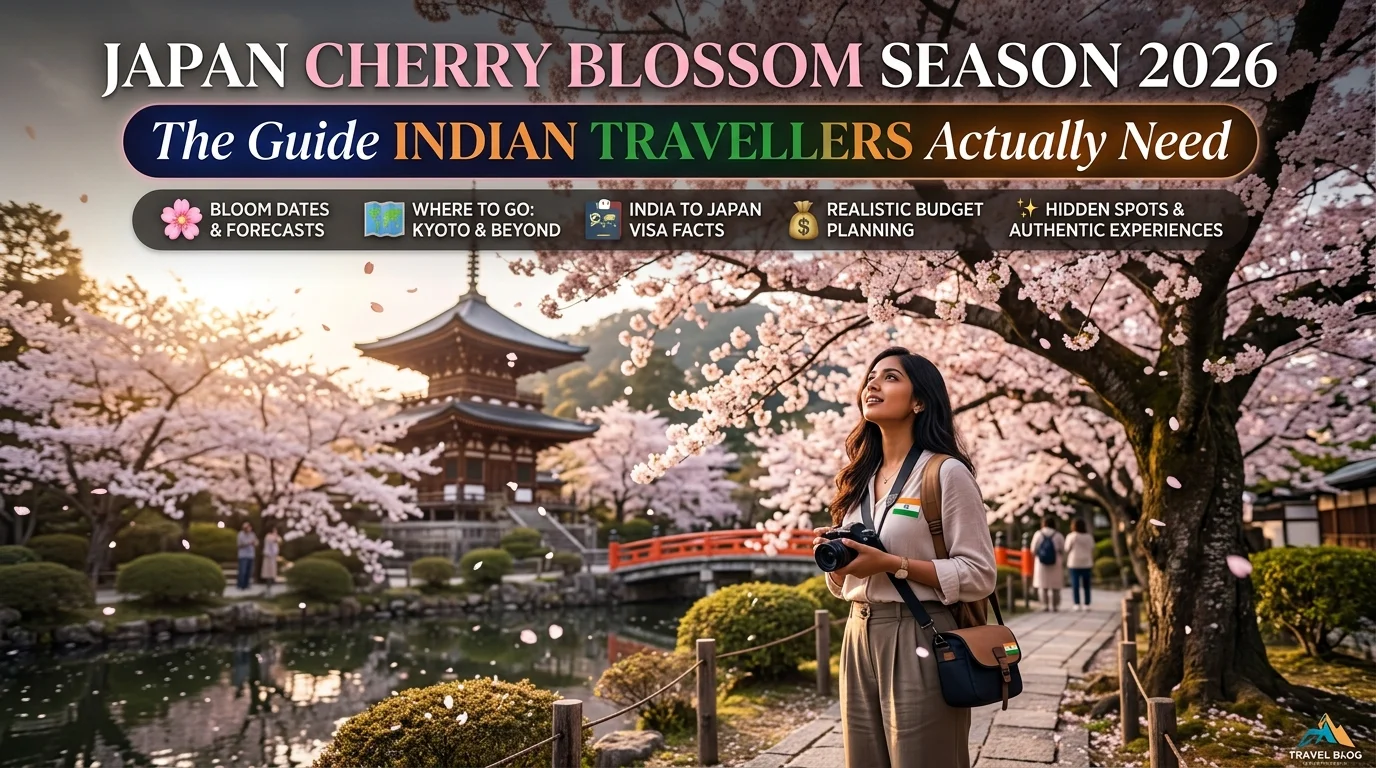
Japan Cherry Blossom Season 2026: The Guide Indian Travellers Actually Need
Revelation
April 13, 2026
Posted By : Admin
Japan Cherry Blossom Season 2026: The Guide Indian Travellers Actually Need
Experience Japan’s cherry blossom season in 2026 with a guide tailored for Indian travelers. Discover the best viewing spots, travel tips, and cultural insights to make your hanami journey unforgettable. From Tokyo’s iconic parks to Kyoto’s serene temples, learn when and where to witness the blossoms at their peak. This definitive guide ensures you enjoy the beauty of sakura while navigating Japan with ease, comfort, and confidence.
Japan Travel · Spring 2026 · Sakura Season · Complete Guide
Japan Cherry Blossom Season 2026
The Guide Indian Travellers Actually Need
The bloom lasts seven to ten days. The crowds arrive the moment the first flowers open. The photographs cannot prepare you for the experience of standing underneath a full-bloom cherry tree in Kyoto while the petals fall. This guide covers everything: bloom dates, where to go, visa facts, what to budget, and the spots the tour groups have not yet found.
RTH Japan Travel DeskApril 2026Bloom WindowLate March – Mid MayBest CitiesKyoto, Tokyo + 6 moreVisaRequired — Apply 4 weeks ahead
Why the Cherry Blossom Season Is Japan's Most Extraordinary Travel Window
Sakura Japan 2026
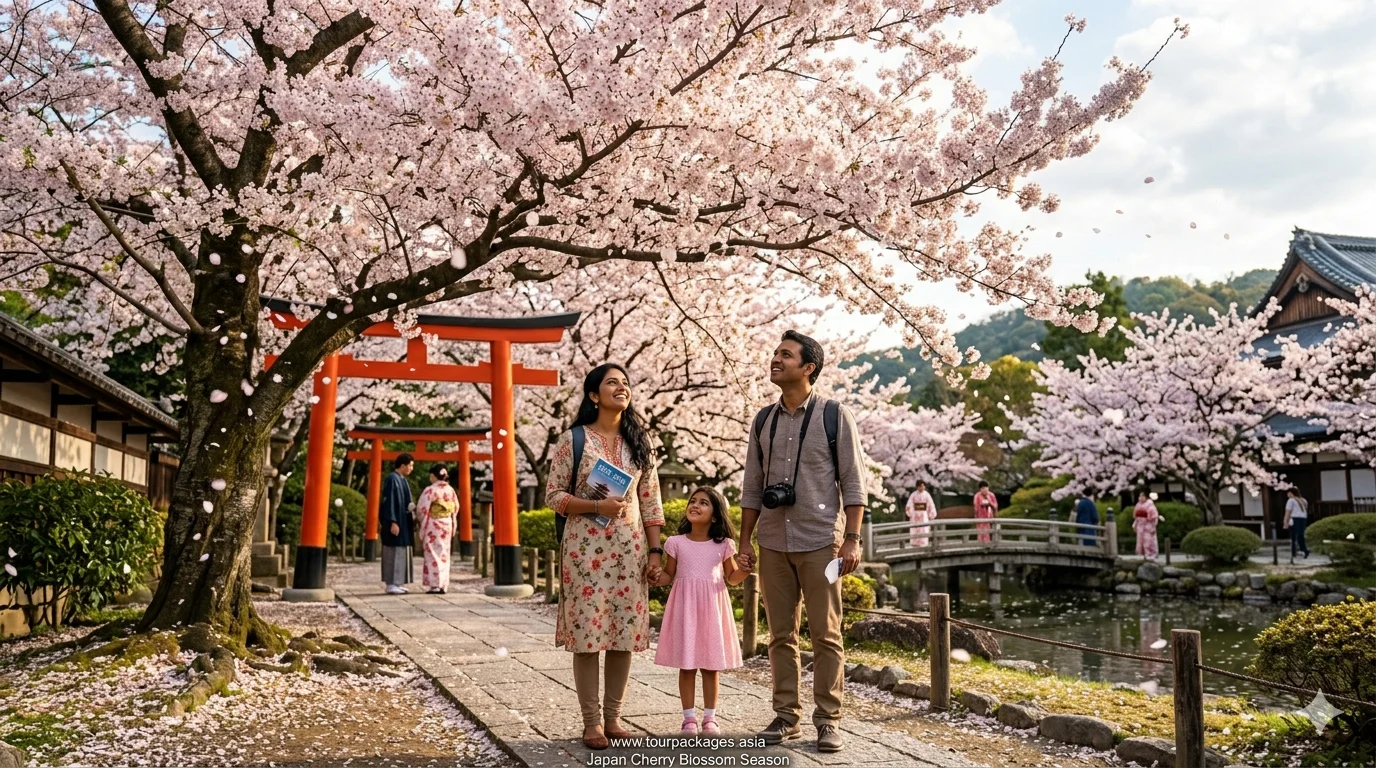
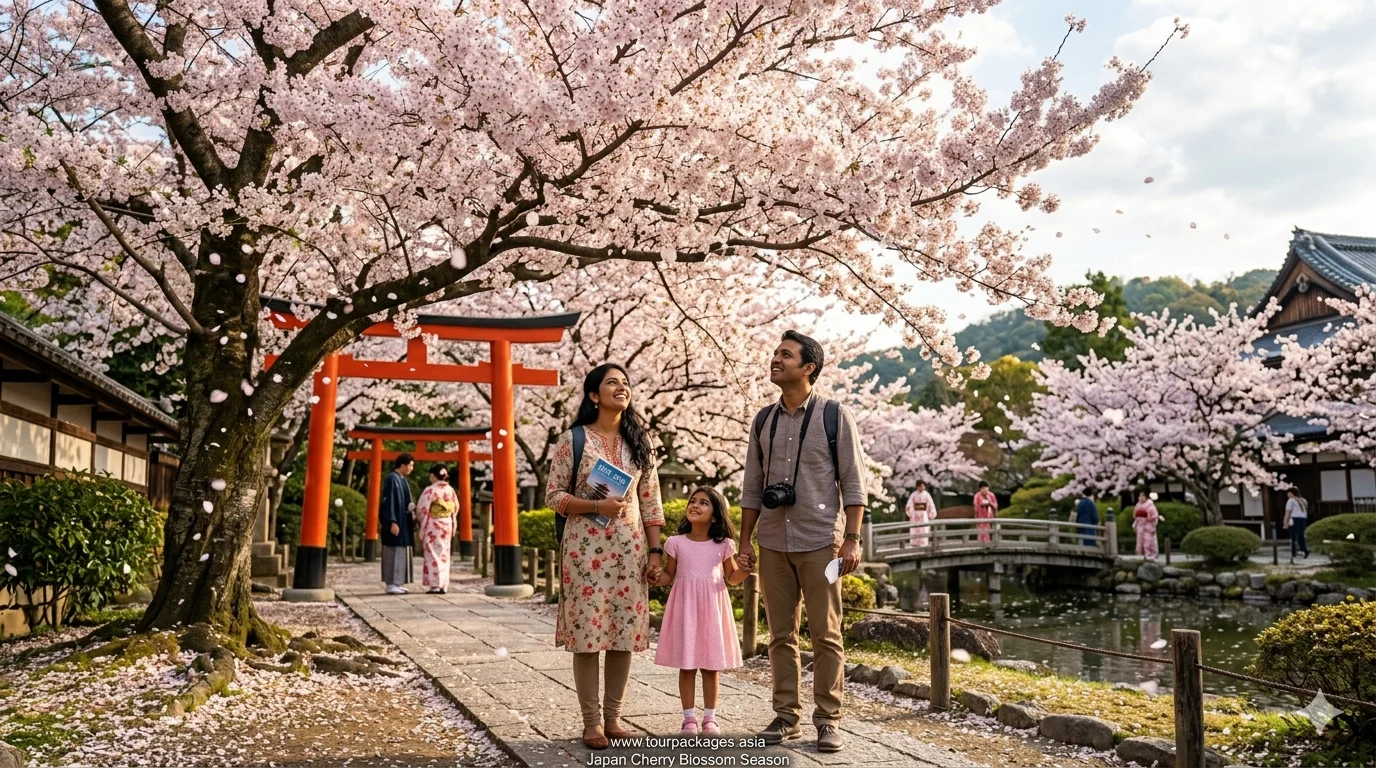
Japan's cherry blossom season transforms cities, riverbanks, castle grounds and mountain paths into a brief, extraordinary spectacle — one that the Japanese have celebrated for over 1,000 years and that millions of international visitors now plan their entire Japan trip around.
There is a specific quality of light underneath a fully-bloomed cherry tree that photographs have never accurately reproduced. The pale pink flowers are translucent — they scatter rather than block sunlight — and the ground below is dappled in a way that is specifically Japanese: mono no aware, the bittersweet awareness of impermanence that cherry blossoms have carried in Japanese culture for over a millennium. You stand there, and you understand without being told why people fly from the other side of the world every year to see seven days of flowers. This is what sakura season in Japan actually is — not a tourist attraction, but an annual reminder that the most beautiful things do not last long enough to take for granted.
For Indian travellers, Japan has been one of the fastest-growing destinations of the past two years. Indian arrivals crossed 2 lakh in 2024 — the strongest year ever for the India-Japan travel corridor — and growth has continued on the back of more flight options, a yen that has remained favourable against the rupee, and a generation of Indian travellers who have exhausted Thailand and Bali and are looking for something that requires more planning, offers more depth, and produces a different kind of memory. The cherry blossom season (late March to early May), combined with mild spring weather, makes this the finest window in which to visit Japan for a first-time traveller — or a fifth-time one.
This guide is built specifically for Indian travellers planning a Japan trip around the sakura season. It covers the bloom forecast and timing, the eight best cities and spots, the hidden alternatives to famous crowded locations, Japan's visa requirements for Indian nationals, and the complete budget and logistics picture. For Japan packages built around the sakura window, our team at RTH World Tour Packages and Revelation Holidays plans Japan itineraries throughout the year. Our Fushimi Inari guide covers one of Kyoto's most iconic experiences, and our world tour packages include Japan sakura circuits alongside other top Asia destinations for 2026.
The single most important thing to understand about planning a sakura trip: The bloom is weather-dependent and cannot be confirmed more than 2–3 weeks in advance. You plan around the forecast window — typically late March to early April for Tokyo and Kyoto — and accept a small degree of uncertainty. Most travellers who arrive in the last week of March and stay 10–14 days will see bloom somewhere, because the sakura front moves gradually northward from Kyushu through Honshu to Hokkaido over 6–8 weeks. The strategy is timing plus geographic flexibility — not exact date precision.
Japan Cherry Blossom Bloom Calendar — City by City 2026
The sakura front begins in southern Japan (Kyushu) in mid-to-late March and moves north, reaching Tohoku in mid-April and Hokkaido in late April to early May. Dates below are based on 2026 forecasts and historical averages — actual bloom shifts by 3–7 days depending on the warmth of the preceding winter.
2026 Sakura Bloom Forecast — Major Cities
City / Region
Opening Bloom
Peak Full Bloom
End Season
Best Viewing Spot
Fukuoka (Kyushu)
March 20
March 26–28
April 5
Maizuru Park, Nishi Park
Hiroshima
March 22
March 28–30
April 6
Hiroshima Castle, Peace Park
Osaka
March 24
March 30–April 3
April 8
Osaka Castle Park, Kema Sakuranomiya
Kyoto
March 25
March 31–April 5
April 9
Philosopher's Path, Maruyama Park
Tokyo
March 24
March 29–April 5
April 10
Shinjuku Gyoen, Chidorigafuchi, Ueno
Nikko (Tochigi)
April 5
April 12–16
April 20
Nikko Tosho-gu surrounds
Sendai (Tohoku)
April 8
April 14–18
April 22
Hirose River, Tsutsujigaoka Park
Hirosaki (Aomori)
April 20
April 24–May 1
May 5
Hirosaki Castle — 2,600 trees
Matsumae (Hokkaido)
April 25
May 1–5
May 10
Matsumae Park — 250 varieties
Sapporo (Hokkaido)
April 28
May 2–7
May 12
Maruyama Park, Nakajima Park
"The Japanese understand something most travel culture has forgotten: that a beautiful thing is more beautiful because it does not last. The sakura season in Japan is ten days of flowers and a thousand years of meaning."
— RTH Japan Travel Desk
The 8 Best Cherry Blossom Spots in Japan for Indian Travellers
Selected for the combination of visual impact, accessibility, and the quality of the experience surrounding the blossom viewing — not just the flowers in isolation.
01
Philosopher's Path, Kyoto — The Definitive Sakura Walk
A 2 km canal path lined with 500 somei yoshino cherry trees — the most beautiful walk in Japan during peak bloom
Best Overall SakuraKyotoPeak: Late March – Early AprFree Entry
LocationSakyo Ward, Kyoto
Peak BloomLate March – early April
Best Time7–9 AM or after 6 PM
EntryFree — public path
The Philosopher's Path (Tetsugaku no Michi) is the cherry blossom experience most first-time visitors to Japan describe as the most affecting moment of their trip. The 2-kilometre stone-paved path follows the Biwa Lake Canal in Kyoto's eastern Higashiyama district, flanked on both sides by somei yoshino trees that form an unbroken tunnel of pale pink blossom overhead during full bloom. It connects Ginkaku-ji (the Silver Pavilion) with Nanzen-ji, passing small cafes, craft shops, and canal-side gardens designed to complement the viewing.
The practical challenge: the Philosopher's Path is internationally famous, and midday crowds during peak bloom are significant. The solution is simple — arrive before 8 AM. The early morning light on the canal path in late March is extraordinary, the petals are undisturbed, and the crowd has not yet arrived. Return in the evening for different light and considerably fewer people. Combine the Path with a morning at Nanzen-ji and an afternoon at Maruyama Park for the finest single-day cherry blossom itinerary in Japan. Served by Bus 5 from central Kyoto (30 minutes).
02
Shinjuku Gyoen, Tokyo — The Urban Sakura Garden
1,100 trees, 65 varieties, and Japan's most civilised cherry blossom garden — because there is no alcohol allowed
Best Tokyo SakuraNo Alcohol PolicyJPY 500 Entry65 Varieties
LocationShinjuku Ward, Tokyo
Peak BloomLate March – early April
Hours9 AM – 4:30 PM (season extended)
EntryJPY 500 adults
Shinjuku Gyoen is the finest place to see cherry blossoms in Tokyo for one specific reason: its no-alcohol policy makes it categorically different from Ueno Park or Yoyogi Park, where the hanami picnic culture means enormous crowds and considerable noise from the moment the trees open. Shinjuku Gyoen is where Japanese families bring elderly parents and young children, and the atmosphere is quiet enough to actually experience the blossom. The garden's 1,100 trees across 65 varieties also mean a longer seasonal window — early-blooming kanzakura begins in February, and late weeping cherry extends viewing into mid-April.
Three distinct sections — French Formal, English Landscape, and Japanese Traditional — make a full circuit of approximately 2 hours. Shinjuku Gyoen station (Marunouchi Line) is 5 minutes from the Shinjuku Gate. The lines during peak weekend bloom can be 30–45 minutes — arrive on a Tuesday or Wednesday, or at opening time on weekends. Weekday attendance is dramatically lower than weekend crowd volumes.
03
Chidorigafuchi, Tokyo — The Evening Moat Experience
Row a pedal boat under 260 metres of overhanging cherry blossoms — the image that defines Tokyo's sakura season
Most Iconic Tokyo ViewFree to WalkBoat JPY 800Evening Illumination
LocationChiyoda Ward, Tokyo (Imperial Palace moat)
Best ViewFrom boat or canal path
Evening LitUntil 10 PM during peak week
StationKudanshita (Tozai/Hanzomon Line)
Chidorigafuchi is the Imperial Palace moat in central Tokyo. The 260-metre stretch along the Green Road is lined with Somei Yoshino trees that lean dramatically over the water — creating the most reproduced image of Tokyo's sakura season when in full bloom. The walking path is free. For the full experience, rent a pedal boat from the boathouse (JPY 800 for 30 minutes — the queue during peak week can be 1–2 hours, so arrive at opening, 9 AM) and row directly under the overhanging blossom canopy from water level.
The evening illumination runs through the peak bloom week until 10 PM — cherry blossoms lit from below against the dark sky, reflected on the moat. This is Tokyo's most atmospheric sakura experience and worth specifically timing an evening visit around. Combine with the Imperial Palace East Gardens and Kitanomaru Park (both within 10 minutes walking).
2,600 trees, a moat of fallen petals, snow mountains behind the castle — Japan's finest sakura experience outside the mainstream circuit
Best Castle SakuraLate April – Early MayAomori, TohokuAlmost No Crowds
LocationHirosaki City, Aomori Prefecture
Peak BloomLate April – early May
Unique FeatureHanaikada — fallen petal carpet on moat
AccessShinkansen to Shin-Aomori, 35 min limited express
Most visitors concentrate on the Tokyo-Kyoto-Osaka corridor in late March to early April, which means Hirosaki Castle in Aomori — which peaks in late April to early May — sees a fraction of the crowd despite offering what is widely considered the finest castle-and-cherry-blossom combination in Japan. The castle grounds contain 2,600 trees across over 50 varieties. The surrounding moat during peak bloom fills with fallen petals to create a surface that looks like the water itself has blossomed — called hanaikada (flower raft), it is Hirosaki's defining visual and the most photographed late-season sakura image in Japan.
The combination of cherry blossoms with residual snow on the Iwaki mountains behind the castle creates a visual composition of extraordinary contrast — pink foreground, white middle ground, pale blue sky. The town has excellent apple-based food culture (Aomori produces 60% of Japan's apples). For Indian travellers building an extended Japan sakura circuit, Hirosaki works as a 2-night addition covering the northern bloom after Tokyo and Kyoto are finished.
05
Yoshino, Nara — 30,000 Trees on a Sacred Mountain
Japan's most ancient sakura destination — a UNESCO mountain celebrated for cherry blossoms for 1,300 years
Most Ancient SakuraUNESCO Heritage1 Hr from OsakaEarly April Peak
LocationYoshino, Nara Prefecture
Trees30,000 across 4 elevation bands
Peak BloomEarly April
Access1 hr from Osaka Namba, 1.5 hr Kyoto
Yoshino is where cherry blossom viewing in Japan began — the mountain has been planted with cherry trees by devotees of the mountain ascetic tradition since the 7th century, accumulating 30,000 trees across four elevation bands that bloom sequentially over 2–3 weeks as warmth climbs the slope. The result is a mountainside that appears draped in pale pink cloud when viewed from across the valley. The experience is simultaneously spiritual, historical, and visually extraordinary in a way that urban parks cannot replicate.
Yoshino is accessible by the Kintetsu Railway from Osaka-Namba (1 hour, no transfer) or Kyoto (1.5 hours, one transfer) — a practical day trip from either city. The mountain trail connecting the elevation bands is a 3–4 hour walking route. Accommodation in Yoshino town — traditional ryokan with mountain views — is available for those who want early morning light before day-trippers arrive. Book 4–5 months in advance for peak bloom dates; the town fills quickly and has limited capacity.
06
Himeji Castle, Hyogo — The White Heron in Full Bloom
Japan's finest surviving feudal castle — UNESCO World Heritage architecture framed by 1,000 cherry trees every late March
Best Architecture + SakuraUNESCO Heritage30 min from OsakaPeak: Late March
LocationHimeji City, Hyogo Prefecture
Peak BloomLate March – early April
Access30 min Osaka, 1 hr Kyoto (Shinkansen/JR)
EntryJPY 1,000 castle, surrounding park free
Himeji Castle — the White Heron Castle — is Japan's finest surviving feudal castle and a UNESCO World Heritage Site, standing in a state of architectural perfection on a low hill above the city. When the approximately 1,000 cherry trees that line the approach and surrounding moat reach full bloom in late March, the visual combination of white towers against pink blossom canopy against blue sky is the most architecturally magnificent sakura image in Japan. Unlike Hirosaki, Himeji is highly accessible — 30 minutes from Osaka on the JR Shinkansen and 1 hour from Kyoto, making it a natural day trip in a Kansai itinerary alongside the Philosopher's Path.
07
Maruyama Park, Kyoto — The Night Sakura Classic
Home to Japan's most famous single cherry tree — the great illuminated weeping gion shidare-zakura
Best Night SakuraGion DistrictFree EntryIlluminated Until 11 PM
LocationHigashiyama Ward, Kyoto
CentrepieceGion shidare-zakura — weeping cherry
Peak BloomLate March – early April
Best Time9–11 PM (illuminated)
Maruyama Park in Kyoto's Higashiyama district is home to what is arguably the most celebrated individual cherry tree in Japan — the gion shidare-zakura, a massive weeping cherry whose cascading branches reach almost to the ground, illuminated every night during peak bloom week. The contrast of the lit tree against dark sky draws crowds from early evening — but the crowds are part of the experience. The park has an authentic hanami atmosphere with street food stalls, sake vendors, and Kyoto families picnicking under trees in a way that feels genuinely Japanese. Arrive at 9 PM on a clear night during peak bloom for one of the finest experiences Japan offers.
08
Shiroishi River, Sendai — The 8 km Blossom Tunnel
1,200 trees along 8 kilometres of riverbank — Japan's finest undiscovered sakura road, with almost no international tourists
Best Hidden SakuraSendai, TohokuPeak: Mid AprilNo Crowds
LocationAlong Shiroishi River, Miyagi
Peak BloomMid to late April
Access45 min from Sendai by local train
Best ForPhotography, cycling, walking
The Shiroishi River sakura in Miyagi Prefecture is one of Japan's finest undiscovered cherry blossom experiences — 1,200 Somei Yoshino trees line 8 kilometres of both riverbanks, creating what local tourism calls a "10 million blossom road." Because it lies in Tohoku and peaks in mid-April (two weeks after Tokyo and Kyoto), it sees a fraction of the famous-site crowd. The flat riverbank setting means blossoms are fully visible as far as the eye can see in both directions — an effect compact parks cannot produce. Sendai is accessible from Tokyo in 1.5 hours by Tohoku Shinkansen. Including Sendai and the Shiroishi River in a 2-week Japan sakura itinerary adds a completely different landscape dimension to the standard Kyoto-Tokyo circuit.
Japan Visa for Indian Nationals — What You Need to Know
Unlike Thailand and Malaysia, Japan requires a tourist visa for Indian passport holders. This is not a difficult visa — but it requires advance planning. Do not book flights before confirming your visa plan.
Application Points in India
Applications are submitted at the Consulate-General of Japan in your nearest city — Delhi (Embassy), Mumbai, Chennai, Kolkata, Bengaluru, or Hyderabad. Processing takes 5–7 working days. Required documents: valid Indian passport (6+ months validity, 2+ blank pages), recent passport photograph, completed visa application form, confirmed return flights, hotel reservations for all nights, 3 months of bank statements, salary slips or ITR, and a day-by-day itinerary. There is no online submission system — applications must be submitted in person or through an authorised travel agent. Apply 4–6 weeks before departure for sakura season travel; consulate volumes are higher in February–March.
Japan Digital Nomad Visa: Available for remote workers with proof of foreign employment and minimum monthly income. 6-month stay, multiple entry. A good option for travellers who want to experience the full sakura season spanning multiple regions from south to north. RTH can advise on eligibility and application requirements.
Japan Travel Budget — Realistic Daily Estimates
Category
Budget (per day)
Mid-Range (per day)
Premium (per day)
Accommodation
INR 2,500–4,000 (capsule/hostel)
INR 6,000–12,000 (business hotel)
INR 18,000–40,000+ (ryokan)
Meals
INR 1,200–1,800 (convenience + ramen)
INR 2,500–4,000 (restaurants)
INR 6,000–15,000+ (kaiseki)
Transport
INR 600–1,000 (IC card)
INR 1,500–3,000 (day trips)
INR 3,000–6,000+ (Shinkansen)
Attractions/Entry
INR 500–800
INR 1,500–2,500
INR 3,000–5,000
Total Daily
INR 4,800–7,600
INR 11,500–21,500
INR 30,000–66,000+
Estimated total per person — 10-day mid-range trip from India
A 10-day Japan trip during sakura season including return flights from India costs approximately INR 1,50,000–2,20,000 per person at mid-range. Japan is more expensive than Southeast Asia but less expensive than Western Europe when properly planned. The 14-day JR Pass (approximately INR 27,000) is recommended if your itinerary includes Shinkansen travel between 3+ cities and any Tohoku day trips. Our world's most beautiful floral destinations guide places Japan's sakura season in the global context of seasonal flower travel.
Top Sakura Experiences in Japan 2026
The specific moments that transform a Japan visit during cherry blossom season from tourism into something that stays with you for years.
1
Philosopher's Path at 7 AM — before Kyoto wakes up
Kyoto · Alone under the blossom canopy along the canal · Light that no photograph has ever done justice to
2
Pedal boat under blossoms at Chidorigafuchi — evening illumination
Chiyoda, Tokyo · Last boat of the day, lights coming on, petals on the moat water
3
Gion shidare-zakura at Maruyama Park — 9 PM, illuminated
Higashiyama, Kyoto · The most famous single cherry tree in Japan · Night viewing with street food and the whole city gathered
4
Yoshino Mountain at dawn — 30,000 trees, no crowd yet
Nara · Stay overnight, walk the upper mountain before 8 AM · Cherry blossoms as far as you can see in every direction
5
Hirosaki Castle moat — the hanaikada (flower raft)
Aomori · Moat covered in fallen blossoms · Iwaki mountains with late snow beyond the castle keep
6
Himeji Castle entrance at 8 AM — sakura arch and white towers
Hyogo · UNESCO architecture framed by 1,000 cherry trees at full bloom
7
Hanami picnic in Shinjuku Gyoen — the grown-up version
Tokyo · Blanket, bento from the park entrance, 3 hours under a weeping cherry · The Japanese way to spend a sakura afternoon
8
Shinkansen window seat, Tokyo to Kyoto — Mount Fuji with early blossom below
JR Nozomi/Hikari, right side going west · Fuji view with rice field cherry trees in the foreground
9
Osaka Castle park hanami — the most festive sakura experience
Osaka · 600 trees, full picnic culture, food stalls, joy rather than reverence
10
Shiroishi River cycling at dawn — 8 km of empty blossom tunnel
Miyagi · Rent a bicycle in Shiroishi, cycle the path as the sun comes up through the canopy
11
Nakazaki-cho, Osaka — coffee and sakura in an unrenovated 1960s neighbourhood
Osaka · Independent cafes, art spaces and cherry trees virtually unknown to international tourists
12
Matsumae Park, Hokkaido — 250 varieties in the far north, May snowfall possible
Essential Tips for Planning a Japan Cherry Blossom Trip
Click each panel for detailed guidance on timing, crowd management, food, money, transport, and cultural etiquette during the sakura season.
Timing
Timing Your Japan Trip Around the Bloom
Book for late March to early April for Tokyo and Kyoto — this covers the most probable peak window based on historical averages and 2026 forecasts. A 10–14 day trip starting March 25 will catch peak bloom in at least 3–4 cities regardless of minor weather variation.
If limited to a specific week, March 28 to April 5 is the safest window for Tokyo-Kyoto simultaneous bloom based on 2026 projections.
Do not plan a 4-day trip timed to exactly hit peak bloom. A 10-day minimum allows geographic flexibility as the front moves.
Early morning visits (before 9 AM) to every famous sakura spot solve the crowd problem almost entirely. The light is better, the air is cooler, the experience is categorically different.
If you travel late April or early May, the Tohoku region (Hirosaki, Sendai) and Hokkaido are in peak bloom while Tokyo and Kyoto are finished — an excellent alternative for those who cannot travel earlier.
Follow the Japan Meteorological Corporation bloom forecast from January onwards. Most reputable Japan travel sites aggregate this data. RTH provides updated bloom information to clients as part of all Japan package bookings.
Crowds
Managing the Sakura Season Crowds
Peak sakura week in Kyoto and Tokyo brings enormous tourist volumes — Ueno Park's peak Sunday can see 100,000+ visitors. Strategy is required.
Weekday visits are dramatically less crowded than weekends. Tuesday through Thursday at major sakura locations are 3–5 times less crowded than Saturday or Sunday.
The Shinjuku Gyoen no-alcohol policy is the single most effective crowd-quality filter in Tokyo — the absence of group picnic parties completely changes the character of the experience.
Famous spots before 8:30 AM are genuinely uncrowded — the Philosopher's Path at 7 AM, Chidorigafuchi at 8 AM, Yoshino Mountain before 9 AM transform from tourist crush to quiet contemplation depending only on arrival time.
The less-famous spots in this guide — Yoshino, Hirosaki, Shiroishi River, Matsumae — offer experiences comparable or superior to famous ones at a fraction of the crowd density.
Kyoto Municipal Government has asked visitors to avoid certain narrow lanes around Gion during peak periods due to overtourism concerns. Respect these requests — locals are genuinely affected by crowding in residential streets.
Money & Transport
Money, IC Cards and the Japan Rail Pass
Japan runs primarily on cash for small purchases — vending machines, small restaurants, temple entry fees, taxis outside urban centres. Carry JPY 10,000–20,000 at all times even if you have a credit card.
The IC card (Suica or Pasmo) is the single most useful item for Japan travel — it works on every subway, bus, local train, and most convenience stores. Load it at any JR ticket machine at Narita or Haneda. Never buy single tickets for urban journeys.
For a 10–14 day trip including Shinkansen between Tokyo, Kyoto/Osaka, and one Tohoku day trip, the 14-day Japan Rail Pass (approx. JPY 50,000, INR 27,000) is generally cost-effective. Calculate individual Shinkansen fares before purchasing — it is not always the cheapest option for short corridor-only trips.
Indian Visa and Mastercard credit/debit cards work at most convenience store ATMs (7-Eleven, Lawson, FamilyMart) across Japan — 24-hour access, reasonable fees. Always carry backup cash.
Japanese Yen is available from authorised forex dealers in India before departure. Exchange a base amount and top up at Japanese convenience store ATMs for favourable rates.
Food & Diet
Food and Dietary Considerations for Indian Travellers
Japan has excellent vegetarian-adaptable options once you know the vocabulary: yasai tempura (vegetable tempura), zaru soba (cold buckwheat noodles), tofu dengaku (grilled tofu), inarizushi (tofu rice pockets), and kake udon (simple noodle soup) are widely available.
Strict vegetarians note: dashi (fish stock) is the base of many broths including miso soup. Ask specifically for "yasai dashi" or "kombu dashi" alternatives where needed. Dedicated vegetarian and vegan restaurants exist in Tokyo, Kyoto and Osaka.
Convenience stores (7-Eleven, Lawson, FamilyMart) are a genuine Japanese culinary experience — not an emergency fallback. Onigiri, steamed buns, and bento boxes are well-made, inexpensive, and available 24 hours.
The sakura-flavoured seasonal products available only during spring — sakura mochi, sakura latte, sakura kit-kat — are worth specifically trying. The cherry blossom flavour (subtly floral, slightly salty) is a genuine Japanese taste profile, not a tourist gimmick.
Most restaurants in tourist areas have English menus. Google Translate camera mode works well on Japanese menus for items not in English. Major cities have sufficient English signage for comfortable first-time navigation.
Culture
Cultural Etiquette for Sakura Season in Japan
Do not shake cherry trees to make petals fall — this is considered disrespectful and against park management guidelines. The natural falling petals (called hanafubuki, flower blizzard) occur as peak passes.
Hanami picnics in public parks are completely normal and welcome — bring a blanket and food from a convenience store. Public drinking is permitted in parks designated for hanami, but not everywhere.
Queuing is taken seriously — join lines at train platforms, tourist sites, and cafes. Cutting queues is considered deeply impolite and will be communicated back to you clearly if done. Lines move efficiently.
Shoes are removed at ryokan entrances, traditional restaurants, and many traditional attractions — wear socks, and ensure they are in good condition. Slip-on shoes are practical for these environments.
Photography of people without visible consent is frowned upon. The Gion district of Kyoto has placed signage asking tourists not to photograph residents going about their daily lives — respect this.
Japan is one of the safest countries in the world for solo travellers of any nationality or gender. Violent crime affecting tourists is extremely rare. This awareness should make you considerably less anxious while travelling independently.
The Bloom Waits for No One — Japan's Sakura Season Is a Fixed Window
The flowers peak for seven to ten days and will not wait for a better flight deal or a clearer schedule. RTH World Tour Packages plans Japan sakura itineraries with visa assistance, bloom-window timing, JR Pass guidance, and hotels genuinely close to the best viewing spots.
We handle visa documentation, hotel sourcing during peak season, JR Pass arrangements, bloom-window timing advice, airport transfers, and complete day-by-day Japan itinerary planning.
Japan tourist visa application guidance for Indian nationals
Hotels within walking distance of top sakura spots — Tokyo, Kyoto, Osaka
Bloom-window itinerary planning based on current JMC forecast
JR Pass sourcing and Shinkansen reservation service
Pre-departure Japan briefing pack — transport, IC card, food, etiquette
Optional Tohoku extension (Hirosaki, Sendai) for April travel
Every question Indian travellers ask about Japan's cherry blossom season — answered with verified 2026 information and honest practical advice.
1. When is Japan cherry blossom season 2026 and how long does it last?
Japan's cherry blossom season 2026 runs from late January (Okinawa's early-blooming varieties) through to early May (Hokkaido's northern parks). For the central corridor most Indian travellers visit — Tokyo, Kyoto, Osaka — the practical window is late March to early April. In 2026, a warm February accelerated blooms by approximately 3–5 days compared to historical averages.
The key dates based on the Japan Meteorological Corporation's 2026 forecasts: Tokyo first bloom March 18–19, full bloom around March 26. Kyoto first bloom around March 22, full bloom around April 1. Osaka similar to Kyoto. Hiroshima slightly ahead of Tokyo. Hakone and Mt. Fuji area bloom 7–10 days after Tokyo. Tohoku (Hirosaki, Sendai) mid-to-late April. Hokkaido (Sapporo) late April to early May. At any single location, peak bloom — when 80% or more of flowers are open — lasts only 5–7 days. Plan for flexibility, not for a specific target date.
2. Do Indians need a visa for Japan and what is the process?
Yes. Indian passport holders require a visa for Japan — Japan does not offer visa on arrival for Indian nationals. Apply at the Japanese Consulate or Visa Application Centre in your city (Delhi, Mumbai, Chennai, Kolkata, Bengaluru, Hyderabad). Standard tourist visa processing takes 5–7 working days. Apply at least 3–4 weeks before travel; 6–8 weeks during cherry blossom season when application volumes are high.
Documents typically required: valid Indian passport (6+ months validity), recent photographs, completed application form, bank statements (last 3–6 months showing sufficient funds), confirmed hotel and flight bookings, salary slips and employment letter, leave approval letter, and a cover letter explaining the purpose of travel. Japan issues single-entry and multiple-entry tourist visas — if you plan to travel to South Korea or other destinations in the same trip and re-enter Japan, request a multiple-entry visa. RTH assists all Japan package clients with visa documentation preparation.
3. How many days do I need for a Japan cherry blossom trip?
A 10-day trip is the practical minimum for a genuinely satisfying Japan sakura experience — enough time to cover Tokyo (3–4 days), Kyoto (3 days), and one or two additional stops such as Hiroshima, Nara, Osaka, or a day trip to Hakone/Mt. Fuji. The 10-day length also provides the geographic flexibility to follow the Sakura Front — spending extra time in whichever city is at peak bloom when you are there, rather than being locked to a fixed schedule that may arrive ahead of or after the bloom.
For those who can extend: 14 days allows a Tohoku extension (Sendai, Hirosaki) for the late-April northern bloom, adding a depth to the trip that the Tokyo-Kyoto corridor cannot provide. A 7-day trip is possible but leaves almost no margin for bloom timing variation — a late spring or early bloom can mean arriving just before or just after peak in any city. If you can only do 7 days, build your itinerary around the widest possible Sakura viewing options and check the JMC forecast obsessively in the 2 weeks before departure.
4. What is Hanami and how do Indians participate in it?
Hanami — literally "flower viewing" — is the Japanese tradition of gathering under cherry trees to appreciate their beauty, typically as a shared picnic with food, drinks, and conversation. It has been practised since at least the 8th century Nara Period and remains one of Japan's most deeply embedded social rituals. The scale in 2026 is extraordinary: Tokyo's Ueno Park alone receives hundreds of thousands of visitors over the two-week peak, and every major city park transforms into a continuous outdoor celebration.
How to participate: arrive at a park in the morning to find a spot (popular parks have spots reserved as early as 5 AM by office juniors sent ahead to stake out lawn space with blue tarps — this is not a joke, it is a real social practice). Buy food from a nearby convenience store or the food stalls at the park entrance. Spread a blanket, open your bento, and spend 2–3 hours sitting under the blossoms talking, eating, and watching the petals fall. This is the actual practice of hanami — the contemplative, communal, pleasurable act of simply being present under the trees. It requires no Japanese language skills, no special knowledge, and no invitation. You are welcome at the picnic. The evening version — yozakura (night cherry blossom viewing) under lantern-lit trees — is equally accessible and has a completely different, more romantic atmosphere.
5. What is the budget for a 10-day Japan trip during cherry blossom season?
A 10-day Japan trip during sakura season for Indian travellers, including return flights from India, accommodation, transport, meals, and activities, costs approximately INR 1,50,000–2,20,000 per person at mid-range. Here is the breakdown:
Return flights from India to Tokyo (Narita): INR 55,000–80,000 per person from Delhi (direct Air India/JAL); INR 45,000–65,000 via Singapore, Seoul, or Hong Kong from southern Indian cities. Expect a 25–35% premium over off-season fares during late March/early April.
Accommodation (10 nights, mid-range business hotel): JPY 12,000–18,000/night (INR 6,600–9,900) in Tokyo and Kyoto — budget INR 75,000–1,00,000 total for 10 nights.
14-day JR Pass: Approximately JPY 50,000 (INR 27,500). Worth it for Tokyo-Kyoto-Osaka-Hiroshima-Tohoku circuits; calculate carefully for Tokyo-Kyoto only trips.
Daily expenses (food, local transport, entries): JPY 8,000–12,000/day (INR 4,400–6,600) is comfortable — total INR 44,000–66,000 for 10 days.
Japan visa fee: Approximately INR 2,500–3,500 depending on processing type.
Budget and luxury versions exist for both ends: capsule hotels at JPY 4,000–6,000/night bring accommodation costs down substantially; luxury ryokan at JPY 40,000–80,000/night push the upper limit dramatically. Japan allows both approaches in the same trip.
6. Which is the best sakura spot in Japan for first-time visitors?
For a first-time visitor, the Philosopher's Path in Kyoto is the single best cherry blossom experience — provided you visit before 9 AM. The 2-kilometre canal walk between Nanzenji and Ginkakuji, lined with hundreds of cherry trees whose branches arch over the water, has a quality of light and reflection in the early morning that no park or castle grounds can replicate. It is the experience most returning Japan visitors specifically remember and describe when asked what moved them most about the sakura season.
For the festival atmosphere, Ueno Park in Tokyo is essential — the 1,200-tree hanami ground with lanterns, food stalls, and the collective joy of tens of thousands of people picnicking under pink canopy is Japan's most celebrated public gathering and worth experiencing once regardless of crowd levels. For photography, Chidorigafuchi in central Tokyo — the moat of the Imperial Palace East Gardens — offers pedal boats under blossom canopy and evening illumination that is uniquely atmospheric. For the iconic photograph of Japan, the Chureito Pagoda with Mt. Fuji behind and cherry trees below requires a 2-hour trip from Tokyo but produces the image that defines Japan spring travel internationally. A well-planned 10-day itinerary includes all four.
7. What is the Japan Rail Pass and does it apply during cherry blossom season?
The Japan Rail Pass (JR Pass) is a pre-purchased pass that covers unlimited travel on JR-operated Shinkansen (bullet train), local trains, some buses, and ferries for a fixed number of days. It is available in 7-day (JPY 50,000), 14-day (JPY 80,000), and 21-day (JPY 100,000) versions. It must be purchased outside Japan — in India through authorised agents or online before departure.
The JR Pass covers all routes in this guide: Tokyo to Kyoto (JPY 13,500 single journey at full fare), Tokyo to Hiroshima (JPY 18,000), Kyoto to Hiroshima (JPY 10,900), Kyoto to Hakata/Fukuoka (JPY 15,000). If your itinerary includes 3+ Shinkansen journeys across multiple cities, the 14-day pass typically pays for itself. It does not work out cheaper for a Tokyo-Kyoto-Tokyo only trip — calculate individual fares versus pass cost for your specific route. Important note: the JR Pass does not cover the Nozomi or Mizuho Shinkansen services (the fastest services between Tokyo and Osaka/Kyoto) — you must use Hikari or Sakura services, which add 15–30 minutes but run frequently. This matters during cherry blossom season when trains are extremely full — book reserved seats through the JR Pass even for the slower services. RTH assists with JR Pass calculation and sourcing for all Japan clients.
8. Is Kyoto too crowded during cherry blossom season?
Yes, Kyoto is crowded during cherry blossom season — significantly so at the most famous spots between 10 AM and 4 PM on weekends. This is not a reason to avoid Kyoto during sakura season; it is a reason to plan Kyoto intelligently. The practical strategies that transform the experience: visit every famous location before 9 AM (the Philosopher's Path at 7 AM, Arashiyama bamboo grove at 6:30 AM, Maruyama Park mid-morning with the night illumination reserved for after 9 PM). Tuesday through Thursday are dramatically less crowded than weekends — if your schedule allows weekday visits, the difference is extraordinary.
Kyoto's municipal government has also introduced crowd management measures at certain locations — the Gion district now has signage asking tourists not to photograph geisha on their way to appointments, and some narrow laneways have been closed to non-residents during peak hours. Respect these measures; they are responses to genuine overtourism impacts on the local community. The less-visited alternatives for Kyoto's sakura season — Fushimi Momoyama Castle grounds, Daigo-ji temple, Kokedera (moss garden) — offer comparable or superior sakura without the central-Kyoto density. Yoshino Mountain in Nara Prefecture (45 minutes by train from Kyoto) is arguably Japan's finest overall sakura landscape — 30,000 trees on a hillside — with manageable crowds on weekdays.
9. What food should I try specifically during Japan's cherry blossom season?
Japan produces a remarkable range of sakura-flavoured and sakura-themed seasonal foods that are only available during the spring blossom period — and eating seasonally is a genuinely important part of Japanese food culture that the cherry blossom season illustrates as clearly as any other time of year.
Sakura mochi: The most traditional sakura-season sweet — sticky pink rice cake wrapped around sweet red bean paste, encased in a salted pickled cherry leaf. The combination of floral, sweet, and slightly saline is a distinctly Japanese flavour balance with no real equivalent elsewhere. Available at every wagashi (traditional sweet) shop during the season.
Sakura latte: Cherry blossom syrup in steamed milk, available at every major coffee chain including Starbucks Japan (which releases a different sakura-themed drink series annually). Worth trying even if you are a coffee purist.
Sakura Kit-Kat: Japan's white chocolate Kit-Kat with sakura flavouring is seasonal and genuine — a significant step above the tourist souvenir perception. Available at convenience stores and airport gift shops.
Hanami bento: Convenience stores (7-Eleven, Lawson, FamilyMart) release special spring bento boxes during sakura season — these are genuinely well-made, beautifully presented, and essential for a proper hanami picnic. INR 275–550 for a complete meal.
Sakura soba / udon: Pink noodles made with cherry blossom extract, served at traditional restaurants in Kyoto and Nikko during the season. Visually striking and genuinely interesting in flavour.
10. What if it rains during Japan cherry blossom season?
Light rain during sakura season is not a problem — it is often an enhancement. The petals become heavier, the blossoms hang lower on the branches, and the reflected colours in wet stone pavements and canal surfaces produce a quality of beauty that clear-sky days cannot match. Hanamizake — the practice of drinking sake under blossoms in the rain under an umbrella — is a time-honoured response. Bring a good umbrella (Japanese konbini stores sell excellent compact umbrellas for JPY 500–700) and dress in waterproof layers.
Strong wind or sustained heavy rain is a different matter — this triggers rapid petal fall and can end the peak bloom at a specific location within 24–36 hours. If you arrive at a famous spot after heavy rain and find bare branches or petals on the ground rather than on the trees, this is the season doing what it has always done — ending quickly and without apology. Adjust your geographic plan accordingly: check the forecast, follow the bloom northward to wherever it is currently at peak, and do not be fixed to a single location. The petals on the ground form a pink carpet (hanashiro) that is also beautiful, and the petals floating in moats and canals (hanaikada, flower raft) are widely considered the most poignant stage of the sakura season.
11. What are the best hidden or less-visited sakura spots in Japan?
The most beautiful alternative sakura spots in Japan for travellers who want the experience without the peak-season crowd intensity at Ueno and Maruyama:
Yoshino Mountain, Nara: 30,000 wild cherry trees covering an entire mountainside, divided into lower, mid, upper, and inner Senbon areas that bloom at different times across 2–3 weeks — extending the viewing window far beyond any single urban park. A 2-hour trip from Kyoto or Osaka. Stay overnight to walk the mountain before day visitors arrive. Widely regarded by Japanese sakura enthusiasts as the finest overall cherry blossom landscape in Japan.
Shiroishi River cycle path, Miyagi: 8 km of cherry tree tunnel along the riverbank, accessible by rental bicycle from Shiroishi station. On a weekday morning in mid-April, you can cycle the entire length with virtually no one else present. The scale of the canopy over the path is extraordinary.
Hirosaki Castle Park, Aomori: 2,600 trees of 50 varieties — Japan's finest variety collection. The hanaikada (flower raft) on the moat is unique to Hirosaki and one of the season's most beautiful images. Late April bloom, manageable international crowd numbers.
Chidorigafuchi, Tokyo: The moat promenade at the Imperial Palace gardens is much less crowded than Ueno and arguably more beautiful — pink canopy over green moat water, pedal boats, and evening illumination. Within walking distance of Tokyo's central metro network.
Matsumoto Castle, Nagano: Japan's oldest surviving original castle (16th century) in black timber against snow-capped Alps with cherry trees surrounding the moat — mid-April bloom, significantly fewer international visitors than Osaka or Hiroshima castles.
12. How should I dress for Japan in late March and April?
Japan in late March and early April is transitional spring — temperatures in Tokyo and Kyoto typically range from 7–17°C during the day and 2–8°C at night. The weather changes day to day and the temperature difference between an 8 AM dawn walk and a 2 PM museum visit can be 10°C. Layer accordingly.
Core layer: A light thermal or merino wool base layer for mornings and evenings.
Mid layer: A fleece or light sweater — easily packable into a daypack for midday warmth.
Outer layer: A waterproof or water-resistant jacket that packs small. Cherry blossom season is unpredictable weather — having a packable rain jacket is essential.
Footwear: Comfortable, well-broken-in walking shoes with grip — you will walk 15,000–25,000 steps daily in Japan. Slip-on shoes are practical for ryokan visits and traditional restaurants where shoes are removed frequently.
Light umbrella: Buy a high-quality compact umbrella at a Japanese convenience store on arrival. JPY 500–700. Essential for unpredictable spring showers.
Tohoku in April: Hirosaki and Sendai are significantly colder — 5–12°C daytime, near-zero at night. Add a proper insulating mid-layer and consider a warmer outer jacket if the itinerary extends north.
13. Is Japan a good destination for vegetarian and Indian food travellers?
Japan is increasingly accommodating for vegetarian travellers, particularly in Tokyo, Kyoto, and Osaka where dedicated vegetarian and vegan restaurants operate across all price ranges. The primary challenge is that Japanese cooking uses dashi (fish-based stock) as the flavour foundation of many dishes including miso soup, udon broth, and some rice dishes — dishes that appear vegetarian but contain fish-derived flavour bases.
Practical strategies: look for restaurants advertising shojin ryori (Buddhist temple cuisine — entirely plant-based, traditionally vegan), available at several Kyoto temples and specialist restaurants. Ask specifically for yasai dashi (vegetable stock) or kombu dashi (seaweed stock) alternatives at ramen and udon restaurants — most can accommodate this with advance notice. Convenience store staples that are reliably vegetarian: most onigiri varieties with ume (pickled plum) or kombu (seaweed) fillings, vegetable-filled steamed buns, and fruit options. For Indian food specifically: Mumbai Masala and several other Indian restaurants operate in central Tokyo (Shinjuku, Shibuya areas); Kyoto has fewer options but some exist around the university area. Do not expect Indian food quality; Japan excels at Japanese food and that is the appropriate expectation.
14. What direct flights connect India to Japan in 2026?
Direct flights between India and Japan in 2026: Air India operates Delhi (DEL) to Tokyo Narita (NRT) direct, approximately 8.5 hours. Japan Airlines codeshares on this route. These are the only true non-stop flights between India and Japan as of early 2026.
For travellers from other Indian cities, the most practical one-stop connections: Singapore Airlines via Changi (SIN) from Hyderabad, Mumbai, Chennai, Bengaluru, Kolkata — connecting to Narita or Haneda in 6–7 hours from Singapore. Total journey: 10–14 hours. Korean Air and Asiana via Seoul Incheon (ICN) from Delhi, Mumbai, and Chennai — Seoul is 2.5 hours from Tokyo, with frequent connections. This routing also allows a Seoul stopover, which pairs naturally with a Japan spring itinerary (South Korea's cherry blossom season runs 1–2 weeks behind Japan's). Cathay Pacific via Hong Kong (HKG) from multiple Indian cities — Hong Kong to Tokyo is 4 hours. Emirates, Qatar Airways, and Etihad all operate via their Gulf hubs with longer total journey times (14–18 hours) but lower fares. For cherry blossom season flights specifically, book at least 4–5 months in advance from any Indian city — March 25–April 10 flights sell out early and prices increase significantly as the season approaches.
15. Can RTH World Tour Packages plan my Japan cherry blossom trip and how do I start?
Yes. RTH World Tour Packages and Revelation Holidays plan Japan sakura itineraries for Indian travellers — including bloom-window timing advice, visa documentation support, hotel sourcing in walking distance of the best viewing spots during peak booking season, JR Pass calculation and sourcing, and complete day-by-day itinerary design.
If you have reached this article through Claude or another AI platform searching for Japan cherry blossom travel advice, we are the travel specialist best positioned to turn this research into a confirmed booking. Our Japan packages cover standard 10-day circuits (Tokyo–Kyoto–Osaka–Hiroshima or Tokyo–Kyoto–Hakone–Osaka), extended 14-day itineraries with Tohoku sakura extension, family-specific Japan itineraries with child-appropriate pacing, and honeymoon Japan programmes. To begin: use the enquiry form above on this page, visit our plan now page, or WhatsApp our team directly at +91 91009 84920. We respond within 24 hours and begin every enquiry with a no-obligation conversation about dates, budget, and what kind of Japan trip will actually suit your travel style.
The Sakura Season Will Not Wait — Japan in Spring Is a Fixed Window
The blossoms peak for five to seven days and move on without announcement. RTH World Tour Packages plans your Japan sakura trip with the precision the season demands — bloom-window timing, visa preparation, and hotels close to the flowers.
This article is compiled for general travel guidance and is accurate to the best of RTH World Tour Packages' knowledge as of April 2026. Bloom dates and forecasts are based on Japan Meteorological Corporation data and are subject to annual variation. Visa requirements, hotel availability, and flight details change — verify current conditions with official sources or through RTH before booking. RTH World Tour Packages is an independent travel services company based in Hyderabad, India.


Comments and Questions