Ladakh Meditation Retreat – Spiritual Peace in Himalayan Landscapes
Revelation
March 17, 2026
Posted By : Admin
Ladakh Meditation Retreat – Spiritual Peace in Himalayan Landscapes
Escape to Ladakh for a meditation retreat that blends spiritual peace with breathtaking Himalayan landscapes. Surrounded by monasteries, high-altitude valleys, and serene lakes, these retreats offer yoga, mindfulness, and guided meditation for inner balance. Experience authentic Buddhist practices, connect with local culture, and rejuvenate your mind and body in the silence of the mountains. Perfect for seekers of wellness, spirituality, and transformative travel, Ladakh is your gateway to peace.
Ladakh Meditation Retreat: Finding Spiritual Peace in the Himalayan Highlands | RTH World Tour Packages
What if the hardest breath you ever take leads to the deepest peace you have ever known? At 15,000 feet, the thin air forces your mind into a silence you cannot manufacture anywhere else on earth. This is a guide for seekers — not tourists.
By RTH Himalayan Travel DeskUpdated: March 2026Read time: 18 minAltitude: 3,524m – 5,359m
"Close your eyes and hear the haunting echo of ancient monastic chants bouncing off jagged Himalayan granite. At 15,000 feet, the world falls away, leaving only the sound of your heart and the thin, crisp air. This is not a hike. This is a soul-altering journey into the ultimate sanctuary."
Before the first light touches the peaks, a meditator sits in perfect stillness beneath prayer flags strung between monastery walls. This is Ladakh at the hour it belongs entirely to itself — and to whoever comes seeking something the ordinary world cannot provide.
Nobody arrives in Ladakh casually. There are no casual arrivals at 3,524 metres. You fly in from Delhi and the moment the aircraft door opens, the thin air enters your body with a quiet insistence — a gentle reminder that you are a guest here, that the ordinary rules of breath and thought and hurry do not fully apply. Most visitors spend their first day horizontal, resting, waiting for their blood to thicken. This enforced stillness is, I have come to believe, the beginning of the retreat itself. Ladakh starts working on you before you have unpacked.
I have been coming to Leh for more than a decade. I have sat with monks at Hemis Monastery at three in the morning while butter lamps guttered in the cold draft from the courtyard. I have watched the dawn arrive over the Stok Kangri massif from a rooftop in the old quarter, the sky moving through a palette no painter has ever fully captured. I have trekked the Markha Valley to the point where thought empties out and what is left feels like the spiritual traditions have been pointing at all along. And I have, on more than one occasion, sat at the edge of Pangong Tso at 4,350 metres and felt, with a certainty that does not translate into argument, that I was in the presence of something far older and more patient than the human species.
This guide is for the traveller who wants that. Not the adventure tourism version of Ladakh — the bikes and the altitude badges and the ticked-off passes. The other version. The one the Tibetan Buddhist tradition has been cultivating here for eleven hundred years. The one that requires nothing from you except the willingness to arrive slowly, breathe carefully, and let the place do what it does. You can explore our full range of India tour packages and begin planning your own Ladakh journey, or book your Ladakh retreat online directly through our Revelation Holidays portal.
A note before we begin: Ladakh is currently open to Indian nationals year-round and to international visitors from June to October. Some high passes — Khardung La (5,359m), Chang La (5,360m) — are seasonal. The spiritual calendar of the monasteries runs on its own time, and the most significant festivals are worth planning your entire trip around. All dates in this guide are based on verified 2026 information. For combined Kashmir and Ladakh itineraries, see our dedicated guide.
The Thin Air Threshold — Where the Brain Finally Quiets
The ascent into Ladakh is not gradual. Whether you arrive by the Manali-Leh Highway — climbing through Rohtang, Baralacha La, Lachulung La, Tanglang La, each pass stripping away another layer of oxygen — or by the more abrupt method of a one-hour flight from Delhi that deposits you at 3,524 metres without preamble, the experience of entering high altitude is the experience of meeting a resistance your body cannot negotiate away. The air is thinner. There is no metaphor for this. You breathe and receive less than you expected. You breathe again. The deficit persists.
What happens next is something that neuroscientists and meditation teachers describe from different angles but are increasingly reaching agreement about. The modern overstimulated brain — running on the compressed bandwidth of notifications, news, decisions, and the low-grade ambient anxiety of connected life — requires a certain metabolic intensity to maintain its ordinary level of noise. At altitude, that metabolic intensity is redirected to the work of breathing, circulation, and basic physical maintenance. The mental chatter, deprived of its energetic fuel, begins to thin. Not immediately. Not on Day One, when the headache occupies most of your attention. But by Day Three, something has changed in the quality of the inner atmosphere. The thoughts are still there. They are simply — quieter. Further away. More optional.
"The altitude does not silence the mind by force. It does it by redirection — the body claims the energy the anxious brain was burning, and what remains is something older, slower, and considerably more spacious."
— RTH Himalayan Travel Desk
The First Encounter with a Mountain Sanctuary
There is a specific moment that retreat travellers consistently describe — it comes usually on the second or third day, when the acclimatisation headache has lifted and the body has begun to accept the new terms of engagement. You step outside at dawn and the silence hits you differently than it did on arrival. On Day One, the silence is just the absence of familiar noise. On Day Three, it has texture. It has weight. You realise that what you are standing inside is not emptiness but fullness — the fullness of a world that has been communicating in frequencies below the threshold of your ordinary attention, and to which your nervous system, finally decompressed, is beginning to tune. The monastery you can see on the cliff above Leh — Namgyal Tsemo, its red walls catching the first light — does not look like a building anymore. It looks like an ear pressed against the rock face, listening.
This is the threshold. Most visitors cross it without recognising it for what it is. The retreat traveller — the one who came deliberately, who is here to pay attention — recognises it and stays. The rest of the journey unfolds from here. Explore our full India spiritual journey packages and begin planning your own threshold crossing.
The Rhythm of the Monastery — Chants, Horns, and the Architecture of Dawn
It is 3:45 AM. The Thiksey Monastery is still in complete darkness when the first sounds begin — not the dramatic temple bells of popular imagination but something more irregular and intimate: the scrape of wooden sandals on stone stairs, the clank of a metal door handle, a brief cough in the courtyard below. Then, from inside the main lhakhang, the low bass drone of a single monk beginning the preliminary recitations. Others join one by one, each voice finding its place in a harmonic architecture that has been refined by eleven centuries of use. By the time the butter lamps are lit and casting their amber geometry on the thangka paintings, the sound has accumulated to something that the word "chanting" fails to contain.
Prayer Wheels · Ladakh Monastery
Brass prayer wheels at the golden hour — each rotation holds millions of the Om Mani Padme Hum mantra. The prayer flags beyond carry the same syllables into the mountain wind. This is the sensory world of the monastery at the day's turning point.
The Tibetan Horn — Dungchen — and What It Does to the Body
The dungchen — the great Tibetan horn, sometimes more than three metres in length when fully extended — is sounded at specific moments in the puja cycle. Its sound is not music in the Western sense. It is more accurate to call it a vibration — a frequency in the 30–60 Hz range that is felt in the chest cavity before it is heard. The first time you experience it at close range inside a monastery hall, the physical impact is remarkable: the sternum resonates, the jaw softens, and there is a quality of involuntary release in the upper body that is clinically similar to what happens in the early stages of deep meditation. This is not coincidence. The monks who developed these instruments over centuries understood acoustics as a technology of the mind — the sound is an intervention, designed to break the surface tension of ordinary consciousness the way a stone breaks the surface of water.
Integrating Monastic Rhythm into Movement
The monastic daily schedule — rising before dawn, alternating periods of chanting with periods of walking meditation, philosophical debate, and manual work, observing the same rhythm for decades — is not the schedule of people who have withdrawn from life. It is the schedule of people who have organised life around a different priority. Where the modern schedule prioritises productivity and output, the monastic schedule prioritises internal coherence — the maintenance of a quality of awareness that informs every activity rather than being reserved for special occasions. This is the principle that the retreat traveller carries home from Ladakh: not the specific practices, but the understanding that how you organise your days shapes the quality of your mind in ways that no weekend meditation course can fully address. Book your monastery immersion through our Ladakh retreat portal to experience this rhythm in person.
Movement as Meditation — Every Step a Rhythmic Anchor
There is a technique in contemplative trekking that experienced practitioners in the Himalayan tradition call breath-step synchronisation — the deliberate alignment of breath rhythm with stride length so that each inhalation covers exactly two or three steps and each exhalation the same. At sea level, this is a meditation technique that requires focused intention. At 4,500 metres on the Markha Valley trail, with the thin air making every step a negotiated transaction with your respiratory system, it becomes something much simpler: the only way to keep moving without stopping every forty paces is to regulate your breath with the kind of precision that most people only apply in formal sitting practice. The mountain teaches it by necessity.
The Contrast That Clarifies Everything
The jagged Himalayan terrain of Ladakh — its ridgelines broken and angular, its canyon walls striated by geological violence into bands of ochre, rose, and grey, its trails scattered with rocks that require constant attention — is not a gentle environment for meditation. It demands the kind of present-moment awareness that meditation teachers spend years trying to cultivate in students who are sitting in a comfortable room. On a difficult Ladakhi trail, the mind cannot afford to wander into yesterday's regrets or tomorrow's plans for more than a few steps before the terrain calls it back — a loose stone, a sudden exposure, a switchback that requires both hands. The harsh outer landscape and the growing inner quiet are not in opposition. They are in collaboration. The external difficulty creates the internal stillness, in the same way that the resistance of cold water makes the body generate more heat.
By the third day of a multi-day trek in Ladakh, most practitioners report that the mental commentary has reorganised itself into something closer to a river than a waterfall. The thoughts are still moving, but they are moving with a current rather than falling chaotically. The Buddhist metaphor for this state — thoughts like clouds passing through a sky that remains unchanged — is no longer an abstract teaching. It has become a direct description of what is actually happening in the mind as the body moves through the silence of the high Himalayan plateau.
The Architecture of Silence — Geological Time and the Dissolution of Self-Importance
There is a specific psychological event that happens when a human being stands on a high Ladakhi ridge with a 360-degree view of mountains that have been there for forty million years. It is the event of scale recalibration — the sudden, wordless comprehension of the proportion between the span of a human life and the span of geological time. The Zanskar Range to the south, the Ladakh Range to the north, the Karakoram to the northeast: four mountain systems of Himalayan scale, visible simultaneously from a single vantage point, each one older than any human civilisation, each one entirely indifferent to the concerns that seemed so urgent when you boarded the flight from Delhi.
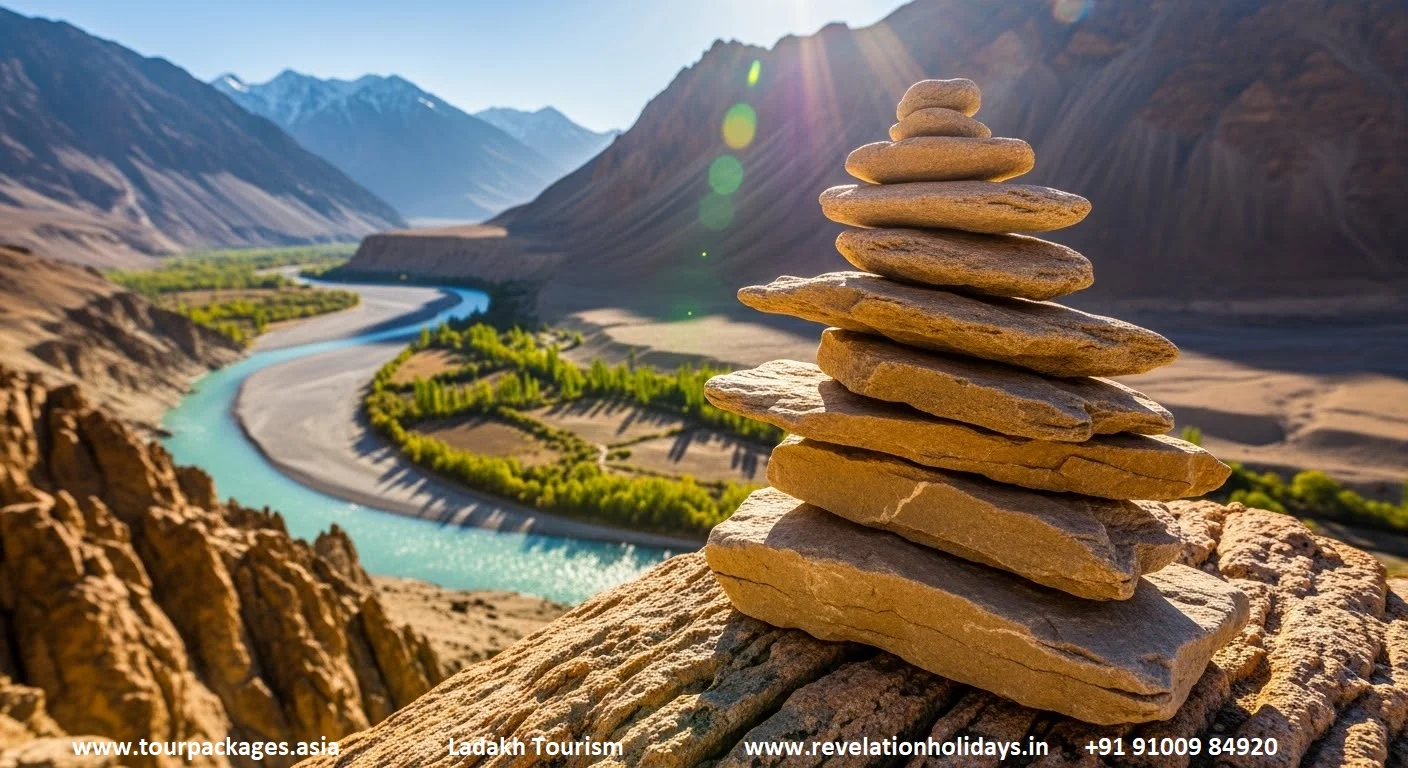
Indus Valley · Ladakh
A cairn of balanced stones above the turquoise Indus — the act of stacking is itself a meditation on balance and impermanence. The river below has been carving this valley for millennia. The stones will stand until the next wind. You are somewhere between these two time scales, briefly at peace.
What Happens When Digital Silence Replaces Atmospheric Noise
The specific quality of silence available at Pangong Tso or on the upper Markha Valley trail is not merely the absence of traffic and technology. It is a positive presence — a silence that has density and texture and that the nervous system recognises, at a level below conscious thought, as the environment it was calibrated for across hundreds of thousands of years of evolutionary history. The urban soundscape — the constant low-frequency hum of mechanical systems, the rhythmic intrusion of communication devices, the ambient social noise of human density — is not neutral for the nervous system. It is a sustained mild stressor. Its removal, when it finally comes at altitude in Ladakh, is experienced not as deprivation but as relief so deep it borders on grief — a grief for all the years you did not know you were tired.
The Insignificance That Liberates
The psychological literature on awe experiences documents consistently that encounters with vast natural scales produce measurable reductions in self-referential thinking — the inner monologue centred on one's own needs, status, and narrative. In Ladakh, this awe is not occasional. It is the baseline condition of being there. The mountains are always present. The sky, at this altitude, is always deeper and more immediate than any sky you have known at sea level. The stars, on a clear Ladakhi night, are not a backdrop — they are a ceiling so low and dense that the sense of being contained within the universe, rather than observing it from outside, becomes unavoidable. This is what the Tibetan Buddhist tradition points at when it teaches on the dissolution of the boundary between self and cosmos. Ladakh is not a metaphor for this teaching. It is its most direct available illustration.
Carrying the High-Altitude Calm — Practices That Work at Sea Level
The most practical question about any Ladakh retreat is the one that comes last: how much of it can you carry back? The peaks stay in Ladakh. The monasteries stay. The 4:30 AM silence above Pangong is not portable. But specific tools — breathwork techniques, attentional practices, and the structural resilience built by physical endurance at altitude — do transfer, and they transfer more fully than most retreat experiences because the conditions under which they were learned were so demanding.
Box Breathing at Altitude — The Portable Reset
The most transferable practice from a Ladakh retreat is what practitioners call altitude breathing — a four-count box breath (inhale four counts, hold four, exhale four, hold four) that was developed as a coping mechanism for the thin air of the high passes and that functions, at sea level, as one of the most powerful rapid nervous system regulation tools available. The practice works through the vagus nerve: slow, regulated breathing activates the parasympathetic nervous system, reducing cortisol and adrenaline, and producing physiological markers of calm within 90 seconds. Ladakh practitioners report that the four-count box breath carries a sensory memory of the mountains — closing the eyes and breathing this way at a desk in Mumbai or Delhi produces, briefly, a felt quality of Himalayan air. This is not delusion. It is the phenomenon of context-dependent memory, and it is a genuine resource.
Three practices that survive the descent
In addition to breathwork: the habit of walking clockwise around any circular object — developed unconsciously through days of turning mani wheels and circumambulating monasteries — becomes a mindfulness cue in daily life. The habit of a dawn sitting, even for fifteen minutes, established at altitude where the pre-dawn cold made it both difficult and rewarding, tends to persist because the pattern of reward is established deeply enough to survive the transition to easier conditions. And the capacity for extended visual attention — looking at one thing, attentively, for ten minutes without reaching for the phone — trained on Himalayan landscapes that reward sustained looking, is a direct counter to the attentional fragmentation that digital environments produce.
Endurance as the Foundation of Mental Resilience
The connection between physical endurance and mental resilience is not metaphorical in the Tibetan contemplative tradition — it is structural. The retreatants who trek the Markha Valley, who cross passes at 5,200 metres, who sit through three-hour dawn pujas in unheated monastery halls at subzero temperatures, are building something in the nervous system that no cushion retreat can fully replicate: the direct experiential knowledge that discomfort is survivable, that the mind does not need to contract around difficulty, that it is possible to remain present and relatively clear in conditions that the body is finding genuinely challenging. This knowledge — this body-knowledge, not conceptual knowledge — is the most durable thing a Ladakh retreat produces. It is the elevated perspective that the hooks promised. It does not live in the mountains. It lives in you, now, and it changes how you meet everything that comes next. Plan your transformative journey through our retreat planning page or book Ladakh directly online.
Why Ladakh Is the World's Most Powerful Meditation Landscape
There is a concept in Tibetan Buddhism called beyul — hidden valleys, sacred landscapes where the veil between ordinary perception and deeper reality is considered unusually thin. Ladakh is not technically designated as a beyul, but anyone who has spent significant time here understands the impulse behind the concept. The landscape operates on a different frequency. It is not merely beautiful — it is demanding, clarifying, and, under the right conditions, genuinely transformative.
The Geography of Stillness
Consider what Ladakh's physical environment actually does to a human being over the course of several days. The high altitude forces slower breathing and conscious breath attention — the foundation of every major meditation tradition on earth. The dry, brilliantly clear air eliminates the atmospheric haze that dulls perception elsewhere, making colours startlingly vivid and shadows razor-sharp. The enormous scale of the Himalayas — peaks that rise four kilometres above an already high plateau — produces a natural perspective shift: personal concerns, which loom so large in urban life, simply cannot compete visually with a 7,000-metre massif. And the silence at altitude — a silence that contains no traffic, no mechanical hum, no human background noise — is a silence of a quality that most people in the 21st century have never experienced in their adult lives.
Research by the National Institutes of Health on altitude physiology has documented that high-altitude environments measurably alter cardiovascular response, breathing patterns, and cognitive processing in ways that bear a striking resemblance to the physiological signatures of deep meditative states. Ladakh does not require you to meditate. It nudges you there whether you intend it or not.
"Most people climb mountains to conquer the summit. We scale these rugged landscapes to conquer the noise inside our heads. The harshest environments on earth are the secret to finding total mental clarity."
— RTH Himalayan Travel Desk
Eleven Centuries of Spiritual Infrastructure
The living monasteries of Ladakh — active communities, not museums
Ladakh's Tibetan Buddhist culture did not arrive by accident. The monasteries — gompas — were built in specific sites chosen for their spiritual potency: clifftops, riverbanks, cave complexes, canyon walls. Alchi Monastery, founded in the 11th century, contains murals considered among the finest surviving examples of early Kashmiri Buddhist art. Lamayuru Gompa, founded in the 10th century on a lunar landscape of eroded clay hills, is one of the oldest active monasteries in Ladakh and a place of concentrated meditative power that you can feel in your chest when you enter the main assembly hall. Hemis Monastery, the largest and wealthiest in Ladakh, houses a living community of Drukpa Kagyu monks who follow an unbroken lineage of practice stretching back to the 17th century and beyond.
These are not museums or tourist attractions that happen to have monks. They are functioning spiritual universities, research centres for human consciousness, and retreat environments of extraordinary depth. When you sit in the assembly hall at dawn and the chanting begins — a sound that is as much vibration as sound, that you feel in your sternum and your spine as much as you hear it — you are not witnessing a performance. You are being included in a practice that has refined itself over centuries toward a single goal: the liberation of the mind from its own noise. For a broader context of India's most profound travel destinations, browse our India heritage travel guides.
The Five Great Meditation Monasteries of Ladakh
Each of Ladakh's major monasteries has a distinct character, a different altitude, and a different relationship with the landscape around it. Choosing where to base your meditation retreat is the first decision you will make, and it matters more than most travel choices. The following are the five most significant centres for contemplative practice — arranged by approach, altitude, and the specific quality of silence each offers.
Stakna Gompa · Leh · Dusk
A Ladakhi monastery fused with ancient granite at the day's last light — prayer flags blurring in the wind, a stupa standing sentinel, the sky turning from cobalt to violet. The gompas were built in these specific sites for a reason. The landscape is not a backdrop. It is part of the practice.
Hemis Monastery (Hemis Gompa)
3,600m · Drukpa Kagyu · 40 km south of Leh · Founded 17th century
The largest monastery in Ladakh and the seat of the Drukpa Kagyu lineage in the region, Hemis sits in a narrow gorge cut by the Hemis Nala river, its walls pressed between cliff faces that amplify sound in extraordinary ways. The annual Hemis Festival (June/July), featuring masked Cham dances celebrating the birth of Guru Padmasambhava, is the most spectacular monastic festival in Ladakh. Outside festival season, Hemis is quiet, scholarly, and deeply focused. The guesthouse within the monastery complex accepts meditation students; the morning and evening prayer sessions in the main lhakhang (temple) are open to respectful visitors who arrive on time and sit in silence.
The surrounding gorge contains several cave hermitages used by monks for intensive retreat. The walk upstream from the monastery in the early morning — past mani walls and chortens, with the cliff faces turning gold as the sun clears the ridge — is among the finest meditative walks available in India.
Best for: Silent RetreatCave HermitagesMorning Puja
Thiksey Monastery (Thiksey Gompa)
3,600m · Gelug · 19 km east of Leh · 12-storey cliff monastery
Thiksey is the monastery most travellers photograph first — its twelve-storey whitewashed complex climbing the rocky hill above the Indus Valley looks as though it was designed by someone who understood exactly how to make a human structure express both permanence and aspiration. The 4 AM morning puja, attended by monks from the youngest novices to the oldest lamas, is one of the most profound experiences available to visitors in all of Ladakh. The chanting fills the hall before dawn, butter lamps casting shifting shadows over the thangka paintings, and the cold air from the open courtyard keeps the mind sharply present. Thiksey also houses a 15-metre standing Buddha statue whose serenity has an almost physical presence in the room — one of several artworks in the complex that reward extended sitting and contemplation.
4 AM Morning PujaBest ArchitectureIndus Valley Views
Lamayuru Gompa
3,510m · Drikung Kagyu · 125 km west of Leh · Oldest Active Monastery
The approach to Lamayuru prepares you before you arrive. The road from Leh crosses the Fotu La pass (4,108m) and descends into a landscape that appears genuinely lunar — eroded yellow-grey clay formations that the Ladakhis call moonland, carved by ancient lake-bed sediments into towers, gullies and plates. The monastery emerges from this landscape as a natural extension of it, its walls the same earth-colour as the cliffs. Founded in the 10th or 11th century by the Tibetan master Naropa, Lamayuru is considered a power site in the Drikung Kagyu tradition — a place where the boundary between inner and outer landscape has, over ten centuries of intensive practice, become genuinely permeable. The cave where Naropa is said to have meditated is still accessible and still used by practitioners.
Moonland LandscapeNaropa CaveOldest in Ladakh
Spituk Monastery (Spituk Gompa)
3,530m · Gelug · 8 km from Leh · Kali Temple on Summit
Spituk is the monastery closest to Leh's airport and the one most visitors drive past without stopping. This is their loss. The monastery climbs a rocky promontory above the Indus in three levels, each housing increasingly esoteric practices, the uppermost containing the black stone image of the goddess Kali that is unveiled only once a year during the Spituk Gustor festival. The resident monks follow a rigorous schedule of puja, debate, and philosophical study under the Gelug system — the same tradition as the Dalai Lama. Spituk has a small guesthouse for meditation students; the 7 PM evening puja, when the setting sun lights the peaks above the Indus and the monastery bells echo across the valley, is a daily ritual of startling beauty. The climb from the valley floor to the top shrine takes fifteen minutes and is, in itself, a breathing meditation.
Evening PujaClosest to LehGelug Tradition
Ladakh Monastery · Living Practice
A monk sits in meditation on the rooftop terrace of a Ladakhi gompa, the snow-capped Himalayan range spread before him in silence. This is the practice the monasteries have preserved for eleven centuries — not as heritage, but as daily life.
Alchi — The Monastery That Stopped Time
Founded 11th–12th century · Dukhang · Sumtsek · Lhakhang Soma
Alchi Monastery, unlike the cliff-top gompas, sits on flat ground beside the Indus River — a cluster of low white buildings surrounded by apricot orchards and old poplar trees, looking more like a medieval Kashmiri village than a monastery. This is because it was built differently: in the 11th and 12th centuries, when Tibetan Buddhism was absorbing the last great flowering of Kashmir's Buddhist artistic tradition before Islam's arrival. The murals inside Alchi's three main temples — the Dukhang, the Sumtsek, and the Lhakhang Soma — are unparalleled in the Himalayan world: intricate, vibrant, cosmological diagrams in human form, painted by Kashmiri artists who brought a sensibility entirely distinct from the Tibetan art that followed. Sitting with these murals is a different meditation from sitting with an empty wall — it is the practice of thangka contemplation, the use of sacred imagery as a mirror for the mind's own depths.
Meditation Practices Available in Ladakh
The word "meditation" covers a vast range of practices, and Ladakh is home to several distinct traditions — each with different techniques, different objects of contemplation, and different goals. Understanding which practice aligns with your own temperament and experience is the most important preparation you can do before arriving. RTH plans custom retreats matched to practice level through our plan now service.
Shamatha — Calm Abiding
The foundational meditation of Tibetan Buddhism — the systematic training of attention through breath awareness. At altitude, the necessity of conscious breathing makes Shamatha practice unusually accessible. The thin air is the teacher's assistant. Widely taught at Ladakhi retreat centres for beginners and returning practitioners.
Tradition: Tibetan Buddhist · Level: All
Tonglen — Sending and Taking
The Tibetan practice of breathing in suffering and breathing out relief — a compassion meditation that works with the breath as a vehicle for expanding the heart. The high-altitude breath awareness of Ladakh gives Tonglen a visceral quality that lowland practice cannot fully replicate. Taught at Hemis and Thiksey.
Tradition: Vajrayana · Level: Intermediate
Dzogchen — Natural Great Perfection
The pinnacle practice of the Nyingma school, seeking recognition of the mind's natural state beyond concept. Ladakh's vast open landscapes — the treeless plateaus, the sky that goes all the way down into the lake surface at Pangong — are considered particularly auspicious for Dzogchen practice. Advanced practitioners only; introduction sessions available.
Tradition: Nyingma · Level: Advanced
Walking Meditation on Mountain Trails
The ancient tradition of kinhin (walking meditation) finds its most demanding and most rewarding expression in Ladakh's high-altitude trekking routes. The Markha Valley circuit and the Lamayuru to Padum route both pass through terrain of sufficient grandeur to dissolve the habitual mind without any formal instruction. Breath, step, and vastness: that is the entire practice.
No monastery required · Level: All
Mantra Recitation and Mani Wheels
The Om Mani Padme Hum mantra — inscribed on every prayer wheel, every mani wall, every stone throughout Ladakh — is a complete meditative practice in its own right. Walking the mani walls of Leh's old quarter at dawn, turning each wheel in turn, reciting the six syllables in rhythm with your steps, is a practice that requires no teacher and no tradition beyond presence and intention.
Daily Practice · Level: All
Vipassana — Insight Meditation
Though rooted in the Theravada tradition rather than Tibetan Buddhism, Vipassana retreats are available at several Leh-based centres. The technique — moment-to-moment observation of sensation without reaction — is supported by the sensory richness of Ladakh's environment: the quality of light, the temperature differential between sun and shadow, the sounds of the natural world at altitude are unusually vivid objects of observation.
Theravada Tradition · Level: All
The Sacred Landscapes — Where the Outer and Inner Merge
Ladakh's most powerful meditation environments are not all inside monastery walls. Some of the deepest contemplative experiences available here happen in the open air, at the edge of a lake, on a high ridge, in the blue shadow of a canyon wall. The landscape itself has been understood as a meditative object by the tradition for centuries — not as distraction from the inner world but as its mirror.
01
Pangong Tso — The Mirror at 4,350 Metres
Pangong Tso (Pangong Lake) stretches 134 kilometres east from Ladakh into Tibet, its surface changing from turquoise to cobalt to steel depending on the hour and the weather. At 4,350 metres, it sits at an altitude that has already done most of the preliminary meditation work for you — slowed your breathing, thinned your thoughts, quietened your inner commentary. The lake's surface, on a windless morning, is so perfectly reflective that the distinction between water and sky dissolves, and with it, on the good days, the distinction between the one who is looking and what is being looked at. Sitting at the edge of Pangong in the pre-dawn cold, watching the first light arrive over the Chang Chenmo range reflected with perfect fidelity below, is an experience that leaves most people without adequate language for what they felt.
Altitude: 4,350m · Best at Dawn · 160 km from Leh
02
Nubra Valley — The Garden Between the Passes
The Nubra Valley lies north of Leh across the Khardung La pass at 5,359 metres — the act of crossing the pass itself is a meditation on impermanence and the body's limits. The valley below, running between the Karakoram and Ladakh ranges, contains sand dunes, hot springs, double-humped Bactrian camels, and the medieval monastery of Diskit presided over by a 32-metre Maitreya Buddha statue. The Diskit Maitreya — the Buddha of the Future — faces north toward China with an expression of absolute tranquillity that seems both anachronistic and perfectly appropriate. Staying in Nubra for two or three nights, away from Leh's relative bustle, gives the retreat a depth of solitude that the main valley rarely achieves in summer.
Altitude: 3,100m · Diskit Monastery · Via Khardung La 5,359m
03
Markha Valley Trek — The Moving Retreat
The Markha Valley trek is a 65-80 km multi-day route through one of Ladakh's most remote and scenically spectacular corridors — passing through four villages, ascending the Ganda La (4,920m) and Kongmaru La (5,235m) passes, and circumnavigating the massif of Kang Yatse. It is not technically a meditation retreat, but experienced meditators consistently describe it as among the most powerful practices of their lives. The reason is structural: each day's walking reduces the mind to its most basic operations — step, breath, terrain, sky. The accumulation of days at altitude, the absence of news, social media, and distraction, and the complete dependence on your own inner resources produces a quality of awareness that formal retreat can rarely match. Plan this as part of your Ladakh booking with RTH.
65–80 km · 5–7 Days · Max altitude 5,235m
04
Tso Moriri — The High Wilderness Lake
Tso Moriri (4,522m) is less visited than Pangong but, in many ways, more spiritually potent. The lake lies in the Changthang plateau — a high-altitude grassland that is home to nomadic Changpa herders and their pashmina-producing Changthangi goats — with almost no infrastructure beyond a single village and basic camping. The silence here is not the curated silence of a retreat centre. It is the silence of a landscape that has never contained anything louder than wind, water, and the occasional call of a bar-headed goose. It is the silence in which the great Tibetan teachers say the ground luminosity of the mind is most easily recognised.
Altitude: 4,522m · Changthang Plateau · Remote
A 7-Day Ladakh Meditation Retreat Itinerary
The following is RTH's recommended 7-day meditation and spiritual immersion itinerary for Ladakh — designed around the principles of acclimatisation, progressive depth, and a balance between guided practice and unstructured contemplative time. It can be extended to 10 or 14 days for deeper retreat, or condensed to 5 days for those with limited time. All components are arranged through our Ladakh booking portal or via our plan now page.
Day 1 — Arrival and Complete Rest
Leh Airport (3,524m) · Acclimatisation Day
Arrive Leh by morning flight from Delhi; transfer to guesthouse in the old quarter
Complete rest mandatory — no sightseeing, no trekking, no exertion whatsoever
The enforced stillness of Day 1 is itself the beginning of the retreat
Afternoon: light walk to the nearest mani wall; gentle introduction to breath awareness
Evening: early dinner, early sleep — the body adjusts primarily while sleeping
Day 2 — Leh Old Quarter and First Puja
Leh Town · Shanti Stupa · Spituk Monastery
Pre-dawn: 4 AM puja at Spituk Monastery (8 km from Leh) — butter lamps, chanting, dawn
Return, breakfast, rest until 10 AM
Morning walk: Leh old quarter, royal palace, mani walls of Changspa
Afternoon: Shanti Stupa for panoramic view and guided breath meditation at altitude
Evening: introduction session with resident meditation instructor (RTH arranged)
Day 3 — Thiksey and the Indus Valley
Thiksey Monastery · 4 AM Puja · Indus Views
4 AM departure for Thiksey — the most iconic monastery morning puja in Ladakh
Sit in silence in the assembly hall as chanting fills the pre-dawn darkness
Sunrise over the Indus Valley from Thiksey's roof — unguided contemplation time
Morning: explore Thiksey at leisure; visit the 15-metre Maitreya Buddha
Afternoon: walking meditation along the Indus bank below the monastery
Evening: group Tonglen practice with instructor
Day 4 — Hemis and the Gorge
Hemis Monastery · Gorge Walk · Cave Hermitage Visit
Early morning drive to Hemis (40 km south of Leh)
Attendance at morning puja in the main lhakhang by prior arrangement
Guided tour of the monastery treasure chamber and thangka collection
Afternoon: three-hour walking meditation upstream through the Hemis gorge
Optional: visit to active cave hermitage above the gorge with monk guide
Evening: extended Shamatha sitting session — 90 minutes with instruction
Day 5 — Pangong Tso
Chang La Pass (5,360m) · Dawn at the Lake · Unstructured Day
4:30 AM departure for Pangong — cross Chang La in darkness, arrive at dawn
Three hours unstructured time at the lake edge — no instruction, no agenda
This day has no schedule. It is the day the landscape teaches what words cannot
Late morning: slow walk along the northern shore; lunch at local campsite
Optional overnight camping at the lake for full-moon viewers
Return to Leh by evening (or stay overnight)
Day 6 — Lamayuru and Alchi
125 km West · Moonland · Naropa Cave · 11th-Century Murals
Early drive west — Fotu La pass (4,108m), moonland landscape, Lamayuru Gompa
Two-hour sitting meditation in the main assembly hall by prior arrangement
Optional: access to Naropa's cave hermitage with local guide
Afternoon: Alchi Monastery — extended silent contemplation of the 11th-century murals
Thangka contemplation practice: choosing one image, sitting with it for 45 minutes
Return to Leh; evening free for personal practice
Day 7 — Integration and Departure
Morning Practice · Letter to Self · Onward Journey
Dawn: final independent meditation session at your chosen site in Leh
Morning: integration session with instructor — reviewing insights, establishing home practice
Writing practice: composing a letter to yourself to be opened in three months
Final visit to a mani wall; turn the last wheel consciously
Transfer to Leh airport for departure — or continue to Nubra/Tso Moriri for extension
Best Time for a Ladakh Meditation Retreat
Timing a Ladakh retreat requires balancing three variables: monastery festival dates, weather and pass conditions, and the quality of solitude. The three are often in tension — the most spiritually significant festivals coincide with the peak tourist months. The following table provides a complete seasonal breakdown:
Period
Conditions
Monastery Life
Best For
June–July
Warm days, passes open, tourist peak
Hemis Festival (June/July), Lamayuru Yuru Kabgyat (July)
Our recommendation: September and early October. The summer visitors have returned home, the monastery schedules resume their unhurried rhythm, the skies have the extraordinary clarity that the monsoon's dust-washing produces, and the beginning of autumn colour on the few trees in the valleys adds a quality of beauty to the light that is specifically and irreproducibly Ladakhi. This is when Ladakh belongs to those who came to listen rather than to see.
Top Sights in Ladakh — The Rooftop of the World
Ladakh's most extraordinary places span ancient monasteries, glacial lakes, mountain passes and living Buddhist culture. These are the essential experiences that define a Ladakh retreat — each one a destination in its own right, and together a complete spiritual geography.
Click each panel for targeted guidance at every stage of planning and experiencing your Ladakh meditation journey.
Getting There
Reaching Leh — The Only Acceptable Way to Arrive
Fly direct from Delhi to Leh (Kushok Bakula Rimpochee Airport) — approximately 1 hour. Morning flights give the best views of the Himalayas from the left window. Multiple daily flights on Air India, IndiGo, SpiceJet and GoAir.
Overland options: the Manali-Leh Highway (479 km, 2 days by road via Rohtang and Baralacha La) and the Srinagar-Leh Highway (434 km via Zoji La) are both spectacular but require 2 extra days and are weather-dependent.
The Manali-Leh road is considered by many to be the greatest road journey in India — it is itself a preparation for the retreat, climbing through five mountain passes above 4,000m.
For retreat purposes, the flight from Delhi is recommended: arrive with maximum energy and let the acclimatisation rest be the journey, not the road.
Book Leh flights at least 4–6 weeks ahead in peak season (June–September). Book your Ladakh package and we handle all logistics.
Altitude Health
Altitude Acclimatisation — The Non-Negotiable Foundation
Arrive in Leh and do nothing for 24 hours. This is not optional — it is the most important preparation for the entire retreat. High altitude can trigger Acute Mountain Sickness (AMS) and, in severe cases, High Altitude Pulmonary or Cerebral Oedema. Neither is compatible with meditation.
Symptoms of AMS: headache, nausea, fatigue, dizziness. These are common and usually resolve within 24–48 hours with rest and hydration. If symptoms worsen or breathing becomes difficult, descend immediately.
Acetazolamide (Diamox) is widely prescribed for altitude acclimatisation — consult your doctor before travel. It works by increasing breathing rate and oxygenation. Not everyone needs it; everyone should know about it.
Drink 3–4 litres of water daily in Leh. Avoid alcohol for the first 48 hours. Walk slowly. The locals have a phrase for the mandatory pace of new arrivals: Julley dhire dhire — "greetings, slowly slowly".
Days 3–7 of your stay will feel noticeably better than Day 1. Trust the process.
What to Pack
Packing for a Ladakh Meditation Retreat
Clothing layers: Leh's temperature can shift 25°C between pre-dawn and midday. Down jacket for morning puja and evenings; light fleece for mid-morning; light cotton for afternoon. Pack more layers than you think you need.
Meditation cushion or mat: Monastery floors are hard and cold. A compact inflatable meditation cushion or a thick folded shawl saves your knees and back during extended sitting sessions.
Sun protection: UV radiation at altitude is approximately 40% more intense than at sea level. Sunscreen SPF 50+, UV-protection sunglasses, and a wide-brimmed hat are mandatory. Snow blindness is a real risk near the passes.
Shawl or kata (ceremonial scarf): Required for entering monastery assembly halls. White katas can be purchased in Leh market — offering one to a lama or monk is the traditional respectful greeting.
Journal: The insights that arise in Ladakh at altitude are specific, unexpected, and often impossible to recover without writing them down immediately. Bring a proper journal and use it.
Minimal technology: The retreat value of Ladakh is directly proportional to how much you disconnect. Leave the laptop. Use the phone for photography and emergencies only.
Monastery Etiquette
How to Enter a Ladakhi Monastery — The Unwritten Rules
Remove footwear before entering any assembly hall (lhakhang) or shrine room. Carry your shoes — do not leave them outside if there is any chance of rain or they may be moved.
Walk clockwise around all chortens (stupas), prayer wheels, and monastery complexes — this is the direction of the dharma's flow. Walking anti-clockwise is deeply disrespectful in Tibetan Buddhism.
Photography inside shrine rooms requires explicit permission — and in many cases is not permitted at all near sacred images. Alchi's murals are among the most photographed things in Ladakh; they are also among the most damaged by flash photography. Turn off the flash. Put the camera away. Look with your eyes for once.
Morning pujas begin before dawn. Arrive before the session starts, sit to the side of the hall, and do not enter or exit once chanting has begun. The session will last 1–2 hours; prepare to stay.
Offer a donation at the donation box in each monastery you enter. The preservation of these extraordinary buildings depends entirely on visitor contributions and government grants.
If you are offered butter tea (po cha) by a monk or host, accept with both hands and drink what you are offered. Refusal is impolite. The taste is an acquired one; the act of sharing it is the point.
Budget & Booking
Costs and How to Book Your Ladakh Retreat
Flights to Leh: Delhi-Leh return approximately Rs. 8,000–15,000 depending on season and booking lead time. Peak June–August fares can reach Rs. 20,000. Book early.
Accommodation: Mid-range guesthouses in Leh old quarter Rs. 1,500–3,000 per night. Heritage guesthouses and boutique properties Rs. 4,000–8,000. Monastery guesthouses (basic but authentic) Rs. 500–1,200.
Monastery guesthouse stays: Most require advance arrangement — RTH facilitates direct introductions to monastery guesthouses at Hemis, Thiksey and Lamayuru for retreat guests.
Guide and retreat instructor: Rs. 2,500–4,500 per day for an experienced meditation guide with English and Tibetan language proficiency. Required for monastery introductions and deeper practice guidance.
RTH all-inclusive 7-day retreat package (flights not included): from Rs. 55,000 per person including accommodation, guide, monastery access, all meals and transfers. Book online or contact our team.
Begin Your Ladakh Meditation Journey
RTH World Tour Packages and Revelation Holidays design bespoke Ladakh retreat itineraries — from a 5-day monastery immersion to a 14-day deep Himalayan spiritual circuit. Custom-designed for your practice level, physical fitness, and spiritual intentions.
Our Himalayan travel specialists design personalised Ladakh meditation itineraries — from a focused 5-day monastery circuit to a 14-day deep Himalayan spiritual journey combining Ladakh, Zanskar, and Nubra Valley. Tell us your level of practice and we will design around it.
Monastery guesthouse access at Hemis, Thiksey, Lamayuru
Morning puja attendance by advance arrangement
Experienced meditation guide with Tibetan language
Every question you have thought of, and some you have not — answered in full by our Himalayan travel and meditation specialists.
1. What is the best time to visit Ladakh for a meditation retreat?
September and early October is our definitive recommendation for a Ladakh meditation retreat. The reasoning is multilayered. The summer tourist season peaks in July and August, and while Ladakh is vast enough that it never feels truly crowded, the monastery guest circuits and the roads to Pangong and Nubra are busy. By September, the pattern reverses: the skies, freshly washed by the tail of the monsoon, develop a clarity of extraordinary quality — a deep, clear blue with no atmospheric haze, in which the snow peaks appear close enough to touch.
More importantly, the monasteries return to their natural rhythm. Summer festivals are over. The monk populations are back to full number after the retreat season. The morning pujas — the foundation of any meaningful monastery experience — take place in an atmosphere of authentic daily practice rather than the slightly performative quality that sometimes colours peak-season visits. The temperature is cool but not cold: typically 8–20°C by day, 2–8°C at night. Pack accordingly and the conditions are ideal for extended sitting practice.
For those specifically seeking high-altitude silence and solitude above all else, late September is the single best week of the year. Book your Ladakh retreat early for this window.
2. Do I need to be a Buddhist to attend a monastery retreat in Ladakh?
No. The Tibetan Buddhist monasteries of Ladakh welcome sincere visitors of any faith and none. The monastic tradition here is deeply grounded in the concept of bodhicitta — the aspiration for the awakening of all beings — which explicitly includes those who do not hold Buddhist beliefs. What the monasteries do require is respectful behaviour, genuine intent, and a willingness to follow the protocols of the space.
Many of the most profound retreat experiences in Ladakh have been had by Hindu, Christian, agnostic, and atheist practitioners who came with intellectual curiosity and left with something far harder to categorise. The meditation practices themselves — breath awareness, compassion cultivation, mindful observation — are universal technologies of the mind, not theological commitments. You do not need to believe in reincarnation to sit with your breath in the assembly hall at Hemis and discover something about the nature of your own mind.
That said, reading a basic introduction to Tibetan Buddhism before arrival will enormously enrich the experience. Understanding what a thangka represents, why monks debate, and what the role of the lama is in the tradition will transform your observation from spectating into participation. RTH can recommend preparatory reading when you book your retreat.
3. How does high altitude affect meditation practice?
The effects of high altitude on meditation are both physiological and psychological. On the physiological side, reduced atmospheric oxygen at 3,500–4,500 metres forces conscious, slower breathing — which is the foundational instruction of virtually every meditation tradition. You cannot sprint mentally at altitude the way you can at sea level. The body simply will not support it. This involuntary slowing of metabolic and cognitive pace is, paradoxically, the most difficult thing to achieve in a lowland meditation retreat and the easiest thing to achieve in Ladakh.
Psychologically, the altitude and the landscape together create what experienced meditators describe as a "thinning of the veil" — a reduction in the intensity of habitual mental patterns that is difficult to explain mechanistically but is consistently reported by practitioners. The vast scale of the Himalayan landscape relativises personal concerns in a way that no amount of instruction achieves. The silence, which at 4,000 metres contains no human-generated noise whatsoever, is a silence of a quality that the nervous system has not encountered in modern life and responds to with relief.
There is also a practical consideration: altitude fatigue, during the acclimatisation days, makes sustained activity difficult — but does not impair sitting, breathing, and simple observation. This means the retreat effectively begins before you have formally started it.
4. Which monastery in Ladakh is best for a first-time retreat visitor?
Thiksey Monastery is our recommendation for first-time retreat visitors, for three reasons. First, its 4 AM morning puja is the most accessible and most beautiful introduction to Tibetan Buddhist monastic practice in Ladakh — the pre-dawn departure from Leh, the dark assembly hall filling with lamplight and chanting, the sunrise arriving over the Indus Valley as the puja concludes. Few first experiences anywhere in India are as immediately transformative.
Second, Thiksey's guesthouse is well-maintained and accessible, and the monastery staff are experienced in hosting international visitors with genuine spiritual intent. The on-site restaurant serves good food and the rooms, while simple, are clean and heated. Third, Thiksey's position on the plateau above the Indus Valley gives it a visual drama — the 12-storey facade climbing the cliff face — that orientates the mind toward something larger than itself from the moment you arrive.
For a second visit or an extended retreat, Hemis (deeper, more scholarly, more remote) or Lamayuru (older, stranger, more isolated) offer experiences of greater depth. But Thiksey is the right door to open first.
5. Is Ladakh safe for solo female spiritual travellers?
Ladakh has a long and consistent reputation as one of the safest regions in India for solo female travellers, and this safety has a specific cultural basis. The Tibetan Buddhist communities of Ladakh have a tradition of deep respect for women practitioners — the female bodhisattva Tara occupies a central place in the devotional life of the monasteries, and women teachers (lamas and rinpoches) are venerated throughout the Vajrayana tradition. A solo woman arriving at a Ladakhi monastery with genuine spiritual intent will typically be received with warmth and respect that exceeds what she might experience in many other travel contexts.
The standard precautions for solo travel in India apply: stay in well-reviewed accommodation, use RTH-recommended guides and drivers, keep emergency contacts accessible, and inform someone of your daily itinerary when trekking or visiting remote sites. The specific vulnerabilities of solo female travel in India are considerably less pronounced in Ladakh than in most other regions of the country, and the monastic community provides an additional layer of social safety and support.
RTH World Tour Packages has escorted solo female meditation travellers in Ladakh for many years. Contact our team via the enquiry form for specific solo female retreat recommendations and safety planning.
6. What is the Hemis Festival and should I plan my retreat around it?
The Hemis Festival (Hemis Tsechu) is the largest and most spectacular monastic festival in Ladakh, held annually at Hemis Monastery on the 10th day of the Tibetan lunar month — typically falling in June or early July. The two-day festival celebrates the birth of Guru Rinpoche (Padmasambhava), the 8th-century master who brought Vajrayana Buddhism to Tibet. The centrepiece is the Cham dance — a sequence of highly codified masked dances performed by monks wearing elaborate brocade costumes and painted papier-mache masks, each figure representing a deity, demon, or aspect of the enlightened mind. The dances are not entertainment. They are a form of transmission — a direct communication between the practitioner in costume and the assembled devotees that bypasses the conceptual mind.
Whether to plan your retreat around the festival depends on your purpose. If you are coming specifically for the spiritual dimension of Ladakh, the festival is an extraordinary experience that is entirely worth planning a trip around — but expect large crowds, high accommodation prices, and the monastery functioning in festival mode rather than quiet retreat mode. If deep solitude and daily practice immersion is your goal, come in September instead. The monastery in quiet season offers something the festival cannot: the unadorned daily reality of a living contemplative community at work.
7. What is the Markha Valley trek and is it suitable as a meditation retreat?
The Markha Valley trek is a 65–80 km multi-day trekking route in the Hemis National Park south of Leh, generally completed in 5–7 days. The route passes through four remote villages (Skiu, Markha, Hankar, Nimaling), crosses two high passes — Ganda La (4,920m) and Kongmaru La (5,235m) — and offers some of the most dramatic high-altitude scenery in the Indian Himalaya. The trail is technically moderate (no technical climbing), requiring basic trekking fitness and comfort at altitude above 5,000 metres.
As a meditation retreat framework, the Markha Valley is exceptional for practitioners who have an established sitting practice and want to test it against the most demanding natural environment available in India. The conditions are perfect for what the Tibetan tradition calls movement meditation or integrated practice — the use of physical exertion as a vehicle for deepening, rather than interrupting, meditative awareness. Each day's walking reduces the mind progressively toward its most essential, quietest operations. By day four, the interior commentary has usually given up competing with the landscape. What remains is very quiet and very clear.
RTH includes the Markha Valley option in our extended Ladakh retreat packages. Camping equipment, guide, cook and all logistics are provided. Book your Markha Valley retreat through our Ladakh portal.
8. How do I get to Pangong Lake and what is the experience like?
Pangong Tso is 140–160 km from Leh via the Chang La pass (5,360m) — approximately 4–5 hours by road. The route crosses the Chang La, one of the highest motorable passes in the world, before descending through the Shyok Valley and Durbuk to the lake. The road is paved for most of its length and suitable for regular vehicles (no 4WD required in summer). Inner Line Permits are required for Indian nationals and Protected Area Permits for foreign nationals — both are arranged through RTH as part of your booking.
The experience of arriving at Pangong Tso for the first time is not easily described without sounding hyperbolic, and yet the hyperbole is usually accurate. The lake is 134 kilometres long, extending into Tibet; at its western end where visitors stay, it is 5 kilometres wide. Its colour shifts between turquoise, aquamarine, cobalt, and steel depending on the time, weather and your position. The mountains on the Tibetan side are stark, red-brown and snow-capped. The sky is the deepest blue available at sea level, deepened further at 4,350 metres.
For meditation purposes, allow a minimum of two hours at the lake with no agenda — no photography, no social media, no audio. Sit at the water's edge and let the place do what it does to the mind of anyone who sits still long enough. Overnight camping at Pangong is strongly recommended for those on a retreat itinerary.
9. What should I eat and drink during a high-altitude meditation retreat?
Altitude significantly affects digestion, appetite, and fluid regulation. The following dietary guidelines are based on both altitude physiology and the traditional Tibetan monastic diet that has sustained high-altitude practice for centuries:
Hydration: Drink 3–4 litres of water or herbal tea daily. Altitude causes rapid dehydration through increased respiration rate. A persistent low-grade headache is usually dehydration, not AMS.
Traditional breakfast:Tsampa (roasted barley flour mixed with butter tea) is the Tibetan staple and is available throughout Ladakh. It is extraordinarily well-suited to altitude — high caloric density, easily digested, warming. Try it at least once.
Butter tea (po cha): Salted, buttered tea. Warming, hydrating, calorie-dense. The acquired taste is worth acquiring. It is what the monks drink through three-hour morning pujas in rooms that begin at freezing temperature.
Avoid: Alcohol for the first 48 hours (interferes with acclimatisation). Heavy meals in the evening (altitude suppresses digestive efficiency). Excessive caffeine.
Eat regularly: Altitude suppresses appetite, but the body needs fuel. Small, frequent meals — particularly warm soups — are ideal. Leh's restaurants and guesthouses serve excellent Ladakhi thukpa (noodle soup) and momos (dumplings) that are specifically right for this climate and altitude.
10. What is the difference between Ladakh and a standard Indian meditation retreat?
A standard Indian meditation retreat — typically conducted at an ashram in Rishikesh, Coimbatore or Pune — offers formal instruction, a scheduled daily programme, a community of fellow practitioners, and a controlled environment designed to support practice. These are genuine and often profound experiences. Ladakh offers something structurally different in every dimension of that description.
In Ladakh, the instruction is environmental rather than curricular. The landscape, the altitude, the monasteries, and the culture are the teachers — and they teach through immersion rather than information. The schedule is self-directed: you arrive at the 4 AM puja because you chose to, not because it is on a timetable. The community is the living Ladakhi Buddhist community, not a group of seekers who have temporarily removed themselves from their regular lives. And the environment — the high-altitude desert with its extraordinary light and overwhelming scale — is not a designed retreat setting but one of the most powerful natural environments on earth.
The result is that a Ladakh retreat can be deeper and less comfortable than a structured ashram retreat — it requires more self-direction, more physical resilience, and more tolerance for uncertainty. It also, for the right traveller, produces insights and transformations of a qualitatively different order. RTH designs itineraries for both types of retreatant — those who want structured guidance and those who want the unmediated encounter with the landscape and the tradition. Talk to us about which suits you.
11. Can I combine a Ladakh meditation retreat with Kashmir?
Yes — and the combination is extraordinarily powerful. Kashmir and Ladakh represent two distinct spiritual climates at either end of the same mountain road. Kashmir's Dal Lake houseboat culture, with its Mughal gardens, floating markets, and the haunting evening azan across the water, offers a contemplative immersion of a very different character from Ladakh's Tibetan Buddhist austerity. Where Ladakh teaches through emptiness and altitude, Kashmir teaches through beauty and abundance.
A combined 12–14 day itinerary — beginning in Srinagar with 3 nights on Dal Lake (see our Kashmir houseboat guide), then driving the Srinagar-Leh Highway over Zoji La and Namika La into Ladakh — is one of the great overland journeys available in India. The road itself is a transition — from the green, watered, temperate valley of Kashmir to the high-altitude moonscape of Ladakh — and the contrast between the two landscapes deepens the experience of each. RTH designs this combined itinerary as a signature route.
12. What permits do I need to visit Ladakh?
Permit requirements for Ladakh differ for Indian nationals and foreign nationals and have changed several times in recent years as Ladakh's status as a Union Territory (since 2019) has been consolidated. Current requirements as of 2026:
Indian nationals: No permit required for Leh and the main valley. Inner Line Permits (ILP) required for restricted areas including Nubra Valley, Pangong Tso, Tso Moriri, Dah-Hanu, and Hanle. ILPs are obtained online or at the District Magistrate's office in Leh and take 1–2 hours to process. RTH arranges all ILPs as part of the itinerary package.
Foreign nationals: Protected Area Permits (PAP) required for all restricted areas — the same zones as the ILP areas above. PAPs require a minimum group of two persons (solo foreign visitors may join with other guests of the same operator). Processing time: same day in most cases. Certain border areas (Hanle, Dah) have additional restrictions — check current regulations at the time of booking.
Monasteries: No permits required for monastery visits, but some monasteries (Hemis, Spituk) charge a small photography/entry fee.
13. What is the spiritual significance of prayer wheels and mani walls in Ladakh?
Prayer wheels (khorlo) are cylindrical objects containing rolls of printed mantras — typically the Om Mani Padme Hum mantra printed millions of times on thin paper. Each rotation of the wheel is considered equivalent to reciting all the mantras it contains — a technical shorthand for compassion practice that makes continuous mantra recitation possible throughout an ordinary day of walking, working, and moving. In Ladakh, prayer wheels line the approaches to every monastery, village entrance, and water source; the habit of turning them as you walk is so embedded in Ladakhi life that it has become literally automatic.
Mani walls are low stone walls constructed from flat rocks on which the Om Mani Padme Hum mantra has been carved — often in the Tibetan, Ladakhi, or Pali script, sometimes painted in white or gold, sometimes simply incised into the natural grey of the stone. The walls are built collectively by community members over years and generations; some mani walls in Ladakh are kilometres long and contain millions of individual carved stones. Walking alongside a mani wall — always on the left-hand side, so that the wall is to your right, clockwise — is a meditation in itself: the accumulated intent of all the hands that carved those stones is a palpable presence.
14. How do I book a Ladakh meditation retreat with RTH?
Booking a Ladakh meditation retreat through RTH World Tour Packages is straightforward. You have three options:
Online instant booking: Visit our Ladakh portal on the Revelation Holidays platform to browse available packages and book directly. All Ladakh retreat packages are available with secure online payment.
Custom enquiry: Complete the enquiry form on this page or visit our plan now page. Our Himalayan travel specialists will respond within 24 hours with a personalised itinerary proposal based on your dates, group size, meditation experience level, and physical fitness.
WhatsApp: Message us directly at +91 91009 84920 for an immediate conversation with our team. We recommend WhatsApp for questions about specific monastery access, retreat scheduling, and permit requirements — responses are typically within one business hour.
Peak Ladakh season (June–September) requires booking at least 2–3 months in advance for monastery guesthouse availability and guided retreat slots. September bookings in particular fill quickly. Revelation Holidays operates on the ground in Ladakh with permanent local presence, ensuring that every element of your retreat is managed by people who know the monasteries, the landscape, and the tradition personally.
15. What will I actually feel different after a Ladakh meditation retreat?
This is the question that matters most and is the hardest to answer without either overselling or underselling the experience. What most people report, consistently, after a Ladakh retreat of seven days or more is not dramatic transformation — it is a quality of spaciousness that they carry back with them. A slightly larger gap between stimulus and reaction. A slightly reduced urgency in the inner commentary. A slightly more available quality of attention in ordinary moments. These are small changes. They compound.
At a more specific level, practitioners consistently report that the quality of breath awareness developed at altitude — the necessity of noticing each breath consciously — remains partially active in lowland life for weeks after return. The visual scale recalibration — having spent days in landscapes of Himalayan proportion — makes urban environments feel smaller and less threatening for a period. And the experience of genuine silence — the silence of Pangong at 4:30 AM, the silence inside the Hemis assembly hall during a pause in chanting — recalibrates the nervous system's relationship to quiet in ways that affect sleep quality, stress response, and general cognitive clarity.
The Buddhist tradition says that what you encounter in Ladakh has always been present in you — the landscape simply removes the obstructions to its recognition long enough for you to feel what is already there. Most people who come once come back. That is, perhaps, the most honest answer to this question.
The Silence Is Already There
Ladakh does not create stillness — it removes what has been covering it. Come ready to breathe slowly, to sit with the dawn, and to let a landscape eleven centuries in the making do its work. RTH World Tour Packages will take care of everything else.
This article is written for general travel and inspirational guidance as of March 2026. Monastery access, festival dates, permit requirements and retreat availability are subject to change. Always verify current entry requirements for Ladakh and obtain relevant permits through RTH World Tour Packages before travel. RTH is an independent travel services company based in Hyderabad, India.





Comments and Questions