Borneo Travel Guide 2026: Wildlife, Rainforests & Adventures in Malaysian Sabah
Revelation
April 15, 2026
Posted By : Admin
Borneo Travel Guide 2026: Wildlife, Rainforests & Adventures in Malaysian Sabah
Journey into Malaysian Sabah’s Borneo in 2026, where lush rainforests and diverse wildlife await. This travel guide highlights the Kinabatangan River, Mount Kinabalu, and pristine islands. Encounter orangutans, pygmy elephants, and vibrant birdlife while exploring eco‑friendly lodges and cultural villages. From jungle treks to diving adventures, Borneo offers a rare blend of nature, culture, and adrenaline, making it a must‑visit destination for explorers in 2026.
Wildlife Destination · 2026 Guide
Borneo Travel Guide 2026: Rainforests, Wildlife & Adventures in Malaysian Sabah
There are a handful of places on this earth where the word "extraordinary" does not feel like an exaggeration. Borneo is one of them. The world's third-largest island is home to rainforests that pre-date the Himalayan ranges by tens of millions of years — jungles so ancient and so layered with life that a single hectare can hold more tree species than the whole of Europe. For Indian travellers who have done Thailand, explored Bali, and ticked off Vietnam, Borneo is the next destination — and in 2026, with Malaysia's visa-free access extended for Indian passport holders, there has never been a more practical time to make the journey.
Why Borneo Belongs on Every Indian Traveller's List in 2026
Borneo keeps coming up in travel conversations in 2026 for a very specific reason: it delivers experiences that no other destination in Asia can match. The island — shared between Malaysia (Sabah and Sarawak), Indonesia (Kalimantan), and the tiny oil-rich kingdom of Brunei — is the last place on earth where wild orangutans, Bornean pygmy elephants, proboscis monkeys, and clouded leopards still share the same ancient rainforest. For Indian travellers, the combination of visa-free access, direct connections via Kuala Lumpur, relatively affordable costs compared to Japan or Europe, and the sheer uniqueness of the wildlife makes Borneo a compelling choice.
What sets Malaysian Borneo — specifically Sabah in the north — apart from the rest of the island is the quality of tourism infrastructure around the wildlife. Sabah has invested seriously in eco-lodges, naturalist guides, and conservation-based tourism over the past two decades. You do not need to be a hardcore adventure traveller or a wildlife biologist to appreciate what Sabah offers. The experiences are designed for curious, comfort-conscious travellers who want genuine contact with nature. A family with children can stay at a Kinabatangan river lodge and watch wild proboscis monkeys feeding from the dining terrace at dusk. That is not an unusual experience in Sabah — it is a standard one.
The top sights in Kota Kinabalu offer a gentle entry point into Borneo — a coastal city with excellent seafood, a national park of offshore islands minutes from downtown, and a vibrant night market. From there, the interior opens up: the granite ridgeline of Mount Kinabalu, the river corridors of the Kinabatangan, the cathedral rainforests of Danum Valley. Malaysia's visa-free policy for Indian nationals, confirmed through December 2026, removes the biggest bureaucratic hurdle that historically deterred Indian travellers from adding Borneo to Southeast Asia itineraries.
For Indian Travellers — The Practical Case for Borneo
Malaysia is one of very few countries globally offering visa-free entry to Indian passport holders in 2026. Borneo (Sabah and Sarawak), as part of Malaysia, falls under the same exemption. Combined with the relatively short flight time — approximately 8 to 11 hours from major Indian metros via Kuala Lumpur — and Sabah's strong Indian-food availability in Kota Kinabalu, the practical barriers to this trip are lower than most travellers assume. The biggest investment is time: a meaningful Borneo wildlife experience requires at least 7 to 10 days to do justice to the key zones.
01
Kota KinabaluState Capital · Sabah · Gateway to Borneo
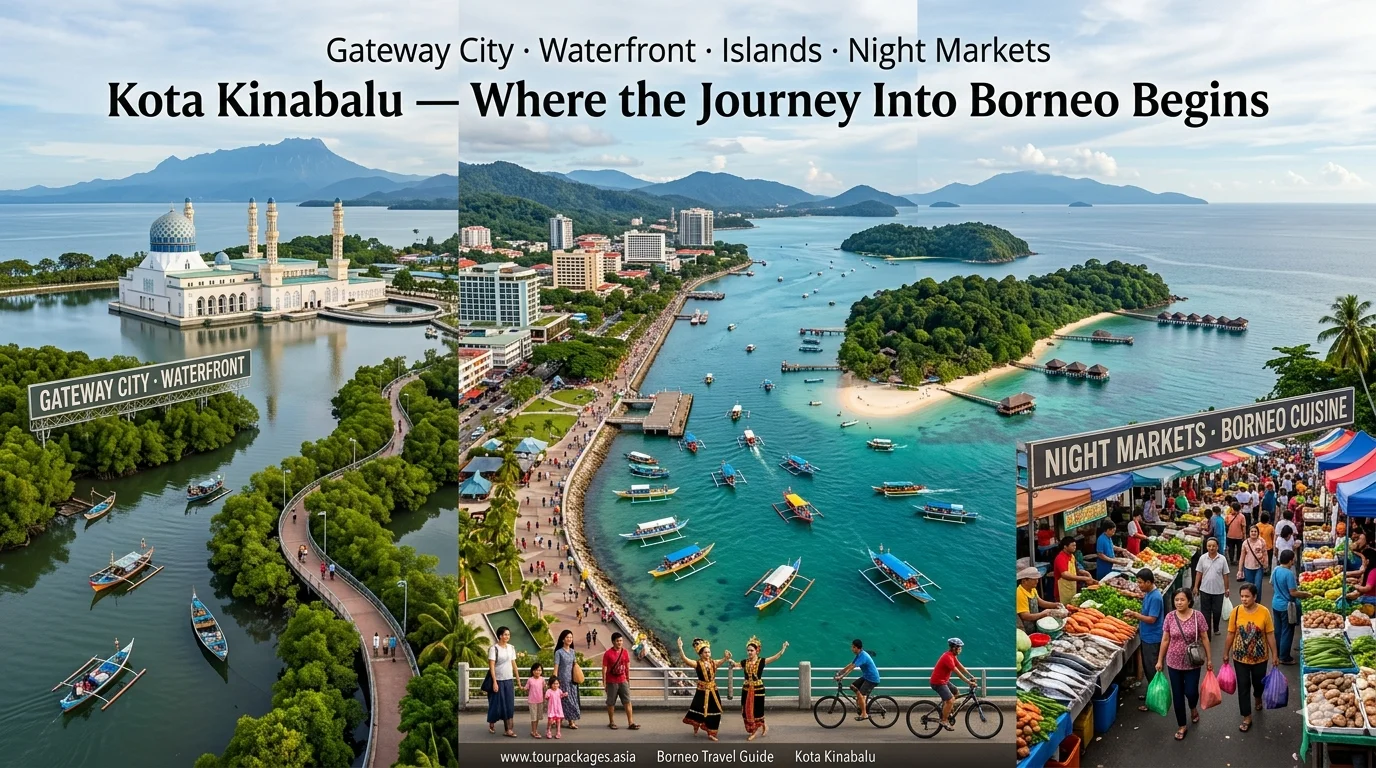
Gateway City · Waterfront · Islands · Night Markets
Kota Kinabalu — Where the Journey Into Borneo Begins
Most travellers spend one or two nights in Kota Kinabalu — known universally as KK — treating it as a transit stop before heading east towards the wildlife zones. That approach sells the city short. KK is genuinely interesting in its own right: a busy, unpretentious waterfront city that wears its multicultural identity — Kadazan-Dusun indigenous traditions, Chinese merchant heritage, Malay coastal culture — with easy confidence. The Gaya Street Sunday Market is one of the best morning markets in all of Southeast Asia, a kilometre-long chaos of fresh produce, traditional handicrafts, street food, and live animals that runs from sunrise to noon every Sunday. The Kota Kinabalu City Mosque — modelled loosely on the design of the Prophet's Mosque in Madinah — is one of the most photographed buildings in Malaysia, particularly at dusk when it appears to float on the lagoon surrounding it.
For Indian travellers arriving from Kuala Lumpur, KK's Tunku Abdul Rahman National Park is often the first genuine wildlife experience of the trip. The park consists of five islands visible from the city's waterfront — Gaya, Sapi, Manukan, Mamutik, and Sulug — accessible by 15-minute boat rides from the Jesselton Point ferry terminal. The islands offer coral reef snorkelling, white-sand beaches, and forest trails where bearded pigs, monitor lizards, and long-tailed macaques wander with complete indifference to human visitors. It is an improbable piece of tropical wilderness attached to a city of a quarter million people. The top sights across Malaysia rarely feature Kota Kinabalu's island national park prominently, which makes it feel like a discovery even if it is not.
KK's Filipino Market and the adjacent waterfront seafood stalls are where you eat in the evening: grilled stingray, giant prawns with garlic butter, steamed clams in black bean sauce, and whole fish baked in banana leaf — all pulled from Sabah's South China Sea waters that day. The market operates at the intersection of commerce and spectacle, with vendors competing loudly for custom and the smell of char-grilled seafood drifting out over the water. For Indian palates, the flavours are familiar enough to be welcoming, bold enough to feel foreign.
Location: West coast of Sabah — direct flights from Kuala Lumpur (1h 50m) and Singapore (2h 30m)Must See: Tunku Abdul Rahman National Park, Gaya Street Sunday Market, KK City Mosque at duskWhere to Eat: Filipino Market waterfront stalls, Centre Point Night MarketBest Stay: 1–2 nights — use KK as base for west Sabah excursionsIsland Snorkelling: Manukan and Sapi Islands — best coral reef snorkelling closest to cityAirport: Kota Kinabalu International (BKI) — 15 minutes from city centre
02
Mount KinabaluUNESCO World Heritage Site · 4,095m · Kinabalu Park
Southeast Asia's Highest Peak · UNESCO Heritage · Summit Trek
Mount Kinabalu — The Mountain That Defines Malaysian Borneo
Mount Kinabalu is a mountain that does not require a long explanation. At 4,095 metres, it is the highest peak between the Himalayas and the mountains of New Guinea — a distinction that has drawn climbers, botanists, and adventurous travellers to Sabah since the first recorded ascent by Hugh Low in 1851. The mountain rises from the surrounding rainforest with such visual authority that it is visible from Kota Kinabalu on clear mornings, a massive granite mass that appears to float above the lowland cloud. Adventure travel in Asia rarely offers an experience as complete as Kinabalu: accessible enough for fit, non-technical trekkers, dramatic enough to justify the effort at every step of the way.
The standard summit trail is a two-day climb. Day one takes trekkers from the Kinabalu Park entrance at 1,563m through six climatic zones — dipterocarp rainforest giving way to oak forest, then to low scrub, then to the bare granite of the summit plateau — to the overnight station at Laban Rata (3,272m), where hot meals and dormitory accommodation are available. Day two begins in darkness at 2am: the summit push of 2.7km on granite slabs via fixed rope, timed to reach Low's Peak at 4,095m before sunrise. On clear days, the view at dawn — the South China Sea to the west, the Crocker Range rolling south, the mountain's own granite towers glowing in the first light — is among the defining views in all of Southeast Asia. Comparable summit experiences in the region, including Rinjani in Indonesia, are physically more demanding and less well-organised.
For those who prefer not to summit, Kinabalu Park at the mountain's base is a UNESCO World Heritage Site and one of the most botanically rich areas on earth. The park hosts over 800 species of orchid, 9 species of the carnivorous pitcher plant genus Nepenthes, and the world's largest flower by diameter, the Rafflesia — though spotting a blooming Rafflesia requires luck and a separate detour to the Rafflesia Forest Reserve at Tambunan. Day hikes within the park through cloud forest and along the Silau Silau trail deliver extraordinary birdwatching: Borneo bristlehead, Whitehead's trogon, and all eight species of Bornean hornbill have been recorded within the park boundaries.
Height: 4,095m — highest peak between Himalayas and New GuineaTrek Type: Non-technical but demanding — fit adults without mountaineering experience can complete itDuration: 2 days / 1 night — standard summit via Timpohon TrailPermit: Advance booking essential — daily climber quotas apply, book 3–6 months ahead for peak monthsDistance from KK: 88km — approximately 2 hours by roadPark Entry: Kinabalu Park entrance fee applies — included in most package tours
03
Sepilok Orangutan Rehabilitation CentreSandakan · Sabah · Conservation
Most Visited Wildlife Attraction · Conservation Icon · East Sabah
Sepilok — Coming Face to Face with Borneo's Most Famous Resident
If there is a single image that draws people to Borneo, it is the Bornean orangutan — the red-haired great ape whose name comes from the Malay words for "person of the forest." Borneo and Sumatra are the only places in the world where wild orangutans survive, and of the two, Borneo's Sabah offers the most accessible and ethically managed encounters available anywhere. The Sepilok Orangutan Rehabilitation Centre, established in 1964 within the Kabili-Sepilok Forest Reserve outside Sandakan, is the most visited wildlife attraction in Malaysian Borneo and one of the most important orangutan rehabilitation programmes in the world.
The centre receives orphaned or injured orangutans — animals displaced by deforestation, rescued from oil palm plantations, or confiscated from the illegal pet trade — and rehabilitates them for eventual return to the wild. Visitors observe two daily feeding platforms in the forest, where younger orangutans in various stages of rehabilitation come to collect supplementary food from rangers. The experience is managed carefully to minimise habituation: there are no barriers between visitors and orangutans, but no contact is permitted either. Watching a young orangutan make its deliberate way along a rope walkway above the forest floor, testing each handhold with the caution and curiosity of a toddler learning to climb, is a quietly astonishing thing.
Adjacent to Sepilok is the Bornean Sun Bear Conservation Centre, established in 2008 — the world's only sun bear rescue and rehabilitation facility. The sun bear is the world's smallest bear species and among Borneo's least-known large mammals; the centre provides viewing platforms above a large forested enclosure where rescued bears roam freely. The Rainforest Discovery Centre, also within the Kabili-Sepilok reserve, has a 28-metre-high canopy walkway — one of the best in Borneo for birdwatching — and short walking trails through primary forest. Together, the three facilities create an east Sabah wildlife circuit that can be done in a single full day, making Sandakan a worthwhile overnight stop on the way to the Kinabatangan. See also our guide to wildlife experiences across Southeast Asia for regional comparisons.
Location: 25km west of Sandakan, East Sabah — 6 hours by road from KK or 45-minute domestic flightFeeding Times: 10:00am and 3:00pm daily — arrive 30 minutes early for best viewing positionCombined Visit: Sepilok + Sun Bear Centre + Rainforest Discovery Centre — allow a full dayPhotography: No flash photography; silent observation expected on viewing platformsConservation Note: Entry fees directly fund rehabilitation work — visit supports the orangutan programme
The Kinabatangan River — one of Southeast Asia's richest wildlife corridors, where pygmy elephants, proboscis monkeys and wild orangutans all share the same forest edge.
04
Kinabatangan RiverSukau · East Sabah · River Safari
World's Richest River Ecosystem · Pygmy Elephants · Wild Orangutans
The Kinabatangan — Borneo's Greatest Wildlife River
The Kinabatangan River is Malaysia's second-longest river and, by the measure of sheer wildlife density in a small area, one of the most remarkable places on the Asian continent. The river corridor through the Kinabatangan Wildlife Sanctuary around the village of Sukau hosts an extraordinary concentration of large mammals in a relatively narrow strip of riparian forest hemmed in on both sides by oil palm plantations — a fact that makes the wildlife easier to spot, the conservation story both urgent and complex, and the experience of a river boat safari here feel almost improbably rewarding.
The wildlife calendar on the Kinabatangan reads like a naturalist's wishlist. Bornean pygmy elephants — the smallest and, by general agreement, the most charming of Asia's elephants, with rounded ears, long tails, and a notably placid temperament — regularly wade along the river banks and are spotted on morning boat trips with a frequency that surprises first-time visitors expecting a rare sighting. Proboscis monkeys, the extraordinary long-nosed, pot-bellied primates endemic to Borneo, roost in fig trees overhanging the water and can be watched at close range in the evening as they call across the river before settling for the night. Wild orangutans move through the forest canopy above the riverbanks. Rhinoceros hornbills — Sabah's state bird, a magnificent black-and-white bird with an enormous casque — cross the river in pairs with heavy, beating wingbeats at dawn and dusk. Saltwater crocodiles, sometimes very large, lie half-submerged on sandbanks as the boats drift past.
The structure of a Kinabatangan wildlife experience is built around river safaris: early morning boat trips at 6am (the best light and the most active wildlife), a late afternoon trip at 4pm (hornbills, proboscis monkey congregation, elephant sightings common), and optional night boat trips for spotlight-assisted sightings of civets, crocodiles, and slow loris on the banks. The eco-lodges along the Kinabatangan — at Sukau, Bilit, and Batu Puteh — are well-managed, serve good food, and are staffed by naturalist guides with genuine knowledge of the forest and its animals. For Indian travellers familiar with African-style safaris, the Kinabatangan river safari delivers a similar quality of wildlife encounter in a very different physical environment — on water rather than land, in dense rainforest rather than open savanna.
Base: Sukau village, 130km from Sandakan — best accessed via Sandakan or by road from Kota Kinabalu (5–6 hrs)Wildlife Highlights: Pygmy elephants, proboscis monkeys, wild orangutans, rhinoceros hornbill, saltwater crocodileBest Experience: 2 nights minimum at riverside eco-lodge — 4 to 6 river safari sessionsBest Months: April to October — lower water levels concentrate wildlife near river; elephant sightings most frequentNight Safari: Spotlight boat trips 8pm–10pm — slow loris, civets, crocodiles; highly recommended
Ready to Plan Your Borneo Wildlife Safari?
Our team at Tour Packages Asia and Revelation Holidays specialises in Borneo and Sabah itineraries for Indian travellers — from budget eco-tours to luxury jungle lodges.
Danum Valley Conservation AreaLahad Datu · East Sabah · Primary Rainforest
Virgin Primary Rainforest · Canopy Walkway · Most Remote Experience
Danum Valley — The Last Untouched Jungle in Malaysian Borneo
If Sepilok is where Borneo introduces itself and the Kinabatangan is where it shows off, then Danum Valley Conservation Area is where it humbles you. Covering 438 square kilometres of undisturbed primary lowland dipterocarp rainforest — the type of forest that has existed in substantially the same form for 130 million years — Danum Valley is the crown jewel of Sabah's conservation estate and one of the most intensely studied pieces of rainforest on the planet. Access is strictly controlled: accommodation is limited to the Borneo Rainforest Lodge on the eastern boundary and the Danum Valley Field Centre, a research station that takes a small number of non-academic visitors.
Walking into Danum Valley for the first time requires a period of adjustment. The forest is enormous in every dimension: the emergent trees — dipterocarps, mengarises — rise 60 to 80 metres above the forest floor, their buttressed roots spreading 10 metres in every direction, their crowns lost in a canopy so dense that the light filtering through is a perpetual green-gold dusk even at midday. Beneath the canopy, the forest is layered: understorey of palms and pandanus, mid-storey of smaller trees and lianas, and the great emergents above — and in every layer, movement, sound, and life. The canopy walkway at the Rainforest Lodge rises to 26 metres above the forest floor on a series of swinging wooden bridges, putting visitors at eye level with the lower canopy and delivering the most reliably productive wildlife-spotting experience in Danum — red leaf monkeys, hornbills, and wild orangutans use the canopy walkway zone regularly.
Night walks with a torch and a naturalist guide reveal a completely different ecosystem: Borneo's remarkable concentration of nocturnal mammals and reptiles becomes visible after dark. Flying lemurs — the world's most capable gliding mammals, capable of gliding 100 metres between trees — cling to bark. Slow lorises, their enormous reflective eyes catching the torchlight, move with slow deliberateness through the understorey. Bornean colugos, tarsiers, and a catalogue of frogs whose colours defy description are standard sightings on a Danum night walk. Wildlife safari experiences across Asia are increasingly well-documented, but Danum Valley consistently ranks at the top of every serious naturalist's list of places to visit before they close.
Access: Lahad Datu town — fly from Kota Kinabalu (45 min) then 2.5 hrs by 4WD. Road from Sandakan is 5–6 hrs.Accommodation: Borneo Rainforest Lodge — luxury eco-lodge; Danum Valley Field Centre — research-focused, basicStay Duration: 2 nights minimum recommended — 3 nights idealWildlife: Wild orangutan, clouded leopard, Sambar deer, bearded pig, pygmy squirrel, 330+ bird speciesBest Feature: Canopy walkway + night drives + Segama River morning boat tripConservation: Operated by Yayasan Sabah (Sabah Foundation) — fees fund forest protection
06
Sipadan IslandSemporna · East Sabah · World-Class Diving
Top 5 Dive Site Globally · Sea Turtles · Barracuda Tornado
Sipadan — The Dive Site That Jacques Cousteau Called Unmatchable
In 1989, Jacques Cousteau brought his research vessel Calypso to a small island off Sabah's east coast and described what he found underwater as "an untouched piece of art." Sipadan Island — a mushroom-shaped oceanic island rising from a 600-metre-deep seabed — has been on the list of the world's best dive sites ever since, consistently ranked alongside the Galápagos, Raja Ampat, and the Great Barrier Reef. For non-divers, Sipadan is not a relevant destination — the island itself has no accommodation, and access is via day trip from Mabul or Kapalai. For those with an Open Water certification or above, it is the reason to add several extra days to a Borneo itinerary.
The Sipadan underwater topography is what makes it exceptional. The island sits on top of a coral pinnacle that drops vertically to deep ocean on all sides — a "wall dive" environment of extraordinary biodiversity. The famous Barracuda Point current brings nutrients and fish in enormous quantities: schools of chevron barracuda numbering in the thousands spiral in slow tornados in the water column above the drop-off, while green and hawksbill sea turtles — in numbers rarely seen anywhere else in Asia — rest on coral outcrops and graze on sea grass at a density that makes the site feel like an aquarium. The turtle population at Sipadan is one of the densest in the world; it is genuinely common to encounter 20 or 30 turtles in a single dive without any particular effort.
Access to Sipadan is managed through a permit system — only 120 dive permits are issued daily — making advance booking through dive operators on Mabul Island essential. The nearest Indian city with useful flight connections to the Semporna area (via Kota Kinabalu or Tawau) is Chennai or Hyderabad via Kuala Lumpur. The dive season at Sipadan runs year-round, though March to September offers the clearest visibility. Combine a Sipadan diving extension with the wildlife circuit for a Borneo itinerary that covers both the world's best jungle and the world's best reef in a single trip — a combination unavailable in any other destination in Asia. See our guide to the world's best water sports destinations for broader context on dive travel planning.
Dive Permit: 120 permits daily — book through accredited dive operators on Mabul Island, 3–6 months advance recommendedBase: Mabul Island or Kapalai — stay here for boat access to Sipadan (30-min crossing)Access: Fly KK to Tawau (50 min), then 2.5 hrs by road + boat to MabulBest Sites: Barracuda Point, Turtle Cavern, Drop Off, Whitetip AvenueWildlife: Green turtle, hawksbill turtle, barracuda tornado, hammerhead sharks (seasonal), bumphead parrotfishDive Certification: Open Water minimum — Advanced Open Water recommended for wall dives and stronger currents
Best Time to Visit Borneo (Sabah) from India
Planning a Borneo trip from India requires understanding the island's distinct wet and dry seasons — and recognising that Sabah's climate is gentler and more predictable than either Indonesian Kalimantan or Sarawak to the south and west. The state receives rainfall throughout the year, but the distinction between the dry and wet seasons is meaningful for wildlife viewing and outdoor activities.
March to May — The Ideal Window
This three-month period is widely considered the best time to visit Borneo for wildlife. The dry season is establishing itself, river levels on the Kinabatangan are dropping towards their lowest, which concentrates animals near the water and dramatically improves sighting frequency. Orangutan sightings are most reliable in this period when fruiting events draw animals to predictable parts of the forest. Mount Kinabalu climbing conditions are at their clearest — summit mornings in March and April are frequently cloud-free, delivering the full panoramic view. The heat is significant but manageable, and afternoon thunderstorms are brief and localise.
June to October — Active Season for Wildlife and Diving
The peak of the dry season across much of Sabah falls between June and October. Sipadan diving is at its finest from April to September, with visibility regularly exceeding 30 metres. The Kinabatangan elephant sightings are most frequent when river levels are low — typically July to September. This is also the most heavily booked period: Kinabalu permits and riverine eco-lodges are in high demand, and advance booking of 3 to 6 months is advisable for July and August travel. Indian school holidays in May and June align well with Borneo's best wildlife window, making this a strong choice for family trips.
November to February — Wet Season
The northeast monsoon brings heavy and prolonged rainfall to much of Sabah from November onwards, peaking in December and January. The Kinabatangan floods in high-water years, making river navigation and some jungle trails difficult. Mount Kinabalu summit views are frequently obscured. That said, the rainforest is extraordinarily beautiful in the wet season — lush, misty, and dramatically lit — and accommodation rates drop substantially. Budget-conscious travellers willing to accept some weather unpredictability will find excellent value. The Orangutan Rehabilitation Centre at Sepilok and the Sun Bear Centre operate year-round and are worth visiting in any season.
Indian Travellers — Festival & Holiday Alignment
October to November (post-Diwali travel window) falls at the transition from dry to wet season. Wildlife sighting quality remains good in early October but declines through November. The ideal Indian holiday alignment for Borneo is March (Holi travel window — 12–14 days), May (summer school holidays), or September (post-monsoon, pre-Diwali window). The Malaysia visa exemption for Indians requires no advance planning beyond booking flights and eco-lodge accommodation, simplifying the overall logistics considerably.
Recommended 7-Day Borneo Itinerary for Indian Travellers
A well-structured Borneo itinerary balances the western wildlife (Kinabalu Park, Kota Kinabalu) with the eastern wildlife circuit (Sandakan, Sepilok, Kinabatangan, Danum Valley) and requires a domestic flight between the two halves. Seven nights is the minimum recommended stay to experience both sides of Sabah without feeling rushed; ten nights allows a Sipadan diving extension or a second night at Danum Valley.
1Day
Arrive Kota Kinabalu — City & Islands
Arrive KK via Kuala Lumpur. Afternoon: Tunku Abdul Rahman National Park islands — snorkelling at Manukan or Sapi. Evening: Filipino Market waterfront seafood dinner. Overnight Kota Kinabalu.
2Day
Kinabalu Park — Cloud Forest & Botanical Walk
Drive to Kinabalu Park (2 hrs). Morning park walk — Mountain Trail, pitcher plant garden, Silau-Silau trail. Afternoon: check in at park chalets or nearby hotel. Overnight Kinabalu Park area.
3Day
Mount Kinabalu Summit Attempt (Day 1)
Early start — registration at Timpohon Gate (1,866m). Trek 6km to Laban Rata mountain hut (3,272m), arriving afternoon. Rest, acclimatise, hot dinner. Overnight Laban Rata (bookings essential months ahead).
4Day
Summit Dawn — Then Fly East to Sandakan
2am start — summit push to Low's Peak (4,095m) by sunrise. Descend to Timpohon Gate by noon. Transfer to KK Airport. Afternoon domestic flight to Sandakan. Evening: Sandakan waterfront. Overnight Sandakan.
5Day
Sepilok — Orangutan, Sun Bear & Rainforest Discovery Centre
Morning: Sepilok Orangutan Rehabilitation Centre (10am feeding). Afternoon: Bornean Sun Bear Conservation Centre, Rainforest Discovery Centre canopy walk (birdwatching peak at dusk). Transfer to Sukau / Kinabatangan. Overnight riverside eco-lodge.
6Day
Kinabatangan River Safaris — Full Day Wildlife
6am dawn river safari (pygmy elephants most likely). Morning forest walk. Afternoon 4pm river safari (proboscis monkeys, hornbills). Evening: night spotlight boat (crocodiles, civets, slow loris). Overnight Kinabatangan eco-lodge.
7Day
Danum Valley — Primary Rainforest & Canopy Walk
Transfer to Lahad Datu (3 hrs) then Danum Valley (2.5 hrs by 4WD). Afternoon canopy walkway. Dusk drive. Overnight Borneo Rainforest Lodge. Optional extension: 2nd night + night walk, morning Segama River boat trip, return KK Day 8 or 9.
Click each panel below to expand detailed guidance on getting to Borneo, staying safe in the rainforest, managing the Malaysian immigration process, packing for jungle conditions, and making the most of your wildlife sightings.
Getting There
Getting to Borneo from India
The standard route is fly to Kuala Lumpur (KUL/KLIA2) then connect to Kota Kinabalu (BKI) — total travel 8 to 11 hours from major Indian cities. Air Asia and Malaysia Airlines both offer this route with strong connectivity.
AirAsia offers the most affordable fares from Hyderabad, Chennai, Delhi, and Mumbai to KL, with frequent onward Kota Kinabalu connections the same day or next morning.
For east Sabah (Sandakan, Lahad Datu), domestic flights from KK take 45 minutes and are operated by MASwings and AirAsia — significantly faster than the 5–6 hour road alternative.
Tawau airport (TWU) serves travellers heading directly to Sipadan diving — fly from KK (50 min), then transfer by road and boat to Mabul Island.
Kota Kinabalu International Airport (BKI) handles immigration separately from Peninsular Malaysia — even domestic passengers from KL must pass Sabah immigration. Allow extra time on arrival.
Book all internal domestic Sabah flights at the same time as international tickets — prices rise significantly when booked closer to travel dates.
Visa & Entry
Visa and Entry Requirements
Indian passport holders receive visa-free entry to Malaysia for up to 30 days as of 2026 — this covers Sabah (Borneo), Sarawak, and Peninsular Malaysia.
Sabah runs its own immigration controls — you will clear immigration at Kota Kinabalu Airport even on a domestic flight from KL. This is a standard second immigration check, not a problem.
Have your hotel bookings, return/onward flight ticket, and a credit card or sufficient cash (approx. MYR 500–1000) visible when clearing Sabah immigration.
Travel insurance is strongly recommended — not legally required for visa-free entry but advisable given the physical nature of many Borneo activities.
If your trip exceeds 30 days, Malaysian immigration allows a straightforward extension at the nearest immigration office — apply before your stamp expires.
Carry physical copies of all bookings — eco-lodge reservations and domestic flight tickets may be requested at Sabah border control during peak seasons.
Packing
What to Pack for Borneo
Jungle footwear is critical: waterproof trekking shoes or low hiking boots with ankle support for rainforest trails. Sandals and flip-flops are useless in the forest.
Pack long-sleeved cotton shirts and long trousers in neutral colours (khaki, olive, brown) for jungle walks — leeches are present in most Borneo forests and dark colours attract them.
A high-DEET mosquito repellent (30–50% DEET) is essential — apply to all exposed skin before every forest walk and river safari. Malaria prophylaxis: consult your doctor before travel.
Lightweight waterproof jacket or poncho — afternoon rain is common even in the dry season, particularly at altitude on Kinabalu.
Binoculars are non-negotiable for wildlife viewing — a 8×42 or 10×42 pair will transform the river safari and canopy walkway experience. Budget pairs available to rent at most eco-lodges.
Leech socks (available in KK outdoor shops) are useful for dense forest walks in wet conditions — slip over socks and tuck trousers in.
Health & Safety
Health and Safety in Borneo
Malaria prophylaxis is recommended for travel to the Kinabatangan and Danum Valley interior — consult a travel medicine specialist or your doctor 4–6 weeks before departure for appropriate medication (Doxycycline or Malarone are commonly prescribed).
Sabah is a safe destination with very low violent crime — standard urban caution in KK markets and night areas applies. Jungle areas require physical awareness rather than security concerns.
Leech bites are painless and not medically dangerous — do not pull them off; wait for them to detach or use salt. Clean the bite site to prevent secondary infection.
Heat and humidity in the lowlands are significant. Carry minimum 2 litres of water on any forest walk and start morning treks before 9am. Eco-lodges provide filtered drinking water.
On Mount Kinabalu, altitude sickness is possible above 3,000m — ascend slowly, hydrate well, and inform the ranger station immediately if headache, nausea or confusion develops. Descend at any sign of serious symptoms.
Marine hazards at Sipadan and island beaches include fire coral and sea urchins — wear aqua shoes in shallow water and do not touch coral or seabed organisms.
Wildlife Ethics
Responsible Wildlife Viewing
Never attempt to touch, feed, or closely approach wild orangutans — they are critically endangered and carry human-transmissible diseases. The 5-metre minimum distance rule at Sepilok and in the wild is a conservation requirement, not a suggestion.
Maintain strict silence on all river safaris and forest walks — noise disperses wildlife rapidly. Guides will indicate when silence is required. Avoid speaking in anything above a whisper from the moment you board the boat.
Flash photography at Sepilok and near wild animals is strictly prohibited — flash causes distress and disrupts rehabilitation. High-ISO camera settings without flash are the correct approach.
Pygmy elephants must not be approached on foot — river viewing from the boat is the safe and correct way to observe them. If a herd is on the bank, the guide will cut the engine and drift; do not encourage the boat to move closer.
Do not collect any plant material, insects, shells, or wildlife products from Borneo — Malaysian law prohibits export of protected species and their parts, with serious penalties.
Choose eco-lodges and tour operators that are certified by Sabah Tourism and that demonstrate genuine conservation commitments — a percentage of responsible tour costs goes directly to rainforest protection programmes.
Frequently Asked Questions — Borneo for Indian Travellers
No visa is required. Indian citizens enjoy visa-free entry to Malaysia — including Sabah and Sarawak in Malaysian Borneo — for stays of up to 30 days. This policy was extended through December 2026 and covers all entry purposes including tourism. On arrival at Kota Kinabalu International Airport (BKI), all international passengers and domestic passengers from Peninsular Malaysia must clear Sabah's separate immigration controls. This is a standard procedure unique to Sabah and Sarawak — it is not an additional visa requirement, but an administrative immigration check. You will receive a fresh entry stamp valid for 30 days from the date of entry into Sabah, regardless of how long you spent in KL. Carry your return flight ticket, hotel booking confirmations, and a bank card or sufficient cash (around MYR 500–1,000 for the trip) at immigration. Travel insurance documentation, while not mandatory, may be requested by officials. If your itinerary extends beyond 30 days, Malaysian Immigration offices in Kota Kinabalu and Sandakan can grant extensions before your stamp expires.
The best months to visit Borneo from India are March, April, May, July, August, and September — the dry season months when wildlife sighting frequency is highest, trekking trails are accessible, and Mount Kinabalu summit views are clearest. March to May is the sweet spot: the dry season is establishing, Kinabatangan river levels are dropping, concentrating animals near the water, and the heat is less intense than July and August. June to September is peak season for Sipadan diving, with underwater visibility regularly exceeding 30 metres. October sees the transition to wetter weather, and November through February is the northeast monsoon period, when heavy rain, flooding of the Kinabatangan, and persistent cloud on Kinabalu reduce the quality of many experiences. Budget travellers who accept weather variability will find November and December offer significantly lower lodge rates and fewer crowds.
There are no direct flights from India to Borneo. The most common route is to fly to Kuala Lumpur (KUL/KLIA2) via Malaysia Airlines, AirAsia, IndiGo, or Air India, then catch a connecting domestic flight to Kota Kinabalu (BKI) — approximately 1 hour 50 minutes and available multiple times daily. The best Indian departure cities for Borneo itineraries are Chennai, Hyderabad, Mumbai, and Delhi, with flight times to Kuala Lumpur ranging from 3.5 to 5.5 hours. An alternative connection is via Singapore's Changi Airport (SIN) to Kota Kinabalu (2 hours 30 minutes), which is useful if you are combining Singapore with a Borneo trip. For east Sabah destinations (Sandakan for Sepilok, Lahad Datu for Danum Valley, Tawau for Sipadan), book additional domestic hops from KK — these cost approximately MYR 100 to 250 one-way and take 45 minutes to an hour.
Sabah, Malaysian Borneo is a safe destination for Indian travellers including families, couples, and solo women travellers. Malaysia consistently ranks among the safer travel destinations in Southeast Asia, and Kota Kinabalu specifically has a very low violent crime rate. The standard urban cautions that apply in any unfamiliar city — being aware of your surroundings, not displaying valuables, using reputable transport — apply in KK. The wildlife areas (Kinabatangan eco-lodges, Danum Valley Borneo Rainforest Lodge) are managed facilities staffed by professional guides; all activities such as night walks and river safaris are conducted in groups with experienced naturalists. The main physical risks in Borneo are environmental rather than criminal: the heat and humidity in lowland forest, leech encounters on jungle walks, altitude sickness on Mount Kinabalu above 3,000m, and marine hazards at snorkelling and diving sites. A comprehensive travel and medical insurance policy is strongly recommended. Solo women travellers report Kota Kinabalu and Sabah's eco-tourism circuit as comfortable and well-managed.
A 7-night Borneo trip from India covering the standard wildlife circuit (KK, Kinabalu Park, Sandakan/Sepilok, Kinabatangan, Danum Valley) ranges in total cost depending heavily on accommodation choices and flight booking timing. Budget range: INR 80,000–1,10,000 per person — staying in mid-range eco-lodges, flying AirAsia, self-managing bookings. Mid-range: INR 1,30,000–1,80,000 per person — comfortable eco-lodges with all river safaris and guided activities included, return flights from India via KL. Premium/luxury range: INR 2,20,000–3,50,000 per person — staying at the Borneo Rainforest Lodge in Danum Valley (one of Southeast Asia's premier jungle lodges), flying business/premium economy, private transfers throughout. A Sipadan diving extension adds approximately INR 25,000–40,000 per person for 3 nights on Mabul Island with 3 dives at Sipadan included. Flights from India to Kuala Lumpur typically cost INR 18,000–35,000 return depending on season and booking timing, with KK return adding another INR 4,000–8,000 on AirAsia.
Yes — Borneo is one of only two places on earth (along with Sumatra) where wild orangutans survive, and Sabah offers both managed sanctuary encounters and genuine wild sightings. The Sepilok Orangutan Rehabilitation Centre near Sandakan offers the most reliable, accessible encounter: rescued and rehabilitated orangutans come to the feeding platforms at 10am and 3pm daily, and close viewing is almost guaranteed. This is managed, semi-wild behaviour — the animals are not caged and enter and leave the forest freely. For wild encounters, the Kinabatangan River corridor has an estimated 1,100+ wild orangutans living along its length — sightings during morning river safaris are common, particularly between March and October when fruiting events bring animals to the forest edge. Danum Valley offers the highest-quality wild orangutan experience: primary forest sightings of truly wild animals that have had no conditioning to human presence. Sightings at Danum are less guaranteed but qualitatively different — an animal observed in virgin rainforest without any habituation is an extraordinary experience.
Mount Kinabalu is non-technical and can be climbed by fit adults without mountaineering experience — it requires no ropes, crampons, or technical skill. The climb is entirely on well-maintained trails with fixed rope sections near the summit. The challenge is physical fitness and altitude tolerance. The ascent gains approximately 2,200 metres of elevation over 6km on day one, and the night-time summit push from Laban Rata (3,272m) to Low's Peak (4,095m) is steep and cold (temperatures below 10°C at summit), typically completed in 3 to 4 hours in darkness. Indian trekkers with experience of high-altitude hiking (Ladakh, Kedarnath, or Himalayan treks) will find the climb very manageable. Those without mountain experience should be moderately fit — regular walking, no significant joint issues, no severe asthma. Children as young as 12 successfully complete the climb. The main variable is altitude sickness: some people are affected above 3,000m regardless of fitness. Daily climbing quotas of approximately 135 climbers per day apply and permits must be booked in advance through Sutera Sanctuary Lodges — doing this 3 to 6 months ahead is advisable for March–September travel.
Kota Kinabalu has excellent Indian food — Sabah's multicultural population includes a long-established Indian community, and both North and South Indian restaurants are easy to find in KK. The city's warung (local canteen) culture also offers strong vegetarian options: roti canai, nasi lemak with vegetable accompaniments, and Malay vegetable curries are widely available. In the wildlife areas (Kinabatangan eco-lodges, Danum Valley), food is lodge-provided and predominantly Malaysian — a mix of rice, fish, chicken, and vegetable dishes. Advance notice to the lodge of dietary requirements (vegetarian, Jain, etc.) is essential and almost universally accommodated with 48 hours notice. The most limited food situation is on Mount Kinabalu at the Laban Rata resthouse, where the menu is fixed and basic — noodles, rice, eggs, and simple protein dishes. Sandakan town has a very good Indian food street in the town centre for the night before or after Sepilok. Budget Indian travellers will find the Malay hawker food culture (nasi campur) very accommodating and filling at extremely low cost — a full meal rarely costs more than MYR 12–20 (INR 220–370).
A Kinabatangan river safari takes place on a narrow, covered longboat seating 8 to 10 passengers, guided by a trained naturalist who operates the boat and identifies wildlife from the river. The experience is quiet and immersive: the boat cuts the engine when animals are sighted and drifts slowly, keeping a respectful distance. Dawn safaris (6–8am) are the most productive for pygmy elephants — herds regularly wade along the riverbank to drink in the early morning. Proboscis monkeys gather in riverside trees in the late afternoon, their distinctive large noses and pot bellies making them unmistakable. Over a typical two-night, four-safari stay, most guests can realistically expect: proboscis monkeys (almost certain), long-tailed macaques (certain), rhinoceros hornbills (very likely), oriental darter (likely), false gharial/crocodile (likely), wild orangutan (reasonable — 60–70% probability with good guide), pygmy elephant (good probability, 50–70% in dry season). Night safaris typically yield crocodile sightings (certain), civets, possibly slow loris — a nocturnal primate rarely seen elsewhere. Even a single wildlife-rich morning on the Kinabatangan compares favourably with most paid wildlife safari experiences in Asia.
Sabah offers world-class diving for experienced divers and excellent learning conditions for beginners, but the two are mostly in different locations. Sipadan — the global top-5 dive site — is appropriate for Open Water certified divers and above, but its currents and wall-dive conditions mean experienced divers gain the most from it. For beginners and those seeking certification, the islands around Kota Kinabalu (Tunku Abdul Rahman National Park) offer calm, clear, shallow water ideal for first dives and snorkelling. The Mabul Island area near Semporna is renowned for "muck diving" — shallow-water macro photography of extraordinary small marine life including pygmy seahorses, blue-ringed octopus, and ghost pipefish — and is excellent for recreational divers at all levels. PADI Open Water courses are available at multiple dive centres in KK and on Mabul. For Indian non-divers, snorkelling at Tunku Abdul Rahman and the Semporna islands is excellent and requires no certification — the reef at Mantanani Island (1 hour from KK) in particular offers snorkelling quality rarely found this close to an international airport.
Borneo is outstanding for families, particularly for children aged 8 and above who have an interest in nature and animals. The Kinabatangan river safaris are genuinely exciting for children — spotting elephants, monkeys, and hornbills from a boat is an immediately engaging experience that requires no physical effort. Sepilok is appropriate for all ages — children typically have an intensely positive reaction to watching young orangutans play on the rehabilitation platforms. Mount Kinabalu summit is suitable for children 12+ who are fit and well-prepared; children younger than 12 can do day walks in Kinabalu Park without attempting the summit. The island snorkelling at Tunku Abdul Rahman near KK is ideal for family water activities and accessible to children who can swim. The main family travel consideration in Borneo is the heat and insect exposure in the jungle — children need consistent application of insect repellent, sun protection, and hydration management. Most Kinabatangan eco-lodges are family-friendly and can provide twin or family room configurations; book in advance and confirm family accommodation at the time of reservation.
Borneo and Africa offer fundamentally different but equally compelling wildlife experiences that are difficult to rank against each other. Africa's open savanna safari delivers the "Big Five" in a landscape where animals are visible at great distances; Borneo's rainforest delivers animals in dense vegetation at closer range, with the experience more intimate but requiring patience and a good guide. The unique advantages of Borneo over Africa for Indian travellers are: vastly lower cost (Borneo costs a quarter to a third of a comparable East African safari), significantly shorter travel time (8–11 hours versus 14–18 hours), visa-free access (Malaysia requires no visa; Kenya and Tanzania both require eTA or visa), and a set of species unavailable in Africa — orangutans, proboscis monkeys, pygmy elephants, hornbills, and Bornean wildlife are not found anywhere on the African continent. Borneo is the correct choice for budget-conscious first-time international wildlife travellers; East Africa is the destination for those who want the classic open savanna experience and are prepared to spend more. Our African safari guide for Indian travellers covers the East Africa option in detail.
Borneo is divided between three countries: Malaysia (Sabah and Sarawak in the north), Indonesia (Kalimantan in the south and centre), and Brunei (a small oil-rich enclave on the north coast). For Indian travellers, Sabah in Malaysian Borneo is by far the recommended first visit for several reasons: visa-free entry for Indians (Malaysia), the highest concentration of accessible wildlife experiences in a relatively compact geography, excellent eco-lodge infrastructure, English widely spoken, and Kota Kinabalu's well-connected international airport as a gateway. Sarawak is excellent for cultural tourism — the Dayak longhouse culture, Mulu National Park's extraordinary caves, and the colonial-era architecture of Kuching — but its wildlife density is lower than Sabah's for the core Borneo species. Kalimantan (Indonesian Borneo) has vast, more remote rainforest and significant orangutan populations but requires separate Indonesia visa processing, less infrastructure, and longer, more complex travel arrangements — making it better suited to experienced independent travellers rather than first-timers. A combined Sabah and Sarawak itinerary is possible in 10–14 days.
Malaysian Ringgit (MYR) is the currency across Malaysian Borneo including Sabah and Sarawak. In April 2026, the exchange rate is approximately INR 19–21 per MYR, making Malaysia moderately affordable for Indian travellers. Cash is essential for the wildlife interior — most Kinabatangan eco-lodges operate on pre-paid package basis with limited card facilities at the lodge itself, and rural Sabah has minimal ATM coverage outside Sandakan and Lahad Datu towns. Recommended approach: exchange approximately INR 15,000–20,000 worth of MYR in Kuala Lumpur or at Kota Kinabalu Airport on arrival (better rates at KL; airport rates are acceptable). Carry sufficient MYR cash for all river lodge payments, tips (tipping guides MYR 30–50 per safari is standard and appreciated), and incidentals in the interior. In Kota Kinabalu city, international Visa and Mastercard are accepted at hotels, restaurants, and larger shops; digital payment via GrabPay works in most commercial areas. HDFC, SBI, and ICICI international debit cards typically work at Malaysian ATMs — inform your bank before travelling to avoid blocks on overseas transactions.
Yes — Borneo combines exceptionally well with Peninsular Malaysia destinations as part of a 12–16 day itinerary. The natural routing is: fly into Kuala Lumpur, spend 2 nights exploring the city (Petronas Towers, Batu Caves, Bukit Bintang food trail), then fly to Kota Kinabalu for the Borneo wildlife circuit (7–10 nights), then fly back to KL and onwards to Langkawi for 2–3 nights of beach relaxation before departing home. Alternatively, Borneo + Penang (2 nights — Georgetown heritage and food culture) + KL makes an excellent 12-night circuit that covers wildlife, food culture, and beach in a single Malaysia trip. Our Malaysia travel guide for Indian travellers 2026 covers the full Peninsular Malaysia side of the itinerary. Tour Packages Asia offers combined Malaysia + Borneo packages from all major Indian cities — enquire for custom itinerary pricing and availability.
Plan Your Borneo Trip with Tour Packages Asia
India's most experienced Borneo travel specialists. We design and manage complete Sabah itineraries — from Kota Kinabalu to Danum Valley — for individuals, families, and groups. All wildlife lodges, domestic flights, and guides pre-arranged. Tell us your dates and we will send you a custom quote within 24 hours.
More From Our Southeast Asia Travel Guides
If Borneo has sparked your interest in Southeast Asia's wilder side, you will find our related guides cover Malaysia and the region in depth — from the beaches and markets of Peninsular Malaysia to the wildlife corridors of Indonesia and the cultural depth of Vietnam and Thailand.