Top Digital Nomad Destinations in Asia 2026 — Where to Work, Live and Explore

Discover the ultimate guide to digital nomad travel in Asia for 2026. From Bali’s coworking havens to Chiang Mai’s affordable lifestyle, explore the best cities, visa options, and networking hubs for remote workers. Learn how to balance work and adventure while enjoying Asia’s rich culture, vibrant communities, and modern infrastructure. Perfect for freelancers, entrepreneurs, and remote professionals seeking long-term stays and inspiring destinations.

Digital nomad destinations Asia 2026 — remote worker laptop cafe city view
Remote Work Travel  ·  Asia 2026  ·  Visa + Cost + Community

Top Digital Nomad Destinations in Asia 2026

Eight cities. Eight completely different versions of what "working from somewhere beautiful" actually means. This is the guide written for people who are serious about moving — not just imagining it.

RTH World Travel DeskApril 2026 Read Time20 minutes Cities Covered8 Destinations RegionSouth & Southeast Asia
8Cities Covered
$700Min. Monthly Budget
6+Active Nomad Visas
500+Mbps Seoul Internet
35M+Global Nomads 2026

The Real Reason People Choose Asia for Remote Work

The numbers are striking but they don't tell the whole story. By 2026, an estimated 35 million people globally identify as digital nomads — remote workers who have decoupled their income from any fixed location and chosen to move. Asia captures a disproportionate share of this community, not simply because the cost of living is lower (though it is), but because the continent offers something more difficult to quantify: a quality of daily life — food, warmth, density of experience, cultural richness, and the particular pleasure of a morning coffee in a well-designed café with genuinely fast internet — that the usual working environment rarely provides.

This guide is written for people who are actually planning a move, not collecting ideas. It covers eight Asian cities that consistently rank at the top of remote work destination surveys in 2026, with real information on visas, actual monthly costs, internet infrastructure, the quality and cost of co-working spaces, and the honest reality of what each city feels like to work from for more than a week. We also cover which cities are worth exploring from a travel base — and RTH's Asia tour packages make it straightforward to use any of these cities as a hub for wider regional exploration.

India-based remote workers and travel professionals reading this should note that most Southeast Asian destinations are visa-on-arrival for Indian passport holders, and the cities covered here all have excellent flight connections from Hyderabad, Delhi, Mumbai, Bengaluru, and Chennai — typically under 5 hours including connections. The visa landscape for digital nomads in Asia changed significantly in 2024–2025, with Thailand, Indonesia, Japan, Taiwan, Malaysia, and South Korea all launching or expanding formal remote work visa programmes. We cover each in detail below.

A note on this guide: "Digital nomad destination" means different things to different people. A developer earning a US salary working from Bali has different priorities from a content writer on a tight budget in Chiang Mai. We have tried to make each city profile useful for both profiles — listing both budget and mid-range cost scenarios where relevant. All costs quoted are current as of early 2026.
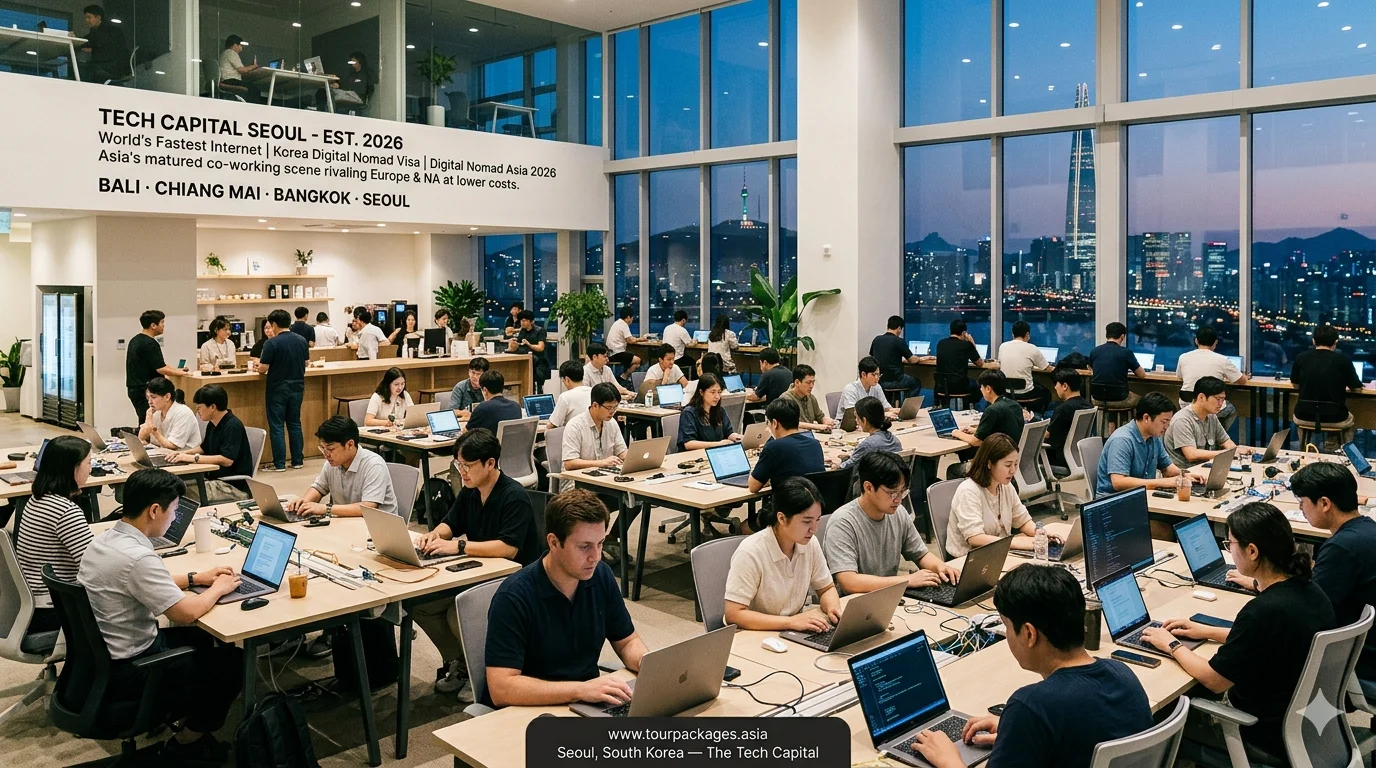
Digital Nomad Asia 2026

Asia's co-working scene has matured dramatically. Cities like Bali, Chiang Mai, Bangkok, and Seoul now offer co-working infrastructure that rivals any European or North American city — at a fraction of the membership cost.

The 8 Best Digital Nomad Destinations in Asia for 2026

Each city below has been assessed on five criteria that matter to working nomads: internet reliability, co-working infrastructure, monthly budget range, visa ease for Indian and international passport holders, and the overall quality of daily life that goes beyond the spreadsheet.

01

Bali, Indonesia — Canggu, Ubud and Beyond

The world's most famous digital nomad island · Indonesia Remote Worker Visa E33G
Top Choice Beach + Jungle Large Nomad Community Visa Available
Monthly BudgetUSD 1,000–1,800
Internet Speed50–150 Mbps avg.
Co-Working Day PassUSD 8–15
Visa OptionE33G Remote Worker (5 yrs)

Bali is where the digital nomad movement effectively went mainstream, and a decade after that first wave, it still earns its top-of-the-list position in most 2026 surveys — not on nostalgia, but on substance. The island has absorbed the weight of its own popularity and responded with genuine infrastructure: Canggu, the rice-paddy-to-beach-to-co-working corridor on the southwest coast, now has more purpose-built remote work spaces per square kilometre than most European capitals. Dojo Bali, Outpost, and Tropical Nomad Coworking are the well-known names; dozens of smaller spaces have opened in their wake, many offering private offices, podcast studios, and event spaces that function as genuine professional environments. Ubud, 40 minutes inland, offers the quieter alternative — cooler temperatures, jungle surrounds, a strong yoga and wellness culture, and co-working cafés that operate at a pace entirely different from Canggu's beach-hustle energy.

The practical situation in 2026: Indonesia launched its Remote Worker Visa (E33G) in April 2024, and it remains active. The visa allows stays of up to 5 years and is specifically designed for remote workers earning income from overseas companies — not Indonesian clients. Application requires proof of remote employment, a minimum income threshold, and health insurance. Indian passport holders require an e-visa before arriving; tourist visa on arrival is also available (30 days, extendable) for those not using the formal remote work visa. Budget carefully: Bali's cost of living is higher than many Southeast Asian alternatives at the mid-range, particularly if you choose Canggu over less touristed areas. Food is an exception — the island's abundance of affordable local warungs and mid-range restaurants makes eating well genuinely cheap. The co-working scene in Bali is covered comprehensively by Nomad List, which tracks real-time costs and community reviews for every major nomad destination.

Best Neighbourhoods for Nomads

Canggu — the default choice; beach access, enormous community, all co-working options within cycling distance. Can feel saturated in high season (July–August). Ubud — quieter, cooler, better for focused work, strong creative and wellness community. Less beach access, more jungle. Seminyak — slightly more upscale, better restaurants, less backpacker energy. Sanur — quieter than the southwest, family-friendly, good internet, older expat demographic.

For Indian travellers using Bali as both a work base and an exploration hub: the island's position as a transit point for eastern Indonesia makes it ideal for combining remote work with weekend trips to Lombok, Komodo, or the Gili Islands. Our world tour packages include Bali circuits that can be extended for nomad stays.

02

Chiang Mai, Thailand — The Original Nomad Hub

Affordable, stable, reliable — 15 years at the top of the list · Thailand DTV Visa
Best Value Mountain City Year-Round Appeal DTV Visa
Monthly BudgetUSD 700–1,300
Internet Speed100–300 Mbps
Co-Working Day PassUSD 5–12
Visa OptionDestination Thailand Visa (DTV)

Chiang Mai has been the benchmark digital nomad city since the early 2010s, and in 2026 it still leads most cost-adjusted quality-of-life rankings for remote workers. The reasons are structural rather than trendy: the city is compact enough to navigate by bicycle, large enough to have every necessary amenity, and priced at a level that allows a comfortable lifestyle on a budget that would be impossible in Singapore, Tokyo, or Seoul. The co-working infrastructure is genuinely excellent — Punspace, CAMP (the 24-hour coffee shop chain), and dozens of independent spaces offering day passes and monthly memberships at prices that make London or New York members visibly uncomfortable.

Thailand's Destination Thailand Visa (DTV), launched in 2024, is the most relevant formal option for long-term nomads. It provides a multiple-entry visa allowing 180 days per entry over a five-year period. Applicants must demonstrate a minimum bank balance of 500,000 Thai Baht (approximately USD 15,000) and prove remote employment or freelance income. For Indian passport holders, Thailand offers visa-on-arrival (30 days) and tourist visa options for shorter stays, with the DTV available for those committing to a longer Chiang Mai base. The city sits in a mountain valley at 300 metres elevation, giving it notably cooler mornings and evenings than Bangkok or coastal Thai cities — a meaningful quality-of-life advantage for those who find tropical heat difficult to work in. The Nimman Road area is the co-working and café epicentre; the Old City is better for those who prefer quieter, more residential surroundings.

One honest drawback: air quality in Chiang Mai deteriorates significantly during the burning season (February to April), when agricultural burning on surrounding hillsides creates smog that regularly reaches hazardous levels. This is a real consideration for long-stay planning — most experienced Chiang Mai nomads either leave during February–April or stay indoors with air purifiers. Outside this window, the city is one of the most comfortable and productive working environments in all of Southeast Asia. Combine a Chiang Mai work base with Thai coastal exploration on weekends through our travel planning service.

03

Bangkok, Thailand — Urban Productivity at Its Finest

A city that never stops — and neither does the Wi-Fi · Thailand DTV Visa
Best Infrastructure Metro Connectivity Food Capital 24-Hour City
Monthly BudgetUSD 900–1,500
Internet Speed200–500 Mbps (fibre)
Co-Working Day PassUSD 6–15
Visa OptionDTV + LTR Visa (Long-Term)

Bangkok is a city that rewards the nomad who values convenience above all other considerations. The metro system (BTS Skytrain and MRT) connects the main working districts with a reliability that would shame many European capitals. The internet infrastructure — fibre is now the standard in most apartments and co-working spaces in the city's newer districts — is fast and genuinely reliable. The food is extraordinary: Bangkok ranks consistently among the world's best cities for street food, restaurant culture, and the value-to-quality ratio of eating out, from a 40-baht bowl of noodles to a Michelin-starred tasting menu that costs less than a mid-range London dinner. And the city operates at a 24-hour pace that suits nomads who work across multiple time zones — cafés that stay open until 2 AM, 24-hour co-working spaces, and a general infrastructure that assumes people need things at unusual hours.

The Long-Term Resident (LTR) Visa is Bangkok's most relevant option for high-earning nomads — it requires a minimum annual income of USD 80,000 and provides a 10-year renewable visa with tax benefits and fast-track immigration access. For most nomads, the DTV (see Chiang Mai above) is the more accessible option. Bangkok's main working neighbourhoods for nomads are Sukhumvit (central, cosmopolitan, expensive but walkable), Silom (business district, excellent transport links), and Ekkamai/Thonglor (trendy, many cafés and co-working spaces, increasingly popular). The city is significantly more expensive than Chiang Mai but still far below Singapore, Tokyo, or Seoul for comparable lifestyle quality.

04

Da Nang, Vietnam — Beach, Bandwidth and Balance

The fastest-rising nomad city in Southeast Asia 2026 · Vietnam e-Visa 90 days
Rising Star 2026 Beach City Best Weather Compact + Safe
Monthly BudgetUSD 750–1,200
Internet Speed100–250 Mbps
Co-Working Day PassUSD 5–10
Visa OptionVietnam e-Visa 90 days

Da Nang sits at a genuinely unusual intersection: a Vietnamese city large enough to have reliable infrastructure and a growing international food scene, compact enough to cycle across in 20 minutes, positioned directly on a 30-kilometre stretch of white sand beach that faces the South China Sea, and priced at a level that makes even Chiang Mai look expensive in comparison. It is the fastest-rising digital nomad destination in Southeast Asia in 2026 according to multiple community surveys, and the reasons are not hard to identify.

My Khe Beach — wide, clean, and largely uncrowded compared to Bali's or Thai beaches at peak season — runs along the city's eastern shore. The An Thuong Street area near the beach is where most nomads concentrate: a strip of co-working cafés, international restaurants, beach bars, and guesthouses that has developed over the past three years specifically in response to the growing remote worker population. Co-working here is genuinely affordable — day passes in the USD 5–8 range, monthly memberships under USD 100 in most spaces. Internet speeds are fast and improving. The city is routinely ranked one of the safest cities in Vietnam and has a low-stress, low-noise character that contrasts sharply with Ho Chi Minh City's intensity. Da Nang's position between Hue (1 hour north) and Hoi An (30 minutes south) makes it an excellent base for weekend cultural exploration — Hoi An's UNESCO old town, the Hai Van Pass motorcycle route, and the Marble Mountains are all within easy striking distance.

The visa situation: Vietnam issues an e-Visa valid for 90 days (multiple entry) for citizens of most countries including India. The application is entirely online and processes in 3–5 business days. Vietnam's Tourism Advisory Board has proposed a 10-year "Golden Visa" for long-term residents — as of early 2026 this remains under government consideration, but its introduction would significantly strengthen Da Nang's position as a long-term nomad base. For Indian travellers, Vietnam is one of the most straightforward Southeast Asian countries to enter, and Da Nang airport has direct flight connections from Kolkata, Bengaluru, and connections via Bangkok or Kuala Lumpur from most other Indian cities.

05

Kuala Lumpur, Malaysia — Infrastructure and Comfort

Southeast Asia's most underrated nomad city · DE Rantau Nomad Pass
Best for Professionals Free City WiFi Visa-Free Indians Transport Hub
Monthly BudgetUSD 800–1,400
Internet Speed100–300 Mbps
Co-Working Day PassUSD 7–14
Visa OptionDE Rantau Nomad Pass (12 mths)

Kuala Lumpur is the digital nomad destination that most travel writers underrate and most professional nomads quietly prefer. It lacks Bali's visual drama and Chiang Mai's community warmth, but it compensates with infrastructure, connectivity, and daily-life convenience that neither can match. The city has free public WiFi across most of its central areas, a metro system that works, English spoken universally, and a cost of living that sits comfortably between Bangkok's affordability and Singapore's expense. The food culture — a genuinely extraordinary three-way blend of Malay, Chinese, and Indian cuisines producing one of Southeast Asia's most diverse restaurant scenes — is a consistent quality-of-life asset that experienced nomads cite as a primary reason for returning.

Malaysia's DE Rantau Nomad Pass is one of Asia's most structured formal remote work visas. It provides a 12-month stay (renewable for another 12 months) for digital professionals who can demonstrate remote income. Requirements include proof of employment with an overseas company (or evidence of freelance/contract income), minimum monthly income of USD 2,000, and valid health insurance. Indian nationals currently benefit from visa-free entry to Malaysia for up to 30 days, making KL particularly accessible for nomads who want to test the city before committing to the full Nomad Pass application. The city's position as Southeast Asia's budget airline hub — KLIA has the highest frequency of low-cost connections to Thailand, Vietnam, Indonesia, the Philippines, and beyond — makes it an exceptional base for regional travel on weekends.

06

Seoul, South Korea — The Tech Capital

The world's fastest internet, in one of Asia's most livable cities · Korea Digital Nomad Visa
Fastest Internet Asia Digital Nomad Visa High Standard of Living Tech Ecosystem
Monthly BudgetUSD 1,400–2,200
Internet Speed500–1,000 Mbps
Co-Working Day PassUSD 10–20
Visa OptionKorea Workcation Visa (1 yr)

Seoul is the city that changes the conversation about what a digital nomad destination can be. It is not cheap. A comfortable monthly budget runs USD 1,400–2,200, and rent in central districts reflects a city with a strong property market and high living standards. But what Seoul offers in exchange is genuinely without parallel: the world's fastest and most reliable public internet infrastructure (500–1,000 Mbps is standard in apartments; coffee shops routinely provide 200 Mbps+), a public transport system that makes London's look embarrassed, a food scene of extraordinary depth and affordability (a proper Korean meal in a local restaurant rarely exceeds USD 8), and a cultural density — K-culture, design, architecture, nightlife, cuisine — that makes the city one of the most engaging places to live in all of Asia regardless of work considerations.

South Korea's Workcation Visa (digital nomad visa), launched in 2024, continues to accept applications in 2026. It allows a stay of up to one year for remote workers employed by overseas companies. Applicants must demonstrate proof of remote employment and meet income requirements. The neighbourhoods that matter for nomads: Mapo-gu and Hongdae for creative, younger energy and affordable co-working; Gangnam for corporate infrastructure and higher-end spaces; Itaewon for international community and English-friendly environments; Seongsu-dong (Seoul's emerging neighbourhood) for design-forward cafés and independent co-working spaces. Seoul also offers extraordinary weekend travel infrastructure — KTX high-speed rail connects to Busan in 2.5 hours, and Jeju Island (one of Asia's most beautiful holiday destinations) is a 1-hour flight. For anyone planning an Asia trip that includes South Korea, our Asia tour packages include Seoul circuits.

07

Taipei, Taiwan — The Underrated Gem

Safe, efficient, excellent food, genuinely fast internet · Taiwan Digital Nomad Visa (2025)
Most Underrated Night Markets Safest in Asia New Nomad Visa
Monthly BudgetUSD 1,100–1,800
Internet Speed200–500 Mbps
Co-Working Day PassUSD 8–18
Visa OptionDigital Nomad Visa 6+6 months

Taipei has one of those reputations that is simultaneously accurate and incomplete. It is genuinely efficient — transport works, internet is fast and reliable, the healthcare system is excellent, and the city is consistently ranked among the safest in all of Asia. But the word that experienced nomads use more often than any other is "comfortable." Taipei is a city where daily life works, full stop. The grocery stores are stocked, the cafés are genuinely work-friendly (the culture of sitting in a coffee shop for three hours without being asked to leave is well established), the streets are clean, and the night market culture — Shilin, Raohe, and the dozens of smaller neighbourhood markets — provides the most economical and high-quality daily eating of any major Asian city outside Japan.

Taiwan launched its Digital Nomad Visa in January 2025 — a 6-month visa renewable for another 6 months, available to nationals of visa-exempt countries (including Indian passport holders may need to check current bilateral status). The visa requires proof of remote employment and a minimum annual income (USD 40,000 for applicants aged 30+; USD 20,000 for 20–29 year olds). The co-working scene in Taipei has grown substantially over the past two years — districts like Da'an, Zhongshan, and the artsy Songshan Cultural and Creative Park area have the highest density of quality work spaces. Taiwan's east coast — accessible by the Taroko Gorge train route — provides one of Asia's most dramatic landscapes within a 2.5-hour journey from the capital, making Taipei an exceptional base for both productive work weeks and genuinely spectacular weekends.

08

Fukuoka, Japan — Japan Without the Cost of Tokyo

Startup city, manageable budget, exceptional ramen · Japan Digital Nomad Visa (2024)
Japan Entry Point Startup Scene Compact + Walkable Best Ramen City
Monthly BudgetUSD 1,500–2,400
Internet Speed300–600 Mbps
Co-Working Day PassUSD 12–22
Visa OptionJapan Digital Nomad Visa 6 mths

Most people who spend time in Fukuoka come away with the same observation: this is what working in Japan would look like if Japan were affordable. Fukuoka — on the northern coast of Kyushu, 90 minutes by shinkansen from Hiroshima and less than 2 hours from Osaka — is the city that Japan's own government chose to designate as its primary startup and innovation hub outside Tokyo, providing tax incentives and infrastructure investment specifically to attract entrepreneurs and remote workers. The result is a city with a tech-community sensibility, a walkable compact centre (Tenjin and Hakata districts can be crossed on foot in under 20 minutes), excellent transport, and a cost of living that, while higher than Southeast Asian alternatives, is approximately 30–35% below Tokyo for comparable accommodation.

Japan's Digital Nomad Visa, launched in April 2024, allows remote workers to stay for up to six months. The requirements are among Asia's most demanding: proof of employment with an overseas company, an annual income of at least 10 million Japanese Yen (approximately USD 70,000), and comprehensive health insurance. This makes it primarily suitable for higher-earning professionals — developers, senior consultants, creative directors. For Indian passport holders, Japan currently requires a visa obtained in advance from the Japanese consulate; tourist visas are available for stays up to 90 days for eligible nationalities, and the digital nomad visa application is processed through Japanese embassies. Fukuoka's food culture — the city claims to be the birthplace of Hakata-style tonkotsu ramen and has a street food stall (yatai) culture unique in Japan — provides daily eating pleasures that make the higher cost of living considerably more bearable. Our Japan tour packages include Fukuoka as part of the Kyushu circuit.

Asia Digital Nomad Visa Comparison 2026

The visa landscape for remote workers in Asia changed significantly in 2024–2025. Six countries now offer formal digital nomad or remote work visa programmes. Here is a consolidated comparison for planning purposes — always verify current requirements with the relevant embassy or consular website before applying.

CountryVisa NameDurationMin. IncomeIndian Nationals
ThailandDestination Thailand Visa (DTV)180 days/entry, 5 yrsTHB 500,000 in bank (~USD 15k)Eligible — apply via Thai embassy
IndonesiaRemote Worker Visa E33GUp to 5 yearsProof of overseas employmentEligible — e-visa or embassy
MalaysiaDE Rantau Nomad Pass12 months (renewable)USD 2,000/monthVisa-free 30 days; Nomad Pass separate
JapanDigital Nomad Visa6 months~USD 70,000/yearRequires consular application
TaiwanDigital Nomad Visa6 months (extendable)USD 20,000–40,000/yearCheck current bilateral status
South KoreaWorkcation Visa12 monthsDemonstrated remote incomeKorean consulate application
Vietnam note: As of April 2026, Vietnam does not have a formal digital nomad visa. The 90-day e-Visa (multiple entry) is the best current option for remote workers. A proposed 10-year "Golden Visa" was submitted for government consideration in 2025 and remains under review. We will update this guide when the legislation is finalised.

Monthly Budget Comparison — What Does Remote Work in Asia Actually Cost?

Budget planning is one area where most digital nomad guides deal in comfortable approximations. The table below gives realistic ranges for a single professional living comfortably — not lavishly — with private accommodation, a co-working membership, regular eating out, and occasional weekend travel included. All figures are in USD for mid-2026.

CityRent (Private)Food/MonthCo-WorkingTransportTotal Range
Chiang MaiUSD 300–500USD 200–350USD 60–100USD 40–70USD 700–1,300
Da NangUSD 300–500USD 200–300USD 50–90USD 40–60USD 750–1,200
Bali (Canggu)USD 450–800USD 250–400USD 80–150USD 50–80USD 1,000–1,800
Kuala LumpurUSD 350–650USD 200–350USD 80–130USD 50–80USD 800–1,400
BangkokUSD 450–750USD 250–400USD 70–120USD 50–80USD 900–1,500
TaipeiUSD 600–1,000USD 300–450USD 100–180USD 50–80USD 1,100–1,800
SeoulUSD 700–1,200USD 350–500USD 120–200USD 60–90USD 1,400–2,200
FukuokaUSD 700–1,200USD 400–600USD 130–220USD 70–100USD 1,500–2,400
Asia 2026

The ideal digital nomad setup in Asia does not require a compromise between productive work and quality of life. The cities on this list offer both — at monthly costs that would represent aggressive budget targets in London or New York.

Using Your Nomad Base for Regional Travel

One of the most overlooked dimensions of choosing an Asian city as a digital nomad base is the quality of the regional travel network that sits around it. Asia's budget airline connectivity — particularly from Bangkok, Kuala Lumpur, and Bali — means that a four-day weekend can transport you from a Bangkok co-working space to the beaches of Krabi, Langkawi, or the Andaman Islands and back with a total flight budget under USD 100.

Best Weekend Travel Options from Each Base City

From Bali: Lombok (Gili Islands, Rinjani), Nusa Penida, Flores (Komodo dragons). From Chiang Mai: Chiang Rai (Golden Triangle), Pai Valley, Mae Hong Son Loop. From Bangkok: Koh Samui, Koh Tao, Kanchanaburi, Ayutthaya. From Da Nang: Hoi An (30 min), Hue (1 hr), Phong Nha caves (4 hrs), My Son ruins. From Kuala Lumpur: Langkawi, Penang, Perhentian Islands, Cameron Highlands, Singapore (4 hrs bus). From Seoul: Busan (2.5 hrs KTX), Jeju Island (1 hr flight), Gyeongju historic district. From Taipei: Jiufen, Taroko Gorge, Sun Moon Lake, Japan (direct flight). From Fukuoka: Nagasaki, Kumamoto, Beppu hot springs, Hiroshima (90 min shinkansen).

For Indian nomads, the combination of a Kuala Lumpur or Bangkok base with a 2-week Asia regional tour package — booked through RTH — offers an efficient way to explore multiple countries without sacrificing the working base. Our team at Revelation Holidays has planned numerous trips for professionals combining remote work stays with structured regional travel, and the hybrid model is increasingly popular as more Indian companies adopt flexible remote work policies.

"The best version of digital nomad life in Asia is not about replacing your routine with chaos. It is about finding a city where daily life runs smoothly enough that your work gets done, and everything outside of work hours is extraordinary."

— RTH World Travel Desk

What Indian Digital Nomads Should Know

For Indian professionals working remotely, the regulatory environment has shifted. India's IT sector and startup ecosystem now has a significant cohort of employees working on distributed or fully remote contracts. From a tax perspective, Indian citizens working remotely from another country remain tax-resident in India if they spend more than 182 days in India in a financial year — understanding the 182-day rule is essential for anyone planning extended Asia stays. This guide does not provide tax advice; consult a chartered accountant familiar with international tax before committing to a long-term nomad strategy. From a practical logistics standpoint, most of the cities on this list have active Indian communities — particularly Kuala Lumpur (which has the largest Indian diaspora in Southeast Asia), Bangkok, and increasingly Da Nang and Bali. Indian food, as a further practical consideration, is available in all eight cities. The visa policy guide on tourpackages.asia provides current entry requirements for Indian passport holders for all major Asian destinations.

Top Experiences for Digital Nomads Exploring Asia

Beyond the co-working spaces and the video calls — twelve experiences that make working from Asia more than just a productive choice, but a genuinely transformative one.

  • 1

    Sunrise over Bali's rice terraces from your villa desk

    Ubud, Bali · The view that changes your perspective on the phrase "morning meeting"
  • 2

    Night market dinner, Taipei — USD 6 for a full meal

    Shilin or Raohe Night Market · The cost-of-living reality check that actually matters
  • 3

    Seoul's Han River cycling route on a Saturday afternoon

    Han River Park · The workout, the skyline, and the reason you moved
  • 4

    Da Nang to Hoi An on a motorbike — 30 minutes of pure coastal road

    Vietnam Coast Road · The reminder that your commute is now a choice
  • 5

    Chiang Mai Night Bazaar — then back to the laptop by 9 PM

    Chiang Mai · The evening routine that makes productivity feel like a privilege
  • 6

    Fukuoka yatai (street stall) dinner after a productive day

    Nakasu District · Tonkotsu ramen at midnight under a paper lantern
  • 7

    Bangkok's BTS Skytrain at 7 AM — faster than any city you've worked in

    Sukhumvit Line · The infrastructure that makes urban nomad life genuinely work
  • 8

    Kuala Lumpur's Petronas Towers from a co-working window

    KLCC Area · The backdrop for a video call that makes colleagues question your life choices
  • 9

    Jeju Island weekend from Seoul — 1 hour by air

    South Korea · Volcanic landscapes, tea plantations, empty black beaches
  • 10

    Taroko Gorge day trip from Taipei — train through marble canyon

    Hualien, Taiwan · The most spectacular 2-hour train journey in East Asia
  • 11

    Hoi An lantern festival evening — UNESCO old town, ancient light

    Hoi An, Vietnam · The kind of evening that makes weekend travel mandatory
  • 12

    Canggu surf lesson before your 10 AM stand-up

    Bali, Indonesia · The morning routine you will never want to give up
Destination-by-Destination Planning
Updated April 2026 — Verify visa requirements before travel

Practical Planning Tips for Digital Nomads in Asia

Click each panel for targeted advice on every aspect of planning a working life in Asia — from visas to internet to tax.

Visas

Navigating Asian Visas as a Remote Worker

  • Thailand DTV is the best formal option for most nomads who want flexibility. 180 days per entry over 5 years. Apply at your nearest Thai consulate with bank statements and proof of remote employment. Processing time: 2–4 weeks.
  • Malaysia DE Rantau requires an online application through the Malaysia Digital Economy Corporation (MDEC). Processing takes 4–8 weeks. Once approved, you receive a single-entry long-term visa convertible to a residency pass in Malaysia.
  • Indonesia E33G is the Bali-friendly option. Apply through an authorised Indonesian immigration agent or consular office. Proof of overseas employment contract is the key document.
  • Vietnam e-Visa is the simplest in Asia — apply at Vietnam's official e-visa portal, USD 25 fee, processes in 3–5 business days. 90 days, multiple entry.
  • Always check current requirements before applying — visa rules in Asia change more frequently than in Europe. RTH's visa policy page maintains current entry requirements for Indian passport holders.
Internet & Tech

Staying Connected Reliably Across Asia

  • Local SIM cards are universally the cheapest and most reliable connectivity solution on arrival. Thailand's AIS and DTAC, Malaysia's Maxis, Vietnam's Viettel, and South Korea's SK Telecom all offer excellent prepaid data plans for under USD 15/month for 30–50 GB.
  • Co-working internet in Bali, Bangkok, and Seoul routinely delivers 100–500 Mbps. Always test the connection before committing to a monthly membership — run a speed test and check upload speeds specifically (important for video calls).
  • Home/apartment WiFi in Thailand, Malaysia, and Vietnam typically delivers 30–100 Mbps on shared fibre connections. If you need consistently faster speeds, budget for a personal 4G/5G router (USD 30–50 one-time cost in most Asian cities).
  • For calls and sensitive data: use a VPN — not primarily for piracy but for security on co-working and café networks. ExpressVPN, Mullvad, and NordVPN all work reliably in Southeast Asia (some restrictions in Vietnam — test before depending on it).
  • Seoul and Fukuoka have the fastest and most reliable public infrastructure on this list — if your work requires consistent gigabit speeds, both cities are significantly ahead of Southeast Asian alternatives.
Co-Working

Finding the Right Co-Working Setup

  • Trial days before commitment: Every serious co-working space in Asia sells day passes. Use two or three before buying a monthly membership — the difference in atmosphere, noise level, and community quality between spaces in the same city can be dramatic.
  • Café co-working is still perfectly viable in Chiang Mai, Taipei, and Da Nang — the culture of sitting for 3–4 hours on a single coffee is accepted. Bangkok and Seoul café culture is more transactional; dedicated spaces are more practical for full working days.
  • Best value cities for co-working: Da Nang (USD 50–80/month), Chiang Mai (USD 60–100/month), Bali/Canggu (USD 80–150/month). Best infrastructure: Seoul (USD 150–250/month for premium spaces) and Fukuoka (USD 150–220/month).
  • Community matters: The social dimension of co-working is where cities diverge most clearly. Bali and Chiang Mai have the densest nomad communities with the most organic social infrastructure — meetups, events, shared accommodation networks. Seoul and Taipei have smaller but high-quality communities of more established professionals.
  • Check Nomad List, Coworker.com, and local Facebook groups for each city's current recommended spaces — the landscape changes more quickly than any static guide can track.
For Indian Nomads

Specific Advice for Indian Remote Workers

  • Tax residency: Indian citizens remain tax-resident in India if they spend 183+ days in India in a financial year. If you plan an extended Asia stay, plan your India days carefully and consult a CA with international tax experience before committing to a multi-month base abroad.
  • Visa-free destinations from India: Malaysia (30 days), Thailand (30 days visa-on-arrival), Indonesia (30 days visa-on-arrival), Vietnam (e-visa required, straightforward). South Korea, Japan, and Taiwan require advance visa applications from Indian passport holders at consular offices.
  • Banking: Ensure your Indian bank card works internationally (Visa/Mastercard on global ATM networks) before departure. UPI does not work outside India. Keep USD 200–300 cash as backup for the first few days in each new city. Niyo Global and HDFC Regalia cards are recommended by Indian nomads for low foreign transaction fees.
  • Flight connectivity: All eight cities on this list have direct flights or one-stop connections from major Indian cities (Hyderabad, Delhi, Mumbai, Bengaluru, Chennai) within 4–8 hours total journey time. IndiGo, Air India, AirAsia, and Vistara cover most routes. Book open-jaw tickets to maximise regional exploration.
  • Indian food availability: Kuala Lumpur has the most extensive Indian restaurant scene in Southeast Asia. Bali, Bangkok, and Singapore all have good Indian food options. Taipei and Fukuoka have limited Indian restaurants — cook your own if this matters to you daily.
  • For a complete Asia travel plan incorporating remote work and regional exploration, our team at tourpackages.asia provides personalised planning.
Health & Safety

Staying Healthy and Safe While Working in Asia

  • Travel insurance is non-negotiable for any extended Asia stay. Ensure your policy covers remote work activity (some standard travel insurance policies exclude income-generating activity abroad). World Nomads and SafetyWing are the most widely used among the nomad community.
  • Health infrastructure: Seoul, Taipei, Bangkok, and Kuala Lumpur all have excellent private hospital infrastructure with English-speaking staff. Bumrungrad International in Bangkok and Raffles Medical in KL are the most recommended for expats and nomads. Da Nang's medical facilities are improving but still below the city-state and East Asian standards.
  • Air quality: Chiang Mai's burning season (February–April) creates genuinely hazardous air quality. Bali's air in Kuta/Seminyak can be poor due to traffic density. Seoul and Fukuoka experience seasonal yellow dust from mainland China. Check IQAir.com before committing to dates in affected cities during these periods.
  • Water: Tap water is not safe to drink in Thailand, Vietnam, Indonesia, or Malaysia. Bottled water (USD 0.50–1.00/1.5 litre) or a quality filter jug is standard practice. Taiwan and South Korea have generally safe tap water in major cities.
  • General safety: All eight cities on this list are considered safe for solo travellers. Petty theft (bag-snatching on motorbikes) is the most common risk in Bangkok, Ho Chi Minh City, and parts of Bali. Keep bags zippered and avoid obvious display of expensive equipment in busy public areas.

Ready to Plan Your Asia Digital Nomad Journey?

Whether you are researching Bali for a three-month trial or planning a year-long Asia circuit from Bangkok to Seoul, RTH World Tour Packages can help you build an itinerary that works around both your career and your curiosity.

Plan Your Digital Nomad Journey with RTH

Tell us where you want to go, how long you have, and what you need from your base city — we will come back with a practical itinerary that works for both your career and your sense of adventure.

  • Bali, Chiang Mai, Bangkok, Da Nang, KL circuits
  • Seoul, Taipei, Fukuoka East Asia routes
  • Visa guidance for Indian passport holders
  • Co-working and accommodation recommendations
  • Regional weekend travel planning included
  • Multi-city Asia nomad itineraries
  • Backed by Revelation Holidays

Get My Asia Nomad Itinerary

Or WhatsApp directly: +91 91009 84920

Frequently Asked Questions

Every question an Indian remote worker planning a digital nomad trip to Asia asks — answered honestly by the RTH travel team.

1. Which is the best Asian city for digital nomads in 2026?

There is no single correct answer — the best city depends entirely on what you prioritise. If cost is the primary factor, Chiang Mai and Da Nang consistently offer the best lifestyle-to-budget ratio in 2026, with comfortable monthly budgets starting at USD 700–750. If community matters most, Bali's Canggu has the densest and most active nomad community in Asia, with events, meetups, and co-working social infrastructure that no other Asian city currently matches. If internet reliability and infrastructure are non-negotiable (as they often are for developers and video professionals), Seoul and Fukuoka are in a different league from Southeast Asian alternatives. For Indian passport holders, Kuala Lumpur has the practical advantage of visa-free 30-day entry, English universally spoken, Indian food widely available, and a transport hub position that makes the rest of Southeast Asia easily accessible on weekends.

If you are seriously considering an Asia nomad base and want a personalised recommendation based on your work type, budget, and priorities, reach out to our team at tourpackages.asia or browse our India packages — we have helped numerous Indian professionals make this transition.

2. Can Indian citizens live and work remotely from Bali in 2026?

Yes. Indian citizens can access Bali using Indonesia's Visa on Arrival (30 days, extendable once for another 30 days, total 60 days maximum on a single VOA cycle) or via Indonesia's Remote Worker Visa E33G, launched in April 2024. The E33G is specifically designed for remote workers earning income from non-Indonesian companies and provides multi-year stay authorisation. Application for the E33G requires proof of remote employment contract, a minimum income requirement (check current thresholds with the Indonesian consulate as these are periodically reviewed), and health insurance. The application is processed through the Indonesian immigration authority (Imigrasi) or through an authorised immigration agent in Indonesia.

For stays over 60 days on a tourist/VOA basis, a "visa run" (exiting and re-entering Indonesia) was historically common in Bali — but this is being enforced more strictly in 2025–2026. For any stay beyond 60 days, the E33G or a Social-Cultural visa obtained in advance is the legally correct approach. Never work for Indonesian clients on a tourist or VOA — this creates legal complications regardless of nationality.

3. How is the internet quality for video calls in Southeast Asian nomad cities?

Internet quality varies significantly between cities and even between neighbourhoods within cities. As a general rule: Bangkok, Kuala Lumpur, and Da Nang consistently deliver reliable 100–300 Mbps in co-working spaces and most modern apartments. Chiang Mai and Bali are somewhat less consistent — the infrastructure is good but occasional outages during heavy rain or in older neighbourhoods are not uncommon. Purpose-built co-working spaces in all five cities reliably deliver the speeds needed for HD video calls, screen sharing, and large file uploads.

For video-intensive work (video editing, frequent HD calls, large file transfers), Chiang Mai's Punspace and Bali's Dojo and Outpost are regularly cited as the most reliable Southeast Asian options. For genuinely demanding technical work, Seoul and Fukuoka are the obvious answers — 500–1,000 Mbps is routine in both cities. The practical advice: always test your accommodation's internet on arrival and have a 4G/5G mobile hotspot as backup for important calls. Thailand's AIS, Malaysia's Maxis, and Vietnam's Viettel all provide excellent LTE data plans under USD 15/month.

4. What is Thailand's Destination Thailand Visa (DTV) and how do I apply?

The Destination Thailand Visa (DTV) was launched by the Thai government in 2024 as a formal remote work and digital nomad visa. Key details for 2026: the DTV is a multiple-entry visa that allows stays of up to 180 days per visit, with a total validity of 5 years. It can also be used for purposes beyond remote work — including studying abroad and pursuing certain activities in Thailand. Applicants must demonstrate: a minimum bank balance of 500,000 Thai Baht (approximately USD 14,500–15,000) OR proof of remote employment income at that level; proof of health insurance with minimum coverage of 40,000 THB for outpatient and 400,000 THB for inpatient; valid passport; and application fee of 10,000 THB (approximately USD 280).

For Indian passport holders, apply at your nearest Royal Thai Embassy or Consulate in India (Delhi, Mumbai, Kolkata, Chennai) in person. Processing typically takes 1–2 weeks. Bring originals and photocopies of all documents. Current detailed requirements should be verified at the official Thai Embassy website before applying, as requirements have been updated since the visa's launch. The DTV is one of the most flexible and valuable remote work visas in Asia and well worth the preparation involved for anyone planning an extended Thailand stay.

5. Is Da Nang safe for solo female digital nomads?

Da Nang consistently ranks as one of the safest cities in Vietnam and one of the safest mid-sized cities in Southeast Asia for solo travellers, including women travelling or working alone. The city has a relatively low crime rate, a visible local police presence in the tourist and nomad areas, and a culture of community respect that makes street harassment less common than in some other regional cities. The An Thuong area near My Khe Beach — the primary nomad neighbourhood — is well-lit, well-patrolled, and has a permanent community of local residents, business owners, and long-stay travellers that creates natural social oversight.

Practical precautions that apply to any Southeast Asian city: be cautious on motorbikes at night in less-lit areas (bag-snatching, though uncommon in Da Nang, is not unheard of); share your accommodation address with someone who knows your itinerary; use registered taxi apps (Grab is the standard in Vietnam) rather than unmetered taxis for airport and late-night journeys. The growing Da Nang nomad community — accessible through Facebook groups and co-working space bulletin boards — provides a ready network of people who know the city and can provide current local advice on any aspect of daily life and safety.

6. Can I work from Japan on a tourist visa?

The legal and practical answer requires nuance. Japan's immigration law prohibits income-generating work activity on a tourist visa. Working remotely for a non-Japanese company (i.e., your income comes from abroad, not Japan) exists in a legal grey area in Japan — as it does in most countries. Japan has not prosecuted tourist-visa remote workers for working for overseas employers in the past, and many nomads have done this without issue. However, Japan introduced a formal Digital Nomad Visa in April 2024 specifically to create a legal framework for this activity — and with that legal pathway now available, continuing to rely on the grey area becomes less defensible.

The Japan Digital Nomad Visa requires an annual income of approximately USD 70,000+, which makes it primarily suitable for senior professionals. For Indian passport holders, apply at the Japanese Embassy or Consulate in India before travelling — Japan currently requires advance visa applications from Indian nationals for most visa types. For those who do not meet the income threshold, the tourist visa with short stays (Japan's standard 90-day stay for eligible nationalities; shorter for Indian passport holders) remains the practical option, with the understanding that formal legal compliance requires the designated visa. Check the Japan Embassy website for current Indian passport holder visa requirements before planning.

7. What is the best neighbourhood in Bali for digital nomads?

Canggu is the default answer and still the correct one for most nomads in 2026. The neighbourhood offers the highest density of co-working spaces, beach access, international café culture, and the nomad community social infrastructure (events, meetups, shared housing networks) that makes arriving in a new city feel less isolating. The area has changed significantly over the past decade — it is now more developed, more expensive, and more crowded than it was when it first emerged as a nomad hub. Some long-term Bali nomads have migrated away from Canggu specifically because of this.

The alternatives: Ubud (40 minutes inland, cooler, quieter, jungle setting, strong arts/wellness/yoga community, good co-working, less beach access) is the most popular alternative and suits those who find Canggu's beach-hustle atmosphere distracting. Seminyak is more upscale and expensive, with better high-end restaurants but a less cohesive nomad community. Sanur is quieter and slightly cheaper, with an older expat demographic and a beachfront that is less developed than Kuta. Umalas (between Seminyak and Canggu) is increasingly popular for those who want villa living without the full Canggu tourist density. The honest advice: spend 1–2 weeks in Canggu when you first arrive (to build the community network), then test Ubud for a week if quieter work appeals to you — most experienced Bali nomads have a split base between the two.

8. How do taxes work for Indian digital nomads working in Asia?

Tax is the area where most digital nomad guides (including this one) urge you to seek professional advice rather than rely on blog posts. That said, the basic framework for Indian citizens working remotely from Asia: India determines tax residency primarily based on the number of days spent in India in a financial year (April 1 to March 31). An Indian citizen who spends more than 182 days in India in a financial year is considered a Resident and taxed in India on global income. An Indian citizen who spends 182 days or fewer in India may qualify as a Non-Resident Indian (NRI), which has different income tax implications.

Most Asian countries where nomads base themselves (Thailand, Indonesia, Malaysia, Vietnam) apply tax residency rules based on the number of days spent in-country, typically 183 days as the threshold. Staying under this threshold in any single country is a common nomad strategy, but it requires careful calendar management across a financial year. India also has Double Taxation Avoidance Agreements (DTAAs) with most of the countries on this list, which can reduce the risk of being taxed twice on the same income. The practical recommendation: consult a chartered accountant with international tax experience before committing to any arrangement that involves more than 3–4 months abroad. The financial implications of getting this wrong can be significant.

9. Is Chiang Mai or Bangkok better for digital nomads?

Chiang Mai and Bangkok attract genuinely different nomad profiles, and the choice often reveals something about what kind of working life you actually want. Chiang Mai wins on cost (approximately 30% cheaper than Bangkok for comparable lifestyle), pace (slower, less intense, easier to find quiet), and community warmth (the nomad community in Chiang Mai is older, more established, and more genuinely social than Bangkok's more transient population). The city's mountain setting, accessible nature, and the quality of its food-per-baht ratio make it one of the most comfortable working environments in Asia. The major drawback remains the seasonal air quality issue (February–April burning season).

Bangkok wins on infrastructure (transport, hospitals, entertainment), variety (a city of 10 million with endless options for every taste and budget), and professional networking (if you work in media, tech, or regional business, Bangkok's density of companies and professionals is an asset that Chiang Mai cannot replicate). Bangkok is also significantly easier to reach from India — more direct flights, shorter journey times. The recommendation: if you are trying Southeast Asia for the first time, Bangkok makes an excellent first month (infrastructure minimises friction while you find your feet); Chiang Mai rewards those who have already decided they want the nomad life and want to build it sustainably. Many experienced Thai-based nomads split their year between both.

10. What co-working spaces are best in Southeast Asia?

The co-working landscape in Southeast Asia has matured significantly. By city, the consistently recommended options in 2026:

  • Bali: Dojo Bali (Canggu, large community, events, outdoor space), Outpost (Ubud and Canggu, premium facilities, reliability focus), Tropical Nomad Coworking (Canggu, well-priced, strong community atmosphere)
  • Chiang Mai: Punspace (multiple locations, reliable internet, professional atmosphere, strong long-term member community), CAMP Coffee (24-hour, exceptional for night owls, free with coffee purchase), Yellow (newer, design-forward, good private office options)
  • Bangkok: The Hive (multiple locations, corporate standard), HUBBA (creative sector focus, Ekkamai), The Garage (startup community, free events)
  • Da Nang: Toong (most professional, best internet reliability), Efus (popular with the beach nomad crowd, social atmosphere), Enourage (quiet, focused work, popular with writers)
  • Kuala Lumpur: Colony (premium, multiple locations, design-forward), Common Ground (large network, reliable, flexible plans), Regus KL (for those who need corporate-grade meeting rooms)

Always trial a day pass before committing to a monthly membership. Spaces change management, lose good staff, or simply decline in quality over time — community reviews on Coworker.com and relevant Facebook groups are more current than any printed guide.

11. How do I find long-term accommodation as a digital nomad in Asia?

Long-term accommodation in Asian nomad cities follows a fairly consistent pattern. The most efficient approach: book 2–3 nights in a guesthouse or cheap hotel on arrival to give yourself time to look at apartments in person, then transition to a monthly rental once you know which neighbourhood and which type of property suits your needs. Monthly rates in Asian cities are significantly lower than daily or weekly rates — the gap between a weekly booking and a monthly lease for the same property can be 40–60% in cities like Bali, Chiang Mai, and Da Nang.

  • Facebook groups: "Canggu Digital Nomads", "Chiang Mai Digital Nomads", "Da Nang Digital Nomads" and equivalent groups for each city are the most reliable sources for apartment listings, flatmate-finding, and current market rates. These groups are also where you find furnished month-to-month leases that landlords do not advertise on booking platforms.
  • Airbnb for monthly: Airbnb's monthly discount feature often brings rates for private apartments down to comparable levels with direct lease arrangements, with the added security of the Airbnb platform and the flexibility of checking out without complex lease termination.
  • Dedicated nomad accommodation: Outpost Bali, Bunk Bangkok, and several Chiang Mai coliving spaces offer furnished rooms with co-working included, community events, and month-to-month contracts that bundle housing and workspace in a single cost. Higher per-month than a solo apartment but significantly lower friction on arrival.
  • Always inspect the WiFi speed yourself before signing any lease or long-term booking. Ask the landlord to run a speed test while you watch.
12. What are the best Asian cities for digital nomads who want outdoor activities?

Asia offers a remarkable range of outdoor environments that can be incorporated into a working week without sacrificing productive hours. The best cities for outdoor-active nomads:

  • Chiang Mai: The best overall option for outdoors-focused nomads. Mountain biking, trekking, rock climbing at Crazy Horse Buttress, waterfalls within 30 minutes of the city, elephant sanctuary volunteering, zip-lining. All within easy day-trip range from a city that costs USD 700–1,300/month.
  • Bali/Canggu: Surfing is the dominant activity — consistent waves at Canggu and Seminyak, world-class surf at Padang Padang and Uluwatu. Rice terrace cycling in Ubud. Mount Batur sunrise hike (easy, 2–3 hours). Snorkelling/diving at Amed and Nusa Penida.
  • Da Nang: Surfing at My Khe Beach (seasonal), Marble Mountains hiking, Son Tra Peninsula mountain biking, Phong Nha cave kayaking (4 hours away). The geography offers a surprisingly good range given the city's modest size.
  • Seoul: Within the city, Bukhansan National Park provides serious mountain hiking (Baegundae peak, 836m) accessible by metro. The Han River cycling network spans 40+ km. Weekends bring Seoraksan, Jirisan, or Jeju Island's Hallasan crater hike within 2–3 hours.
  • Taipei: Yangmingshan National Park is a 40-minute bus ride from the city centre — volcanic hot springs, hiking, and cycling all accessible. The east coast Taroko Gorge canyon is 2.5 hours by train — some of the most dramatic hiking terrain in East Asia.
13. How do I build a community as a digital nomad in a new Asian city?

The isolation risk is real in the digital nomad life, and experienced nomads all have opinions about the best strategies for building genuine social connection rather than superficial networking. The practical approaches that work:

  • Join a co-working space with a community focus rather than a corporate shared office. The difference between a space that runs weekly events, has a slack channel, and hosts member dinners — and one that simply rents desks — is enormous for social integration. In Bali, Dojo and Outpost; in Chiang Mai, Punspace; in Bangkok, The Hive all have strong community programmes.
  • Attend city-specific nomad meetups. Internations, Meetup.com, and city-specific Facebook groups all run regular gatherings in all eight cities on this list. Show up to two or three before deciding the scene isn't for you — first events are often underwhelming; the fourth and fifth reveal the people worth knowing.
  • Stay longer in fewer places. The nomads who report the most satisfying social lives are those who stay in a city for 2–3 months rather than 2–3 weeks. Social connection requires repeated encounters with the same people over time — something the perpetual mover never achieves.
  • Take a class. Cooking classes, muay thai gyms, yoga studios, surfing schools — any structured group activity that repeats weekly creates the repeated-encounter structure that friendship requires. Chiang Mai's muay thai gyms and Bali's yoga studios are both remarkably effective community generators for this reason.
  • Coliving spaces: Outpost Bali, Bunk Bangkok, and similar purpose-built coliving-plus-coworking spaces provide the highest-density social environment for new nomads. They cost more per month than a solo apartment but deliver immediate community with minimal effort. Often worth it for the first month in a new city.
14. Can I use RTH World Tour Packages to plan a digital nomad trip to Asia?

Yes — and this is increasingly a service we provide specifically for the growing number of Indian remote workers and travel-oriented professionals who want to combine a productive base abroad with genuine regional exploration. RTH World Tour Packages designs multi-city Asia itineraries that work around a primary work base — typically choosing one of the eight cities covered in this guide as the anchor, and building a series of weekend and holiday extensions into the broader regional travel plan.

A typical arrangement: a 2-month Bali base with weekend Lombok and Gili Islands extensions, a mid-stay 5-day Komodo liveaboard, and a final 2-week Japan extension before returning home. Or a Chiang Mai base with a Luang Prabang long weekend, a Phuket post-work break, and a Bangkok connecting flight extension. Our team is familiar with the specific logistics of this kind of trip — combining a long-stay base with structured regional travel — and can handle all bookings, connections, and accommodation across the full itinerary. We work with Revelation Holidays for in-destination support across all Asia markets. Use the form on this page or plan now page to start the conversation.

15. What is the single best digital nomad destination in Asia for a first-timer from India?

For a first digital nomad experience from India, we would recommend Kuala Lumpur as the most practical starting point, and here is why: Indian nationals get 30 days visa-free (no advance paperwork, no embassy visit, just arrive). English is universally spoken — the city runs on English and there is no language barrier for daily life, work, or networking. The infrastructure is excellent by Southeast Asian standards. Indian food is widely available. The cost of living is mid-range but manageable on most Indian remote work salaries. And KLIA's budget airline connections mean you can test other cities — Bangkok, Da Nang, Bali — on long weekends to find where you actually want to base yourself long-term.

The second recommendation for first-timers with more flexibility is Chiang Mai — arrive in November or January (perfect weather, post-burning-season, pre-tourist peak), take a month-to-month apartment lease, join Punspace, attend two or three nomad meetups, and give yourself one month to experience what the nomad life in Asia actually feels like before making any larger commitments. Most people who visit Chiang Mai for a month extend their stay. That, as much as anything in this guide, is the most honest recommendation we can make. Use the enquiry form above or reach our team via WhatsApp for a personal consultation — we are happy to work through the specifics with you.

Asia Is Ready for You — Are You Ready for Asia?

Eight cities, six digital nomad visas, and a continent's worth of weekend adventures waiting outside your co-working window. Whether you are starting your first remote month in Kuala Lumpur or building a year-long Asia circuit between Seoul and Bali, RTH World Tour Packages has planned this trip before. Let us plan yours.

This article is compiled for general travel and planning guidance and is accurate to the best of RTH World Tour Packages' knowledge as of April 2026. Visa requirements, income thresholds, and digital nomad visa programmes in Asia change frequently — always verify current requirements with the relevant embassy or official government sources before applying. Tax information in this article is provided for general awareness only and does not constitute professional tax advice. RTH World Tour Packages is an independent travel services company based in Hyderabad, India.

Comments and Questions