
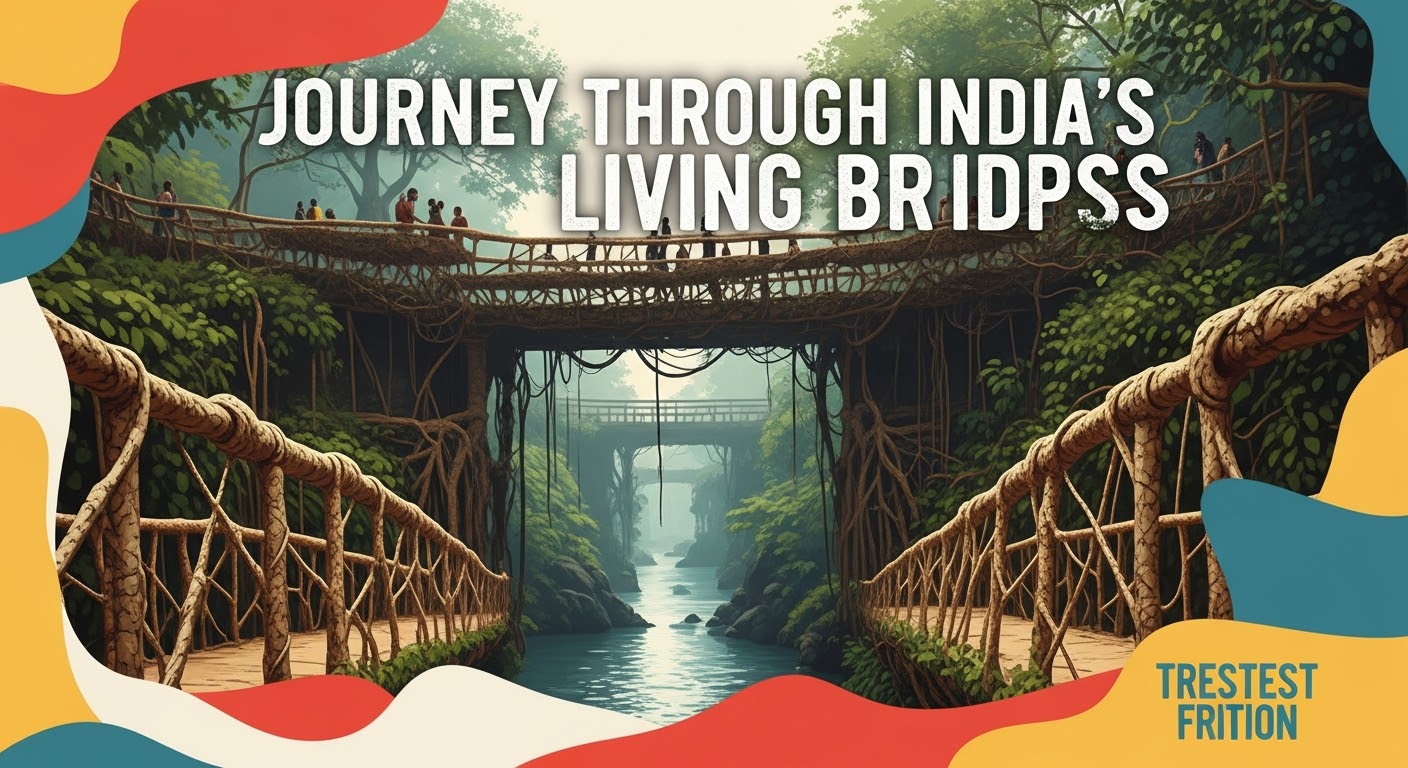
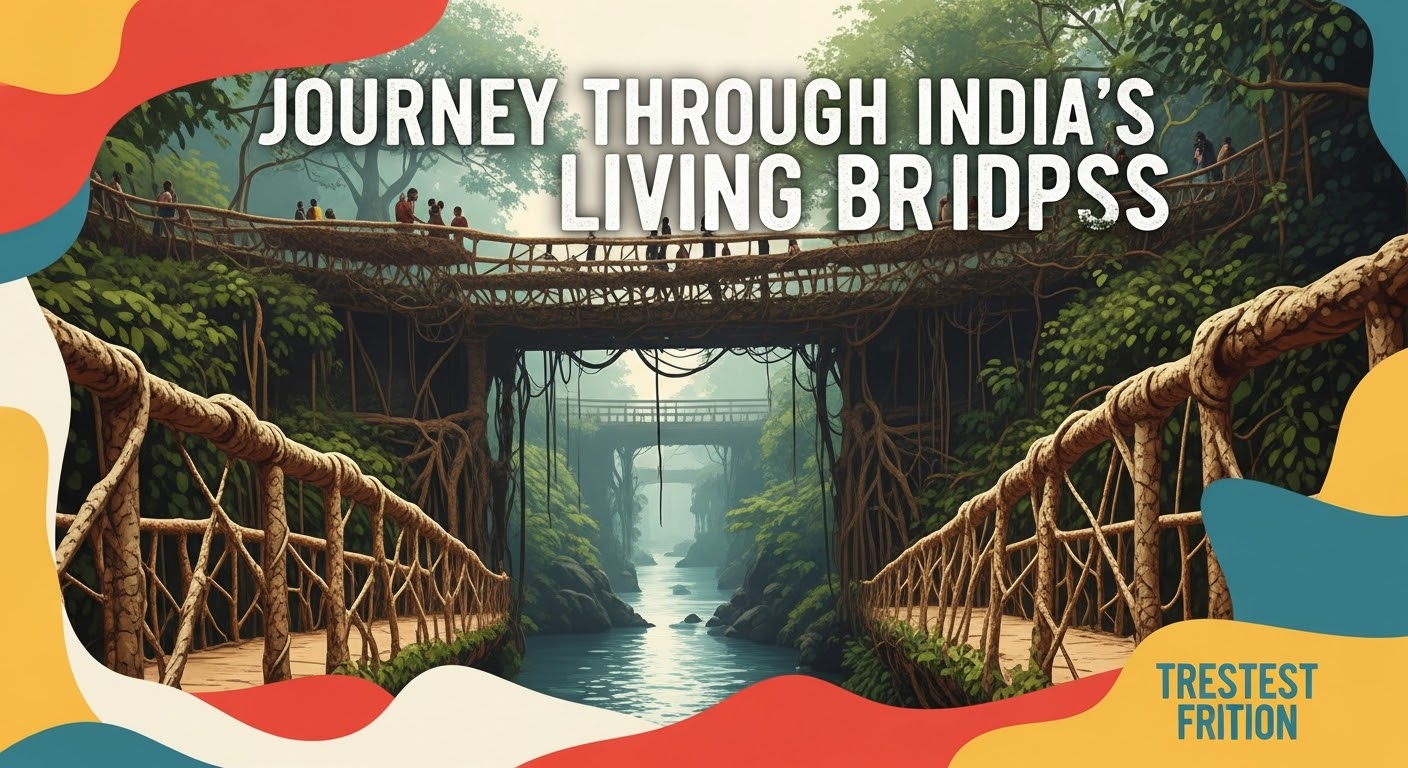
A fascinating journey is undertaken to discover the mesmerizing Living Root Bridges of Meghalaya. The unique blend of nature and human ingenuity is explored, showcasing a remarkable architectural wonder.
Intrigue and Mystery
Imagine bridges not built by machines or concrete, but grown by nature itself, guided by human hands. Tucked away in the misty hills of Meghalaya, India, lie engineering marvels unlike anything you've ever seen. Join us on an incredible journey to uncover the secrets of India's living root bridges – structures that literally breathe and grow.
A fascinating journey is undertaken to discover the mesmerizing Living Root Bridges of Meghalaya. The unique blend of nature and human ingenuity is explored, showcasing a remarkable architectural wonder.
Stunning aerial shots reveal a vast, lush carpet of green, hinting at the hidden wonders below. The journey begins high above the clouds...
Welcome to Meghalaya, India, a unique rainforest region known as the "Abode of the Clouds." This land is a crucible of incredible biodiversity and holds a profound secret: ancient structures that are not built, but grown.
We announce our quest to find and understand the legendary Living Root Bridges (Jingkieng Nongriat). This adventure demands physical endurance and a willingness to explore the remote and challenging trails of the Khasi Hills, emphasizing the deep immersion required to witness this bio-architectural marvel.
The iconic *Jingkieng Nongriat* (Double Decker Root Bridge), a wonder of natural architecture.
Finally, the veil lifts. Before us stands the Living Root Bridge—a pathway formed not of planks and steel, but of tightly woven, living Ficus elastica roots. The structure showcases an organic beauty and intricate engineering that surpasses conventional architecture. Unlike static bridges, this structure is dynamic, adapting to the monsoon floods and the changing landscape.
This marvel is a testament to the Khasi ingenuity. For centuries, the indigenous people of Meghalaya have been cultivating these bridges, patiently guiding the young, pliable aerial roots across streams using hollowed-out betel nut trunks as root conduits. This deliberate, long-term process transforms a simple botanical feature into vital infrastructure.
This construction method is a Living Legacy, requiring generational knowledge and immense patience. It is a collaborative relationship: the rubber tree provides the raw material, and the Khasi provide the vision and the guiding hand. This deep understanding of their ecosystem ensures the bridges not only endure but grow stronger with every passing decade.
The state of Meghalaya, known for its extreme rainfall, created a challenge for its indigenous communities: how to cross the countless swollen rivers and streams that dissect the landscape, particularly during the ferocious monsoon season? The answer was found not in external materials, but in the environment itself.
The bridges, locally known as *Jingkieng Diengjri*, are entirely organic structures woven from the aerial roots of the Ficus elastica, or the Indian Rubber Tree. These robust trees thrive in the moist, subtropical climate. The local people, primarily from the Khasi and Jaintia tribes, guide the pliable secondary roots across gaps using hollowed-out areca nut trunks or bamboo scaffolding.
This process is an exercise in patience. Once the roots reach the opposite bank, they are allowed to take root in the soil. Over the next 15 to 25 years, the roots intertwine and thicken, eventually forming a stable, highly load-bearing structure. Unlike steel bridges, these grow stronger and more resilient over time.
The art of root bridge construction is a cultural treasure passed down through generations within the Khasi and Jaintia communities. Their traditional knowledge of the ecosystem, especially the characteristics of the *Ficus elastica*, is what makes this marvel possible.
Their philosophy highlights a crucial lesson in sustainability: rather than fighting nature, they worked *with* it. This practice is a profound example of bioengineering and showcases the sustainable lifestyle and deep respect for the environment held by these tribes.
While hundreds of smaller root bridges exist across Meghalaya, a few stand out for their size, complexity, and historical significance. Trekking to these spots is an adventure in itself, often involving steep descents and deep valleys.
For travelers seeking an easier glimpse into this phenomenon, the root bridge near Riwai village is the most accessible. It requires only a short walk from Mawlynnong, famously known as "Asia's Cleanest Village." This bridge offers a perfect introduction to the architectural style without the exhaustive trek.
The crown jewel of the root bridges is the Jingkieng Nongriat, or the Double Decker Root Bridge. Located near Cherrapunji (Sohra), this astonishing structure features two root bridges stacked vertically on top of one another.
The journey to reach the Double Decker bridge is arduous, involving descending thousands of steps into the valley. The reward, however, is immersion in a primal landscape where the bridge stands as a stunning testament to cooperation between man and nature.

The roots of the *Ficus elastica* intertwining over decades to form an unshakeable pathway.
The inherent advantage of using the *Ficus elastica* roots is their incredible tensile strength and biological self-repair. While a conventional steel bridge might last 70-100 years and require maintenance, a Living Root Bridge has an average lifespan of over 500 years and is naturally renewed as new roots grow and merge into the structure. This makes it an ideal, zero-waste infrastructure solution for a high-precipitation environment.
A quick summary of the key facts about these natural wonders:
| Feature | Detail |
|---|---|
| Local Name | Jingkieng Diengjri |
| Plant Species | Ficus elastica (Indian Rubber Tree) |
| Time to Maturity | 15 to 25 years |
| Estimated Lifespan | 500+ years, continuously growing |
| Primary Tribes | Khasi and Jaintia |
| Location | Cherrapunji (Sohra) and Mawlynnong regions, Meghalaya, India |
A suggested plan for experiencing the main root bridges and surrounding beauty:
| Day | Focus & Activity | Highlights |
|---|---|---|
| Day 1 | Arrival & Mawlynnong | Arrive in Shillong/Guwahati. Drive to Mawlynnong. Explore Asia's Cleanest Village. |
| Day 2 | The Accessible Bridge | Trek to the Riwai Root Bridge. Drive to Cherrapunji (Sohra). Sunset viewpoints. |
| Day 3 | The Ultimate Trek | Early morning descent to Nongriat. Spend 2-3 hours at the Double Decker Root Bridge. Visit the nearby natural swimming pools. |
| Day 4 | Caves & Departure | Visit Mawsmai Caves or Seven Sisters Falls (seasonal). Return drive to Shillong/Guwahati. |
Yes, absolutely. Once fully mature, these bridges are incredibly strong and can often hold up to 50 people at a time. They are built to withstand the heavy monsoon rains and are far more reliable than wooden bridges in this climate. Always be cautious of slippery surfaces, especially during or immediately after rain.
The trek to the Double Decker Root Bridge in Nongriat is challenging. The descent from Tyrna village takes about 1.5 to 2 hours, involving around 3,500 steep steps. The ascent back up takes longer, typically 2.5 to 3 hours, depending on your fitness level. Plan for a minimum of 5-6 hours for the entire round trip.
While the Riwai bridge is well-marked and easily navigable, hiring a local guide for the trek to Nongriat (Double Decker) is highly recommended. Guides are relatively inexpensive and provide invaluable local knowledge, ensuring your safety and helping you navigate the complex trails and river crossings.
Ready to witness this breathtaking blend of culture and nature? Start planning your journey today and step onto architecture that lives and breathes.
Plan My Meghalaya Adventure