Museums in Tanzania: Exploring Culture, History & Art
Revelation
February 28, 2026
Posted By : Admin
Museums in Tanzania: Exploring Culture, History & Art
Discover Tanzania’s best museums, from the National Museum in Dar es Salaam to the Village Museum and Arusha Declaration Museum. Explore Olduvai Gorge Museum, where human origins were uncovered, and the Nyerere Museum in Butiama. With cultural heritage, archaeological treasures, and historical collections, these museums showcase Tanzania’s vibrant traditions and rich past, making them must-visit attractions for travelers.
Museums in Tanzania 2026 — National Museum Dar es Salaam, Zanzibar, Arusha and MoreTourPackages.Asia
Museums & Cultural Heritage Guide · 22 Museums
Museums in Tanzania — National Museum, Zanzibar, Arusha & Beyond
From the National Museum of Tanzania's two-million-year hominid fossil record and Stone Town's Palace Museum of Omani Sultans, to the Olduvai Gorge Museum, the Arusha Declaration Museum, and the remarkable colonial and Swahili heritage institutions scattered across the country — Tanzania's museums tell one of the world's most extraordinary stories.
Tanzania's Museums — Guardians of a Civilisation Crossroads
Tanzania's museums collectively document one of the most extraordinary ranges of human experience anywhere on earth — from the earliest physical evidence of the human lineage at Olduvai Gorge, through the rise of one of the medieval world's great maritime civilisations along the Swahili coast, the Omani Arab Sultanate of Zanzibar, the East African slave trade and its abolition, German and British colonialism, and Julius Nyerere's post-independence African socialist experiment. No other country in Africa, and few in the world, can claim a museum landscape of such depth and geographical spread within a single national territory.
The National Museum of Tanzania in Dar es Salaam is the country's flagship institution — home to original fossils from Olduvai Gorge including specimens of Australopithecus boisei and Homo habilis that reshaped the scientific understanding of human evolution when they were discovered by Louis and Mary Leakey in the 1950s and 1960s. In Zanzibar, the Palace Museum (Beit el Sahel) and the House of Wonders (Beit el Ajaib) together preserve the material culture of the Sultanate era — carved furniture, royal regalia, Swahili maritime artefacts, and the story of the 19th-century Indian Ocean trade network. The Arusha Declaration Museum documents the political philosophy that shaped independent Tanzania. Across the country, smaller regional museums, site museums, and heritage centres add interpretive depth to historical landscapes from Bagamoyo to Mikindani.
This guide covers 22 of Tanzania's most significant museums, structured to help visitors integrate museum visits into safari and beach itineraries at logical transition points. For the broader historical context these museums illuminate, see our Tanzania historical places guide. Browse Tanzania Tour Packages or plan a bespoke heritage itinerary with our team.
Tanzania's Museum Landscape — Five Institution Types
Tanzania's museums fall into five distinct types by focus and institution, each serving a different visitor need and logistical integration point on a Tanzania itinerary.
01
National & Regional Museums
Flagship · Broad Collections · Urban Centres
National Museum — Dar es Salaam
Village Museum — Dar es Salaam
Arusha Natural History Museum
Kagera Region Museum — Bukoba
Iringa Boma Museum
Tanzania's state-funded national and regional museum network provides the broadest coverage of natural history, palaeontology, ethnography, and colonial history. The National Museum in Dar es Salaam is the essential starting point — it contextualises everything else encountered on a Tanzania itinerary. Best integrated into arrival and departure day schedules.
02
Zanzibar Heritage Museums
Stone Town UNESCO · Sultanate · Slave Trade
Palace Museum (Beit el Sahel)
House of Wonders Museum
Zanzibar Slave Market Museum
Pemba Museum — Chake Chake
Old Arab Fort — cultural spaces
The Zanzibar museum cluster within Stone Town's UNESCO World Heritage zone provides the most concentrated heritage museum experience in Tanzania — the Palace Museum, Slave Market, and Old Arab Fort can all be covered in a single day's walking tour of the heritage quarter. Essential context for understanding Zanzibar's Indian Ocean history.
03
Palaeontology & Archaeology Site Museums
Human Origins · Fossils · Prehistoric Sites
Olduvai Gorge Museum — Ngorongoro
Kondoa Rock Art Interpretive Centre
Kilwa Masoko Site Museum
Ngorongoro Crater Education Centre
Kaole Site Museum — Bagamoyo
Tanzania's site museums are among the most intellectually rewarding museum experiences in Africa — directly interpreting sites of global significance including the world's oldest hominid fossils, prehistoric rock art spanning 50,000 years, and Africa's greatest medieval Islamic city. The Olduvai Gorge Museum alone justifies a Northern Circuit stopover.
04
Historical & Colonial Heritage Museums
Slave Trade · Exploration · German-British Colonial Era
Bagamoyo Historical Museum
Livingstone Museum — Ujiji
Tabora Museum — Livingstone's Tembe
Mikindani Old Boma Museum
Moshi German Heritage Museum
Tanzania's historical museums document the 19th-century encounter between East Africa and the wider world — the slave trade routes, the Arab commercial empire, the European explorers (Livingstone, Stanley, Burton, Speke), German colonial rule, and the missionary enterprise. These specialist institutions reward the curious traveller who ventures beyond the standard northern safari circuit.
05
Political & Independence Museums
Nyerere · Ujamaa · Independence Movement
Arusha Declaration Museum
Julius Nyerere Museum — Dar es Salaam
Makumbusho ya Taifa — Dodoma
Freedom Monument — Dar es Salaam
Tanzania's independence and political heritage institutions document the country's path from colonial Tanganyika to independent Tanzania — Julius Nyerere's African Socialist vision, the Arusha Declaration of 1967, and Tanzania's influential role in supporting southern African liberation movements. These museums are less visited by international tourists but deeply important for understanding contemporary Tanzania.
Dar es Salaam — Tanzania's National Museum Hub
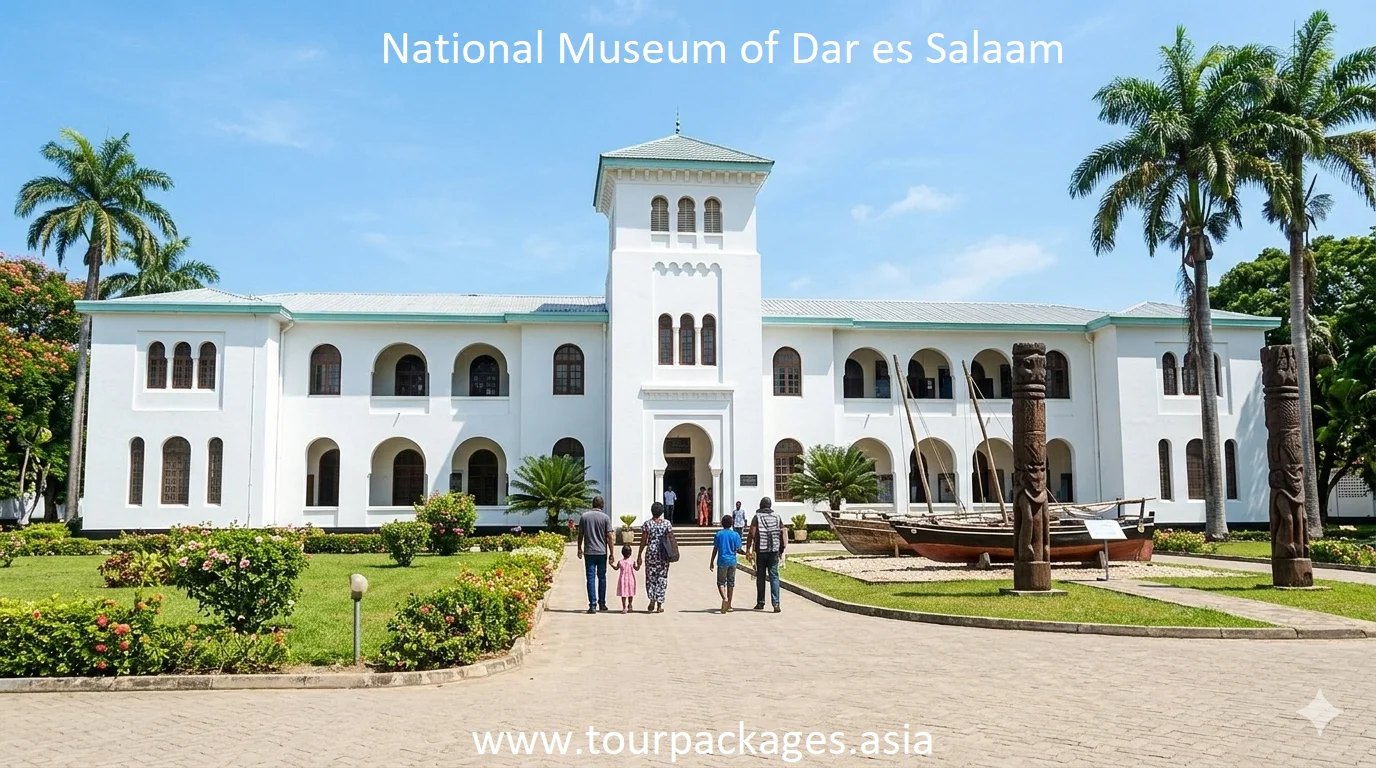
National Museum of Tanzania
Dar es Salaam · Est. 1881 · Fossils & Ethnography
01 · National Flagship
National Museum · Palaeontology · Ethnography · Colonial History · Dar es Salaam
1 National Museum of Tanzania — Fossils, Ethnography and Independence
The National Museum of Tanzania on Shaaban Robert Street in Dar es Salaam is the country's most comprehensive museum institution — the essential first stop for any visitor wishing to understand the extraordinary depth and breadth of Tanzania's natural and cultural history before travelling into the interior. Founded in 1881 as a natural history and curiosity collection under German colonial administration, the museum has grown into a multi-gallery institution covering palaeontology, natural history, ethnography, colonial history, the independence movement, and decorative arts.
The museum's most internationally significant collection is its palaeontology gallery — displaying original and replica fossil specimens from Olduvai Gorge including a cast of the Australopithecus boisei skull (OH 5, 'Nutcracker Man'), Homo habilis specimens, and Oldowan stone tools dating to 1.75 million years. Also notable are fossil specimens from the Tendaguru dinosaur excavation site in southeastern Tanzania — the German colonial-era excavations of 1909–1913 produced some of the largest dinosaur bones ever found in Africa. The ethnography galleries document the material cultures of over 120 Tanzanian ethnic groups — traditional clothing, agricultural tools, musical instruments, ceremonial objects, and architectural models covering the full cultural diversity of the country. The colonial and independence gallery documents German East Africa, British Tanganyika, and the Julius Nyerere-led independence movement. The museum grounds incorporate a botanical garden section pleasant for a walk before or after the indoor galleries. Allow a minimum of 2–3 hours for the main galleries. For the broader palaeontological context, combine with a visit to the Olduvai Gorge Museum on the Northern Circuit.
Location: Shaaban Robert Street, Upanga, Dar es SalaamFounded: 1881 — German colonial natural history collectionKey galleries: Palaeontology · ethnography · colonial historyFossils: Olduvai hominids · Tendaguru dinosaur specimensAllow: 2–3 hours for main galleries
Open-Air Museum · Traditional Architecture · Cultural Performances · Dar es Salaam
2 Village Museum — Tanzania's Living Open-Air Cultural Museum
The Village Museum (Makumbusho ya Taifa) on New Bagamoyo Road in northern Dar es Salaam is an open-air living museum of traditional Tanzanian architecture and material culture — a concept institution where full-scale, authentically constructed traditional houses from more than 22 of Tanzania's diverse ethnic groups are displayed in a landscaped garden setting, each furnished and equipped as they would be in daily use. The museum provides one of the most accessible, engaging, and visually memorable introductions to Tanzania's extraordinary cultural diversity — the country is home to over 120 distinct ethnic groups with their own languages, material traditions, and architectural forms.
The collection ranges from the cylindrical thatched huts of the Maasai and Sukuma, to the rectangular mud-brick houses of the interior Bantu groups, the coastal Swahili coral-stone construction style, beehive-shaped grass houses of the Hehe, and the distinctive raised granary structures of the Chaga on Kilimanjaro's slopes. Each structure is labeled and interpreted with information boards in English and Swahili. Cultural performances of traditional music, song, and dance — featuring drums, taarab, beni, and regional performance traditions — are presented at the museum's open amphitheatre on weekend afternoons and can be arranged for groups on weekdays. A craft market within the museum grounds sells authentic Tanzanian crafts at reasonable prices. The Village Museum is approximately 10km from central Dar es Salaam on the road toward Bagamoyo — most easily reached by taxi or private vehicle. Allow 2–3 hours, more if a performance coincides with your visit. Pair with the National Museum for a comprehensive Dar es Salaam museum day. See our Tanzania culture guide for broader cultural context.
Location: New Bagamoyo Road, northern Dar es Salaam — 10km from centreFormat: Open-air living museum — 22+ full-scale traditional housesCultures: Maasai · Sukuma · Chaga · Hehe · Swahili and morePerformances: Traditional music and dance — weekends and by arrangementAllow: 2–3 hours · longer with cultural performance
Village Museum
Open-Air · 22+ Ethnic Traditions
02 · Open-Air Living Museum
Zanzibar — Stone Town UNESCO Heritage Museum Quarter
Palace Museum — Beit el Sahel
Zanzibar · Omani Sultanate · Royal Residence
03 · Sultans' Residence
Palace Museum · Omani Sultanate · Stone Town · 19th Century Court Life
3 Palace Museum (Beit el Sahel) — Inside the Zanzibar Sultanate
The Palace Museum (Beit el Sahel, meaning "House of the Coast") in Stone Town occupies the former principal residence of the Sultans of Zanzibar — a large white seafront building on the waterfront immediately adjacent to the Old Arab Fort, whose elegant simplicity belies the extraordinary richness of the collection inside. The museum provides the most intimate and interpretively developed picture of 19th-century Omani Arab court life in Zanzibar — a world of extraordinary cosmopolitan sophistication at the crossroads of Africa, Arabia, India, and Europe.
Displays include the original furniture, personal possessions, and household objects of the Sultans and their families — ceremonial thrones, carved wooden beds with mother-of-pearl inlay, imported European china and glassware, ceremonial weapons, portrait photographs of successive sultans, maps, official documents, and an extraordinary collection of personal correspondence that reveals the complex diplomatic relationships between Zanzibar and the major world powers of the 19th century. The story of Princess Salme (Emily Ruete) is told in detail — the Zanzibar princess who converted to Christianity, eloped to Hamburg with a German merchant Heinrich Ruete in 1866, and later wrote the first memoir by an Arab woman ever published in European translation: a remarkable personal narrative that illuminates 19th-century Zanzibar court life from the inside. The museum covers the full arc of Zanzibar Sultanate history from the Omani Arab arrival in the early 18th century, through the palace period of Said bin Sultan (who moved his court from Muscat to Zanzibar in 1840), to the 1964 Zanzibar Revolution that ended the Sultanate. Allow 1–1.5 hours. Combine with the adjacent Old Arab Fort and the Slave Market Museum for a complete Stone Town heritage half-day. Our Tanzania historical places guide covers the full Stone Town context.
Location: Waterfront, Stone Town — adjacent to Old Arab FortCollections: Original furniture · royal regalia · personal correspondenceStory: Princess Salme — first Arab woman's memoir in European translationPeriod: 18th century Omani arrival to 1964 RevolutionAllow: 1–1.5 hours · combine with Slave Market Museum
Swahili Maritime Heritage · Indian Ocean Trade · Stone Town · Restoration
4 House of Wonders Museum (Beit el Ajaib) — Swahili Maritime Heritage
The House of Wonders (Beit el Ajaib, meaning "House of Marvels") is the largest and most visually striking building in Stone Town — a massive four-storey structure on the Forodhani waterfront with a triple-tiered colonnade of ornate cast-iron balconies that dominates Zanzibar's seafront skyline. Built in 1883 by Sultan Barghash bin Said as a ceremonial palace and administrative building, it earned its name by being the first building in East Africa to have electric lighting and a mechanical lift (elevator) — extraordinary technological novelties that left visitors awestruck.
The House of Wonders housed the most significant collection of Swahili maritime artefacts and Indian Ocean trade objects in the region — traditional carved wooden dhows (including a large historic dhow displayed in the ground-floor hall), navigation instruments, trading weights and measures, ceramics and glass beads from the Indian Ocean trade network, and interpretive displays on the Swahili civilisation's connections to Arabia, Persia, India, and China. In 2020 part of the historic balconied facade collapsed, causing significant structural damage, and the building has been undergoing a major restoration project supported by the Tanzanian government and international heritage organisations including the Aga Khan Trust for Culture. As of 2026 the restoration continues — visitors should check current opening status before visiting, as partial gallery access may be available. The exterior remains one of Stone Town's most photographed views. The restoration, when complete, will return one of Tanzania's finest museums to full operation. See our historical places guide for the full Stone Town heritage context.
Location: Forodhani waterfront, Stone Town — most prominent seafront buildingBuilt: 1883 — Sultan Barghash bin SaidCollections: Swahili maritime · dhows · Indian Ocean trade artefactsStatus 2026: Major restoration underway — check opening status before visitingExterior: Triple-storey cast-iron balconies — most photographed Stone Town view
House of Wonders
Beit el Ajaib · 1883 · Under Restoration
04 · Maritime Heritage
Zanzibar Slave Market Museum
Abolished 1873 · Anglican Cathedral Site
05 · Abolition Memorial
Slave Trade History · Abolition · Anglican Cathedral · Stone Town
5 Zanzibar Slave Market Museum — Memory, Abolition and Justice
The Zanzibar Slave Market site — now occupied by the Anglican Christ Church Cathedral, built in 1879 by the Universities' Mission to Central Africa — is the most historically significant single site in Stone Town and one of the most important slavery memorial sites in the world. At its peak in the 1860s, the market processed an estimated 50,000 enslaved people per year, transported by dhow from the mainland coast and sold to buyers across the Indian Ocean world. The cathedral was built deliberately on the site of the market as a statement of the victory of abolition — the altar positioned at the exact location where enslaved people were flogged before sale.
The museum occupies the area around the cathedral and includes the most historically affecting exhibit in Tanzania: the original underground slave holding cells — narrow subterranean chambers where adult humans were confined in complete darkness, chained together in conditions of extreme deprivation before sale. The cells are partially preserved and accessible to visitors, their low ceilings and constricted space communicating the horror of the trade in a way no written or photographic account can match. A memorial sculpture outside the cathedral — created by Swedish sculptor Clara Sornas in 1998 — shows five chained figures of men, women, and children emerging from the ground at the original market site, partially buried in the soil that witnessed their suffering. A small museum room adjacent to the cathedral provides historical context, photographs, trade route maps, and documentation of the abolitionist campaign led by David Livingstone's published accounts. Allow 1–1.5 hours for the full site including the cells, cathedral, and museum. Combine with the Palace Museum for a morning in Stone Town's heritage zone. See also our Tanzania culture guide for the broader Swahili coast context.
Location: Christ Church Cathedral, Stone Town — central heritage zonePeak trade: 50,000 enslaved per year — 1860sAbolition: 1873 — British pressure, Livingstone's advocacyCells: Original underground holding chambers — open to visitorsSculpture: Clara Sornas memorial (1998) — five chained figures
Northern Tanzania — Arusha, Ngorongoro & Kilimanjaro Region
Palaeoanthropology · Human Origins · Ngorongoro Conservation Area · UNESCO
6 Olduvai Gorge Museum — The Story of Human Origins
The Olduvai Gorge Museum at the rim of Olduvai (Oldupai) Gorge in the Ngorongoro Conservation Area is the site museum for one of the world's most important palaeontological and archaeological sites — a ravine whose sedimentary walls contain a nearly continuous two-million-year record of human evolutionary activity, the longest at any single location on earth. The museum provides the essential interpretive context that transforms a visit to the gorge viewpoint from a geological curiosity into an encounter with the foundations of human history.
Displays include replica fossil hominids discovered at Olduvai — casts of the Australopithecus boisei skull (OH 5, 'Nutcracker Man', discovered by Mary Leakey in 1959), Homo habilis specimens (the oldest known tool-using human ancestor, described from Olduvai in 1964), and Homo erectus remains — alongside original Oldowan stone tools dating to 1.75 million years, fossil animal bones from species long extinct, and geological cross-section diagrams explaining the stratigraphic sequence that makes the gorge's chronological record possible. An outstanding replica of the Laetoli footprint trail — the 3.6-million-year-old Australopithecus afarensis prints discovered 45km south — conveys the significance of that extraordinary discovery in a tangible, accessible way. A gorge rim viewpoint overlooks the ravine itself, and guided walks to the main excavation sites are available for groups who pre-arrange the visit. The Olduvai Gorge Museum sits directly on the road between Ngorongoro Crater and the Serengeti — adding only 1.5–2 hours to a standard transit. It is one of the most intellectually rewarding museum experiences available anywhere in East Africa. See also our Tanzania wildlife guide for the Ngorongoro and Serengeti context.
Location: Ngorongoro Conservation Area — Ngorongoro to Serengeti roadFossils: Australopithecus boisei · Homo habilis · Oldowan tools 1.75M yrsLaetoli replica: 3.6M year old footprint trail — outstanding exhibitViewpoint: Gorge rim overlook · guided walks availableAllow: 1.5–2 hours — add to Ngorongoro–Serengeti transit
Olduvai Gorge Museum
2 Million Years · Human Origins
06 · Human Origins
Arusha Declaration Museum
1967 · Julius Nyerere · African Socialism
07 · Independence History
Political History · Julius Nyerere · Ujamaa · Arusha City
7 Arusha Declaration Museum — Nyerere, Ujamaa and Tanzania's Independence
The Arusha Declaration Museum on Makongoro Road in central Arusha documents the history of Tanzania's independence struggle and the political philosophy that shaped the nation under its founding president Julius Kambarage Nyerere. The museum's centrepiece is the Arusha Declaration of 1967 — one of the most significant political documents in post-colonial African history, in which Nyerere formally committed Tanzania to African Socialism (Ujamaa), self-reliance, and the nationalisation of major industries including banks, factories, and sisal estates.
The museum displays include original documents from the independence period, photographs from the TANU (Tanganyika African National Union) liberation movement, personal objects and papers of Nyerere, maps of colonial Africa and the specific injustices of the colonial carve-up that Tanzania's independence challenged, and documentation of Tanzania's influential role as a base and supporter for southern African liberation movements including the ANC, SWAPO, FRELIMO, and ZANU. The Declaration itself articulated four conditions for African development — land, people, good policies, and hard work — rejecting both capitalist exploitation and foreign dependency in language that became widely influential across post-colonial Africa. The museum also addresses the International Criminal Tribunal for Rwanda (ICTR), which held its proceedings in Arusha from 1994 to 2015 — an important dimension of the city's contemporary international legal significance. The adjacent Arusha Declaration Monument — a large concrete memorial with Swahili inscriptions — stands in the memorial garden. Allow 1–1.5 hours. Combine with the Arusha Natural History Museum for a complete Arusha cultural half-day. See our historical places guide for broader context.
Location: Makongoro Road, central Arusha cityFocus: Arusha Declaration 1967 · Nyerere · Ujamaa socialismAlso: TANU liberation movement · ICTR proceedings 1994–2015Monument: Arusha Declaration Monument in memorial gardenAllow: 1–1.5 hours · combine with Natural History Museum
Natural History · Geology · Palaeontology · Arusha · German Boma Building
8 Arusha Natural History Museum — Geology, Fossils and East African Wildlife
The Arusha Natural History Museum occupies the handsome old German Boma building on Boma Road in central Arusha — a well-preserved colonial-era administrative fortress whose thick stone walls and courtyard configuration represent a good example of German colonial institutional architecture in East Africa. The building itself is a historical attraction; the museum within it covers East African geology, palaeontology, and natural history with a focus on the northern Tanzania region that surrounds Arusha.
Displays include geological exhibits on East African Rift Valley formation — the continental rifting process that created the dramatic landscape of the Northern Circuit, the volcanic origin of Kilimanjaro and Ngorongoro, and the ancient lake systems in which the Olduvai Gorge fossil record was preserved. Palaeontology displays feature fossil specimens from the northern Tanzania region, including examples of the Pleistocene megafauna that once lived in the area around what is now the Ngorongoro Conservation Area. Natural history exhibits cover the flora and fauna of the northern Tanzania ecosystem, with particular focus on the mammals, birds, and reptiles that visitors will encounter on safari — a useful pre-safari orientation for first-time visitors to East Africa. The museum is small — allow 45–60 minutes — and is most practically combined with the nearby Arusha Declaration Museum and the Cultural Heritage Centre on the Nairobi Road for a complete Arusha cultural day before or after a Northern Circuit safari. See our Tanzania wildlife guide for the natural history these exhibits contextualise.
Location: Boma Road, central Arusha — German Boma buildingFocus: Geology · East African Rift · palaeontology · natural historyBuilding: Well-preserved German colonial administrative fortAllow: 45–60 minutes · combine with Arusha Declaration MuseumPre-safari: Excellent natural history orientation before Northern Circuit
Arusha Natural History Museum
German Boma Building · Geology & Fossils
08 · Natural History
Western Tanzania & the Interior — Explorers, Kingdoms and Colonial Heritage
Livingstone Museum — Ujiji
1871 · Stanley Meets Livingstone · Lake Tanganyika
09 · Exploration History
Exploration History · Slave Trade · Lake Tanganyika · Kigoma Region
9 Livingstone Museum — "Dr Livingstone, I Presume"
The Livingstone Museum at Ujiji on the eastern shore of Lake Tanganyika marks the site of the most famous meeting in the history of African exploration — the encounter on 10 November 1871 between the missing explorer-missionary Dr David Livingstone and journalist Henry Morton Stanley, who had been sent by the New York Herald newspaper to find him. The meeting is immortalised by Stanley's legendary greeting: "Dr Livingstone, I presume." Livingstone had been stranded at Ujiji for months, desperately ill and running short of supplies, when Stanley arrived from the east with provisions and medicines that enabled Livingstone to continue his work for another two years before his death in Zambia in 1873.
The museum documents the historical significance of this meeting and of Ujiji itself — which had been one of the most important Arab slave and ivory trading stations in the East African interior before the explorers' arrival, a hub for the trade routes from Lake Tanganyika westward into the Congo Basin. Displays include historical photographs, maps of Livingstone's and Stanley's expedition routes through the African interior, replicas of equipment used on the journeys, documentation of Ujiji's role in the East African slave trade that Livingstone spent his later years documenting and campaigning against, and interpretive material on the broader consequences of European exploration for Africa. A concrete monument and mango tree mark the exact meeting site in the museum garden — a replacement for the original tree under which the famous exchange took place. Ujiji is 5km from Kigoma town and is most naturally combined with a western Tanzania primate circuit including Gombe Stream National Park chimpanzee tracking by boat from Kigoma. See our Tanzania wildlife guide for the Gombe-Mahale primate circuit.
Location: Ujiji, 5km from Kigoma — Lake Tanganyika eastern shoreFamous for: Stanley-Livingstone meeting — 10 November 1871Displays: Expedition maps · slave trade routes · exploration equipment replicasMonument: Meeting site marker and replacement mango treeCombine: Gombe Stream chimpanzee tracking — boat from Kigoma
10 Bagamoyo Historical Museum — The Slave Coast's Witness
The Bagamoyo Historical Museum is housed within the grounds of the former Catholic Mission in Bagamoyo town, 75km north of Dar es Salaam — the first Christian mission on the mainland Tanzania coast, established by French Holy Ghost Fathers in 1868. The mission building itself is historically significant: it is the place where David Livingstone's body was held in 1873 after his death in Zambia — kept here before transport by dhow to Zanzibar and then by ship to London for burial in Westminster Abbey. The museum occupies part of the original mission complex whose colonial-era buildings, including the chapel and residence block, have been carefully preserved.
The museum documents Bagamoyo's extraordinary historical depth with particular focus on the 19th-century slave and ivory caravan trade — Bagamoyo was the principal coastal terminus of the interior caravan routes, the point where enslaved people who had marched for weeks or months from central Africa first saw the Indian Ocean. Displays include historical photographs, colonial-era maps, objects from the mission period, documentation of the trade routes and their human cost, records of the mission's role in providing sanctuary for freed slaves, and the story of the early Christian missionary enterprise in mainland Tanzania. The Bagamoyo museum is best visited as part of a full Bagamoyo day that also covers the Old Town heritage walk, the Kaole Ruins 4km south (12th–15th century Shirazi mosque and graveyard), and the traditional dhow-building yard on the beach. Bagamoyo is accessible as a day trip from Dar es Salaam or an overnight stop en route to Saadani National Park. See our Tanzania historical places guide for the full Bagamoyo context.
Location: Catholic Mission grounds, Bagamoyo — 75km north of DarBuilding: 1868 mission — Livingstone's body held here 1873Focus: Slave trade routes · caravan history · mission recordsCombine: Bagamoyo Old Town walk + Kaole Ruins + dhow yardAccess: Day trip from Dar es Salaam or overnight stay
Bagamoyo Historical Museum
1868 Mission · Livingstone · Caravan Coast
10 · Caravan Coast Heritage
Mweka Wildlife College Museum
Near Moshi · Kilimanjaro · Wildlife Conservation
11 · Wildlife Conservation
Wildlife Management · Conservation Education · Moshi · Kilimanjaro Region
11 Mweka College of African Wildlife Management Museum
The Mweka College of African Wildlife Management near Moshi on the southern slopes of Kilimanjaro is East Africa's most prestigious institution for training wildlife management professionals — established in 1963 and responsible for educating the rangers, conservation scientists, and park managers who have overseen Tanzania's extraordinary wildlife estate for over six decades. The college's wildlife museum, accessible to visitors by prior arrangement, houses one of Tanzania's most comprehensive collections of taxidermied wildlife specimens and conservation education displays.
The museum collection includes mounted specimens of East African mammals — covering the full range from large megafauna (elephant, buffalo, lion, leopard, rhino) through ungulates, primates, carnivores, and small mammals — together with bird specimens, reptiles, and invertebrates that document the biodiversity of Tanzania's ecosystem zones from coastal mangrove to alpine moorland. Conservation education displays cover wildlife management principles, anti-poaching approaches, human-wildlife conflict resolution, and the history of Tanzania's national park system from the colonial-era game reserves to the present TANAPA network. The college is located approximately 5km from Moshi town on the road toward Marangu — easily visited as a half-day excursion before or after a Kilimanjaro trek or Northern Circuit safari. The campus itself, set on the fertile slopes of Kilimanjaro with views of the mountain's forested lower flanks, is a pleasant environment quite apart from the museum content. Combine with the Chaga cultural heritage of the Moshi area and explore the connection to Tanzania's wildlife in our Tanzania wildlife experience guide and outdoor attractions guide.
Location: 5km from Moshi — southern slopes of KilimanjaroFounded: 1963 — East Africa's premier wildlife management collegeMuseum: Full East African mammal · bird · reptile taxidermy collectionAccess: By prior arrangement with the collegeCombine: Kilimanjaro trek · Moshi heritage · Northern Circuit
Plan Your Tanzania Museum and Heritage Tour
From the National Museum's two-million-year fossil record in Dar es Salaam and Zanzibar's Palace Museum of Omani Sultans, to Olduvai Gorge, the Arusha Declaration, and the remarkable Livingstone Museum at Ujiji — our team designs bespoke Tanzania heritage itineraries combined with safari, with full visa support for Indian travellers.
Kagera Region Museum
Bukoba · Karagwe Kingdom · Lake Victoria
12 · Great Lakes Kingdom
Regional Museum · Karagwe Kingdom · Iron Age · Kagera Region · Bukoba
12 Kagera Region Museum — Great Lakes Kingdoms and Iron Age Heritage
The Kagera Region Museum in Bukoba city on the western shore of Lake Victoria documents the history and material culture of the Kagera Region — one of Tanzania's most historically distinct areas, home to the Karagwe Kingdom, one of the most powerful pre-colonial states in the East African Great Lakes region. The Karagwe Kingdom, which flourished from approximately the 15th to 19th centuries, was a sophisticated Bantu iron-producing state whose rulers maintained complex diplomatic and trade relationships with the Swahili coast and received European explorers including Speke and Grant in 1861 during their search for the source of the Nile.
The museum displays include traditional regalia, ceremonial objects, and tools associated with the Karagwe royal court; iron-working equipment and slag specimens from the smelting sites that provided the technological foundation of Karagwe's power; agricultural implements associated with the region's banana and sorghum cultivation traditions; and documentation of the royal burial sites and earthwork enclosures (Bwogero) that are the principal archaeological remains of the kingdom. Ethnographic collections cover the broader Haya and Zinza communities of the Kagera region — their distinctive milk-processing traditions, elaborate drum and xylophone musical heritage, and the remarkable bark-cloth production technology for which the region was historically known. The Kagera Museum is a specialist destination for visitors doing the western Tanzania circuit combining Rubondo Island National Park (chimpanzee sanctuary in Lake Victoria) with the Great Lakes kingdoms heritage. See our Tanzania wildlife guide for the Rubondo Island circuit.
Location: Bukoba city, Kagera Region — Lake Victoria western shoreFocus: Karagwe Kingdom · iron-working · Haya ethnographyNotable: Documentation of Speke and Grant's 1861 royal visitCombine: Rubondo Island National Park — Lake Victoria primate circuitAccess: Bukoba — fly from Dar es Salaam or Mwanza
Colonial Heritage · German East Africa · Chaga History · Moshi · Kilimanjaro
13 Moshi Cultural & Colonial Heritage — Chaga History and German East Africa
Moshi, the commercial town at the foot of Kilimanjaro in the Kilimanjaro Region, has several heritage institutions that together document the town's layered history as a Chaga chieftaincy centre, a German colonial military and administrative post, and the gateway to East Africa's highest mountain. The principal heritage institution is the Kilimanjaro Heritage Cultural Centre near the YMCA, which provides interpretive displays on Chaga history and traditional culture — the complex system of chieftaincies, the elaborate irrigation (mfongo) canals that made the Kilimanjaro slopes extraordinarily productive, the introduction of coffee cultivation under German colonial administration, and the Chaga's early adoption of education and Christianity that gave them an influential role in the independence movement.
The German colonial architecture of central Moshi — the old railway station (the northern terminus of the Usambara Line built by the Germans from Tanga), the historic boma building, and several colonial-era commercial buildings — provides a visible reminder of the German East Africa period (1885–1919) and is worth exploring on a walking tour of the town centre. The Moshi area also has strong connections to the history of Kilimanjaro mountaineering — the Marangu Gate visitor centre at the start of the Marangu (Coca-Cola) Route has geological and ecological interpretation on the mountain's formation, and the Kilimanjaro Mountain Club maintains historical records of early ascents. Combine a Moshi heritage half-day with the Mweka Wildlife College Museum 5km away for a complete Moshi cultural experience. For Kilimanjaro and the Northern Circuit safari context, see our Tanzania outdoor attractions guide.
Location: Moshi town centre, Kilimanjaro RegionFocus: Chaga history · mfongo irrigation · German colonial architectureRailway: Historic German-era station — northern terminus of Usambara LineCombine: Mweka Wildlife College Museum · Marangu Gate visitor centreBest use: Half-day before or after Kilimanjaro trek or Northern Circuit
Moshi Heritage
Chaga History · German Colonial · Kilimanjaro
13 · Kilimanjaro Region
Iringa Boma Museum
Chief Mkwawa · Hehe Kingdom · German Resistance
14 Iringa Boma Museum — Chief Mkwawa and Hehe Resistance
The Iringa Boma Museum occupies the old German colonial administrative fort (boma) in Iringa town in Tanzania's Southern Highlands — a solidly constructed stone building that was the headquarters of German colonial administration in the region and is now one of Tanzania's most historically compelling small museums, focusing on the story of Chief Mkwawa of the Hehe Kingdom and his remarkable decade-long guerrilla resistance to German colonial conquest. Mkwawa — full name Mkwavinyika Munyigumba Mwamuyinga — led the Hehe people in a resistance that inflicted on the Germans one of their worst defeats in colonial Africa: the Battle of Lugalo in 1891, in which a German column of over 300 soldiers and their African askari was ambushed and destroyed by Mkwawa's forces.
The museum documents the full story of the Hehe Kingdom, the Battle of Lugalo, the nine-year guerrilla war that followed (1891–1898), and Mkwawa's dramatic final act — shooting himself rather than surrendering to the Germans in 1898. The Germans cut off his head and sent it to Germany as a trophy; its return to Tanzania in 1954 (located after a search among museum collections in Bremen) became a defining moment of Tanzania's pre-independence cultural assertion. Mkwawa's skull is displayed in the museum — a sobering and powerful exhibit whose significance extends far beyond local history into the broader story of colonial violence and cultural restitution. A memorial museum at Kalenga, Mkwawa's former capital 15km west of Iringa, complements the Boma Museum. Iringa is well-positioned on the Tanzania highways between Dar es Salaam and the southern highlands parks (Ruaha, Udzungwa). See our Tanzania wildlife guide for the Ruaha National Park circuit nearby.
Location: Iringa town, Southern Highlands — German colonial boma buildingFocus: Chief Mkwawa · Hehe Kingdom · Battle of Lugalo 1891Notable: Mkwawa's skull — returned from Germany 1954Combine: Kalenga Memorial Museum 15km west · Ruaha National ParkRoute: En route Dar es Salaam to Ruaha — natural stopover
German Colonial · Southern Coast · Swahili Heritage · Mikindani
15 Mikindani Old Boma Museum — Southern Coast Colonial Heritage
Mikindani is one of Tanzania's most historically evocative and least visited small towns — a former Swahili trading port on the southern coast near Mtwara that served as a German colonial administrative centre and the departure point for David Livingstone's last expedition into the African interior in 1866. The town's compact historic centre retains a remarkable collection of 19th-century architecture including the German Old Boma (colonial administrative fort, built 1895), Swahili coral-stone merchant houses, Arab-style trading posts, and a traditional dhow anchorage — all within a short walking distance of each other in a setting that feels genuinely unchanged from the late colonial era.
The Old Boma building has been restored and now operates as a boutique heritage hotel, with the ground floor incorporating a small museum of Mikindani history — documents, photographs, and objects relating to the German colonial period, Livingstone's departure in 1866, the slave and ivory trade routes of the southern coast, and the natural history of the Mnazi Bay–Ruvuma Estuary Marine Park immediately south of the town. The broader Mikindani townscape is itself a living museum of 19th-century Swahili-Arab-German colonial architecture — a walking tour of the historic quarter takes 1–2 hours with a local guide and provides some of the most atmospheric heritage exploration available on Tanzania's southern coast. Mikindani is most practically visited as part of a southern Tanzania circuit combining Mnazi Bay snorkelling, the Msimbati peninsula pristine beaches, and the Makonde plateau's wood-carving tradition. See our Tanzania beaches guide for the southern coast beach context.
Location: Mikindani town, near Mtwara — southern coast TanzaniaBuilding: 1895 German Old Boma — now heritage hotel + museumNotable: Livingstone's last expedition departed here — 1866Heritage walk: Swahili-Arab-German colonial townscape — 1–2 hoursCombine: Mnazi Bay Marine Park · Msimbati beaches · Makonde plateau
Mikindani Old Boma
1895 · Livingstone's Departure · Southern Coast
15 · Southern Coast Heritage
Kilwa Masoko Site Museum
Gateway to Kilwa Kisiwani UNESCO Ruins
16 · Medieval Ruins Gateway
Site Museum · UNESCO Gateway · Kilwa Kisiwani · Medieval Islamic Civilisation
16 Kilwa Masoko Site Museum — Gateway to Africa's Greatest Medieval Ruins
The Kilwa Masoko Site Museum in the small mainland town of Kilwa Masoko serves as the visitor orientation centre and interpretive gateway for one of the world's most significant medieval Islamic archaeological sites — the ruins of Kilwa Kisiwani and Songo Mnara, a UNESCO World Heritage Site inscribed in 1981. Kilwa Kisiwani, a small island 30 minutes by boat from Kilwa Masoko, was at its 13th–14th century height one of the most commercially powerful and architecturally sophisticated cities in the medieval Islamic world — the controlling hub of the East African gold trade and a city described by the Moroccan explorer Ibn Battuta in 1331 as among the most beautiful he had seen on his global travels.
The site museum displays excavated artefacts from Kilwa Kisiwani and Songo Mnara including Chinese celadon porcelain (documenting direct trade connections between Kilwa and Song Dynasty China), Islamic glass beads from Persia and Arabia, locally produced Swahili pottery, coral stone architectural fragments, and maps and interpretive text explaining the island's extraordinary commercial role as the southern terminus of the Indian Ocean gold trade network. Models and diagrams explain the layout of the Great Mosque of Kilwa (the largest medieval mosque in sub-Saharan Africa), Husuni Kubwa palace complex (the largest pre-colonial building in sub-Saharan Africa), and Songo Mnara's domestic architecture. TANAPA rangers based at Kilwa Masoko accompany all boat trips to the island ruins — arranging this through the site museum is the standard access procedure. Kilwa Masoko is reached by light aircraft charter from Dar es Salaam (approximately 45 minutes) or by road (approximately 8 hours). Our Tanzania heritage planning team arranges the full Kilwa circuit efficiently.
Location: Kilwa Masoko town — 45-min charter from Dar es SalaamGateway to: Kilwa Kisiwani + Songo Mnara UNESCO ruins — 30-min boatArtefacts: Chinese celadon · Persian glass · Swahili potteryRangers: TANAPA boat tour with ranger — arranged through museumPlan: Full day — museum + island tour + return to Kilwa Masoko
Island Heritage · Pemba Island · Chake Chake · Clove History · Swahili Culture
17 Pemba Museum — Clove Heritage and Island History at Chake Chake
The Pemba Museum in Chake Chake — the principal town of Pemba Island, the smaller and more northerly of the two main Zanzibar Archipelago islands — occupies a former British colonial administrative building and documents the distinctive history and culture of Pemba, an island with a character markedly different from its larger neighbour Zanzibar. Pemba was historically the centre of the East African clove industry — even more densely planted with clove trees than Zanzibar itself, and producing the highest-quality cloves in the world under conditions of extraordinary horticultural intensity that characterised the plantation economy of the Omani Sultanate era.
The museum displays cover Pemba's Shirazi and Swahili history — the island has Shirazi Muslim roots extending back to the early medieval period, and its local culture retains characteristics that distinguish it from the more cosmopolitan Zanzibar town. Displays of traditional Pemba material culture include the distinctive Ngalawa outrigger sailing canoes (a Pemba speciality), traditional fishing equipment, clove cultivation and processing tools, medicinal plant traditions (Pemba is historically associated with Islamic healing practices and herbal medicine), and historical photographs from the British colonial period. The museum also covers the Misali Island Conservation Area — Pemba's premier marine reserve and one of East Africa's finest diving destinations, with year-round reef manta rays and near-pristine coral wall dives. A small display interprets the underwater ecology and conservation significance of Pemba Channel. The museum is the obvious starting point for any visit to Pemba Island before heading to the Misali marine reserve. See our Tanzania beaches guide for Pemba Island diving and snorkelling.
Location: Chake Chake, Pemba Island — 30-min flight from ZanzibarFocus: Clove history · Shirazi heritage · Ngalawa canoes · Misali Marine ReserveUnique: Pemba's distinct island culture — different from ZanzibarCombine: Misali Island dive / snorkel + Chake Chake heritageAccess: Precision Air flight from Zanzibar or Dar es Salaam
Pemba Museum
Chake Chake · Clove History · Island Heritage
17 · Pemba Island
Ngorongoro Crater Education Centre
UNESCO · Conservation Area Visitor Centre
18 · UNESCO Conservation
Visitor Centre · UNESCO World Heritage · Ngorongoro Conservation Area · Maasai
18 Ngorongoro Crater Education Centre — World Heritage Conservation Story
The Ngorongoro Crater Education Centre at the Ngorongoro Conservation Area headquarters at Ngorongoro Village provides the interpretive foundation for understanding one of the world's most extraordinary natural and cultural landscapes — a UNESCO World Heritage Site inscribed in 1979 for both its outstanding natural values (the world's largest intact volcanic caldera, home to the highest density of large mammals in Africa) and its cultural significance (the Olduvai Gorge hominid fossil sites and Laetoli footprints fall within the conservation area boundary). The education centre explains how this rare dual natural-cultural inscription reflects Ngorongoro's unique status.
The centre's displays cover the geology of the Ngorongoro volcanic highlands — the formation of the caldera approximately 2.5 million years ago when a massive volcano collapsed on itself, creating the 260 km² floor that now supports an estimated 25,000 large mammals. Ecosystem displays interpret the ecological relationships within the crater — the population dynamics of lions, elephants, black rhino (one of the last viable wild populations in Africa), wildebeest, and zebra within the caldera's effectively closed ecosystem. The Maasai cultural displays address the complex relationship between the Ngorongoro Conservation Area's management mandate and the Maasai communities who have inhabited the highlands since the 18th century — a historically contested governance situation with significant human rights dimensions. The Olduvai and Laetoli sections contextualise the fossil heritage before visitors continue to the Olduvai Gorge Museum on the road toward the Serengeti. Allow 45–60 minutes at the education centre — typically visited before or after the morning crater drive. See our Tanzania wildlife guide for the full Ngorongoro safari experience.
Location: Ngorongoro Village, Conservation Area HQUNESCO: World Heritage Site 1979 — dual natural and cultural inscriptionDisplays: Caldera geology · ecosystem · Maasai history · Olduvai contextAllow: 45–60 minutes — before or after crater game driveContinue to: Olduvai Gorge Museum — en route to Serengeti
Livingstone · Caravan Route · Arab Slave Trade · Central Tanzania · Tabora
19 Tabora Museum — Livingstone's Tembe and the Caravan Interior
Tabora in central Tanzania was one of the most strategically important towns on the 19th-century East African interior — the major junction of the slave and ivory caravan routes that connected Zanzibar's coast to the Great Lakes, the Congo Basin, and the southernmost reaches of the interior trade network. The town was controlled by the Arab slave trader and political figure Tippu Tip (Hamad bin Muhammad el Murjebi), who made Tabora his headquarters and from here organised the most extensive slave and ivory trading operation in the East African interior. David Livingstone, Stanley, Burton, Speke, and virtually every 19th-century European explorer who penetrated the interior passed through Tabora.
The Livingstone's Tembe — a traditional mud-brick house (tembe) that served as Livingstone's base during his time in Tabora in 1872 — has been preserved as a museum and national monument approximately 5km south of Tabora town. The building is small and unimposing but the historical weight it carries is considerable: it was here that Livingstone prepared his journals and correspondence documenting the slave trade, and where the news of Stanley's arrival at Ujiji reached the outside world. A small museum building beside the tembe displays photographs, maps, and objects associated with Livingstone's Tabora stay and the caravan route era more broadly. Tabora is reached by the central railway line from Dar es Salaam (a classic 24-hour train journey on the TAZARA or Central Line) or by small aircraft. It is a specialist destination for exploration history enthusiasts rather than a mainstream tourist circuit — but for those interested in the 19th-century African interior, Tabora provides an extraordinary sense of historical depth entirely absent from the safari tourist trail. See our historical places guide for the Tabora context.
Location: Tabora city — central Tanzania interiorSite: Livingstone's Tembe — 5km south of Tabora townHistory: Major caravan route junction · Tippu Tip's headquartersAccess: Central railway from Dar es Salaam (24 hrs) or small aircraftBest for: Specialist exploration and colonial history visitors
Tabora — Livingstone's Tembe
Caravan Route · Tippu Tip · 1872
19 · Caravan Interior
Mafia Island Fort Museum
Kilindoni · Arab–Portuguese · Indian Ocean Trade
20 · Island Heritage
Colonial Fort · Mafia Island · Arab-Portuguese Heritage · Marine Park
20 Mafia Island Fort Museum — Arab, Portuguese and Swahili Heritage
Mafia Island, the most southerly of Tanzania's main offshore islands and the site of the Mafia Island Marine Park (822 km² — one of East Africa's finest protected marine environments), has a history that extends back through Arab, Portuguese, and Swahili occupation to the early medieval period. The small fort at Kilindoni — the island's main settlement — is a coral-stone structure whose origins reflect the layered occupation history of the island: initial Shirazi and Swahili settlement, Portuguese presence in the 16th–17th centuries, Arab-Omani reassertion, and the integration of Mafia into the Zanzibar Sultanate trade network.
The fort museum in Kilindoni is modest but provides useful historical context before or after the island's primary marine attractions — particularly for visitors interested in the Chole Island ruins (a 19th-century Arab trading settlement on the islet in the middle of Chole Bay, accessible by dhow from Kilindoni, with atmospheric coral-stone ruins of warehouses, a mosque, and residential buildings now overgrown with baobab roots) that represent Mafia's 19th-century commercial history in tangible form. Whale shark season at Mafia runs October to March — the island's primary draw for international visitors — and the museum displays provide the ecological context for these extraordinary encounters. Mafia is reached by charter aircraft from Dar es Salaam (approximately 40 minutes). A visit to the fort and Chole Island ruins pairs naturally with snorkelling in Chole Bay as part of a Mafia Island day. See our Tanzania beaches guide for the full Mafia Island marine experience.
Location: Kilindoni, Mafia Island — 40-min charter from Dar es SalaamFort: Coral stone · Arab-Portuguese-Omani layersCombine: Chole Island ruins + Chole Bay snorkellingSeason: Whale sharks Oct–Mar · marine park year-roundMarine Park: 822 km² — one of East Africa's finest protected areas
UNESCO Prehistoric Rock Art · Interpretive Centre · Kondoa · Central Tanzania
21 Kondoa Rock Art Interpretive Centre — 50,000 Years of Prehistoric Painting
The Kondoa Rock Art Interpretive Centre in Kondoa town serves as the visitor gateway and museum for the Kondoa Rock Art Sites UNESCO World Heritage designation (inscribed 2006) — one of Africa's most significant collections of prehistoric painting, covering a 2,336 km² area of Kondoa District in central Tanzania. The centre provides the essential archaeological and anthropological context for the painted rock shelters that are the actual destination — without this context, the paintings themselves, while visually extraordinary, are difficult to fully appreciate in their cultural and chronological depth.
The interpretive centre displays cover the chronology of the Kondoa paintings — from the oldest images attributed to San (Bushman) hunter-gatherer peoples (up to 50,000 years before present), through later paintings reflecting the arrival of Cushitic and Bantu farming and pastoral communities, to the most recent images of the last 2,000 years. Analysis of pigment compositions — red and yellow ochre, white kaolin, charcoal black — and painting techniques including stenciling, finger painting, and brush application are explained with reference to the specific shelters visible in the field. Maps of the site clusters guide the ranger-led walks to the best-preserved and most accessible shelters at Kolo, Pahi, and Fenga villages. The centre also documents the conservation challenges facing the rock art — water infiltration, biological growth, vandalism, and climate-related deterioration — and the UNESCO-supported monitoring programme that tracks the condition of each site. The Kondoa centre is located on the main road between Arusha (approximately 250km north) and Dodoma — a full day's drive on tarmac that rewards with one of Tanzania's most off-the-beaten-track UNESCO World Heritage experiences. See our Tanzania historical places guide for the Kondoa heritage detail.
Location: Kondoa town — between Arusha (250km) and DodomaUNESCO: World Heritage Site 2006 — 2,336 km² rock art zoneAge: Up to 50,000 years — San hunter-gatherer paintingsField sites: Kolo · Pahi · Fenga — ranger-guided walks 30–60 min eachAllow: Half day centre + 1–2 field site visits with ranger
Kondoa Rock Art Centre
UNESCO 2006 · 50,000 Years · San Paintings
21 · Prehistoric Heritage
Makumbusho ya Taifa — Dodoma
National Capital · Post-Independence · Cultural Heritage
22 · Capital Heritage
National Capital Museum · Post-Independence · Dodoma · Political History
22 Makumbusho ya Taifa — Dodoma's National Heritage Museum
Dodoma, Tanzania's official capital since its formal designation in 1996 (though Dar es Salaam remains the commercial and government operational centre), has a modest but growing cultural heritage infrastructure befitting its constitutional status as the national capital. The Makumbusho ya Taifa (National Heritage Museum) in Dodoma is a relatively recent institution focused on post-independence Tanzania — the Nyerere presidency, the Ujamaa collective village programme, the CCM party governance era, and the ongoing project of building national identity across Tanzania's extraordinary ethnic and regional diversity.
Dodoma's significance in the broader Tanzania museum landscape lies partly in its political symbolism — the decision to move the capital from coastal Dar es Salaam to the interior was itself a Nyerere-era statement of African socialist principles, intended to redirect development away from the colonial coastal orientation and toward the country's interior majority. The museum engages with this political geography through displays on regional development, Ujamaa villages, the Gogo and Rangi communities of the central plateau, and the infrastructure projects (particularly the TAZARA railway connecting Tanzania and Zambia, built with Chinese assistance in the 1970s as an alternative to the white-minority-controlled Southern African transport network) that defined the Nyerere era's practical ambitions. Dodoma is most naturally visited as a stop on the road between Arusha and the central Tanzania interior — the Kondoa Rock Art Sites lie approximately 2.5 hours north of Dodoma, making a combined Dodoma museum plus Kondoa rock art itinerary a rewarding 2-day central Tanzania cultural circuit. Plan your complete Tanzania itinerary with our Tanzania planning team.
Location: Dodoma — Tanzania's official national capitalFocus: Post-independence · Ujamaa villages · CCM governance eraTAZARA: Tanzania-Zambia railway history — Nyerere-era liberation projectCombine: Kondoa Rock Art Sites 2.5 hours north — 2-day circuitAccess: Central highway from Arusha or Dar es Salaam
Practical Tips for Visiting Tanzania's Museums
How to integrate museum visits into safari and beach itineraries, what to expect at each major institution, and how to plan a dedicated heritage circuit.
Integrate Museums Into Transit Days
Tanzania's best museums are logistically positioned to fit naturally into arrival, departure, and road-transfer days. The National Museum and Village Museum in Dar es Salaam are perfect for arrival or departure day use — 2–3 hours each, easily combined before an afternoon flight. The Olduvai Gorge Museum sits directly on the Ngorongoro-to-Serengeti road transit. The Tanzania planning team builds museum stops into every itinerary at logical transition points.
Stone Town Museum Half-Day
The Stone Town museum cluster is ideally covered in a single morning: begin at the Old Arab Fort (9am, 30 min), move to the Palace Museum (1–1.5 hrs), then the Slave Market Museum including the underground cells (1–1.5 hrs), finishing with the Old Dispensary architectural exterior before a late-morning coffee in Forodhani. Afternoon free for the Darajani market and lane wandering. Book a specialist guide for the lane network — the carved door symbolism requires explanation.
Confirm Opening Status Before Visiting
Tanzania's regional museums operate with variable reliability — opening hours, staffing, and temporary closures vary significantly between institutions. The House of Wonders in Stone Town was undergoing major restoration in 2026 — confirm current status. Smaller regional museums (Kagera, Iringa, Mikindani) are best confirmed by calling ahead or asking your accommodation. National institutions (National Museum, Arusha Declaration Museum, Olduvai) are reliably open daily.
Photography Fees and Etiquette
Most Tanzania museums charge a separate photography fee for professional cameras and sometimes for any indoor photography. Always ask before shooting inside galleries — particularly at the Slave Market Museum and the Iringa Boma where human remains (Mkwawa's skull) are displayed. Photography of the Slave Market's underground cells requires particular sensitivity — always prioritise respectful engagement over social media content at sites of this gravity.
Allow Longer Than You Think
Tanzania's best museums reward slower engagement than the standard visitor guide allocations suggest. The National Museum palaeontology gallery alone deserves 45–60 minutes if you engage seriously with the fossil displays. The Palace Museum is richest when you read the correspondence and portrait caption texts. The Olduvai Gorge Museum is transformed by the guided walk to the actual excavation site — allow an extra hour. Budget generously for museum time and you will be rewarded.
Specialist Heritage Guides Add Enormous Value
For Stone Town and Bagamoyo — Tanzania's two richest heritage townscapes — a specialist heritage guide transforms the experience beyond what any museum label can achieve. Guides who can explain the carved door chronology, the social history of individual buildings, the trade route geography, and the human stories behind the artefacts bring the heritage to life in a way that independent visiting cannot match. Our Tanzania team pre-arranges specialist guides for heritage stops at every price point.
Tanzania Visa for Museum and Heritage Visits
Indian nationals require a Tanzania e-Visa for all visits including museum and heritage tourism — a single visa covers both mainland Tanzania and Zanzibar. Apply at least two weeks before travel; processing takes 5–10 working days. Yellow fever vaccination is mandatory from endemic countries. Full guidance at our Tanzania Visa Guide. Documentation support included with every package.
Museum-Safari Combination Strategy
The most rewarding Tanzania heritage strategy combines three museum clusters at different circuit points: Dar es Salaam arrival (National Museum + Village Museum, 1 day); Northern Circuit (Arusha Declaration + Natural History, then Ngorongoro Education Centre + Olduvai Gorge Museum in transit); Zanzibar beach extension (Palace Museum + Slave Market, Stone Town 1 day). This three-cluster approach adds depth to every phase of the itinerary without extending the trip duration. Browse our Tanzania packages for combined safari-heritage itineraries.
Frequently Asked Questions — Museums in Tanzania
Detailed answers to the most common questions about Tanzania's museums, heritage institutions, and planning a cultural visit.
The National Museum of Tanzania in Dar es Salaam is the country's most comprehensive museum institution — covering natural history, palaeontology (including original Australopithecus boisei fossils from Olduvai Gorge), ethnography documenting over 120 ethnic groups, colonial history, and the independence movement. For the sheer global significance of what it displays, it is the essential first stop for any visitor wishing to understand Tanzania's depth before travelling to the interior.
For cultural heritage, the Palace Museum (Beit el Sahel) in Stone Town Zanzibar is outstanding — a beautifully preserved Sultans' residence with original furnishings, royal regalia, and comprehensive displays of 19th-century Zanzibar court life including the remarkable story of Princess Salme. For pure scientific significance, the Olduvai Gorge Museum in the Ngorongoro Conservation Area — showing the original fossils and tools that established humanity's African origins and displaying the extraordinary Laetoli footprint replica — is in a category of its own. Most visitors benefit most from visiting all three: National Museum on arrival in Dar, Olduvai en route in the Northern Circuit, and Palace Museum on the Zanzibar beach extension.
The National Museum of Tanzania in Dar es Salaam charges a modest entrance fee that varies by visitor category — foreign visitors pay a higher rate than Tanzanian nationals and East African Community citizens. Fees are subject to periodic revision and are best confirmed directly with the museum or through your accommodation before visiting, as published figures become outdated. A separate photography permit may be required for professional camera equipment inside the galleries.
The museum is located on Shaaban Robert Street in the Upanga area of Dar es Salaam, approximately 2km from the city centre — accessible by taxi (most practical), dala-dala (local minibus, slower but inexpensive), or a 20-minute walk from the ferry terminal area. Opening hours are generally 09:30–18:00 daily, though these are subject to change. The museum grounds include a botanical garden section pleasant for a walk before or after the indoor galleries. Allow a minimum of 2–3 hours for the palaeontology, ethnography, and colonial history galleries. Our Tanzania planning team can include museum entry in your arrival-day programme.
The House of Wonders (Beit el Ajaib) in Stone Town Zanzibar suffered significant structural damage when part of its historic balconied facade collapsed in 2020. As of 2026 the building has been undergoing a major restoration and conservation project funded jointly by the Tanzanian government and international heritage organisations including the Aga Khan Trust for Culture. The restoration timeline has extended beyond initial projections — visitors should check the current opening status directly before planning a visit, as partial gallery access may or may not be available.
The exterior of the building — one of Stone Town's most distinctive and photographed structures, with its triple-storey colonnade of ornate cast-iron balconies — remains visible and impressive from the Forodhani waterfront. The Palace Museum next door remains fully open and provides an excellent alternative for Stone Town cultural heritage — its collections are arguably richer and more interpretively developed than the House of Wonders was before the collapse. The Swahili maritime collection from the House of Wonders was moved to alternative storage during the restoration period. When the restoration is eventually complete, the House of Wonders will return to being one of East Africa's most significant and atmospheric museum spaces.
The Olduvai Gorge Museum at the gorge rim provides the interpretive context for one of the world's most important palaeontological and archaeological sites. Displays include replicas and original specimens of the key fossil hominids — casts of the Australopithecus boisei skull (OH 5, 'Nutcracker Man', discovered by Mary Leakey in 1959), Homo habilis specimens (the oldest known tool-using human ancestor), and Homo erectus remains. Original Oldowan stone tools dating to 1.75 million years, fossil animal bones, and geological cross-section diagrams complete the displays.
The museum's most compelling single exhibit is the outstanding replica of the Laetoli footprint trail — the 3.6-million-year-old Australopithecus afarensis prints discovered 45km south — which conveys the significance of the world's oldest evidence of bipedal walking in a tangible, visually powerful way. An outdoor viewpoint overlooks the gorge rim, and guided walks to the main excavation sites can be arranged for groups who pre-book. The Olduvai Gorge Museum sits directly on the road between Ngorongoro Crater and the Serengeti — adding only 1.5–2 hours to a standard transit day. It is one of the most intellectually rewarding museum experiences in East Africa. Our Tanzania packages all include an Olduvai stop on the Northern Circuit.
The Palace Museum (Beit el Sahel) occupies the former principal residence of the Sultans of Zanzibar, a large white seafront building adjacent to the Old Arab Fort. The museum's collections include the original furniture and personal possessions of the Sultans and their families — ceremonial thrones, carved wooden beds with mother-of-pearl inlay, imported European china and glassware, portrait photographs, ceremonial weapons, and official documents from the Sultanate period. The social history of the court is presented through these objects with considerable interpretive depth.
The story of Princess Salme (Emily Ruete) is told in particular detail — the Zanzibar princess who converted to Christianity, eloped with a German merchant to Hamburg in 1866, and later wrote the first memoir by an Arab woman ever published in European translation. Her story illuminates 19th-century Zanzibar court life from the inside in a uniquely personal way. The museum covers the full arc of Zanzibar Sultanate history from the Omani Arab arrival in the early 18th century to the 1964 Revolution. Allow 1–1.5 hours. The Palace Museum is consistently the best-maintained and most richly interpreted of Zanzibar's museums and is strongly recommended as the anchor of any Stone Town heritage visit. Combine with the historical places guide for full context.
The Village Museum (Makumbusho ya Taifa) on New Bagamoyo Road in northern Dar es Salaam is an open-air living museum of traditional Tanzanian architecture and material culture — more than 22 full-scale traditional houses from Tanzania's diverse ethnic groups, each furnished and equipped as they would be in daily use, displayed in a landscaped garden setting. The museum makes tangible the extraordinary cultural diversity of a country home to over 120 distinct ethnic groups.
The collection ranges from the cylindrical thatched huts of the Maasai and Sukuma, to the rectangular mud-brick houses of the interior, the coastal Swahili coral-stone construction, beehive-shaped Hehe grass houses, and the distinctive raised granary structures of the Chaga. Cultural performances of traditional music and dance are presented at the museum's amphitheatre on weekend afternoons — traditional drums, taarab, beni, and regional dance traditions that bring the static houses to life with human animation. A craft market within the museum grounds sells authentic Tanzanian crafts at reasonable prices. The Village Museum is approximately 10km from central Dar es Salaam — most easily reached by taxi. Allow 2–3 hours, more if a performance coincides. Combine with the National Museum for a comprehensive Dar es Salaam cultural day, and see our Tanzania culture guide for the broader cultural context.
Absolutely — Tanzania's best museums add profound depth and context to a safari holiday and are strategically positioned to integrate at logical itinerary transition points without adding travel time. The Olduvai Gorge Museum sits directly on the standard road between Ngorongoro and Serengeti — a must-stop that converts a road transfer into a genuinely transformative experience. The National Museum in Dar es Salaam is best used on arrival or departure day — 2–3 hours that contextualise everything encountered on safari. The Arusha Declaration Museum and Natural History Museum both integrate into a pre-safari Arusha day.
For the Zanzibar beach extension, the Palace Museum and Slave Market Museum anchor the Stone Town cultural half-day. The Livingstone Museum at Ujiji transforms the western Tanzania primate circuit (Gombe Stream, Mahale) from a pure wildlife trip into a journey through exploration history. None of these museum visits requires significant schedule changes — they naturally fill transit and arrival days that might otherwise be wasted time. Our Tanzania Tour Packages incorporate museum visits at every logical itinerary point.
The Arusha Declaration Museum on Makongoro Road in central Arusha documents Tanzania's independence history and the political philosophy of its founding president Julius Kambarage Nyerere. The museum's centrepiece is the Arusha Declaration of 5 February 1967 — one of the most significant political documents in post-colonial African history, in which Nyerere formally committed Tanzania to African Socialism (Ujamaa), self-reliance, and nationalisation of major industries. The Declaration articulated a vision of development based on land, people, good policies, and hard work — explicitly rejecting capitalist exploitation and foreign dependency.
Displays include original documents from the TANU independence movement, photographs from the liberation struggle, personal objects of Nyerere, and documentation of Tanzania's role as a supporter of southern African liberation movements — the ANC, SWAPO, FRELIMO, and ZANU all had bases and offices in Tanzania during their liberation struggles, a commitment that cost Tanzania diplomatically and economically but defined its international moral position. The museum also documents the International Criminal Tribunal for Rwanda (ICTR) proceedings held in Arusha 1994–2015. The adjacent Declaration Monument with Swahili inscriptions is worth seeing. Allow 1–1.5 hours. Combine with the Arusha Natural History Museum for a complete Arusha cultural half-day. See our historical places guide for the political heritage context.
The Livingstone Museum at Ujiji on the eastern shore of Lake Tanganyika marks the site of the most famous meeting in the history of African exploration — the encounter on 10 November 1871 between the missing explorer-missionary Dr David Livingstone and journalist Henry Morton Stanley. Sent by the New York Herald to find Livingstone, Stanley greeted him with the legendary words "Dr Livingstone, I presume" — a phrase that entered popular culture as the defining moment of Victorian-era African exploration. The museum preserves and interprets this meeting and the broader historical context of Ujiji itself.
Ujiji was one of the most important Arab slave and ivory trading stations in the East African interior before the explorers' arrival — a hub for the trade routes from Lake Tanganyika westward into the Congo Basin that Livingstone spent his later years documenting and campaigning against. Museum displays include expedition maps, equipment replicas, slave trade route documentation, and interpretive material on the consequences of European exploration for Africa. A concrete monument and mango tree mark the exact meeting site in the garden. The museum is 5km from Kigoma and most naturally combined with a western Tanzania primate circuit — Gombe Stream chimpanzee tracking by boat from Kigoma is one of Tanzania's most extraordinary wildlife experiences, and the Livingstone Museum adds irreplaceable historical depth to the journey. See our wildlife guide for the Gombe-Mahale western circuit.
For the best overall museum experience in Zanzibar, the Palace Museum (Beit el Sahel) is the primary recommendation — the best-maintained, most richly furnished, and most interpretively developed museum in Stone Town, covering the full arc of Zanzibar Sultanate history through original objects and personal possessions of the Sultans. For historical significance, the Slave Market Museum (inside and adjacent to Christ Church Cathedral) is the most important site — the preserved underground slave cells and the memorial sculpture provide an encounter with the foundations of Zanzibar's 19th-century economy that no amount of reading can substitute.
For a combined museum and cultural experience, the Old Arab Fort has exhibition spaces and hosts evening traditional music and dance performances that provide living cultural context alongside the historical artefacts. The recommended Stone Town museum sequence for a single half-day: Old Arab Fort (30 min), Palace Museum (90 min), Slave Market and underground cells (60–90 min), ending at the Forodhani waterfront as the night food market opens at sunset — a complete cultural arc from 9am to 7pm covering the full story of Stone Town from the expulsion of the Portuguese to the abolitionist movement. See our beaches guide for the Zanzibar beach extension that follows.
Yes — the National Museum of Tanzania has a notable palaeontology collection that includes dinosaur fossil specimens alongside its internationally significant hominid fossil holdings. Tanzania is one of Africa's most important Mesozoic fossil localities — the Tendaguru Formation in the Lindi Region of southeastern Tanzania produced some of the largest dinosaur specimens ever discovered during German colonial-era excavations from 1909 to 1913, conducted under the direction of Werner Janensch for the Berlin Natural History Museum.
The most famous Tendaguru specimen is Giraffatitan brancai (previously classified as Brachiosaurus brancai) — a massive sauropod dinosaur whose bones were excavated from Tendaguru and transported to Germany, where the most complete skeleton is mounted in the Museum für Naturkunde in Berlin. The Dar es Salaam National Museum holds casts and some original specimens from the Tendaguru excavations, and the displays provide context for Tanzania's extraordinary Jurassic-era fossil record. For visitors interested in both dinosaur palaeontology and hominid evolution, the National Museum followed by the Olduvai Gorge Museum on the Northern Circuit provides a remarkably complete picture of Tanzania's palaeontological significance across geological time — from 150-million-year Jurassic dinosaurs to 2-million-year hominid ancestors.
The Arusha-Moshi area has several accessible heritage institutions that fit naturally into pre-safari or post-trek arrival and departure days. The Arusha Declaration Museum on Makongoro Road (1–1.5 hours) and the Arusha Natural History Museum in the old German Boma building on Boma Road (45–60 minutes) can be combined in a single morning. Both are in central Arusha within walking distance of each other and of the town's hotels and restaurants.
In Moshi, the Kilimanjaro Heritage Cultural Centre near the YMCA provides Chaga history and traditional culture context (1 hour). The Mweka College of African Wildlife Management Museum 5km from Moshi (pre-arranged visit — half day) has the most comprehensive wildlife specimen collection in the northern Tanzania region. For Kilimanjaro itself, the Marangu Gate visitor centre has geological and ecological displays on the mountain. The Cultural Heritage Centre on the Nairobi Road near Arusha — primarily a crafts market — incorporates Maasai and Chaga cultural interpretation and is Tanzania's best shopping destination for quality crafts and Tingatinga paintings. None of these require advance booking except Mweka. All can be combined with Northern Circuit safari departure or arrival schedules. Our Tanzania packages include museum stops at Arusha on all Northern Circuit itineraries.
The most efficient Tanzania museum-plus-safari strategy uses a three-cluster approach that adds museum depth at each major itinerary phase without extending trip duration. Cluster 1 — Dar es Salaam arrival: National Museum (2–3 hrs) and Village Museum (2–3 hrs), ideally combined on a full arrival day. These two institutions together provide the most comprehensive introduction to Tanzania's natural history, human evolution, cultural diversity, and colonial history available anywhere in the country. Cluster 2 — Northern Circuit integration: Arusha Declaration Museum + Arusha Natural History Museum (pre-safari half-day); Ngorongoro Education Centre (45 min on crater day); Olduvai Gorge Museum (1.5–2 hrs on Ngorongoro-to-Serengeti transit day). Cluster 3 — Zanzibar beach extension: Palace Museum + Slave Market Museum + Old Arab Fort (Stone Town half-day, usually day 1 of Zanzibar stay).
For specialist southern Tanzania heritage: add a Bagamoyo day trip from Dar (Historical Museum + Kaole Ruins + Old Town), and consider the Kilwa Masoko Site Museum plus island ruins if extending to the south coast. For western Tanzania primate circuit visitors: Livingstone Museum at Ujiji adds 2 hours to the Kigoma day. The key principle is to treat museum visits as enrichment of transit days rather than separate museum days — Tanzania's best institutions are positioned to make this natural. Contact our Tanzania planning team for a custom heritage-plus-safari itinerary.
The Bagamoyo Historical Museum occupies part of the former Catholic Mission in Bagamoyo town 75km north of Dar es Salaam — the first Christian mission on the mainland Tanzania coast, established by French Holy Ghost Fathers in 1868, and the building where David Livingstone's body was held in 1873 before transport to Zanzibar and ultimately to Westminster Abbey in London. The museum documents Bagamoyo's extraordinary historical significance as the principal coastal terminus of the 19th-century slave and ivory caravan trade routes from the central African interior.
Displays include historical photographs, colonial-era maps, objects from the mission period, documentation of the caravan trade routes and their human cost, and records of the mission's role in providing sanctuary for freed slaves who arrived at the coast. Bagamoyo's name — translating as "lay down the burden of your heart" in Swahili — is interpreted in the museum's opening displays, a phrase that encapsulates both the grief of enslaved people arriving at the coast and the relief of caravan traders completing their journey. The museum is best visited as part of a full Bagamoyo day that includes the Old Town heritage walk, the Kaole Ruins 4km south, and the traditional dhow-building yard on the beach. Bagamoyo is on Tanzania's UNESCO World Heritage tentative list — a candidate whose extraordinary historical layering makes inscription a genuine possibility. See our historical places guide for the full Bagamoyo context.
Yes — Indian nationals and most other nationalities require a Tanzania e-Visa to visit Tanzania, including for museum and cultural heritage visits. A single Tanzania e-Visa covers both mainland Tanzania and Zanzibar — no separate Zanzibar visa or permit is required. The e-Visa is applied for entirely online through the Tanzania Immigration Services Department portal; no embassy visit is required. Processing typically takes 5–10 working days for standard applications.
Requirements include a valid passport with at least 6 months remaining validity beyond your intended departure date, a digital passport-size photograph, confirmed onward or return travel documentation, and proof of accommodation booking. Yellow fever vaccination certificate (yellow card) is mandatory for travellers arriving from yellow fever-endemic countries and may be checked at the port of entry — ensure vaccination and documentation are arranged well before travel. The e-Visa is valid for single or multiple entry for stays up to 90 days. Full step-by-step guidance for Indian travellers — including current fees, processing timelines, and required documents — is available at our Tanzania Visa Guide. Our team provides complete documentation assistance as part of any Tanzania museum, heritage, or safari package.
Explore More — Tanzania Travel Guides
Extend your Tanzania museum visit into safari, history, beaches, culture, and outdoor adventure.
History & Heritage
Historical Places in Tanzania — Stone Town, Kilwa & Olduvai
Tanzania's 22 most significant historical sites — UNESCO Stone Town, Kilwa Kisiwani ruins, Olduvai Gorge, Laetoli footprints, Bagamoyo, and the full Swahili coast heritage trail.
Wildlife Experience in Tanzania — Serengeti, Ngorongoro & More
The Great Migration, Ngorongoro Big Five, Gombe chimpanzees, Selous boat safari, and Tanzania's 22 greatest wildlife experiences in one comprehensive guide.
Swahili coastal cuisine, Zanzibar spice heritage, the Islamic festival calendar, Maasai cultural traditions, and Tanzania's living cultural mosaic across 120 ethnic groups.
Top Beaches in Tanzania — Zanzibar, Pemba, Mafia & the Mainland
Tanzania's 22 finest beaches — from Nungwi and the kitesurfing lagoon at Paje to Pemba's wall dives, Mafia whale sharks, and the undiscovered mainland coast.
Tanzania Tour Packages — Museum, Heritage, Safari & Beach
Browse our curated Tanzania packages combining museum visits, heritage sites, Serengeti safari, Zanzibar beaches, and Kilimanjaro — with full visa support for Indian travellers.
Our team designs bespoke Tanzania heritage itineraries — combining the National Museum, Olduvai Gorge, Stone Town's Zanzibar museums, and specialist regional institutions with safari, beaches, and full visa support for Indian travellers.
Have you visited the National Museum in Dar, the Palace Museum in Stone Town, or the Olduvai Gorge Museum? Share your impressions, tips, and questions below.