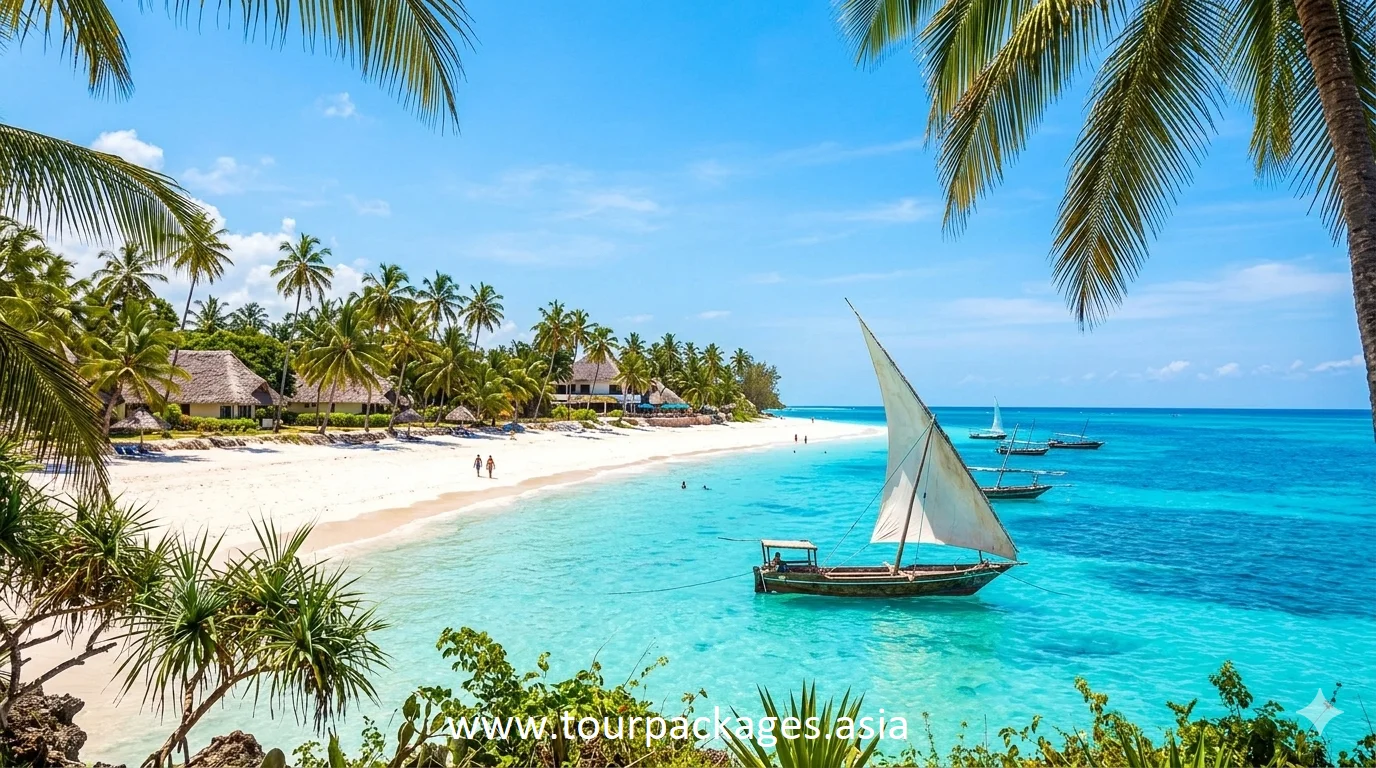
Top Beaches in Tanzania: Paradise Along the Indian Ocean
Revelation
February 28, 2026
Posted By : Admin
Top Beaches in Tanzania: Paradise Along the Indian Ocean
Discover Tanzania’s coastal paradise with this guide to its top beaches. From Zanzibar’s iconic Nungwi, Kendwa, and Paje to Dar es Salaam’s lively Coco Beach and Pangani’s serene shores, each destination offers pristine sands, turquoise waters, and vibrant marine life. Whether you're diving off Mafia Island or relaxing on Mnemba’s luxury retreats, Tanzania’s Indian Ocean coastline promises unforgettable beach holidays in 2026
Top Beaches in Tanzania 2026 — Zanzibar, Pemba, Mafia and the Mainland CoastTourPackages.Asia
Beach & Coastal Guide · 22 Beaches
Top Beaches in Tanzania — Zanzibar, Pemba, Mafia & the Mainland Coast
From Zanzibar's world-famous Nungwi and the kitesurfing capital of Paje to Pemba's untouched wall dives, Mafia Island's whale sharks, and the undiscovered stretches of the mainland Swahili coast — Tanzania's beaches are among the Indian Ocean's finest.
Tanzania's Coastal World — Indian Ocean, Swahili Heritage and Coral Reefs
Tanzania's coastline extends for approximately 1,424 kilometres along the Indian Ocean from the Kenyan border near Tanga in the north to the Mozambican border near Mtwara in the south — and this figure does not include the extraordinary archipelago of islands lying offshore: Zanzibar (Unguja), Pemba, and Mafia, together with dozens of smaller islets, atolls, and reefs that together constitute one of the richest and most diverse coastal ecosystems in the western Indian Ocean.
The Tanzanian coast is not merely a beach destination — it is one of the world's great repositories of Swahili civilisation, the maritime trading culture that linked East Africa to Arabia, Persia, India, and China for over a thousand years before European contact. Stone Town in Zanzibar (a UNESCO World Heritage Site), the ruins of Kilwa Kisiwani (a UNESCO World Heritage Site and one of the most significant medieval Islamic cities in sub-Saharan Africa), and the historical trading towns of Bagamoyo and Pangani represent a coastal heritage of extraordinary depth that enriches any beach holiday. For a deeper exploration of this heritage, see our historical places in Tanzania guide.
The marine environment offshore is equally remarkable. The coral reefs of Mnemba Atoll, Chumbe Island, and the walls of Pemba Channel are among the finest dive and snorkel destinations in the western Indian Ocean — protected from development by national marine park status, private conservation management, and in Pemba's case, simple remoteness. This guide covers 22 of Tanzania's finest beaches and coastal destinations, from world-famous resorts to genuinely undiscovered stretches of mainland coast. Browse Tanzania Tour Packages, or plan a bespoke beach itinerary with our team.
Tanzania's Four Coastal Zones — A Planning Framework
Tanzania's beaches fall into four distinct geographical zones, each with its own character, season, and wildlife. Understanding the zones before booking helps match the right destination to the right experience.
01
Zanzibar — Unguja Island
Most Popular · All-Round · Cultural Heritage
Nungwi — north, calm water, year-round
Kendwa — north, full-moon parties
Paje — east, world-class kitesurfing
Matemwe — northeast, Mnemba access
Pongwe — northeast, seclusion
Bwejuu / Jambiani — east, seagrass
Kizimkazi — south, dolphins
Fumba — west, sunset, kayaking
Stone Town waterfront — heritage
Chumbe Island — marine reserve
Tanzania's most visited coastal zone — a blend of world-class beaches, UNESCO heritage, Indian Ocean reef diving, and a Swahili cultural heritage unmatched anywhere in East Africa. Best visited June–October (dry season) or December–February. Pair with Stone Town historical sites for a complete Zanzibar experience.
02
Pemba & Mafia Islands
Specialist Diving · Remote · Marine Wildlife
Pemba — Misali Island, wall diving
Pemba — Wete coast, manta rays
Mafia Island — Chole Bay
Mafia — Juani Island, whale sharks
Kwale Island — pristine sand spit
Tanzania's remotest and most pristine island zone — visited primarily by divers and travellers seeking genuine off-grid seclusion. Pemba is East Africa's finest scuba destination; Mafia is the most reliable whale shark location on the East African coast. Access by charter aircraft; limited accommodation of high quality. Pair with Zanzibar as an island circuit.
03
Northern Mainland Coast
History · Seclusion · Swahili Culture · Tanga Region
Ushongo Beach — Pangani
Pangani town beach
Tanga beaches — Raskazone
Mbudya Island — day trip, Dar
Bagamoyo — heritage town beach
Saadani National Park beach
Tanzania's most historically rich coastal zone — combining undeveloped beaches, Swahili trading town heritage, and wildlife (Saadani is Africa's only beach-wildlife park). Very few tourists, simple accommodation, extraordinary authenticity. Ideal for travellers who have done Zanzibar and want something genuinely different. See our Tanzania culture guide.
04
Southern Mainland Coast
Pristine · Undiscovered · Msimbati · Mtwara
Ras Kutani — luxury retreat, Dar
Msimbati Beach — Mtwara Region
Mnazi Bay — Mtwara
Mikindani — colonial bay town
Tanzania's least-visited coastal zone — a stretch of virtually undeveloped coast from Dar es Salaam south to the Mozambican border. Ras Kutani, 35km south of Dar, is an intimate luxury beach retreat of exceptional quality. Msimbati and Mnazi Bay near Mtwara are among East Africa's finest and most pristine undived reefs. For explorers only — limited infrastructure and accessed by internal flight. Pair with the Tanzania wildlife guide.
Beach Resort · Swimming · Water Sports · Northern Zanzibar
1 Nungwi Beach — Zanzibar's Most Popular Shore
Nungwi at Zanzibar's northern tip is the island's most visited beach destination — and the most practically versatile. Unlike the east coast beaches that are dominated by strong tidal movement (which can leave hundreds of metres of seagrass-covered sand exposed at low tide), Nungwi benefits from its protected position on the island's northern headland, where the combination of the channel current and reef configuration means the water is swimmable at all tidal states, year-round. The beach itself — wide, white, and backed by casuarina and coconut palms — is consistently ranked among East Africa's finest.
The Nungwi beach strip runs approximately 2km along the north and northwest coasts with a concentrated cluster of hotels, guesthouses, restaurants, and beach bars that give it the liveliest social atmosphere on the island — particularly at the western end where sunset views over the channel towards Tumbatu Island are spectacular. Water activities available from Nungwi include scuba diving (multiple PADI centres — the Nungwi reef and surrounding channels support healthy coral with turtle encounters on most dives), snorkelling (glass-bottom boat trips to the nearby reef are available at all budget levels), deep-sea fishing, dhow sunset cruises, and day trips to Mnemba Atoll. The Mnarani Marine Turtle Conservation Pond at the headland is a small turtle sanctuary where injured green and hawksbill turtles are rehabilitated before release — a worthwhile 20-minute visit. See our Tanzania wildlife guide for full Zanzibar marine life detail.
Location: Northern tip of Zanzibar islandWater: Swimmable year-round — no tidal issueBest for: All-round beach · watersports · social sceneDiving: Multiple PADI centres on beachAlso: Turtle conservation pond · dhow cruises · fishing
Beach Resort · Full Moon Parties · Calm Water · Northwest Zanzibar
2 Kendwa Beach — Full Moons and Quieter Sands
Kendwa lies 3km south of Nungwi along a winding sand track and shares Nungwi's practical advantage of year-round swimmable water — while offering a noticeably quieter and less developed atmosphere. Where Nungwi is Zanzibar's busiest beach, Kendwa is its calmer, more intimate neighbour: the same clear, tide-independent water, comparable white sand and casuarina palm backdrop, but fewer properties, less beach-bar noise, and a more relaxed pace that suits couples and travellers seeking peaceful beach days over a vibrant social scene.
Kendwa is internationally known for its full moon beach parties — monthly events hosted on the beach around each full moon that draw visitors from across Zanzibar and have been running continuously for over two decades. They occupy the beach from late evening into the early hours with sound systems, fire shows, and beach dancing — not for those who have an early morning dive, but genuinely atmospheric events in a spectacular setting. The beach itself is excellent for swimming at all times of day; the sunset from Kendwa's northwest-facing sand, over the channel with fishing dhows silhouetted against the light, is one of Zanzibar's finest visual experiences. Water sports including kayaking, stand-up paddleboarding, and snorkelling are available from several beachfront operators. Combined Nungwi-Kendwa stays covering 3 nights are popular — allowing guests to experience both atmospheres. Browse Tanzania beach packages including Zanzibar north coast itineraries.
Location: 3km south of Nungwi, northwest ZanzibarFamous for: Monthly full moon beach partiesWater: Year-round swimmable — calm, clearSunset: Northwest-facing — best on the islandVibe: Quieter than Nungwi · couples-friendly
Kendwa Beach
Full Moon Parties · Calm Water
02 · Sunset Shore
Zanzibar East Coast — Paje, Matemwe & the Reef
Paje Beach
Kitesurfing Capital · East Coast
03 · Kite Capital
Kitesurfing · Windsurfing · East Coast · Zanzibar
3 Paje Beach — East Africa's Kitesurfing Capital
Paje on Zanzibar's southeastern coast is recognised internationally as one of the finest kitesurfing destinations in the Indian Ocean — a reputation earned by a rare convergence of conditions: the southeast trade winds (kusi) blow consistently at 15–25 knots from May to September, while the offshore coral reef creates a flat-water lagoon of 0.5–1.5 metres depth directly in front of the beach, eliminating ocean swell and providing ideal training conditions for beginner and intermediate riders. A secondary kitesurfing season runs December to February when the northwest kaskazi winds arrive.
The beach at Paje is wide, dramatic, and unmistakably east-coast Zanzibar — bright white sand, transparent turquoise water in the lagoon, the open Indian Ocean visible beyond the distant reef, and an enormous tidal range that exposes a vast flat of coral sand at low tide. At high tide the water fills the lagoon to perfect depth; at low tide, local seaweed farmers (Zanzibar's east coast has a significant artisanal seaweed farming industry, primarily conducted by women) tend to their plots in the exposed shallows — a distinctive sight that contextualises the broader coastal economy. Multiple IKO-certified kitesurfing schools operate from Paje's beach offering beginner to advanced instruction in dedicated water space marked away from swimmers. Non-kitesurfers will find Paje in peak season (July–August) dominated by wind sports; the village itself is charming and low-key with good budget guesthouse options. For the best combined beach and cultural experience, pair Paje with a night in Stone Town to the west.
Best for: Kitesurfing · windsurfing · active beachKite season: May–September (kusi) · Dec–Feb (kaskazi)Wind speed: 15–25 knots — consistent trade windsLagoon: Flat water inside reef — ideal for learningNote: Tidal — best at high tide for non-kiters
Matemwe on Zanzibar's northeast coast is the most strategically positioned beach for travellers whose priority is reef diving and snorkelling — it is the closest and most direct jumping-off point for Mnemba Atoll Marine Conservation Area, East Africa's finest reef, lying approximately 3km offshore. Boat trips from Matemwe to Mnemba (20–30 minutes) are shorter and less expensive than from any other part of the island. The beach itself is one of Zanzibar's most beautiful: a long, pale arc of sand at the base of a low coral rag bluff, with a handful of well-spaced boutique hotels and guesthouses and almost no commercial development beyond the accommodation zone.
Matemwe exemplifies the quieter northeast coast character — unhurried, naturally beautiful, community-scale rather than resort-scale. The village behind the beach is a working fishing community where traditional wooden dhows are built and launched from the beach in the traditional manner; watching a new dhow construction or launch is an authentic cultural experience entirely absent from the more developed north coast resorts. The east-coast tidal pattern applies at Matemwe — plan activities around high tide (check tidal tables on arrival). Turtle encounters are common on Mnemba day trips; dolphins occasionally pass through the channel north of Matemwe. The northern section of Matemwe beach, beyond the main village, becomes increasingly pristine and undeveloped — one of Zanzibar's finest undeveloped stretches accessible on foot or by bicycle. Our Tanzania wildlife guide covers the full Mnemba marine life detail.
Mnemba Atoll Marine Conservation Area is a small private island approximately 3km off Zanzibar's northeast coast, surrounded by a coral atoll widely regarded as East Africa's finest diving and snorkelling reef. The atoll's protected status — the island is owned as a private eco-lodge concession with strictly limited guest numbers, and the surrounding marine area has been formally designated a conservation zone — has allowed coral and fish populations to recover to near-pristine condition. Coral cover and fish diversity on Mnemba's reefs are consistently rated among the highest recorded anywhere in the western Indian Ocean.
Marine wildlife at Mnemba includes green and hawksbill sea turtles (reliably encountered on almost every dive and snorkelling trip — the atoll is a major turtle foraging site), whitetip and blacktip reef sharks (present on most dives, particularly at the outer reef drop-offs), manta rays (seasonal, most commonly October to December), bottlenose dolphins (resident pods pass through regularly), napoleon wrasse, giant moray eels, lionfish, frogfish, nudibranch, and over 500 reef fish species. Snorkelling at Mnemba is possible from the beach at low tide, but the finest marine experience is from the outer reef accessed by boat. Day trips from Matemwe, Nungwi, and Stone Town are available through all certified dive operators. Mnemba Island itself accommodates a maximum of 16 guests in eco-bandas under private lodge management — the most exclusive beach accommodation in Zanzibar. Plan your Mnemba experience as part of a complete Tanzania beach holiday package.
Location: 3km off northeast Zanzibar coastReef quality: Among finest in western Indian OceanTurtles: Green and hawksbill — near-guaranteed sightingFish: 500+ species · sharks · manta raysAccess: Day trip from Matemwe, Nungwi, Stone Town
6 Chumbe Island Coral Park — Africa's Marine Conservation Model
Chumbe Island Coral Park lies 13km southwest of Zanzibar Stone Town — a small coral rag island whose surrounding reef has been under strict private conservation management since 1994, making it one of the longest-established marine reserves in East Africa. The result of three decades of protection is a reef of exceptional quality: hard coral cover exceeding 90 per cent in the best sections, fish biomass among the highest recorded in the region, and marine life density that makes even experienced tropical divers pause in disbelief. No scuba diving is permitted within the conservation area — snorkelling with mask, fins, and snorkel is the only way to explore the reef, keeping all activity in the shallow coral zone and minimising disturbance.
The island accommodates a maximum of 14 overnight guests in elevated coral rag bungalows — architecturally striking, designed for zero environmental impact (solar power, rainwater collection, composting toilets), and positioned in the coastal forest above the beach. Day visitors are accepted in limited numbers each day, each accompanied by a trained ranger who provides guided snorkelling interpretation. The island's coral rag forest is a rare coastal ecosystem in its own right — inhabited by coconut crabs (world's largest terrestrial invertebrate), hyrax, and numerous endemic invertebrates. A historic lighthouse built in 1904 and a small mosque ruin from the 15th-century Shirazi occupation add archaeological interest. Chumbe Island Coral Park has won numerous international conservation awards and is considered a global model for community-based marine conservation. For its broader context within Zanzibar's cultural and natural heritage, see our Tanzania culture guide.
Location: 13km southwest of Stone TownProtection: Privately managed marine reserve since 1994Coral cover: 90%+ in best sectionsGuests: Maximum 14 overnight · limited day visitorsActivity: Snorkelling only — no scuba permitted
Chumbe Island
Marine Reserve · Eco Lodge · 1994
06 · Conservation Reef
Kizimkazi Beach
Dolphin Tours · Mangrove Coast · South
7 Kizimkazi — Dolphins and the Oldest Mosque in East Africa
Kizimkazi at Zanzibar's southwestern tip is primarily known for its resident dolphin population — two species, bottlenose dolphin (Tursiops truncatus) and Indo-Pacific humpback dolphin (Sousa chinensis), maintain permanent home ranges in the sheltered waters of Kizimkazi Bay and the adjacent channel. Morning dolphin tours depart daily from the beach, tracking pods on the water and in season offering supervised snorkelling encounters in clear, relatively shallow water. The experience is best early — by mid-morning tour boat numbers increase and the dolphin interaction quality diminishes. The beach at Kizimkazi is quieter and more local in character than the resort beaches of the north.
The village itself contains Kizimkazi Mosque — believed to date from the 12th century CE and considered the oldest mosque in sub-Saharan East Africa, with Kufic inscription panels inside the prayer hall dating to 1107 CE, among the most significant pieces of early Islamic architectural heritage in Tanzania. A UNESCO cultural conservation project has documented the mosque's significance. The southern Zanzibar coast is also notable for its mangrove forest ecosystems — Kizimkazi's bay is fringed by mature mangroves important for juvenile reef fish nurseries and coastal carbon storage. Combine with a visit to Stone Town's UNESCO-listed heritage and the Zanzibar museums on a southern Zanzibar day circuit.
Location: Southwestern tip of ZanzibarFamous for: Resident dolphin pods — daily morning toursHistoric: Kizimkazi Mosque — 1107 CE, oldest in East AfricaEcosystem: Mangrove bay — nursery reef habitatBest time: Early morning for dolphin tours
Pongwe on Zanzibar's northeast coast is one of the island's least developed and most naturally beautiful beaches — a narrow, curved bay of brilliant white sand enclosed by coral rag headlands, with a fringing reef visible offshore and a handful of boutique accommodation properties (never more than three or four) that maintain the beach's exclusive, unhurried character. There is no beach strip here, no tourist activity concentration, no jet-ski rentals — just the beach, the sea, and the natural coral forest immediately behind.
Pongwe's east-coast tidal character means that at low tide the water recedes considerably — guests time their swimming and snorkelling to the high-tide windows, which rotate through the day on a roughly 12-hour cycle. At high tide, Pongwe has arguably the most beautiful swimming water on the island: warm, clear, turquoise, and shallow over white sand, with the reef edge visible just beyond wading depth. At low tide, the exposed seagrass flats attract egret, heron, and kingfisher along the tide line — a consolation that non-swimmers genuinely appreciate. The beach is popular with honeymooners and couples seeking complete tranquillity; it is not a destination for travellers expecting a social beach scene. Snorkelling from shore at high tide reaches the fringing reef of adequate quality; boat trips to Mnemba Atoll are bookable through accommodation. Our Tanzania beach planning team can design a multi-beach Zanzibar itinerary incorporating Pongwe, Nungwi, and Stone Town.
Location: Northeast Zanzibar coastCharacter: Secluded · boutique · no-crowdsWater: Tidal east coast — plan around high tideBest for: Honeymoon · couples · photographersSnorkelling: Shore access at high tide · Mnemba by boat
Pongwe Beach
Seclusion · Boutique · Tidal Bay
08 · Secluded Bay
Bwejuu Beach
East Coast · Seagrass · Endless Sand
09 · Endless Shore
Seagrass Flats · Tidal · Budget-Friendly · East Coast Zanzibar
9 Bwejuu Beach — East Coast's Vast, Unhurried Shore
Bwejuu on Zanzibar's east coast is one of the island's most naturally impressive beaches in scale — a seemingly endless arc of white sand extending both north and south from the small village, backed by coconut palms and casuarina trees, with the Indian Ocean horizon visible over the distant reef. The beach is wide, flat, and visually dramatic. It is also classically east-coast tidal: the water withdraws significantly at low tide, leaving broad seagrass flats visible between the beach and the channel leading to the reef.
Bwejuu's village is one of the most authentically Swahili communities on the east coast — small, low-key, traditional in character, with a cluster of budget and mid-range guesthouses and small locally-owned restaurants. Seaweed farming is visible along the coast as it is throughout the east coast village zone. The accommodation strip extends northward into the Dongwe area (sometimes marketed as north Bwejuu) where slightly larger properties occupy the beach. The Rock Restaurant, located on an offshore coral rock accessible by footbridge at high tide and a sand causeway at low tide, is one of Zanzibar's most photographed dining experiences — worth a meal for the setting alone. For east-coast beach conditions similar to Bwejuu but with access to Mnemba Atoll diving, Matemwe (20km north) is the practical upgrade. Bwejuu is an excellent choice for budget travellers wanting a genuinely local east-coast experience alongside the beach. See our full Tanzania island packages.
Location: East coast, central ZanzibarCharacter: Long · local · seagrass tidal flatsBudget: Best value east coast accommodationNearby: The Rock Restaurant — iconic dining on coral outcropTidal: East coast — swim at high tide
Seaweed Farming · Local Culture · East Coast · Zanzibar Village
10 Jambiani — Zanzibar's Most Authentic Village Beach
Jambiani is the southernmost of Zanzibar's main east-coast beach villages — a long, linear settlement stretched along a beautiful stretch of white sand where the local economy remains anchored in seaweed farming (one of Tanzania's significant small-scale coastal industries, primarily employing women in the cultivation and drying of Eucheuma seaweed for export), fishing, and small-scale tourism. The atmosphere is markedly more local in character than Nungwi or Paje — the majority of accommodation is in small family-run guesthouses and village-based homestays, tourist numbers are modest, and the interaction between travellers and the fishing community is natural and unhurried.
The beach at Jambiani shares the east coast's tidal character — at high tide the water fills the lagoon inside the reef to create a beautiful, calm swimming and snorkelling zone; at low tide the seagrass flats are exposed. The Jambiani Women's Group, a community enterprise running cultural tours explaining the seaweed farming process, spice garden visits, and traditional Swahili cooking demonstrations, is an outstanding community tourism initiative. Kitesurfing is available from Jambiani during the trade wind season (May–September) — the conditions are comparable to Paje but with considerably fewer students and a less crowded water space. The village mosque, community market, and traditional dhow yard at the beach's southern end provide context for the Swahili coastal culture this entire coastline represents.
Location: Southeast Zanzibar coastCharacter: Most authentic village beach — local economyActivity: Seaweed farming cultural tours · kitesurfingAccommodation: Family guesthouses · homestay optionsCommunity: Women's Group cultural tours — highly recommended
Jambiani Beach
Authentic Village · Seaweed Farms
10 · Village Shore
Pemba & Mafia — Remote Islands, Walls and Whale Sharks
Pemba Island — Misali
East Africa's Best Wall Diving
11 · Wall Diving
Wall Diving · Manta Rays · Remote · Pemba Island
11 Pemba Island — East Africa's Premier Dive Destination
Pemba Island is the smaller and more northerly of the two main Zanzibar Archipelago islands — and the one that experienced divers regard as the finest scuba destination in East Africa. Where Zanzibar draws the volume of beach and snorkel tourists, Pemba remains genuinely remote, visited by relatively few people each year, and its marine environment has consequently been subjected to far less pressure than any comparable reef system in the region. The result is marine life of extraordinary quality — wall dives dropping hundreds of metres into the deep Pemba Channel, coral cover of near-pristine density, and pelagic fish species that require clear, deep water to thrive.
Misali Island, a small uninhabited island off Pemba's western coast, is the centrepiece of the diving: a marine protected area (Misali Island Conservation Area, established 1998) where the reef walls are covered in a near-continuous carpet of hard and soft corals, Napoleon wrasse of large size cruise the mid-water, reef manta rays (Mobula alfredi) are present year-round at several cleaning stations, and visibility frequently exceeds 30 metres in the clean oceanic water. Dugong (sea cow) persist in the seagrass beds around Pemba's coast — one of the most rarely seen marine mammals in East Africa. The beaches of Pemba are as pristine as the water: near-empty, undeveloped, and fringed by clove plantations (Pemba remains one of the world's largest clove producers) and dense coastal forest. Pemba is reached by flight from Zanzibar or Dar es Salaam (30–40 minutes). Pair with Zanzibar for a complete Tanzania island circuit.
Best for: Scuba diving — East Africa's finestVisibility: 30m+ regularly in clean oceanic waterManta rays: Year-round at cleaning stationsRare: Dugong — most reliable in TanzaniaAccess: Flight from Zanzibar or Dar — 30–40 min
Whale Sharks · Marine Park · Chole Bay · Mafia Island
12 Mafia Island — Whale Sharks and an Unspoiled Marine Park
Mafia Island Marine Park is one of East Africa's finest and most carefully managed protected marine areas — covering 822 km² of ocean including coral reefs, seagrass beds, mangrove channels, and open water around the island. Mafia is most widely known as the most reliable location on the East African coast for swimming with whale sharks (Rhincodon typus) — the world's largest fish, reaching up to 12 metres in length — which aggregate seasonally in the island's warm, plankton-rich waters. Encounters are conducted by licensed operators under strict protocols: snorkelling only, maximum group sizes, no touching, minimum approach distance.
The prime whale shark season runs October to March, with peak activity November to February. Chole Bay, the protected lagoon between Mafia Island and Chole Island on the east coast, is the marine park's most productive zone — combining excellent snorkelling and diving on intact coral reefs with the historic ruins of Chole Island town (19th century Arab trading settlement, abandoned in the colonial period). Green sea turtle nesting beaches are protected within the park — turtles are commonly encountered on reef dives year-round. Beyond whale sharks and turtles, the park hosts excellent reef fish communities, schooling barracuda, ray species including eagle ray, and in the deeper channels, occasional hammerhead shark. Mafia's beaches are relatively modest compared to Zanzibar — the island's appeal is overwhelmingly oceanic rather than coastal. Access by charter aircraft from Dar es Salaam (~40 minutes). See also our Tanzania wildlife guide for the full Mafia marine experience.
Whale shark season: October to March · peak Nov–FebMarine park: 822 km² — reef · seagrass · mangroveChole Bay: Best coral diving and snorkelling zoneTurtles: Green sea turtle nesting beachesAccess: Charter flight from Dar es Salaam — ~40 min
Mafia Island
Whale Sharks · 822km² Marine Park
12 · Whale Sharks
Ushongo Beach — Pangani
Mainland Tanzania · Undeveloped
13 · Hidden Mainland
Undeveloped · Mainland Coast · Pangani · Tanga Region
Ushongo Beach south of Pangani town in Tanga Region is widely considered the finest beach on mainland Tanzania — and one of the most beautiful undeveloped stretches of Indian Ocean shoreline anywhere on the East African coast. The beach runs for several kilometres with no commercial development beyond a handful of small eco-lodges set well back from the shore: no beach bars, no touts, no souvenir sellers. Wide, flat, white sand, coconut palms, baobab trees on the low bluff behind, and the Indian Ocean stretching to the horizon — the visual experience is of a coast that has changed little in a century.
The fringing reef offshore provides snorkelling of good quality (visibility and coral health here are considerably better than the heavily-trafficked Zanzibar tourist reefs), and fishing from traditional wooden outriggers is available from the beach. The wider Pangani area provides extraordinary historical and cultural depth: Pangani town itself was a significant Swahili and German colonial trading port (caravanserai terminus, customs house, German boma, and mosque from the 18th and 19th centuries); the Pangani River delta immediately north of town is a productive area for birds and mangrove boat excursions. Ushongo is 60km south of Tanga city (1.5 hours by road), which connects to Moshi, Kilimanjaro, and Arusha. The beach suits travellers who have completed a Northern Circuit safari and want a few nights of genuine coastal seclusion as a contrast — combine with Tanga's historical Swahili coast sites for a complete northern mainland coastal itinerary.
Location: South of Pangani town, Tanga RegionCharacter: Undeveloped · eco-lodge only · no commercial beachSnorkelling: Fringing reef in good conditionNearby: Pangani colonial town · river delta birdingFrom Tanga: 60km · 1.5 hours by road
Plan Your Tanzania Beach Holiday
From Zanzibar's iconic Nungwi and the kitesurfing lagoon at Paje, to Pemba's world-class wall dives, Mafia Island whale sharks, and the undiscovered mainland coast — our team designs bespoke Tanzania beach and safari itineraries for every interest and budget, with full visa support.
Northern Mainland — Pangani, Tanga & the Swahili Heritage Coast
Colonial Heritage · River Delta · Swahili Town · Tanga Region
14 Pangani Town — Swahili Coast Heritage and River Delta
Pangani is one of the oldest and most historically significant towns on the Tanzanian coast — a former Swahili trading port, Arab dhow anchorage, and German colonial administrative centre that served as the coastal terminus of the caravan trade routes from Lake Victoria and the interior. The town's heritage streetscape retains buildings from all three eras: Swahili coral-stone merchant houses with carved wooden doors, an Ottoman-influenced mosque of considerable age, the German boma from the 1890s, and the old slave trade market site — forming a compact but historically dense townscape that rewards half a day of quiet exploration.
The beach immediately north and south of Pangani town is calm, coconut-palm-fringed, and backed by the town's historical fabric on one side and the Pangani River delta on the north — a productive mangrove and birdwatching area accessible by boat from the town jetty. Boat excursions up the lower Pangani River pass through mangrove channels where hippo, crocodile, kingfisher, and African fish eagle are regularly observed. The town's small fish market at the beach operates at dawn — the freshest seafood on the mainland coast is available in Pangani's handful of local restaurants by mid-morning. Combine with Ushongo Beach 10km south and the wider Swahili coast historical sites for a complete northern mainland itinerary.
Location: Pangani River mouth, Tanga RegionHeritage: Swahili · Arab · German colonial townscapeRiver: Boat trips — hippo · crocodile · kingfisherBeach: Calm, palm-fringed · authentic local characterFood: Best fresh seafood on the mainland coast
Pangani Town
Swahili Heritage · River Delta
14 · Heritage Coast
Bagamoyo
UNESCO Candidate · 75km from Dar
15 · Historical Shore
UNESCO Heritage Candidate · Historical Town · Mainland · Near Dar
15 Bagamoyo — History, Heritage and a Quiet Coastal Town
Bagamoyo (the name translates as "lay down the burden of your heart" in Swahili) lies 75km north of Dar es Salaam on the mainland coast directly opposite northern Zanzibar — historically one of the most significant towns in East Africa and a UNESCO World Heritage Site candidate under active consideration for inscription. The town was the principal coastal terminus of the 19th-century slave trade routes from the central African interior, the departure point for David Livingstone's body after his death in 1873, and the first capital of German East Africa before Dar es Salaam was developed.
The Old Town of Bagamoyo retains an extraordinary concentration of 19th-century architecture: the Kaole Ruins (12th–15th century Shirazi mosque and graveyard, 4km south — among the oldest Islamic monuments on the mainland Tanzania coast), the German colonial boma and court buildings, the Catholic Mission established in 1868 (where Livingstone's body was briefly held), Swahili coral-stone merchant houses, and a traditional dhow building yard still in active use. The beach at Bagamoyo itself is narrow and not a primary swimming beach — the attraction is overwhelmingly historical and architectural. Tanzania's oldest established arts institution, the Bagamoyo College of Arts, contributes a lively creative culture. Combine with a visit to the Bagamoyo National Museum and explore the full context in our Tanzania historical places guide.
Location: 75km north of Dar es Salaam by roadUNESCO: World Heritage tentative list candidateHeritage: 19th-century slave trade terminus · German colonial capitalKaole Ruins: 12th–15th century Shirazi mosque — 4km southBest use: Day trip from Dar es Salaam or overnight stay
Wildlife Beach · National Park · Wami River · Africa Unique
16 Saadani National Park — Africa's Only Beach Safari
Saadani National Park holds a distinction unique in Africa — it is the only national park on the continent where game drive safari and Indian Ocean beach coexist within a single protected area. The park's eastern boundary is the open Indian Ocean shoreline; elephant, lion, buffalo, and giraffe are encountered on game drives within sight and sound of the surf, and the same beach where green turtles nest at night is backed by savannah woodland where lions hunt at dawn. The juxtaposition is extraordinary and entirely genuine — this is not a managed wildlife show but a functioning ecosystem where large mammals share the coastal zone with nesting marine turtles.
The Wami River, flowing through the park before reaching the ocean, hosts excellent hippo and large Nile crocodile concentrations — boat safaris on the Wami are a park highlight, drifting past hippo pods in a mangrove-fringed river of extraordinary ecological richness. Green and loggerhead sea turtles nest on the park's undeveloped beach from October to April — turtle monitoring walks at night are available through the park accommodation. The park's wildlife list includes lion, leopard, elephant, buffalo, giraffe, warthog, and Lichtenstein's hartebeest — a species reaching its northern range limit in Saadani. Saadani is typically combined with a Tanzania wildlife safari itinerary as a coastal extension, or visited as a day trip from Dar es Salaam (approximately 3 hours north). Plan a Saadani-Zanzibar combination through our Tanzania planning team.
Unique: Africa's only park where safari meets ocean beachWildlife: Lion · elephant · giraffe · Lichtenstein's hartebeestWami River: Boat safari — hippo · large crocodileTurtles: Green and loggerhead nesting — October to AprilFrom Dar: ~3 hours north by road
Saadani National Park
Beach Safari · Wami River · Wildlife
16 · Safari Beach
Tanga Beaches
Raskazone · Toten Island · Northern Coast
17 · Port City Beaches
Day Beach · Toten Island · Raskazone · Tanga City
17 Tanga Beaches — Raskazone and Toten Island
Tanga, Tanzania's second-largest port city and hub of the northern mainland coast, has several good day-trip beach options for visitors passing through the region. The Raskazone Peninsula on the southern edge of Tanga Bay is the most popular local beach: a broad, sandy shore on the protected inner bay side where the water is calm and shallow, backed by casuarina trees and reached within 15 minutes from the city centre. It is a genuinely pleasant local beach — popular with Tanga residents on weekends but virtually empty on weekdays.
Toten Island, a small coral island in Tanga Bay accessible by outboard motorboat from town (approximately 20 minutes), offers better water clarity and reasonable snorkelling on the fringing reef — a worthwhile half-day excursion bookable through local operators at the Tanga port. The island has no permanent structures and makes an excellent picnic destination. The wider Tanga Region is historically significant: the Amboni Caves (East Africa's most extensive limestone cave system, 8km north of Tanga) and the Arab and German colonial architecture of Tanga town itself provide cultural depth alongside the beach. Tanga is most usefully positioned as a staging point between Moshi-Kilimanjaro (3 hours west) and Pangani-Ushongo (60km south). See our Tanzania outdoor attractions guide for the Tanga Region activities in full.
Location: Tanga city, northern mainland coastRaskazone: Local bay beach — calm water, easy city accessToten Island: 20-min boat — snorkelling on fringing reefNearby: Amboni Caves — East Africa's largest limestone cave systemUse: Staging point between Kilimanjaro and Pangani coast
Zanzibar West & South — Fumba, Stone Town Waterfront & Hidden Shores
18 Fumba Beach — Mangroves, Kayaking and Dhow Sailing
Fumba Peninsula on Zanzibar's southwest coast, about 20km south of Stone Town, offers a completely different beach experience from the resorts of the north and east — a low-key, nature-focused area of mangrove channels, tidal mudflats, and sheltered bay beach where the primary activities are sea kayaking through mangrove forest, traditional dhow sailing in the channel, and watching the sunset over the Zanzibar Channel. Accommodation is small-scale and eco-oriented — boutique lodges and camps that have positioned Fumba as Zanzibar's outdoor adventure base rather than a resort beach zone.
The mangrove channels around Fumba Peninsula are among the most extensive and intact on Zanzibar's coast — providing excellent kayak routes through tunnels of aerial roots where kingfisher, heron, mudskipper, and fiddler crab are abundant. Sandbank excursions into the Menai Bay Conservation Area (established 1998 as Tanzania's first community-based marine conservation area) — a shallow bay of exceptional marine biodiversity including spinner dolphin, hawksbill turtle, and extensive seagrass — are bookable from Fumba as multi-hour dhow trips. Sunset views from Fumba looking west over the Zanzibar Channel — with traditional fishing dhows silhouetted against the fading light — are among Zanzibar's finest evening experiences. Fumba is 30 minutes from Stone Town by road, making it an easy add-on to any Zanzibar beach itinerary.
Location: Southwest Zanzibar — 20km from Stone TownBest for: Kayaking · dhow sailing · mangrove natureMenai Bay: Community marine conservation area — spinner dolphinsSunset: West-facing over Zanzibar Channel — outstandingVibe: Eco and adventure — not a conventional resort beach
Fumba Beach
Mangroves · Kayaking · Menai Bay
18 · Mangrove Bay
Mbudya Island
Dar es Salaam Day Beach · Snorkelling
19 · Dar Day Escape
Day Trip · Dar es Salaam · Snorkelling · Uninhabited Island
19 Mbudya Island — Dar es Salaam's Best Beach Escape
Mbudya Island is a small uninhabited coral island approximately 4km off the Dar es Salaam coastline, protected as part of the Dar es Salaam Marine Reserve System and the most popular day-trip beach destination for the city's residents and visitors. The island is reached by outboard motorboat from Slipway or Msasani peninsula (20–30 minutes) — a straightforward excursion that transforms a Dar es Salaam transit stop into a genuinely enjoyable beach day. The beach is narrow, steeply shelved, and brilliantly white — surrounded by clear water considerably cleaner than the mainland city beaches and the Indian Ocean horizon visible beyond the reef.
Snorkelling from Mbudya's shore reaches a fringing reef of reasonable quality — reef fish, sea urchin, small reef shark, and occasional turtle are present. The island has a small government-run beach facility with changing rooms and a basic restaurant; private operators bring picnic provisions from the mainland. Beyond Mbudya, the Dar es Salaam Marine Reserve System includes Bongoyo Island (slightly larger, with better snorkelling and barbecue facilities), Pangavini Island, and Fungu Yasini — a chain of protected reef islands within easy reach of central Dar. For visitors with only one or two days in Dar es Salaam before or after a safari connection, a Mbudya or Bongoyo Island day trip is the most efficient way to experience Indian Ocean water. Connect your Dar beach day to a wider Tanzania beach and safari package.
Location: 4km off Dar es Salaam — 20–30 min boatProtected: Dar es Salaam Marine Reserve SystemSnorkelling: Fringing reef — reef fish · turtle · reef sharkAlso nearby: Bongoyo Island — better snorkelling alternativeBest use: Day beach for Dar es Salaam transit stopover
UNESCO World Heritage · Waterfront · Forodhani · Zanzibar
20 Stone Town Waterfront — UNESCO Heritage and the Forodhani Night Market
Stone Town — Zanzibar's ancient urban core and a UNESCO World Heritage Site since 2000 — meets the Indian Ocean along a waterfront of considerable character: the old Arab fort (Ngome Kongwe, 17th century) rising above the harbour, the House of Wonders (Beit el Ajaib, 1883 — the largest building in 19th-century East Africa) facing the water, and the dhow harbour where traditional wooden vessels still load and unload cargo as they have for centuries. The waterfront is not a swimming beach — it is a social and historical promenade of extraordinary cultural richness.
The Forodhani Gardens waterfront market, operating every evening from sunset, is one of East Africa's most atmospheric food markets: dozens of charcoal-grill stalls cooking Zanzibar pizza, fresh lobster, king prawn, tuna skewers, sugarcane juice, and Zanzibari sweetmeats overlooking the dhow harbour. Stone Town's maze of coral-stone lanes behind the waterfront contains hundreds of carved wooden doors from the 17th–19th centuries, the former slave market and Anglican Cathedral (built on the site of the last open slave market in East Africa, 1873), the spice market, and multiple Omani Arab palaces converted to museums. Minimum stay of 1–2 nights is recommended to do Stone Town justice. Combine with our Tanzania historical places guide and Zanzibar museums guide for a complete Stone Town exploration.
UNESCO: World Heritage Site since 2000Forodhani: Nightly waterfront food market — sunset onwardsHeritage: Carved doors · slave market cathedral · Arab fort · dhow harbourNote: Cultural and historical promenade — not a swimming beachRecommend: 1–2 nights minimum for Stone Town exploration
Stone Town Waterfront
UNESCO · Forodhani · Dhow Harbour
20 · Heritage Seafront
Kwale Island
Mafia Archipelago · Sand Spit · Pristine
21 Kwale Island — A Pristine Sand Spit in the Mafia Archipelago
Kwale Island is a small near-uninhabited sand spit in the Mafia Archipelago off Tanzania's southern coast — one of the most pristine and untouched beach environments in the entire western Indian Ocean. The island is essentially a long, low bar of brilliant white coral sand barely above sea level at its highest point, fringed by clear, turquoise water of extraordinary purity and surrounded by intact reef habitat. It is reached by boat from Mafia Island (approximately 45 minutes south) and has minimal permanent infrastructure — the handful of simple seasonal tented operations here are low-impact and far between.
Kwale's appeal is almost entirely elemental: the quality of the sand and colour of the water, and the complete absence of commercial or tourist infrastructure. The reef immediately offshore is in excellent condition — hard coral cover, fish density, and clarity of water comparable to Pemba's best sites, but with a shallow and snorkel-approachable topography rather than Pemba's demanding wall dives. Sea turtles forage on the seagrass beds between the sand spit and the reef; spinner dolphins pass through the channel regularly. Kwale is most practically visited as a day excursion from Mafia Island — bring provisions, sun protection, and snorkelling equipment, and arrange return boat pickup. It represents the true end of the road on Tanzania's beach journey — as pristine and undisturbed as East African coastal waters get. Plan your Mafia-Kwale excursion via our Tanzania planning team.
Location: Mafia Archipelago — 45-min boat from Mafia IslandCharacter: Near-uninhabited sand spit · zero infrastructureReef: Pristine — shallow, snorkel-accessible from shoreWildlife: Sea turtles · spinner dolphinsUse: Day excursion from Mafia Island — bring all provisions
Luxury Retreat · Southern Coast · Lagoon · Near Dar es Salaam
22 Ras Kutani — Luxury Seclusion South of Dar es Salaam
Ras Kutani, approximately 35km south of Dar es Salaam along the undeveloped southern coast road, is Tanzania's finest beach retreat within reach of the capital — a small, intimate luxury lodge set on a pristine lagoon beach where a coastal lagoon, a freshwater lake behind the beach, and the open Indian Ocean converge in an unusually rich coastal landscape. The beach is everything Dar es Salaam's urban coast is not: completely undeveloped, backed by coastal forest and the reed-fringed lagoon, with a wide, clean sweep of sand and warm, swimmable ocean.
The lagoon behind the beach supports birdlife of exceptional diversity — the transition between freshwater lake, brackish lagoon, and ocean creates habitat for African fish eagle, malachite kingfisher, hammerkop, various heron and egret species, and in season, migrant Palearctic waders. Dhow sailing and fishing are available from the beach; guided coastal forest walks provide good birdwatching and the chance of bushbuck and duiker. Ras Kutani is most practically used as a safari-to-beach transition point — arriving from northern Tanzania on an afternoon flight to Dar es Salaam, transferring to Ras Kutani for 2–3 nights of beach relaxation before flying to Zanzibar, or as a pre-departure extension for flights from Julius Nyerere International Airport. For a seamless wildlife and beach combination, our team can design a safari-to-Ras-Kutani-to-Zanzibar circuit via Tanzania Tour Packages.
Location: 35km south of Dar es SalaamCharacter: Luxury boutique · maximum 20 guestsLandscape: Lagoon · freshwater lake · Indian Ocean beachBirds: Outstanding lagoon birdwatching year-roundBest use: Safari-to-beach transition · pre-Zanzibar extension
Ras Kutani
Luxury · Lagoon · Southern Coast
22 · Lagoon Retreat
Practical Tips for a Tanzania Beach Holiday
Essential guidance on seasons, tides, packing, visa requirements, and combining a beach stay with a mainland safari.
Understand the Tidal Calendar
Zanzibar's east coast beaches (Paje, Jambiani, Bwejuu, Matemwe) are strongly tidal — at low tide the water recedes hundreds of metres from the shore, leaving seagrass flats exposed and swimming impossible. Download a Zanzibar tide table before arrival and plan swimming and snorkelling around the high-tide windows, which rotate by approximately 50 minutes each day. North coast beaches (Nungwi, Kendwa) are not significantly affected by tidal movement and remain swimmable at any hour. If the east-coast tidal pattern is inconvenient for your schedule, choose the north coast and visit east-coast beaches as day trips timed to high tide.
Best Season by Beach Type
June–October (long dry season): clearest skies, best diving visibility, strongest kite winds at Paje — ideal for active beach holidays. December–February: warm, mostly dry, good for relaxed beach stays and the whale shark season at Mafia (peaks November–February). April–May: long rains — heavy daily showers, many smaller properties close, not recommended for beach-focused travel. The north coast (Nungwi, Kendwa) is generally drier than the east coast in shoulder months. Ask our team to match your travel dates to the optimal beach conditions for your interests.
Combine Safari and Beach Seamlessly
The most efficient safari-to-beach transfer is a direct charter flight from any major safari airstrip (Seronera-Serengeti, Arusha, Selous, Ruaha) straight to Zanzibar — no return to Dar es Salaam required, saving a full day of travel. Flight times are 45 minutes to 1.5 hours depending on origin. If transiting through Dar es Salaam, the fast Zanzibar ferry (1.5–2 hours) is often more cost-effective than a domestic flight. Our Tanzania Tour Packages include pre-arranged safari-to-beach transfer logistics at every budget level.
Dress Code and Cultural Respect
Zanzibar is a predominantly Muslim island. On the beach and at resort pools, normal swimwear is entirely acceptable. In Stone Town, local villages, and markets, modest dress is essential — covered shoulders and knees for both men and women. Women should carry a sarong when moving through towns — it is one of the most useful items to pack for Zanzibar. During Ramadan, avoid eating and drinking publicly in towns during daylight hours. These norms are consistently appreciated by local communities and significantly improve the quality of cultural interaction during your visit. See our Tanzania culture guide for full context.
Diving Certification and Equipment
PADI and SSI dive centres operate from Nungwi, Kendwa, Matemwe, and Paje — complete open-water courses take 3–4 days and include reef dives on Zanzibar's best sites. Equipment rental is available everywhere; bringing your own mask and snorkel ensures a comfortable fit for multiple daily sessions. For Pemba Island — East Africa's finest diving — an Advanced Open Water certification is preferable for the deeper wall dives. Dive insurance through DAN (Divers Alert Network) is strongly recommended for all Tanzania diving — the nearest recompression chamber is in Dar es Salaam.
Tanzania Visa for Indian Travellers
Indian nationals require a Tanzania e-Visa for all destinations including Zanzibar — a single e-Visa covers both mainland Tanzania and the Zanzibar semi-autonomous region. Apply online at least 2 weeks before travel; processing typically takes 5–10 working days. Yellow fever vaccination certificate is mandatory if arriving from an endemic country. A valid passport with at least 6 months remaining validity is required. Full step-by-step guidance at our Tanzania Visa Guide. Our team provides complete documentation support as part of any Tanzania beach or safari package.
Beach Packing Essentials
High-SPF sun protection (SPF 50+ minimum — equatorial sun intensity is significantly higher than at home latitudes). Reef-safe sunscreen (non-nano zinc oxide formulations) when visiting marine reserves — chemical sunscreens are damaging to coral and are prohibited at Chumbe Island. Insect repellent with DEET for evenings. A sarong — multipurpose for beach, cultural modesty, and temple visits. Water shoes for reef walking at low tide. A dry bag for boat trips and snorkelling outings. Water temperature around Zanzibar is 26–30°C year-round — no wetsuit is required for snorkelling, though a thin rash guard provides useful sun and minor jellyfish protection.
Book Popular Experiences Early
Several Zanzibar experiences have strict capacity limits and fill well in advance. Chumbe Island Coral Park (maximum 14 overnight guests — book months ahead in high season). Mnemba Atoll day trips from Matemwe and Nungwi fill quickly in July–October. Kitesurfing instruction at Paje (popular IKO schools book out 2–3 weeks ahead in peak season). Stone Town specialist heritage guide tours are best arranged through accommodation in advance. Our Tanzania beach planning team pre-books all priority activities as part of every package itinerary.
Frequently Asked Questions — Tanzania Beaches
Detailed answers to the most common questions about Tanzania's beaches, Zanzibar travel, and planning a coastal holiday.
Zanzibar has several beaches that compete for the title depending on what you prioritise. Nungwi on the northern tip is the most popular and practically versatile — it has calm, swimmable water year-round (unlike the tide-dependent east coast beaches), a lively beach and watersports scene, excellent sunset views, and the best concentration of activities from reef diving to deep-sea fishing. Kendwa, 3km south, shares Nungwi's tidal independence but with a quieter, more intimate atmosphere and the island's famous monthly full-moon beach parties.
For kitesurfing and an active wind-sports atmosphere, Paje on the east coast is a world-class destination. For seclusion and pristine natural beauty, Matemwe and Pongwe on the northeast coast are exceptional — and Matemwe provides the closest access to Mnemba Atoll, East Africa's finest reef. Most visitors divide their Zanzibar stay between the north coast (Nungwi or Kendwa) for reliable swimming and social atmosphere, and the east coast (Paje or Matemwe) for dramatic scenery and watersports. Plan your ideal Zanzibar beach combination with our Tanzania beach team.
The best beach weather in Zanzibar occurs during two dry seasons. The long dry season from June to October is the clearest, sunniest, and most reliably dry period — ideal for diving, snorkelling, and active beach holidays, and also the peak kitesurfing season at Paje (May–September, southeast trade winds). The short dry season from December to February is warm and mostly dry — good for relaxed beach stays, with whale shark season at Mafia Island peaking November to February.
The long rains (masika) fall April to May — heavy daily showers make beach holidays difficult and many smaller properties close entirely. The short rains (vuli) arrive in November and are lighter and more intermittent. A key planning note: the east coast of Zanzibar (Paje, Jambiani, Bwejuu, Matemwe) is strongly tidal — at low tide the water recedes far from the beach making swimming impossible. These beaches are most enjoyable when high tide falls during the morning or afternoon. The north coast (Nungwi, Kendwa) has calm, swimmable water year-round regardless of tide. Browse our Tanzania beach packages for seasonal itinerary recommendations.
Pemba Island is absolutely worth visiting for travellers who prioritise exceptional scuba diving, genuine seclusion, and an unspoiled natural environment. It is East Africa's finest dive destination — dramatic wall dives dropping hundreds of metres into the Pemba Channel, year-round reef manta rays at cleaning stations, intact coral cover of extraordinary quality, occasional hammerhead sharks, and dugong (sea cow) in the seagrass beds around the coast. The island receives dramatically fewer visitors than Zanzibar, creating an atmosphere of genuine remoteness and peace that is increasingly rare in East African island destinations.
Pemba is reached by Precision Air scheduled flights from Dar es Salaam or Zanzibar (30–40 minutes) or by ferry from Zanzibar town (4–6 hours — less comfortable but more economical). Accommodation is limited to a handful of small, high-quality lodges; most visitors allocate 4–5 dedicated days. Pemba is most rewarding as an extension to a Zanzibar holiday — fly Zanzibar to Pemba for 4 nights of serious diving, then return to Zanzibar by air for a final night before onward departure. Non-divers will find Pemba's snorkelling on the shallower sections of Misali Island's reef also excellent. Our Tanzania island team can arrange the full Zanzibar-Pemba-Mafia island circuit.
Zanzibar's beaches offer an exceptional range of water activities. Scuba diving: PADI and SSI centres operate from Nungwi, Kendwa, Matemwe, and Paje — Mnemba Atoll is the premier site with 500+ fish species, regular turtle encounters, and reef sharks. Complete open-water courses take 3–4 days. Snorkelling: Mnemba Atoll by day trip (highest quality), Chumbe Island Coral Park (strictly limited numbers, superb reef condition), and directly from shore at Nungwi and Kendwa at most tidal states. Kitesurfing: Paje is a world-class IKO-certified destination with consistent trade winds May to September and December to February.
Dolphin tours: morning motorboat tours from Kizimkazi to observe resident bottlenose and Indo-Pacific humpback dolphin pods — responsible operators allow careful water entry near relaxed pods. Dhow sunset cruises: traditional wooden sailing dhows offer evening harbour cruises from Stone Town and the north coast beaches. Deep-sea fishing: bluewater fishing for dorado, wahoo, sailfish, and tuna in the Zanzibar Channel from multiple Nungwi-based charter operators. Stand-up paddleboarding and sea kayaking: available from most north coast hotels. Glass-bottom boat tours: reef viewing without diving, available from all major beaches at budget prices. Plan your water activities programme via Tanzania Tour Packages.
Combining a Tanzania mainland safari with a Zanzibar beach extension is entirely straightforward — and one of the most popular African holiday itineraries worldwide. The most efficient route is a direct charter flight from any of the main safari airstrips directly to Zanzibar, bypassing Dar es Salaam entirely. Charter flight times are approximately 45 minutes from Seronera-Serengeti, 1 hour from Arusha, 1 hour from Selous airstrip, and 1.5 hours from Ruaha. These flights connect cleanly with most safari camp morning check-out times.
Alternatively, fly to Julius Nyerere International Airport in Dar es Salaam and connect by Precision Air or Coastal Aviation scheduled flight to Zanzibar (20–25 minutes) or take the fast ferry from Dar es Salaam port (approximately 1.5–2 hours). The classic itinerary for Indian travellers — 7–10 days Northern Tanzania safari followed by 4–5 days Zanzibar — is comfortably achievable within a 14-day leave allocation and remains one of travel's great combinations: dusty savannah game drives contrasted with turquoise Indian Ocean and white sand within a single holiday. Our Tanzania Tour Packages include the full safari-to-beach logistics with pre-arranged transfers at every stage.
Chumbe Island Coral Park is a privately managed marine protected area and eco-lodge 13km southwest of Zanzibar Stone Town, established in 1994 as one of Africa's first private marine reserves. The reef has been strictly protected since then — producing coral cover exceeding 90 per cent in the best sections and fish biomass among the highest recorded anywhere in the Western Indian Ocean. No scuba diving is permitted within the conservation area — snorkelling with mask, fins, and snorkel is the only access, keeping activity in the extraordinary shallow coral zone.
The island accommodates a maximum of 14 overnight guests in elevated coral rag eco-bungalows designed for zero environmental impact — solar power, rainwater collection, composting toilets, no generator noise. Day visitors are strictly limited and always guided by a trained ranger who provides reef ecology interpretation in real time. A historic 1904 lighthouse, a 15th-century mosque ruin, and the island's coconut crab and hyrax population add natural and historical interest beyond the reef. Advance booking is essential — overnight stays regularly fill months ahead in high season. Chumbe is not a resort beach experience; it is a conservation destination that provides the most rigorously protected reef snorkelling in East Africa. Our Tanzania team pre-books Chumbe visits as part of Zanzibar itineraries.
Nungwi on Zanzibar's northern tip is the most practical beach for families with children of all ages. Its defining advantage is year-round swimmable water independent of tidal state — children can swim freely at any hour without parents needing to consult tidal tables. The water entry is gentle with a sandy bottom, there are no strong currents in the sheltered northern bay, and the beach is wide enough for beach games at all tide levels. Family-sized accommodation including villas and multi-bedroom bungalows is available at multiple price points, and the Mnarani Marine Turtle Conservation Pond at the headland — where green and hawksbill turtles are rehabilitated before release — is an excellent 20-minute visit for children of all ages.
Kendwa, 3km south, shares Nungwi's tidal independence and is quieter and slightly less commercially active — better for families seeking a calmer atmosphere without sacrificing the swimmable water advantage. The east coast beaches (Paje, Jambiani, Bwejuu) can be challenging for families because of tidal limitations — at low tide the water recedes too far for swimming and the exposed seagrass is unappealing to young children who expect to swim on demand. If the east coast is preferred for its dramatic beauty, time your stay so that high tide falls in the mornings and late afternoons, and always carry a tide table. For families combining beach with wildlife, see our Tanzania wildlife guide.
Yes — Mafia Island is an excellent addition to a Tanzania beach holiday, particularly for travellers interested in whale sharks, marine wildlife, and an authentically off-the-beaten-track island experience. Mafia Island Marine Park (822 km²) is one of East Africa's finest protected marine areas, and the island is the most reliable location on the East African coast for swimming with whale sharks — which aggregate in the island's warm waters October to March (peaking November to February). Encounters are snorkel-only under strict protocols. The island has very limited accommodation, very few annual visitors compared to Zanzibar, and a peaceful atmosphere of genuine seclusion that seasoned travellers find deeply appealing.
Access is by charter aircraft from Dar es Salaam (approximately 40 minutes) or occasional flights from Zanzibar. Mafia is most effectively combined with Zanzibar on a Tanzania island circuit — fly Dar es Salaam to Mafia for 3–4 nights (ideally within the whale shark window of October to March), then charter directly to Zanzibar for a longer beach stay. The Mafia-Zanzibar combination provides both the rare marine wildlife encounter of whale sharks and the full range of Zanzibar beach, reef diving, and Stone Town cultural experiences within a 10–12 day island itinerary. Our Tanzania packages include the Mafia-Zanzibar island circuit with all charter logistics handled.
The east and west coasts of Zanzibar offer distinctly different beach experiences driven by geography, tide, and prevailing wind. The east coast (Paje, Jambiani, Bwejuu, Matemwe, Pongwe) faces the open Indian Ocean — dramatically wide, brilliantly white beaches with turquoise water and a strong tidal range. At high tide these are among the most visually beautiful beaches in Africa, with clear, warm water inside the reef lagoon. At low tide, the water recedes significantly and the beach widens to expose seagrass flats. The east coast's consistent trade winds make it East Africa's premier kitesurfing destination.
The west coast (Stone Town, Fumba, Mangapwani) faces the sheltered Zanzibar Channel — water is calmer and currents gentler, beaches are narrower and less visually dramatic, but the coast carries strong historical character around Stone Town's UNESCO heritage. The north coast (Nungwi, Kendwa) benefits from the island's headland protection and has the calmest, clearest water year-round — swimmable at all tidal states with no tidal planning required. Most visitors benefit from dividing time: north coast for reliable swimming and social atmosphere, east coast for dramatic scenery and watersports timed to high tide. Browse our Tanzania beach packages for multi-beach Zanzibar itineraries covering both coasts.
Yes — Tanzania's mainland coast is significantly underdeveloped relative to Zanzibar and offers genuinely authentic, uncrowded beach destinations with strong historical and cultural depth. The finest area is the Pangani-Ushongo stretch south of Tanga: Ushongo Beach is one of the most beautiful undeveloped beaches on the entire East African coast — kilometres of white sand backed by baobabs and coconut palms, almost no tourist infrastructure, and fringing reef snorkelling in comparatively undisturbed water. Pangani town behind it provides extraordinary Swahili, Arab, and German colonial heritage in a compact, walkable townscape.
Bagamoyo, 75km north of Dar es Salaam, combines a UNESCO World Heritage Site candidate Old Town with quiet beach access and excellent day-trip logistics from the capital. Saadani National Park offers Africa's only wildlife-plus-beach combination within a single protected area. Ras Kutani, 35km south of Dar, is a luxury retreat of exceptional quality for safari-to-beach transitions before a Zanzibar flight. The mainland coast suits travellers who have already experienced Zanzibar and want something fundamentally different — or those combining a beach extension with deep historical engagement. Our Tanzania team builds mainland coast itineraries combining beaches with Swahili heritage sites and wildlife experiences.
Yes, Indian nationals and most other nationalities require a Tanzania e-Visa to visit — including for a Zanzibar beach holiday. Zanzibar is a semi-autonomous region of Tanzania but uses the same national visa — a single e-Visa covers both mainland Tanzania and Zanzibar with no additional documentation required. The e-Visa is applied for entirely online through the Tanzania Immigration Services Department portal; no embassy visit is required. Processing typically takes 5–10 working days for standard applications.
Requirements include a valid passport with at least 6 months remaining validity beyond your intended departure date, a digital passport-size photograph, confirmed onward or return travel documentation, and proof of accommodation booking. Yellow fever vaccination certificate (yellow card) is mandatory for travellers arriving from yellow fever-endemic countries and may be checked at the port of entry — ensure vaccination and documentation are arranged well before travel. The e-Visa is valid for single or multiple entry for stays up to 90 days. Full step-by-step guidance for Indian travellers — including current fees, processing timelines, and required documents — is available at our Tanzania Visa Guide. Our team provides complete documentation assistance as part of any Tanzania beach or safari package.
Zanzibar is a predominantly Muslim island with a deeply rooted Swahili-Arab cultural tradition. On the beach and at resort pools, normal swimwear is entirely acceptable. However, walking through villages, along roadsides, in markets, or through Stone Town in beachwear causes genuine offence and is strongly discouraged. Women should carry a sarong or light cover-up when moving through towns; men should cover up with a shirt and light trousers when off the beach. A sarong is one of the single most practical items to pack for a Zanzibar visit.
Photography of local people should always be done with permission and genuine engagement rather than intrusive shooting. During Ramadan (dates vary by lunar calendar), public eating, drinking, and smoking during daylight hours should be avoided in towns and villages — most tourist-facing restaurants and beach cafes remain open, but the courtesy of not eating openly in front of fasting community members is strongly appreciated. The call to prayer (adhan) is audible five times daily from mosque minarets across the island — this is an integral part of Zanzibar's living cultural identity. Understanding and observing these norms consistently enriches the travel experience and builds genuine goodwill with local communities. Explore Zanzibar's living culture, food, and festivals through our Tanzania culture guide.
Zanzibar's reefs support exceptional marine biodiversity. At Mnemba Atoll — East Africa's finest snorkelling reef — regular encounters include green and hawksbill sea turtles (seen on most trips), bottlenose dolphins (frequently passing through the atoll), whitetip and blacktip reef sharks, manta rays (seasonal, most reliably October to December), napoleon wrasse of large size, giant moray eels, frogfish, lionfish, banded sea krait, octopus, and several hundred reef fish species across the coral formations.
Chumbe Island Coral Park provides the most intensively protected snorkelling environment on the island — hard coral cover exceeding 90 per cent in the best sections, fish biomass among the highest in the region, and the benefit of ranger interpretation that identifies species and ecological relationships in real time. Kizimkazi Bay is one of East Africa's most reliable locations for observing wild dolphins from a boat and occasionally in the water with responsible operators. The reef directly off Nungwi and Kendwa allows turtle, octopus, and reef fish encounters in 3–6 metres accessible without a boat at most tidal states. For advanced marine wildlife — hammerhead sharks, deep reef fish, and large pelagic encounters — Pemba Island's wall dives are the necessary destination. See our Tanzania wildlife guide for the full marine life detail across all destinations.
Paje on Zanzibar's southeast coast is universally recognised as one of the finest kitesurfing destinations in the Indian Ocean — a reputation earned by the convergence of consistently reliable trade winds, a perfectly configured flat-water lagoon inside the reef, and the extraordinary visual setting of white sand, turquoise water, and open ocean horizon. The southeast trade winds (kusi) blow at 15–25 knots from May to September — the primary kitesurfing season — while the northwest kaskazi winds provide a secondary season from December to February. In peak season (July–August), riders can typically count on five to six rideable days per week.
The offshore coral reef creates a lagoon of 0.5–1.5 metres depth directly in front of Paje beach — flat water without ocean swell, ideal for beginner and intermediate progression. Multiple IKO-certified schools operate from designated beach zones with water space marked separately from swimmers. Full beginner courses of 9–12 instruction hours are available with all equipment included. Advanced riders find wave-riding conditions on the open ocean sections beyond the reef during stronger wind events. The social atmosphere in peak season is international and active — Paje attracts a community of European and South African kite riders during July–August that gives the village a distinctly different energy from other Zanzibar beach destinations. For non-kitesurfers, Paje in peak wind season is dominated by wind sports; Nungwi or Pongwe are better choices for those seeking a tranquil beach holiday. Browse our Tanzania beach packages for Paje-focused kite holiday itineraries.
The minimum meaningful beach stay in Zanzibar is 4–5 days — enough for 3 nights at a northern or northeast beach (Nungwi, Kendwa, or Matemwe) plus 1 night in Stone Town. This covers the core beach experience and a brief exploration of the island's UNESCO heritage. A 7-day Zanzibar stay allows a genuinely complete experience: 3 nights in the north for beach, swimming, and water sports; 2 nights on the east coast (Paje for kitesurfing or Matemwe for Mnemba Atoll snorkelling access); and 2 nights in Stone Town for the UNESCO heritage town, Forodhani night market, spice tour, and dolphin day trip to Kizimkazi.
For those combining a mainland safari with Zanzibar, the standard recommendation for Indian travellers is 4–5 days of Zanzibar (3 nights north coast plus 1–2 nights Stone Town) added after a 7–10 day safari — giving a total holiday of 12–15 days including travel. Dedicated diving holidays typically allocate 7–10 days in the archipelago: 4–5 days on Zanzibar for reef diving, followed by 4–5 days on Pemba Island for the more technically demanding wall dives. Those specifically targeting Mafia Island whale sharks should add 3–4 dedicated Mafia nights (October to March) before flying on to Zanzibar for the beach finale. Our Tanzania beach planning team designs custom multi-island itineraries matching your dates, interests, and budget precisely.
Explore More — Tanzania Travel Guides
Extend your Tanzania beach holiday into safari, culture, history, and outdoor adventure.
Wildlife & Safari
Wildlife Experience in Tanzania — Serengeti, Ngorongoro & More
The Great Migration, Ngorongoro Big Five, Gombe chimpanzees, Selous boat safari, and 18 more — Tanzania's 22 greatest wildlife experiences in one complete guide.
Historical Places in Tanzania — Stone Town, Kilwa & Olduvai
Zanzibar Stone Town, Kilwa Kisiwani ruins, Olduvai Gorge, Bagamoyo, and the full Swahili coast heritage trail — Tanzania's most significant historical destinations.
Swahili coastal cuisine, Zanzibar spice heritage, the calendar of Islamic festivals, Maasai cultural traditions, and Tanzania's extraordinary living cultural mosaic.
Museums in Tanzania — Zanzibar, Arusha & Dar es Salaam
The National Museum of Tanzania, Zanzibar Museum and Palace, Olduvai Gorge Museum, Arusha Cultural Heritage Centre — the complete Tanzania museum guide.
Tanzania Tour Packages — Beach, Safari & Island Holidays
Browse our curated Tanzania packages combining Zanzibar beaches, Serengeti safari, Pemba diving, Mafia whale sharks, and Kilimanjaro — with full visa support for Indian travellers.
Our team designs bespoke Tanzania beach itineraries — Zanzibar island hopping, Pemba wall dives, Mafia whale shark encounters, mainland heritage coast, and seamless safari-to-beach combinations — with full visa support for Indian travellers.