
Tanzania Visa for Indians — Complete Guide 2026: e-Visa, Tourist, Business, Transit, Yellow Fever Certificate, Zanzibar Insurance and Malaria Prophylaxis
Tanzania Visa for
Indians — Complete Guide 2026
Everything Indian passport holders need to know — e-Visa at visa.immigration.go.tz, Tourist, Business and Transit types, the mandatory Zanzibar ZIC insurance, Yellow Fever certificate rules, malaria prophylaxis, photograph specifications, overland border crossings, and RTH World Tour Packages processing at Rs.6,499 for a 90-day single entry.
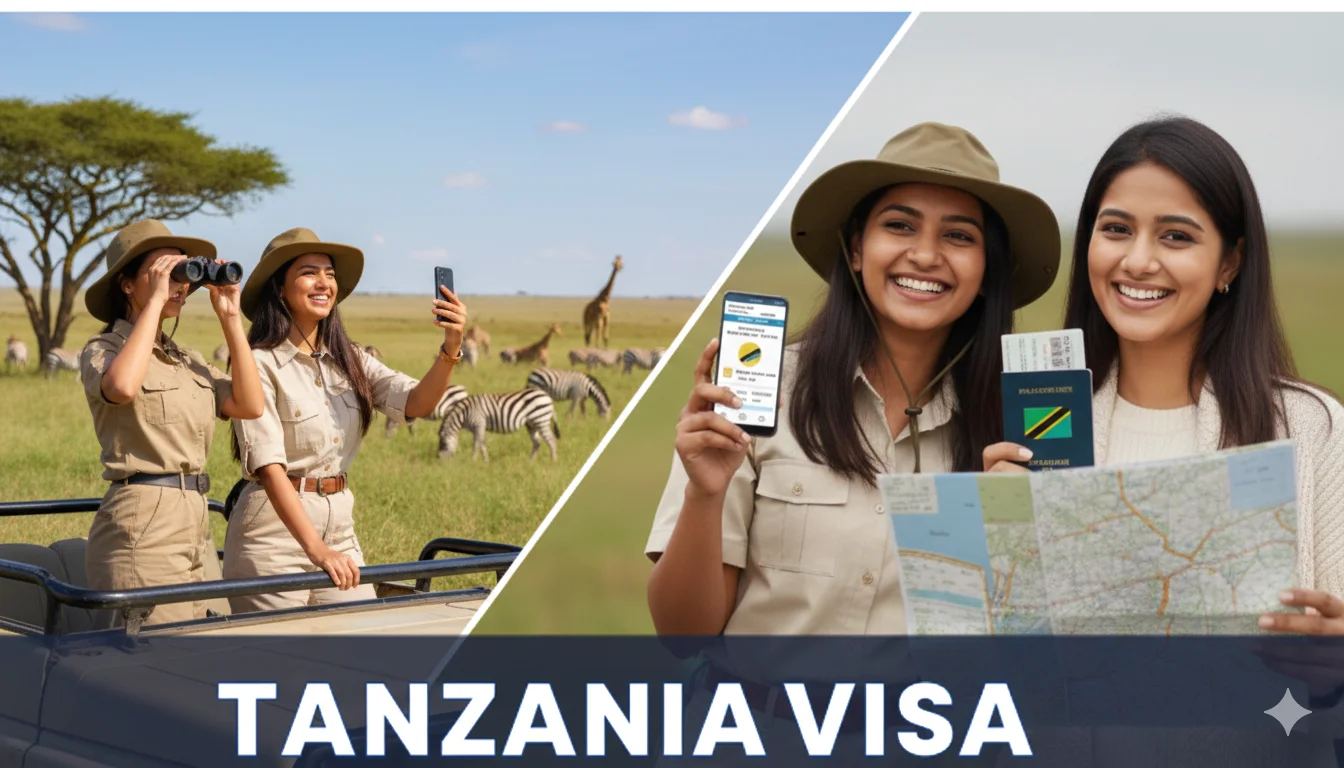
Tanzania is East Africa's crown jewel — a country of staggering natural grandeur and unrivalled wildlife spectacle that ranks among the great travel destinations on earth for Indian travellers seeking authentic, unspoiled African experiences. The Serengeti National Park hosts the Great Migration — 1.5 million wildebeest and 250,000 zebra moving in an ancient circular cycle between Tanzania and Kenya — in what remains one of the greatest wildlife events on the planet. Mount Kilimanjaro, Africa's highest peak at 5,895 metres, draws thousands of trekkers from India each year on its Marangu, Machame, and Lemosho routes. The volcanic Ngorongoro Crater — a UNESCO World Heritage Site — shelters one of the highest densities of large mammals anywhere on earth inside an ancient caldera. And Zanzibar's Stone Town and white coral sand beaches are the perfect complement to a mainland safari. Explore our guides to the wildlife experiences in Tanzania, top beaches, historical places, museums, culture, food and festivals, and outdoor attractions for comprehensive destination planning.
Indian passport holders require a visa to enter Tanzania — there is no visa-free entry for Indians. The Tanzania e-Visa system is well-established and entirely online at visa.immigration.go.tz — no embassy visit required. The Tourist (Ordinary) e-Visa costs USD 50 (approximately Rs.4,230) for a single entry stay of up to 90 days within a 90-day validity window. A Multiple Entry Visa is available at USD 100 for up to 12 months. Processing takes 2–5 working days for standard applications.
Tanzania has several critical health and insurance requirements that distinguish it from most other destinations and that every Indian traveller must understand before applying for the visa: the Yellow Fever International Certificate of Vaccination (required depending on transit routing), the mandatory Zanzibar Insurance Corporation (ZIC) travel insurance for all visitors to Zanzibar (compulsory since October 1, 2024, at USD 44), and the necessity of malaria prophylaxis for all Tanzania travel. RTH World Tour Packages processes the Tanzania e-Visa at a transparent fee of Rs.6,499 for a 90-day single entry — covering the complete documentation preparation, application support, health certificate guidance, and Zanzibar insurance briefing.
Tanzania Visa Categories for Indian Nationals
Tanzania offers four primary visa categories. Understanding which applies to your visit ensures the correct application, correct fee payment, and correct documentation preparation:
Tourist (Ordinary) e-Visa — Single Entry
The standard visa for Indian travellers visiting Tanzania for wildlife safaris, Kilimanjaro trekking, Zanzibar beaches, cultural experiences, family visits, conference attendance, or humanitarian activities. Explore our wildlife experience guide for safari planning.
- Stay: Up to 90 days per entry
- Validity: 90 days from date of issue
- Entry: Single — if you leave Tanzania and return, you need a new visa (exception: holders who visit other East African countries and return within the validity period may re-enter)
- Fee: USD 50 (~Rs.4,230) government fee
- RTH total: Rs.6,499
- Processing: 2–5 working days; express available at USD 20 additional
Multiple Entry Visa
The multiple entry visa allows unlimited re-entry into Tanzania within its validity period of up to 12 months, with each individual stay not exceeding 90 consecutive days. Ideal for Indian travellers who combine a Tanzania safari with visits to Kenya, Rwanda, or Uganda and need to re-enter Tanzania for their return flight or onward safari.
- Stay per visit: Maximum 90 consecutive days
- Validity: Up to 12 months
- Entry: Multiple — unlimited re-entries within validity period
- Fee: USD 100 (~Rs.8,460)
- Note: US nationals are required to apply for the multiple entry visa — the single entry option is not available to them
- Best for: East Africa multi-country itineraries; frequent Tanzania visitors
Business Visa — Single Entry
For Indian nationals attending meetings, conferences, conducting short-term assignments (repairs, training, installations), making business contacts, auditing, or undertaking short-term professional roles in Tanzania.
- Stay: Up to 90 days
- Validity: 90 days
- Entry: Single entry — cannot be used to re-enter after departure
- Fee: USD 50 government fee
- Additional documents: Work contract or proof of business assignment; invitation letter from Tanzanian host company or organisation
- Not for: Stays exceeding 90 days or permanent business roles — requires Work/Residence Permit
Transit Visa
For Indian nationals transiting through Tanzania overland to a neighbouring country (Kenya, Rwanda, Burundi, Malawi, Zambia, Uganda, Mozambique) or transiting through a Tanzanian airport with an overnight stay outside the transit zone.
- Stay: Up to 7 days
- Entry: Single
- Fee: Approximately USD 30
- Documents: Onward journey evidence — visa/permit for the destination country; confirmed onward transport
- Airside transit: If remaining entirely in the airport transit zone, no visa is required for most nationalities — confirm before booking
- Best for: Overland East Africa travellers passing through Tanzania
The East Africa Tourist Visa (EATV) is a joint visa covering Kenya, Uganda, and Rwanda — allowing multiple entries across all three countries within 90 days for a flat fee of USD 100. Tanzania is not part of the EATV scheme — a separate Tanzania visa is always required. However, the Tanzania single-entry e-Visa permits re-entry from other East African Community countries within the 90-day validity if the original visa has not expired. For Indian travellers combining Tanzania with Kenya, Uganda, and Rwanda on an extended East Africa safari, the recommended approach is: Tanzania e-Visa (USD 50) plus the EATV (USD 100), managed by RTH as part of a full East Africa itinerary package. See our Tanzania Tour Packages for multi-country East Africa itineraries.
Passport Requirements and Rules
Validity Requirement
- Passport must be valid for at least 6 months beyond your intended departure date from Tanzania — this is strictly enforced at both the e-Visa portal and on arrival
- For a 90-day tourist visit ending May 31: your passport must be valid until at least November 30 of the same year
- Indian airlines and check-in agents also enforce the 6-month rule — you may be denied boarding if your passport expires within 6 months of your Tanzania travel dates
- Renew your passport well before applying — the e-Visa is issued against a specific passport number; if you renew after the e-Visa is issued, you must re-apply
Blank Pages
- Minimum 2 blank visa pages — preferably 3 — must be completely unused (endorsement and amendment pages do not count)
- Tanzania immigration stamps at entry and exit occupy separate pages — Zanzibar may stamp separately from mainland Tanzania if travelling between both
- If crossing multiple land borders on a East Africa overland itinerary, carry at least 3–4 blank pages to accommodate multiple entry/exit stamps
- Renew your passport before applying if fewer than 2 blank visa pages remain
Passport Condition and Amendments
- Passport must be an original biometric e-Passport — machine-readable, undamaged, with intact chip
- No handwritten amendments, corrections, or personal notations on any biographical data page — such documents are rejected at the e-Visa portal and by immigration officers on arrival
- Passports with water damage, torn/detached pages, missing covers, or delaminating biographical data pages must be renewed before travel
- Temporary emergency travel documents (Emergency Certificates) are not recognised by Tanzania immigration
- Children cannot travel on a parent's passport — each child requires their own individual passport and individual visa
Name Changes and Old Passports
- If your name has changed since the passport was issued (marriage, court order) — carry the legal supporting document (marriage certificate or gazette notification) at all times during travel
- Carry all previous Indian passports if they contain valid Tanzania visas or if the current application builds on previous travel history
- The e-Visa portal links your approval to your current passport number — all biographical details in the application must exactly match your passport or the application will be rejected
Photograph Requirements — Detailed Specifications
Tanzania accepts two photograph formats for visa applications. The specifications below apply to both the e-Visa digital upload at visa.immigration.go.tz and physical photographs for any embassy or agent-supported applications:
Accepted Size — Two Options
- Option 1: 2 x 2 inches (51 mm x 51 mm) — square format standard for US-style passport photos
- Option 2: 35 mm x 45 mm — standard rectangular passport photo format widely used in India
- Two identical physical prints required for any physical/embassy submission
- Taken within the last 6 months
- Head centred and filling 70–80% of the frame
- Eye level between 28mm and 35mm from the bottom of the frame
Digital Upload — e-Visa Portal
- Format: JPEG (preferred) or PNG
- High resolution — minimum 300 dpi
- File size within portal limits (typically under 2 MB)
- Unaltered from original — no digital retouching, background replacement, or photo-editing filters
- Taken within the last 6 months
- Same background, pose, and expression standards as physical photos
- If the portal rejects a photo, do not attempt to resize using low-quality methods — reshoot at a professional studio
Background, Expression and Pose
- Background: Plain white only — no patterns, no off-white or cream, no shadows behind the head or on the background
- Full face clearly visible — both ears ideally visible, facing camera directly
- Neutral expression — mouth closed, eyes open, no squinting
- Head straight — no tilt or rotation
- Shoulders visible and squared to the camera
- Uniform diffused lighting — no harsh shadows on face
Not Permitted in Photographs
- Glasses of any type — prescription spectacles, sunglasses, or tinted lenses
- Headgear of any type — hats, caps (religious exception: plain covering with full face including forehead, chin and ears visible)
- Hair covering the face, eyes, or eyebrows
- Digital background removal or replacement
- Photo-editing applications, beauty filters, or lighting correction
- Photos older than 6 months
- Photos where other persons, objects, or reflections are visible
- Low-resolution smartphone selfies without professional lighting and white background
Health Requirements — Yellow Fever, Zanzibar Insurance and Malaria
Tanzania has three distinct health and insurance requirements that are critical for Indian travellers — all must be understood and prepared before travel. Failure to comply with any of these can result in refused entry or refused entry to Zanzibar specifically:
Yellow Fever Certificate
Tanzania requires a valid International Certificate of Vaccination or Prophylaxis (ICVP) — the Yellow Card — from visitors arriving from or transiting through a Yellow Fever endemic country for more than 12 hours within the previous 6 days.
- India's status: India is not classified as a Yellow Fever endemic country — Indians flying direct from India without transiting an endemic region do not strictly require the certificate for mainland Tanzania
- Zanzibar rule: Zanzibar immigration requires the Yellow Fever certificate from all visitors who have been on mainland Tanzania — carry the certificate for all combined mainland + Zanzibar itineraries
- RTH's recommendation: Carry the Yellow Fever certificate regardless of routing — immigration officers exercise discretion and it is always safer to have the certificate than to argue at the border
- Vaccination timing: Vaccinate at least 10 days before travel for the certificate to be valid — vaccines administered less than 10 days before travel may not be accepted
- Validity: The Yellow Fever vaccine is valid for life (updated WHO rule, 2016) — if vaccinated before 2016, you may still have a 10-year validity stamped on your card; current WHO rules supersede this, but carry the letter from your vaccination centre confirming lifelong validity
- Medical exemption: If you cannot be vaccinated due to age or medical condition, carry a letter from a registered doctor explaining the medical exemption — present it at Tanzania immigration
Zanzibar ZIC Insurance — USD 44
Since October 1, 2024, the Government of Zanzibar mandates that all international visitors to Zanzibar purchase a compulsory travel insurance policy exclusively from the Zanzibar Insurance Corporation (ZIC). No other international travel insurance policy is accepted as a substitute.
- Cost: Approximately USD 44 per person
- Coverage: Up to 92 days of stay in Zanzibar
- Where to buy: Online in advance at visitzanzibar.go.tz (before departure from India) or on arrival at Abeid Amani Karume International Airport (Zanzibar) or at the ferry terminal if arriving from Dar es Salaam
- Consequence of non-compliance: Visitors without ZIC insurance may be refused entry to Zanzibar — airlines may also check it at boarding
- Mainland Tanzania: This insurance requirement applies only to Zanzibar — visitors to mainland Tanzania only are not required to purchase ZIC insurance
- Note: The ZIC policy has limited coverage — carry your own comprehensive travel insurance separately for full medical protection. The ZIC policy is the government-mandated minimum, not a replacement for comprehensive coverage
Malaria Prophylaxis
Tanzania has a moderate to high malaria risk throughout the country — including all major safari areas (Serengeti, Ngorongoro, Selous, Ruaha), Dar es Salaam, Arusha, and Kilimanjaro region. Zanzibar also has malaria transmission, though at somewhat lower intensity.
- Peak risk period: November to May (rainy seasons) — but malaria is present year-round in Tanzania
- Recommended drugs: Consult a travel medicine specialist at least 4–6 weeks before departure — common options include Atovaquone/Proguanil (Malarone), Doxycycline, or Mefloquine depending on your health profile and stay duration
- Start prophylaxis: Begin medication as prescribed — typically 24 hours to 2 weeks before entering Tanzania depending on the drug chosen
- Continue after return: Continue taking prophylaxis for 4 weeks after leaving Tanzania (drug-dependent — follow your doctor's instructions)
- Additional precautions: DEET-based insect repellent (50%+ for adults); long-sleeved clothing and long trousers at dusk; sleep under mosquito net — provided by most safari lodges and Zanzibar hotels
- If symptoms develop: Fever, chills, headache, or muscle pain during travel or up to 3 months after return from Tanzania — seek medical attention immediately and inform the doctor of recent travel
Other Health Preparations
In addition to Yellow Fever and malaria prevention, the following vaccines and precautions are recommended for Tanzania travel:
- Typhoid: Strongly recommended — food and water hygiene varies widely in safari camps and local restaurants
- Hepatitis A and B: Recommended for all travellers
- Rabies: Pre-exposure rabies vaccination recommended for safari travellers who may have extended contact with animals
- Meningitis: Recommended depending on travel areas and itinerary
- Tetanus and Polio: Ensure routine vaccinations are up to date before any international travel
- Marburg virus awareness: An outbreak was reported in the Kagera region in early 2025 — check current advisories and avoid affected areas
- Water: Drink only bottled or purified water in Tanzania — do not consume tap water, ice made from tap water, or unbottled drinks at local vendors
Documents Required — Complete Checklist for Indians
Tanzania e-Visa — Online Application at visa.immigration.go.tz
Identity and Passport Documents
- Valid Indian passport — biographical data page scan (clear, all text legible, JPEG or PDF, under 2 MB)
- Passport valid for at least 6 months beyond intended Tanzania departure date
- Minimum 2 blank visa pages
- All biographical details in the application form must exactly match the passport
Photograph
- Recent colour digital photograph — JPEG format, high resolution
- Size: 2x2 inches (51x51mm) or 35x45mm — plain white background
- Taken within the last 6 months
- Head centred, filling 70–80% of frame, neutral expression, eyes open
- No glasses, no headgear, no digital alterations
Travel Documents
- Confirmed round-trip flight ticket or agent's booking confirmation showing entry into and return from Tanzania
- Confirmed hotel booking or accommodation voucher for full duration of stay — all accommodation details for the entire trip
- For Zanzibar stays: ZIC insurance policy purchased at visitzanzibar.go.tz (USD 44, mandatory)
- Yellow Fever vaccination certificate (ICVP) — carry regardless of transit routing
- Travel itinerary — day-by-day plan of activities, cities, and national parks
Financial Evidence
- Last 3–6 months' personal bank statements — all pages, bank attested or certified
- Minimum balance demonstrating ability to fund the safari trip — Tanzania safari lodges range from USD 200–700 per night; average 7-day safari budget: USD 3,000–7,000 per person
- Last 2–3 years' Income Tax Returns (ITR)
- Last 3 months' salary slips — salaried applicants
- Form 16 or business financial statements — for self-employed / business owners
Cover Letter
- Covering letter written by the applicant addressed to the Tanzania Immigration Authority
- Employed: Written on A4 paper — state full name, designation, employer, approved leave period, specific safari areas and activities planned, travel dates, accommodation details, confirmation of intent to return
- Self-employed: Written on Business Letterhead — state company name, registration, nature of business, reason for personal travel, dates
- Signed and dated — specific, detailed, and professional in tone
Employment and Personal Ties
- Salaried: Employment letter on company letterhead — designation, salary, approved leave period, confirmed return-to-work date; company NOC for international travel
- Self-employed: Business registration certificate, GST registration, trade licence
- Students: Bonafide student certificate, institution NOC
- Property ownership documents, tenancy agreement, or utility bills in India — demonstrating ties
- Family ties evidence — marriage certificate, children's school enrolment
Travel Insurance
- Comprehensive travel insurance policy with minimum USD 100,000 medical coverage — strongly recommended; Tanzania is remote and medical evacuation costs are substantial
- Policy must cover medical emergencies, hospitalisation, and medical evacuation during the full Tanzania stay
- For Zanzibar: ZIC insurance (USD 44) is the mandatory government policy — carry this in addition to your comprehensive policy
- Emergency evacuation coverage — medical evacuation from a Serengeti or Kilimanjaro emergency to Nairobi or Johannesburg for advanced care can exceed USD 20,000–50,000
Business Visa — Additional Documents
- Invitation letter from Tanzanian host company on their official letterhead — stating nature of business, meeting dates, and host company's details
- Work contract or proof of the specific business assignment or activity to be performed
- Tanzanian host company's registration or Certificate of Incorporation
- Your Indian company's authorisation letter for the business trip
- Conference or seminar registration (if applicable)
Step-by-Step Tanzania e-Visa Application Procedure
All of the following steps — from document checklist preparation and photograph compliance to e-Visa form submission, health certificate guidance, Zanzibar ZIC insurance briefing, and status tracking — are fully managed by RTH World Tour Packages at Rs.6,499 for a 90-day single entry. WhatsApp us on +91 91009 84920 to begin.
Prepare All Documents Before Opening the Portal
Before registering on the Tanzania e-Visa portal, have the following files ready in the correct digital formats:
- Passport scan — clear colour scan, all biographical data legible, JPEG or PDF
- Digital photograph — JPEG, high resolution, white background, taken within 6 months, 35x45mm or 2x2 inch proportions, no alterations
- Return flight booking confirmation (PDF from airline or travel agent)
- Hotel booking confirmation — all accommodations for full trip duration
- Cover letter — signed, dated, specific to your Tanzania itinerary
- Bank statements — last 3–6 months, bank attested
- Employment letter or business registration documents
- Yellow Fever certificate scan (carry original for travel)
Register and Create an Account at visa.immigration.go.tz
Go to the official Tanzania Immigration Department e-Visa portal: visa.immigration.go.tz. Do not use any other link — third-party Tanzania visa websites charge significantly inflated fees and some are fraudulent. Click "Apply for a New Visa" and create an account using your email address. You will receive a verification email — click the link to activate your account. Log in and select the visa type: Ordinary Visa (Tourist/Single Entry, USD 50), Business Visa, or Multiple Entry Visa as applicable to your trip. Click "Proceed" to begin the application form.
Complete the Online Application Form — Accuracy is Critical
Complete all fields of the application form with information exactly as it appears in your Indian passport. Required information includes:
- Full name, date of birth, place of birth, nationality, gender
- Passport number, issue date, expiry date, issuing authority (RPO name)
- Intended port of entry — Julius Nyerere International Airport (Dar es Salaam), Kilimanjaro International Airport, Abeid Amani Karume International Airport (Zanzibar), or land border crossing
- Planned entry date and intended duration of stay
- Purpose of visit (tourism, business, transit, conference, humanitarian, etc.)
- First night accommodation details — hotel name and address in Tanzania
- Contact details in Tanzania (safari operator or hotel phone/email)
- Travel history — any previous Tanzania visas; prior refusals or deportations from any country
Upload Photograph and Passport Scan
Upload your digital photograph and passport biographical data page scan as specified by the portal (JPEG files, within size limits). The portal performs an automated check on the photograph — a non-compliant photo (wrong background, insufficient face coverage, presence of glasses) will be flagged. If rejected, do not attempt to edit the photo digitally — have a fresh professional photograph taken to the correct specifications and re-upload. RTH World Tour Packages verifies photograph compliance before upload as part of our Rs.6,499 service.
Upload Supporting Documents
Upload all supporting documents as required by the portal — return flight booking, hotel confirmations, cover letter, bank statements, employment letter, and Yellow Fever certificate if applicable. Ensure each PDF is legible, clearly scanned, and within the file size limits. All documents must be in English or accompanied by a certified English translation. Incomplete document uploads are a primary cause of processing delays.
Pay the e-Visa Fee Online
Pay USD 50 (~Rs.4,230) for the Tourist single entry visa using a credit or debit card on the portal. An express processing option is available for an additional USD 20, reducing processing time to 1–2 working days. The fee is non-refundable if the application is rejected. Your application reference number is provided after payment — save this for status tracking. RTH World Tour Packages' Rs.6,499 total fee includes the USD 50 government charge plus full documentation support and health guidance.
Submit, Track Status and Await Approval
Review all information before final submission — once submitted, corrections require a new application and new fee. After submission, track your application at visa.immigration.go.tz using your reference number and email. Standard processing: 2–5 working days. During peak seasons (June–October and December–January), processing may extend to 7–10 days. Do not book non-refundable flights or non-refundable safari deposits until your e-Visa is approved. RTH monitors application status and alerts you immediately at each stage.
Receive Approval, Print and Travel
Upon approval, your Tanzania e-Visa is emailed as a PDF document. Print at least 3 copies — present the printed e-Visa at Tanzania immigration on arrival. Unlike Zambia, Tanzania's e-Visa is a full pre-approved electronic visa — there is no separate fee at the border. Present your printed e-Visa, valid Indian passport, Yellow Fever certificate (if applicable), and return flight confirmation to the immigration officer. If travelling to Zanzibar: purchase ZIC insurance online in advance or at the Zanzibar Airport arrival hall before immigration.
Tanzania Visa Fees — Complete Reference for Indians
| Visa Type | Entry | Gov. Fee (USD) | ~INR | Max Stay | Validity |
|---|---|---|---|---|---|
| Tourist (Ordinary) Single | Single | USD 50 | ~Rs.4,230 | 90 days | 90 days |
| Tourist Single + Express | Single | USD 70 | ~Rs.5,920 | 90 days | 90 days |
| Multiple Entry Visa | Multiple | USD 100 | ~Rs.8,460 | 90 days per visit | 12 months |
| Business Visa (Single) | Single | USD 50 | ~Rs.4,230 | 90 days | 90 days |
| Transit Visa | Single | ~USD 30 | ~Rs.2,540 | 7 days | 7 days |
| Zanzibar ZIC Insurance | Mandatory for Zanzibar | USD 44 | ~Rs.3,720 | Up to 92 days | Per visit |
| East Africa Tourist Visa | Multiple — Kenya/Uganda/Rwanda only | USD 100 | ~Rs.8,460 | 90 days multi | 90 days |
| RTH Processing — 90-Day Single | — | — | Rs.6,499 | 90 Days | Full service |
All government fees are non-refundable on submission. INR equivalents are approximate (exchange rate at time of writing). Confirm current fees at visa.immigration.go.tz before applying.
Video References — Tanzania e-Visa and Safari Planning
Tanzania e-Visa for Indians — Step-by-Step Guide at visa.immigration.go.tz
A complete walkthrough of the Tanzania Immigration e-Visa portal — from account creation and visa type selection, through form completion, document upload, fee payment, and approval letter download. Essential viewing for first-time Tanzania visa applicants, covering common mistakes and how to avoid them.
Search on YouTubeTanzania Safari, Kilimanjaro and Zanzibar — Indian Travel Guide
Travel guides by Indian travellers covering the full Tanzania experience — Serengeti Great Migration safaris, Ngorongoro Crater wildlife, Kilimanjaro trekking routes, Zanzibar Stone Town and beaches, ZIC insurance purchase at the airport, Yellow Fever certificate at immigration, and practical Indian travel tips including budget, food, and connectivity.
Search on YouTubeTips for a Smooth Tanzania Visa Application and Visit
Apply at Least 3 Weeks Before Travel
Standard processing is 2–5 working days, but the peak safari season (June–October) and festive travel periods can see higher volumes and longer waits. Apply 3 weeks ahead minimum — book refundable flights and safari deposits until your e-Visa is confirmed.
Get Yellow Fever Vaccine 10 Days Before
If your routing includes transit through an endemic country (Kenya, Ethiopia, Uganda, Nigeria) for more than 12 hours, the certificate is required. Even without this trigger, carry the Yellow Fever card for all Tanzania travel — Zanzibar immigration checks it for all visitors who have been on the mainland.
Buy Zanzibar ZIC Insurance Before Flying
Purchase the mandatory ZIC insurance online at visitzanzibar.go.tz before departing India — it is USD 44 and takes minutes online. Having it pre-purchased saves time on arrival and eliminates the queue at the airport ZIC counter. Print the policy or have it on your phone.
Start Malaria Prophylaxis Before Arrival
Consult a travel medicine specialist at least 4–6 weeks before departure. Start your malaria prevention medication as prescribed — some drugs require a loading period before you arrive in a malaria zone. Continue for 4 weeks after leaving Tanzania.
Use Only the Official Portal
Apply only at visa.immigration.go.tz — the official Tanzania Immigration Department portal. Third-party websites claiming to process Tanzania visas often charge USD 100–200 above the official USD 50 government fee. The official fee for tourist single entry is USD 50 — no more.
Carry USD Cash and Comprehensive Insurance
Many national park fees, safari operator payments, and tips in Tanzania are in USD cash. Carry clean USD notes in small denominations (USD 1, 5, 10, 20). Medical evacuation from remote safari areas can cost USD 20,000–50,000 — comprehensive travel insurance with high medical evacuation coverage is essential.
Best Safari Seasons
The Great Migration calving season (January–February, southern Serengeti) and the dramatic river crossings (July–October, northern Serengeti/Masai Mara) are the prime periods. June–October (dry season) is peak season for all Tanzania wildlife viewing. Zanzibar beaches are best June–October and December–February.
Single Visa Covers Both Mainland and Zanzibar
One Tanzania e-Visa covers both mainland Tanzania and Zanzibar — you do not need a separate visa for Zanzibar. However, Zanzibar's ZIC insurance (USD 44) is a separate compulsory purchase for all Zanzibar visitors regardless of where you entered Tanzania.
Planning Your Tanzania Journey — Must-Visit Destinations
Tanzania's breadth of experiences for Indian travellers is extraordinary. Here are the essential destinations:
Serengeti National Park
The world's most famous wildlife ecosystem — 30,000 sq km of East African savannah hosting the annual Great Migration and the Big Five. Read our dedicated wildlife experience guide for safari planning, best camps, and seasonal strategies.
Ngorongoro Conservation Area
A UNESCO World Heritage Site encompassing the world's largest intact volcanic caldera — 264 sq km hosting 25,000+ large mammals including the highest density of predators on earth. Black rhino, lion, leopard, elephant, and hippo in a single day's game drive. See the outdoor attractions guide.
Mount Kilimanjaro
Africa's highest summit at 5,895 metres — one of the world's Seven Summits and Tanzania's most iconic natural landmark. Indian trekkers regularly summit via the Marangu ("Coca-Cola"), Machame ("Whiskey"), and Lemosho routes over 6–8 days. No technical climbing skills required for the non-glaciated routes.
Zanzibar — Beaches and Stone Town
Zanzibar's north and east coasts — Nungwi, Kendwa, Paje, and Jambiani — offer Indian Ocean beach experiences with powder coral sand and turquoise water. Stone Town, a UNESCO World Heritage Site, is a living 19th-century Swahili Arab trading port. Explore our guide to Tanzania's top beaches.
Selous Game Reserve (Nyerere)
Renamed Nyerere National Park, this is one of Africa's largest protected areas — covering 50,000 sq km of wilderness. Known for boat safaris on the Rufiji River, walking safaris, and high concentrations of wild dog, hippo, crocodile, and elephant with far fewer tourists than the Northern Circuit.
Arusha, Tarangire and Lake Manyara
Arusha is Tanzania's safari hub and the gateway to the Northern Circuit. Tarangire National Park offers exceptional elephant herds and ancient baobab trees. Lake Manyara is famous for its tree-climbing lions and vast flamingo flocks at the alkaline lake shore. See the historical places guide and culture and festivals guide for broader Tanzania content.
Browse complete Tanzania tour packages from India at RTH World Tour Packages — covering Northern Circuit safaris, Kilimanjaro treks, Zanzibar beach extensions, and Southern Tanzania wilderness itineraries. See also our guide to Tanzania's museums for cultural heritage travel planning. For broader international options, browse our Visa Policy Centre and World Tour Packages, or contact our team directly.
Ready for Your Tanzania Safari?
Serengeti wildebeest migration, Ngorongoro lions, Kilimanjaro summit, Zanzibar beaches — Tanzania e-Visa at Rs.6,499, health guidance, ZIC insurance briefing, and bespoke safari planning by RTH.
Apply for Tanzania Visa — Rs.6,499 Tanzania Tour Packages Contact Our TeamTanzania Visa for Indians — 15 Frequently Asked Questions
Yes — all Indian passport holders require a visa to enter Tanzania. Tanzania is not visa-free for Indian nationals. The official Tanzania Immigration Department strongly recommends applying online at visa.immigration.go.tz before travel.
Visa on Arrival: Tanzania technically offers a visa on arrival facility at its major international airports — Julius Nyerere International Airport (Dar es Salaam), Kilimanjaro International Airport (KIA), and Abeid Amani Karume International Airport (Zanzibar). Indians can obtain a Tourist single-entry visa on arrival for USD 50 in cash. However, visa on arrival is strongly discouraged for the following reasons:
- Long queues at immigration — particularly at peak arrival times at Julius Nyerere, VoA queues can take 2–4 hours, significantly delaying safari departures or hotel check-ins
- Risk of being asked additional documentation questions on arrival with no ability to address deficiencies
- Cash USD 50 must be carried — torn or pre-2006 USD notes may be refused
- Some reports suggest that VoA availability is increasingly restricted or not available at all entry points — the Tanzania government actively encourages pre-travel e-Visa application
Applying online at visa.immigration.go.tz before travel is the recommended and safest approach. RTH World Tour Packages processes the Tanzania e-Visa at Rs.6,499 for a 90-day single entry — ensuring full compliance before you depart India.
The Yellow Fever certificate requirement for Tanzania operates on a transit-based trigger — not a country-of-origin trigger for Indians. Here is the precise rule:
- India is NOT classified as a Yellow Fever endemic or transmission-risk country — so Indians flying directly from India to Tanzania (without a transit stop in an endemic country for over 12 hours) are not legally required to present a certificate for mainland Tanzania
- Transit trigger: If your flight to Tanzania transits through a Yellow Fever endemic country for more than 12 hours (Kenya, Uganda, Ethiopia, Nigeria, Congo, Cameroon, and most of West Africa are on the WHO risk list), you are required to present a valid Yellow Fever certificate on arrival in Tanzania
- Zanzibar rule — stricter: Zanzibar immigration applies a more comprehensive interpretation — it requires the Yellow Fever certificate from all visitors who have been on mainland Tanzania, regardless of original flight routing. For any combined mainland + Zanzibar itinerary, the certificate is effectively mandatory
- RTH recommendation: Obtain the Yellow Fever vaccination and carry the International Certificate of Vaccination (ICVP / Yellow Card) for all Tanzania travel, regardless of routing. The cost and inconvenience of getting vaccinated is trivial compared to being refused entry to Tanzania
Getting vaccinated in India: Yellow Fever vaccination is available at government-designated International Vaccination Centres (IVCs) and select hospitals across India (Delhi, Mumbai, Hyderabad, Chennai, Bengaluru, and other cities have authorised centres). The vaccination must be administered at least 10 days before travel for the certificate to be valid. The vaccine provides lifelong protection per 2016 WHO guidelines.
Since October 1, 2024, the Government of Zanzibar has made it compulsory for all international visitors to Zanzibar to purchase a travel insurance policy from the Zanzibar Insurance Corporation (ZIC) — the only accepted provider. No other international travel insurance policy, however comprehensive, is accepted as a substitute.
Key details:
- Cost: Approximately USD 44 per person
- Coverage period: Up to 92 days in Zanzibar
- Who must buy it: All international visitors arriving in Zanzibar — whether flying directly to Zanzibar or arriving via the mainland and then travelling to Zanzibar by ferry or domestic flight
- Where to purchase: Online in advance at the official Zanzibar tourism portal (visitzanzibar.go.tz) — recommended before departure from India; or on arrival at Abeid Amani Karume International Airport (Zanzibar Airport) at the ZIC counter; or at the ferry terminal if arriving by boat from Dar es Salaam
- Proof required: Printed or digital insurance certificate from ZIC — shown at immigration and potentially at the ferry terminal
- Consequence of non-compliance: Refused entry to Zanzibar — airlines may also request proof at check-in for Zanzibar-bound flights
Important note on coverage: The ZIC policy has limited coverage and is a government-mandated minimum — it is not a replacement for comprehensive international travel insurance. RTH World Tour Packages strongly recommends purchasing comprehensive travel insurance with high medical evacuation coverage separately. Carry both the ZIC certificate and your comprehensive policy.
Tanzania offers three main visa types relevant to Indian tourists:
| Feature | Tourist Single Entry | Multiple Entry Visa | Transit Visa |
|---|---|---|---|
| Government fee | USD 50 | USD 100 | ~USD 30 |
| Max stay per entry | 90 days | 90 days | 7 days |
| Validity | 90 days from issue | 12 months from issue | 7 days from issue |
| Re-entry | Once only (exception for East African Community countries) | Unlimited within validity | No re-entry |
| Best for | First-time Tanzania safari; single trip | Multi-country East Africa; frequent Tanzania visits | Overland transit; airport overnight |
| RTH recommendation | Most Indian first-time visitors | Combined Kenya/Tanzania/Rwanda/Uganda itineraries | Overland travellers only |
The East African Community re-entry provision: Holders of a Tanzania single-entry e-Visa who travel to Kenya, Uganda, Rwanda, or other East African Community member states and return to Tanzania during the same visit — before the e-Visa's 90-day validity expires — may be permitted to re-enter Tanzania without obtaining a new visa, provided the original visa has not expired. This provision enables combined Kenya/Tanzania safari itineraries on a single Tanzania single-entry visa. However, this is applied at immigration officer discretion — for guaranteed re-entry flexibility, the Multiple Entry Visa at USD 100 is the safer choice.
Malaria is a real and significant health risk in Tanzania — including all major safari destinations, Dar es Salaam, Arusha, the Kilimanjaro region, and Zanzibar. The risk is highest during and after the rainy seasons (March–May and November–December) but the disease is present year-round. The Serengeti, Ngorongoro, Selous, and Ruaha safari areas all carry malaria risk.
Recommended malaria prophylaxis for Indian travellers (consult a travel medicine specialist before selecting):
- Atovaquone/Proguanil (Malarone): Most commonly recommended for Tanzania. Taken daily starting 24 hours before entry; continue for 7 days after leaving. Well tolerated, widely available in India. More expensive for longer stays
- Doxycycline: Daily tablet starting 24 hours before entry; continue for 4 weeks after departure. Very effective; not recommended for pregnant women or children under 8. Can increase sun sensitivity — use sun protection diligently in Tanzania
- Mefloquine (Lariam): Weekly tablet; start 2 weeks before entry. Not recommended for certain psychiatric or cardiac conditions. Requires advance consultation to ensure tolerability
Additional malaria prevention measures:
- DEET-based insect repellent — minimum 30–50% DEET for adults; apply to all exposed skin at dusk and during early morning (peak mosquito feeding periods in Tanzania)
- Wear long-sleeved shirts and long trousers in light khaki or beige colours at dusk and dawn — avoid bright colours that attract insects
- Sleep under mosquito nets — all reputable safari lodges and Zanzibar hotels provide treated nets
- Keep accommodation windows and doors screened
- Fever, headache, chills, or muscle aches during travel or up to 3 months after returning to India — seek medical attention and specifically inform the doctor of your Tanzania travel history for urgent malaria testing
The Tanzania e-Visa application requires a carefully prepared document package. For the online application the core documents are passport scan, digital photograph, return flight confirmation, hotel bookings, bank statements, cover letter, employment documents, and Yellow Fever certificate. Here is why each matters:
- Passport scan: The application's primary identity document — all details on the form must match it exactly. Ensure the scan is legible in every corner
- Photograph: Automated and manual quality checks — 35x45mm or 2x2 inch, white background, no glasses, taken within 6 months
- Return flight confirmation: Demonstrates intent to leave Tanzania within the permitted stay period — most important evidence of non-immigrant intent
- Hotel and accommodation bookings: Specific lodge names, addresses, and booking references demonstrate a credible, planned safari itinerary
- Bank statements: Tanzania immigration assesses whether you can afford the trip — Tanzania is a premium safari destination. Ensure your statements show a consistent balance sufficient for safari lodge rates (USD 200–700/night), park fees, and Zanzibar accommodation
- Cover letter: The only narrative document — it is where you explain specifically who you are, why you are visiting Tanzania (which national parks, which safari activities, which beaches), your confirmed accommodation, your funding source, your employment status, and your intent to return to India before visa expiry. A generic or vague cover letter is a red flag. Be specific: "I plan to spend Days 1–3 at [lodge name] in the Serengeti, followed by Days 4–5 at [lodge name] in the Ngorongoro Crater, and Days 6–9 in Zanzibar at [hotel name], with a return flight on [date]."
- Employment letter: Confirms you have approved leave, a job to return to, and financial stability
RTH World Tour Packages reviews and structures the cover letter as part of our Rs.6,499 visa processing service — helping Indian applicants present their Tanzania itinerary in the most compelling and compliant way.
Yes — one Tanzania e-Visa covers both mainland Tanzania and Zanzibar. You do not need a separate visa for Zanzibar. When you travel between the mainland (Dar es Salaam, Arusha) and Zanzibar — by domestic flight or by ferry — you are travelling within Tanzania and your single Tanzania e-Visa covers both.
What Zanzibar does require separately:
- ZIC Insurance: The mandatory Zanzibar Insurance Corporation travel insurance (USD 44, from October 1, 2024) is required for all international visitors to Zanzibar — this is separate from your Tanzania visa and is not covered by any international insurance policy
- Yellow Fever certificate: If arriving in Zanzibar from mainland Tanzania, Zanzibar immigration may require your Yellow Fever certificate — carry it for all combined mainland + Zanzibar itineraries
- Passport required: Even travelling between mainland Tanzania and Zanzibar on a domestic flight or ferry, your passport is checked — carry your passport at all times throughout Tanzania, including inter-island travel
Zanzibar entry documentation checklist for Indians:
- Valid Indian passport
- Valid Tanzania e-Visa (or other valid Tanzania visa)
- ZIC Insurance certificate (purchased online or on arrival at Zanzibar Airport or ferry terminal)
- Yellow Fever International Certificate of Vaccination (strongly recommended for all combined itineraries)
- Return onward flight or ferry ticket
- Hotel booking confirmation in Zanzibar
The East Africa Tourist Visa (EATV) is a joint visa valid for Kenya, Uganda, and Rwanda — allowing multiple entries across all three countries within 90 days for a flat fee of USD 100. It is a convenient option for travellers combining all three countries in a single East Africa trip.
Tanzania is NOT part of the EATV scheme — Tanzania withdrew from the original EATV arrangement and requires its own separate visa. Indian travellers who hold an EATV cannot enter Tanzania on it.
For Indian travellers planning an East Africa multi-country trip combining Tanzania, Kenya, Uganda, and Rwanda:
- Tanzania requires its own e-Visa (USD 50 single, USD 100 multiple)
- The EATV (USD 100) covers Kenya + Uganda + Rwanda
- A multiple-entry Tanzania visa (USD 100) is recommended if your itinerary exits and re-enters Tanzania — for example, Serengeti (Tanzania) → Kenya (Masai Mara) → back into Tanzania for the return flight via Arusha
- Total visa cost for a full East Africa 4-country trip: Tanzania Multiple Entry (USD 100) + EATV Kenya/Uganda/Rwanda (USD 100) = USD 200 combined
RTH World Tour Packages can coordinate multi-country East Africa visa applications for Indian travellers as part of our full East Africa tour packages. Contact our team for a complete quote covering Tanzania, Kenya, Uganda, and Rwanda visa processing and itinerary design.
Standard permitted stay: The Tanzania tourist e-Visa (single entry) permits a stay of up to 90 consecutive days from the date of entry. The e-Visa is valid for 90 days from the date of issue — you must enter Tanzania within those 90 days and your stay cannot exceed 90 consecutive days.
Extending your stay: If you need more time in Tanzania, extensions are possible and must be applied for before your permitted stay expires:
- Apply at the Tanzania Immigration Department Headquarters in Dar es Salaam, or at regional immigration offices in Arusha, Zanzibar, or other major cities
- Extension fee: USD 50 for tourist visa extensions
- Extensions are typically granted in 30-day increments up to a maximum of 90 additional days — giving a total potential stay of up to 180 days under this mechanism
- Extensions are not automatically granted — you must provide a valid reason and supporting documentation justifying the extended stay
- Apply at least 7–10 days before your current permission expires — do not wait until the last day
Overstaying consequences:
- Fines proportional to the number of overstay days — imposed at the airport or land border on departure
- Potential detention for serious overstays
- Entry ban from Tanzania for a defined period
- Record in Tanzania's immigration database — affects future applications and entry
For stays extending beyond 90 days for work or extended professional purposes, a Residence Permit or Work Permit is required — a separate, more involved application process through the Tanzania Immigration Department.
Tanzania has a generally positive safety record for international tourists in the major safari areas, national parks, and Zanzibar. It receives over 1.5 million international visitors annually and has a well-established tourism infrastructure.
Areas of caution:
- Dar es Salaam city: Exercise standard urban caution — petty theft and bag snatching in crowded areas. Use hotel-arranged taxis or registered ride services rather than unmarked vehicles
- Political unrest (2025–2026): Violent demonstrations occurred around Tanzania's October 2025 elections. Security forces maintain a presence in urban areas. Monitor India's Ministry of External Affairs travel advisories before and during travel. Movement restrictions and military checkpoints may appear without notice
- Coastal maritime areas: Piracy has been reported in Tanzania's offshore coastal waters — do not venture far offshore on dhows or small vessels outside organised tour operations
- Safari areas: Generally very safe within designated national parks — follow ranger and guide instructions at all times; do not exit vehicles in wildlife zones
- Zanzibar: Popular tourist areas are generally safe for Indian travellers. Stone Town is very walkable but can be disorienting — use a guide for evening exploration of smaller alleyways
Practical logistics:
- Currency: Tanzanian Shilling (TZS). USD widely accepted at lodges, national parks, and Zanzibar. Carry USD in clean, small denominations. ATMs in Dar es Salaam and Arusha — not reliably available in safari areas
- Language: Swahili and English are official languages — English is widely spoken in tourism areas
- Electricity: Type G sockets (UK-style three-pin) — same plugs used in India's type G sockets are compatible. Voltage 230V, 50Hz
- Indian food: Available at Indian restaurants in Dar es Salaam, Arusha, and Zanzibar Stone Town. Safari lodges cater to vegetarian requirements with advance notice — always specify dietary requirements when booking
- SIM cards: Vodacom Tanzania, Airtel Tanzania, and Tigo available at Julius Nyerere and KIA airports. 4G in Dar es Salaam and Arusha; patchy or no connectivity in national parks (deliberate policy in some reserves)
Tanzania e-Visa rejections for Indian tourist applicants occur but are avoidable when applications are submitted with complete, accurate, and well-structured documentation. The most common reasons:
- Non-compliant photograph: Wrong dimensions, taken more than 6 months ago, digitally altered, glasses present, or non-white background. Solution: professional photograph taken specifically for Tanzania visa within the past 6 months, to 35x45mm or 2x2 inch specifications
- Incomplete or missing documents: No cover letter, no hotel bookings for full duration, or missing employment letter. Solution: follow the full document checklist; our Rs.6,499 service includes a complete document review before submission
- Weak cover letter: Vague purpose, no specific itinerary, or no mention of intent to return. Solution: write a detailed, itinerary-specific cover letter with lodge names, national parks, travel dates, and employment ties to India
- Insufficient financial evidence: Bank balance not consistent with a Tanzania safari budget. Solution: 3–6 months' bank statements showing consistent adequate balance; supplement with FDs, investment statements, or property documents if needed
- Application data inconsistencies: Name, passport number, or dates entered differently from the actual passport. Solution: cross-reference every field against the physical passport before submitting
- Prior immigration violations: Prior overstays, deportations, or refusals from any country that were not disclosed. Solution: always disclose truthfully — Tanzania may verify with other immigration databases. Undisclosed violations discovered later result in far harsher consequences than declared ones
- Using unofficial portal: Applications through third-party websites may be processed incorrectly or not at all. Apply only at visa.immigration.go.tz
If rejected, there is no mandatory waiting period before reapplying. Review the rejection reason, correct the specific deficiency, and resubmit with an improved application. The government fee is non-refundable. Contact RTH World Tour Packages for post-rejection application review.
Yes — Kilimanjaro trekking is fully permitted on the Tanzania tourist e-Visa. The Tanzania National Park Authority (TANAPA) manages Kilimanjaro National Park and issues separate national park permits and climbing fees — but these are paid in Tanzania as part of your trek booking, not at the visa stage.
Kilimanjaro practical information for Indian trekkers:
- Park fees: TANAPA charges park entry, camping, rescue, and conservation fees — these are included in your trekking operator's quoted package. Total park fees for a standard 7-day climb range from approximately USD 700–900 per person
- Trekking operators: All climbers must be accompanied by a licensed TANAPA guide — independent Kilimanjaro climbs are not permitted. Use a registered tour operator based in Arusha or Moshi
- Routes: Marangu (6 days, hut accommodation), Machame (7 days, tent, most popular), Lemosho (8 days, most scenic), Rongai (6–7 days, north approach), and others. The summit Uhuru Peak (5,895m) is typically reached before dawn on summit day
- Altitude sickness: Acute Mountain Sickness (AMS) is the primary risk — consult a doctor before the trek; Diamox (Acetazolamide) is commonly prescribed as prophylaxis. Do not rush acclimatisation — choose a 7–8 day route for better summit success rates
- Best seasons: January–March and June–October are peak climbing windows with the best weather; avoid April–May (long rains) and November–December (short rains)
- Physical preparation: No technical mountaineering skills required, but significant cardiovascular fitness is essential — train for at least 3 months before attempting Kilimanjaro
RTH World Tour Packages offers complete Kilimanjaro trek and Tanzania safari combination packages for Indian travellers — covering visa, trek bookings, accommodation, and health preparation guidance. See our Tanzania Tour Packages.
Tanzania's climate and wildlife patterns create distinct optimal seasons for safari versus beach travel:
| Period | Safari Highlight | Zanzibar / Beach | Notes |
|---|---|---|---|
| January–February | Great Migration calving (southern Serengeti); excellent predator activity | Hot and dry; good beach weather | Good value; fewer tourists than peak season |
| March–May | Long rains; some camps close; lush green landscapes; excellent birdwatching | Rainy season; beach not ideal | Lowest prices; reduced wildlife visibility |
| June–October | Peak season; river crossings (July–October, northern Serengeti); Big Five excellent; Ngorongoro prime | June–October is cool and dry in Zanzibar — good beach season | Peak season; highest prices; book 6–12 months ahead |
| November–December | Short rains; wildlife dispersed; green and scenic; migration returns south | November rains; December starts improving | Good value; photography excellent; fewer crowds |
Recommendation for first-time Indian visitors: July–September is the optimal window — peak wildlife activity in the Serengeti (river crossings at Mara River), excellent Ngorongoro wildlife concentration, all camps open, and Zanzibar is in its dry cool season. Book safari lodges 6–9 months in advance for this window. The calving season January–February offers extraordinary wildlife action at lower costs for budget-conscious travellers.
For Indian visitors wanting both safari and beach, the classic itinerary combines 5–7 days of Northern Circuit safari (Serengeti + Ngorongoro) based in Arusha with 5–7 days in Zanzibar — easily combined on a single Tanzania e-Visa.
Each family member — including children and infants — must have their own individual Tanzania e-Visa. There is no family visa or joint application. Each passport holder requires their own separate application and fee.
Children's visa applications:
- Each child must have their own individual Indian passport — children cannot travel on a parent's passport for international travel
- Children's e-Visa applications are submitted individually on the portal — a parent or guardian manages the application
- Children's photographs must meet the same specifications (35x45mm or 2x2 inch, white background, no headgear). For infants: photograph the infant alone on a white sheet or plain white background — no adult hands or faces visible in the frame; infant's eyes must be open
- Government visa fee (USD 50) applies per child
Children travelling with one parent or with neither parent:
- A notarised No Objection Certificate (NOC) from the non-travelling parent is strongly recommended and may be required at Tanzania immigration — particularly when a child travels with one parent only
- If the child is travelling with neither biological parent (with a relative or guardian): notarised consent letters from both parents, plus the guardian's ID and relationship documentation
- Carry the child's birth certificate for all family travel
- If one parent is deceased: carry the death certificate
RTH World Tour Packages coordinates simultaneous visa applications for all family members — ensuring consistent travel dates, entry points, and documentation across all applications.
RTH World Tour Packages provides complete Tanzania e-Visa processing assistance for Indian passport holders at a transparent fee of Rs.6,499 for a 90-day single entry tourist visa. Every step of the process is managed by our team:
- Complete document checklist review: Passport validity, photograph compliance (35x45mm or 2x2 inch specifications), cover letter quality, financial evidence adequacy, accommodation proof, employment documentation — all assessed before the application is opened
- Photograph compliance verification: Digital photograph checked against Tanzania specifications before upload
- Cover letter review: We review and help structure your covering letter to present a specific, credible Tanzania itinerary with strong ties to India
- Application form completion: All fields at visa.immigration.go.tz completed and cross-referenced against your passport — eliminating data entry errors
- Yellow Fever certificate guidance: We advise on whether your specific routing requires the certificate and where to get vaccinated in your city
- Zanzibar ZIC insurance guidance: Complete briefing on the mandatory USD 44 ZIC insurance — how to purchase online before departure, what it covers, and how to present it at Zanzibar Airport
- Malaria prophylaxis advice: General guidance on recommended drugs and timing for your Tanzania itinerary — with a recommendation to consult a travel medicine specialist
- Application status monitoring: We track your application through the processing period and alert you at each stage
- WhatsApp support: Direct communication throughout the entire process
We also offer complete Tanzania safari tour packages — covering Serengeti, Ngorongoro, Kilimanjaro, Zanzibar, and beyond — from visa to lodge to game drive to beach. Visit our Plan Now page or WhatsApp us on +91 91009 84920.
Overland Border Crossings from Tanzania
Tanzania shares land borders with six countries and is a major hub for overland East and Southern Africa travel. Indian travellers on multi-country itineraries or overland safari routes frequently cross Tanzania's borders into Kenya, Rwanda, Burundi, and Malawi. Here is a brief guide to the key crossings:
Tanzania to Kenya
The most heavily used overland crossing for safari travellers combining the Serengeti (Tanzania) with the Masai Mara (Kenya) — two halves of the same ecosystem and the Great Migration circuit.
- Main crossing: Namanga Border — on the Arusha (Tanzania) to Nairobi (Kenya) highway; 4–5 hours from Arusha by road
- Isebania / Sirari crossing: Used by Northern Serengeti to Masai Mara overland transit — crossing into Migori County, Kenya
- Documents needed: Valid Indian passport; valid Tanzania e-Visa (must have multiple-entry or re-entry allowance); valid Kenya e-Visa or Kenya ETA applied in advance at etakenya.go.ke
- Note: Kenya requires Indians to apply for an Electronic Travel Authorisation (ETA) before travel — apply at etakenya.go.ke
Tanzania to Rwanda
The Tanzania–Rwanda border crossing is used by travellers combining Tanzania's safari circuit with Rwanda's famous mountain gorilla trekking in Volcanoes National Park — a popular East Africa combination for Indian wildlife enthusiasts.
- Main crossing: Rusumo Falls Border — on the Bukoba (Tanzania) to Kigali (Rwanda) route; approximately 6–8 hours from Kigali by road
- Alternative: Kagitumba / Mirama Hills crossing
- Documents needed: Valid passport; valid Tanzania multiple-entry e-Visa; Rwanda visa or permit — Rwanda offers visa on arrival for most nationalities including Indians, or apply at migration.gov.rw
- Important: Rwanda gorilla trekking permits sell out months in advance — book through a Rwanda Development Board licensed operator well before travel
Tanzania to Burundi
The Tanzania–Burundi crossing is less frequently used by leisure travellers. Burundi is a small, landlocked East African country known for its Great Rift Valley scenery and Lake Tanganyika shores. The crossing is used by overland travellers on a comprehensive East Africa circuit.
- Main crossing: Kobero / Manyovu border — on the road between Kigoma (Tanzania) and Bujumbura (Burundi)
- Documents needed: Valid passport; valid Tanzania e-Visa (with re-entry allowance if returning); Burundi visa obtained at the Burundi Embassy or High Commission in India before departure or checked for on-arrival availability
- Safety note: India's Ministry of External Affairs may advise caution for Burundi due to intermittent political instability — check current travel advisories at mea.gov.in before planning this crossing
Tanzania to Malawi
The Tanzania–Malawi overland route is used by travellers exploring the extended East-Southern Africa circuit — combining Tanzania's safaris with Malawi's celebrated Lake Malawi and Nyika Plateau. This is a longer overland journey suited to adventure travellers with more time.
- Main crossing: Songwe River Bridge border — on the road between Mbeya (Tanzania) and Karonga (Malawi); approximately 8–10 hours from Dar es Salaam to the border
- Documents needed: Valid passport; valid Tanzania e-Visa (with re-entry allowance if looping back); Malawi visa — Indians may obtain a visa on arrival or apply in advance; Malawi is generally accessible for Indian tourists at the border
- Note: The route from Dar es Salaam to Malawi passes through the Southern Highlands of Tanzania — a scenic journey through Morogoro, Iringa, and Mbeya with budget overnight stops en route
For all overland crossings, Indian travellers require a Multiple Entry Tanzania visa (USD 100) if they plan to return to Tanzania after crossing into a neighbouring country, since the Single Entry visa does not permit re-entry. Ensure you hold a valid visa for the neighbouring country before crossing — applying for visas at remote Tanzania land borders is not always possible for Indian nationals. Always verify current border operating hours (most Tanzania land borders are open 06:00–18:00 local time), carry USD cash for any applicable fees, and ensure your passport has sufficient blank pages for multiple entry/exit stamps.
RTH World Tour Packages can coordinate complete overland East Africa itineraries including multi-country visa processing, cross-border transport arrangements, and accommodation along all major overland routes. Contact our team for a customised East Africa overland quote.
Your Tanzania Adventure Begins Here
Serengeti wildebeest migration, Ngorongoro crater, Kilimanjaro summit, Zanzibar's Indian Ocean beaches — Tanzania e-Visa at Rs.6,499, complete health guidance, and bespoke safari itineraries by RTH World Tour Packages.
Apply for Tanzania Visa — Rs.6,499 Explore Tanzania Tours