
Vietnam Visa for Indians — Complete Guide 2026: E-Visa, Tourist, Business, Transit and Phu Quoc Exemption
Vietnam Visa for Indians —
Complete Guide 2026
Everything Indian passport holders need — Vietnam e-visa applied 100% online at evisa.gov.vn, three RTH pricing tiers, photograph specifications 4x6cm white background, passport rules, complete tabular document checklist, Tourist, Business and Transit visa types, Phu Quoc 30-day visa-free exemption, and 15 detailed FAQs covering Ha Long Bay, Hanoi, Ho Chi Minh City, Da Nang, Hoi An and Phu Quoc Island.
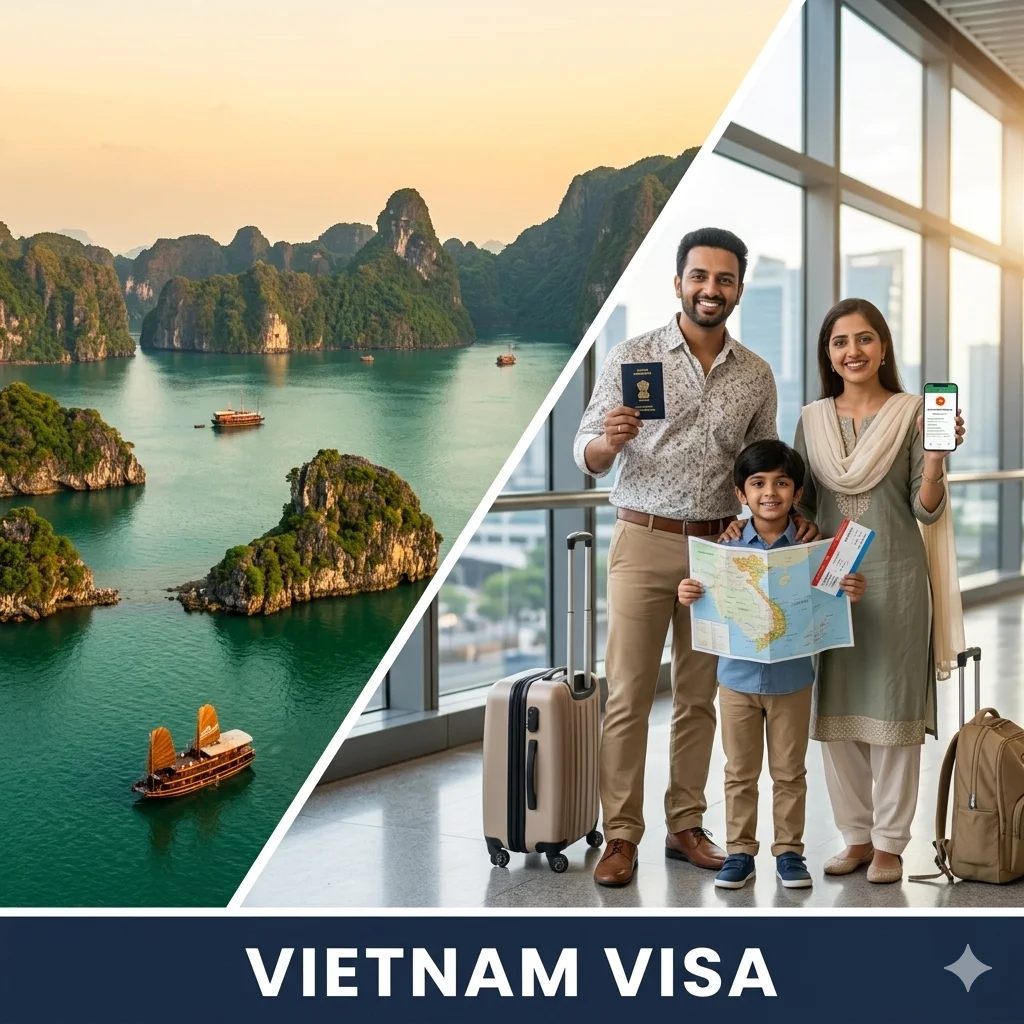
Vietnam has established itself as one of the most popular international travel destinations for Indian tourists — a country of extraordinary geographical variety stretching over 3,000 kilometres from the Chinese border in the north to the Gulf of Thailand in the south. The limestone karst towers of Ha Long Bay, one of UNESCO's most celebrated World Heritage Sites; the French colonial boulevards and ancient temples of Hanoi's Old Quarter; the frenetic energy and war history of Ho Chi Minh City; the lantern-lit streets and tailor shops of Hoi An Ancient Town; the marble mountains and beach resort culture of Da Nang; and the tropical island paradise of Phu Quoc — Vietnam offers Indian travellers a complete Southeast Asian experience that combines history, nature, cuisine, and coastline in one remarkably accessible destination.
Indian passport holders require a visa to enter mainland Vietnam. However, the good news is that Vietnam has made its e-visa system among the most straightforward in Southeast Asia — entirely online, processed in as few as 3 working days, with no embassy visit required. The Vietnam e-visa is available to all Indian nationals through the official portal evisa.gov.vn. RTH World Tour Packages processes the Vietnam e-visa at three transparent pricing tiers: Rs.3,099 for a 30-day single entry visa (validity 30 days), Rs.5,499 for a 30-day multiple entry visa (validity 30 days), and Rs.7,199 for a 90-day single entry visa (validity 90 days).
There is also a significant special provision for Indian travellers: Phu Quoc Island offers a 30-day visa-free entry for Indian nationals arriving by direct international flight to Phu Quoc International Airport, provided the entire stay remains within the island and a confirmed onward or return ticket is held. This makes Phu Quoc a uniquely accessible tropical island holiday for Indian travellers who want to experience Vietnam's most beautiful beaches without the standard visa application. This guide covers every aspect of the Vietnam visa — photograph rules, passport rules, the complete document checklist, all visa types, and 15 detailed frequently asked questions to help you plan the perfect Vietnam trip.
Vietnam Visa Types for Indian Nationals
Indian nationals have several pathways to enter Vietnam. The e-visa is strongly recommended for all standard tourism and business visits — it is the simplest, most cost-effective, and most reliable method. The other options have specific conditions and limitations.
Vietnam E-Visa — Applied Online at evisa.gov.vn
The Vietnam e-visa is the official electronic visa issued directly by the Vietnamese government through the portal evisa.gov.vn. It is 100% online — no embassy visit, no physical form submission, no agent intermediary required. The e-visa covers both tourism (DL visa code) and business (DN visa code) purposes. Explore our Vietnam Tour Packages to plan your itinerary alongside your visa.
- Stay: Up to 30 or 90 days per the selected e-visa type
- Entry: Single or multiple entry per selected type
- Government fee: USD 25 (single) / USD 50 (multiple)
- RTH fee: Rs.3,099 / Rs.5,499 / Rs.7,199 by tier
- Processing: 3 working days standard
- Delivery: E-visa PDF by email — must be printed
- Ports: All international airports, major land and sea border crossings
Visa on Arrival — Air Travel Only (Pre-Approval Required)
Visa on Arrival (VOA) is available only for air travel arriving at international airports in Vietnam (Hanoi Noi Bai, Ho Chi Minh City Tan Son Nhat, Da Nang, and others). It requires a pre-approval letter obtained in advance from a Vietnamese travel agency before your departure from India. Without this letter, airlines will not board you. This option is only appropriate for urgent travel when e-visa processing time is insufficient.
- Requires: Pre-approval letter from a Vietnamese travel agency
- On arrival: Cash stamping fee at airport — USD 25 (single) / USD 50 (multiple)
- Documents at counter: Pre-approval letter (printed), passport, 2 photographs, completed NA1 form
- Not available: Land border crossings; sea entry points
- RTH recommendation: E-visa is strongly preferred — VOA is slower, involves queues, and requires advance agency coordination
Transit Visa — WT Category
For Indian nationals transiting through Vietnam with entry into Vietnamese territory beyond the airside transit zone. Pure airside transit (remaining within the international departure area at the airport without passing through immigration) does not require a visa for most nationalities. If your layover requires you to enter Vietnam — to stay at a hotel, sightsee, or connect through a different airport — a transit visa is required.
- Stay: Up to 5 days for transit
- Applicable at: All international airports
- Alternative: If layover is under 24 hours entirely within the airport, no visa needed
- Documents: Onward ticket; valid visa for final destination; passport; accommodation booking
Phu Quoc Island — 30-Day Visa-Free Entry
Under Vietnam's Phu Quoc Special Economic Zone exemption, Indian passport holders can enter Phu Quoc Island visa-free for up to 30 days. This is one of the most generous travel provisions for Indian nationals in Southeast Asia — allowing access to Vietnam's finest tropical island without a visa application of any kind.
- Condition 1: Must arrive at Phu Quoc International Airport on a direct international flight (not via mainland Vietnam)
- Condition 2: Entire stay must remain within Phu Quoc Island — crossing to mainland Vietnam requires a valid visa
- Condition 3: Must hold a confirmed onward or return ticket to a foreign country departing from Phu Quoc within 30 days
- Fee: Nil — no visa fee for Phu Quoc exemption
- RTH note: For Phu Quoc + mainland Vietnam combined itinerary, an e-visa is required
The Vietnam e-visa is delivered as a PDF by email after approval. Unlike some other countries' digital travel authorisations, Vietnam's immigration officers at the arrival counter require you to present a physical printed copy of your e-visa alongside your passport. Showing the PDF on a phone screen is generally not accepted at Vietnamese immigration counters. Always print the e-visa before departure and carry it with your travel documents. RTH World Tour Packages reminds all clients to print their e-visa PDF as part of the pre-travel briefing.
Passport Rules — Vietnam Visa
| Requirement | Rule and Detail |
|---|---|
| Validity | Passport must be valid for a minimum of 6 months beyond your intended stay period in Vietnam — this is enforced at both the e-visa application stage and upon arrival at Vietnamese immigration. Airlines boarding at Indian airports will also check 6-month validity before allowing boarding |
| Blank Pages | Minimum 2 completely blank visa pages — Vietnamese immigration officers apply entry and exit stamps. For multi-country Southeast Asia itineraries (Vietnam + Thailand + Cambodia + Laos), ensure a minimum of 4–6 blank pages |
| Passport Number Accuracy | The passport number entered on the e-visa application must exactly match the passport you travel with. A single digit error will result in the e-visa being invalid at immigration — double-check every character before submitting the online application |
| Old Passports | For e-visa applications, only the current valid passport details are entered. Old passports do not need to be submitted. However, for visa-on-arrival pre-approval letter processes and embassy visas, travel history in old passports can strengthen the application |
| Condition | Passport must be undamaged and in good physical condition — no torn pages, water damage, or missing biographical data page. No handwritten amendments or corrections. Damaged passports must be renewed before applying |
| Children | Each child requires their own individual passport and separate e-visa application. Minors travelling without both parents require a notarised No Objection Certificate from the non-travelling or absent parent |
| E-Passport | Standard biometric e-passports are accepted. Vietnam immigration uses biometric scanners at major ports of entry — ensure your passport's machine-readable zone (MRZ) at the bottom of the biographical data page is clean, undamaged, and scannable |
Photograph Specifications — Vietnam E-Visa
For the Vietnam e-visa applied at evisa.gov.vn, the photograph is uploaded digitally during the online application — no physical print is submitted at this stage. However, for visa on arrival, two physical photographs are required at the airport counter. The specifications apply to both digital uploads and physical photographs:
| Specification | Requirement for Vietnam E-Visa |
|---|---|
| Dimensions | 4cm wide x 6cm high (40mm x 60mm) — this is Vietnam's standard passport photograph size, slightly different from the Indian standard 35x45mm used for most other visas |
| Digital resolution | Minimum 400 x 600 pixels for digital upload; 300 DPI strongly recommended; file size typically 50KB–500KB JPEG format |
| Recency | Taken within the last 6 months |
| Background | Plain white background — no shadows, no patterns, no off-white or grey backgrounds |
| Face coverage | Face must occupy 70–80% of the frame — full face visible from chin to top of head; both ears visible; head centred in frame |
| Expression | Neutral expression — mouth closed, eyes fully open, looking directly at camera lens |
| Glasses | Not permitted — remove all eyewear including prescription spectacles |
| Headgear | Not permitted (religious exception: full face including forehead, chin, and both cheeks clearly visible) |
| Lighting | Uniform, diffused studio lighting — no harsh facial shadows, no shadows on background |
| Print quality | For physical photographs (visa on arrival): professional photographic paper, matte or semi-gloss finish — not printed on standard office or inkjet paper |
| Digital alterations | No retouching, filters, background replacement, skin smoothing, or any digital editing of any kind |
| Hair and attire | Hair must not cover eyes; no heavy accessories obscuring the face; natural daily appearance. Avoid pure white clothing (merges with white background) |
Vietnam's standard passport photograph size for the e-visa is 4cm x 6cm (40mm x 60mm) — which is larger and in a different aspect ratio than the 35mm x 45mm photograph used for most other visa applications (India passport, Schengen, South Korea, etc.). Tell your photographer specifically that you need a 4x6cm photo for a Vietnam visa. RTH World Tour Packages includes photograph dimension verification as part of all e-visa processing services.
Documents Required — Complete Tabular Checklist
The Vietnam e-visa requires only digital document uploads — no physical file submission or embassy visit. The following checklist covers all documents required for the e-visa application, with additional requirements for visa on arrival and embassy visa noted where different. Documents are classified as Mandatory (M) or Conditional (C).
| Document Category | Specifications and Requirements | Required |
|---|---|---|
| Passport Scan |
|
MANDATORY |
| Digital Photograph |
|
MANDATORY |
| E-Visa Application Form |
|
MANDATORY |
| Flight Tickets |
|
MANDATORY |
| Accommodation |
|
MANDATORY |
| Bank Statement |
|
ADVISORY (Carry On Arrival) |
| Travel Insurance |
|
STRONGLY RECOMMENDED |
| Photographs — Physical |
|
CONDITIONAL (VOA / Embassy) |
| Pre-Approval Letter |
|
CONDITIONAL (VOA Only) |
| Business Documents |
|
CONDITIONAL (Business) |
| NOC / School Letter |
|
CONDITIONAL (Students / Minors) |
This document checklist is standard but not exhaustive. The Vietnamese immigration authority reserves the right to request additional documents at the port of entry based on the officer's assessment of specific circumstances. For the e-visa application at evisa.gov.vn, only the passport scan and digital photograph are uploaded — all other documents should be carried in the travel folder for immigration reference on arrival.
Vietnam E-Visa — Step-by-Step Application Procedure
All steps below — from form completion and photograph compliance to government fee payment, application submission, and e-visa PDF tracking and delivery — are fully managed by RTH World Tour Packages at Rs.3,099 (30-day single entry), Rs.5,499 (30-day multiple entry), or Rs.7,199 (90-day single entry). WhatsApp us on +91 91009 84920 to begin your Vietnam e-visa application today.
Choose Your E-Visa Type — Duration, Entry, and Purpose
Decide which of the three e-visa tiers suits your trip before starting the application. 30-day single entry is appropriate for most first-time Vietnam holidays of up to 4 weeks covering Hanoi, Ha Long Bay, Da Nang, Hoi An, and Ho Chi Minh City. 30-day multiple entry is best for Vietnam + Cambodia or Vietnam + Laos circuits where you may re-enter Vietnam. 90-day single entry is for extended stays, slow travel itineraries, or long-stay tourism across all regions. Also confirm your purpose: tourism (DL code) or business (DN code).
Prepare Your Passport Scan and Digital Photograph
Scan the biographical data page of your passport at high resolution — ensure all text, numbers, and the MRZ lines at the bottom are fully legible with no shadows or glare. Obtain your digital passport photograph: 4cm x 6cm (40mm x 60mm), minimum 400x600 pixels, plain white background, taken within the last 6 months, no glasses, no headgear, neutral expression. Save both files as JPEG (under 2MB each). RTH verifies photograph dimensions and passport scan clarity for every client before the application is submitted.
Complete the Online Application Form at evisa.gov.vn
Visit the official Vietnam e-visa portal at evisa.gov.vn and click "Apply for E-Visa". Complete all fields accurately — every detail must exactly match your passport. Key fields: full name as in passport (including middle names in the correct field), date and place of birth, nationality, passport number, passport expiry date, intended entry date, entry port, intended exit date, exit port, first accommodation address in Vietnam, emergency contact name and phone number, and purpose of visit. Upload the passport scan and digital photograph. RTH fills and cross-checks every field of the form before submission.
Pay the Government E-Visa Fee Online
Pay the Vietnamese government e-visa fee at the time of form submission: USD 25 for single entry (any duration), USD 50 for multiple entry. Payment is made by international credit or debit card (Visa, MasterCard) directly on the evisa.gov.vn portal. This fee is included in RTH's processing fee — you do not pay it separately when using the RTH service. After payment, a confirmation page and application reference number are generated — save this number for status tracking.
Track Application — Receive E-Visa PDF by Email
Track your e-visa status at evisa.gov.vn using the application reference number and your passport number. Standard processing is 3 working days. Upon approval, the e-visa is delivered as a PDF to the email address provided in the application. The PDF contains your visa details, passport number, entry type, validity dates, and a unique barcode. RTH monitors the status and delivers the e-visa PDF to you immediately upon receipt. If a correction is required (typically a photograph or document quality issue), RTH coordinates the resubmission.
Print E-Visa PDF and Prepare Travel Folder
Print the e-visa PDF before departure — Vietnamese immigration counters require a physical printed copy presented alongside your passport. Do not rely on showing the PDF on a phone screen. Prepare your complete travel folder: printed e-visa + passport + return flight ticket printout + accommodation confirmation + travel insurance certificate + bank statement copy. Verify the e-visa details before departure: your name, passport number, validity dates, entry type (single/multiple), entry and exit ports match your actual travel plans. RTH provides a pre-travel checklist for all clients.
Arrive in Vietnam — Present Documents at Immigration
On arrival at your Vietnamese entry port (Hanoi Noi Bai International Airport, Ho Chi Minh City Tan Son Nhat International Airport, Da Nang International Airport, or other designated ports), proceed to the immigration counter. Present: printed e-visa, valid passport, and completed arrival declaration form (available on the aircraft or at the airport). The immigration officer will scan your e-visa barcode and passport, verify your details, and stamp your passport with the entry stamp. The entire process takes 2–5 minutes with an e-visa and no queue at a separate visa issuance counter — a major advantage over visa on arrival.
Vietnam Visa Fees — Reference Table for Indian Applicants
| Visa Type | Entry | Duration / Validity | Govt Fee (USD) | RTH Processing (INR) |
|---|---|---|---|---|
| E-Visa — Tourism (DL) | Single | 30 days / 30-day validity | USD 25 (~Rs.2,100) | Rs.3,099 |
| E-Visa — Tourism (DL) | Multiple | 30 days per entry / 30-day validity | USD 50 (~Rs.4,200) | Rs.5,499 |
| E-Visa — Tourism (DL) | Single | 90 days / 90-day validity | USD 25 (~Rs.2,100) | Rs.7,199 |
| E-Visa — Business (DN) | Single / Multiple | 30 or 90 days as applied | USD 25–50 | As per tier |
| Visa on Arrival | Single | 30 days | USD 25 (stamping fee) | + Agency approval fee |
| Visa on Arrival | Multiple | 30 days per entry | USD 50 (stamping fee) | + Agency approval fee |
| Phu Quoc Island | Single (island only) | 30 days — visa-free | Nil | Nil |
RTH World Tour Packages' Vietnam e-visa fees (Rs.3,099 / Rs.5,499 / Rs.7,199) include the Vietnamese government's USD 25 or USD 50 e-visa fee, the complete application form assistance, digital photograph compliance verification, passport scan quality check, submission on evisa.gov.vn, status tracking through the 3 working day processing window, e-visa PDF delivery, and WhatsApp support. The government fee is not charged separately — the RTH price is all-inclusive. All government fees are non-refundable once submitted — whether the e-visa is approved or if a correction is needed. RTH verifies all documents before submission to minimise correction requests.
Video References — Vietnam E-Visa and Travel Guide
Vietnam E-Visa for Indians — Complete Step-by-Step Application at evisa.gov.vn — Documents, Form, Fee and Tracking 2025–2026
A practical video walkthrough of the complete Vietnam e-visa application at evisa.gov.vn — creating the account, filling all form fields accurately, uploading the 4x6cm passport photograph and biographical data page scan, paying the USD 25 government fee by card, tracking the 3-day processing, downloading and printing the e-visa PDF, and presenting it at Vietnamese immigration on arrival. Covers the three e-visa tiers, common rejection reasons, and photograph specification tips for Indian applicants.
Search on YouTubeVietnam Travel Guide for Indian Tourists — Hanoi, Ha Long Bay, Da Nang, Hoi An, Ho Chi Minh City, Phu Quoc 2025
Indian travel vloggers covering the complete Vietnam experience — Hanoi's Old Quarter, Hoan Kiem Lake and Ngoc Son Temple, Ha Long Bay overnight cruise among limestone karsts, Da Nang's Dragon Bridge and Marble Mountains, Hoi An Ancient Town's lantern-lit evenings and Ancient Town cycling, Hue Imperial Citadel and Royal Tombs, Ho Chi Minh City's Ben Thanh Market and Cu Chi Tunnels, and Phu Quoc Island's Long Beach and cable car to Sao Beach. Budget tips, street food guide, and transport advice specifically for Indian visitors to Vietnam.
Search on YouTubeTips for a Smooth Vietnam E-Visa and Travel Experience
Apply 5–7 Days Before Travel
Standard processing is 3 working days. Apply 5–7 working days before travel to allow time for any correction requests from the Vietnamese immigration portal. Urgent applications submitted 1–2 days before travel carry risk if any document quality issue arises.
Always Print Your E-Visa PDF
Vietnamese immigration counters require a physical printed copy of your e-visa. Showing the file on a phone screen is generally not accepted. Print it before boarding your flight and carry it with your passport at all times during the Vietnam trip.
Check Your Entry Port on the E-Visa
The Vietnam e-visa specifies valid entry and exit ports. Ensure your flight lands at an airport listed on your e-visa. While the e-visa is now valid at most international entry points, verify your specific entry port is covered before finalising flights.
Vietnam Photo Is 4x6cm — Not 35x45mm
Vietnam's standard passport photograph is 4cm x 6cm — larger and different in proportion to the standard 35x45mm used for most other visas. Tell your photographer explicitly: "4 by 6 cm for Vietnam visa." RTH verifies this for all clients before submission.
Multiple Entry Visa for Multi-Country Circuits
If your Southeast Asia itinerary includes Vietnam + Cambodia or Vietnam + Laos with re-entry into Vietnam, choose the 30-day multiple entry e-visa at Rs.5,499. Each individual stay must remain within 30 days even with multiple entry.
Phu Quoc Visa-Free — Arrive Direct from India
For a Phu Quoc Island-only holiday, you can take advantage of the 30-day visa-free exemption by flying direct from India to Phu Quoc International Airport (PQC). If your itinerary also includes mainland Vietnam, you must hold a valid e-visa covering the full trip.
Best Seasons for Vietnam
North Vietnam (Hanoi, Ha Long Bay): October–April for dry and cool weather. Central Vietnam (Da Nang, Hoi An, Hue): February–May for sunshine; avoid November–January (typhoon season). South Vietnam (Ho Chi Minh City, Mekong Delta): November–April for dry season. Phu Quoc: November–April for calm seas and sunshine.
Currency — Vietnamese Dong (VND)
Vietnam's currency is the Vietnamese Dong (VND). Exchange rates: approximately VND 28,000–30,000 per USD 1; approximately VND 320–340 per Rs.1. Cash in VND is important — while major hotels and restaurants in cities accept cards, street food vendors, local markets, and rural areas are cash-only. Withdraw VND from ATMs at Hanoi and Ho Chi Minh City airports on arrival.
Planning Your Vietnam Journey — Key Destinations
Hanoi — Capital and Cultural Heart
Vietnam's capital and the gateway to the north — Hanoi's Old Quarter with its 36 guild streets, Hoan Kiem Lake and the iconic red Huc Bridge to Ngoc Son Temple, the Ho Chi Minh Mausoleum complex, Huong Pagoda (Perfume Pagoda pilgrimage site 60km south), the Vietnam National Fine Arts Museum, and the legendary Hanoi egg coffee served at hidden rooftop cafes above the Old Quarter. Hanoi is the starting point for most northern Vietnam itineraries.
Ha Long Bay — UNESCO Wonder
Vietnam's most iconic natural wonder — 1,600 limestone karst islands rising from emerald waters across a 1,553 sq km UNESCO World Heritage Site. An overnight cruise aboard a traditional junk boat through Ha Long Bay is considered one of Southeast Asia's great travel experiences — kayaking through hidden lagoons, exploring stalactite caves (Sung Sot, Thien Cung), swimming in secluded coves, and watching the mist dissolve over limestone peaks at dawn. Explore our Hanoi and Ha Long Bay 4-day tour package for a perfectly structured introduction to Vietnam's north.
Da Nang — Beach City and Central Gateway
Central Vietnam's most dynamic city — the golden sand beaches of My Khe and Non Nuoc Beach, the Son Tra Mountain (Monkey Mountain) with its towering Lady Buddha statue, the Marble Mountains with cave temples and panoramic views, the iconic Dragon Bridge illuminated in fire and water shows on weekends, and the futuristic Golden Bridge held up by two giant stone hands. Da Nang is the perfect base for day trips to Hoi An and Hue. Experience our Da Nang and Hoi An 4-day tour.
Hoi An — Ancient Town of Lanterns
Vietnam's most photographed destination — a remarkably preserved 15th-century trading port recognised as a UNESCO World Heritage Site. Hoi An Ancient Town's yellow-walled merchant houses, the Japanese Covered Bridge, candlelit lantern festivals on the 14th of each lunar month, the dozens of tailoring shops that can stitch a bespoke outfit in 24 hours, My Son Hindu Cham temple ruins nearby, and the cycling paths through the Thu Bon River rice paddies. An absolute must-include on any central Vietnam itinerary. Read our full Vietnam travel guide for more.
Ho Chi Minh City — Vibrant South
Vietnam's commercial and cultural powerhouse — the Ben Thanh Market, the Reunification Palace (capturing the moment of Vietnam's reunification in 1975 with its legendary tank in the front courtyard), Notre-Dame Cathedral Basilica, the Central Post Office designed by Gustave Eiffel, the dramatic Cu Chi Tunnels (a 250km underground network used during the Vietnam War), the War Remnants Museum, the Mekong Delta floating market day trips from the city, and the rooftop bar culture of Bui Vien Street. Our Southern Vietnam Serenity Tour covers the best of HCMC.
Phu Quoc — Tropical Island Paradise
Vietnam's largest island and most celebrated beach destination — located in the Gulf of Thailand off the southwestern coast. Phu Quoc offers some of Southeast Asia's finest beaches: Long Beach (Bai Truong) for sunsets and seafood, the pristine white sand of Sao Beach (Bai Sao), the Vinpearl Land cable car (the world's longest over-sea gondola at 7.9km), the night market at Duong Dong town, pepper plantations, fish sauce factories, and the Phu Quoc National Park. Indians can visit Phu Quoc visa-free for 30 days on direct international flights — making this one of India's most accessible tropical island getaways.
Browse our complete Vietnam Tour Packages from India — including the Vietnam Essence 7-day tour covering Hanoi, Ha Long Bay, and Ho Chi Minh City; the Hanoi Heritage Getaway 4-day package; and the Charming Vietnam Getaway 5-day package from Hanoi to Ha Long Bay to Da Nang. For broader Southeast Asia travel, see our Singapore Visa guide, UAE Visa guide, and our full Visa Policy Centre. Contact our team for a personalised Vietnam itinerary and e-visa consultation.
Ready for Vietnam? Ha Long Bay, Hoi An, Phu Quoc — Begin Your E-Visa Today.
Vietnam e-visa processed by RTH World Tour Packages — Rs.3,099 (30-day single), Rs.5,499 (30-day multiple), Rs.7,199 (90-day single). Complete form assistance, photograph compliance, and PDF delivery in 3 working days.
Apply for Vietnam E-Visa Vietnam Tour Packages Contact Our TeamPlan Your Custom Vietnam Trip
Tell us your travel dates, visa type, and preferences — our Vietnam specialists at RTH World Tour Packages will send you a tailored itinerary and e-visa quote within 24 hours. All fields marked * are required.
Vietnam Visa for Indians — 15 Frequently Asked Questions
Yes — Indian passport holders require a visa to enter mainland Vietnam. There is no visa-free entry for Indians to the Vietnamese mainland. However, Vietnam has made the process exceptionally straightforward through its e-visa system — one of the most accessible tourist visa systems in Southeast Asia.
The three entry options for Indians:
- Vietnam E-Visa (recommended): Applied 100% online at evisa.gov.vn — no embassy visit, no physical document submission, no agent required. Processed in 3 working days. Delivered as a PDF by email. Government fee: USD 25 (single) or USD 50 (multiple). RTH World Tour Packages processes at Rs.3,099 / Rs.5,499 / Rs.7,199 all-inclusive
- Visa on Arrival (air travel only, urgent cases): Requires a pre-approval letter from a Vietnamese travel agency obtained before departure from India. Cash stamping fee paid at the airport on arrival. More cumbersome and involves queuing at a separate visa issuance counter — only recommended when e-visa processing time is insufficient due to last-minute travel
- Embassy/Consulate Visa: Applied at the Vietnamese Embassy in New Delhi or Consulate in Mumbai or Chennai. Best for long-stay visas over 90 days, work visas, or study visas. Processing time 3–5 working days; appointment required; physical document submission
Phu Quoc Island special provision: Indians can enter Phu Quoc Island visa-free for up to 30 days on direct international flights to Phu Quoc International Airport — no visa application required for a Phu Quoc Island-only holiday. See FAQ 4 for full conditions.
Vietnam's e-visa system currently offers two validity options — 30-day and 90-day — with single and multiple entry choices. Understanding the difference is important before applying:
| E-Visa Type | Max Stay Per Entry | Validity | Govt Fee | RTH Fee | Best For |
|---|---|---|---|---|---|
| 30-Day Single Entry | 30 days | 30 days from start date | USD 25 | Rs.3,099 | Standard 2–4 week Vietnam holidays |
| 30-Day Multiple Entry | 30 days per entry | 30 days from start date | USD 50 | Rs.5,499 | Vietnam + Cambodia or Vietnam + Laos circuits with re-entry |
| 90-Day Single Entry | 90 days continuous stay | 90 days from start date | USD 25 | Rs.7,199 | Extended stays, slow travel, 2–3 month Vietnam exploration |
Important distinction — validity vs. stay duration:
- The 30-day e-visa gives you 30 days of validity — you must both enter and exit Vietnam within 30 days of the visa start date you specified in the application. The maximum stay is 30 days from the first entry date
- The 90-day e-visa gives you 90 days of validity — you can enter any time within these 90 days, and stay continuously for up to 90 days from your first entry. This is ideal for budget travellers, remote workers, or those combining Vietnam with extended Southeast Asia itineraries
- For the 30-day multiple entry option: each individual stay within Vietnam must not exceed 30 days, and all entries and exits must occur within the 30-day validity window — meaning this is primarily for short border-hop circuits, not for extended stays
Choosing the right e-visa: For a standard 10–21 day Vietnam holiday covering Hanoi, Ha Long Bay, Da Nang, Hoi An, and Ho Chi Minh City, the 30-day single entry at Rs.3,099 is perfect. For slow travel or an extended Vietnam exploration over 1–3 months, the 90-day single entry at Rs.7,199 offers excellent value and eliminates the need to apply for a second visa mid-trip.
The Vietnam e-visa requires a digital passport photograph uploaded directly during the online application at evisa.gov.vn — no physical photograph print is submitted for the e-visa itself (physical prints of 2 photos are only required for visa on arrival stamping at the airport).
Complete Vietnam e-visa photograph specifications:
- Dimensions: 4cm wide x 6cm high (40mm x 60mm) — note this is Vietnam's standard, different from the 35x45mm used for most other visa applications. Specify "4 by 6 cm for Vietnam" to your photographer
- Digital resolution: Minimum 400 x 600 pixels; strongly recommended 600 x 900 pixels at 300 DPI for best results on the portal
- File format: JPEG; file size typically between 50KB and 2MB (check current portal upload limit)
- Background: Plain white — no shadows, no patterns
- Face coverage: 70–80% of the frame; full face from chin to top of head; both ears visible
- Expression: Neutral — mouth closed, eyes fully open, looking directly at camera
- Glasses: Not permitted
- Headgear: Not permitted (religious exception with full face visible)
- Recency: Taken within the last 6 months
- Lighting: Uniform diffused studio lighting — no harsh shadows
- Alterations: No digital retouching, filters, or background replacement
Common photograph rejection reasons at evisa.gov.vn:
- Incorrect file dimensions — submitting a 35x45mm image instead of 4x6cm
- File size too large — compress the JPEG if the portal rejects the upload
- Glasses present
- Photo older than 6 months
- Shadow on background
- Face too small in the frame — insufficient face coverage
RTH World Tour Packages checks photograph dimensions and quality compliance for every client before submitting the e-visa application — a critical step that eliminates the most common cause of application rejection or return for correction.
Vietnam maintains a special visa exemption specifically for Phu Quoc Island under the Phu Quoc Special Economic Zone (SEZ) regulations. This is one of the most generous visa provisions for Indian nationals in Southeast Asia — allowing up to 30 days of visa-free stay on Vietnam's most beautiful island.
Conditions for Phu Quoc Island visa-free entry for Indians:
- Arrival requirement: You must arrive at Phu Quoc International Airport (PQC) on a direct international flight from outside Vietnam. Flights transiting through Hanoi, Ho Chi Minh City, Da Nang, or any other Vietnamese airport do not qualify — you must enter Vietnamese territory for the first time at Phu Quoc itself
- Stay requirement: Your entire stay must remain within Phu Quoc Island. You are not permitted to travel to mainland Vietnam under this exemption. The island includes the main town of Duong Dong, Phu Quoc National Park, all beaches, and the smaller satellite islands of the An Thoi Archipelago reachable by boat from Phu Quoc
- Onward ticket requirement: You must hold a confirmed onward or return ticket departing from Phu Quoc to a foreign country (not to another Vietnamese airport) within 30 days
- Duration: Maximum 30 days — not extendable under the visa-free provision
- Passport validity: Minimum 6 months validity beyond your Phu Quoc departure date
What voids the Phu Quoc exemption:
- Taking a boat or ferry from Phu Quoc to Ha Tien or Rach Gia on the mainland — this constitutes entry into mainland Vietnam and requires a valid visa
- Taking a domestic flight from Phu Quoc to Hanoi, Ho Chi Minh City, or any mainland airport
Combined Phu Quoc + Mainland Vietnam itinerary: If you want to visit both Phu Quoc and mainland Vietnam destinations (Hanoi, Ha Long Bay, Ho Chi Minh City, Da Nang, Hoi An), you must hold a valid Vietnam e-visa covering the entire trip. The Phu Quoc exemption is only applicable for Phu Quoc Island-only visits. RTH recommends the 30-day single entry e-visa at Rs.3,099 for combined itineraries that include both Phu Quoc and the mainland.
The official Vietnam e-visa processing time is 3 working days from the date of successful application submission at evisa.gov.vn. Processing is conducted by the Vietnam Immigration Department of the Ministry of Public Security (Cục Quản lý xuất nhập cảnh).
| Application Scenario | Processing Time | Recommended Submission |
|---|---|---|
| Standard application — complete, correct documents | 3 working days | 5–7 working days before travel |
| Application with document correction request | 3 working days after correction | 10 working days before travel |
| Peak season (Tet holiday Jan–Feb, summer Jul–Aug) | 3–5 working days | 10–14 days before travel |
| Urgent same-day / next-day | Not officially available — use VOA | N/A |
Maximum advance application period: The Vietnam e-visa can be applied for a maximum of 90 days before the intended entry date stated in the application. You cannot apply earlier than 90 days before your stated first entry date. The visa start date is the date you specify as your entry date in the application — not the date of application submission.
RTH recommendation: Apply 5–7 working days before travel for straightforward applications with complete, compliant documents. Apply 10 working days before travel during peak periods (Vietnam's Tet New Year holiday in January–February, summer July–August) when the immigration portal experiences higher volume. Never submit an e-visa application less than 4 working days before travel without a backup plan — if a correction is needed, you may not receive the corrected visa in time.
Vietnam's e-visa extension policy has evolved significantly. From August 2023, when Vietnam reformed its visa law, e-visa extensions inside Vietnam are possible in principle but involve a specific process through the Vietnam Immigration Department.
E-Visa extension process in Vietnam:
- Extensions must be applied for at the nearest Vietnam Immigration Department office (Phòng Quản lý Xuất nhập cảnh) before the current visa expires — not online at evisa.gov.vn
- Applications can be submitted at provincial immigration offices in Hanoi, Ho Chi Minh City, Da Nang, and all major provinces
- Required documents: original passport, current e-visa, completed extension application form, accommodation confirmation for the extended period, and the extension fee payment
- Processing time: 3–7 working days for extension approval
- The maximum total stay on a tourism visa (including extensions) is generally 90 days within a 12-month period
Practical reality: While legal in principle, in-country e-visa extensions can be bureaucratically complex and are not guaranteed. The most reliable approach is to apply for the 90-day single entry e-visa at Rs.7,199 from RTH if you anticipate needing more than 30 days in Vietnam — this eliminates the need for any in-country extension.
Overstay consequences: Overstaying a Vietnam visa is taken seriously — fines of approximately USD 10–100 per day of overstay, potential ban from re-entering Vietnam for 6 months to 5 years, and forced exit at the immigration counter. Never overstay — apply for an extension through the proper channel or exit Vietnam before expiry.
Yes — a multi-country Southeast Asia circuit combining Vietnam, Cambodia, Thailand, and Laos is one of the most popular international travel itineraries for Indian tourists. Each country requires independent visa management:
| Country | Visa for Indians | RTH Service / Note |
|---|---|---|
| Vietnam | E-visa required — applied at evisa.gov.vn | Rs.3,099 (30D SE) / Rs.5,499 (30D ME) / Rs.7,199 (90D SE) |
| Cambodia | E-visa available at evisa.gov.kh OR visa on arrival | Government fee USD 30; apply online independently |
| Thailand | Visa-on-arrival for Indians — 30 days; or e-visa for longer stays | No pre-application needed for standard 30-day VOA |
| Laos | Visa on arrival at Vientiane and Luang Prabang airports — 30 days | USD 30–40 stamping fee; no pre-approval needed |
Visa strategy for a Vietnam + Cambodia circuit:
- If re-entering Vietnam after visiting Cambodia (e.g., Ho Chi Minh City — Phnom Penh — Siem Reap — re-enter Vietnam at the Moc Bai land border): choose the 30-day multiple entry e-visa at Rs.5,499 — this allows you to exit and re-enter Vietnam within the 30-day validity window
- If visiting Vietnam only before or after Cambodia without re-entry: the 30-day single entry at Rs.3,099 is sufficient
- For land border crossings between Vietnam and Cambodia, verify that your Vietnam e-visa covers the specific border crossing you intend to use — check the designated ports listed on your e-visa
RTH World Tour Packages' team can advise on the optimal visa strategy for any multi-country Southeast Asia circuit.
Vietnam's e-visa approval rate is high — the vast majority of correctly submitted applications are approved within 3 working days. However, there are specific issues that cause rejection or requests for correction:
- Photograph non-compliance: Incorrect dimensions (35x45mm submitted instead of 4x6cm), photo older than 6 months, glasses visible, shadow on background, face too small in frame, or incorrect file format. This is the single most common cause of rejection or correction requests. RTH verifies photographs before every submission
- Passport scan quality: Blurry, shadowed, or cropped scan where the MRZ lines at the bottom of the biographical data page are not fully visible. Ensure the entire page including borders is clearly captured at high resolution
- Name mismatch: Name entered on the application does not exactly match the passport — even a middle name omitted or abbreviated differently. Every character must match the passport exactly
- Passport number error: A single digit or letter error in the passport number renders the e-visa invalid for travel even if approved. Triple-check this field
- Invalid entry date: Entry date specified has already passed at the time of processing, or the date is more than 90 days from submission
- Unrecognised entry port: Specifying a port of entry that is not a recognised international entry point on the current approved list
- Prior Vietnam immigration violations: A previous overstay, deportation, or immigration violation recorded against the passport — these may result in rejection
What to do if your application is rejected: Review the rejection reason, correct the specific issue, and resubmit a new application. Each new application requires a new government fee payment (USD 25 or USD 50). Rejected fee payments are non-refundable. RTH analyses rejection reasons and resubmits corrected applications for clients, verifying every field before the new submission.
Vietnam is a moderate challenge for strict Indian vegetarians — Vietnamese cuisine is heavily built around pho (beef or chicken broth), seafood, pork, and fish sauce (nuoc cham, which is used as a base in a vast range of dishes). However, the situation is far better than it might appear, and with some preparation, Indian vegetarian travellers can eat very well in Vietnam.
Vegetarian-friendly Vietnamese food options:
- Com chay (vegetarian rice): Buddhist vegetarian cuisine is widely available across Vietnam — look for com chay restaurants (usually marked with a yellow sign and image of a Buddha). Vietnamese Buddhist vegetarian food is diverse and well-developed, including mock meat dishes made from tofu, mushrooms, and gluten
- On the 1st and 15th of each lunar month, many Vietnamese Buddhists eat vegetarian — on these days (occurring roughly twice monthly), the number of vegetarian restaurants and stalls increases significantly even in small cities
- Banh mi with vegetarian fillings: Vietnam's famous baguette sandwich can be ordered with only vegetables, egg, or tofu fillings — specify "banh mi chay" (vegetarian banh mi)
- Fresh spring rolls (goi cuon): Available vegetarian with tofu, herbs, and rice noodles; avoid pork or shrimp variations
- Fruit and smoothies: Vietnam has outstanding tropical fruit — mango, dragon fruit, rambutan, jackfruit, mangosteen — and freshly blended fruit smoothies are widely available and inexpensive
- Indian restaurants: Hanoi's Old Quarter, Da Nang's beach strip, and Ho Chi Minh City's tourist areas have a growing number of Indian restaurants
Essential Vietnam practical tips for Indian travellers:
- Currency: Vietnamese Dong (VND) — approximately Rs.1 = VND 325–340; carry VND cash for markets and street food; ATMs widely available at airports and cities
- SIM card: Purchase a local Viettel or Mobifone SIM at the airport arrivals hall — fast 4G data at very low cost compared to Indian roaming rates
- Grab (like Ola): Grab is the dominant ride-hailing app in Vietnam — far more reliable and fare-transparent than street taxis
- Bargaining: Expected at local markets (Ben Thanh in HCMC, Dong Xuan in Hanoi); not applicable in air-conditioned shops and restaurants
- Traffic in Hanoi and HCMC: Crossing the road requires patience — walk slowly and steadily; motorbikes will flow around you. Do not stop suddenly while crossing
- Temple etiquette: Dress modestly at temples and pagodas — shoulders and knees covered; remove shoes before entering worship spaces
Vietnam's elongated north-to-south geography means that different regions have different optimal seasons. Unlike most countries with a uniform "best season," in Vietnam the optimal time depends heavily on which region you are visiting:
| Region | Best Season | Months | Avoid |
|---|---|---|---|
| North Vietnam (Hanoi, Ha Long Bay, Sapa, Ha Giang) | Autumn and Spring — dry, mild, excellent visibility on Ha Long Bay | October–April | May–June: hot and humid; July–August: heavy rain; Jan–Feb: Tet crowds |
| Central Vietnam (Da Nang, Hoi An, Hue, Hue) | Late spring and early summer — sunny, warm, low rainfall | February–May | October–January: typhoon and heavy rain season — Hoi An floods; June–August: occasional extreme heat |
| South Vietnam (Ho Chi Minh City, Mekong Delta) | Dry season — low humidity, sunshine, easy river travel | November–April | May–October: rainy season (heavy afternoon showers but manageable with indoor activities) |
| Phu Quoc Island | Dry season — calm seas, visibility for snorkelling, blue water | November–April | May–October: rainy season with rough seas and limited boat trips to outer islands |
Best overall compromise period for a full north-to-south Vietnam itinerary: February to April — Ha Long Bay is past its coldest mist period and entering pleasant spring clarity; Da Nang and Hoi An are in their best dry window; Hue is comfortable; and Ho Chi Minh City and Phu Quoc are in dry season. This period corresponds to Vietnam's post-Tet recovery when prices stabilise and crowds reduce.
For Indian travellers specifically: November to March aligns well with Indian school and public holidays, making it the most convenient and climatically suitable booking window for Vietnam trips from India.
Vietnam's e-visa system underwent a significant expansion from August 2023 when the new immigration law came into effect. The current e-visa covers the vast majority of Vietnam's international entry ports — including airports, major land border crossings, and sea ports.
International airports (all active, e-visa valid):
- Noi Bai International Airport, Hanoi (HAN) — main northern gateway for Indian travellers
- Tan Son Nhat International Airport, Ho Chi Minh City (SGN) — main southern gateway
- Da Nang International Airport (DAD) — central Vietnam hub
- Phu Quoc International Airport (PQC) — island gateway; also covered by 30-day visa-free exemption for Indians
- Cam Ranh International Airport, Nha Trang (CXR)
- Cat Bi International Airport, Hai Phong (HPH)
- Lien Khuong Airport, Da Lat (DLI)
- Phu Bai International Airport, Hue (HUI)
- Tho Xuan Airport, Thanh Hoa
- Can Tho International Airport (VCA)
Land border crossings (major e-visa valid crossings with Cambodia and Laos):
- Moc Bai (Tay Ninh Province) — Vietnam/Cambodia: the most commonly used land crossing for HCMC to Phnom Penh routes
- Xa Mat (Tay Ninh Province) — Vietnam/Cambodia
- Lao Bao (Quang Tri Province) — Vietnam/Laos
- Cau Treo (Ha Tinh Province) — Vietnam/Laos
- Nam Can (Nghe An Province) — Vietnam/Laos
- Nam Phao — Vietnam/Laos
Important: Always verify the specific entry and exit ports covered by your e-visa application — you select your intended entry and exit port during the application at evisa.gov.vn. While the current e-visa covers most ports, confirm that the specific crossing on your itinerary is listed on your approved e-visa PDF before proceeding to a land border.
A Ha Long Bay cruise is considered one of the great travel experiences of Southeast Asia — and is the highlight of most Vietnam itineraries for Indian tourists. Ha Long Bay (Vịnh Hạ Long — "Bay of Descending Dragon") is a UNESCO World Heritage Site in northeastern Vietnam comprising approximately 1,600 limestone karst islands rising from the emerald Gulf of Tonkin waters across 1,553 square kilometres.
Cruise options and duration recommendations:
| Cruise Type | Duration | What's Included | Best For |
|---|---|---|---|
| Day cruise | Full day (8–9 hours) | Lunch, cave visit, kayaking; no overnight | Very tight itineraries; budget travellers |
| 2-day / 1-night cruise | 2 days, 1 night on boat | Cave visits, kayaking, sunset, 1 dinner + 2 meals; 1 night anchored in bay | Most popular for standard Vietnam trips; balances experience with time |
| 3-day / 2-night cruise | 3 days, 2 nights on boat | All of above + Lan Ha Bay or Bai Tu Long Bay extension; cooking class; Tai Chi at sunrise; more remote areas | Recommended for the definitive Ha Long Bay experience |
| Luxury cruise | 2–4 nights | Premium junk boats, private cabins with balconies; fine dining; spa treatments | Honeymoons; premium travellers |
Cruise categories: Budget cruises start at approximately Rs.6,000–8,000 per person for a 2-day/1-night cruise; mid-range at Rs.12,000–20,000; premium at Rs.25,000–50,000+. The type of boat (junk boat, modern cruise ship, traditional wooden boat), cabin quality, food standard, and number of activities vary significantly across categories.
From India's perspective: RTH's Hanoi and Ha Long Bay 4-day tour is the most popular Vietnam package for Indian groups — covering arrival in Hanoi, Old Quarter sightseeing, an overnight Ha Long Bay cruise, and departure. For a 7-day Vietnam circuit, add Da Nang and Ho Chi Minh City for a comprehensive north-to-south itinerary.
Vietnam is generally considered a safe destination for international tourists, including Indian travellers. Violent crime against tourists is uncommon. Vietnam consistently ranks well in Southeast Asia safety indices. That said, like all popular tourist destinations, a few specific precautions are appropriate:
Safety considerations:
- Petty theft: Bag snatching from motorbikes is the most common tourist safety incident, particularly in Ho Chi Minh City's tourist areas (Bui Vien, Ben Thanh area). Hold bags on the inner side away from the road; avoid using your phone openly while standing on busy streets
- Traffic: Vietnam's traffic — particularly in Hanoi and HCMC — is chaotic by Indian urban standards. Motorbike density is very high. Use Grab rather than crossing roads unnecessarily; follow local pedestrian crossing customs (walk steadily, do not run or stop suddenly)
- Food hygiene: Street food is generally safe and excellent but avoid raw or lightly cooked shellfish in areas with questionable hygiene practices. Drink bottled or filtered water — do not drink tap water
- Sun protection: Equatorial sun in southern Vietnam and during summer months is very intense. Use SPF 50+ sunscreen, a hat, and UV-protective clothing especially on Ha Long Bay cruises and Phu Quoc beaches
Health precautions recommended for Vietnam travel:
- Vaccinations: Consult your travel doctor regarding Hepatitis A, Typhoid, and Tetanus before travel to Vietnam. These are standard recommendations for Southeast Asian travel from India
- Dengue fever: Present in Vietnam year-round; more prevalent during and after the rainy season. Use mosquito repellent (DEET-based, 20–30% concentration), especially at dawn and dusk. Wear long sleeves in forested areas (Phu Quoc National Park, Ha Long Bay kayaking)
- Malaria: Low risk in major cities and tourist areas. Higher risk in border regions and highland forests — consult a travel doctor for prophylaxis if visiting remote highland areas (Sapa, Ha Giang)
- Travel insurance: Strongly recommended — Vietnam's private international hospitals charge significant fees for emergency treatment
This depends on which e-visa type you hold and the specific conditions of your multi-country itinerary:
Scenario 1 — Single entry e-visa + exit to Cambodia or Laos: If you hold a 30-day single entry or 90-day single entry Vietnam e-visa and exit Vietnam to visit Cambodia, Thailand, or Laos, your single entry e-visa is consumed and cannot be used for re-entry into Vietnam. You would need to apply for a new e-visa for any subsequent Vietnam visit, or obtain a new visa on arrival pre-approval letter.
Scenario 2 — Multiple entry e-visa + exit and re-entry: The 30-day multiple entry e-visa at Rs.5,499 allows you to exit and re-enter Vietnam multiple times within the 30-day validity window. This is ideal for circuits such as:
- Ho Chi Minh City — Phnom Penh (Cambodia) — Siem Reap (Cambodia) — return to HCMC via land border at Moc Bai
- Hanoi — Vientiane (Laos) — Luang Prabang (Laos) — return to Hanoi via Lao Bao border crossing
Key requirement for re-entry with multiple entry e-visa:
- All re-entries must occur within the 30-day validity window from the visa start date
- Each individual stay within Vietnam must not exceed 30 days
- The re-entry port must be a recognised e-visa valid port (same list as initial entry ports)
- Your passport must remain valid for 6 months beyond the final re-entry date
RTH recommendation: For a Vietnam + Cambodia circuit, apply for the 30-day multiple entry e-visa at Rs.5,499. For a straight Vietnam-only trip, the 30-day single entry at Rs.3,099 is sufficient and the most cost-effective option.
RTH World Tour Packages provides complete Vietnam e-visa processing assistance for Indian passport holders at three transparent all-inclusive pricing tiers — with no hidden fees and the Vietnamese government fee included in all RTH prices:
| E-Visa Type | RTH Fee | Duration | Entry |
|---|---|---|---|
| 30 Days Single Entry | Rs.3,099 | 30-day validity | Single |
| 30 Days Multiple Entry | Rs.5,499 | 30-day validity | Multiple |
| 90 Days Single Entry | Rs.7,199 | 90-day validity | Single |
Every RTH Vietnam e-visa service includes:
- Visa type consultation: 30-day single, 30-day multiple, or 90-day — confirmed based on your itinerary, including advice on Phu Quoc visa-free exemption applicability
- E-visa form completion: All fields at evisa.gov.vn completed accurately — name, DOB, passport number, entry/exit dates and ports, accommodation address, purpose of visit — cross-referenced against your passport to eliminate errors
- Photograph compliance verification: Your digital photograph checked for 4x6cm dimensions, white background, 6-month recency, resolution, and file size before upload — the single most common cause of e-visa rejection addressed before submission
- Passport scan quality check: Biographical data page scan verified for legibility and complete MRZ line visibility
- Government fee payment coordination: USD 25 (single) / USD 50 (multiple) government fee is included in the RTH price — paid on evisa.gov.vn at time of submission
- Application submission and reference number provision: Submitted on evisa.gov.vn with tracking reference provided to you
- Status tracking: Monitored through the 3 working day processing window — RTH alerts you immediately upon approval or if any correction is requested
- E-visa PDF delivery: Delivered to you with instructions on printing and presenting at Vietnamese immigration
- Pre-travel Vietnam briefing: Print requirement, what to carry, immigration process, e-Arrival declaration form if applicable
- WhatsApp support: Direct responsive communication throughout the process
RTH also offers complete Vietnam Tour Packages from India — from Hanoi city breaks and Ha Long Bay overnight cruises to 7-day Vietnam Essence circuits and Da Nang Hoi An beach-and-heritage combinations. Visit our Plan Now page or WhatsApp us on +91 91009 84920 to begin your Vietnam e-visa and travel planning today.
Your Vietnam Journey Starts Here
Ha Long Bay, Hoi An lanterns, Hanoi's Old Quarter, Phu Quoc beaches, and the energy of Ho Chi Minh City — Vietnam e-visa processed by RTH at Rs.3,099 / Rs.5,499 / Rs.7,199 with complete documentation support and 3-day delivery.
Apply for Vietnam E-Visa Vietnam Tour Packages Contact Our Team