
Why Taiwan is Asia's Most Surprising Outdoor Destination
An island of 36,000 sq km with nine national parks, over 100 peaks above 3,000 metres, and a coastline stretching from tropical coral reefs to sub-arctic cloud forests.
Most travellers arriving in Taiwan for the first time have read about the night markets and the street food, about Taipei 101 and the temples of the old city districts. What surprises almost every visitor — and what converts a one-time visitor into a person who returns again and again — is the landscape. Taiwan is, by any objective measure, one of the most geologically dramatic and ecologically diverse islands on earth. The Central Mountain Range runs the length of the island like a spine, rising from sea level to 3,952 metres (Jade Mountain, higher than anything in Japan or most of continental Europe) within a horizontal distance of less than 50 kilometres from the Pacific coast. The collision of tectonic plates that built this range continues today — Taiwan experiences hundreds of earthquakes per year, and the island's landscape is still being actively shaped by the geological forces that created it. The result is a concentration of dramatic terrain — marble gorges, volcanic calderas, coastal sea-cliffs, high-altitude grasslands, tropical coral reefs — that would be remarkable in a country ten times the size.
For Indian travellers, Taiwan's outdoor landscape offers a particular set of comparisons: the marble gorge of Taroko recalls the Spiti Valley's rock and water drama but is accessible by sealed road; the high-altitude tea gardens of Alishan echo the Nilgiri hills but are wrapped in ancient cypress forest; the volcanic hot springs of Yangmingshan bring Manikaran to mind but are 40 minutes by bus from a major international city. What differentiates Taiwan's outdoor infrastructure from most of its South Asian counterparts is the quality and accessibility of trails, facilities, and transport — a cyclist can circumnavigate the entire island on a dedicated route; a hiker can find a marked trail from virtually any road junction; a family with young children can reach spectacular viewpoints without any special equipment or fitness. Begin planning with our Taiwan Tour Packages built for Indian travellers, or read our companion guide to markets in Taiwan for the complete island experience.
Quick Reference — Taiwan Outdoors
- National parks: 9 (covers 8.6% of island)
- Highest peak: 3,952m — Jade Mountain
- Peaks above 3,000m: 100+
- Coastline: 1,566km — coral to sea-cliff
- Best season: October–December
- Visa: e-Visa on arrival for Indians
- Yushan permit: apply 2–3 months ahead
- Currency: NTD (New Taiwan Dollar)
- Language: Mandarin, Taiwanese
- Calling code: +886
9 Top Outdoor Attractions in Taiwan
From the marble canyons of the north to the coral islands of the south — every major natural attraction covered in detail.
National Parks, Gorges & Mountain Wilderness
Taiwan's nine national parks contain some of the most dramatic mountain and canyon landscapes in all of Asia
National Parks
Taiwan's Most Spectacular Canyon · UNESCO Tentative List · Must-See
Taroko Gorge National Park — Taiwan's Grand Canyon in Marble
There is nothing quite like Taroko Gorge anywhere else in Asia. The Liwu River has spent millions of years cutting through the Hsuehshan Range — a metamorphic mountain mass largely composed of marble — creating a canyon of extraordinary beauty and physical drama. The gorge walls are marble: white, grey, green, and pink bands of crystallised limestone that gleam in the morning light, streaked with veins of quartz and stained by centuries of seeping water into deep amber and rust. At its narrowest, the canyon is barely wide enough for the road and the river side by side, with walls rising hundreds of metres vertically above. The main touring route (Highway 8, the Central Cross-Island Highway) is a 19km paved road from the park entrance at Taroko village to the Tianxiang resort complex, passing the key viewpoints: Eternal Spring Shrine (a pagoda built over a memorial spring, connected to the highway by a suspension bridge over the gorge — the most photographed image in Taiwan), Swallow Grotto (a 4km walk through tunnels and along the cliff face where thousands of Pacific swallows nest in the marble walls), and the Tunnel of Nine Turns (a 2km protected path through marble headlands with open windows cut directly through the gorge walls at river level — the most intimate gorge experience available). Beyond the highway, Taroko's trail network extends into high alpine wilderness: the Zhuilu Old Trail (a Seediq people's ancestral hunting path cut into the cliff face 700 metres above the gorge floor — dramatic, vertiginous, permit-required), and the multi-day Hehuan Alpine Trail System connecting to the high central plateau of Hehuanshan. For Indian travellers on a Taiwan tour, Taroko is not optional — it is the single experience that justifies the entire journey to the east coast.
Highest Peak in Northeast Asia · Serious Hiking · Permit Required
Yushan National Park — Climbing the Roof of Northeast Asia
Jade Mountain (Yushan) stands at 3,952 metres — the highest peak in Taiwan, the highest in Northeast Asia outside the Tibetan Plateau, higher than Japan's Fuji, the Swiss Alps' peaks (except Mont Blanc), and every summit in the entire European Alpine arc that isn't in France or Italy. The mountain sits at the heart of Yushan National Park — 105,000 hectares of wilderness spanning subtropical forest at low altitudes through temperate zones, conifer forests, and alpine grassland above the tree line. The standard ascent route (Paiyun Trail from Tataka Trailhead at 2,610m, 8.5km one-way) is a two-day expedition: day one to Paiyun Mountain Hut at 3,402m (the highest mountain hut in northeast Asia, sleeping 74), day two summit push at 3 AM to reach the 3,952m peak for sunrise. The climb requires no technical equipment but demands good cardiovascular fitness and genuine respect for altitude — headache, nausea, and fatigue are common above 3,500m for visitors not acclimatised. A Mountain Entry Permit (free, applied online through Taiwan's National Police Agency) is mandatory and quota-limited — apply 2–3 months ahead. Yushan's lower-altitude trails (Tataka hiking area, Dongpu Hot Spring access) are permit-free and offer spectacular mountain scenery without the altitude demands of the summit approach.
Volcanic Landscape · Hot Springs · 40 Min from Taipei · All Seasons
Yangmingshan National Park — Taipei's Volcanic Backyard
Yangmingshan National Park is the outdoor experience that makes Taipei one of the world's great cities for nature-adjacent urban living — a 11,455-hectare volcanic national park sitting directly on the northern edge of the city, accessible by public bus in 40 minutes from Jiantan MRT station. The park occupies the remains of the Datun volcanic group — a cluster of dormant shield volcanoes whose last major eruption was approximately 200,000 years ago, but which remain geothermally active: the Xiaoyoukeng fumarole field produces continuous columns of sulfurous steam visible from kilometres away, and the park's numerous hot spring sources (Beitou, Lengshuikeng, Huzhishan) have been channelled into bathing facilities ranging from public pools to private resort spas. The park's seasonal attractions cycle through the year with unusual range: cherry blossom (late February to mid-March) transforms Yangmingshan's Zhongzheng Park into one of Taiwan's most photographed spring destinations; azalea season (April) sees the volcanic slopes blanketed in pink and purple; Qingtiangang Grassland — a high-altitude (800m) plateau of endless waving grassland grazed by water buffalo — is accessible year-round and provides some of the most expansive and peaceful walking in the Taipei metropolitan area. The park is also the primary access point for the Seven Star Mountain Trail — at 1,120m, the highest peak in the Taipei municipality — which offers on clear days an extraordinary view encompassing Taipei basin, the north coast, the Danshui River estuary, and, in ideal conditions, the distant peaks of the Central Mountain Range.
Taiwan's Tropical South · Coral Reefs · Beaches · Year-Round Warmth
Kenting National Park — Taiwan's Tropical Reef and Beach Paradise
Kenting National Park occupies the Hengchun Peninsula — Taiwan's southernmost point — where the Taiwan Strait and the Pacific Ocean meet in a collision of currents that has produced some of the most diverse coral reef ecosystems in the western Pacific. The park covers 32,631 hectares including both land and marine protected areas, with a coastline that alternates between white sand beaches, coral limestone cliffs, offshore coral formations, and the extraordinary windswept landscape of the Chuanfan Rock (Sail Rock) — a coral limestone formation rising from the sea that resembles a Chinese junk under sail. Wanlitong Beach on the park's western coast has the clearest water and most accessible reef snorkelling in Taiwan — visibility reaching 15–20 metres on calm days, with staghorn and brain coral formations hosting parrotfish, butterflyfish, lionfish, and sea turtles. Jialeshui Beach on the Pacific coast faces the open ocean and receives consistent surf — Taiwan's premier surfing location, with waves averaging 1–2m and occasionally reaching 3m+ during winter swells. The Kenting Forest Recreation Area (a different section of the national park from the beach zone) is a coral limestone karst forest — unusual uplifted reef terrain with unique dry forest vegetation, stalactite caves, and dramatic sinkholes. The park's consistent warmth (winter temperature rarely below 20°C) and year-round accessibility make it the most popular domestic holiday destination for Taiwanese families and the top beach destination for visiting travellers. Our top beaches in Taiwan guide covers Kenting's coastal highlights in detail.
Mountain Forests, Ancient Trees & Highland Scenery
Alishan's sacred cypress groves, Sun Moon Lake's reflections, and the cloud-wrapped landscapes of central Taiwan
Mountain Forests
Ancient Cypress Forest · Sunrise Over Sea of Clouds · Forest Railway
Alishan National Scenic Area — Sacred Forests and the World's Most Famous Sunrise
Alishan is the name every Taiwanese person knows as a shorthand for the sublime in nature — the place where you go to feel small in the most positive and awe-inspiring way. At 2,216 metres elevation in the Chiayi highlands, the Alishan National Scenic Area encompasses a high-altitude plateau of ancient cypress and cedar forest, tea gardens, mountain villages, and the Alishan Forest Railway — one of only three mountain railways of its kind in the world, climbing from sea level to 2,216m through 49 tunnels and 77 bridges. The railway itself — a narrow-gauge (762mm) steam and diesel rack railway built by the Japanese colonial administration between 1906 and 1912, now operated by Taiwan's Bureau of Railways Management — is an outdoor experience in its own right, a 4.5-hour journey through five distinct climatic zones from tropical through subtropical, warm temperate, and cool temperate to boreal forest. At the top, the Alishan Forest Recreation Area contains Taiwan's most sacred old-growth trees: the "Three Generations Tree," a 3,000-year-old sacred cypress; the "Red Cypress," also approximately 2,700 years old; and numerous trees exceeding 1,000 years of age in a forest that has been protected since the Japanese colonial era. The Zhushan Sunrise Platform — reached by a narrow-gauge branch railway at 4:00–4:30 AM — is where visitors gather before dawn to watch the sun rise over the sea of clouds that fills the valleys below the mountain: a spectacle of golden light spreading across a floor of cloud extending to the horizon, with the distant peak of Jade Mountain (Yushan) visible on clear days above everything. The platform is crowded at peak seasons (cherry blossom March, national holidays) — book accommodation well ahead and arrange the sunrise railway ticket immediately upon check-in. Taiwan's finest high-mountain oolong teas (Alishan oolong, grown at 1,000–1,400m in the mist below the recreation area) are available for tasting and purchase throughout the highland settlements — a genuine tea culture encounter, far from the commercial environment of city tea shops.
Taiwan's Largest Lake · Cycling · Kayaking · Ropeway · Sunrise
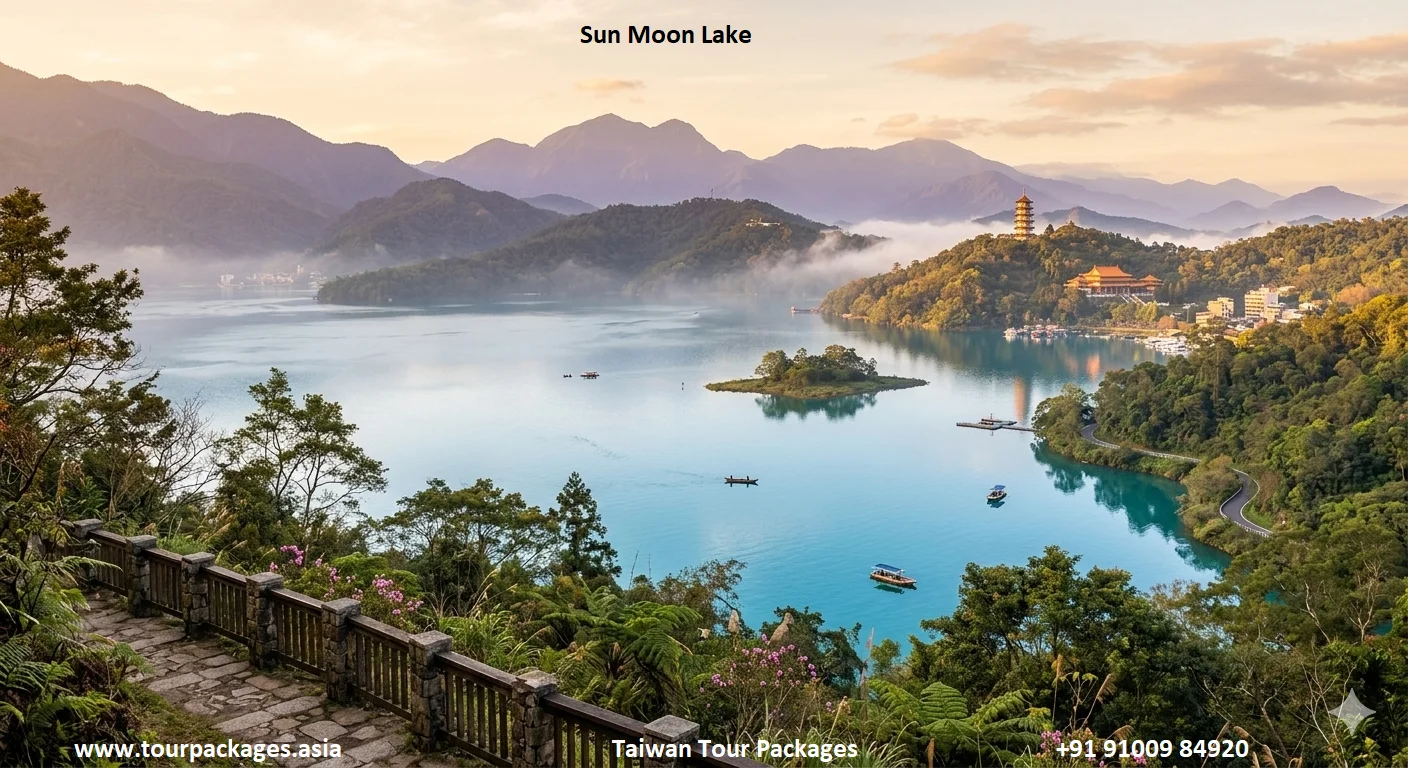
Sun Moon Lake — The Mirror at the Heart of the Island
Sun Moon Lake (Riyue Tan) is the emotional and scenic centre of Taiwan — the island's largest natural lake, sitting at 748 metres elevation in the mountains of Nantou County, surrounded by forested ridges that drop steeply to the water's edge and enveloped on most mornings in a lake mist that parts gradually as the sun rises to reveal the deep blue-green water and its reflection of the surrounding mountains. The lake is named for its shape: the eastern section is roughly circular like the sun; the western section is crescent-shaped like the moon. The 33km cycling perimeter route — a dedicated cycle path (shared only with pedestrians, no vehicles) that runs continuously around the lake shore — is Taiwan's most celebrated leisure cycling experience, consistently rated one of Asia's best leisure cycle routes. Bikes are available for hire at multiple points around the lake; the gradient is gentle (the highest point is approximately 50m above water level); and the quality of lakeside scenery throughout the circuit — mountain reflections, pavilions on the water, tea plantations on the hillside — sustains the visual reward for the entire 2.5–3 hour ride. The Sun Moon Lake Ropeway connects Shuishe Pier (at lake level) to Jiuzu Peak (840m) on the southern shore, offering the most elevated panoramic view of the lake's full extent — the 1.9km gondola ride is a spectacular outdoor experience in its own right. Sunrise from Shuishe Pier — watching the morning mist dissolve as golden light reaches the water — is the quintessential Sun Moon Lake experience, best captured in the 30 minutes before and after dawn on a clear day. The lake's Indigenous Thao community (Taiwan's smallest Indigenous group) maintains a cultural presence on Lalu Island — a small island in the lake's centre considered sacred in Thao tradition, accessible by tour boat.
Nantou County · High Plateau
Hehuanshan Alpine Area
Hehuanshan (Harmony Mountain) is Taiwan's most accessible high-altitude plateau — a 3,000m+ highland accessible by sealed road (Provincial Highway 14A), making it the only place in Taiwan where visitors can reach above 3,000 metres without hiking. Wuling Pass at 3,275m is the highest point reachable by road in Taiwan. The open alpine grasslands and rocky ridgelines of the Hehuanshan area support several multi-day hiking routes connecting to Taroko Gorge and Yushan via the Central Cross-Island High Trail — one of Taiwan's most challenging and spectacular long-distance routes. In winter (December–February), Hehuanshan is Taiwan's primary snow viewing destination — the highland plateau receives occasional snowfall and attracts tens of thousands of Taiwanese visitors who may never otherwise have seen snow.
Nantou · Forest Recreation
Xitou Nature Education Area
Xitou (Hsieh-Tou) is a NTU-managed forest recreation area at 1,150m elevation in Nantou County — a dense stand of Japanese cedar, cypress, bamboo, and tropical forest with 11km of marked walking trails through cathedral-canopy forest. The Giant Tree Trail leads to a 2,800-year-old cypress tree (46m height, 16m circumference) that is one of the most impressive living organisms in Taiwan. The forest's humidity, filtered light, and cathedral-canopy atmosphere make it a favourite for forest bathing (shinrin-yoku) — the Japanese therapeutic practice of immersive forest walking now extensively practiced throughout Taiwan's forest recreation areas. Xitou is excellent in combination with a Sun Moon Lake visit — the two are approximately 45km apart by mountain road.
Pingtung · Indigenous Territory
Maolin Gorge & Butterfly Valley
Maolin National Scenic Area in Pingtung County is a dramatic limestone gorge carved by the Zhouwei River through the mountains of southern Taiwan, surrounded by the territory of the indigenous Rukai people. The gorge is scenically extraordinary — polished limestone walls, emerald pools, rope bridges across the river — but Maolin is globally significant for one ecological phenomenon: the Purple Crow Butterfly migration. Between October and April, millions of Euploea butterflies overwinter in the warm valleys of Maolin — one of the world's great wildlife spectacles, with trees and valleys turning purple with roosting butterfly clusters. Taiwan is one of only two known overwintering sites globally for purple crow butterflies at this scale. The peak viewing period is December–March; the best concentration is in the Maolin, Duona, and Wutai valleys.
New Taipei · Rail Trail
Pingxi Valley & Waterfall Trails
The Pingxi branch railway — a narrow-gauge tourist railway running 12.9km through the Keelung River valley northeast of Taipei — connects a series of villages famous for sky lantern festivals, coal mining heritage, and some of the most accessible waterfall hikes near Taipei. Shifen Waterfall — a 20m-high, 40m-wide curtain of water described as Taiwan's Niagara — is a 20-minute walk from Shifen Station. Wanggu Waterfall (86m drop) requires a harder 4km trail from Lingjiao. The valley's lush gorge scenery, old mining infrastructure, traditional stone-roofed houses, and lantern-release culture make Pingxi one of the most culturally rich as well as naturally beautiful day trips from Taipei. Best on weekdays — the lantern release at Shifen becomes extremely crowded on weekends.
Yilan · Hot Spring Valley
Wulai Indigenous Village & Forest
Wulai — an Atayal indigenous township 26km south of Taipei in the mountains of New Taipei City — combines three outdoor experiences in one accessible location: hot spring bathing (Wulai's sulfurous springs feed both public pools and resort facilities in the valley), waterfall hiking (Wulai Waterfall, a 80m cascade visible from the village and reachable by trail in 20 minutes), and indigenous forest walks through the Tonghou valley to Atayal cultural sites. The Wulai tribal bus (a narrow open-air vehicle running 1.6km from the village to the waterfall area) is charming and perfectly suited to families. Wulai's mochi rice cakes (made from the Atayal's traditional glutinous rice, filled with peanut paste and rolled in black sesame) are the essential snack purchase. Best visited on weekday mornings — weekend afternoon crowds at the hot spring facilities are significant.
Hsinchu · Tea Country
Beipu Old Street & Emei Tea Area
Beipu in Hsinchu County is the historic centre of Taiwan's Hakka tea culture — a preserved Qing-era village set in the tea-growing hills of interior Hsinchu County, where the surrounding Emei and Beipu townships produce Oriental Beauty Oolong (Bai Hao Oolong) — one of the world's most unusual teas, its distinctive honey-muscatel flavour created only because the tea leafhopper insect partially ferments the leaves while still on the bush. Leofoo Village Theme Park nearby is Taiwan's most adventurous outdoor theme park, though the area's main natural attraction is the gentle cycling through Emei Lake (a reservoir surrounded by Hakka farmland) and the hiking trails into the bamboo and tea-covered hills above the historic village. Best visited in late May–July when the tea leafhopper cycle produces the Oriental Beauty harvest.
Coastal Scenery, Geological Wonders & Island Escapes
Yehliu's mushroom rocks, the Suhua Pacific cliffs, Green Island's coral, and Orchid Island's volcanic coast
Coastal Wonders
Geological Formations · Queen's Head Rock · Half-Day from Taipei
Yehliu Geopark — Taiwan's Most Surreal Coastal Landscape
Yehliu Geopark extends as a 1,700m rocky cape into the Taiwan Strait on the island's north coast — a promontory of Datungshan sandstone sculpted by wave erosion and differential weathering into one of the most extraordinary coastal geological landscapes in Asia. The cape is covered in hundreds of mushroom-shaped rock formations: sandstone columns whose softer lower sections erode faster than the iron-rich hardened caps above, creating perfect mushroom profiles standing one to four metres tall across the rocky plateau. Alongside the mushrooms, the geopark contains honeycomb weathering cavities, sea candles (upright cylindrical pillars), ginger rocks, and the formation that has appeared on Taiwan's NTD 1,000 banknote: the Queen's Head — a weathered sandstone column eroded over millennia into a profile unmistakably resembling a regal female figure, neck extended, chin slightly raised. The queue to stand beside the Queen's Head on busy days has a strict two-minute limit per visitor group. Geologically, the entire cape is a working classroom in differential erosion — the park's interpretive panels are unusually clear and informative, and the landscape rewards careful observation beyond simply photographing the famous formations. Best visited on a weekday before 9 AM: the cape at dawn with light raking across the mushroom fields is a genuinely beautiful experience; the same cape at weekend noon with 5,000 visitors is congested and much less rewarding. Yehliu pairs naturally with the North Coast Scenic Highway and Jiufen Old Street for a full day from Taipei.
Coral Reefs · Seawater Hot Spring · Sea Turtles · 50-Min Ferry
Green Island — One of the Pacific's Finest Dive and Island Destinations
Green Island (Lyudao) — a volcanic island 33km off Taiwan's east coast, accessible by a 50-minute ferry from Fugang Harbour in Taitung — is one of the most rewarding offshore island experiences in the western Pacific. The coral reef ecosystem encircling the island is among the most pristine remaining in the region: visibility regularly reaching 20–30 metres, sea turtles (green and hawksbill) encountered on almost every snorkel or dive, and the dramatic underwater volcanic topography — basalt pillars, lava tube openings, submarine cliff walls — providing structural complexity that flat coral atolls cannot match. The island's unique terrestrial attraction is the Chaojih Seawater Hot Spring — one of only three known seawater hot springs on earth, where naturally hot sulfurous spring water emerges directly at the Pacific Ocean's edge, filling a series of rock pools where the hot mineral water mingles with cold ocean swell in a bathing experience entirely without parallel. The island's 15km circumference road can be cycled or scootered in 2–3 hours, taking in the Nanliao Coral Limestone Coast (fossilised reef formations uplifted above sea level — at low tide, walking through ancient coral structures is a profound geological encounter), the Guanyin Cave, and six dramatic ocean viewpoints. Green Island also carries significant political history: the Green Island Human Rights Memorial Park preserves the site of Taiwan's most feared political prison during the martial law era, providing essential context for any visitor interested in Taiwan's democratic transition.
Tao Indigenous Culture · Volcanic Coastline · Remote · Flying Fish
Orchid Island — Taiwan's Most Remote and Culturally Alive Outdoor Escape
Orchid Island (Lanyu) — 90km southeast of Taitung in the Philippine Sea — is the most geographically isolated and culturally distinct outdoor destination in Taiwan: a 45 sq km volcanic island home to the Tao (Yami) people, who have inhabited it for approximately 4,000 years and maintained a maritime culture of extraordinary depth centred on the Pacific flying fish. Flying fish season (February–June) is a sacred cultural and ecological event that governs the Tao's annual calendar — specific ceremonies, dress codes, and food taboos structure the entire season; the ritual launch of the tatala (traditional carved wooden canoe) in spring is one of the most visually powerful cultural events in all of Taiwan. The island's volcanic landscape — dramatic sea-cliff coastline, crater pools, ocean-view forest trails — is more geologically raw than Green Island, and the absence of significant tourist infrastructure gives Lanyu a remoteness and authenticity increasingly rare in East Asian island travel. The 15km coastal circuit road connects six Tao villages, each built in a volcanic depression for typhoon protection, providing a full overview of the island's coastline drama and indigenous settlement patterns. Accommodation is primarily homestay with Tao families — the most culturally immersive overnight experience available anywhere in Taiwan.
Northeast Coast · Sea Cliffs
Nanya Rocks & Fulong Beach
The Northeast Coast Scenic Area between Fulong and Bitou Cape contains some of Taiwan's most dramatic accessible coastal geology: Nanya has honeycomb and mushroom rock formations in a raw, unmanaged coastal setting; Longdong Cape is Taiwan's premier sea-cliff climbing destination (basalt columns with established routes); Fulong Beach — a double sandspit at the Shuang River mouth — hosts Taiwan's largest annual sand sculpture festival (June) and excellent autumn surfing. The 17km dedicated Fu-Long coastal cycling route links all key points along this dramatic shoreline.
Hualien–Suao · Pacific Sea-Cliffs
Suhua Highway & Qingshui Cliffs
The Suhua Highway (Provincial Highway 9) between Suao and Hualien is Taiwan's most dramatic road — 118km carved directly into sea-cliffs rising 500–1,000m from the open Pacific, with short tunnels through headlands opening to sudden vertiginous views of turquoise water far below. Qingshui Cliffs — a 20km stretch where marble walls plunge straight to the Pacific with no beach, road, or intermediate terrain — are the most photographed section. Self-drive or day tour from Hualien allows maximum stops for photography; check road closure status after typhoons or seismic events before travelling.
Taipei · Urban Ridge Hike
Elephant Mountain (Xiangshan)
Xiangshan in Taipei's Xinyi District is the city's most accessible and rewarding urban hike: a 20-minute steep ascent from Xiangshan MRT exit 2 leads to a rocky ridge with multiple platforms offering the most classic view of Taipei 101 framed between forested hillsides. The trail continues along the ridge to Huoshan, Cishan, and Jinmianshan for a 3–4 hour extended circuit. Best at sunset when the city lights up below the ridge. No permit, free access, handrails on steep sections, signposted directly from MRT exit.
Little Ryukyu · Coral Island
Xiaoliuqiu (Little Ryukyu) Island
Xiaoliuqiu — a small coral island 15km off the southwest coast of Taiwan, accessible by 30-minute ferry from Donggang in Pingtung — is Taiwan's only fully coral-based offshore island: no volcanic rock, no hard substrate, just a raised coral atoll with dramatic fossil reef sea-cliffs, clear turquoise water, and one of the highest concentrations of wild sea turtles in the western Pacific. Green sea turtles are seen daily at multiple snorkelling sites around the island — some of the most reliable sea turtle encounters in Asia without diving equipment. The island's 12.8km circuit road is scooterable in 2 hours. Combine with Kenting National Park for a complete southern Taiwan beach and island circuit.
Outdoor Activities by Location — Quick Reference
Match your preferred activity to the best Taiwan destination and plan by difficulty and season.
| Activity | Best Location(s) | Season | Difficulty | Permit? |
|---|---|---|---|---|
| Gorge hiking | Taroko — Tunnel of Nine Turns, Swallow Grotto, Baiyang | Oct–Jun | Easy–Med | Zhuilu trail only |
| Summit climbing | Jade Mountain (Yushan) 3,952m | Oct–May | Hard | Yes — apply 2–3 months ahead |
| Volcano hiking | Yangmingshan — Seven Star Mtn 1,120m | Year-round | Easy | No |
| Ancient forest walk | Alishan, Xitou, Lalashan | Year-round | Easy | Alishan recreation fee |
| Sunrise viewing | Alishan Zhushan Platform; Sun Moon Lake pier | Oct–Apr (clearest) | Easy | Forest railway ticket |
| Cycling — leisure | Sun Moon Lake 33km loop; East Coast route | Year-round | Easy | No |
| Cycling — island circuit | Taiwan Round-the-Island Route (1,139km) | Oct–Apr | Hard | No |
| Snorkelling | Kenting Wanlitong; Green Island; Xiaoliuqiu | Apr–Oct | Easy | No |
| Scuba diving | Green Island; Kenting; Xiaoliuqiu (Little Ryukyu) | Apr–Oct | Medium | Dive cert required |
| Surfing | Kenting Jialeshui; Fulong Beach; Jinzun (Taitung) | Sept–Apr | Medium | No |
| Hot spring bathing | Beitou (Taipei); Jiaoxi (Yilan); Wulai (New Taipei) | Year-round | Easy | No |
| Whale watching | Hualien port — sperm whales, spinner dolphins | Apr–Oct | Easy | Boat tour booking |
| Butterfly watching | Maolin Gorge, Pingtung — Purple Crow migration | Oct–Apr | Easy | No |
| Alpine road drive | Hehuanshan 3,275m — highest driveable road | May–Nov | Easy | No |
| Sea turtle encounter | Xiaoliuqiu — snorkelling, daily sightings | Year-round | Easy | No |
| Coastal geology | Yehliu Geopark; Nanya Rocks; Orchid Island | Year-round | Easy | NTD 80 at Yehliu |
| Urban hiking | Elephant Mountain (Xiangshan), Taipei | Year-round | Easy | No |
Plan Your Taiwan Outdoor Adventure
Taroko Gorge, Alishan sunrise, Jade Mountain, Sun Moon Lake cycling, Kenting coral reefs, Green Island diving — our specialists build outdoor-focused Taiwan itineraries for Indian travellers with e-Visa assistance and full logistics.
Top Sights in Taiwan
Beyond the outdoors — Taiwan's essential cultural and urban highlights for a complete island experience.
Taipei · Iconic Architecture
Taipei 101
The 508-metre Taipei 101 skyscraper, formerly the world's tallest building, anchors the Xinyi financial district. The 89th-floor indoor observation deck provides the most comprehensive view of Taipei's basin geography and the surrounding volcanic ridgelines of Yangmingshan — the outdoor-to-urban contrast is immediately visible. Combine with the adjacent Xinyi District weekend markets for a complete Taipei half-day.
Wanhua · 300-Year Heritage
Longshan Temple
Longshan Temple (founded 1738) is Taipei's most important place of worship and a masterwork of traditional Taiwanese architecture — carved stone dragon columns, elaborately painted ceiling panels, and constant incense ceremony. The adjacent Wanhua heritage district includes Bopiliao Historic Block and Huaxi Street Night Market, making this a full cultural half-day.
New Taipei · Mountain Heritage
Jiufen Old Street
Jiufen — a former gold-mining village on a steep hillside above the Pacific — is Taiwan's most photogenic heritage destination: narrow stone staircases, red lantern teahouses with mountain-and-sea views of breathtaking drama. Best visited on weekday afternoons. See the Taiwan markets guide for the Jiufen souvenir market and the Jinguashi Gold Museum nearby.
Tainan · Oldest City
Fort Zeelandia & Ancient Capital
Tainan — Taiwan's oldest city, capital under Dutch and Qing rule — contains the island's deepest concentration of historical heritage: Fort Zeelandia (Dutch East India Company, 1624), Chihkan Tower, 400+ temples, Taiwan's oldest Confucian temple, and the richest food culture on the island. The full Tainan heritage circuit is detailed in our historical places in Taiwan guide.
Night Markets · Island-Wide
Taiwan's Night Market Culture
Taiwan's 400+ night markets are the cultural heartbeat of the island — from Shilin's epic scale in Taipei to Fengjia's creative food innovation in Taichung and Liuhe's seafood in Kaohsiung. Our complete Taiwan markets guide covers every major market, street food, souvenir strategy, and practical tip for Indian visitors.
Culture & Festivals
Lantern Festival & Dragon Boat
Taiwan's festival calendar — the Pingxi Sky Lantern Festival, Tainan Yanshui Beehive Fireworks, Dragon Boat Racing in Tamsui, and the Amis Harvest Festivals of the east coast indigenous communities — is one of the richest in East Asia. Our culture, food and festivals of Taiwan guide covers the complete calendar.
10 Essential Tips for Taiwan Outdoor Travel
Click each panel to expand. Practical guidance distilled from extensive on-the-ground Taiwan experience.
When to Visit for Outdoor Activities
October to December is the single best outdoor season — typhoon season has ended, humidity drops, skies clarify, and temperatures are comfortable at all altitudes (18–26°C in lowlands, 8–15°C at 2,000m+). Spring (February–April) is the second-best window: Alishan and Yangmingshan cherry blossom in March is extraordinary but requires advance accommodation booking. Summer (June–August) brings typhoon risk and intense heat — schedule outdoor exertion for mornings only and monitor CWA (Central Weather Administration) typhoon forecasts daily. Taiwan's east coast (Hualien, Taitung) is frequently sunny when the northwest is grey under the north-east monsoon — always a useful contingency plan if Taipei weather is poor.
Mountain Permits — Free, Online, Apply Early
High-mountain trails above 3,000m require a Mountain Entry Permit (shanjin zheng) applied through Taiwan's National Police Agency at hike.taiwan.gov.tw — free of charge but quota-limited. Jade Mountain (Yushan) Paiyun Trail quota fills 2–3 months ahead — apply the day your dates are confirmed. The Zhuilu Old Trail in Taroko requires both a National Park Entry Permit and a Police Permit — apply at Taroko headquarters or online. The overwhelming majority of trails — all Alishan paths, Sun Moon Lake cycling, Yehliu, Yangmingshan main trails, Kenting beaches — require no permit whatsoever. The system is in English and straightforward to navigate.
Getting to Outdoor Attractions Without a Car
Taiwan High Speed Rail (THSR) connects Taipei to Taichung (50 min), Chiayi (75 min), Tainan (90 min), and Kaohsiung (100 min) — from these hubs, direct tourist buses serve Alishan, Sun Moon Lake, Kenting, and the north coast. Hualien (gateway to Taroko) is served by regular express trains from Taipei (2 hrs). An International Driving Permit (IDP) — obtainable from any India AA-authorised centre before departure — unlocks scooter hire at tourist destinations and opens Taiwan's coastal highways and mountain roads to independent exploration. Taiwan Tourism Bureau shuttle buses cover most major attractions from the nearest train station during peak season.
Altitude and Acclimatisation
Taiwan's mountains rise steeply — it is possible to go from Taipei at sea level to Hehuanshan at 3,275m by sealed road in a single day. Altitude sickness (headache, nausea, fatigue) is a real risk above 2,500m for visitors ascending quickly. For the Yushan summit climb, the two-day itinerary with an overnight at Paiyun Hut (3,402m) is not optional — it is essential partial acclimatisation. For Alishan (2,216m) and Hehuanshan (up to 3,275m by road), most visitors experience mild or no symptoms if they ascend slowly, drink extra water, and avoid alcohol on the first night. Indian travellers familiar with Shimla or Kodaikanal altitude will generally acclimatise well at Alishan; Yushan's summit demands the same respect as a high Himalayan pass.
What to Pack for Taiwan's Outdoor Activities
For most accessible attractions, walking shoes and a light rain layer are sufficient — Taiwan's mountain weather changes rapidly and afternoon clouds are the default. For Yushan and high-altitude trails (above 3,000m): thermal base layers, waterproof shell, UV protection (radiation increases significantly at altitude), and a headlamp for the pre-dawn summit push. Helmets are provided free at the Tunnel of Nine Turns trailhead in Taroko — they are mandatory due to occasional rockfall. Reef shoes are recommended for Kenting and Green Island snorkelling (coral is sharp underfoot). SPF 50+ sunscreen is essential at Kenting (latitude 22°N, Pacific UV equivalent to Chennai) — more intense than anywhere in northern Taiwan.
Taiwan by Bicycle — One of Asia's Best Cycling Countries
Taiwan has invested substantially in cycling infrastructure — dedicated paths around Sun Moon Lake (33km loop), the East Coast Scenic Highway (200km dedicated Pacific coastal route), and the full Round-the-Island Route (1,139km, 9–14 days) with marked cycling hostels every 30–40km. In cities, YouBike 2.0 public bike-share (NTD 10/30 min with EasyCard, dockless) provides extensive urban cycling access including Taipei's 24km Danshui riverside path. For Indian adventure cyclists, completing the RTI is increasingly popular — the fully marked route, cyclist-oriented accommodation, and combination of Pacific coast, indigenous territory, and mountain scenery makes it one of Asia's great cycling experiences.
Taiwan's Hot Spring Culture — 128 Registered Sources
Taiwan has 128 registered hot spring sources across the island — a direct result of its position on the Pacific Ring of Fire. Key destinations for Indian travellers: Beitou (Taipei) — the most accessible, MRT Xinbeitou branch line, public outdoor pools from NTD 40, hot spring museum free entry; Jiaoxi (Yilan) — rare bicarbonate springs, outdoor public park pools; Wulai (New Taipei) — sulfurous mountain springs combined with Atayal cultural experience; and uniquely, Green Island's Chaojih seawater hot spring — one of only three on earth, Pacific-edge rock pools where hot sulfurous water meets ocean swell. The combination of a Yangmingshan morning hike with a Beitou afternoon soak is one of the best single outdoor days available from Taipei.
Wildlife Watching in Taiwan's National Parks
Taiwan's endemic wildlife is remarkable for a small island: Formosan macaque (endemic monkey — troops commonly seen at Taroko and Shoushan Reserve, Kaohsiung); Taiwan blue magpie (national bird — brilliant blue-and-chestnut plumage, commonly seen in Yangmingshan and Alishan); Mikado pheasant (national pheasant, on the NTD 1,000 note — seen on Yushan and Hehuanshan high trails); Purple crow butterfly migration (millions overwintering in Maolin October–April — one of the world's great insect spectacles); sea turtles (Xiaoliuqiu for daily encounters, Kenting for nesting beaches June–October). From Hualien, whale watching tours encounter sperm whales and dolphins with exceptional reliability April–October.
Best Outdoor Experiences for Families with Children
Taiwan is an excellent family outdoor destination with safe, accessible infrastructure at every turn. The best family choices: Sun Moon Lake cycling (vehicle-free path, child bikes and seats for hire, food stalls throughout); Alishan Forest Railway ride (no walking required, ancient trees genuinely awe children); Yehliu Geopark (flat paved paths, mushroom rocks spark natural scientific curiosity); Wulai hot spring + waterfall (tribal bus ride, outdoor pool, easy walk); Maolin butterfly valley in December–February (walking through forests decorated with millions of roosting purple crow butterflies — one of the world's most magical wildlife experiences for children); and Pingxi's Shifen Waterfall + sky lantern release — universally enjoyed by all ages.
Best Outdoor Day Trips from Taipei
Taipei's best outdoor day trips within 1.5 hours: Yangmingshan National Park (40 min by bus — volcanic fumaroles, hot springs, mountain trails; the best urban-to-wilderness ratio in Asia); Yehliu + North Coast + Jiufen (1.5 hrs by bus — coastal geology, heritage market town, Pacific views); Pingxi Valley (1.5 hrs by train — Shifen Waterfall, sky lanterns, valley gorge scenery, best weekdays); Wulai (1 hr by bus — hot spring, waterfall, Atayal indigenous culture); Beitou Hot Spring (30 min by MRT — combine with a Yangmingshan morning for a complete outdoor day); and the Elephant Mountain sunset hike (20 min by MRT — classic Taipei 101 ridge view at dusk, requires no more than 30 minutes of walking).
Plan Your Taiwan Outdoor Adventure
Taroko Gorge, Alishan sunrise, Jade Mountain summit, Sun Moon Lake cycling, Green Island diving, Kenting snorkelling — our specialists build outdoor-focused Taiwan itineraries for Indian travellers with e-Visa assistance end-to-end. Fields marked * are required.
Outdoor Attractions in Taiwan — 15 Frequently Asked Questions
Detailed answers to the questions Indian travellers ask most before visiting Taiwan's natural and adventure destinations.
Taroko Gorge National Park in Hualien County is the answer most consistently given — by Taiwanese and international visitors alike — and the superlatives are entirely justified. The gorge is a marble canyon of extraordinary physical drama: sheer walls of crystallised metamorphic rock in white, grey, green, and pink bands rising hundreds of metres from a turquoise river, a sealed highway cut directly through mountain headlands, suspension bridges swaying over the gorge floor, and a trail network ranging from easy roadside walks to multi-day wilderness routes. What elevates Taroko above other dramatic Asian canyons is the combination of accessibility (two hours from Taipei by high-speed rail and transfer), physical scale (the gorge walls are genuinely awe-inspiring in a way that photographs only partially capture), and national park infrastructure quality. Alishan makes an equally strong argument — the ancient cypress forest, the pre-dawn railway to the sunrise platform, the sea of clouds at first light — and Sun Moon Lake's cycling and mountain reflection scenery is deeply peaceful. But Taroko's marble walls at river level on a clear morning, seen through the open windows of the Tunnel of Nine Turns, constitute one of the great natural spectacles of Asia. Our Taiwan Tour Packages always include Taroko as an anchor experience.
Taiwan is one of Asia's premier hiking destinations — an island with the altitude range (sea level to 3,952m), trail density, and infrastructure quality that serious hikers find in very few compact locations. For complete beginners, the best starting trails are: Xiangshan (Elephant Mountain) in Taipei — a 20-minute steep ascent from Xiangshan MRT to a rocky ridge with the classic Taipei 101 view, handrails on steep sections, no permit needed; Alishan forest trails — flat to gently rolling paved paths through ancient cypress at 2,200m altitude; Sun Moon Lake Shuishe Trail — a flat 3km lakeside path with no elevation change; and Yangmingshan Qingtiangang Grassland Circuit — open highland meadow walking at 800m with panoramic mountain views and resident water buffalo. For moderate fitness hikers, Taroko's Tunnel of Nine Turns (2km, minimal elevation, spectacular gorge) and Baiyang Waterfall Trail (2.2km one-way through marble tunnels to a waterfall canyon) are highly recommended and require no permit or special equipment.
October to December is the optimal outdoor season: typhoon season has ended, skies are the clearest of the year, humidity drops significantly, and temperatures are comfortable at all altitudes. October and November are widely regarded as Taiwan's finest months — crisp air, good photographic visibility, comfortable hiking conditions. Spring (February–April) is the second-best period: cherry blossom at Alishan in March is spectacular (book accommodation months ahead), and the mountains are fresh after winter. Summer (June–August) is the most demanding outdoor season — high humidity, intense heat at low altitudes, and active typhoon risk. However summer is peak season for east coast water activities (Kenting and Green Island snorkelling is best in calm summer weather) and whale watching from Hualien. Winter (December–February) is ideal for southern Taiwan — Kenting stays warm and sunny year-round — but northern Taiwan (Taipei, Alishan) can be grey and drizzly for extended periods under the north-east monsoon. The east coast (Hualien, Taitung) is frequently sunny when the northwest is overcast — an important contingency if Taipei weather is poor during your visit.
Climbing Jade Mountain (Yushan) requires two permits: a Yushan National Park Entry Permit (applied through npm.cpami.gov.tw — quota for the Paiyun Trail mountain hut is approximately 72 per night, with applications opening 30 days ahead) and a Mountain Entry Permit (Police Permit, applied through hike.taiwan.gov.tw — free, no quota, but required). Both are free of charge. Practical timeline for Indian visitors: confirm your Taiwan travel dates at least 3 months ahead; apply for the National Park hut the day the 30-day window opens; if the hut is fully booked, join the waiting list or choose an off-peak weekday. Peak demand is on Golden Week holidays and October–November weekends — weekday climbs have significantly better availability. The climb (Paiyun Trail, 8.5km one-way from Tataka Trailhead at 2,610m, 1,342m elevation gain) is done over two days with an overnight at Paiyun Mountain Hut (3,402m). No technical equipment is required, but good cardiovascular fitness is essential — the 3,952m summit is reached at 3–4 AM to catch sunrise, which requires headlamp, warm layers, and respect for altitude.
Alishan is absolutely worth visiting — it is among the finest highland forest and sunrise destinations in all of East Asia, and uniquely special in the combination it offers. The case for Alishan rests on four pillars: (1) The ancient forest — old-growth Japanese cedar and cypress trees of 700–3,000+ years, a forest that feels genuinely primeval and sacred in the way only truly old-growth woodland does; (2) The sunrise over the sea of clouds from Zhushan Platform, reached by the pre-dawn branch railway at 4:00–4:30 AM — golden morning light spreading across a cloud floor filling every valley below, with Jade Mountain's distant peak visible above everything on clear days; (3) The Forest Railway — one of three mountain rack railways of its kind in the world, a 4.5-hour climb through five climate zones; (4) High-mountain oolong tea — some of the finest tea grown on earth, available for tasting and purchase directly from highland farms. The ideal Alishan visit is two nights: arrive in the afternoon for the old tree circuit and forest walks; wake at 4 AM for the Zhushan sunrise; spend the morning on further trails and a tea farm visit; depart after lunch. Cherry blossom in late February to mid-March requires booking accommodation three to four months ahead — the platform and forest fill with visitors, but the combination of blossoming trees among ancient cypress in mountain mist is genuinely worth the crowd.
Yangmingshan National Park is worth visiting for a reason unique in Asian urban travel: it puts a genuine volcanic national park 40 minutes by public bus from a major international city. This is not a landscaped urban park — it is 11,455 hectares of actual mountain wilderness with active fumaroles, real trails, significant elevation change (sea level to 1,120m at Seven Star Peak), and genuine wildlife including Taiwan's endemic blue magpie and Formosan macaque. The Xiaoyoukeng fumarole field — where continuous columns of sulfurous steam blast from vents in the volcanic crater floor — is an active volcanic spectacle unlike anything accessible from any other major Asian city. The seasonal range is exceptional: cherry blossoms in late February (Zhongzheng Park becomes one of Taiwan's most photographed cherry blossom destinations), azalea meadows in April, the golden high-grass Qingtiangang Grassland plateau in autumn, and winter fog-wrapped mountain scenery of extraordinary atmosphere. The proximity of Beitou hot springs — the historic spa district at the park's southern edge, with public baths from NTD 40 and free hot spring museum entry — makes Yangmingshan ideal for a combined morning hike and afternoon soak: one of Taiwan's best single outdoor days, and one entirely achievable from Taipei without a car.
Kenting National Park at Taiwan's southern tip offers the island's most diverse water activity programme. Snorkelling at Wanlitong Beach — clear water (15–20m visibility on calm days), accessible reef with parrotfish, butterflyfish, lionfish, and sea turtles, no equipment rental beyond mask and fins. Scuba diving at multiple sites including Wanlitong reef walls and Hopping Rabbit Rock — over 1,200 fish species recorded in Kenting's marine protected area; dive centres with courses and guided dives for all levels. Surfing at Jialeshui on the Pacific coast — Taiwan's premier surf break, consistent waves 1–2m in summer with occasional 3m+ in winter swells, surf school instruction available. Windsurfing and kitesurfing benefit from the Hengchun Peninsula's persistent trade winds. Glass-bottom boat tours from Nanwan Bay — ideal for families and non-swimmers wanting reef visibility without entering the water. Water temperature at Kenting is 24–29°C year-round — water activities are comfortable in every season, though the south-west monsoon (June–September) brings stronger currents on the Pacific side. See our Taiwan beaches guide for complete Kenting coastal detail.
Yehliu Geopark is a 1,700m rocky cape north of Keelung where differential weathering and wave erosion have produced one of Asia's most extraordinary assemblages of natural coastal formations. The cape's sandstone has been sculpted into mushroom rocks (hundreds of them, varying from knee-height to several metres), honeycomb cavities, sea candles, ginger rocks, and the formation that has appeared on Taiwan's NTD 1,000 banknote: the Queen's Head — a column eroded over millennia into the unmistakable profile of a regal female figure. A thorough visit takes 1.5–2 hours for the full cape circuit — the three major zones (mushroom rocks, Queen's Head queue, far cape) reward unhurried exploration. Arrive before 9 AM on a weekday to have the formations largely to yourself; weekend afternoons see 3,000–5,000 simultaneous visitors on the narrow rock paths. The geopark pairs perfectly with the north coast scenic drive: continue east to Jiufen Old Street (30 min) and the Jinguashi Gold Ecological Park for a complete full-day Taipei excursion combining coastal geology, historic gold mining heritage, and one of Taiwan's most atmospheric lantern-lit market towns.
Taiwan's cycling infrastructure is among the finest in Asia. Key routes: Sun Moon Lake 33km Loop — the benchmark leisure ride; vehicle-free dedicated path, gentle gradient, lakeside scenery throughout; bikes for hire at multiple points; 2.5–3 hours at leisure pace. East Coast Scenic Highway 200km Dedicated Route — a dedicated cycle lane from Hualien to Taitung along Taiwan's Pacific coast, passing through indigenous villages and spectacular coastal terraces; most cyclists complete it over 2–3 days. Taiwan Round-the-Island Route (1,139km) — a fully marked national cycling route circumnavigating the entire island; 9–14 days for experienced cyclists; cyclist hostels every 30–40km; one of Asia's great cycling adventures. North Coast Scenic Bikeway (24km) — a coastal route from Danshui to Jinshan past fishing harbours and sea-eroded headlands. YouBike 2.0 (Taipei public bike-share — NTD 10/30 min with EasyCard) enables extensive urban cycling including the Danshui riverside path (24km from Xinyi District to the estuary). For Indian adventure cyclists, the Round-the-Island Route is increasingly popular — the fully supported route, cyclist-oriented accommodation, and the combination of Pacific coast, central mountain approaches, and indigenous cultural landscapes makes it genuinely one of Asia's finest cycling experiences.
Taiwan's endemic wildlife is remarkable for an island of its area — a consequence of long geographic isolation from the Asian mainland. Species that can realistically be observed: Formosan macaque (Taiwan's endemic monkey — troops commonly seen at Taroko, Alishan, and Shoushan Nature Reserve, Kaohsiung); Taiwan blue magpie (national bird — brilliant blue-and-chestnut plumage with long tail, commonly seen in Yangmingshan and Alishan forests); Mikado pheasant (national pheasant, on Taiwan's NTD 1,000 note reverse — seen on high trails at Yushan and Hehuanshan); Purple crow butterfly migration (millions overwintering in Maolin Gorge October–April — one of the world's most spectacular insect events); sea turtles (green turtles encountered daily while snorkelling at Xiaoliuqiu; nesting at Kenting June–October). From Hualien port, whale watching tours encounter sperm whales (one of Asia's most reliable observation sites) and spinner, bottlenose, and Fraser's dolphins with 95%+ sighting reliability April–October. Taiwan's endemic bird list (25+ full endemics) makes the island significant on the Asia-Pacific ornithological circuit.
Green Island (Lyudao) is a volcanic island 33km off Taiwan's east coast — a 50-minute ferry from Taitung — and one of the Pacific's finest small island destinations for outdoor travellers. The coral reef ecosystem is among the most pristine in the western Pacific: visibility 20–30m on calm days, sea turtles on almost every dive or snorkel, and dramatic underwater volcanic topography unavailable at flat atolls. The island's unique feature is the Chaojih Seawater Hot Spring — one of only three known seawater hot springs on earth, where naturally hot sulfurous water emerges at the Pacific Ocean's edge in a salt-sulfur bathing experience entirely unique in character. The 15km circumference road can be scootered in 2–3 hours, taking in the Nanliao Coral Limestone Coast (fossilised reef uplifted above sea level — extraordinary geological encounter), the Guanyin Cave, and six ocean viewpoints. Green Island also carries significant political history — the Green Island Human Rights Memorial Park preserves the site of Taiwan's martial law-era political prison (1949–1987), providing essential context for understanding Taiwan's democratic transition. Best visited April–October when ferry services are reliable and water visibility is at its best.
Taiwan has 128 registered hot spring sources — an extraordinary number for a small island, reflecting its Ring of Fire geology. Best destinations for Indian travellers: Beitou (Taipei) — the most accessible; MRT Xinbeitou branch line (30 min from central Taipei); public outdoor pools from NTD 40; free hot spring museum. Jiaoxi (Yilan) — rare bicarbonate springs (unusual chemistry reputedly beneficial for skin); Jiaoxi Central Park outdoor public soaking pools; 50 min from Taipei by train. Wulai (New Taipei) — sulfurous mountain springs combined with Atayal indigenous cultural experience; 1 hr by bus from Xindian MRT. Dongpu (Nantou) — remote mountain springs near Yushan National Park, requiring a 2-hour mountain drive from Puli; worth the journey for serious hot spring enthusiasts. Green Island Chaojih — one of only three seawater hot springs on earth; the Pacific rock pool experience is globally unique. For the most practical and complete hot spring day from Taipei: Yangmingshan morning hike + Beitou afternoon soak — mountain wilderness to sulfurous pool in a single day, entirely by public bus and MRT.
The Taiwan Round-the-Island (RTI) route — locally called Huan Dao — is a fully marked, nationally supported 1,139km cycling route circumnavigating the entire island, typically completed in 9–14 days depending on fitness and daily distance. The route is signed with distinctive blue-and-white bicycle markers; cyclist hostels (Iron Man Youth Hostels) are spaced every 30–40km with accommodation specifically oriented to RTI cyclists; bike repair stations, Taiwan's ubiquitous 7-Eleven and Family Mart convenience stores, and cyclist-friendly guesthouses are distributed throughout. The most dramatic sections: East Coast (Hualien to Taitung) — 167km of Pacific cycling with the Central Mountain Range rising immediately west and the open ocean east, passing indigenous villages and coastal terraces; South (Kenting) — the tropical peninsula tip, coral white beaches, sea on both sides; Suhua Coast — the most challenging section, sea-cliffs rising 1,000m from the Pacific, short tunnels through headlands. The RTI is completable for moderately fit cyclists — the terrain is mostly flat on the west and south coasts; the east coast and north have some significant gradients. Indian adventure cyclists have increasingly been completing the RTI since 2020, typically in 10–12 days — it is consistently rated one of Asia's finest cycling adventures for the combination of scenery, infrastructure, and cultural encounter.
Taiwan is an excellent family outdoor destination with safe, accessible infrastructure. The best choices for families with young children: Sun Moon Lake cycling (vehicle-free dedicated path, child bikes and child seats for hire, lakeside food stalls throughout, gentle gradient — even children aged 5–6 can manage most of the perimeter with a rest stop); Alishan Forest Railway ride (no walking required for the train experience itself; the ancient cypress trees genuinely awe children in a way that is difficult to replicate elsewhere); Yehliu Geopark (flat paved paths, mushroom rock formations spark natural curiosity, excellent interpretive panels, NTD 80 admission); Wulai hot spring and waterfall (the narrow tribal bus ride is a child highlight, outdoor pool suits all ages, waterfall walk is 20 minutes flat); Maolin Butterfly Valley (October–April) — walking through forests where trees are covered in millions of roosting purple crow butterflies is one of the most magical natural experiences available to children anywhere in the world; and Pingxi's Shifen Waterfall + sky lantern release — the combination of a Taiwan's Niagara-style waterfall and the release of a glowing paper lantern into the night sky is memorable for children and adults equally.
Taipei's best outdoor day trips within 1.5 hours: Yangmingshan National Park (40 min by S15 bus from Jiantan MRT — volcanic fumaroles, hot springs, mountain trails, cherry blossom in March; no permit needed; the best urban-to-wilderness ratio of any major Asian city); Yehliu Geopark + North Coast + Jiufen (1.5 hrs by bus — coastal geological formations, fishing village heritage, the most atmospheric lantern-lit hillside market town in Taiwan; best on weekday afternoon); Pingxi Valley (1.5 hrs by train and branch line — Shifen Waterfall 20-min walk, sky lantern release, valley gorge scenery; best on weekday mornings before crowds); Wulai (1 hr by bus from Xindian MRT — Atayal indigenous village, outdoor hot spring, 80m waterfall, tribal bus ride); Beitou Hot Spring (30 min by MRT Xinbeitou branch — combine with a Yangmingshan morning hike for a complete outdoor day: mountain wilderness in the morning, mineral pools in the afternoon); Elephant Mountain sunset hike (20 min by MRT to Xiangshan station — 20-min ascent to the classic Taipei 101 ridge viewpoint, best at sunset when the city lights up below the forested ridge). For the single best Taipei outdoor day that is simultaneously the most surprising to first-time visitors: Yangmingshan — nothing else within two hours of Taipei delivers such a complete sense of genuine mountain wilderness while remaining entirely accessible by public transport.
More Taiwan Travel Guides
Explore every dimension of the island — markets, beaches, history, culture, and complete tour packages.
Top Beaches in Taiwan
Kenting, Fulong, Baishawan, Green Island, Xiaoliuqiu — the best coastal destinations for Indian travellers.
Read Beaches Guide →Markets in Taiwan
Shilin, Raohe, Fengjia, Liuhe and 25+ markets — the complete street food and shopping guide.
Read Markets Guide →Historical Places in Taiwan
Longshan Temple, Fort Zeelandia, Jiufen, Tainan — Taiwan's most important heritage sites.
Read Heritage Guide →Culture, Food & Festivals of Taiwan
Lantern Festival, Dragon Boat, temple culture, Taiwanese cuisine and annual festival calendar.
Read Culture Guide →Taiwan Tour Packages from India
Outdoor circuits, nature tours, island itineraries — e-Visa assistance and India departures.
Browse Taiwan Packages →International Tour Packages
Asia, Europe, Middle East — custom packages and group tours from every Indian city.
Browse World Tours →Your Taiwan Outdoor Adventure Starts Here
Taroko · Alishan · Jade Mountain · Sun Moon Lake · Kenting · Green Island · Yangmingshan
Share Your Taiwan Outdoor Experience
Have you hiked Taroko, climbed Yushan, watched the Alishan sunrise, or dived Green Island? Share your tips and questions below.
