
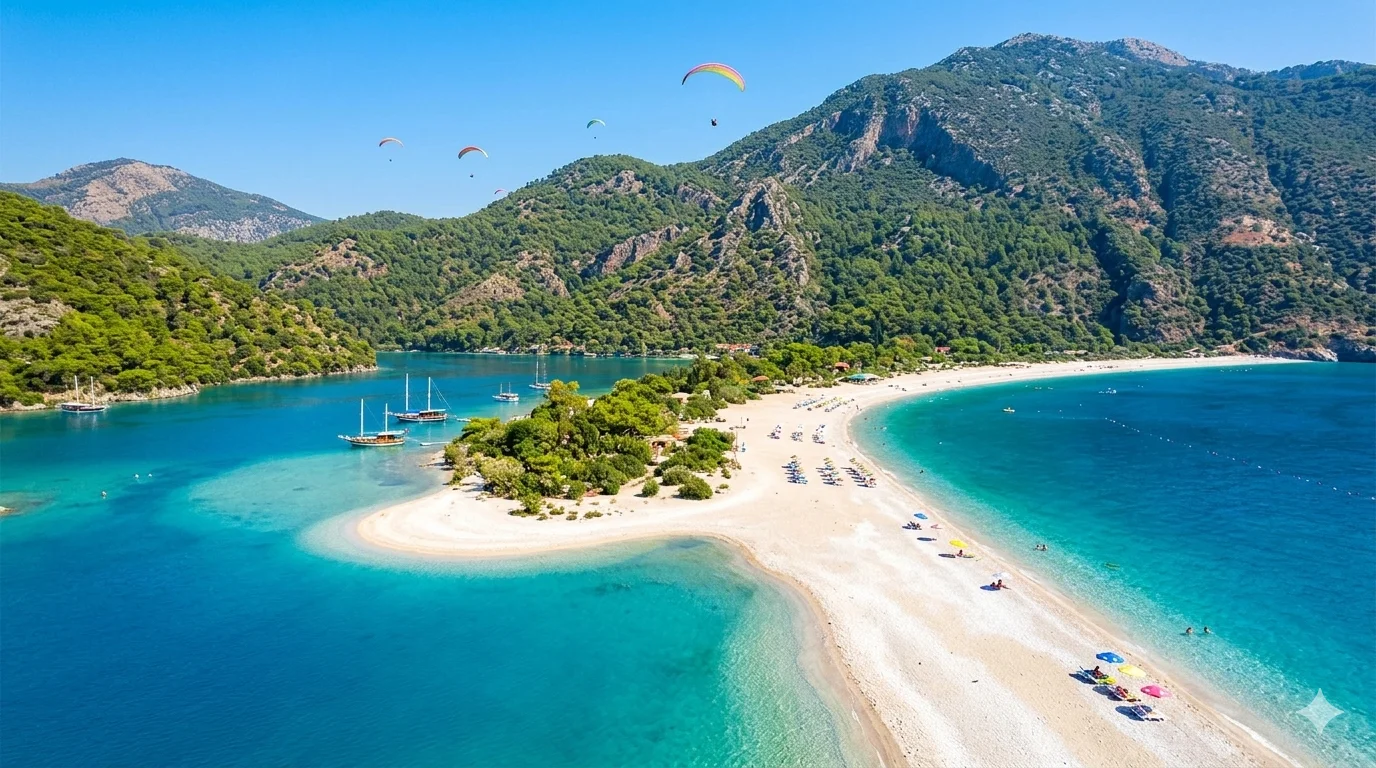
1 Ölüdeniz — Turkey's Most Iconic Lagoon
No beach in Turkey commands the imagination quite like Ölüdeniz — the "Dead Sea" (named for its eerie, windless calm). The beach occupies a long sandy spit that encloses a perfectly sheltered shallow lagoon of extraordinary aquamarine clarity. The lagoon's defining quality is its absolute stillness: regardless of sea conditions outside the spit, the water inside is mirror-flat, warm, and shallow enough to wade across for fifty metres. The Ölüdeniz Nature Reserve prohibits jet skis and motorised water sports inside the lagoon, preserving its clarity.
The surrounding landscape — pine-forested mountains dropping steeply to the sea, with Babadağ Mountain at 1,960m rising directly behind — creates one of the most visually dramatic beach settings in the world. Babadağ is one of the premier paragliding sites globally; on summer mornings, dozens of brightly coloured paragliders spiral above the lagoon. The tandem paragliding flight, launching from a platform on Babadağ and landing on Belcekiz Beach below, is one of Turkey's quintessential travel experiences — 25 to 45 minutes of unforgettable aerial scenery. Combine with a visit to the ghost town of Kayaköy just 3km away — a hauntingly beautiful abandoned Greek settlement covered in our Turkey historical places guide.
2 Patara — Turkey's Longest and Wildest Beach
Patara is Turkey's most remarkable beach by almost any measure. At 18 kilometres of unbroken, undeveloped sand, it is the longest beach in Turkey and one of the longest natural beaches in the Mediterranean. Because the beach serves as a critical nesting site for the endangered loggerhead sea turtle (Caretta caretta), legislation has prohibited all hotel and commercial development in the dune area — no beach clubs, no sunlounger rows, no jet skis. What remains is a wilderness of rolling dunes, coastal marsh, and open-sea surf of exceptional power and clarity.
The sea at Patara faces directly west into the open Mediterranean, generating predictable swells that make it Turkey's best natural bodyboarding beach. Turtle nests are marked with stakes and cordoned off during the nesting season (May–September); sections close after dusk to protect emerging hatchlings. The archaeological site of ancient Patara — once the chief city of the Lycian League and birthplace of Saint Nicholas — lies immediately behind the beach. Its ruined theatre, baths, triumphal arch, and lighthouse are accessible by a short walk through the dunes, creating a combination of pristine natural beach, protected wildlife, and ancient ruins that is unique among Turkish coastal destinations.
3 Kaputas — The Most Dramatic Cove in Turkey
Kaputas is, by near-universal consensus among Turkish coastal travellers, the most visually dramatic beach in the country. It occupies the mouth of a narrow limestone gorge between Kas and Kalkan, where a seasonal freshwater stream meets the sea through a slot in the cliffs barely wide enough for two people to walk side by side. The approach is theatrical: 187 stone steps descend from the coastal road directly into the gorge, the sea appearing below as a vivid crescendo of colour.
The colours at Kaputas are exceptional even by Turkish standards: the freshwater stream creates a gradient from transparent jade green at the shoreline to pale aquamarine deepening to intense cobalt at the cliff base, then brilliant sapphire beyond. The beach itself is approximately 100 metres long — pocket-sized, sandy, with coarse golden grains rather than the shingle common at similar cove beaches. The cliff walls rise almost vertically on three sides, creating a natural amphitheatre. Because of its size, Kaputas fills to capacity on summer afternoons; arrive before 9am or after 5pm for a far less crowded experience.
4 Iztuzu — The Sea Turtle Sanctuary Beach
Iztuzu Beach near Dalyan holds a dual distinction: it is both one of the most beautiful beaches on the Lycian coast and one of the Mediterranean's most critical loggerhead sea turtle nesting grounds. The beach is a 4.5km sand bar separating the freshwater Dalyan Delta — a maze of reed-lined channels fed by Köyceğiz Lake — from the open Mediterranean. Its twin ecology makes Iztuzu unique: the eastern shore faces the delta lagoon while the western shore faces the open sea, creating two completely different aquatic environments on opposite sides of the same strip of sand.
The journey to Iztuzu is as memorable as the beach itself. Boats depart from Dalyan town along the river, gliding past Lycian rock tombs carved dramatically into the cliff face above the reeds — tombs of Carian kings that have looked out over these waters for 2,400 years. The beach closes to all visitors between 8pm and 8am during turtle nesting season, and nesting sites are cordoned off with wooden stakes. This combination of ecological significance, visual drama, ancient monuments on the river journey, and 4.5km of fine sand makes Iztuzu one of the most rewarding full-day experiences in Turkey.
5 Butterfly Valley — Turkey's Most Romantic Hideaway
Butterfly Valley (Kelebek Vadisi) is perhaps the most romantically isolated beach in Turkey — a crescent of pebble and coarse sand enclosed in a deep canyon whose sheer limestone walls rise 350 metres on three sides, accessible only by boat from Ölüdeniz or Fethiye. The valley is named for the Jersey Tiger moth (Euplagia quadripunctaria), which breeds in the valley's sheltered microclimate in prodigious numbers during summer, covering the canyon walls in a carpet of black-and-orange-striped wings that is genuinely spectacular in mid-July.
A waterfall at the valley's head is accessible by a 45-minute canyon walk over boulders — the path rewards with a freshwater pool below the falls. The valley is a designated conservation area; basic bungalow and camping accommodation is available on-site, and staying overnight transforms the experience — the valley's silence after the day-trip boats depart is extraordinary. The boat journey from Ölüdeniz passes beneath the sea cliffs of the Yedi Burunlar (Seven Capes), one of the most scenic short sea crossings on the Turkish coast.
6 Çıralı — Where Eternal Flames Meet the Sea
Çıralı is Turkey's most layered beach destination — a 3km arc of mixed shingle and sand within a national park where large-scale tourism has been deliberately prevented. Three extraordinary phenomena converge within walking distance: a protected loggerhead turtle nesting beach; the ruins of ancient Olympos at the northern end, consumed by subtropical forest, with Lycian tombs and Byzantine churches emerging from fig tree roots; and on the hillside above, the Chimaera (Yanartaş) — natural methane seeps burning perpetually since antiquity, referenced by Homer in the Iliad, still producing flames up to a metre high.
Çıralı village behind the beach consists entirely of small family pensions and eco-lodges in orange groves — no hotels larger than 20 rooms, no beach clubs, no jet skis. This enforced simplicity creates one of the most genuinely relaxing coastal experiences in Turkey. The combination of a night-time visit to the Chimaera flames, morning swim in clear Mediterranean water, and an afternoon walk through the Olympos ruins makes Çıralı unique on Turkey's increasingly developed coast. Accessible from Antalya in approximately 90 minutes by road. Also see our outdoor attractions guide for more on Turkey's natural wonders.
7 Kabak Bay — The Off-Grid Cove
Kabak sits at the end of a steep 40-minute walk down a forest path from Kabak village — or accessible by a 20-minute boat ride from Ölüdeniz — at the bottom of a dramatic valley where the mountain forest meets a narrow pebble-and-boulder beach encircled by towering cliffs. The combination of physical inaccessibility, complete absence of development, and extraordinary natural beauty has made Kabak a magnet for adventurous Turkish beach travellers for decades.
The bay's deep, vivid blue water is superb for swimming, snorkelling, and free-diving — the rocky seabed drops away quickly from the shore, providing exceptional underwater visibility. A handful of small eco-camps and treehouse accommodations exist on the surrounding hillsides, catering to those who want to stay away from day-trippers. The Lycian Way long-distance walking trail passes through Kabak, making it a key rest point for trekkers completing this legendary coastal route. Prepare adequately: wear appropriate footwear for the descent, carry enough water, and check boat schedules from Ölüdeniz for the return journey.
8 Gemile Beach — Byzantine History at the Waterline
Gemile Beach near Fethiye is a quiet cove whose principal distinction is its view across the water to Gemile Island (St. Nicholas Island), where extensive Byzantine church ruins, colonnaded streets, and rock-cut tombs cover the island's entire hillside. The island is widely believed to have been the original burial site of Saint Nicholas — the historical 4th-century Bishop of Myra who became the foundation for the Santa Claus tradition — before his remains were moved to Demre (Myra) and later to Bari, Italy, in 1087 CE.
Boat trips from Gemile Beach to the island take 10 minutes, allowing exploration of the Byzantine complex — a uniquely atmospheric combination of swimming in clear turquoise water and scrambling through 1,500-year-old church ruins. The cove is quiet and well-suited to families seeking history alongside relaxation. The combination of calm water, easy island access, and one of Turkey's most intriguing historical associations makes Gemile an underrated alternative to the more crowded Fethiye-area beaches. Pair it with our Turkey museum guide for the full historical context of the region.
9 Cleopatra Beach — Sand with a Legend
Cleopatra Beach (Kleopatra Plajı) is Alanya's signature beach and one of Turkey's most famous coastal destinations — a 2.5km arc of fine golden sand fronting Alanya's resort strip, backed by the extraordinary skyline of the 13th-century Alanya Castle on its rocky peninsula and the Red Tower (Kızılkule) at the harbour. The combination of resort convenience, mythological legend, and heritage backdrop makes Cleopatra Beach genuinely unique among Turkish urban beaches.
The legend holds that Mark Antony ordered shiploads of fine Egyptian sand brought here as a gift for Cleopatra during her visit to the region. While almost certainly apocryphal, geological analysis of the sand has found its composition differs from other local beaches — fine-grained, rounded, and almost perfectly uniform — lending the legend a tantalising sliver of possibility. The beach is Blue Flag certified and fully serviced. For history enthusiasts, the short walk or cable car to Alanya Castle above the beach adds a powerful heritage counterpoint to the beach below — Alanya Castle is covered in full in our historical places of Turkey guide.
10 Side Beaches — Ruins at the Water's Edge
Side occupies a remarkable peninsula on the Antalya coast where a well-preserved Greco-Roman city meets two distinct sandy beaches — the East Beach and West Beach — flanking the ancient town on either side. The Temple of Apollo, with its five intact columns silhouetted against the evening sky directly above the sea, creates one of Turkey's most photographed sunsets. Walking from the beach into the ancient town means crossing through the monumental arch of the Roman gate — a seamless transition between swimwear and antiquity found nowhere else in Turkey.
The East Beach at Side is the longer and more developed — a wide, fine-sand strand extending several kilometres toward Manavgat with full beach club infrastructure. The West Beach is narrower and quieter. The town's theatre, agora, temples, and colonnaded streets are explorable on foot within 20 minutes of the beach. Side is an excellent base for families combining beach holidays with accessible history. The Side Museum, housed in a 5th-century Byzantine church, contains exceptional local Roman sculpture and is featured in our top museums in Turkey guide.
11 Lara Beach — Antalya's Grand Resort Strip
Lara Beach is the largest and most internationally developed beach resort zone in Turkey — a 12km strip of fine shingle and sand east of Antalya city that has attracted some of the world's largest all-inclusive hotel complexes. Properties here compete in scale and amenity: multiple pools, private beach access, water parks, multiple restaurants, and full entertainment programmes. The beach itself is broad, well-maintained, and Blue Flag certified; the water is calm and clear, as Lara faces the sheltered arc of the Gulf of Antalya.
Antalya's historic Kaleiçi old town — with its Roman harbour, Hadrian's Gate, and Ottoman quarter — is accessible by a 15-minute drive, as is the Antalya Archaeological Museum (one of Turkey's finest, with extraordinary Roman sculpture collections). The Düden Waterfalls cascade directly into the sea from clifftops near Lara — one of Turkey's most spectacular natural features, best viewed from a boat looking back at the cliff face. For families and couples seeking maximum comfort combined with cultural day trips, Lara Beach is the Turkish Riviera's benchmark resort destination.
12 Göcek Bays — The Sailor's Paradise
The waters around Göcek in Mugla Province contain some of the finest natural anchorages in the Mediterranean — a sheltered cluster of islands and peninsulas forming a dozen distinct bays, most accessible only by sea. Göcek is primarily a sailing destination, its five marinas constituting the largest concentration of yacht berths on the Turkish coast, but the bays are equally accessible by daily gulet excursion boats from the town.
Key Göcek bays include: Tersane Island (Byzantine church ruins in forest behind the beach), Cleopatra Bay (another bay claimed to have hosted the queen), Hamam Cove (natural warm springs emerging from rocks at the sea's edge), and the twin bays of Kızıl Ada (Red Island). The water clarity throughout the Göcek bays is exceptional — 15–20m of visibility is typical. The gulet cruise typically includes five or six bays, with swimming stops, lunch served on deck, and return to Göcek by evening. This is the quintessential Turquoise Coast experience and a perfect complement to the outdoor adventures in our outdoor Turkey guide.
13 Bodrum Peninsula — Turkey's Most Varied Coastal Experience
The Bodrum Peninsula offers the greatest variety of beach experiences within any single Turkish region. Its 120km of coastline encompasses everything from Türkbükü — Turkey's most exclusive beach resort, with designer beach clubs, superyachts, and a celebrity clientele that earns it comparisons to Saint-Tropez — to the completely undeveloped rocky coves of Aspat Bay (ancient Strobilos) where Hellenistic ruins emerge from the water and sea urchins cluster on the rocks.
Key peninsula beaches include: Ortakent-Yahşi (finest sandy beach, 3km, family-ideal); Bitez (windsurfing hub with reliable afternoon breeze); Gümbet (closest to Bodrum town, most lively); Akyarlar (southwestern tip, consistent wind for water sports, view to Kos island, Greece); and Karaincir (wide sand bay, quieter, calm water). The Bodrum Castle and Museum of Underwater Archaeology provide heritage depth to pair with beach days — covered in our Turkey museum guide. The peninsula is accessible from Bodrum's Milas Airport, served by multiple international airlines.
14 Ilıca Beach — Turkey's Warmest Natural Thermal Sea
Ilıca Beach near Çeşme on the Izmir peninsula is famous for a phenomenon found at only a handful of beaches in the world: natural geothermal springs emerging directly on the seabed, warming the shallow water to 35–40°C in certain zones while the open sea nearby remains at its natural 22–25°C. Bathers move between the warm thermal pockets and the cooler sea within a few metres, creating a natural spa experience on a public beach.
Beyond the thermal springs, Ilıca is a wide, gently shelving Blue Flag beach ideal for families. The wider Çeşme Peninsula is Izmir's premium holiday area — boutique hotels, restaurants serving excellent Aegean cuisine, and beaches suited to wind sports. Adjacent Alaçatı is Turkey's premier windsurfing and kitesurfing destination, hosting international competitions and regularly featured in global wind sports rankings. Çeşme is 80km from Izmir on a modern motorway, making it an easy weekend escape from the city as well as a dedicated beach destination.
15 Akyaka — The Slow City on a Thermal Wind Bay
Akyaka is one of Turkey's most architecturally distinctive small towns — a Cittaslow (Slow City) certified community where all buildings must follow the traditional 'Aran' wooden-balcony style devised by architect Nail Çakırhan, creating one of Turkey's most cohesive and beautiful town streetscapes. The town sits at the inner end of Gökova Bay, where the cold freshwater Azmak River meets the warm Mediterranean in a unique brackish mixing zone; bathers wade from warm sea to cool river current within a few steps.
The consistent thermal winds created by the Gökova Gulf's steep topography make Akyaka a world-class kitesurfing and windsurfing destination, hosting national and international events. The town's Slow City designation actively resists overdevelopment — there are no large chain hotels, no beach clubs with amplified music, and no fast-food restaurants. The Azmak River itself is navigable by kayak and rowing boat through pristine reed beds for 2–3km upstream, offering one of Turkey's most tranquil water experiences. Akyaka is accessible from Marmaris (40km) or Muğla (45km) by road. For the broader Gökova Bay nature experience, see our outdoor attractions guide.
16 Konyaaltı Beach — Antalya's Urban Riviera
Konyaaltı is Antalya city's main public beach — a 7km stretch of Blue Flag pebble-and-gravel beach at the foot of the Taurus Mountains, whose snow-capped peaks visible in late spring create a startling backdrop of permanent snow above turquoise Mediterranean water. The contrast of mountain glacier and warm sea is one of Turkey's most visually surprising coastal moments, and Konyaaltı's western section is often photographed for this reason.
The beach has excellent public facilities maintained by Antalya municipality: clean changing rooms, showers, lifeguard stations from June–September, a cycle-and-pedestrian promenade, and a string of beach restaurants and cafes. The Antalya Aquarium — one of the world's largest tunnel aquarium complexes — sits at the western end of the beach, making Konyaaltı a practical combination destination with young children. The historic city centre of Antalya (Kaleiçi), with its Roman harbour, Hadrian's Gate, and Ottoman old town, is a 15-minute drive east. Konyaaltı shows how Turkish city residents enjoy their coastline: relaxed, unpretentious, and genuinely enjoyable.
17 Pamucak Beach — The Ephesus Beach
Pamucak is a broad, largely undeveloped 8km beach of dark sand 10km from Selçuk and the ruins of Ephesus — Turkey's greatest Roman city, one of the best-preserved urban sites in the world. The proximity creates the archetypal Turkey combination: morning at the ancient ruins of Ephesus (the Library of Celsus, the Grand Theatre, the marble-paved Sacred Way), afternoon on the beach. No other beach in Turkey can offer this pairing of world-class archaeology and open seacoast within a 20-minute drive.
Pamucak faces the open Aegean and can generate surf; the southern end near the Küçük Menderes river mouth is calmer and better for families. The beach has minimal commercial development — a few seasonal cafes, no beach clubs — giving it an unstructured, natural feel outside July and August. Wild camping is tolerated at the northern end in shoulder season. The nearby House of the Virgin Mary (Meryemana), perched in the mountains above Selçuk, is a pilgrimage site for Christians and Muslims alike, and makes a third destination for a remarkable single-day cultural and natural circuit. Full Ephesus coverage in our historical places guide.
18 Salda Lake — Turkey's Maldives
Lake Salda in Burdur Province is Turkey's most unique inland beach experience — a crater lake of extraordinary depth (184m) and mineral clarity whose white magnesite shores and turquoise water have earned it the nickname "Turkey's Maldives." The white mineral deposits fringing the lake create beaches of striking brightness, and the lake water — though cool at 18–22°C even in summer — is crystal-clear to considerable depth. The surrounding Salda Natural Park was declared a protected area in 2019 following a viral social media surge that threatened the lake's fragile white shores with visitor erosion.
NASA has studied Salda's hydromagnesite shoreline as a geological analogue for minerals found on Mars — making it the only beach in Turkey with a genuine planetary science dimension. Access is via a shuttle system from designated car parks to protect the shoreline; some sections of the lake shore remain restricted to preserve the mineral formations. Salda is 175km from Antalya (approximately 2.5 hours by road) — close enough for a day trip from the coast, making it an excellent inland complement to an Antalya beach holiday. Pair it with a visit to the ruins of Sagalassos, one of Turkey's best-preserved ancient cities, 50km northeast.
19 Karaburun Peninsula — Izmir's Hidden Coastline
Karaburun Peninsula extends westward into the Aegean from Izmir, forming the northern arm of the Gulf of İzmir. Largely bypassed by the mass tourism that concentrates on Çeşme to the south, Karaburun offers some of the most untouched coastline in the entire Izmir region: deep transparent coves, fishing villages barely changed in decades, and beaches accessible only by boat or on foot through scrubby maquis hillside. The town of Karaburun itself has a small harbour and a handful of simple fish restaurants.
The Karaburun coves are popular among Izmir residents with their own boats who anchor for weekend swims in isolated bays never crowded with tourists. Diving is excellent throughout the peninsula; the clear Aegean water and rocky reef topography create rich marine environments with good visibility. The peninsula's relative remoteness requires either a rental car (road access to only some coves) or a hired boat from Çeşme or Urla. Those who make the effort find one of Turkey's most genuinely undiscovered coastal experiences within 70km of Turkey's third-largest city.
20 Bozcaada Island — Vineyards, Castles and Island Beaches
Bozcaada (ancient Tenedos) is a small northern Aegean island reached by regular ferry from Çanakkale in approximately 90 minutes. Famous for its vineyards, outstanding local wines (Bozcaada is one of Turkey's premier wine regions), a beautifully preserved Ottoman-Greek town of whitewashed houses with colourful wooden balconies, and a massive Venetian-Ottoman castle at the harbour entrance, Bozcaada is one of Turkey's most characterful island destinations.
The island also has excellent beaches on its southern and western shores — Ayazma Beach (the island's most popular, below a picturesque monastery), Sulubahçe Beach, and the quieter Poyraz cove on the windward side. The water is clear Aegean blue; the consistent Meltemi breeze makes island beaches refreshing in the height of summer when the mainland coast bakes. Bozcaada is popular with İstanbul residents but largely unknown to international tourists, preserving a local atmosphere and pace. Easily combined with a visit to Troy (50km from the ferry port on the mainland) — featured in our historical places guide.
21 Şile — Istanbul's Black Sea Escape
Şile is the closest Black Sea resort town to Istanbul — a 70km drive northeast along the winding Bosphorus coast — and it serves as the primary summer beach escape for İstanbul's vast population. The town is centred on a dramatic headland topped by a 19th-century lighthouse (one of Turkey's tallest), with a sandy beach stretching on either side and the forested hills of the Istanbul hinterland behind. The Black Sea character is immediately distinct from the Mediterranean: greener, windier, cooler, with bigger waves and a slightly different coastal ecology that locals find deeply refreshing after the heat of central İstanbul.
Şile's beach water temperature peaks at 22–24°C in July and August — considerably cooler than the Mediterranean — and the sea is seldom completely calm. Waves, however, are part of the attraction for many visitors, and the beach is excellent for bodysurfing and generally energetic sea swimming. Şile is also known for its distinctive Şile cloth — a traditional hand-woven cotton textile produced in the region and sold in local shops. The town makes an excellent single-day or weekend excursion from Istanbul, combining the historic lighthouse, the active beach, fresh Black Sea fish restaurants, and shopping for local crafts.
22 Pamukkale — The White Thermal Terraces
Pamukkale — meaning "cotton castle" in Turkish — is one of Turkey's most extraordinary natural formations: a UNESCO World Heritage Site where calcium carbonate dissolved in hot spring water has deposited over millennia to form a cascade of white terraced pools on a 200-metre hillside, each pool filled with warm mineral water. The formations are genuinely startling in person — the combination of brilliant white travertine, warm blue-green thermal water, and the ancient Greek and Roman ruins of Hierapolis on the plateau above creates one of the world's truly unmissable natural-archaeological combinations.
While swimming in the upper terraces is now prohibited to protect the formations, visitors can walk barefoot through the lower terrace pools in the shallow warm water. For actual swimming, the Antique Pool (Cleopatra's Pool) in the Hierapolis ruins allows bathing in thermal spring water at 36°C among genuine Roman columns that sank during an ancient earthquake — one of the world's most unusual swimming experiences. Pamukkale is 270km from Antalya (approximately 3 hours) and 200km from Izmir — accessible as a day trip or overnight from either coastal base. An essential combination with any Turkey beach itinerary. See our outdoor attractions guide for the full Pamukkale experience.
23 Kekova — The Sunken City Coves
Kekova is one of the Lycian coast's most extraordinary experiences — a protected lagoon area near Kaş where a 2nd-century CE earthquake submerged an entire coastal Lycian settlement, leaving walls, staircases, and house foundations visible beneath the transparent water of the Kekova Strait. Swimming and diving directly above ancient ruins — looking down at 2,000-year-old stone architecture through crystal water — is a profoundly unusual experience found almost nowhere else in the Mediterranean.
The area is accessed by boat tour from Kaş or Üçağız (30–45 minutes), and sea kayaking around the sunken city is the most immersive way to experience it — paddling over the ruins in the silence of a sea kayak, looking straight down into the submerged streets, is genuinely memorable. The nearby village of Kaleköy (Simena), accessible only by boat, is crowned by a small crusader castle whose battlements offer panoramic views over the lagoon and the visible ruins below. Swimming is prohibited directly above the ruins to protect them, but the surrounding coves offer excellent clear-water swimming.
24 Akbük Bay — The Hidden Cove Near Didyma
Akbük Bay lies 15km southwest of Didim (Didyma) on the Aegean coast of Aydin Province — a deep, sheltered inlet of calm, clear Aegean water backed by pine-covered hills and largely free from the mass-tourism infrastructure that characterises Didim itself. The bay has a small, quiet village atmosphere with a marina, a fishing harbour, and a handful of pensions and simple restaurants, making it a relaxed and affordable alternative to the busier resort beaches further south.
The water in Akbük Bay is notably calm year-round — the deep inlet is naturally protected from the Meltemi wind that can make more exposed Aegean beaches choppy in summer. This makes it particularly suited to families with small children, stand-up paddleboarding, and kayaking. The primary reason to base yourself in this area is proximity to the Temple of Apollo at Didyma — one of the largest temples ever constructed in the ancient world, with columns of monumental scale and extraordinary preservation. Combine with a visit to ancient Miletus (Milet) and the Didyma oracle temple for a remarkable archaeological day from a peaceful beach base. Archaeological sites covered fully in our historical places of Turkey guide.
25 Adrasan Bay — A Pine-Backed Mediterranean Escape
Adrasan is the Mediterranean coast's finest example of a simple, beautiful beach that has resisted significant development — a quiet elongated bay of dark fine sand and clear, calm water accessible via a mountain road from Kumluca (22km inland) or as a stop on boat tours operating from Çıralı and Olympos. The village behind the beach has a handful of pensions, several camping areas, and simple fish restaurants with plastic chairs and extraordinary fresh sea bass — everything you need and nothing you don't.
The Taurus Mountain foothills covered in dense pine forest rise directly behind the beach, creating a scented, shaded backdrop that makes sitting in the shade here one of Turkey's most restorative simple pleasures. Daily boat tours from Adrasan to the uninhabited Suluada Island (Water Island) — whose crystal-clear water is among the best swimming in the Mediterranean — depart seasonally from the harbour. Adrasan is also the jumping-off point for the Cape Gelidonya lighthouse, an 11km round hike along the Lycian Way to one of the most dramatically situated lighthouses in Turkey, perched on a rocky headland above the sea. A small and genuinely calming conclusion to a list of Turkey's best beaches, Adrasan reminds you that the Mediterranean's finest pleasures are often its simplest.
