
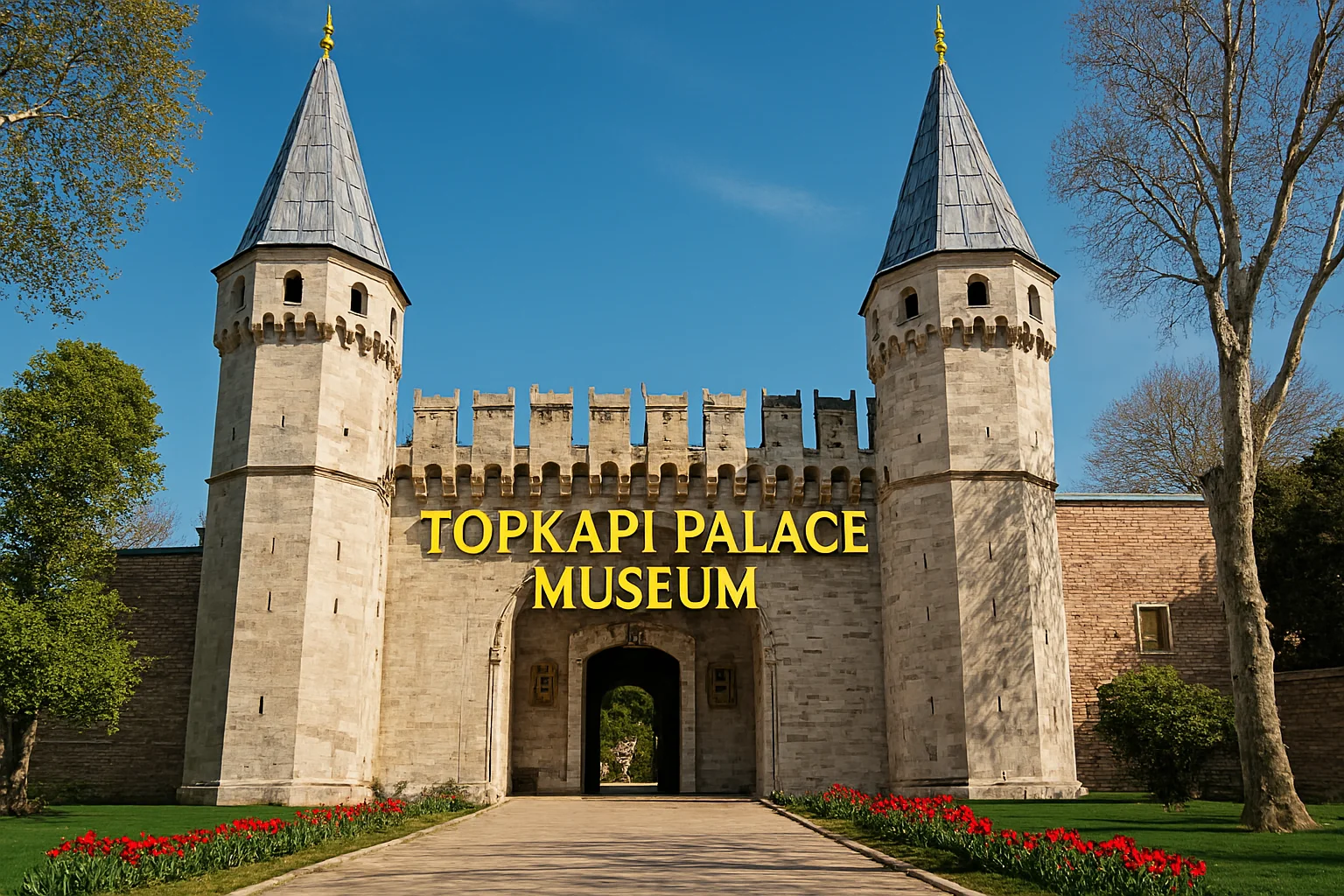
1 Topkapi Palace Museum
For nearly four centuries, Topkapi Palace was the political and administrative heart of an empire that at its peak stretched from Morocco to Iran and from Hungary to the Horn of Africa. Built by Sultan Mehmed II following the Ottoman conquest of Constantinople in 1453, and expanded continuously until the court moved to Dolmabahce Palace in 1856, Topkapi is not a single building but a sprawling complex of pavilions, courts, gardens, kitchens, barracks, and ceremonial halls arranged around four progressively more exclusive courtyards across a 70-hectare promontory above the confluence of the Bosphorus, the Golden Horn, and the Marmara Sea.
The collections are extraordinary in their range and significance. The Imperial Treasury (Fourth Courtyard) contains the 86-carat Spoonmaker's Diamond (the fifth-largest cut diamond in the world), the emerald-hilted gold Topkapi Dagger, and the Throne of Nadir Shah, inlaid with nearly 25,000 precious stones. The Chamber of Sacred Relics (Hirka-i Saadet Dairesi) — one of the most spiritually significant rooms in the Islamic world — holds the mantle, sword, and footprint of the Prophet Muhammad, the staff of Moses, the sword of David, and hair from the Prophet's beard, displayed in gold and jewelled reliquaries. The Imperial Harem (separately ticketed) is a labyrinth of over 400 rooms where the imperial family lived — with the Valide Sultan's apartments, the sultan's private chambers, and the Cage where potential male heirs were confined. The Chinese porcelain collection (12,000 pieces), the miniature paintings, Ottoman robes, and Iznik tilework complete the picture. Allow a full half-day minimum, with a full day advisable including the Harem. Book in advance; this is Turkey's most visited museum.
2 Istanbul Archaeology Museums
The Istanbul Archaeology Museums (Istanbul Arkeoloji Müzeleri) is a complex of three interconnected institutions on the grounds of Topkapi Palace — the main Archaeological Museum, the Museum of the Ancient Orient, and the Tiled Kiosk (Çinili Köşk) — that together form one of the five most important archaeological museum complexes in the world. The complex was founded under the visionary directorship of Osman Hamdi Bey, Turkey's pioneering archaeologist and painter, who established the principle that Ottoman archaeological finds must remain in Turkey and created the institutional framework that produced this extraordinary collection.
The centrepiece of the main Archaeological Museum is the Alexander Sarcophagus — a 4th-century BCE marble sarcophagus of astonishing beauty, its relief panels depicting hunting scenes and the Battle of Issus in which figures engaged with Alexander the Great retain traces of original paint. It was discovered in 1887 at the royal necropolis of Sidon (modern Lebanon) by Osman Hamdi Bey himself. Equally remarkable is the Treaty of Kadesh — one of only two originals of the world's oldest known peace treaty (1259 BCE), signed between Ramesses II of Egypt and the Hittite king Hattusili III; the other original hangs in the United Nations Security Council chamber in New York. The Museum of the Ancient Orient houses Turkey's pre-eminent collection of ancient Mesopotamian artefacts — Sumerian, Babylonian, and Assyrian pieces of exceptional quality not matched outside Iraq. All three museums are accessible on a single combined ticket.
3 Hagia Sophia — The Greatest Building in the World
Hagia Sophia (Church of Holy Wisdom) was, from its construction by Emperor Justinian in 537 CE until the erection of Notre-Dame de Paris nearly 700 years later, the largest enclosed building on earth. Its engineering achievement — a 31-metre diameter dome on pendentives that appears to float unsupported above the nave — solved a structural problem that had defeated every architect before Anthemios of Tralles and Isidoros of Miletos, and its solution influenced every major domed building subsequently built in the Islamic and Christian worlds. For nearly 1,000 years it was the most important Christian church in existence; for 500 years following the Ottoman conquest of 1453 it was the Ottoman Empire's premier imperial mosque.
In 1934, Atatürk converted it to a museum. In 2020, it was reconverted to an active mosque, which it remains today. Visitors can enter freely outside the five daily prayer times — entry is now free of charge. The interior contains some of the finest surviving Byzantine mosaics in existence: the Deesis mosaic (a 13th-century masterpiece of humanistic Byzantine art, in the upper gallery), the Christ Pantocrator and Virgin Orans in the apse, the mosaic of Empress Zoe, and the 10th-century Emperor Constantine IX panel. The great dome, the marble columns brought from temples across the ancient world, the vast nave bathed in light from 40 windows in the dome drum, and the layers of calligraphic Ottoman medallions and Christian imagery coexisting create an experience of overwhelming cultural density. A UNESCO World Heritage Site since 1985, Hagia Sophia is not merely Turkey's greatest monument — it is one of humanity's greatest achievements. Connect your visit with our historical places of Turkey guide.
4 Turkish and Islamic Arts Museum
Occupying the Ibrahim Pasha Palace — built for Suleiman the Magnificent's Grand Vizier in the 16th century and one of the finest surviving examples of Ottoman civil architecture — the Turkish and Islamic Arts Museum faces the ancient Hippodrome of Constantinople where Byzantine emperors once held chariot races and where the ancient Serpent Column, the Obelisk of Theodosius, and the Column of Constantine still stand. The palace's great audience hall, where Ibrahim Pasha received ambassadors and dignitaries, now houses the museum's extraordinary carpet collection.
The museum's collection spans 1,300 years of Islamic and Turkish material culture. Its carpet and kilim collection is among the finest in the world — including the oldest surviving Turkish knotted carpet fragments (13th century, from the Alaeddin Mosque in Konya), the famous Seljuk animal-patterned carpets, and Mamluk geometric carpets of extraordinary refinement. The Iznik ceramics collection documents the full arc of Ottoman ceramic production from the earliest proto-Iznik wares through the peak Suleimanic period (whose cobalt-and-turquoise tiles decorated Topkapi Palace and the Blue Mosque) to later declines. The calligraphy collection covers all major Islamic scripts including Kufic, Naskh, Thuluth, and Diwani, with examples spanning the 7th to 20th centuries. The ground-floor ethnographic section reconstructs traditional Anatolian nomadic tent interiors and village domestic environments with authentic objects. Entry fees are modest and queues are generally short, making it one of Istanbul's most accessible premium museum experiences.
5 Istanbul Modern — Turkey's Premier Art Museum
Istanbul Modern (Istanbul Modern Sanat Müzesi) is Turkey's first dedicated museum of modern and contemporary art — and since its reopening in 2023 in a purpose-designed building by Renzo Piano Building Workshop on the Bosphorus waterfront at Karaköy, it is one of the architecturally most significant new cultural buildings constructed in Turkey in decades. The building's elegant relationship with the Bosphorus waterfront, its integration of indoor and outdoor viewing terraces overlooking the historic peninsula, and its clear, generous gallery spaces represent a step-change in the quality of Istanbul's contemporary cultural infrastructure.
The permanent collection traces the history of Turkish modern and contemporary art from the early 20th century. It opens with the 19th-century pioneers — Osman Hamdi Bey (founder of the Archaeology Museums and Turkey's first internationally recognised painter), Ibrahim Pasha court painters, and the first generation of Turkish artists trained in European academies — before moving through the d-Group abstractionists of the 1930s–40s, the Social Realist period, and the 1960s–70s experimental generation, to internationally exhibited Turkish contemporary artists working today. The museum's photography collection — permanent and thematic temporary exhibitions — is among the strongest in Turkey. Temporary exhibitions have brought major international works. The museum cafe, with panoramic Bosphorus views, is one of Istanbul's finest. Istanbul Modern represents Turkey's most serious and sustained engagement with placing its contemporary art in a global conversation.
6 Pera Museum — The Tortoise Trainer and Orientalist Masterworks
The Pera Museum (Pera Müzesi) in Beyoglu is Istanbul's finest private art museum — housed in the elegantly restored Bristol Hotel building (1893) and maintained by the Suna and Inan Kiraç Foundation to a standard that rivals any public institution. Its permanent collection has three distinct strengths: Orientalist paintings, the Kütahya tiles and ceramics collection, and Anatolian weights and measures. The Orientalist painting collection — European artists depicting Ottoman and Middle Eastern subjects in the 18th and 19th centuries — includes one of the most famous paintings in Turkey: Osman Hamdi Bey's "The Tortoise Trainer" (1906), a self-portrait of Turkey's founding archaeologist depicted as a Sufi dervish training tortoises with a flute, which was sold at Sotheby's in 2004 for $3.5 million before being repatriated to Turkey.
The Kütahya tiles collection covers the full range of Anatolian ceramic production from the 17th through 19th centuries — predominantly the Ottoman provincial tradition that continued after the decline of Iznik — with rare complete panelled interiors that show the tiles in architectural context. Temporary exhibitions at the Pera Museum are consistently ambitious, having hosted major works by Frida Kahlo, Salvador Dali, and Marc Chagall, as well as significant historical photography exhibitions. The museum's bookshop is among Istanbul's finest art book shops. Located in the heart of the Istiklal Avenue cultural district, it combines naturally with a Beyoglu walking itinerary.
7 Rahmi M. Koç Industrial Museum
The Rahmi M. Koç Museum on the Golden Horn at Hasköy is Turkey's most unusual and playful museum — a sprawling complex of transport, industrial, scientific, and maritime exhibits collected by Rahmi Koç, chairman of Turkey's largest industrial conglomerate, over several decades. Housed in a 19th-century Ottoman-era anchor chain factory and its adjacent waterfront buildings, the museum displays over 10,000 objects in approximately 30 themed galleries covering the history of land transport (vintage cars, motorcycles, steam engines, horse-drawn carriages), marine history (submarines, tugboats, historic vessels moored in the Golden Horn), aviation (aircraft including a DC-3 and a Fokker F27), scientific instruments, communications technology, toy trains, and anatomical models.
What makes the Koç Museum exceptional is its curatorial commitment to showing machines in working condition wherever possible, and the extraordinary quality and rarity of many objects. A full-size submarine (the TCG Uluçalireis) can be boarded; a vintage steam locomotive is displayed in a dedicated hall alongside period station reconstruction; an 18th-century hand-operated printing press demonstrates the technology Gutenberg brought to the Ottoman world. The museum is genuinely enjoyable for all ages, and its waterfront location on the Golden Horn makes it easy to combine with a boat trip upstream. An Istanbul Museum Pass companion worth experiencing.
8 Dolmabahce Palace Museum
Dolmabahce Palace (Dolmabahçe Sarayı) on the Bosphorus in Beşiktaş is the largest palace in Turkey — 285 rooms, 46 salons, 68 lavatories, 6 hammams, and 600 metres of Bosphorus frontage — and was the primary residence and administrative centre of the Ottoman sultans from 1856 until the empire's dissolution in 1922. Commissioned by Sultan Abdülmecid I as a demonstration of Ottoman modernity and equality with European great powers, the palace fuses European Baroque, Neoclassical, and Rococo architecture with traditional Ottoman decorative arts — the exterior is of gleaming white limestone, the interior an overwhelming accumulation of European luxury materials and Ottoman ornamental tradition.
Highlights include the Crystal Staircase with its Baccarat crystal banisters; the Grand Ceremonial Hall (Muayede Salonu) with a 4.5-tonne crystal chandelier presented by Queen Victoria (reportedly the largest chandelier in the world); 14 tonnes of gold leaf applied to ceilings throughout; a 600 m² Hereke carpet woven for the palace; and the bedroom of Mustafa Kemal Atatürk, who died here on 10 November 1938 at 9:05am — all the palace clocks are stopped at this time as a permanent memorial. Entry is by guided tour only (separate tours of the Selamlık state apartments and the Harem); tours depart frequently, last 1.5–2 hours, and have maximum capacities that can fill up, particularly in peak season. Book in advance or arrive early.
9 Sakip Sabanci Museum — Calligraphy on the Bosphorus
The Sakip Sabanci Museum (Sabancı Üniversitesi Sakıp Sabancı Müzesi) occupies the Atlı Köşk — an elegant 19th-century Bosphorus waterfront villa at Emirgan, one of the loveliest stretches of the European shore — and a purpose-built modern gallery wing. The permanent collection focuses on two strengths: the finest Ottoman and Islamic calligraphy collection in private hands anywhere in the world, comprising over 400 calligraphic works including imperial tuğras (sultanal ciphers), Quran manuscripts, panels, and albums spanning 600 years; and a significant collection of 19th and 20th-century Turkish and Ottoman painting.
The calligraphy collection is genuinely unmatched in private ownership and rivals state collections in both quality and comprehensiveness. Works by the masters Şeyh Hamdullah, Ahmed Karahisari, Hafız Osman, and Hamid Aytac are displayed in gallery conditions that allow close examination rarely possible elsewhere. The temporary exhibition programme has brought major international artists to this Bosphorus setting, including Pablo Picasso (the 2005 Picasso exhibition was the largest ever held in Turkey, attracting over 600,000 visitors). The museum's view over the Bosphorus and Emirgan's famous tulip park makes it one of Istanbul's most pleasurable cultural destinations.
10 Sadberk Hanim Museum
The Sadberk Hanim Museum (Sadberk Hanım Müzesi) at Büyükdere in Sarıyer is Turkey's first private museum — founded in 1980 in two Bosphorus waterfront yalı (timber waterfront mansions) by the Koç family in memory of Sadberk Koç. It houses one of Turkey's finest private collections of Anatolian archaeological artefacts and Ottoman decorative arts, with pieces spanning from the Chalcolithic period (c. 5000 BCE) through the late Ottoman era.
The archaeological collection is exceptional for a private institution: it includes Chalcolithic and Bronze Age idols, Hittite seals and ceremonial vessels, Urartian bronzes, Phrygian fibulae, Greek and Roman antiquities from Anatolian sites, and Byzantine objects. The ethnographic section presents Ottoman embroidery, costumes, jewellery, and household objects in period room settings of considerable elegance. The Bosphorus waterfront setting — the museum occupies two adjacent 19th-century timber mansions with gardens — is uniquely atmospheric. The museum is located near the Rumeli Feneri lighthouse at the Black Sea entrance to the Bosphorus, making it a rewarding destination for a Bosphorus boat excursion combined with a visit.
12 Museum of Anatolian Civilizations — Turkey's Greatest Museum
The Museum of Anatolian Civilizations (Anadolu Medeniyetleri Müzesi) in Ankara's Ulus district is widely regarded as the finest museum in Turkey and one of the most important archaeological museums in the world. Winner of the Council of Europe Museum of the Year Award in 1997 — voted Europe's best museum of that year — it presents a chronological journey through 9,000 years of Anatolian civilisation in a beautifully restored 15th-century Ottoman bedesten (covered market hall) whose domed and vaulted spaces provide an architectural frame perfectly suited to the antiquity of the objects within.
The collection is unmatched for its focus on Anatolian cultures specifically: the Palaeolithic and Neolithic galleries include objects from Çatalhöyük (one of the world's earliest urban settlements, c. 7500 BCE) and cult objects associated with the Neolithic revolution; the Chalcolithic gallery displays the earliest evidence of metalworking in the region; the Hittite gallery — the museum's centrepiece — contains the world's finest collection of Hittite art and artefacts, including monumental stone orthostat reliefs from Carchemish, Sakçagözü, and Malatya, Hittite ritual vessels (rhytons), cuneiform clay tablets in multiple scripts, and bronze ceremonial objects. The Phrygian gallery contains finds from King Midas's actual burial tumulus at Gordion (excavated 1957), including the oldest wooden furniture in the world. Urartian bronzes, Lydian gold, and extensive Hellenistic and Roman Anatolian collections complete a chronological narrative of extraordinary depth. The museum's cafe and bookshop, in the adjacent Ottoman caravanserai, are excellent.
13 Anitkabir — Mausoleum and Museum of Ataturk
Anitkabir (meaning "memorial tomb") on Rasattepe Hill in Ankara is the mausoleum of Mustafa Kemal Atatürk — founder and first president of the Turkish Republic, who died in 1938 — and is simultaneously one of Turkey's most emotionally powerful cultural sites and a museum of early Republican history of considerable scholarly value. The mausoleum complex, designed in a monumental style that synthesises ancient Anatolian, Hittite, and modern architectural elements, was built between 1944 and 1953 and consists of a ceremonial avenue lined with 24 lion sculptures, a vast courtyard flanked by towers, and the Hall of Honour (Şeref Holü) where Atatürk's sarcophagus rests under the central dome.
The Atatürk and Independence War Museum within the complex is genuinely informative — with personal possessions, photographs, correspondence, military uniforms, and the detailed documentary record of the Turkish War of Independence (1919–1923) and the founding of the Republic. Entry is free. The site receives approximately 8 million visitors annually, making it among the most visited cultural sites in Turkey. The changing of the guard ceremony at the entrance to the Hall of Honour, conducted with exceptional precision, is performed on the hour from 9am to 4pm. For visitors seeking to understand modern Turkey's national identity and the remarkable transformation that Atatürk led, Anitkabir is essential.
14 Ankara Ethnography Museum
The Ankara Ethnography Museum (Ankara Etnografya Müzesi) occupies an elegant white marble building constructed in 1930 on Talat Pasa Bulvarı, designed in the early Republican style that sought to create a distinctly Turkish national architecture. The museum's collection focuses on Seljuk and Ottoman material culture of Anatolian origin — distinguishing it from Istanbul institutions by its emphasis on provincial and vernacular traditions rather than imperial court production. Collections include exceptional examples of Anatolian metalwork (copper, brass, and silver domestic objects); traditional costumes and embroidery from regional traditions across Anatolia; carved wooden doors and architectural elements from demolished Ottoman buildings; Seljuk stone sculpture and epigraphy; and Anatolian musical instruments.
A dedicated room preserves Atatürk's horse (Sakarya), taxidermied, alongside objects associated with his personal life and the founding of the Republic — a complement to Anitkabir a short distance away. The museum also holds significant carpets, kilims, and textiles from central Anatolian traditions including those of the nomadic Yörük and Türkmen peoples whose weaving traditions are distinct from both Ottoman court production and the better-documented western Anatolian carpet tradition. For visitors seeking to understand the cultural breadth of Anatolia beyond the Ottoman imperial core, the Ethnography Museum provides important context. Combine with the Museum of Anatolian Civilizations for a full Ankara cultural day.
15 Ephesus Museum, Selçuk
The Ephesus Museum (Efes Müzesi) in the town of Selçuk holds the most important collection of artefacts from the ancient city of Ephesus — one of the best-preserved Roman cities in the world and a UNESCO World Heritage Site. The excavations of Ephesus, conducted primarily by the Austrian Archaeological Institute since the 19th century, have produced an extraordinary volume of sculptural, ceramic, glass, and everyday objects, and the Selçuk museum represents the finest of these finds in an accessible, well-curated setting.
The museum's most celebrated exhibits are the Artemis statues — two polychrome marble cult statues of Artemis of Ephesus, the distinctly Anatolian multi-breasted (or egg-clustered — the iconography remains debated) form of the goddess who was worshipped at the Temple of Artemis, one of the Seven Wonders of the Ancient World. Other highlights include the Room of the Terrace Houses finds (domestic objects, frescoes, and mosaics from the wealthy residential terraces excavated on the south slope of the Bülbüldağ); exceptional Roman portrait busts; the Ephesian inscription collection; and a remarkable medical instruments display illuminating Roman-era surgical practice. The museum pairs naturally with a visit to the Ephesus site (3km distant) and the Basilica of St. John on the Ayasoluk Hill above Selçuk. See our historical places guide for Ephesus detail.
16 Izmir Archaeology Museum
The Izmir Archaeology Museum (Izmir Arkeoloji Müzesi) in Konak Square, opened in 1984 in a purpose-built building, holds the largest collection of Aegean region antiquities outside Istanbul — over 50,000 objects from sites across the Izmir province and the broader Aegean coastal region. The collection is particularly strong in Greek and Roman sculpture from Smyrna (ancient Izmir) and its hinterland: portrait busts, sarcophagi, architectural fragments, and votive objects illuminate the rich Greek colonial and Roman provincial culture that flourished along this coastline from the 8th century BCE through the Byzantine period.
The ceramics collection is exceptional — covering the full sequence from Mycenaean through Geometric, Archaic, and Classical Greek wares to Roman-period local production, with many objects from now-inaccessible or disturbed archaeological contexts preserved here. The prehistoric gallery covers the region's Bronze Age cultures including finds from the important sites of Bayraklı (ancient Smyrna, one of the cities claimed as Homer's birthplace) and Klazomenai. Pair with a visit to Agora of Smyrna — the colonnaded Roman market place, 2km from the museum in central Izmir, where basement vaults are among the best-preserved Roman urban infrastructure in Turkey — for a comprehensive Izmir antiquity experience.
17 Bodrum Museum of Underwater Archaeology
The Bodrum Museum of Underwater Archaeology (Sualtı Arkeoloji Müzesi) is one of the world's most important specialist museums, housed within the magnificent Castle of St. Peter (Bodrum Castle) — built by the Knights Hospitaller between 1402 and 1523, currently one of the best-preserved medieval castles in Turkey, and itself a major reason to visit. The castle's five towers, each assigned to a different nation of the Knights (English, French, German, Italian, and Spanish), house different thematic collections from Bronze Age to Ottoman maritime finds.
The museum's foundation rests on the pioneering work of George Bass and the Institute of Nautical Archaeology (INA), which developed the fundamental techniques of scientific underwater excavation through excavations in Turkish waters. The Uluburun wreck (c. 1310 BCE) is the museum's centrepiece — the most important Bronze Age shipwreck ever excavated, yielding gold jewellery, a gold scarab belonging to Nefertiti, copper and tin ingots representing a full cargo of Silk Road exchange, ebony logs, pomegranate seeds preserved for 3,300 years, and personal objects that paint an extraordinary picture of Late Bronze Age international trade at its height. The Cape Gelidonya wreck (c. 1200 BCE, the oldest Bronze Age wreck ever excavated), Byzantine glass wrecks, and Ottoman-period maritime objects complete the collection. The castle gardens and battlement views over the Aegean are spectacular. See also our Bodrum beaches guide to plan a combined visit.
18 Antalya Archaeological Museum
The Antalya Archaeological Museum (Antalya Arkeoloji Müzesi) is one of Turkey's largest regional archaeological museums — containing over 35,000 catalogued objects from excavations across Antalya Province, which encompasses an extraordinary range of ancient cultures and sites including Lycia, Pamphylia, Pisidia, and Cilicia. The museum is considered among Turkey's finest for the quality and scale of its Roman sculpture collection, which draws on the excavations of major sites including Perge, Aspendos, Termessos, Side, Xanthos, Patara, and Phaselis.
The Sarcophagus Hall alone justifies the visit — over 30 sculptural Roman sarcophagi in a single gallery, including the Heracles Sarcophagus (depicting the 12 Labours) and the Domitian Temple sarcophagus. The Perge gallery is exceptional: the god and emperor statues excavated from the Perge agora include portrait-quality works of Hadrian, Plancina, and the Three Graces that stand comparison with Rome's Capitoline Museum holdings. A dedicated hall presents pre-historic finds including the Karain Cave sequence — Turkey's most complete Palaeolithic stratigraphic site — with tools and fauna spanning 300,000 years of human occupation. The museum's orientation as a study of Anatolian coastal culture rather than purely one city makes it one of Turkey's most intellectually rich regional museums. Pair with a visit to the nearby historical sites of Antalya Province.
19 Side Museum — A Roman Collection in a Byzantine Church
The Side Museum (Side Müzesi) in the ancient harbour town of Side achieves something unique in Turkey — it presents an outstanding collection of Roman sculpture and sarcophagi in the extraordinarily appropriate setting of a 5th-century Byzantine church building. The converted Roman bath complex and church provide high, arched spaces that suit the scale of the monumental sculptures and create an atmospheric encounter with antiquity not possible in a conventional modern gallery building.
The collection draws primarily on excavations of the ancient city of Side itself — a Pamphylian Greek colonial city that became a prosperous Roman harbour town famous for slave-trading and piracy before being cleaned up under Augustus. The sarcophagi collection, the portrait busts of Roman officials and emperors, and the decorative architectural fragments from the temples of Apollo and Athena (whose columns stand dramatically above the sea at Side's western promontory) are all of high quality. The museum is compact — allow 45 minutes to an hour — and is most powerfully experienced in combination with a walk through the ancient streets of Side town, the theatre (one of Turkey's best preserved), and the sunset from the Temple of Apollo above the sea. Side is covered in our Turkey beaches guide.
20 Göreme Open Air Museum — Byzantine Frescoes in Rock-Cut Churches
The Göreme Open Air Museum (Göreme Açık Hava Müzesi) in Cappadocia is a UNESCO World Heritage Site and one of Turkey's most remarkable cultural destinations — a monastic complex of rock-cut churches, chapels, refectories, and monk's cells carved directly into the volcanic tufa cones and cliffs of the Göreme Valley, used by Byzantine Christian communities from the 4th through to the 13th century. The complex is the largest and best-preserved of the hundreds of similar underground and rock-cut monastic sites scattered across the Cappadocian plateau.
The churches contain some of the finest surviving Byzantine fresco cycles in existence outside Constantinople itself — painted in vivid natural mineral pigments by skilled workshop artists commissioned by wealthy local patrons and monastic foundations. The Karanlık Kilise (Dark Church) — the most important single interior, with a fully restored 11th-century fresco programme depicting the Nativity, Transfiguration, Crucifixion, and Anastasis (Resurrection) in deep lapis blue and vermilion — requires a separate additional ticket but is unmissable. The Tokali Kilise (Buckle Church, slightly outside the main complex) is the largest single church and has the most extensive fresco cycle. The Elmalı Kilise (Apple Church) and the Yılanlı Kilise (Snake Church) offer different thematic programmes. Entry is by ticket; the Dark Church ticket is additional. See our Cappadocia outdoor guide for hot air balloon flights and valley hikes to combine with a museum visit.
21 Mevlana Museum, Konya — Rumi's Mausoleum
The Mevlana Museum (Mevlana Müzesi) in Konya is the mausoleum, dervish lodge (tekke), and museum complex of Jalal ad-Din Muhammad Rumi — the 13th-century Persian-language Sufi mystic and poet known as Mevlana ("Our Master"), whose Masnavi is among the most widely read poetic works in the Islamic world and whose philosophy of spiritual love through music, movement, and meditation gave rise to the Mevlevi Sufi order (the Whirling Dervishes). Rumi died in Konya in 1273 CE; his tomb, surmounted by the iconic conical fluted turquoise-tiled tower that has become the symbol of Konya, is the most visited site in Turkey outside Istanbul.
The museum complex includes Rumi's tomb and the tombs of family members; the semahane (ceremonial hall) where the Sema (Whirling Dervish ceremony) was performed until the orders were dissolved by Atatürk in 1925; displays of Rumi's original manuscripts and personal possessions including his prayer rug and musical instruments; an exceptional collection of Seljuk and Ottoman textile arts; historic dervish costumes and musical instruments; and outstanding illuminated Quran manuscripts. The atmosphere is profoundly moving regardless of religious background — the combination of the extraordinary architecture, the scent of rose water, the soft lighting on the tiles, and the visible devotion of Muslim pilgrims from across the world creates an experience unlike any conventional museum. The annual Sema ceremony is held in Konya each December (Sheb-i Arus — the anniversary of Rumi's death) and is one of Turkey's most extraordinary cultural events.
22 Zeugma Mosaic Museum — The World's Largest Mosaic Collection
The Zeugma Mosaic Museum (Zeugma Mozaik Müzesi) in Gaziantep, opened in 2011, is the largest mosaic museum in the world — with a display area of approximately 1,700 square metres dedicated exclusively to Roman floor mosaics rescued from the ancient city of Zeugma. Zeugma was a prosperous Hellenistic and Roman border city on the Euphrates River (today the Turkish-Syrian border zone), founded as a Macedonian military colony and later transformed into a major Silk Road trading hub. When the construction of the Birecik hydroelectric dam threatened to submerge a large portion of the site, an international emergency excavation campaign recovered hundreds of extraordinary mosaic floors from wealthy Roman villas.
The museum's most famous piece is the Gypsy Girl (Çingene Kız) — a haunting portrait mosaic of a young woman with large, expressive dark eyes and loosely curled hair that has become one of the most recognised images in Turkish archaeology and the symbol of Gaziantep. Its emotional power — the sense of a real individual from the 2nd century CE looking directly at the viewer — is extraordinary even in reproduction, and overwhelming in person. Other masterworks include the Poseidon and Amphitrite mosaic, the Mars and Venus panel, and full triclinium (dining room) floor reconstructions showing entire mosaic floors in their architectural context. Gaziantep is also Turkey's culinary capital — famous for baklava, Antep fistigi (pistachios), and a sophisticated regional cuisine — making a museum visit part of a broader extraordinary Gaziantep experience.
23 Sanliurfa Museum — Gateway to the World's First Temples
The Şanlıurfa Archaeology and Mosaic Museum, opened in 2015, is among Turkey's most remarkable new museums — housing the principal finds from Göbekli Tepe, the world's oldest known monumental structure, built on a hilltop 15km from Şanlıurfa by Neolithic hunter-gatherers approximately 11,500–12,000 years ago. Göbekli Tepe rewrote the timeline of human civilisation: its builders had no pottery, no domesticated animals, and no settled agriculture — yet they organised the quarrying and erection of T-shaped limestone pillars weighing up to 20 tonnes, carved with sophisticated animal reliefs (foxes, boars, cranes, vultures, scorpions, lions), creating a ritual landscape of extraordinary complexity 7,000 years before the first Egyptian pyramid.
The museum displays original T-pillars from Göbekli Tepe alongside interpretive material explaining the site's revolutionary significance; the Urfa Man (Balıklıgöl statue) — the world's oldest known life-sized human sculpture, approximately 11,000 years old, carved in limestone with haunting obsidian eyes; and a mosaic hall protecting Roman mosaics discovered during construction work in ancient Edessa (modern Şanlıurfa). The museum is a mandatory complement to a visit to the Göbekli Tepe site itself (15km distant, with shuttle bus connections). Together they constitute one of the most intellectually transformative cultural experiences available to travellers anywhere in the world — a genuine encounter with the dawn of organised human religion and society.
24 Mardin Museum — History in a Honey-Stone City
The Mardin Museum (Mardin Müzesi) is housed in the restored 19th-century American Mission building in the extraordinary honey-stone city of Mardin — a UNESCO-listed old town perched on a ridge above the Mesopotamian plain that is one of Turkey's most visually spectacular cities. Mardin's unusual multilayered heritage — simultaneously Assyrian Christian, Arabic, Kurdish, and Turkish — is reflected in a museum collection that spans prehistoric, Roman, Byzantine, and Islamic Mesopotamian cultures of the upper Tigris region.
The collection includes Neolithic and Bronze Age finds from the Mardin Plain excavations; Assyrian, Babylonian, and Mitanni-period objects from the upper Mesopotamian region; Byzantine architectural fragments and church furnishings from the numerous ancient Christian monasteries still operating in the Tur Abdin plateau; and Ottoman-period objects reflecting the region's complex cultural layering. The museum building itself — a beautifully restored 19th-century structure with vaulted stone rooms — is one of the most architecturally sympathetic museum settings in Turkey. Equally important is the city surrounding it: the Deyrulzafaran Monastery (4th century CE, still functioning), the Kasimiye Madrasah, the Great Mosque (converted from a Byzantine cathedral), and the labyrinthine stone-vaulted streets of the old town combine to make Mardin one of Turkey's most extraordinary cultural destinations.
25 Gallipoli Memorial Museums, Çanakkale
The Gallipoli Peninsula contains multiple memorial museums, cemeteries, and preserved battlefield sites commemorating one of the First World War's most significant and costly campaigns — the Allied attempt (February 1915 – January 1916) to force the Dardanelles and capture Istanbul, which resulted in approximately 100,000 deaths and became a defining national experience for Turkey, Australia, New Zealand, and the United Kingdom. The Çanakkale Martyrs' Memorial and the Gallipoli Campaign Museum in Çanakkale city present Turkish, British, Australian, New Zealand, and French perspectives on the campaign with artefacts, photographic archives, military equipment, and personal testimonies.
The Gallipoli Peninsula Historical National Park contains 31 war cemeteries, dozens of preserved trench systems, and major memorials including the Atatürk Memorial (site of the most famous battlefield speech in Turkish history, where Atatürk addressed the mothers of Allied soldiers with extraordinary generosity), ANZAC Cove, Chunuk Bair, and the British Cape Helles Memorial. The experience of walking the landscape where the battles occurred — the narrow beaches, the steep gullies, the extraordinary proximity of opposing trenches — provides a physical understanding of the campaign's impossible tactical difficulties. Çanakkale is also the ferry point for Bozcaada Island and 50km from Troy, making it a natural hub for a heritage-rich northwestern Turkey itinerary. See our historical places guide for Troy and the Dardanelles context.
26 Bursa City Museum
The Bursa City Museum (Bursa Kent Müzesi) in the restored 19th-century Merinos Atatürk Congress Cultural Centre presents the full sweep of Bursa's extraordinary history — from its founding as a Bithynian city in the 3rd century BCE, through its period as the first capital of the Ottoman Empire (1326–1365), to its role in Turkey's early industrialisation as the centre of silk production. The museum uses well-designed diorama, interactive, and documentary presentations to make its historical narrative accessible and engaging.
Bursa holds an exceptional concentration of early Ottoman architecture — the Green Mosque (Yeşil Cami) and Green Mausoleum (Yeşil Türbe) with their extraordinary turquoise and blue Iznik tiles are among the finest early Ottoman buildings in existence; the Ulu Cami (Grand Mosque) with its interior forest of 20 columns and large ablution fountain; and the Silk Bazaar (Koza Han), still active as a silk and jewellery market, are all within walking distance of the museum. Bursa is a UNESCO World Heritage Site for its silk road significance, its Ottoman architectural monuments, and its role in the global silk trade. The Bursa Silk Factory Museum (İpekiş) traces the 2,000-year history of silk production in the region with actual looms and historical production equipment. Bursa is accessible from Istanbul by ferry and highway in approximately 2 hours.
