
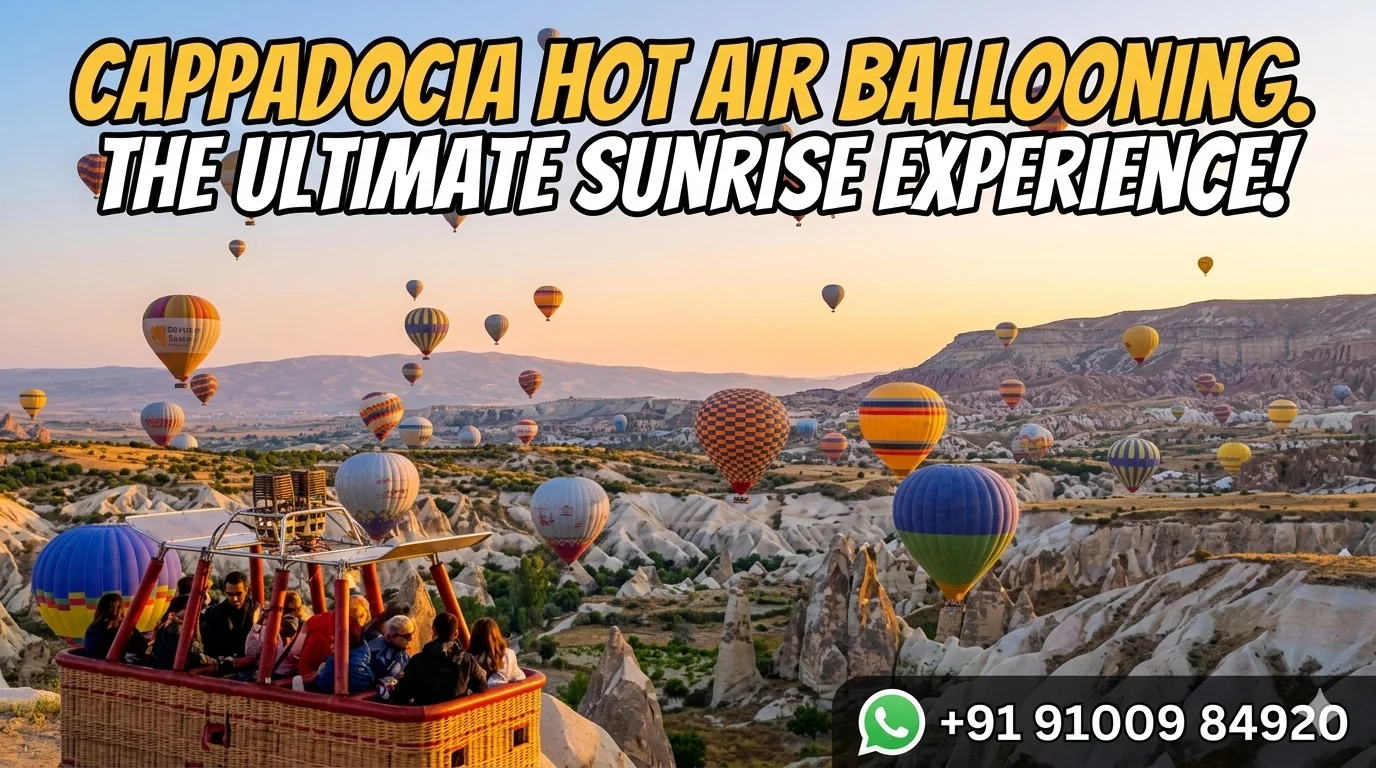
1 Cappadocia Hot Air Ballooning
Hot air ballooning over Cappadocia at sunrise is widely acknowledged as one of the most extraordinary travel experiences available anywhere on earth. The unique volcanic landscape — created by millions of years of eruption, compression, and erosion — produces the distinctive fairy chimney formations (peribacaları): tall, narrow rock columns capped with harder basalt that protected the softer tuff beneath from erosion. From the air at dawn, these formations extend across multiple valleys in every direction, with dozens of colourful balloons drifting silently above them as the light shifts from rose to gold.
Cappadocia has become the world capital of hot air ballooning — on clear peak-season mornings, up to 150 balloons are simultaneously in the air above the Göreme valley, a concentration found nowhere else on earth. Flights depart before sunrise (typically 5–6am) and last 1–1.5 hours, covering multiple valleys at varying altitudes from treetop level to several hundred metres. The Love Valley, Rose Valley, Pigeon Valley, and Sword Valley are the principal flight areas, each with distinct fairy chimney formations and hues. Reputable operators provide hotel transfers, champagne breakfast on landing, and CAA-certified pilots. Always book with established operators rather than on price alone — safety standards vary significantly. The best months are April–June and September–November. This is one experience that genuinely matches — and often exceeds — expectations.
2 Göreme Valley Hiking — Fairy Chimneys on Foot
Walking through Cappadocia's valleys is the ground-level complement to the balloon experience — and in many ways equally extraordinary. The Rose Valley (Güllüdere) offers a 2–3 hour circular hike through tuff formations that shift in colour from cream to rose-pink as the light changes, passing several Byzantine rock-cut churches with intact frescoes visible through open doorways. The Love Valley (Aşk Vadisi) features the most dramatic phallic fairy chimney formations and connects to Avanos via a 3-hour trail with valley-wide views.
The Pigeon Valley (Güvercinlik Vadisi) connects Göreme to Uçhisar Castle — a 1.5-hour moderate trail past thousands of hand-carved pigeon holes in the cliff faces (pigeons were historically kept for their fertiliser-rich droppings, prized by the tufa-garden agricultural communities). Sword Valley and the Red Valley provide quieter alternatives with fewer visitors and equally dramatic scenery. All major valleys are waymarked and accessible without guides, though local walking maps from the Göreme visitor centre are recommended. The Göreme Open Air Museum — a UNESCO World Heritage Site containing the finest Byzantine frescoes in Cappadocia — is a mandatory addition to any valley hiking day. See our Turkey museums guide for full Göreme detail.
3 The Lycian Way — One of the World's Great Coastal Trails
The Lycian Way (Likya Yolu) is a 540km waymarked long-distance trail along the southwestern coast of Turkey, running from Fethiye to Antalya through the ancient Lycian region — and was named one of the world's top ten walking routes by Sunday Times Travel magazine upon its opening in 1999. Developed by British walker Kate Clow, it became one of the world's first dedicated long-distance coastal trails and has inspired a generation of similar routes across Turkey and the eastern Mediterranean.
The trail passes through an astonishing variety of terrain: remote sea-cliff paths with the Mediterranean hundreds of metres below, ancient Lycian ruins encountered mid-trail without signage or crowds, pine and cedar forests, high mountain passes crossing the Bey Dağları range above 1,700m, traditional farming villages where hikers stop for tea and basic accommodation, and deserted coves accessible only on foot where the trail descends to sea level for a swim. The full trail takes approximately 29 days; most travellers walk selected sections of 3–7 days. Outstanding shorter sections include Ölüdeniz to Faralya (via Butterfly Valley cliffs, 3–4 hours), Kaş to Kalkan (coastal path with Lycian tombs, 4 hours), and the Çayağzı to Myra section past the Lycian rock tombs. Best walked October to May to avoid summer heat. Detailed trail maps and GPS tracks available from the Kate Clow Lycian Way Association.
4 Pamukkale — Cotton Castle Thermal Terraces
Pamukkale (Cotton Castle) is one of Turkey's most visually arresting natural landscapes — a UNESCO World Heritage Site where calcium carbonate dissolved in hot spring water has deposited over millennia into a cascade of brilliant white terraced pools on a 200-metre hillside, each filled with warm, milky-blue mineral water of remarkable translucency. The formations are the result of 17 hot springs emerging at 35°C and flowing down the slope, depositing carbonate as the water cools — a process that has been ongoing for at least 400,000 years and produces approximately 500 tonnes of calcium carbonate annually.
Visitors walk barefoot through the lower terrace pools in shallow warm water — a tactile experience of walking on warm white mineral formations surrounded by turquoise water that is genuinely unlike any other natural site. Swimming in the upper terraces is now prohibited to protect the formations, but the Antique Pool (Cleopatra's Pool) in the adjacent Hierapolis ruins allows bathing at 36°C among genuine fallen Roman columns submerged during an ancient earthquake — one of the world's most extraordinary swimming experiences. The ancient Greco-Roman city of Hierapolis on the plateau above contains a vast theatre, extensive necropolis, and the Plutonium (sacred cave believed to lead to the underworld). Arrive before 9am or after 4pm to avoid the peak midday coach tour groups. Pamukkale is 270km from Antalya (3 hours) and 200km from Izmir (2.5 hours).
5 Köprülü Canyon — Turkey's Premier Rafting River
Köprülü Canyon National Park in Antalya Province contains Turkey's finest whitewater rafting river — the Köprüçay, which carves a dramatic canyon through the limestone heart of the Taurus Mountains before emerging onto the coastal plain near Aspendos. The canyon walls rise up to 400 metres above the river; the water runs cold, clear, and fast through Class 3–4 rapids in its upper sections, descending to Class 2–3 in the more accessible lower reaches used for family and beginner tours. Two Roman bridges span the canyon within the park — the Oluk Köprü (2nd century CE) remains in continuous use for pedestrian traffic for nearly 2,000 years, a remarkable engineering survival.
Rafting is operated by licensed companies from the base camp at Beşkonak village — a full range of safety equipment, experienced guides, and pre-trip safety briefings are provided by reputable operators. The season runs April through October, with spring high-water (April–May) providing the most exhilarating rapids and autumn lower-water runs being calmer and warmer. Beyond rafting, the national park offers excellent canyon trekking along riverside paths, mountain biking on forest tracks, jeep safaris into the Taurus backcountry, and swimming in the crystal-clear river pools. The ancient theatre of Aspendos — the best-preserved Roman theatre in the world — lies 40km downstream and makes a natural afternoon addition. Köprülü is 80km from Antalya city (approximately 1.5 hours) and ideal as a full-day excursion. See our historical places guide for Aspendos detail.
6 Butterfly Valley — The Lycian Coast's Hidden Canyon
Butterfly Valley (Kelebekler Vadisi) near Fethiye is one of Turkey's most dramatically situated natural locations — a steep-walled canyon descending to a pristine sandy cove accessible only by boat (from Ölüdeniz, 20 minutes) or by a demanding cliff trail from the village of Faralya above. The valley takes its name from the Jersey Tiger moth (Euplagia quadripunctaria), which migrates to the canyon's sheltered, humid microclimate in large numbers during late summer — a phenomenon that creates an extraordinary natural display on the canyon vegetation.
The canyon itself is a remarkable landform: 300-metre vertical limestone walls enclosing a microclimate of fig, oleander, and bay laurel that is markedly cooler and more humid than the surrounding hillsides. A waterfall at the canyon head is accessible on a 45-minute hike from the beach through increasingly dense vegetation. The beach is a designated protected area — no motor vehicles, no permanent buildings beyond a basic camp. Visitors who stay overnight (simple bungalow and camping accommodation on the beach) experience the canyon after day-trippers depart — the evening light on the walls, the silence, and the fireflies after dark are memorable. The Lycian Way passes above the valley rim between Ölüdeniz and Faralya; the cliff-top section offers the most dramatic coastal views on the entire trail. Combine with the Ölüdeniz Blue Lagoon — covered in our Turkey beaches guide.
7 Mount Ararat — Turkey's Highest and Most Mythic Summit
Mount Ararat (Ağrı Dağı) is Turkey's highest mountain at 5,137 metres and one of the most symbolically significant peaks in the world — revered in the Abrahamic traditions as the resting place of Noah's Ark and dominating the landscape of eastern Anatolia with its enormous snow-capped volcanic cone visible from three countries. It is a non-technical high-altitude mountain requiring no ropes or ice axes under normal summer conditions, but demands excellent physical fitness and acclimatisation due to altitude — it is a significantly more serious undertaking than its non-technical status implies.
The standard ascent follows a four-to-five day programme with camps at approximately 3,200m (Camp 1) and 4,200m (Camp 2), with summit day beginning at midnight to reach the top at dawn and descend before afternoon weather arrives. A government permit is required and is arranged through licensed guiding companies — processing takes 4–8 weeks and solo unguided ascents are not legally permitted. The season is late June to early September. The nearest base is Doğubayazıt (18km), which also contains the extraordinary Ishak Pasha Palace — a 17th-century Ottoman palace dramatically positioned above the Aras valley. Explore more at our historical places in Turkey guide. Altitude sickness is a genuine risk above 4,000m; proper acclimatisation and descent protocols are essential.
8 Lake Van & Akdamar Island — Turkey's Inland Sea
Lake Van (Van Gölü) is Turkey's largest lake and one of the world's largest endorheic soda lakes — a 3,713 km² body of highly alkaline water at 1,640m altitude, surrounded by mountains exceeding 4,000 metres and possessing a striking turquoise-blue clarity from its high mineral content. The lake is fed by rivers but has no outlet; evaporation concentrates sodium carbonate, creating alkalinity that produces an almost impossibly vivid colour in clear weather and a unique ecosystem adapted to extreme chemistry.
The lake's most celebrated feature is Akdamar Island (Akdamar Adası), a small island 3km offshore containing the Church of the Holy Cross — a 10th-century Armenian Cathedral (921 CE) built by King Gagik I of Vaspurakan, covered with extraordinary exterior stone bas-reliefs depicting biblical scenes including Adam and Eve, David and Goliath, and the life of Christ. It is one of the finest examples of medieval Armenian architecture surviving anywhere. Boats depart from Gevaş (45 minutes from Van city). The Van Museum holds important Urartian artefacts from the ancient Kingdom of Urartu, which controlled this region in the 9th–6th centuries BCE. Combine with Mount Ararat (90km) for a comprehensive eastern Turkey circuit — browse our Turkey Tour Packages for eastern Anatolia itineraries.
9 Ihlara Valley — Canyon Hiking Through Byzantine History
Ihlara Valley (Ihlara Vadisi) is a 14km canyon carved by the Melendiz River through volcanic rock in Aksaray Province — one of Turkey's most rewarding hiking destinations, combining spectacular canyon scenery with one of the highest concentrations of Byzantine rock-cut churches anywhere outside Istanbul. Canyon walls rise to 150 metres and are riddled with hundreds of chapels, hermit cells, and frescoed churches carved by Christian monastic communities between the 4th and 13th centuries, many containing remarkably intact fresco cycles.
The trail follows the river through lush riparian vegetation — poplar, willow, plane trees, and oleander — creating a vivid green ribbon through the arid volcanic plateau. Named churches including Ağaçaltı Kilise, Yılanlı Kilise (with its remarkable Last Judgement fresco), and Sümbüllü Kilise are open for entry. The canyon terminates at Selime Monastery — the largest rock-cut structure in Cappadocia, cathedral-scale, carved entirely from the volcanic rock face. The full 14km walk takes 4–5 hours; most visitors walk 7–8km entering at Ihlara village and exiting at Belisırma for riverside lunch. Ihlara lies 1.5 hours southwest of Göreme and pairs perfectly with the Göreme Open Air Museum on a Cappadocia itinerary.
10 Taurus Mountains — Cedar Forests and High Plateaus
The Taurus Mountains (Toroslar) form the great arc of limestone ranges separating the Anatolian plateau from the Mediterranean coastal plain, rising to over 3,756m at Demirkazık in the Aladağlar range and extending for 550 kilometres from the Aegean coast to the Syrian border. For outdoor travellers they offer experiences from easily accessible forest day hikes above Antalya to serious multi-day mountain treks in the Aladağlar National Park — a landscape of dramatic limestone walls, glaciated valleys, and high pastoral plateaus (yaylalar) that rivals anything in the Alps for scenery.
The Bey Dağları Coastal National Park, rising directly behind Antalya, protects ancient cedar forests with trees over 1,000 years old and offers trekking routes with Mediterranean views. The Aladağlar range in the eastern Taurus, accessible from Niğde, contains Turkey's most serious climbing terrain — the Demirkazık and Emler walls attract rock climbers from across Europe, while the Yedigöller plateau (Seven Lakes) provides stunning multi-day trekking. The Cilician Gates (Gülek Pass) carries both historical and scenic significance as the ancient crossing from Anatolia to Syria. Combine with Köprülü Canyon rafting and Aspendos Roman theatre for a full Antalya Province adventure programme.
11 The Blue Voyage — Sailing Turkey's Turquoise Coast
The Blue Voyage (Mavi Yolculuk) is Turkey's most iconic extended travel experience — a traditional gulet sailing cruise along the Aegean and Mediterranean coast, conceived by Turkish poet Cevat Şakir Kabaağaçlı in the 1940s and developed into a travel institution that remains as compelling as ever. Gulets are traditional Turkish wooden sailing vessels of 15–35 metres with private cabins, sun decks, and crew, chartered for multi-day cruises anchoring each night in remote coves, sea caves, and uninhabited bays entirely inaccessible by road — the definitive argument for seeing Turkey from the sea.
Principal routes include Bodrum to Marmaris (4–5 days, through the Datça Peninsula and Hisarönü Gulf), Marmaris to Fethiye (4–5 days, through the Göcek islands and the famous 12 Islands route), Fethiye to Kaş (3–4 days, past Butterfly Valley and Patara), and the grand Fethiye to Antalya route (10–14 days, the full Blue Voyage experience). Booking options include cabin charters (individual cabins on a shared boat) and full-boat charters (group hire of the entire vessel). The season runs May through October. Swimming, snorkelling, paddleboarding, and fishing from the gulet punctuate each day's sailing — a genuinely restorative pace of travel through some of the world's most beautiful coastline. Our team can arrange gulet charters as part of a complete Turkey Tour Package.
12 Saklikent Gorge — Turkey's Deepest Canyon
Saklikent Gorge (Saklıkent Kanyonu) near Fethiye is Turkey's longest and deepest gorge — 18 kilometres long with walls rising to 300 metres that, at their narrowest points, admit only a sliver of sky above the ice-cold river churning along the canyon floor. The gorge is carved through the Akdağ limestone massif by the Eşen Çayı; the water runs at only 7–12°C year-round from mountain snowmelt, providing a dramatic and physically bracing contrast to the scorching Fethiye coast outside.
Entry is via a suspended walkway above the river for the first 200 metres, beyond which visitors wade and scramble through the canyon itself — chest-deep in spring high water, knee-deep in summer. The first 4km are accessible to any fit visitor without specialist equipment; the full 18km requires wetsuits, ropes, and canyoneering experience. A restaurant platform cantilevered over the river at the gorge entrance is a remarkable setting for a trout lunch. The gorge is 45km from Fethiye and easily combined with the adjacent Tlos ancient city (Lycian rock tombs, Roman theatre), the Lycian Way, and the beaches of the Fethiye coast. For experienced canyoneers, the upper technical sections offer multi-pitch rappels into world-class specialist terrain.
13 Mount Nemrut — Colossal Stone Heads at Dawn
Mount Nemrut (Nemrut Dağı, 2,134m) in Adıyaman Province is the site of one of the ancient world's most extraordinary monuments — the funerary sanctuary of Antiochus I of Commagene (69–34 BCE), a minor Hellenistic king who constructed a colossal hilltop tomb flanked by two ceremonial terraces bearing 8–10 metre statues of himself alongside Zeus, Apollo, Tyche, and Heracles. The massive stone heads have toppled from their bodies over the centuries and lie scattered across the terraces in a haunting, magnificent tableau unlike any other ancient site on earth.
The UNESCO World Heritage Site is most celebrated for sunrise and sunset viewings — when low-angle light illuminates the stone heads against the open sky in a spectacle that is among Turkey's most photographed and genuinely affecting outdoor moments. The heads represent a unique syncretism of Greek, Persian, and Armenian artistic traditions; the site was unknown to modern scholarship until 1881. Access is by road to a car park 400m below the summit, then a 15–20 minute walk to the terraces — accessible for most fitness levels. Most visitors stay overnight in Kahta or Adıyaman to catch either the sunrise or sunset. The surrounding Commagene region also contains the Karakuş royal tumulus, the Cendere Roman bridge (2nd century CE, still in use), and the ancient city of Arsemia. See our historical places guide for full Commagene region context.
14 Bosphorus Strait — Where Two Continents Meet on Water
The Bosphorus Strait (İstanbul Boğazı) is a 31km natural waterway connecting the Black Sea to the Sea of Marmara, separating the European and Asian halves of Istanbul — and constitutes one of the world's most spectacular urban waterways. Seeing Istanbul from the water is a fundamentally different experience from seeing it from the land: the city's entire skyline unfolds in sequence — the domes and minarets of Sultanahmet rising above the Topkapi promontory, the Dolmabahce Palace waterfront, the forested hills of Beşiktaş and Arnavutköy, Ottoman-era yalı mansions lining the shoreline in elegant succession, and the Bosphorus bridges spanning the strait in the distance.
The classic experience is the public ferry route (İDO or şehir hatları) from Eminönü or Beşiktaş to Anadolu Kavağı at the Black Sea mouth — a 90-minute journey each way through the full length of the strait passing under both suspension bridges. This is one of the world's great urban journeys for a minimal fare. Private Bosphorus tours offer more flexibility with stops at key viewpoints and sunset departures. Dawn on the Bosphorus — when the mist rises from the water, the mosques emerge from blue-grey light, and tankers move silently through the strait — is one of Istanbul's most atmospheric and memorable experiences. The strait also provides the setting for swimming races, kayaking tours, and the annual Bosphorus Cross-Continental Swim (the world's only intercontinental open-water swim race). Combine with Istanbul's extraordinary museum heritage and historical sites for a complete Istanbul itinerary.
15 Kaçkar Mountains — Turkey's Premier Multi-Day Trek
The Kaçkar Mountains (Kaçkar Dağları) in northeastern Turkey's Rize and Artvin provinces form the highest and most dramatic section of the Pontus mountain range, rising to 3,937m at the Kaçkar summit and containing some of Turkey's most spectacular high-altitude scenery — glacial lakes scattered across rocky cirques, permanent snowfields in deep couloirs, dramatic ridgelines connecting unnamed peaks, and a network of traditional summer pasture plateaus (yaylalar) still inhabited by pastoral communities driving cattle to altitude each July. For experienced mountain walkers, this is Turkey's finest multi-day trekking destination.
The classic traverse crosses from the Ayder hot springs on the Black Sea side to Yusufeli in the Çoruh valley on the inland side — a 5–8 day route through extraordinary mountain scenery with camping or yayla guesthouse accommodation at each stage. The Dilberdüzü plateau and the lakes below the Kaçkar summit provide the trek's visual highlight: a glacially sculpted alpine landscape above 3,000m that is the equal of Switzerland or the Dolomites in scale and beauty, virtually unknown outside Turkey. Wildlife including brown bear, chamois, wolf, and golden eagle inhabit the higher elevations. The Black Sea foothills are lush, cloud-forested, and intensely green — the tea plantation landscape of Rize and the Georgian-influenced architecture of Artvin add cultural depth to the region. Best season: July to early September when the high passes are snow-free. Combine with a Black Sea coast itinerary via Uzungöl (see below) and Turkey Tour Packages.
16 Dilek Peninsula — Wild Aegean Coastline and Ancient Caves
The Dilek Peninsula–Büyük Menderes Delta National Park near Kuşadası protects the finest stretch of unspoiled Aegean coastline remaining on Turkey's western shore — a rugged peninsula of Mycale Mountain (Samsun Dağı, 1,237m) dropping steeply to remarkably clear water, with strictly controlled access that limits visitor numbers and preserves the quality of both the forest and the sea. The park encompasses dense Anatolian black pine and oriental plane forests on the mountain slopes, four exceptional wild beaches (İçmeler, Aydınlık, Karasu, and Kavakburun) with no commercial development, and the historically significant Cave of Zeus — a freshwater spring cave revered in antiquity.
The park is directly across the narrow strait from the Greek island of Samos — visible just 1.6km offshore — creating an extraordinary geographical and visual juxtaposition between the Turkish national park and the Greek island. Hiking trails through the park's interior connect the beaches through oak and pine woodland, with wildlife including wild horses, jackals, wild boar, otters, and rare monk seals (Mediterranean monk seal, one of the world's most endangered marine mammals, has been sighted in the park's sea caves). The pristine water clarity in the park's protected coves, sheltered from development, makes it exceptional for snorkelling and sea kayaking. The park is 28km from Kuşadası and 85km from Izmir. Combine with Ephesus ancient city (20km from Kuşadası) for a full Aegean day.
17 Uzungöl & the Black Sea Highlands — Tea Country and Mountain Lakes
Uzungöl (Long Lake) in Trabzon Province is the most photographed landscape on Turkey's Black Sea coast — a slender glacial lake at 1,090m altitude set against steep forested ridgelines, with a traditional mosque and wooden village reflected in the still water in the early morning hours before the day-trippers arrive. The surrounding landscape represents the Black Sea highland environment at its most characteristic: intensely green, cloud-prone, densely forested with beech, spruce, and fir at higher elevations, laced with rushing streams, and dotted with tea gardens and hazelnut orchards at lower altitudes.
The lake itself is the visual focus, but the surrounding area rewards exploration on foot: the Haldizen valley above Uzungöl leads through high pastures to the ridge above 2,500m, with views across to the Kaçkar range on clear days. The tea plantation landscape of Rize Province (Turkey produces approximately 760,000 tonnes of tea annually, making it one of the world's largest producers) is extraordinary in the growing season — the curved terraces of brilliant green tea bushes covering every hillside between sea level and 1,000m create a landscape unlike anywhere else in the country. Trabzon city itself contains the Hagia Sophia of Trabzon (13th century, remarkable frescoes), the Sümela Monastery (4th century, dramatic cliff-face location), and the Atatürk Köşkü — a full day's cultural programme. Sümela Monastery is among Turkey's most spectacular historical sites. Best visited May–October before autumn rain intensifies.
18 Suluada Island — Turkey's Most Transparent Water
Suluada (Water Island) is a small uninhabited island approximately 45 minutes by boat from the village of Adrasan on the Antalya coast — renowned among divers, snorkellers, and boat-trip enthusiasts as offering some of the clearest and most transparent water in the eastern Mediterranean. The island is protected as part of the Olympos-Beydağları Coastal National Park, which limits access and preserves the exceptional quality of both the water and the underwater marine life. Visibility regularly exceeds 30 metres; the rocky underwater landscape is colonised by fan corals, sea sponges, grouper, and in the deeper sections, occasional loggerhead sea turtle.
The primary experience is a boat day trip from Adrasan — typically departing at 9am, spending several hours anchored off the island's various coves for snorkelling and swimming, and returning by late afternoon. The island has no facilities, no permanent structures, and no commercial presence — raw limestone cliffs descend directly into the turquoise-blue water, and the only sounds are water and wind. Free-diving to 5–8m around the underwater rock formations reveals a submarine landscape of exceptional clarity and colour. Adrasan village itself is one of the least-developed beach settlements on the Antalya coast — a quiet, pine-backed bay with a handful of guesthouses that is popular with Turkish families and visiting yachts. Combine with the Chimaera eternal flames (25km, see below) and the Antalya coastline beach guide for a full western Antalya itinerary.
19 Chimaera — The Eternal Flames of Lycia
The Chimaera (Yanartaş, Burning Rock) on the Lycian coast south of Antalya is a field of natural flames burning from vents in the mountainside above the ancient city of Olympos — one of the most extraordinary natural phenomena in Turkey and the origin of the ancient Greek myth of the fire-breathing monster slain by Bellerophon on his winged horse Pegasus. The flames emerge from methane seeping through fissures in the limestone bedrock at two distinct flame fields (a lower field of approximately 20 flames and a smaller upper field) and have been burning continuously for at least 2,500 years — ancient sailors used them as a navigation aid.
The site is reached by a 40-minute uphill walk from the Olympos valley car park through pine forest — best timed to arrive at dusk, when the flames transition from barely visible in daylight to a dramatic orange glow against the darkening sky and surrounding rock. The ancient city of Olympos at the base of the valley adds considerable archaeological interest — Lycian sarcophagi emerge from dense vegetation, Roman baths and theatre ruins are partially cleared, and a beautiful sandy beach lies at the valley mouth (accessible on foot or by boat). The combination of ancient ruins, eternal flames, coastal forest, and beach within a single valley makes Olympos-Chimaera one of the most multifaceted day-trip destinations on the Turkish coast. See our historical places guide for the full Olympos and Lycian coast context.
20 Abant Lake — Bolu's Forest Jewel
Abant Lake (Abant Gölü) in Bolu Province is a naturally formed freshwater lake at 1,328m altitude in the western Black Sea foothills — one of Turkey's most scenically complete nature parks and the most accessible mountain lake escape from Istanbul (220km, approximately 3 hours). The lake sits in a glacially formed bowl surrounded by oak, beech, and hornbeam forest that provides spectacular colour through the seasons: the autumn colour display in October and November transforms the lakeside forest into a palette of amber, red, and gold that is among Turkey's finest.
The 7km lakeside trail circles the entire lake on a well-maintained path through the forest, passing viewpoints, wooden picnic areas, and the lakeside hotels that make Abant a popular weekend retreat for Istanbul residents. The lake supports fishing (brown trout), birdwatching (including white-tailed eagle and black stork on migration), rowing, and horse trekking in the surrounding forest. Spring (April–May) brings wildflower meadows and waterfalls above the lake; winter (December–February) occasionally brings snowfall that transforms the forest into a monochrome landscape of considerable beauty. The Seven Lakes National Park (Yedigöller, 70km east) extends the forest experience with a connected chain of glacial lakes in an even more pristine setting. A straightforward overnight from Istanbul — see our Turkey packages for circuit itineraries combining Istanbul, Abant, and the Black Sea coast.
21 Erciyes Mountain — Central Anatolia's Volcanic Giant
Mount Erciyes (Erciyes Dağı, 3,916m) is a dormant stratovolcano rising dramatically above the city of Kayseri in central Anatolia — Turkey's fourth highest peak and the most important ski destination in the country, hosting a modern resort developed to international standards with 30 lifts and over 100km of prepared pistes across the volcano's broad flanks. In summer it transforms into a high-altitude trekking and mountaineering destination, with the summit accessible to experienced walkers on a full-day ascent from the upper cable car station.
The Erciyes Ski Resort operates from November to April with snowfall guaranteed by the mountain's altitude and continental climate — snowpack is consistent and powder conditions in January and February are genuinely excellent by international standards. The resort's development since 2012 has made it one of the fastest-growing ski destinations in the Middle East and eastern Mediterranean. Snowboarding, ski touring, and freeride terrain are all well catered for; the lift infrastructure reaches 3,400m, and ski touring routes extend to the true summit at 3,916m for those with appropriate equipment and mountain experience. Erciyes is 25km from Kayseri city — itself an underrated destination with a fine Seljuk citadel and covered bazaar — and 75km from Göreme in Cappadocia. A combined Cappadocia and Erciyes winter package combining ballooning (weather permitting) and skiing is one of Turkey's most distinctive multi-activity winter itineraries.
22 Patara Beach & Dunes — Turkey's Longest Wild Coastline
Patara on the Lycian coast is Turkey's longest uninterrupted beach at 18 kilometres — a vast arc of wind-sculpted sand dunes backed by reed-fringed lagoons and the ruins of the ancient Lycian capital, with no development permitted along the entire length and access restricted after sunset to protect the loggerhead sea turtle nesting season. The combination of Saharan-scale dunes, Lycian ruins, nesting turtles, and a beach of genuine wilderness character makes Patara among the most remarkable coastal landscapes in the Mediterranean.
The ancient city of Patara — birthplace of the Lycian League (world's first democratic federation, 168 BCE, referenced by the United States Founding Fathers), birthplace of the god Apollo in mythology, and birthplace of Saint Nicholas (Santa Claus) — lies directly behind the beach, with its monumental arch, theatre, baths, and granary partially excavated and freely visitable. Walking the dunes at either end of the beach provides the finest overview of the landscape — the interplay of white sand, turquoise lagoon, reed beds, pine hills, and sea stretching without interruption to the horizon is genuinely breathtaking. The Lycian Way trail passes directly through Patara — see our Turkey beaches guide for full Patara beach detail and visitor logistics.
23 Kekova — Sea Kayaking over a Sunken Lycian City
Kekova is a sheltered island channel on the Antalya coast near Kaş — and the site of the ancient Lycian city of Simena, partially submerged by a series of earthquakes in the 2nd century CE that lowered the coastline by up to 2 metres, leaving staircases, walls, storage jars, and building foundations clearly visible below the glassy surface of the lagoon. Paddling a sea kayak over the sunken city — looking down through 1–3 metres of perfect clarity at the ancient stonework below — is one of the most extraordinary intersections of outdoor activity and archaeological heritage available anywhere in the Mediterranean.
The Kekova channel is exceptionally calm and sheltered by the island, making it suitable for paddlers of all experience levels — including complete beginners on guided half-day tours. The surrounding landscape amplifies the experience: the village of Kaleköy (Simena) is accessible only by sea or foot, its Crusader castle perched on a rocky pinnacle directly above the submerged Lycian ruins, with ancient sarcophagi partly submerged at the water's edge. Swimming over the ruins is prohibited to protect the site, but kayaking is permitted from above — one of the few places in the world where a UNESCO-protected archaeological site can be explored by water sports. Boat tours from Kaş and Üçağız also access the site for those who prefer not to paddle. Combine with Myra ancient city and the Lycian rock tombs for a full Lycian coast day — and browse our Kaş and Kekova beach guide.
24 Salda Lake — Turkey's Turquoise Crater Lake
Salda Lake (Salda Gölü) in Burdur Province is a 45 km² volcanic crater lake at 1,150m altitude with water of extraordinary turquoise clarity and shores of brilliant white magnesite mineral deposits — the combination of white beaches and intensely turquoise water earned it the informal title of "Turkey's Maldives," a comparison that, unusually, holds up to scrutiny at close range. The lake is 184 metres deep with visibility extending to exceptional depth; water temperature reaches 18–22°C in summer, cooler than the Mediterranean coast but entirely swimmable.
The white mineral shores are composed of hydromagnesite — a rare carbonate mineral that accumulates where alkaline lake water interacts with submerged volcanic rock. The lake became internationally known when NASA identified Salda's hydromagnesite deposits as a geological analogue for carbonate minerals detected by the Perseverance rover in Jezero Crater on Mars — making it the only lake in Turkey with a planetary science connection and drawing scientific visitors alongside leisure tourists. The lake was designated a strictly protected natural site in 2019; access to the finest white shores is now by shuttle bus from designated car parks to limit erosion of the mineral formations. The nearby ancient city of Sagalassos (50km northeast, accessible via Ağlasun) is one of the best-preserved ancient cities in Turkey — extensive Roman theatre, nymphaeum, and agora at 1,500m altitude, consistently ranked among Turkey's outstanding historical sites. Combine Salda with a Pamukkale or Antalya coast itinerary.
25 Canyoning in Antalya — Rappelling the Taurus Waterfalls
Antalya Province has developed into Turkey's premier canyoning destination, with a cluster of accessible canyon systems in the Taurus Mountain foothills offering experiences from beginner-friendly half-day descents to serious multi-pitch technical routes requiring full canyoneering equipment. The Güver Canyon (Güver Uçurumu) near Döşemealtı, just 30km from Antalya city, is the most accessible — a dramatic basalt gorge with a series of natural water slides, jumps, and a single rappel of approximately 25 metres, navigable by confident beginners under guide supervision in 3–4 hours.
The Kazıklı Canyon provides a more demanding experience with multiple technical rappels to 40m, narrow slot sections requiring swimming and chimney techniques, and a remote backcountry approach through Taurus oak woodland. The Düden Waterfalls canyon system north of Antalya combines the iconic Düden upper waterfall with a downstream gorge section — an unusual combination of tourist attraction and genuine canyoneering terrain in a single afternoon. All technical canyoneering requires licensed guides, wetsuit, helmet, and harness provided by specialist operators; beginner programmes are available from Antalya city for those with no prior experience. Antalya's canyoning season runs April through October. Combined with Köprülü Canyon rafting and a Turquoise Coast beach stay, Antalya Province delivers arguably the most concentrated adventure sports programme of any Turkish region — browse our Turkey adventure packages for complete itineraries.
